Guest Post by Willis Eschenbach.
For all of its faults, the IPCC (Intergovernmental Panel on Climate Change) lays out their idea of the climate paradigm pretty clearly. A fundamental part of this paradigm is that the long-term change in global average surface temperature is a linear function of the long-term change in what is called the “radiative forcing”. Today I found myself contemplating the concept of radiative forcing, usually referred to just as “forcing”.
So … what is radiative forcing when it’s at home? Well, that gets a bit complex … in the history chapter of the Fourth Assessment Report (AR4), the IPCC says of the origination of the concept (emphasis mine):
The concept of radiative forcing (RF) as the radiative imbalance (W m–2) in the climate system at the top of the atmosphere caused by the addition of a greenhouse gas (or other change) was established at the time and summarised in Chapter 2 of the WGI FAR [First Assessment Report].

Figure 1. A graph of temperature versus altitude, showing how the tropopause is higher in the tropics and lower at the poles. The tropopause marks the boundary between the troposphere (the lowest atmospheric layer) and the stratosphere. SOURCE

The concept of radiative forcing was clearly stated in the Third Assessment Report (TAR), which defined radiative forcing as follows:
The radiative forcing of the surface-troposphere system due to the perturbation in or the introduction of an agent (say, a change in greenhouse gas concentrations) is the change in net (down minus up) irradiance (solar plus long-wave; in Wm-2) at the tropopause AFTER allowing for stratospheric temperatures to readjust to radiative equilibrium, but with surface and tropospheric temperatures and state held fixed at the unperturbed values.
In the context of climate change, the term forcing is restricted to changes in the radiation balance of the surface-troposphere system imposed by external factors, with no changes in stratospheric dynamics, without any surface and tropospheric feedbacks in operation (i.e., no secondary effects induced because of changes in tropospheric motions or its thermodynamic state), and with no dynamically-induced changes in the amount and distribution of atmospheric water (vapour, liquid, and solid forms).
So what’s not to like about that definition of forcing?
Well, the main thing that I don’t like about the definition is that it is not a definition of a measurable physical quantity.
We can measure the average surface temperature, or at least estimate it in a consistent fashion from a number of measurements. But we can never measure the change in the radiation balance at the troposphere AFTER the stratosphere has readjusted, but with the surface and tropospheric temperatures held fixed. You can’t hold any part of the climate fixed. It simply can not be done. This means that the IPCC vision of radiative forcing is a purely imaginary value, forever incapable of experimental confirmation or measurement.
The problem is that the surface and tropospheric temperatures respond to changes in radiation with a time scale on the order of seconds. The instant that the sun hits the surface, it starts affecting the surface temperature. Even hourly measurements of radiative imbalances reflect the changing temperatures of the surface and the troposphere during that hour. There is no way that we can have the “surface and tropospheric temperatures and state held fixed at the unperturbed values” as is required by the IPCC formulation.
There is a second difficulty with the IPCC definition of radiative forcing, a practical problem. This is that the forcing is defined by the IPCC as being measured at the tropopause. The tropopause is the boundary between the troposphere (the lowest atmospheric layer, where weather occurs), and the stratosphere above it. Unfortunately, the tropopause varies in height from the tropics to the poles, from day to night, and from summer to winter. The tropopause is a most vaguely located, vagrant, and ill-mannered creature that is neither stratosphere nor troposphere. One authority defines it as:
The boundary between the troposphere and the stratosphere, where an abrupt change in lapse rate usually occurs. It is defined as the lowest level at which the lapse rate decreases to 2 °C/km or less, provided that the average lapse rate between this level and all higher levels within 2 km does not exceed 2 °C/km.
This is an interesting definition. It highlights that there can be two or more layers that look like the tropopause (little temperature change with altitude), and if there is more than one, this definition always chooses the one at the higher altitude.
In any case, the issue arises because under the IPCC definition the radiation balance is measured at the tropopause. But it is very difficult to measure the radiation, either upwelling or downwelling, at the tropopause. You can’t do it from the ground, and you can’t do it from a satellite. You have to do it from a balloon or an airplane, while taking continuous temperature measurements so you can identify the altitude of the tropopause at that particular place and time. As a result, we will never be able to measure it on a global basis.
So even if we were not already talking about an unmeasurable quantity (radiative change with stratosphere reacting and surface and tropospheric temperatures held fixed), because of practical difficulties we still wouldn’t be able to measure the radiation at the tropopause in any global, regional, or even local sense. All we have is scattered point measurements, far from enough to establish a global average.
This is very unfortunate. It means that “radiative forcing” as defined by the IPCC is not measurable for two separate reasons, one practical, the other that the definition involves an imaginary and physically impossible situation.
In my experience, this is unusual in theories of physical phenomena. I don’t know of other scientific fields that base fundamental concepts on an unmeasurable imaginary variable rather than a measurable physical variable. Climate science is already strange enough, because it studies averages rather than observations. But this definition of forcing pushes the field into unreality.
Here is the main problem. Under the IPCC’s definition, radiative forcing cannot ever be measured. This makes it impossible to falsify the central idea that the change in surface temperature is a linear function of the change in forcing. Since we cannot measure the forcing, how can that be falsified (or proven)?
It is for this reason that I use a slightly different definition of the forcing. This is the net radiative change, not at the troposphere, but at the TOA (top of atmosphere, often taken to mean 20 km for practical purposes).
And rather than some imaginary measurement after some but not all parts of the climate have reacted, I use the forcing AFTER all parts of the climate have readjusted to the change. Any measurement we can take already must include whatever readjustments of the surface and tropospheric temperatures that have taken place since the last measurement. It is this definition of “radiative forcing” that I used in my recent post, An Interim Look at Intermediate Sensitivity.
I don’t have any particular conclusions in this post, other than this is a heck of a way to run a railroad, using imaginary values that can never be measured or verified.
w.
Willis writes “But until someone can come up with an alternate source of 340 W/m2 of energy to keep the ocean liquid, I’m calling BS on the claim that the ocean is not warmer with DLR than it would be without it.”
Its not about the warming, its about the process. And mostly about the “warming is the same as reduced cooling” At least try to understand this. I’ve done you the courtesy of understanding your posts.
This….
http://wattsupwiththat.com/2011/08/15/radiating-the-ocean/#comment-721248
And then this…
http://wattsupwiththat.com/2011/08/15/radiating-the-ocean/#comment-723255
And I think the only missing bit between those posts is that when the DLR increases and if there is still DSR to keep warming, then the slowing conduction in the skin will cause the skin’s temperature gradient to reduce (less is being lost from below now) and then the hook along with the SST will increase. At no point does the very surface warm beyond the temperature below due to the DLR.
I have to agree with Willis. The DLR is the reason the oceans are not frozen. If that is wrong, please provide a credible alternate explanation.
D Boehm: ‘DLR’ is an artefact, Poynting Vectors representing the temperature of the emitter(s) in the viewing angle of the pyrgeometer sensor. It’s not real otherwise at twice average solar flux, you’d be able to feel it on the back of your hand by the heat sensors!
It cannot do any thermodynamic work until it combines vectorially with information from the hotter body, This is why to measure real energy flux you need two pyrgeometers back to back and take the difference signal.
The Trenberth ‘Energy Budget’ is total bunkum unless you give negative warming power for PVs from the cooler to warmer bodies. It’s far better to work with net energy flows!
AlecM says:
December 17, 2012 at 12:47 am
I totally agree that you can’t have a perpetual motion machine. A greenhouse effect has nothing to do with perpetual motion. Actually, it doesn’t have anything to do with CO2 either, see my posts called The Steel Greenhouse and People Living in Glass Planets.
w.
Mack says:
December 17, 2012 at 12:51 am
Mack, the lack of a citation to your words about Trenberth make it hard to figure what you are talking about. What you said about Trenberth in this thread, and then followed with a recommendation that I should read it again, was:
Now you want to bust me for not replying to that vague and unpleasantly scatological claim? Really? Trenberth goes to great lengths to explain exactly how he develops and derives each of the figures involved in his global energy budget. Have you even read the two papers involved (Earth’s Annual Global Mean Energy Budget and Earth’s global energy budget)? If you have a beef with how he is deriving one or more of the values, you should spell it out.
Because around here, objecting to a scientific work by claiming that the scientist obtained the numbers rectally won’t get a reply from me, or from most folks. That’s just content-free blather, without a scrap of scientific value, devoid of fact, lacking details, claims, citations, and indeed lacking everything but braggadocio.
Sorry to say, Mack, but I chose not to answer your post because there was nothing there to answer. For you to try to bust me now for not answering such vapidity is risible.
w.
“Simple energy calculations show that the incoming sunlight at the surface (global 24/7 average ≈ 160 W/m2) is not enough to balance the known losses from radiation, conduction/convection, and latent heat loss (global 24/7 average ≈ 500 W/m2). The calculation is out of balance by about 340 W/m2. I (and most every scientist I know of) say that this 340 W/m2 is the energy that the ocean is absorbing from the DLR.”
There’s no missing energy – simple Earth’s energy budget show that the surface absorbs 51% of the incoming solar energy and loses 23% by evaporation, 21% by IR radiation (6% radiated diractly to space) and 7% by convection.
51 = 23 + 21 + 7
The link:
http://asd-www.larc.nasa.gov/erbe/components2.gif
AlecM says:
December 17, 2012 at 1:00 am
Why is it that people think that thermal IR cannot be measured? Scientists routinely use instruments to measure it. What they measure is real. When they point their instruments at the ocean, they do not get 60 W/m2, or anything near that. To be radiating at that rate the ocean would be at -90°C (-135°F). Depending on the temperature of the ocean, the instruments say that the ocean is radiating IR constantly at somewhere on the order of 400 W/m, more where it’s warmer, less where it’s cooler. But not 60 W/m2.

You get to have your own opinions about things, Alec, but you don’t get to make up how much the ocean radiates in the thermal infrared. We can measure that, and many people have done so.
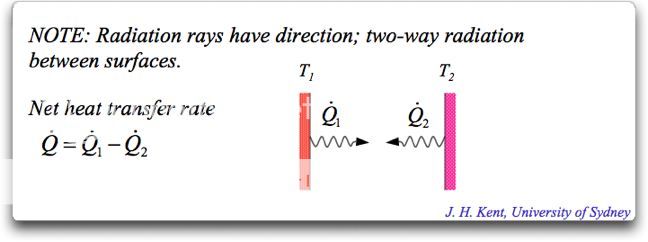
Finally, you have the stick by the wrong end when you say that “only net energy flows are real”. In fact, for radiation, net energy flows are a mathematical construct. The only thing that is real is the radiation coming from the two objects. Here’s my drawing of the thought experiment again, I see nobody answered my question about the thought experiment above … ah, well.
What is real is the radiation (both light and thermal IR) coming from each of the lights. We can use a variety of instruments to measure the radiation coming off of each of the lights. That is what is real.
Now, there is indeed a net flow of heat from the hotter bulb to the colder bulb, but it cannot be measured directly because it is a mathematical abstraction. In a system in which both lights are constantly both absorbing and radiating energy, the net flow is the difference between the two actual flows.
Note that we cannot directly measure the net flow. All we can do is measure each individual flow and subtract one from the other.
w.
TimTheToolMan says:
December 17, 2012 at 1:28 am
Tim, once again you try to explain to me why DLR is not adding 340 W/m2 to the ocean.
Look, Tim, I truly don’t care about the process. I’ll assume that your process is correct, and that for some strange reason the ocean is not absorbing 340 W/m2 from the DLR.
My question is, if your process is correct and the ocean is NOT absorbing 340 W/m2 from the DLR … then where is it absorbing that amount of energy from?
And to echo D. Boehm’s comment above, to date, I have heard no credible alternative explanation.
w.
Willis:I’m sorry to state this so bluntly, but pyrometers do not measure energy flux, they measure temperature. OK, a pyrgeometer is calibrated against a cavity black body in Power Units but that is the S-B power that would be emitted from the isolated emitter in a vacuum. The artefact is because the shield at the back of the detector stops EM information coming the other way.
The only real energy flow is the difference signal between back-to back instruments. This is what the manufacturers state, see the bottom of this page: http://www.kippzonen.com/?product/16132/CGR+3.aspx
These people have sold 1000s of pyrgeometers to climate research knowing full well that they are being misused because Meteorologists and Climate Scientists are taught ‘back radiation’ must be real because the single pyrgeometer is calibrated in W/m^2. This is the most blatant and longest [50 years] misunderstanding in science I have ever come across. and it must be stopped by forcing these academics to teach correct physics. [The other big mistakes are wrong IR physics and wrong cloud physics].
So, there is no opposing 400 W/m*2 and 340 W/m^2 power fluxes. These are instrumental artefacts, a temperature signal expressed in the EM continuum. There is no energy transfer until the information in those two streams combines vectorially as the net energy flux and even then other emitters are involved, e.g. the cosmic microwave background for the atmospheric window radiation.
‘Back Radiation’ does not exist. For normal temperature gradients, it all disappears at the Earth’ surface.
Willis: “Simple energy calculations show that the incoming sunlight at the surface (global 24/7 average ≈ 160 W/m2) is not enough to balance the known losses from radiation, conduction/convection, and latent heat loss”
Well, I for one don’t see why I need to justify myself any further. The incoming heat at the equator is not 160W/sqm. It is 1000W/sqm. The water at the equator is forced to flow E-W and then has nowhere to go but northwards until it rotates around the poles and back down south like some enormous central heating system. That is why the oceans are not frozen. The specific heat capacity of the oceans is such that they can easily abosrb enough energy at the equator to remain unfrozen across the rest of the globe. This also explains why the Arctic ocean is not frozen all the way to the sea bed in winter despite having 6 months with no solar radiation let alone no DLR and with an opaque layer of ice on top. It also explains why the seas around Britain can be 10Celsius always in the winter even though the air temperature can persist below 0Celsius for days on end. You can’t use an average because the areas with less daytime heating will also have less cooling – i.e. the maths is different for the radiators of a central heating system than for the heat exchanger.
If you want to prove to yourself that Trenberth’s figures must be nonsense, go and get a big mirror and put it in the garden in a cold night over your head facing down – see how much warmer it is? No? But surely it must be – after all now you are getting 100% DLR at close range, you don’t have to rely on the weak effect of unsatured CO2 spread throughout the atmosphere. Sit in a shed however and you might well feel a bit warmer because now you have reduced the conduction/convection effect.
Radiation balances are only relevant when seen from space. Below the tropopause only the conduction/convection/evaporation is relevant. If it wasn’t for the cooling effect of the troposphere the oceans would be a lot WARMER, because vibrating atoms conduct heat between them in a far more effective manner than the emission of photons. Bear that in mind – if there was no air above the oceans they would only be able to lose heat by re-radiating photons – a much slower process than by radiating photons. They would be much hotter and would boil into space.
AlecM says:
December 17, 2012 at 2:39 am
Man, this is not even wrong. Where to start. First, DLR is not an artifact by any spelling. It is real, measurable thermal radiation. It is exactly the same kind of thermal radiation emitted by the objects around us.
How much thermal radiation is there? Well, it depends on the temperature and nature of the object. For example, my wooden desk, with a temperature of say 20°F (~70°F) and an emissivity of say 0.95 or so is emitting thermal radiation at the rate of about 400 W/m2.
Now, you can complain all you want that this is more than the average 24/7 solar insolation, and it is, but that doesn’t change the facts. If you were to measure the infrared radiation coming off of my desk, that’s about the number you’d get, 400 W/m2. That’s how we see things with infrared night-vision. That’s how we measure temperature with infrared thermometers. Things radiate, and how much they radiate is a function of their temperature.
And indeed this is real radiation containing real energy. All that stuff about having to combine with other energy to do any work? Doubletalk. Look at the illustration of the two lamps. Radiation goes in all directions. You are claiming that the energy from one of those lamps individually cannot do work … why on earth not? You can get work out of the temperature difference between the two lamps as you point out, but you can also get work from either of them individually. Heck, if nothing else stick a Crookes radiometer in the light from one of them and shade it from the light of the other … you’re getting work out of just one of them.
w.
Willis; Firstly your warm desk. Put two pyrgeometers back to back between the desk and the sofa. The net signal will be near zero. This is a fact. A single pyrgeometer measures temperature expressed in power units. It is not a real energy flow.
That only takes place when the two information streams combine. A rider to this is that the common idea that such streams are strings of photons is also very wrong. This is because the photons only exist at the instant energy quanta are transferred, and that can only happen once the net energy flux is made.
As for the two lamps, solving that problem mathematically is very complex. The 40 W will rise in temperature more than the 100 W because its cooler glass will be a sink for the warmer 100 W envelope.
Right, a better explanation of the two lamps.
7% of the energy is emitted as SW light. The mechanism by which it does work is that EM vectors from the cooler body combine vectorially with the vectors from the hotter body and the net energy then passes from the hotter body to the cooler. Because the cooler body is at much lower temperature, the net flux is the same as the emitted flux.
93% of the energy is IR. Some is absorbed by the glass bulb and this then radiates and convects. Concerning the former, what happens is that radiation from cooler bodies combines vectorially and because we are dealing with a greater proportion of the energy from the cooler body, the radiative heat loss is a smaller proportion than for the SW case. As a result, convection increases.
Now consider the oceans. All the GHG thermal energy received from the atmosphere disappears, removing the same from the 400 W/m^2 you would get for an isolated ocean in a vacuum! So, the energy flow is one way, 60 W/m^2.
Thinks of the opposing Poynting Vectors as an impedance to real IR energy flux. Higher amplitude at any given wavelength reduces that flux from the surface, and it does so unevenly depending on the spectral nature of the radiation from the other direction.
Willis writes “My question is, if your process is correct and the ocean is NOT absorbing 340 W/m2 from the DLR … then where is it absorbing that amount of energy from?”
The surface of the ocean IS absorbing the energy in the top 10um or so…and radiating it back up at about the same rate (some may be used in evaporation) for no net positive effect in the bulk. That is the vital bit. There is no energy gain in the bulk or in the top 1 mm or anywhere due to the DLR.
The ocean is cooling at the surface and the DLR is not warming it. Not even a little bit. Warming comes from sunlight absorbed below and the SST is driven by the energy from below, not from the DLR although the DLR is a factor in determining where the balance is.
Mathematically it accounts for some of the energy the ocean must radiate according to S-B.
Do you understand why I think your statement to tallbloke is wrong?
Willis,
It’s quite difficult for me (layman) to explain, but here goes…Trenberth and academics and AGW people seem not to be content with just accepting that the TOA receives a real measured ( since 1902 by waterflow and now by sattilite) reading of an incoming 1360w/sq.m. but they take this figure and like all true teachers get some idea that this is the amount emitted by the sun and immediatly go to the blackboard and draw a picture of two little circles of the sun and earth. At this point they have stepped out of reality. They then draw rays from the sun to the earth and through a process of maths and geometry work out what THEY think is the incoming TOA solar radiation. A sort of buggering up of a real measurement .Sort of one foot in reality and the other in an AGW fantasy. As I’ve told you before Willis this 1360w/sq.m. is a yearly global average which cannot be divided. It is the real deal. This is what we get. However you and the academics arrive at this CALCULATED figure of 340 w/sq.m incoming at the TOA, which then transforms into figures tearing around in your hysterical imaginations. The neat and paradoxical thing for you AGW deceiving liars is that what the earth receives in reality at the surface ie 340w/sq.m ,happens to coincide with the 340 w/sq.m. you lot work out for the TOA. In this way it easily confuses students because they are unaware of which surface you are referring to …. the actual earths surface or the “surface” of the TOA. When drawing your little pictures of the sun and earth on the blackboard what student is going to pick up on the little distance of the width of the atmosphere eh Willis. This is probably one reason your crap science has done so well. So get real Willis, The reality is that this earth receives 340 oddw/sq.m. at its surface (the sq,m metal plate in equatorial regions getting hot enough to fry eggs on ,remember?) get used to it and you can take Trenberths and your figures a shove em where there ain’t no w/sq.m.
TimTheRToolMan, the operational IR emissivity of the oceans is negatively dependent on temperature so highest IR emission is from temperate seas. specifically off New England and Japan.
I have no problem with modeling and simulation and superposition…these things are commonly used in engineering. However, I do have a problem with creating nonphysical influences and using them in the model. If you want to spread insolation across a disk, that’s fine if there is a physical mechanism that actually does that. I’m not going to spread insolation across a disk when I’m modeling a rotating sphere. If you want to average incoming energy into an average representing a daily dose, that’s fine if you can point to the physical mechanism that does that. I’m not going to average daily insolation across a 24-hour period if there is no physical mechanism. If you want to store and integrate thermal energy, then store it in something with thermal mass like water and dense masses and use those storage mechanisms in your integrating storage/delay/feedback model.
I like the example of an independent 40W lamp radiating into a 100W lamp. Now replace the 40W lamp with a snowglobe and imagine how how much you must increase the 100W to get 40W back from the passive snowglobe…with unconstrained convection. This will give you a sense of proportion for the work done via “back radiation”.
I like the idea of replacing an insulating blanket with a torch to create an equivalent (slower) cooling profile (that’s clever and wise). Now imagine what the torch must do to increase the average temperature of the warm block by 33C. Good luck, my friends.
kencoffman: as an engineer, what do you think of the modelling when it uses the two stream approximation yet only net IR can do thermodynamic work!
Including a TOA error, the result is to increase the IR energy absorbed in the atmosphere from 23 W/m^2 to 134.5 W/m^2, a factor of 5.84. this is the cause of the imaginary positive feedback. They offset higher temperature by exaggerating cloud albedo.
The light bulbs. You are both wrong. If 7% of the energy from a bulb is visible light, it is not true that the remaining 93% is infra-red. Furthermore even if it was it is irrelevant because the laws of entropy make it clear that if photons are obsorbed it doesn’t matter what the frequency they will both decay to heat in the end – i.e. visible light photons cause just as much heating as infra-red.
The reason the hot bulb will not measurably heat the coller bulb is because the bulb has a filament which is probably at 3000Celsius. It is so hot that it is actually boiling single electrons from its surface. The gas in the bulb is inert, so it doesn’t capture these free electrons, but the gas does get seriously hot. The envelope of the bulb does get extremely hot but radiation has almost nothing to do with this because most of the photons are by definition going straight through. Because the envelope of the bulb gets so hot (but not as hot as the filament because the area is much bigger) there will be considerable heating of the air around the bulb and this will take away almost all the heat from the hotter bulb and hence most of the energy. With all this going on around both bulbs the relatively small amount of radiation transfer would be difficult to measure reliably. However, if you ramped down the current in the cooler bulb so it was no longer emitting in the visible spectrum but was still a little warm, you of course would see it was illuminated by the hotter bulb so clearly it is receiving (photon) radiation albeit at a difference frequency. But clearly it isn’t getting much energy through that route because if you put your hand in between the two you won’t feel the heat very much (you will if you put it just above the bulb).
If you wanted to do the experiment properly you would want the bulbs to be in a vacuum like the old bulbs because then there is little conduction as such – but then the tungsten gets so hot it actually starts to boil off whole atoms onto the inside of the glass (so there is conduction in reality and the bulbs can’t run so hot anyway).
What is happening on the microscopic scale in the conduction case is that whole atoms are violently vibrating in a solid and impacting the atoms in the less dense and free-flowing gas around it. In the case of radiation massless photons are being absorbed by electrons causing them to move to a slightly higher orbit around the atom – you can imagine that this latter mechanism really isn’t as effective as conduction in taking heat away from a cooling object.
Willis: The reason you are getting confused is that black-body radiation is measured relative to absolute zero. So, in your example the desk is radiating at 400W. Does this mean putting another desk in front of it will cause 800W of radiation? No. The two desks are at the same temperature so there can be no heat transfer between them. Both are radiating at 400W which seems mighty energetic, but since they are both at that temperature there really isn’t any energy transfer between them (oh, and you won’t easily be able to distinguish between them using a thermal imaging camera either). They would be receiving photons from each other for sure (i.e. the 1st desk can see the photons of the brown second desk just as you can) but the net energy transfer is zero (the 2nd desk is emitting just as much visible light to the first desk)
Bearing in mind what I said about conduction being a much stronger effect than radiation, what happens to happens to still air above a large body of water? The conduction of the heat from the water causes the air to eventually reach the same temperature as the water (note this cannot happens the other way around as heat in free-flowing gases and liquids rises and the water is much desner than the air). If they are at the same temperature due to conduction, how much energy transfer can there be by radiation? The answer is surely zero.
That, Willis, is why the AGW crowd have got it all wrong. Because conduction occurs much more strongly at ground level than radiation, the air is much the same temperature as the land and sea due to conduction. If the air is much the same temperature as land and sea, there can be no net radiative transfer from land or sea to the air. If there is no net radiative transfer from land or sea to air near ground level, then CO2 in the air cannot make a difference to the radiative transfer. Radiation only exceeds conduction above the tropopause when the low density of the air means conduction cannot readily occur and then radiation becomes the only viable way of losing the heat to the dead cold of space.
Well of course DLR warms the skin, but that’s about all it warms. If it didn’t the ocean WOULD freeze. What we have is an enormous eddy of energy (amounting to nearly 60% of the total incoming) cycling between the skin and water vapor in the lower atmosphere. This is precisely the part of the atmosphere where a few extra molecules of CO2 will be lost in the vapor equivalent of 13000 cubic kilometers of water the atmosphere contains on average.
Ryan: what’s so incredibly wrong about the two-stream approximation is that the IPCC consensus claims there is 333 W/m^2 real energy flow from the lower atmosphere to the surface and 396 W.m^2 heading upwards, heating the air both ways as the IR is absorbed by GHGs.
These data are obtained by pyrgeometers and the meteorologists have always believed them to be real energy flows. However, only 63 W/m^2 real energy is radiated and these people can’t imagine that a body at 16°C, the surface, does not emit 396 W/m^2.
Yet this is only the case for an isolated body in a vacuum. in reality, as you show, the lower atmosphere is the same temperature and for the specific case of the 15 micron CO2 band, there is zero net radiation from the surface to be absorbed by the CO2 in the air.
In other words there can never be any CO2-AGW. Yet these people go on to claim fantastic warming by AGW oblivious to the realities of heat transfer, as this article shows.
What’s worse., they get the IR wrong: There is no possibility of any thermalisation even if there were CO2 IR to be absorbed. The IR that is absorbed is indirectly thermalised at clouds mainly, and much of that goes into grey body radiation, 22% of which from the top escapes directly to space.
In short they have made 7 mistakes in basic physics, 3 of which are embarrassing to professionals like me because they have had to have been really dumb, or fraudulent. Everything that could go wrong has gone wrong, not least 1000s of pyrgeometers measuring the temperature of the atmosphere which is then put into the Energy Budget as real energy. You could not make up this level of incompetence nor the blind persistence in the face of real science in insisting there are no errors.
Regarding light bulbs there are now higher efficiency incandescent bulbs where the glass envelope is coated by a dichroic layer which reflects IR back towards the filament. The dichroic passes visible however. This back reflected light heats the filament thus producing more light emission. The result of this is to be able to run the light bulb on lower current to produce the same visible output. It’s not practical to heat the filament to a higher temperature because it will melt but by recycling the IR output you get more visible out in lumens/watt.
AlecM says:
December 17, 2012 at 4:18 am
This is too good. You use a physical measuring device to measure one physically real and measurable signal in the thermal infrared band.
You measure another physically real and measurable signal in the same band. They are about equal. As you would imagine, the difference between them is about zero.
Your conclusion?
Your conclusion from the fact that they are equal is that the signals that you measured are imaginary. They are not real. They do not contain energy.
You realize how crazy you are sounding?
If the signals are not real and they contain no energy, then what the hell were you measuring?
Finally, again you are monomoniacally focussed on the mechanism, on the process. I couldn’t care less about that. I care about where the 340 W/m2 is going to come from to keep the ocean from freezing … and in that regard, you aren’t helping in the slightest.
But don’t feel bad, neither is anyone else.
w.