Guest Post by Willis Eschenbach.
For all of its faults, the IPCC (Intergovernmental Panel on Climate Change) lays out their idea of the climate paradigm pretty clearly. A fundamental part of this paradigm is that the long-term change in global average surface temperature is a linear function of the long-term change in what is called the “radiative forcing”. Today I found myself contemplating the concept of radiative forcing, usually referred to just as “forcing”.
So … what is radiative forcing when it’s at home? Well, that gets a bit complex … in the history chapter of the Fourth Assessment Report (AR4), the IPCC says of the origination of the concept (emphasis mine):
The concept of radiative forcing (RF) as the radiative imbalance (W m–2) in the climate system at the top of the atmosphere caused by the addition of a greenhouse gas (or other change) was established at the time and summarised in Chapter 2 of the WGI FAR [First Assessment Report].

Figure 1. A graph of temperature versus altitude, showing how the tropopause is higher in the tropics and lower at the poles. The tropopause marks the boundary between the troposphere (the lowest atmospheric layer) and the stratosphere. SOURCE

The concept of radiative forcing was clearly stated in the Third Assessment Report (TAR), which defined radiative forcing as follows:
The radiative forcing of the surface-troposphere system due to the perturbation in or the introduction of an agent (say, a change in greenhouse gas concentrations) is the change in net (down minus up) irradiance (solar plus long-wave; in Wm-2) at the tropopause AFTER allowing for stratospheric temperatures to readjust to radiative equilibrium, but with surface and tropospheric temperatures and state held fixed at the unperturbed values.
In the context of climate change, the term forcing is restricted to changes in the radiation balance of the surface-troposphere system imposed by external factors, with no changes in stratospheric dynamics, without any surface and tropospheric feedbacks in operation (i.e., no secondary effects induced because of changes in tropospheric motions or its thermodynamic state), and with no dynamically-induced changes in the amount and distribution of atmospheric water (vapour, liquid, and solid forms).
So what’s not to like about that definition of forcing?
Well, the main thing that I don’t like about the definition is that it is not a definition of a measurable physical quantity.
We can measure the average surface temperature, or at least estimate it in a consistent fashion from a number of measurements. But we can never measure the change in the radiation balance at the troposphere AFTER the stratosphere has readjusted, but with the surface and tropospheric temperatures held fixed. You can’t hold any part of the climate fixed. It simply can not be done. This means that the IPCC vision of radiative forcing is a purely imaginary value, forever incapable of experimental confirmation or measurement.
The problem is that the surface and tropospheric temperatures respond to changes in radiation with a time scale on the order of seconds. The instant that the sun hits the surface, it starts affecting the surface temperature. Even hourly measurements of radiative imbalances reflect the changing temperatures of the surface and the troposphere during that hour. There is no way that we can have the “surface and tropospheric temperatures and state held fixed at the unperturbed values” as is required by the IPCC formulation.
There is a second difficulty with the IPCC definition of radiative forcing, a practical problem. This is that the forcing is defined by the IPCC as being measured at the tropopause. The tropopause is the boundary between the troposphere (the lowest atmospheric layer, where weather occurs), and the stratosphere above it. Unfortunately, the tropopause varies in height from the tropics to the poles, from day to night, and from summer to winter. The tropopause is a most vaguely located, vagrant, and ill-mannered creature that is neither stratosphere nor troposphere. One authority defines it as:
The boundary between the troposphere and the stratosphere, where an abrupt change in lapse rate usually occurs. It is defined as the lowest level at which the lapse rate decreases to 2 °C/km or less, provided that the average lapse rate between this level and all higher levels within 2 km does not exceed 2 °C/km.
This is an interesting definition. It highlights that there can be two or more layers that look like the tropopause (little temperature change with altitude), and if there is more than one, this definition always chooses the one at the higher altitude.
In any case, the issue arises because under the IPCC definition the radiation balance is measured at the tropopause. But it is very difficult to measure the radiation, either upwelling or downwelling, at the tropopause. You can’t do it from the ground, and you can’t do it from a satellite. You have to do it from a balloon or an airplane, while taking continuous temperature measurements so you can identify the altitude of the tropopause at that particular place and time. As a result, we will never be able to measure it on a global basis.
So even if we were not already talking about an unmeasurable quantity (radiative change with stratosphere reacting and surface and tropospheric temperatures held fixed), because of practical difficulties we still wouldn’t be able to measure the radiation at the tropopause in any global, regional, or even local sense. All we have is scattered point measurements, far from enough to establish a global average.
This is very unfortunate. It means that “radiative forcing” as defined by the IPCC is not measurable for two separate reasons, one practical, the other that the definition involves an imaginary and physically impossible situation.
In my experience, this is unusual in theories of physical phenomena. I don’t know of other scientific fields that base fundamental concepts on an unmeasurable imaginary variable rather than a measurable physical variable. Climate science is already strange enough, because it studies averages rather than observations. But this definition of forcing pushes the field into unreality.
Here is the main problem. Under the IPCC’s definition, radiative forcing cannot ever be measured. This makes it impossible to falsify the central idea that the change in surface temperature is a linear function of the change in forcing. Since we cannot measure the forcing, how can that be falsified (or proven)?
It is for this reason that I use a slightly different definition of the forcing. This is the net radiative change, not at the troposphere, but at the TOA (top of atmosphere, often taken to mean 20 km for practical purposes).
And rather than some imaginary measurement after some but not all parts of the climate have reacted, I use the forcing AFTER all parts of the climate have readjusted to the change. Any measurement we can take already must include whatever readjustments of the surface and tropospheric temperatures that have taken place since the last measurement. It is this definition of “radiative forcing” that I used in my recent post, An Interim Look at Intermediate Sensitivity.
I don’t have any particular conclusions in this post, other than this is a heck of a way to run a railroad, using imaginary values that can never be measured or verified.
w.
Errors large and small: Global warming enthusiasts predict a temperature rise of about 3 degrees Celsius, which is almost exactly 1% rise in the absolute temperature. The error from considering the earth as a blackbody in the IR is 3%-4% – not “quite small” in the circumstances.
Scroll up to my comments to Tim the Toolman to see what I think of Trenberth and his Earth’s Energy budget figures Willis.
Willis,
The only things that are measured is an incoming solar radiation of about 1360w/sq.m.( a “solar constant”) which is a yearly global average which cannot be divided but remains simply as that, and that simply attenuates to a yearly global average at the Earth’s surface of about 340 w/sq.m. which corresponds to measured land based readings .
Willis: you ask:
“PPS—Why on earth would you expect Atlanta and Phoenix to have the same temperatures, or for Atlanta to be warmer?”
One of the common ways to study physical phenomena is to try to keep all variables constant, except for the one you are investigatging. The Phoenix/Atlanta comparison is an attempt to hold (almost) everything constant EXCEPT the amount of GHG. Same latitude, same elevation; therefore, same solar insolation at TOA on a given day. But the amount of GHG in Atlanta is somewhere around 4 times as much as in Phoenix. Now, would not one wonder, if the amount of downwelling radiation is proportional to the amount of GHG and if downwelling radiation has ANYTHING to do with temperature, why it is not hotter in Atlanta on some clear day in July. I suspect that it is because there is so much more water available for evaporation in Atlanta, causing a cooling effect. HOWEVER, doesn’t this also show that the temperature at any location on Earth is not very dependant upon the amount of GHGs? I think it’s probably dependant only upon insolation and the amount of water available. Which is maybe why your thermostat hypothesis works, also.
Relative to your kind advice:
“A word to the wise. Capital letters are the equivalent of shouting, and in the amount you used them, they are the infallible mark of someone with lots of passion and not much science. You should avoid that kind of shouting if you wish to be taken seriously.”
I’m sorry that you read the caps as shouting. I mean them to be only for emphasis. I’m just too lazy to underline, italicize, or bold.
Willis
Sorry for the late response but I have been without internet access.
I recall your article (radiating the oceans); it was thought provoking (as is usually the case with your articles) and led to some interesting comments. I always enjoy your articles, because they are often insightful (sometimes very) and almost always give rise to lively debate.
I am not seeking to create a new form of radiation. Any electrician will know that some measurements do not always tell the full story. A common example is a flat car battery. If you strap a voltmeter across a flat battery, it will often read 12 volts suggesting that everything is fine. It is only when you load it (say with the starter motor) that the voltage drops to say less than half. Sometimes, one can measure things but that does not necessarily mean that they have the ability to do work. I am not saying my example of a voltmeter and a flat car battery is completely analogous to the measurement of W/m2
I am suggesting that perhaps (note I use the word perhaps) the 255K DWLWIR which is being measured is incapable of imparting sensible energy/work on 277K (or 288K) water. Why do I say this? Simples, because it does not appear to cause water to evaporate in the way that one would expect given the absorption characteristics of LWIR in water (60% of all LWIR being absorbed within the first 4 microns). This leads me to consider that there is a potential problem with the DWLWIR theory that requires an explanation.
May be 255K DWLWIR can do all sorts of wonderful things on a 200K rock, or another gas molecule (such as an oxygen or nitrogen molecule) at 244K, but it appears that 255K DWLWIR has little (if any) impact on water. I have previously pointed out this problem with oceans, but one can also see the problem on land with dew and frost.
It may well be the case that UWLWIR emitted at TOA into space may have a significant effect on the Earth facing side of orbiting satellites, but, if so, that merely demonstrates that one has to look at the environment in which the radiation is operating to see whether it possess sensible energy capable of performing working in that environ. I emphasise that I am only commenting upon DWLWIR in relation to water (in its many phases on planet Earth).
Consider more carefully my example of dew (or a light film of frost) in a shady hollow. Let’s just do some maths. Let’s assume that an entire 1sqm piece of ground in a shady hollow is entirely covered by dew to a thickness of 1mm (of course, it will be less thick than this in many places). 1m by 1m by 1mm is 1 litre of water, weighing 1kg. DWLWIR, global ave is 333 W/m2. Latent Heat of Evaporation is 2260 KJ/Kg. So theoretically, DWLWIR has enough energy to evaporate water over a 1 sqm area at the rate of 0.14 gram/sec. Accordingly all the dew (1kg worth) in the shadow area would theoretically be evaporated by DWLWIR in less than 2 hours if DWLWIR can perform sensible work.
In addition one has to bear in mind that once the sun went down the night before and temperatures began to drop, the dew as it was forming was receiving the DWLWIR all night long. So why is dew around at the break of daylight? After all, it has already had the benefit of more than 7 hours of DWLWIR if the dew formed sometime before midnight. If DWLWIR could do sensible work, as the dew is forming the DWLWIR would be burning it off such that one might reasonably not expect to see morning dew at all, certainly one would not expect to see dew hang around all day (or most of the day). Dew in the shady hollow that disappears in the early afternoon is probably burnt off by the rise in ambient air temperature taking place from sun up, not form DWLWIR.
In contrast, we know that sunlight can do sensible work. Once the sun gets up, the dew (or frost) on the sunny side of the hollow can be burnt off quite quickly, maybe within 30 mins to 1 hour of sun up. This is notwithstanding that morning sun is very weak. Global ave is about 170 W/m2 (ie., only about half that of the DWLWIR) and due to the low incidence of morning sunlight, we could be talking of no more than 20% of that figure and yet this is sufficient to burn off the dew (or melt the frost unless the ambient air temp is very cold). You do not need many W/m2 because the film is very thin and there is little mass of water to be burnt off.
So you need to explain why on a given day (with its then prevailing ambient temperature and humidity), low incident sunlight (which on any basis is weak) can do something within less than an hour that DWLWIR (which is claimed to be about twice as strong and even more in relation to low incident sunlight) cannot achieve in the whole day.
Given the importance of the water cycle, the latent heat content of water (and its phase changes), the thermal capacity of the oceans in comparison to that of air, the different absorption characteristics of LWIR and Solar Radiance in water etc, if climate science was a real science there would be thousands of experiments conducted on the effect of DWLWIR revealing proper empirical data, and yet there is none!
Willis, I am not saying that I am right and you are wrong. Like most readers of this blog, I have an open (but sceptical mind) and I am here to learn. I am merely pointing out that dew is a potential problem for the concept of DWLWIR (in the figures claimed for it) and I have yet to see any reasonable explanation why low incident sunlight can do something measurable in matter of minutes which DWLWIR cannot achieve in hours.
Willis, before responding with generalities such as the oceans would freeze but for DWLWIR so we know that DWLWIR must be real and must be doing something, just take a little time and do the maths. Please address my specific point with the dew in a shady hollow which can be burnt off by direct low incident morning sun light, but cannot be burnt off in the shadow area by the DWLWIR.
Mack says:
December 15, 2012 at 3:37 am
//////////////////////////////////////////////////////////////////
You are correct to point this out. This is one of the many problems caused by the AGW proponents love for using averages. The use of averages prevents one from seeing what is truly happening in the real world, since the devil is in the detail.
The figure of 170 W/m2 is a calculated global average for solar. However, we know that the sun is imputting more than that figure into the oceans since the oceans are not equally distributed over the globe.
Once you take out the Arctic, Antartic, the land masses of the Northern Hemishpere, it is quite apparent that the bulk of the oceans occupy a more equitorial position and therefore receive more than the global average..
It is of course, the equitorial ocean that acts as the heat pump for the planet. There is plenty of solar to keep this ocean warm (and not freeze). Indeed, Willis wrote an article on ARGO and the cap of temperature of 30degC. In that article, he accepted that theoretically, the tropical oceans would be far warmer if one considers the available energy from the strong equitorial sun.
The null hypothesis is that the oceans on average radiate only about 70 W/m2 and therefore they would not freeze.
“””””…..denniswingo says:
December 14, 2012 at 6:22 am
Wills
I find all of this quite interesting and am throwing my 0.5 cents in.
………………………….
I could blast a terawatt per square meter at 0.7 microns but since nothing at this wavelength absorbs that energy it is as if it does not exist……”””””
Dennis, why don’t you try blasting your TW/m^2 laser of 0.7 micron wavelength radiation into a bucket of water. Don’t worry about standing close to it; since nothing absorbs at that wavelength then of course nothing will happen.
For the legal disclaimer, I have not personally tried this, so I recommend that nobody try it, until they have given you their signed release from liability, or alternatively, you have given them a written gaurantee of liability for any untoward result.
Willis
You seem to consider that the oceans would freeze but for DWLWIR. Perhaps you should ask yourself, why the oceans freeze if DWLWIR is keeping them warm.
My case is simple, the tropical ocean receives plenty of solar such that it will not freeze (even without DWLWIR). Theoretically, the tropical ocean could get up to a temperature of well over 40degC (may be even about 50degC). It does not reach this theoretical temperature for a variety of reasons, one important one being the conveyor belt currents which take away heat and distribute that heat elsewhere. It is this heat pump that that prevents the oceans nearer the poles from being frozen all year round.
As I have mentioned to you many times before, there is a problem with DWLWIR and the oceans. The problem is this.
• The absorption characteristics of LWIR in water is such that 60% of all LWIR is absorbed within 4 microns. LWIR (unlike solar) does not penetrate to any significant depth. All the energy is concentrated in the first 12 or so microns, and 60% of it within the first 4 microns.
• The very top surface skin layer of the ocean is cooler than the bulk ocean below. The heat flow at this layer of the ocean is therefore upwards. Because of the direction of heat flow, any energy absorbed in the top 4 microns (as would be the bulk of the DWLWIR) cannot be conducted downwards to the bulk ocean below. Willis I have shown you this profile before, (but unfortunately, I do not have the link to hand) look it up if you disagree.
• The top micron layer is being heated very quickly. Photons travel at the speed of light, and the energy being inputted is in watts per second. Any heat in the top micron layer cannot therefore be effectively overturned as part of the ocean overturning because that process is a mechanical process that takes hours (not seconds).
• LWDWIR (global average) is said to be about 333 W/m2. Latent Heat of Evaporation is 2260 KJ/Kg. So theoretically, DWLWIR has enough energy to evaporate water (over a 1 sqm area) at the rate of 0.14 gram/sec.
• We know that the water ‘must’ be evaporating at the 0.14 gram/sec rate, because the heat that resulted from the DWLWIR being absorbed in the top micron layer cannot be conducted downwards (which if it could be would slow down the rate of evaporation) because the temperature profile in this layer of the ocean is upward directing (not downward directing and heat cannot travel against the flow). We know that the 0.14 gram/sec evaporation cannot be nullified by ocean overturning because that is a mechanical process that takes about ½ day, not seconds.
So herein lies the problem. If DWLWIR has sensible energy and has the power claimed, it would give rise to water being evaporated at the rate of 0.14grams per second. Annually, this is equivalent to rainfall of about 4.5metres. But we know that annual rainfall of this magnitude is not occurring. The oceans are clearly not evaporating at this rate (which they would be if DWLWIR ‘heats’ the oceans since due to its absorption characteristics, if it does anything it can only heat the top microns of the ocean leading to quick evaporation). The fact that we are not observing this magnitude of rainfall suggests that DWLWIR lacks sensible energy.
You need to explain why the oceans are not evaporating at the rate equivalent to 4.5 metres of rainfall annually. Of course, if you can put forward a physical mechanism explaining how heat concentrated in the top microns layer can be conducted downwards even though this is against the temperature profile of the top microns/millimetres of the ocean, and/or how ocean over turning can turn over the top micron layer faster than the rate of evaporation (0.14 grams per second), then I would be interested in considering this physical process.
PS. We are fortunate that the absorption characteristics of solar is so very different, because if it was the same as LWIR, the oceans would have boiled off eons ago.
PPS. If you read the comments to your earlier post on radiating the oceans, you will note the many commentators who consider that the oceans are only losing heat via radiating at the rate of 70 W/m2. The oceans are in perfect balance without the need for the double accounting that you apply.
Richard Verney says…
“The figure of 170w/sq.m is a calculated global average for solar” The key word you used here is “calculated” . It is not measured but “calculated” . I only take heed of true measurements Richard, because the moment you start calculating you move away from reality and start drawing pictures of the sun and earth on the blackboard, so to speak .
Excuse me. Willis Eschenback is a massage therapist with a degree in psychology. Transport of Heat and Mass does not appear in his curriculum. The Second Law also does not appear. Just to clarify, the Sun is at over 5500 degrees Kelvin. The atmosphere is virtually always slightly cooler than the surface of the Earth. Heat goes from hot to cold, not the other way. Pyrometers and so-called pyrgeometers measure the temperature of the atmosphere.
News flash, if the atmosphere is cooler than the Earth surface, the atmosphere CANNOT warm the Earth’s surface. Carnot, anyone, Bueller? No that was not a miss-spelling, the guy’s name is Carnot, as in Carnot Cycle.
Really, massage? Dude, you belong here why? Carnot is rather important in the engneering world, the engineers who built those power plants that keep the lights on, the heat on in your home, the roads, the cars, the trains, the Internet, the CPU, in your computer, the power grid, and on and on.
Willis, the thing is, radiation can only TRANSFER heat from WARM things to COLDER things. And, by the way, when HEAT is TRANSFERRED, things get HOTTER. Accept it, consider it, make it an important part of your life, and never try to contradict it again. Yes cooler things still radiate. If the warmer things to which they radiate got HOTTER and began to radiate MORE, what stops this runaway????????
Good Lord, no one one here new that???
Knew that, the CPU in your computer, sorry sorry
Dennis, why don’t you try blasting your TW/m^2 laser of 0.7 micron wavelength radiation into a bucket of water. Don’t worry about standing close to it; since nothing absorbs at that wavelength then of course nothing will happen.
Lets go there. Since water does not absorb radiation at 0.7 microns it is unlikely that anything would happen. Beyond that I did not say that nothing would absorb I said the atmosphere would not. If it did then the planet would have fried long ago as the insolation at that wavelength is in the several hundred watts per square meter. Solar power satellite designs use lasers at wavelengths near this to transfer megawatts per square meter with little atmospheric effects. Green lasers at about 550 nanometers are proposed for laser weapons with gigawatts/m2 for this same purpose. Thanks for helping me prove my point. Unless you understand the couplings between radiation sources and sinks you can’t understand this subject and damn few people do understand it. Here is a nice website on the absorption spectrum for water.
http://www.lsbu.ac.uk/water/vibrat.html
Or the First Law, or the Third Law, or the Zero’th Law. Really? Do we all remember all four??? Can we recite them? I can….
richard verney says:
December 15, 2012 at 5:51 pm
Your arguments about DWLWIR and dew are spot on except for one thing – the ground is also emitting radiation. Assuming that the ground and the atmosphere are at the exact same temperature, then the upwelling radiation will always be greater than the downwelling radiation because the ground emits with an almost continuous blackbody spectrum and the atmosphere has a significant range of frequencies where it is transparent (the spectral window). As a result, at night the ground cools until the atmosphere is warmer and the downwelling and upwelling radiation are equal.
When the humidity is high enough, dew, fog, or frost will form. Each of these also emits upwelling radiation. Limiting the discussion to dew, the downwelling radiation keeps it from freezing. In the case of the poles, during the 6 month winter, without the downwelling radiation, the nitrogen in the atmosphere would condense into a liquid.
In the morning, before sun up, the upwelling and downwelling radiation are about equal. In this case, the additional heat from the Sun makes the difference and burns off the dew.
Since you understand electronics, think of W/m2 as current and T^4 as voltage. The surface and atmosphere are capacitors, the Sun is a current source, and deep space is ground. Add resistors as necessary to produce the correct currents.
By the way, solar radiation is UV plus visible plus SWIR, and about 50% of the energy is in the SWIR spectrum. Most of that is absorbed more than 2cm below the surface of the ocean.
http://omlc.ogi.edu/spectra/water/gif/hale73.gif
http://omlc.ogi.edu/spectra/water/data/hale73.dat
Black body Energy in -> Energy out-> a blanket <-Energy back in Energy out -> SPACE
“””””…..Willis Eschenbach says:
December 13, 2012 at 12:00 am
Geoff Sherrington says:
December 12, 2012 at 10:28 pm
My son, a surveyor, heard me mention watt per sq km at the troposphere and immediately interjected “At what altitude?”
Unless light passing through a horizonal sq m is parallel, like some laser light, then because there are more sq m of conceptual surface at a higher altitude quasi-sphere around the globe, the flux through each is less when there is a steady source. How does one define the flux when the “number of sq m” on a surface is forever changing rapidly with altitude, but by definition requires measurement to be taken when steady state is approached?
I have no idea about what models do about the variation in numbers of sq m shared by a watt as altitude is changed. Can someone assure me that the effect is built into the math?
If it is not, then a watt per sq m is ‘more powerful’ at low altitude than one at high and it would be hard to construct a Willis fig 1.
Geoff, your son is right, but it is a difference that doesn’t make a difference. Here’s why……”””””
Geoff, does your son the surveyor, know that the radius of the earth orbit (mean) is 93 million miles. Compared to that, the 15 or so miles of atmosphere thickness, makes no difference to W/m^2 coming from the sun.
Willis,
Consider the fact that in equatorial regions a sq.m metal plate (inches thick) will get hot enough to fry eggs on. Think of the equivalent electrical wattage required to achieve this and you are more likely to agree that the Earth’s surface receives a solar incoming radiation yearly average of 340odd w/sq.m. instead of the IPCC’s 161w/sq.m.
Unless you say that some of this is caused by DLR? In which I would have to say to you in the nicest possible fashion…It’s the sun stupid. 😉
Mack says:
December 15, 2012 at 7:28 pm
//////////////////////////////////////////////////////////
I agree with your comment. I have many issues with the K&T energy budget, but I am merely trying to point out one issue that arises IF that budget were correct. IF DWLWIR possesses sensible energy (in the Earth environ) and IF it is as powerful as claimed, why is it not causing dew to evaporate, or the oceans to evaporate?
The optical absorption of LWIR in water would suggest that there should be significant evaporation since the ‘theoretical’ energy being imparted cannot be spread throughout the bulk volume of the liquid. With Solar the energy penetrates to great depth such that Solar results in the very gradual and relatively slight heating of the bulk liquid. DWLWIR by comparison would concentrate all the energy that it possesses in just a few microns, rapidly raising the temperature of those few microns sufficiently to cause rapid evaporation.
We are not seeing this rapid evaporation of dew, or, for that matter, of the oceans. So why not?
All I am asking is what is the explanation as to why we are not witnessing this in the real natural world? That is what I want Willis to address.
I’d like to add to Mr. Clemenzi’s electrical analogy…
Since you understand electronics, think of W/m2 as current and T^4 as voltage. The surface and atmosphere are capacitors, the Sun is a current source, and deep space is ground. Add resistors as necessary to produce the correct currents.
Sea water and dense things like concrete and bricks are big integrating capacitors. Comparatively, the atmosphere represents a tiny, irrelevant capacitor…comparatively to the day/night cycle and thermal capacity of water, of course.
I wonder about Willis’ analytic skill if he really can’t figure out how tropical surface water, directly heated to an average temperature of greater than 20C by the sun, can be liquid without atmospheric backradiation. As usual, if you let your enemy frame the argument, you will lose. When integrating, it’s important that the dt be appropriate. Water is not heated by average insolation. It’s heated by peak insolation (1KW/m^2) and has thermal mass, so it’s able to store the peak energy it’s exposed to. Of course, it’s possible for a small thermal mass to heat a large thermal mass, by being a lot frigging hotter. To extend the electrical analogy, a small capacitor can add charge to a large capacitor, but only if the the voltage is huge. 1/2 C V^2, you know? Otherwise, the big capacitor charges the small capacitor, right? There’s no need to resort to nonphysical gyrations (ha, epicycles) of radiation to figure this out.
Robert Clemenzi says:
December 15, 2012 at 10:36 pm
////////////////////////////////////////////////////////////////////////
My analogy with the car battery, was not intended as a direct analogy (as I mentioned). It was intended to illustrate a conceptual point, namely there are times when we measure something and not fully comprehend/appreciate the significance (or lack thereof) of what we have measured.
I am well aware that Solar has a wide spectrum and because of it’s spectrum, and the absorption characteristics of water, it penetrates deep into water. Much more than the couple of centremetres mentioned by you. That is one of my points. That is why Solar does not burn of the oceans. It results in the very gradual heating of the bulk, which is to be contrasted with the position that arises with DWLWIR which if it does anything must rapidly heat just the first few microns of the ocean thereby leading to rapid evaporation of the top micron layer.
You omit conduction. The ground also conducts heat to the atmosphere above. In my example of morning dew, for all practical purposes, Solar does not heat the dew at all. If the thin film of dew is 1mm thick, due to the absorption characteristics of water (to the various wavelengths of Solar), for all practical purposes, non of it is absorbed by the dew and it all goes to heat the ground below. The dew is burnt off by conduction brought about by Solar heating the ground below the dew.
To evaporate water you need to consider energy over time. Just before sun up, whatever amount of energy is being conducted and radiated from the ground in the hollow, is for practical purposes the same all over the hollow. Likewise the ambient temperature and humidity of the air above the hollow, At sun up, the only additional factor is the input of Solar on the sunny side of the hollow. This additional energy could be measured, but we know it is slight since there is not much energy in low incident sunlight especially in the late autumn, winter, early spring. This slight additional energy is sufficient to burn off dew within 30 mins (may be a bit more or a bit less – depends upon the prevailing ambient conditions which prevailing ambient conditions are the same in the shady side of the hollow).
As the day warms, the sunny side of the hollow conducts (and you would say radiates) more heat and the atmosphere gradually warms. At this stage of the day DWWIR is increasing. It is now more than was the case when the sun was first up. DWLWIR is omnidirectional so we know that the shady side of the hollow is now receiving some of this increased DWLWIR. The shady side of the hollow may experience this increase in the DWLWIR for hours and yet the dew is not burnt off from the shady side of the hollow. Given the length of time that the dew in the shady side of the hollow is exposed to this increase in DWLWIR, we know that the total energy received from this increased package must be more than the additional energy that was inputted to the sunny side of the hollow by Solar (alone) within the first 30 mins (or so) of daybreak.
One can visualise what is going on without knowing the precise figures. But if the relation between Solar and DWLWIR is in the order suggested by the K&T energy budget, it would not take long for DWLWIR to burn off a thin film of dew especially given the absorption characteristics of water to DWLWIR. When considering this, one must bear in mind the thermal inertia of the ground. The ground is being heated by Solar but heating of the ground could be slow, whereas water theortectically absorbs LWIR almost instantaneously and nearly all the energy from DWLWIR is contrated in the first few microns such that one would expect rapid evaporation to occur. .
Mr. Verney and Mr. Clemenzi your analogy to electrical circuits is quite proper. My heat transfer book uses circuit diagrams as analogy for resistance to heat flow.
Michael Moon says:
December 15, 2012 at 9:39 pm
Egads, sir, why the vitriol?
I belong here because I am a scientist. I have worked as a massage therapist, it is true, along with dozens and dozens of other jobs. I’ve been the guy who sweeps the floor at one end of the scale, and I’ve been the Chief Financial Officer of a company with forty million dollars in annual sales at the other end of the scale. I’ve worked as a musician, and a commercial fisherman. I’ve run an boatbuilding and machine shop on a tiny island in the South Pacific There is a link to my CV here for those interested. If you think that any of my jobs disqualify me as a scientist, you don’t understand how science works.
More to the point, Michael, my climate science is good enough to be published in Nature magazine and other scientific journals. They had no trouble with it, they didn’t care that I have worked as a massage therapist … you see, it’s kinda crazy, but they were interested in my ideas, not my work history. It’s called “science”, you should look it up …
And you? Why do you belong here? Have you published in Nature magazine?
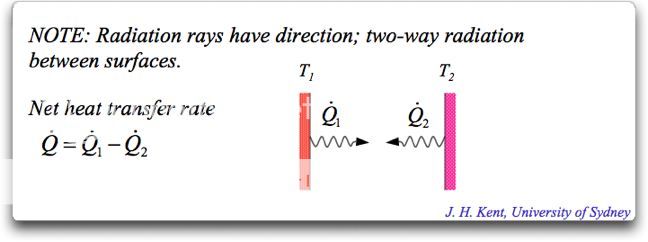
Regarding heat flow, you are missing the boat entirely. While NET heat flow always goes from hot to cold as you claim, with radiation there are always two flows of energy going on. There is a flow of energy from the warmer to the cooler area, and there is also a flow of energy from the cooler to the warmer area. It is only the NET flow that is constrained to always go in one direction. Get a college-level beginner’s physics book, they’ll cover it in there. Here’s an example illustration, from the University of Sydney.
Note the flow of energy going both directions …
So your claim about the atmosphere being unable to add energy to the surface is, well, not to put too fine a point on it, a common newbie mistake. Curiously, this mistake is usually made by people who are arrogant, nasty folk like you, puffed up and full of your self-importance, and eager to display your lack of knowledge.
Finally, my scientific credentials are not the point. The important questions is, are my statements and claims true? It doesn’t matter who makes the scientific claim. The only issue is whether that claim is valid.
w.
richard verney says:
December 16, 2012 at 3:53 am
There is a huge incorrect assumption here, that DLR, once absorbed, cannot spread throughout the body of the ocean. The claim is made that this is so because it is said that the surface of the water is always and forever cooler than the bulk.
But as you point out, Richard, this absorption of DLR energy does NOT cause huge evaporation to occur at the surface.
Your conclusion from this is that the energy somehow is not being absorbed.
My conclusion from this, on the other hand, is that:
a) as soon as the DLR warms the surface of the water very slightly, the surface will be warmer than the bulk and energy will flow into the bulk, and then the surface will be cooler than the bulk again.
b) waves, wavelets, and wind energy are constantly stirring the surface and mixing the energy into the bulk.
Finally, guys, you are missing the question. I don’t care about the mechanisms. I care about the end result. Let me give you an example.
Suppose we are looking at a mountain. You say “The mountain can’t be climbed”.
I say “Take a look with the binoculars, there’s climbers nearing the top right now”.
You say “But I have proven it is impossible.”
I say “People are doing it right now as we speak”.
You say “But there is no mechanism, I have proven to my own satisfaction that it is impossible. Therefore there cannot be people up there”
Do you understand the metaphor? I say that DLR is warming the oceans, AS EVIDENCED BY THE FACT THAT THEY ARE LIQUID.
You say that’s not possible, you advance 500 perfectly reasonable explanations why it can’t happen from DLR, because you can show that the mechanism won’t work.
OK, fine, sez I, then what is keeping the oceans liquid?
Crickets …
I don’t care if you have proven 500 ways that it is impossible. I don’t care about the MECHANISM. I am discussing the real world results, which are a liquid ocean. If the DLR is not heating it … what is? So far, I have no plausible answer from anyone. Someone upthread suggested that it comes from the energy of descending air being compressed and warming up … I fear I didn’t dignify that one with a response, although I should have suggested that they run the numbers and look at the actual amounts of energy involved …
So, I still await an answer—if DLR is not warming the ocean, what is?
w.
A case in point. Decades ago, most psychiatrists were firm in the scientific conclusion that autism was caused by distant and cold mothering. Mothers called that notion bunk and balderdash. Many used foul language in their description of the consensus and worse in their description of psychiatry.
So no, it does not take a card-carrying scientist to refute a consensus and eventually be proven correct. If you were one of those people who discredited people who’s job description was to raise their children, you were eventually labeled a fool.
My advice to AGWers, do NOT walk in those shoes.
richard verney says:
December 16, 2012 at 5:01 am
////////////////////////////////////////////////////////////////////////
At night, the ground radiates energy and cools much faster than the air above it. Via conduction, this pulls energy (heat) from the air immediately above it. At this point, “hollows” are a bit more complicated than the Great Plains. In a hollow, this cold air runs downhill and collects in the valley. As a result, the cold layer above a plain, or calm ocean, may be only a few centimeters thick, but in a hollow it will be several meters thick. This is easy to see in the Smokey’s (an Eastern US mountain chain) where the hollows contain fog long after the peaks are clear.
I agree, the Sun can not heat the dew directly. It heats the leaf, grain of sand, etc. and that heats the dew. Because the conduction from the leaf to the water is much greater than from the leaf to the ground (direct contact verses an air gap), the thermal mass of the bulk surface has almost no effect until after the dew is evaporated.
When evaluating a transient response, the Solar radiation suggested by the K&T energy budget is misleading. 170 W/m2 is averaged over a full day and a full year. The peak radiation to burn off the dew is more like 1,361 W/m2, the TOA value. As for heating the leaf, remember that dew drops are small lenses and that means that the “temperature” can be much higher than predicted by SB. However, for the DWLWIR the dew is opaque, meaning – no lens effect. So comparing an increase of 40 W/m2 to an increase of 1,361 W/m2 plus a lens might explain the difference.
The angle of the sun light is an interesting problem. In general, the amount of energy available is related to the cosine of the angle. However, because leaves are at all angles, and because of the lensing effect, a much higher than expected amount of energy is available to evaporate dew. As long as the sun shines, the amount of energy available is very significant. Passive (non-focusing) collectors are able to boil water in Canada during the winter. The cold air has more to do with where it comes from and the number of daylight hours than with the angle of the Sun.
With respect to dew, in the very early morning, refraction is also an issue. This, plus the extra thickness of the atmosphere (6 miles tropical noon, 154 miles in the morning), is why the morning and evening suns feel so cool.