Guest Post by Willis Eschenbach.
For all of its faults, the IPCC (Intergovernmental Panel on Climate Change) lays out their idea of the climate paradigm pretty clearly. A fundamental part of this paradigm is that the long-term change in global average surface temperature is a linear function of the long-term change in what is called the “radiative forcing”. Today I found myself contemplating the concept of radiative forcing, usually referred to just as “forcing”.
So … what is radiative forcing when it’s at home? Well, that gets a bit complex … in the history chapter of the Fourth Assessment Report (AR4), the IPCC says of the origination of the concept (emphasis mine):
The concept of radiative forcing (RF) as the radiative imbalance (W m–2) in the climate system at the top of the atmosphere caused by the addition of a greenhouse gas (or other change) was established at the time and summarised in Chapter 2 of the WGI FAR [First Assessment Report].

Figure 1. A graph of temperature versus altitude, showing how the tropopause is higher in the tropics and lower at the poles. The tropopause marks the boundary between the troposphere (the lowest atmospheric layer) and the stratosphere. SOURCE

The concept of radiative forcing was clearly stated in the Third Assessment Report (TAR), which defined radiative forcing as follows:
The radiative forcing of the surface-troposphere system due to the perturbation in or the introduction of an agent (say, a change in greenhouse gas concentrations) is the change in net (down minus up) irradiance (solar plus long-wave; in Wm-2) at the tropopause AFTER allowing for stratospheric temperatures to readjust to radiative equilibrium, but with surface and tropospheric temperatures and state held fixed at the unperturbed values.
In the context of climate change, the term forcing is restricted to changes in the radiation balance of the surface-troposphere system imposed by external factors, with no changes in stratospheric dynamics, without any surface and tropospheric feedbacks in operation (i.e., no secondary effects induced because of changes in tropospheric motions or its thermodynamic state), and with no dynamically-induced changes in the amount and distribution of atmospheric water (vapour, liquid, and solid forms).
So what’s not to like about that definition of forcing?
Well, the main thing that I don’t like about the definition is that it is not a definition of a measurable physical quantity.
We can measure the average surface temperature, or at least estimate it in a consistent fashion from a number of measurements. But we can never measure the change in the radiation balance at the troposphere AFTER the stratosphere has readjusted, but with the surface and tropospheric temperatures held fixed. You can’t hold any part of the climate fixed. It simply can not be done. This means that the IPCC vision of radiative forcing is a purely imaginary value, forever incapable of experimental confirmation or measurement.
The problem is that the surface and tropospheric temperatures respond to changes in radiation with a time scale on the order of seconds. The instant that the sun hits the surface, it starts affecting the surface temperature. Even hourly measurements of radiative imbalances reflect the changing temperatures of the surface and the troposphere during that hour. There is no way that we can have the “surface and tropospheric temperatures and state held fixed at the unperturbed values” as is required by the IPCC formulation.
There is a second difficulty with the IPCC definition of radiative forcing, a practical problem. This is that the forcing is defined by the IPCC as being measured at the tropopause. The tropopause is the boundary between the troposphere (the lowest atmospheric layer, where weather occurs), and the stratosphere above it. Unfortunately, the tropopause varies in height from the tropics to the poles, from day to night, and from summer to winter. The tropopause is a most vaguely located, vagrant, and ill-mannered creature that is neither stratosphere nor troposphere. One authority defines it as:
The boundary between the troposphere and the stratosphere, where an abrupt change in lapse rate usually occurs. It is defined as the lowest level at which the lapse rate decreases to 2 °C/km or less, provided that the average lapse rate between this level and all higher levels within 2 km does not exceed 2 °C/km.
This is an interesting definition. It highlights that there can be two or more layers that look like the tropopause (little temperature change with altitude), and if there is more than one, this definition always chooses the one at the higher altitude.
In any case, the issue arises because under the IPCC definition the radiation balance is measured at the tropopause. But it is very difficult to measure the radiation, either upwelling or downwelling, at the tropopause. You can’t do it from the ground, and you can’t do it from a satellite. You have to do it from a balloon or an airplane, while taking continuous temperature measurements so you can identify the altitude of the tropopause at that particular place and time. As a result, we will never be able to measure it on a global basis.
So even if we were not already talking about an unmeasurable quantity (radiative change with stratosphere reacting and surface and tropospheric temperatures held fixed), because of practical difficulties we still wouldn’t be able to measure the radiation at the tropopause in any global, regional, or even local sense. All we have is scattered point measurements, far from enough to establish a global average.
This is very unfortunate. It means that “radiative forcing” as defined by the IPCC is not measurable for two separate reasons, one practical, the other that the definition involves an imaginary and physically impossible situation.
In my experience, this is unusual in theories of physical phenomena. I don’t know of other scientific fields that base fundamental concepts on an unmeasurable imaginary variable rather than a measurable physical variable. Climate science is already strange enough, because it studies averages rather than observations. But this definition of forcing pushes the field into unreality.
Here is the main problem. Under the IPCC’s definition, radiative forcing cannot ever be measured. This makes it impossible to falsify the central idea that the change in surface temperature is a linear function of the change in forcing. Since we cannot measure the forcing, how can that be falsified (or proven)?
It is for this reason that I use a slightly different definition of the forcing. This is the net radiative change, not at the troposphere, but at the TOA (top of atmosphere, often taken to mean 20 km for practical purposes).
And rather than some imaginary measurement after some but not all parts of the climate have reacted, I use the forcing AFTER all parts of the climate have readjusted to the change. Any measurement we can take already must include whatever readjustments of the surface and tropospheric temperatures that have taken place since the last measurement. It is this definition of “radiative forcing” that I used in my recent post, An Interim Look at Intermediate Sensitivity.
I don’t have any particular conclusions in this post, other than this is a heck of a way to run a railroad, using imaginary values that can never be measured or verified.
w.
I wonder what would happen if Willis, E.M. Smith, and Stephen Wilde were to put their ideas, data, and analytical approaches together and present a new formulation for climate processes including the likely impact of CO2 and water vapor. I imagine them getting it vetted by thoughtful professional climate heavy-weights and it getting published in Nature. Nah, never happen. The world’s poorer for it…..
François Meynard,
(December 13, 2012 at 1:10 am)
“Apparently this “CO2 green house effect algorithm” is still used today in the large 3-D climate models.”
I ask myself this question for a long time. The fact is that the narrative always considers convection as feedback. This is obviously unacceptable in a potentially unstable system.
AlecM says:
December 13, 2012 at 12:37 am
======================
Here’s what I found in “Lapse Rate” on Wiki (I don’t pretend to understand it):
Thermodynamic SS/Radiative GHG lapse rate
Robert H. Essenhigh developed a comprehensive thermodynamic model of the lapse rate based on the Schuster-Schwarzschild integral (S-S) Equations of Transfer that govern radiation through the atmosphere including absorption and radiation by greenhouse gases.,.[11][12] “The solution predicts, in agreement with the Standard Atmosphere experimental data, a linear decline of the fourth power of the temperature, T^4, with pressure, P, and, at a first approximation, a linear decline of T with altitude, h, up to the tropopause at about 10 km (the lower atmosphere).” The predicted normalized density ratio and pressure ratio differ and fit the experimental data well. Sreekanth Kolan extended Essenhigh’s model to include the energy balance for the lower and upper atmospheres.[13]
As a son of a rocket engineer, I find all this talk about “top of the atmosphere” at 20 km to be rather misguided.
OK, difference science, different criteria.
But why is 20 km considered to be TOA for climate science?
20 km is only 65,617 feet. The anvils of thunderheads reach that high. The U-2 and SR-71 are air-breathing planes that aerodynamically fly above that altitude.
20 km might be “Top of the Weather”, but it is misguided to think of it as a real Top of the Atmosphere.
My experience is different. My car’s windows won’t frost over when exposed to sunlight, but any in the shade will, whether the windshield or side windows.
Yes. When you do “science” without operational definitions the results can be interpreted as the beholders wishe.
Stephen Rasey says: December 13, 2012 at 8:12 am:
“As a son of a rocket engineer, I find all this talk about “top of the atmosphere” at 20 km to be rather misguided”
I completely agree. The system that I work on (SKYLON) breathes air up to 26 km, in a lifting, climbing, accelerating trajectory. To define TOA @ur momisugly 20 km is moronic.
In my view, TOA should be defined as a notional boundary at which only radiative energy transfer is possible – 300km, anyone?
@jim pace Miller 6:58am. Just stay tuned we are watching that happen on WUWT, the future of honest science? And a forum of empirically based speculation.As science is never absolute, informed speculation is the next best thing.
With so much specialization in the sciences now, it is necessary for outside points of view.
The field description of expert(Drip under pressure) has never been so accurate.
Open access and source can provide exposure of the “minor error” inherent in those crucial misconceptions that seem to ooze out of our universities.
As for climate heavy weights… probably more on the blogs than present in the IPCC team .
http://climaterealists.com/index.php?id=9004
The link above shows what power CO2 has. The photo is of someone back yard. It shows what NZWILLY spoke of concerning his wind shield. CO2 has no power to warm the earth as it cannot even melt alittle frost.
AndyG55 says:
December 13, 2012 at 3:20 am
Hi, Andy, thanks for the question, but I’m not clear what you mean. There is no lapse rate involved in the calculations in Figure 1. They are the R^2 values of the correlation between the temperature and the TOA radiation imbalance.
w.
[UPDATE: Sorry, wrong thread. The real answer to your question is that the lines are obviously some kind of average or approximation of the actual lapse rate, which is often called the “environmental” lapse rate. By inspection, the lapse rate is about 63°C from the surface up to 9 km (see the “Polar” line). That gives us a lapse rate of about 0.7°C per 100 metres.
The theoretical dry lapse rate is about 1°C per hundred metres, and the theoretical wet lapse rate is about 0.55°C per hundred metres. As we would expect, the average environmental rate is somewhere between the two …
w.]
Jeff
Now I wish I had taken a photo of neighbour’s car at 3pm, just before sunset. Both the windscreen and all the side windows were still frosted over. They were like that at dawn. We had sunshine but a temperature of around freezing did not let the ice melt. Also, my other neighbour has a garage with a flat roof. Some rain fell on it a few weeks ago and did not clear before temps fell below freezing. The glacier is still there and does not appear to be receding. I live close to London.
And it is brass monkeys in my barrel.
Dirck says:
December 13, 2012 at 4:12 am
As Richard Courtney mentioned above, the kind of statement you made goes nowhere. All that you are saying is “nuh uh, does not”, which is valueless in a scientific discussion.
If you want to get traction on a scientific site like this, that is far from enough. You need to say what and why and how. Back up your assertions with facts and citations. Give references to show that you are correct. Let me show you how it works. For example, I can say that my statement above, which you object to for unknown reasons, is fully supported by the work of Stephen Schwartz, as I discussed in my post called The Cold Equations.
Then, after you read those two references to find out what I’m talking about, it’s your move.
w.
Larry in Texas asks:
December 12, 2012 at 11:44 pm
In this context, it is the change in temperature with a change in height.
AndyG55 says:
December 13, 2012 at 3:20 am
That drawing is obviously wrong. The polar lapse rate is drawn as about 7.2 K/km, the correct value is about 6.5 K/km. Also, the polar tropopause is not drawn correctly. Over Antarctica, in winter, the tropopause is higher and colder than the tropical tropopause. Figure 1 shows a shape more like what is found over Alaska, not over the pole.
All the books say that the tropopause is about 17 km at the equator and 7 km at the poles. However, on 08-16-2008, the Antarctic polar tropopause was over 20 km.
If you want to see what the tropopause really looks like, you can plot real radiosonde data. I have a program that will show a full year’s data for several different locations.
http://mc-computing.com/Science_Facts/Lapse_Rate/Lapse_Rate_Animations.html
BillC says:
December 13, 2012 at 6:53 am
Thanks, Bill. There are a variety of radiative forcings used in the field. Here’s the distinctions as explained by James Hansen et al. in “Efficacy of Climate Forcings”
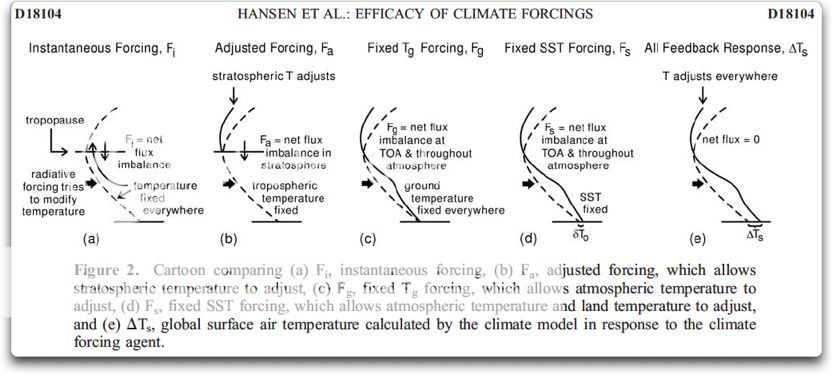
w.
richard verney said: “Willy, I made a very similar observation … save that I would suggest that it is warm air being convected from the ground that keeps the car doors/door windows ice free.”
Warm air cannot be the agent which keeps cars’ side windows ice free, because that would equally well keep the windshield ice free — but the windshield freezes. Furthermore, the grass tops in nearby fields, and rooftops, freeze too. This is a common phenomenon in New Zealand in winter. What they all have in common is that they do not see the ground, and so don’t get the infrared radiation from the ground.
If there was “radiative forcing”, then these sky-facing surfaces would not freeze as they do because radiative forcing equates to infrared from the sky. But they do freeze, so there is no infrared from the sky, ergo, no radiative forcing. So my point is totally on-topic, despite your further demur.
Roger Longstaff says:
December 13, 2012 at 8:43 am
Let me say again what the NASA quote is careful to point out.
So for some purposes, 20 km is perfectly OK, while for others it is far too low.
For my purposes, I take the measurements of the satellites as reflecting the true TOA radiation, and I make no estimate of what actual altitude that might reflect … although the 70 km used by MODTRAN seems like a reasonable number.
w.
I was totally off base in an answer above, viz:
Willis Eschenbach says:
December 13, 2012 at 8:53 am
I have updated my answer above to add:
w.
The argument seems to be based on average temperatures. However the total (blackbody) radiation is proportional to the fourth power of the absolute temperature, so we are “averaging” a highly nonlinear relationship. For example, the total blackbody radiation more than doubles when temperature rises from -23C (250K) to 37C (310K).
A related question: how good a blackbody the Earth surface is? Do oceans, deserts, forests, cloud tops behave the same way? Do IPCC calculations involve the heat capacity, which varies wildly in these examples? Do they consider daily or seasonal variations?
NZ Willy says:
December 13, 2012 at 10:16 am
It is my understanding that a freezer makes ice even though the inside walls of the freezer are emitting infrared radiation. This is because everything above absolute zero emits infrared radiation. Therefore, the fact that something freezes does NOT prove that there is “no infrared from the sky“. It only demonstrates that the amount of IR from the sky is less than the amount of IR released in forming frost.
Johnny says:
December 12, 2012 at 10:04 pm
…. It sounds more like a middle ages religion than a science like physics or chemistry.
>>>>>>>>>>>>>>>>>>>>>>>>>>>>>>>>>
Actually my husband pointed out that IPCC ‘science’ most closely resembles Alchemy.
It looks like the problem does not reside in just climate science either.
So it looks like we are taking a GIANT STEP BACKWARDS 400 yrs to the middle ages. Of course this is where the Neo-luddites want to drag us back to in all technologies.
mkelly says:
December 13, 2012 at 8:50 am
Thanks, mkelly. I see you and other folks above making the argument that since the downwelling longwave radiation doesn’t do what y’all expect it to do, it must not exist, or it must not have any power to warm things … neither one is correct.
Let me start by pointing out that the downwelling longwave radiation (DLR) is a measurable quantity. It is not a fantasy, you can take a radiation measuring device out anywhere on the earth and measure its instantaneous value. It is real, verifiable radiation, which of course contains energy. Since the radiation contains energy, and since energy cannot be destroyed, the radiation adds that energy to whatever it strikes. This is fundamental physics and is beyond question in a scientific sense.
What people seem to forget, however is that the radiation is coming from a cold place. Globally, the average amount of downwelling energy is on the order of about 320 watts per metre squared (W m-2). Sounds like a lot, huh? People say “Why doesn’t that heat things”.
The answer is, the blackbody temperature corresponding to that radiation is right around freezing. Of course, that temperature corresponding to the DLR is lower in winter and higher in summer, and higher at the tropics than at the poles.
So the question you pose is, how can radiation coming off of an atmosphere at a temperature of about freezing warm the earth? And that is a reasonable question.
The answer to that is “warm the earth compared to what?”.
Right now, what we have is the downwelling longwave radiation from the atmosphere at 0°C. The alternative to that is what we would have if there were no greenhouse gases (GHGs). In that case, we would only have the downwelling radiation from outer space, which is at about -270°C … which one would you think would leave the planet warmer?
So you are right, MKelly, that wintertime downwelling radiation, which is coming from the atmosphere at well below freezing, is not enough to melt frost. Nor would we expect it to.
But that doesn’t mean that the radiation doesn’t exist.
And more to the point, what it does mean is that the earth with downwelling longwave radiation from an atmosphere a few degrees below freezing is much warmer than the earth would be in the absence of GHGs and exposed directly to the background temperature of space. This why clear winter nights are the coldest. With little water vapor in the winter, on a clear night you can feel the cold of space sucking the heat out of the landscape.
But when a cloud passes over in that winter night, it is immediately much warmer. That is the effect of the downwelling longwave radiation from the cloud. It doesn’t melt the ice on the winter night, how could it? In that case the downwelling radiation is coming from the cloud, which is colder than the surface and is well below freezing.
So what DLR can do is keep the earth from being much colder than it would be in the absence of GHGs. Does that mean that DLR “warms” the earth? People object to that terminology, for reasons that escape me, so I put it this way:
In other words, DLR doesn’t melt the ice … but it keeps the surface getting much colder, and that leaves the earth a warmer place than it would be in the absence of CO2 and other GHGs.
w.
“But when a cloud passes over in that winter night, it is immediately much warmer. That is the effect of the downwelling longwave radiation from the cloud.”
I don’t think so.
Descending air is adiabatically warmed by conversion of PE to KE as air descends from above,
With a clear sky at night, radiation from the surface is faster than the warming effect of descending air and an inversion forms.
If the descending air is moist, clouds then form at the inversion height because the surface cooling reduces the temperature of the descending air to below its dew point.
Those clouds are then at the temperature of the descending, adiabatically warmed, air from above and thus warmer than the air at the ground so they start to conduct energy downward and that offsets radiative cooling from the surface, often warming the lower layer in the process.
So, why should you believe that?
Consider the difference between a low cloud base and a medium or high cloud base.
The nearer the cloud base to the surface the greater the warming effect which points to conduction as the cause.
If downward IR were the cause it would make no difference whether the cloud base were high or low.
We know full well from observations that low clouds break down an inversion more effectively than high clouds.
So, conduction it must be.
Willis: Here are some points your presentation missed:
We can measure the radiative imbalance (not radiative forcing) from space by starting with incoming solar and then subtracting reflected solar and OLR. The errors in these measurements apparently are too large to make a useful comparison between observed radiative imbalance and theoretical radiative forcing.
The upward and downward radiative flux through the atmosphere can only be calculated if one specifies the composition and temperature (which controls emission) everywhere along the path. In instantaneous change in composition will produce and instantaneous change in flux. In locations where convection is not important (at the tropopause and higher), one can use the power absorbed and emitted by the changed flux to calculate how the temperature will change WITH TIME when assumptions about the composition of the atmosphere are changed. The radiation flux is then recalculated with the new temperature information and a new equilibrium state will be reached. This is what the IPCC does with its defines radiative forcing after the tropopause and the stratosphere reach radiative equilibrium. Since temperature below the tropopause is controlled mostly by convection and the lapse rate, calculations based on radiative equilibrium make no sense. Instead, the IPCC assumes that (to a first approximation) the lapse rate remains constant so that a 1 degC temperature increase at the tropopause will be linked with a 1 degC rise at the surface. The tropopause is special because it allows one to realistically calculate temperature change by radiative forcing/equilibrium and have some rational – a fixed lapse rate – for expecting that temperature change to be relevant to what happens at the surface.
One can calculate radiative forcing at the surface from 2X CO2 (about 1 W/m2). Since the average photon reaching the earth will have been emitted from GHG’s close surface where it is warmer, 2X CO2 will increasing DLR. At the surface, however, you can’t predict whether the additional energy will leave the surface by convection or increased OLR (after surface warming).
The IPCC’s definition of radiation forcing has the limitations you describe. However, it is the best system we have for coming up with one number that compares and integrates the effects of changing atmospheric gases, solar output, aerosols, surface albedo, clouds, etc. When small percent changes in radiative forcing and temperature are involved, a linear relationship is a reasonable approximation.
We sent radiosondes into the atmosphere twice a day from about a hundred locations on the planet. We have excellent information about what is happening in the vicinity of the tropopause.
We are expected to believe without question that GHGs warm the Earth in various ways, but the more I think about the less I can see how they can.
All atoms in the universe are constantly trying to shed their heat and fall to absolute zero [-273C] and the only reason they don’t is that they are usually receiving about as much energy as they are losing.
Assuming a GHG molecule absorbs some heat from the Earth, it will be immediately reradiated, roughly 50% back to Earth and 50% out in to space. When the heat returns to Earth it will again be reradiated and again only 50% of any captured heat will be returned – and so on.
The warming effect of GHGs will approach zero in less than a minute!
NZ Willy says:
December 13, 2012 at 10:16 am
///////////////////////////////////////////////////////////////////////////////////////
I agree with the general thrust of your final paragraph, although never freeze may be a bit too strong.
As regards the second para, you overlook that radiative heating is the least efficient form of heating. I have gas central heating with radiators. Ther gas boiler heats water which is circulated throgh the radiators. One has to place one’s hand within about 1/2 inch of the horizontal panel which sits parallel with the wall before one can feel noticeable heat. On the other hand, one can feel noticable heat when one’s hand is three feet above the top of the radiator. This is not withstanding that the surface area of the top is a fraction of the surface ares of the horizontal panel. Although they are called radoators, it is convection that performs the bulk of the heating. The same is so with a BBQ. One cannot cook meat 4 inches from the side of a BBQ whereas one can cook meat a foot above it. Radiative heating soon gets swamped by convection.
As regards the car, the windscreen, the bonnet and the roof are in the shaddow of the convective heat being given off by the ground on top of which the car is parked, and the adjacenet ground surrounding the car. Unless there is a lot of wind, the convective heat cannot heat the windshield because it is rising vertically.
But consider my point with dew. Consider Spring or Autumn. You have a hollow. When the sun rises, it heats one side of the hollow, the other side of the hollow remains in shaddow. Relatively quickly the dew is burnt off on the sunny side. However, dew on the shaddow side can linger most of the day.
Now Trenbeth suggests that DWLWIR has almost double the power of solar irradiance. In my example, with early morning sun the angle of incidence is low so solar energy in this example is very weak (much below the Trenbeth average). Not withstanding that it is very weak, it can relatively quickly burn off the dew on the sunny side of the hollow. Yet even in hours, DWLWIR cannot burn of the dew in the shaddow part of the hollow. Why is that if DWLWIR has real/sensible energy?
One may be able to measure a signal from DWLWIR (Willis I do not doubt that one can measure a signal). But the issue is, can it do any work? Can it actually heat anything? (Willis is there any published paper showing that DWLWIR actually heats something, rather than mere speculation?) If DWLWIR cannot burn off dew in the shaddow area of a hollow notwithstanding exposure of the dew to DWLWIR of many many hours, I would suggest that it appears that DWLWIR lacks significant sensible energy.
PS> My example is a deep hollow, or perhaps a valley, one side is sunny and the other is not.