
By WUWT regular “Just The Facts”
This format received a positive response in the previous article and apparently encouraged Skeptical Science to take A Big Picture Look at Global Warming, thus this article will be updated on a quarterly basis moving forward. In their article, Skeptical Science argued that “the planet is indeed warming rapidly” and this rate “is expected to increase”. Suggestions as to which data/graphics included below best demonstrate rapid warming are most welcome…
Please note that WUWT cannot vouch for the accuracy of the data/graphics within this article, nor influence the format or form of any of the graphics, as they are all linked from third party sources and WUWT is simply an aggregator. You can view each graphic at its source my simply clicking on it.
Update: John Christy points out via email that RSS and UAH anomalies are not comparable because they use different base periods, i.e., “RSS only uses 1979-1998 (20 years) while UAH uses the WMO standard of 1981-2010. So, March 2012 in RSS has an LT anomaly of -0.03 when based on the 1981-2010 mean annual cycle.”
Global Surface Temperatures:
Generally, when referring to Earth’s “climate” warming, proponents of the Catastrophic Anthropogenic Global Warming (CAGW) narrative, refer to Earth’s Surface Temperature, e.g. “Global warming is the unusually rapid increase in Earth’s average surface temperature over the past century primarily due to the greenhouse gases released by people burning fossil fuels.” NASA Earth Observatory
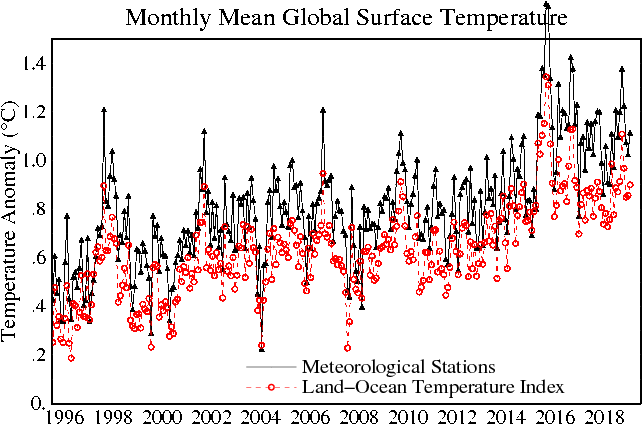
As such, here’s NASA’s Goddard Institute for Space Studies (GISS) Monthly Mean Surface Temperature Anomaly – 1996 to Present;
NOAA’s National Climate Data Center (NCDC) Annual Global Mean Temperature Anomaly Over Land & Sea – 1880 to Present;

Note: The chart above hasn’t been updated with 2011 data for unknown reasons. The chart resides here and the data to update it is here. It appears that a significant decline in temperatures occurred during the last 15 months:
2010 1 0.6335
2010 2 0.6708
2010 3 0.7815
2010 4 0.7518
2010 5 0.7064
2010 6 0.6764
2010 7 0.6581
2010 8 0.5783
2010 9 0.4975
2010 10 0.5655
2010 11 0.7182
2010 12 0.4226
2011 1 0.3962
2011 2 0.4200
2011 3 0.5226
2011 4 0.5894
2011 5 0.5093
2011 6 0.5882
2011 7 0.5687
2011 8 0.5401
2011 9 0.5264
2011 10 0.5739
2011 11 0.4347
2011 12 0.4800
2012 1 0.3630
2012 2 0.3678
(Source: NOAA NCDC)
UK Met Office’s – Hadley Center – Climate Research Unit (CRU) Annual Global Average Land Temperature Anomaly – 1850 to Present;

and the UK Met Office – Hadley Center – Climate Research Unit (CRU) Monthly Global Average Land Temperature – 1850 to Present

Depending on the time frame, it certainly seems that Earth’s surface temperature has increased, though it does not appear to be “warming rapidly”. Furthermore, the surface temperature record is burdened with issues of questionable siting, changes in siting, changes in equipment, changes in the number of measurement locations, modeling to fill in gaps in measurement locations, corrections to account for missing, erroneous or biased measurements, and the urban heat island effect. Thus to see the big picture on the temperature Earth’s temperature, it helps to also look up.
Atmospheric Temperatures:
Since 1979 the temperature of Earth’s “climate” has also been measured via satellite. “The temperature measurements from space are verified by two direct and independent methods. The first involves actual in-situ measurements of the lower atmosphere made by balloon-borne observations around the world. The second uses intercalibration and comparison among identical experiments on different orbiting platforms. The result is that the satellite temperature measurements are accurate to within three one-hundredths of a degree Centigrade (0.03 C) when compared to ground-launched balloons taking measurements of the same region of the atmosphere at the same time.” NASA
The following are 4 Temperature Anomaly plots from Remote Sensing Systems (RSS), each one increases in altitude as is illustrated here:

RSS Temperature Lower Troposphere (TLT) – Brightness Temperature Anomaly- 1979 to Present;

RSS Temperature Middle Troposphere (TMT)- Brightness Temperature Anomaly- 1979 to Present;

RSS Temperature Troposphere / Stratosphere (TTS) -Brightness Temperature Anomaly- 1987 to Present;

RSS Temperature Lower Stratosphere (TLS) – Brightness Temperature Anomaly – 1979 to Present:

According to Remote Sensing Systems, “For Channel (TLT) (Lower Troposphere) and Channel (TMT) (Middle Troposphere), the anomaly time series is dominated by ENSO events and slow tropospheric warming. The three primary El Niños during the past 20 years are clearly evident as peaks in the time series occurring during 1982-83, 1987-88, and 1997-98, with the most recent one being the largest.” RSS
Also, the 2009 – 10 El Niño event is also called out on this RSS Latitudinal Temperature Lower Troposphere (TLT) Brightness Temperature Anomaly from 1979 to Present;

and the 1998 El Niño event, along with the tropospheric cooling attributed to the 1991 eruption of Mt Pinitubo, is called out on this University of Alabama – Hunstville (UAH) Lower Atmosphere Temperature Anomalies – 1979 to Present:

Note that in March the UAH Lower Atmosphere Temperature Anomaly was 0.11 degrees C above the 30 year average, and the RSS Lower Troposphere Brightness Temperature was 0.075 degrees C above the 30 year average. Keep this mind the next time you see claims that recent weather was caused by Global Warming.

There are also regional variations in Lower Troposphere that contribute nuance to the picture. For example, RSS Northern Polar Temperature Lower Troposphere (TLT) Brightness Temperature Anomaly;

shows a .334 K/C per decade increase, whereas the The RSS Southern Polar Temperature Lower Troposphere (TLT) Brightness Temperature Anomaly;

shows a .011 K/C per decade decrease. I am still not aware of a compelling explanation for the significant divergence in the Lower Troposphere temperature trends between the poles.
The satellite record seems to show slow warming of Lower and Middle Tropospheric temperatures, overlaid with the El Niño/La Niña Southern Oscillation (ENSO) cycle, including four comparatively large El Niño events. Lower Tropospheric temperatures appear to have flattened since the large El Niño in 1998 and offer no indication of Earth “warming rapidly”.
Moving higher in the atmosphere, RSS Temperature Troposphere / Stratosphere (TTS) – Brightness Temperature Anomaly- 1987 to Present;
has been incredibly flat since, with a trend of just -.010 K/C per decade. The 1997-98 and 2009 – 10 El Niño events are still readily apparent in the plot, as is a spike from the 1991 eruption of Mt. Pinatubo. Note that the effect of Mt. Pinatubo is the opposite in the Lower and Middle Troposphere versus the Troposphere / Stratosphere (TTS), i.e. “Large volcanic eruptions inject sulfur gases into the stratosphere; the gases convert into submicron particles (aerosol) with an e-folding time scale of about 1 year. The climate response to large eruptions (in historical times) lasts for several (2-3) years. The aerosol cloud causes cooling at the Earth’s surface, warming in stratosphere.”
Ellen Thomas, PHD Wesleyan University
It is interesting that, incorporating the impact of three significant surface driven warming events, Troposphere / Stratosphere Temperatures (TTS) have been quite stable, however there is nuance to this as well.
RSS Northern Hemisphere Temperature Troposphere / Stratosphere (TTS) – Brightness Temperature Anomaly- 1987 to Present;

has been increasing by .046 K/C per decade, whereas the RSS Southern Hemisphere Temperature Troposphere / Stratosphere (TTS) – Brightness Temperature Anomaly- 1987 to Present;

has been decreasing by -.066 K/C per decade.
Moving higher still in the atmosphere, the RSS Temperature Lower Stratosphere (TLS) – Brightness Temperature Anomaly – 1979 to Present;
“is dominated by stratospheric cooling, punctuated by dramatic warming events caused by the eruptions of El Chichon (1982) and Mt Pinatubo (1991).” RSS
The eruptions of El Chichon and Mt Pinatubo are readily apparent in the Apparent Atmospheric Transmission of Solar Radiation at Mauna Loa, Hawaii:

“The stratosphere” … “in contrast to the troposphere, is heated, as the result of near infrared absorption of solar energy at the top of the aerosol cloud, and increased infra-red absorption of long-wave radiation from the Earth’s surface.”
“The stratospheric warming in the region of the stratospheric cloud increases the latitudinal temperature gradient after an eruption at low latitudes, disturbing the stratospheric-troposphere circulation, increasing the difference in height of the troposphere between high and low latitudes, and increasing the strength of the jet stream (polar vortex, especially in the northern hemisphere). This leads to warming during the northern hemisphere winter following a tropical eruption, and this warming effect tends to be larger than the cooling effect described above.” Ellen Thomas, PHD Wesleyan University
The Lower Stratosphere experienced “dramatic warming events caused by the eruptions of El Chichon (1982) and Mt Pinatubo (1991).” RSS “The long-term, global-mean cooling of the lower stratosphere stems from two downward steps in temperature, both of which are coincident with the cessation of transient warming after the volcanic eruptions of El Chichon and Mt. Pinatubo.” … “Here we provide observational analyses that yield new insight into three key aspects of recent stratospheric climate change. First, we provide evidence that the unusual step-like behavior of global-mean stratospheric temperatures is dependent not only upon the trend but also on the temporal variability in global-mean ozone immediately following volcanic eruptions. Second, we argue that the warming/cooling pattern in global-mean temperatures following major volcanic eruptions is consistent with the competing radiative and chemical effects of volcanic eruptions on stratospheric temperature and ozone. Third, we reveal the contrasting latitudinal structures of recent stratospheric temperature and ozone trends are consistent with large-scale increases in the stratospheric overturning Brewer-Dobson circulation” David W. J. Thompson Colorado State University
Above the Stratosphere we have the Mesosphere and Thermosphere, neither of which have I identified current temperature time series for, but of note is that on “July 15, 2010” “A Puzzling Collapse of Earth’s Upper Atmosphere” occurred when “high above Earth’s surface where the atmosphere meets space, a rarefied layer of gas called “the thermosphere” recently collapsed and now is rebounding again.”

“This is the biggest contraction of the thermosphere in at least 43 years,” says John Emmert of the Naval Research Lab, lead author of a paper announcing the finding in the June 19th issue of the Geophysical Research Letters (GRL). “It’s a Space Age record.”
The collapse happened during the deep solar minimum of 2008-2009—a fact which comes as little surprise to researchers. The thermosphere always cools and contracts when solar activity is low. In this case, however, the magnitude of the collapse was two to three times greater than low solar activity could explain.
“Something is going on that we do not understand,” says Emmert.
The thermosphere ranges in altitude from 90 km to 600+ km. It is a realm of meteors, auroras and satellites, which skim through the thermosphere as they circle Earth. It is also where solar radiation makes first contact with our planet. The thermosphere intercepts extreme ultraviolet (EUV) photons from the sun before they can reach the ground. When solar activity is high, solar EUV warms the thermosphere, causing it to puff up like a marshmallow held over a camp fire. (This heating can raise temperatures as high as 1400 K—hence the name thermosphere.) When solar activity is low, the opposite happens.” NASA
In summary, Earth’s Lower and Middle Troposphere appear to have warmed slowly, overlaid with the El Niño/La Niña Southern Oscillation (ENSO) cycle, including four comparatively large El Niño events, and tempered by the cooling effects of the eruption of El Chichon (1982) and Mt Pinatubo (1991). Lower and Middle Tropospheric temperatures appear to have flattened since the large El Niño in 1998 and offer no indication of “warming rapidly”. Tropospheric / Stratospheric temperatures appear to have been influenced by at least three significant surface driven warming events, the 1997-98 El Niño, and the eruptions of El Chichon in 1982 and Mt Pinatubo in 1991, but to have maintained a stable overall trajectory. Stratospheric temperatures appear to have experienced two “dramatic warming events caused by the eruptions of El Chichon (1982) and Mt Pinatubo (1991).”, and “unusual step-like behavior of global-mean stratospheric temperatures” which has resulted in a significant stratospheric cooling during the last 30 years. Lastly, “during deep solar minimum of 2008-2009” “the biggest contraction of the thermosphere in at least 43 years” occurred and “The magnitude of the collapse was two to three times greater than low solar activity could explain.”
Ocean Temperatures:
“The oceans can hold much more heat than the atmosphere. Just the top 3.2 metres of ocean holds as much heat as all the world’s air.” Commonwealth of Australia – Parliamentary Library
As such, changes in Oceanic Oscillations, and Ocean Heat Content are critical to understanding “Earth’s Temperature”. Here is NOAA’s NODC Global Ocean Heat Content from 0-700 Meters – 1955 to Present;

and here is the same from Ole Humlum’s valuable climate data site Climate4you.com, NODC Global Ocean Heat Content – 0-700 Meters – 1979 to Present:

It seems apparent from the plots above that Global Ocean Heat has increased over the last several decades, however Global Ocean Heat doesn’t appear to be “warming rapidly”. Furthermore, there is no evidence or indication of an increasing or accelerating rate, deceleration would appear to be a more accurate label.
Sea Level:
“Global sea level is currently rising as a result of both ocean thermal expansion and glacier melt, with each accounting for about half of the observed sea level rise, and each caused by recent increases in global mean temperature. For the period 1961-2003, the observed sea level rise due to thermal expansion was 0.42 millimeters per year and 0.69 millimeters per year due to total glacier melt (small glaciers, ice caps, ice sheets) (IPCC 2007). Between 1993 and 2003, the contribution to sea level rise increased for both sources to 1.60 millimeters per year and 1.19 millimeters per year respectively (IPCC 2007).” Source NISDC
Global Mean Sea Level Change – 1993 to Present:

Global Mean Sea Level Change Map with a “Correction” of 0.3 mm/year added May, 5th 2011, due to a “Glacial Isostatic Adjustment (GIA)” – 1993 to Present:

Snow and Ice:
A proxy often cited when measuring “Earth’s Temperature” is amount of Snow and Ice on Earth. According to the United States Geographical Survey (USGS), “The vast majority, almost 90 percent, of Earth’s ice mass is in Antarctica, while the Greenland ice cap contains 10 percent of the total global ice mass.” Source USGA However, there is currently there is no generally accepted measure of ice volume, as Cryosat is still in validation and the accuracy of measurements from Grace are still being challenged. Sea Ice Area and Extent are cited as proxies for “Earth’s Temperature” is Sea Ice Area, however there is significant evidence that the primary agents of change in Sea Ice Area and Extent are in fact wind and Atmospheric Oscillations. With this said, here are
Global, Arctic & Antarctic Sea Ice Area from 1979 to Present;

Global Sea Ice Area Anomaly – 1979 to Present:

Northern Hemisphere Sea Ice Area Anomaly, 1979 to Present;

Southern Hemisphere Sea Ice Area Anomaly, 1979 to Present;

Arctic Sea Ice Extent – 15% or greater

Antarctic Sea Ice Extent – 15% or Greater

There appears to have been a negative trend in Northern Hemisphere Sea Ice Area and Extent and a positive trend in Southern Hemisphere Sea Ice Area and Extent, thus the resultant Global Sea Ice Area trend appears to be slightly negative.
In terms of land based data, here is 20 Year Northern Hemisphere Snow Cover with 1995 – 2009 Climatology

Northern Hemisphere Snow Cover Anomalies 1966 – Present

Northern Hemisphere Winter Snow Extent – 1967 to Present:

Northern Hemisphere Spring Snow Extent – 1967 to Present:

Northern Hemisphere Fall Snow Extent – 1967 to Present:

While neither Snow plot offers a global perspective, when looking at the Northern Hemisphere, there appears to have been a slight increase in Snowcover and Winter Snow Extent, a decrease in Spring Snow Extent and no change in Fall Snow Extent over the historical record.
Based on the limited Global Ice and Snow measurements available, and noting the questionable value of Sea Ice Area as a proxy for temperature, not much inference can currently be drawn from Earth’s Ice measurements. However, there does not appear to be any evidence in Earth’s Ice measurements of rapid warming.
Conclusion:
“Earth’s Temperature” appears to have increased during the last several decades, but there does not appear to be any evidence of “rapid warming”.
Additional information on “Earth’s Temperature” can be found in the WUWT Reference Pages, including the Global Temperature Page and Global Climatic History Page
Discover more from Watts Up With That?
Subscribe to get the latest posts sent to your email.
It is cold this year in the UK, I’ve never had to carry full winter clothing on my push bike so late into April before or order a replenishment of coal for the bunker. Despite what the BBC says Bluebells are having a hard time of it.
This is the change in sea level, 1992 to the start of 2012. Sea level increases are due to thermal expansion and melting of land based ice.
The black line is the CUSUM of the detrended data; essentially the rate of change of sea level without data loss by averaging.
http://i179.photobucket.com/albums/w318/DocMartyn/sealevel.jpg
Spring 2007 is the srat of the slowdown and the current slowing kicked in in 2010 big time.
justthefactswuwt says:
April 15, 2012 at 3:10 pm
KR says: April 15, 2012 at 2:10 pm
The decline in spring extent indicates either (a) less total snow to be melted, (b) warmer spring temperatures causing the snowpack to melt faster, or (more likely) both.
===================================================
I’m waiting until after May to update, but as of last year….. over the last 20 years (when the global warming is supposed to be at it’s worse), we see that the agregate snow coverage has a slight increase. http://suyts.wordpress.com/2011/06/01/the-rapidly-melting-snow-extent/
Why? I don’t know.
justthefactswuwt – “But wouldn’t the increace in Winter Snow Extent seem to contridict the hypothsis that there’s “less total snow to be melted”?”
Not necessarily. The slight increase in extent (not depth, mind you) may be due to higher amounts of weather activity, or shifts in precipitation patterns. But the decrease in spring extent (and the decrease in total yearly extent) indicates that the snow present just isn’t sticking around as long. That’s either less snow total – and/or warmer springs melting it faster.
Forget global warming: Scientists discover glaciers in Asian mountain range are actually getting BIGGER
Read more: http://www.dailymail.co.uk/sciencetech/article-2130184/Forget-global-warming-Scientists-discover-glaciers-Asia-getting-BIGGER.html#ixzz1s9X8iZLu
“unusual step-like behavior of global-mean stratospheric temperatures” which has resulted in a significant stratospheric cooling during the last 30 years.
———–
I can read the graph and I don’t see this. I also think drawing a cause and effect relationship here is trying to be sneaky.
“The magnitude of the collapse was two to three times greater than low solar activity could explain.”
———-
The density of the thermosphere is very low. Which means its energy content is very low. Which means it has negligable heating effect on the lower atmosphere.
In short its irrelevant. Smells like FUD to me.
Thanks for all the info, Justthefacts and Anthony. Excellent idea to have it as a regular item
A general question on ocean heat content. The article says: ‘It seems apparent from the plots
above that Global Ocean Heat has increased over the last several decades, however Global Ocean Heat doesn’t appear to be “warming rapidly”.’
Some (eg or possibly ie R. Gates) cite the 23 * 10^22 joules which have gone into the oceans as something which will come back and bite us in the a…in the atmosphere. If true, this is slightly disquieting.
Can somebody point me to something which would challenge this alarmism (this is a sceptical blog, after all)? I get kerflummoxed when dealing with numbers larger than 6 * 10^17. 🙂
however Global Ocean Heat doesn’t appear to be “warming rapidly”.
———
Word games. A description such as “warming rapidly” is understood in terms of its context. Just the facts is trying to be shifty about the context by substituting his own
deceleration would appear to be a more accurate label
———
Sorry, but I am accustomed to interpreting plots of noisy data. I don’t buy this.
KR says: April 15, 2012 at 3:39 pm [/caption]
Not necessarily. The slight increase in extent (not depth, mind you) may be due to higher amounts of weather activity, or shifts in precipitation patterns. But the decrease in spring extent (and the decrease in total yearly extent) indicates that the snow present just isn’t sticking around as long. That’s either less snow total – and/or warmer springs melting it faster.
I am still far from convinced. I’ve added Northern Hemisphere Snow Cover Anomalies to the article so that others can make up their own minds;
Northern Hemisphere Snow Cover Anomalies 1966 – Present
[caption id="" align="alignnone" width="578" caption="Florida State University - Department of Earth, Ocean, and Atmospheric Science - Click the pic to view at source"]
but I am still skeptical that;
– Global warming would cause Northern Hemisphere Winter Snow Cover to increace, but Northern Hemisphere Spring Snow Cover to decline.
– Global warming would cause Northern Hemisphere Winter Snow Cover to increace, but Northern Hemisphere Winter Snow Amount/Depth to decline.
– The decreace in Northern Hemisphere Spring Snow Cover can be attributed to Global Warming, versus to an array of other climate variables, especially Atmospheric Oscillations, which are known to have major influences on Sea Ice Area and Extent: http://wattsupwiththat.com/2011/12/02/hurricanes-and-global-warming-opinion-by-chris-landsea/#comment-816893.
– Even if the above points were all true, the decreace in Northern Hemisphere Spring Snow Cover represents compelling evidence of “rapid warming” of Earth.
So let me see if I have this straight. In the 52 years that I have been alive, the Earth’s temperature has risen 0.5°C and the oceans have risen 5 cm (2.5″)? I don’t think I’m quite ready to give all my Helly-Hansen undies to the Goodwill just yet and how much is it going to cost me to hem-up my pants? I can’t believe these people still enjoy any amount of credibility.
KR: “The slight increase in extent (not depth, mind you) may be due to higher amounts of weather activity…”
Ummm, could you explain what constitutes “higher amounts of weather activity” ?
[I assume it’s different from “higher amounts of climate activity…”]
Hmm I find the hemispheric differences probably the most suggestive of a human signature. As far back as the 70s folks noted that there was a significant disparity in background ozone concentrations in the lower troposphere between the hemisphere’s and this was postulated to be the residual photochemical product of human activity. Now ozone is nothing like carbon dioxide in the sense that whilst being radiatively active, it nevertheless has a relatively short half life in the lower troposhere, whereas as CO2 hangs around for much longer. The disparity could be a natural product of the different land:sea ratios in the two hemisphere’s but given that even in the eightees there were plenty of credible trackings of transcontinental ozone plumes it would seem more likely that the disparity is indeed human in origin.
Now whether this disparity carries over to CO2, whether CO2 differences are sufficient to cause the temperature disparity or the disparity is cuased by something else I would have to leave to other smarter people. However, some people have suggested that efforts to reduce photochemical precursors might explain some of the stalling in temperature increase we have seen in recent years.
cui bono says: April 15, 2012 at 4:19 pm
Some (eg or possibly ie R. Gates) cite the 23 * 10^22 joules which have gone into the oceans as something which will come back and bite us in the a…in the atmosphere. If true, this is slightly disquieting.
Can somebody point me to something which would challenge this alarmism (this is a sceptical blog, after all)? I get kerflummoxed when dealing with numbers larger than 6 * 10^17. 🙂
I am not sure of the basis of the “23 * 10^22 joules” cited, but previously R. Gates has stated that, “Trenberth has calculated that there seems to be about .9 wm2 “missing”, even though some recent studies have found at least a small portion of it in the deeper parts of the Pacific.”
http://wattsupwiththat.com/2011/09/18/tisdale-on-ocean-heat-content-anomalies/#comment-746599
Willis Eschenbach addressed Trenberth’s missing heat calculations here;
http://wattsupwiththat.com/2012/01/26/decimals-of-precision-trenberths-missing-heat/
Bob Tisdale does a good job in analyzing Ocean Heat Content here;
http://wattsupwiththat.com/2011/09/18/tisdale-on-ocean-heat-content-anomalies/
and also addresses R. Gates assumption that there is missing heat/energy, within comments of that thread.
cui bono says: April 15, 2012 at 4:19 pm
“Some (eg or possibly ie R. Gates) cite the 23 * 10^22 joules which have gone into the oceans as something which will come back and bite us in the a…in the atmosphere. If true, this is slightly disquieting.”
Alarming, even. An alternative view is that “Trenberth’s missing heat” isn’t there. That it has gone into deep-space, never to return. That’s why he can’t find it, and that’s why he described it as a “tragedy” in the climate-gate emails. So it may just be the size of the error in their calculations. Alarming indeed, but only to those who attach credibility to IPCC model “projections”.
LazyTeenager says: April 15, 2012 at 4:22 pm
however Global Ocean Heat doesn’t appear to be “warming rapidly”.
———
Word games. A description such as “warming rapidly” is understood in terms of its context. Just the facts is trying to be shifty about the context by substituting his own
“Shifty about the contex”? What does this mean? Would you prefer if it read “however Global Ocean Heat Content does not appear to indicate that the planet is “warming rapidly”.?
LazyTeenager says: April 15, 2012 at 4:25 pm
Sorry, but I am accustomed to interpreting plots of noisy data. I don’t buy this.
Not sure what it is you are or aren’t buying. Do you see an accellerating rate of warming in the Ocean Heat Content plots? If so can you provide a timeframe during which you believe this accelleration has occured? The data is available here if you’d like to plot it yourself:
http://www.nodc.noaa.gov/cgi-bin/OC5/3M_HEAT/heatdata.pl?time_type=yearly700
Goldie says: April 15, 2012 at 5:14 pm
Hmm I find the hemispheric differences probably the most suggestive of a human signature. As far back as the 70s folks noted that there was a significant disparity in background ozone concentrations in the lower troposphere between the hemisphere’s and this was postulated to be the residual photochemical product of human activity. Now ozone is nothing like carbon dioxide in the sense that whilst being radiatively active, it nevertheless has a relatively short half life in the lower troposhere, whereas as CO2 hangs around for much longer. The disparity could be a natural product of the different land:sea ratios in the two hemisphere’s but given that even in the eightees there were plenty of credible trackings of transcontinental ozone plumes it would seem more likely that the disparity is indeed human in origin.
Now whether this disparity carries over to CO2, whether CO2 differences are sufficient to cause the temperature disparity or the disparity is cuased by something else I would have to leave to other smarter people. However, some people have suggested that efforts to reduce photochemical precursors might explain some of the stalling in temperature increase we have seen in recent years.
I’m not even sure how to address this, it seems like pure specultion. Can you provide any empirical evidence in support of your supposition? Here is some literature on the subject, I find no attribution to or association with Ozone.
In this paper “The central role of diminishing sea ice in recent Arctic temperature amplification” by James A. Screen & Ian Simmonds, 2010:
http://www.nature.com/nature/journal/v464/n7293/full/nature09051.html
The abstract states that, “Increased concentrations of atmospheric greenhouse gases have driven Arctic and global average warming; however, the underlying causes of Arctic amplification remain uncertain. The roles of reductions in snow and sea ice cover and changes in atmospheric and oceanic circulation cloud cover and water vapour are still matters of debate.” before claiming that, “Here we show that the Arctic warming is strongest at the surface during most of the year and is primarily consistent with reductions in sea ice cover.”
Here’s another paper, “Vertical structure of recent Arctic warming” by Rune G. Graversen, Thorsten Mauritsen1, Michael Tjernström, Erland Källén & Gunilla Svensson, Nature, 2008.
http://www.nature.com/nature/journal/v451/n7174/abs/nature06502.html
The abstract states that, “The underlying causes of this temperature amplification remain uncertain. The reduction in snow and ice cover that has occurred over recent decades may have played a role. Climate model experiments indicate that when global temperature rises, Arctic snow and ice cover retreats, causing excessive polar warming. Reduction of the snow and ice cover causes albedo changes, and increased refreezing of sea ice during the cold season and decreases in sea-ice thickness both increase heat flux from the ocean to the atmosphere. Changes in oceanic and atmospheric circulation, as well as cloud cover, have also been proposed to cause Arctic temperature amplification. Here we examine the vertical structure of temperature change in the Arctic during the late twentieth century using reanalysis data. We find evidence for temperature amplification well above the surface. Snow and ice feedbacks cannot be the main cause of the warming aloft during the greater part of the year, because these feedbacks are expected to primarily affect temperatures in the lowermost part of the atmosphere, resulting in a pattern of warming that we only observe in spring. A significant proportion of the observed temperature amplification must therefore be explained by mechanisms that induce warming above the lowermost part of the atmosphere. We regress the Arctic temperature field on the atmospheric energy transport into the Arctic and find that, in the summer half-year, a significant proportion of the vertical structure of warming can be explained by changes in this variable. We conclude that changes in atmospheric heat transport may be an important cause of the recent Arctic temperature amplification.”
Here’s another paper, Arctic air temperature change amplification and the Atlantic
Multidecadal Oscillation, by Petr Chylek, Chris K. Folland, Glen Lesins, Manvendra K. Dubey, and Muyin Wang, Geophysical Research Letter, 2009:
http://www.lanl.gov/source/orgs/ees/ees14/pdfs/09Chlylek.pdf
It states that, “Analyzing temperature records of the Arctic meteorological stations we find that (a) the Arctic amplification (ratio of the Arctic to global temperature trends) is not a constant but varies in time on a multi-decadal time scale, (b) the Arctic warming from 1910–1940 proceeded at a significantly faster rate than the current 1970–2008 warming, and (c) the Arctic temperature changes are highly correlated with the Atlantic Multi-decadal Oscillation (AMO) suggesting the Atlantic Ocean thermohaline circulation is linked to the Arctic temperature variability on a multi-decadal time scale.”
In summary we have three papers from the last several years that state that, “Arctic warming” “is primarily consistent with reductions in sea ice cover.” or “A significant proportion of the observed temperature amplification must therefore be explained by mechanisms that induce warming above the lowermost part of the atmosphere.” or “the Arctic temperature changes are highly correlated with the Atlantic Multi-decadal Oscillation (AMO) suggesting the Atlantic Ocean thermohaline circulation is linked to the Arctic temperature variability on a multi-decadal time scale.”
As Oldseadog says: April 15, 2012 at 1:33 pm notes:
“Something is going on that we do not understand”.
Says it all, really.
Recommend postees ALWAYS do a spell check. These guys (warmists) will hammer you to no end.
“I am still not aware of a compelling explanation for the significant divergence in the Lower Troposphere temperature trends between the poles.”
It supports cloud cover changes (e.g. via cosmic ray variation) as a major climate influence. In the northern hemisphere and over most of the rest of the total world’s surface, warming occurs when low-lying cloud cover decreases as albedo decreases then, but, over the expanse of Antarctic ice, the ice sheets there can be more white than the cloud tops. An April 11th “does CO2 correlate” WUWT article discusses that more. Of course, a comprehensive look would also include factors like the Antarctic Circumpolar Current’s effect.
Incidentally, such as the Met Office graphs seen in this article have much historical revisionism. For instance, the fear of global cooling in the 1970s did not occur because previous temperatures had so next to nil decline from the late 1930s as the CRU graphs imply (even in the specifically Northern Hemisphere version of them like the CRU graph seen at http://hidethedecline.eu/media/Northern%20hemisphere%20temperatures/NHBROHANredSmall.jpg ).
Rather, history was as illustrated in this image of the November 1976 National Geographic graph:
http://www.freeimagehosting.net/newuploads/adwfb.jpg
… with the 1976 graph also fitting indirectly with
http://earthobservatory.nasa.gov/Features/ArcticIce/Images/arctic_temp_trends_rt.gif
A comparison is at:
http://hidethedecline.eu/pages/posts/decline-temperature-decline-1940-78-the-cold-data-war-170.php
There is so much more that forms the big picture.
For instance, sea level rise rate was on average no more in the second half of the 20th century than the first half (in fact not more than the rise rate in the late 19th century in prolonged recovery from the Little Ice Age), as illustrated by this:
http://i807.photobucket.com/albums/yy357/Gilthan_2009/sealevel20thcentury.jpg
which is from
http://meteo.lcd.lu/globalwarming/Holgate/sealevel_change_poster_holgate.pdf
which notes:
“The first half of the century (1904-1953) had a slightly higher rate (1.91 +/- 0.14 mm/yr) in comparison with the second half of the century (1.42 +/- 0.14 mm/yr 1954-2003).“
michael hart – Regarding ~20×10^22 Joules, that number comes from http://www.nodc.noaa.gov/OC5/3M_HEAT_CONTENT/ – the 0-2000 meter heat content. ~20×10^22 Joules since 1961.
That’s ocean heat content, which represents ~92% or so of the available mass in the climate. If that energy went into the atmosphere it would have warmed by >40C, two Hiroshima bombs/second, enough energy (over the last 50 years) to boil Sydney Harbor completely dry – every 12 hours from full up (http://tinyurl.com/725v4zn).
Granted, there’s some uncertainty in the earlier OHC numbers. But I don’t think it makes a huge difference if the average energy took 24 hours to boil Sydney Harbor dry or only 6… it’s still a fair bit of heat.
KR mentioned “higher amounts of weather activity”. Does that mean a faster water cycle? How much net global cooling will the faster water cycle cause?
KR says:
“If that energy went into the atmosphere it would have warmed by >40C, two Hiroshima bombs/second, enough energy (over the last 50 years) to boil Sydney Harbor completely dry – every 12 hours from full up”
How much is that in Olympic sized swimming pools?
eric1skeptic, michael hart – There doesn’t seem to be a significant trend from the data I’ve seen, but the increases in total water vapor (~4% since the ’70’s) and heat in the atmosphere _may possibly_ be resulting in more storm variations. But honestly, there’s not enough of a trend to be clear. However, given the rather small trend (I haven’t calculated whether it’s significant) in mid-winter extent, I would suspect simple changes in the weather patterns.
Either way – the reductions in spring extent (10-15% over the time shown) indicate either/both a reduction in total snowfall or/and warmer/earlier springs melting the snow faster.