
By WUWT regular “Just The Facts”
Often in the climate debate, generalities are used to address more nuanced issues, e.g. “There is broad scientific consensus that Earth’s climate is warming rapidly and at an accelerating rate.” from the Wikipedia for Scientific Opinion on Climate Change. But is this true? Let’s take a look.
Global Surface Temperatures:
Generally, when referring to Earth’s “climate” warming, proponents of the Catastrophic Anthropogenic Global Warming (CAGW) narrative, refer to Earth’s Surface Temperature, e.g. “Global warming is the unusually rapid increase in Earth’s average surface temperature over the past century primarily due to the greenhouse gases released by people burning fossil fuels.” NASA Earth Observatory
As such, here’s NASA’s Goddard Institute for Space Studies (GISS) Monthly Mean Surface Temperature Anomaly – 1996 to Present;
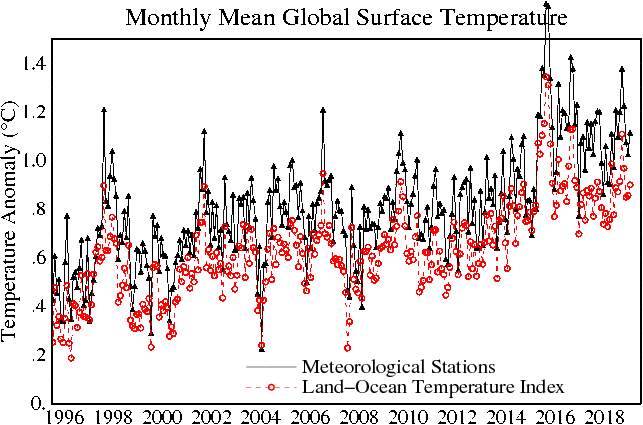
NOAA’s National Climate Data Center (NCDC) Annual Global Mean Temperature Anomaly Over Land & Sea – 1880 to Present;

the UK Met Office’s – Hadley Center – Climate Research Unit (CRU) Annual Global Average Land Temperature Anomaly – 1850 to Present;

and the UK Met Office – Hadley Center – Climate Research Unit (CRU) Monthly Global Average Land Temperature – 1850 to Present

Depending on the time frame, it certainly seems that Earth’s surface temperature has increased, though it does not appear to be “warming rapidly” and there are no indications of “an accelerating rate”. Furthermore, the surface temperature record is burdened with issues of questionable siting, changes in siting, changes in equipment, changes in the number of measurement locations, modeling to fill in gaps in measurement locations, corrections to account for missing, erroneous or biased measurements, and the urban heat island effect. Thus to see the big picture on the temperature Earth’s temperature, it helps to also look up.
Atmospheric Temperatures:
Since 1979 the temperature of Earth’s “climate” has also been measured via satellite. “The temperature measurements from space are verified by two direct and independent methods. The first involves actual in-situ measurements of the lower atmosphere made by balloon-borne observations around the world. The second uses intercalibration and comparison among identical experiments on different orbiting platforms. The result is that the satellite temperature measurements are accurate to within three one-hundredths of a degree Centigrade (0.03 C) when compared to ground-launched balloons taking measurements of the same region of the atmosphere at the same time.” NASA
The following are 4 Temperature Anomaly plots from Remote Sensing Systems (RSS), each one increases in altitude as is illustrated here:

RSS Temperature Lower Troposphere (TLT) – Brightness Temperature Anomaly- 1979 to Present;

RSS Temperature Middle Troposphere (TMT)- Brightness Temperature Anomaly- 1979 to Present;

RSS Temperature Troposphere / Stratosphere (TTS) -Brightness Temperature Anomaly- 1987 to Present;

RSS Temperature Lower Stratosphere (TLS) – Brightness Temperature Anomaly – 1979 to Present:

According to Remote Sensing Systems, “For Channel (TLT) (Lower Troposphere) and Channel (TMT) (Middle Troposphere), the anomaly time series is dominated by ENSO events and slow tropospheric warming. The three primary El Niños during the past 20 years are clearly evident as peaks in the time series occurring during 1982-83, 1987-88, and 1997-98, with the most recent one being the largest.” RSS
Also, the 2009 – 10 El Niño event is also called out on this RSS Latitudinal Temperature Lower Troposphere (TLT) Brightness Temperature Anomaly from 1979 to Present;

and the 1998 El Niño event, along with the tropospheric cooling attributed to the 1991 eruption of Mt Pinitubo, is called out on this University of Alabama – Hunstville (UAH) Lower Atmosphere Temperature Anomalies – 1979 to Present:

Note that in November the UAH Lower Atmosphere Temperature Anomaly was 0.12 degrees C above the 30 year average, and the RSS Lower Troposphere Brightness Temperature was 0.033 degrees C above the 30 year average. Keep this mind the next time you read that recent weather events were caused by Global Warming.

Furthermore, the Middle Troposphere, which follows a similar though flatter trend as the Lower Troposphere, recently dipped below the 30 year trend line i.e. RSS Temperature Middle Troposphere (TMT)- Brightness Temperature Anomaly- 1979 to Present:
There are also regional variations in Lower Troposphere that contribute nuance to the picture. For example, RSS Northern Polar Temperature Lower Troposphere (TLT) Brightness Temperature Anomaly;

shows a .338 K/C per decade increase, whereas the The RSS Southern Polar Temperature Lower Troposphere (TLT) Brightness Temperature Anomaly;

shows a .007 K/C per decade decrease. I am not aware of a compelling explanation for the significant divergence in temperature trends between the poles.
The satellite record seems to show slow warming of Lower and Middle Tropospheric temperatures, overlaid with the El Niño/La Niña Southern Oscillation (ENSO) cycle, including four comparatively large El Niño events. Lower Tropospheric temperatures appear to have flattened since the large El Niño in 1998 and offer no indication of “accelerating” warming.
Moving higher in the atmosphere, RSS Temperature Troposphere / Stratosphere (TTS) – Brightness Temperature Anomaly- 1987 to Present;
has been incredibly flat since, with a trend of just -.004 K/C per decade. The 1997-98 and 2009 – 10 El Niño events are still readily apparent in the plot, as is a spike from the 1991 eruption of Mt. Pinatubo. Note that the effect of Mt. Pinatubo is the opposite in the Lower and Middle Troposphere versus the Troposphere / Stratosphere (TTS), i.e. “Large volcanic eruptions inject sulfur gases into the stratosphere; the gases convert into submicron particles (aerosol) with an e-folding time scale of about 1 year. The climate response to large eruptions (in historical times) lasts for several (2-3) years. The aerosol cloud causes cooling at the Earth’s surface, warming in stratosphere.”
Ellen Thomas, PHD Wesleyan University
It is interesting that, incorporating the impact of three significant surface driven warming events, Troposphere / Stratosphere Temperatures (TTS) have been quite stable, however there is nuance to this as well.
RSS Northern Hemisphere Temperature Troposphere / Stratosphere (TTS) – Brightness Temperature Anomaly- 1987 to Present;

has been increasing by .054 K/C per decade, whereas the RSS Southern Hemisphere Temperature Troposphere / Stratosphere (TTS) – Brightness Temperature Anomaly- 1987 to Present;

has been decreasing by -.062 K/C per decade.
Moving higher still in the atmosphere, the RSS Temperature Lower Stratosphere (TLS) – Brightness Temperature Anomaly – 1979 to Present;
“is dominated by stratospheric cooling, punctuated by dramatic warming events caused by the eruptions of El Chichon (1982) and Mt Pinatubo (1991).” RSS
The eruptions of El Chichon and Mt Pinatubo are readily apparent in the Apparent Atmospheric Transmission of Solar Radiation at Mauna Loa, Hawaii:

“The stratosphere” … “in contrast to the troposphere, is heated, as the result of near infrared absorption of solar energy at the top of the aerosol cloud, and increased infra-red absorption of long-wave radiation from the Earth’s surface.”
“The stratospheric warming in the region of the stratospheric cloud increases the latitudinal temperature gradient after an eruption at low latitudes, disturbing the stratospheric-troposphere circulation, increasing the difference in height of the troposphere between high and low latitudes, and increasing the strength of the jet stream (polar vortex, especially in the northern hemisphere). This leads to warming during the northern hemisphere winter following a tropical eruption, and this warming effect tends to be larger than the cooling effect described above.” Ellen Thomas, PHD Wesleyan University
The Lower Stratosphere experienced “dramatic warming events caused by the eruptions of El Chichon (1982) and Mt Pinatubo (1991).” RSS “The long-term, global-mean cooling of the lower stratosphere stems from two downward steps in temperature, both of which are coincident with the cessation of transient warming after the volcanic eruptions of El Chichon and Mt. Pinatubo.” … “Here we provide observational analyses that yield new insight into three key aspects of recent stratospheric climate change. First, we provide evidence that the unusual step-like behavior of global-mean stratospheric temperatures is dependent not only upon the trend but also on the temporal variability in global-mean ozone immediately following volcanic eruptions. Second, we argue that the warming/cooling pattern in global-mean temperatures following major volcanic eruptions is consistent with the competing radiative and chemical effects of volcanic eruptions on stratospheric temperature and ozone. Third, we reveal the contrasting latitudinal structures of recent stratospheric temperature and ozone trends are consistent with large-scale increases in the stratospheric overturning Brewer-Dobson circulation” David W. J. Thompson Colorado State University
Above the Stratosphere we have the Mesosphere and Thermosphere, neither of which have I found current temperature time series for, but of note is that on “July 15, 2010” “A Puzzling Collapse of Earth’s Upper Atmosphere” occurred when “high above Earth’s surface where the atmosphere meets space, a rarefied layer of gas called “the thermosphere” recently collapsed and now is rebounding again.”

“This is the biggest contraction of the thermosphere in at least 43 years,” says John Emmert of the Naval Research Lab, lead author of a paper announcing the finding in the June 19th issue of the Geophysical Research Letters (GRL). “It’s a Space Age record.”
The collapse happened during the deep solar minimum of 2008-2009—a fact which comes as little surprise to researchers. The thermosphere always cools and contracts when solar activity is low. In this case, however, the magnitude of the collapse was two to three times greater than low solar activity could explain.
“Something is going on that we do not understand,” says Emmert.
The thermosphere ranges in altitude from 90 km to 600+ km. It is a realm of meteors, auroras and satellites, which skim through the thermosphere as they circle Earth. It is also where solar radiation makes first contact with our planet. The thermosphere intercepts extreme ultraviolet (EUV) photons from the sun before they can reach the ground. When solar activity is high, solar EUV warms the thermosphere, causing it to puff up like a marshmallow held over a camp fire. (This heating can raise temperatures as high as 1400 K—hence the name thermosphere.) When solar activity is low, the opposite happens.” NASA
In summary, Earth’s Lower and Middle Troposphere appear to have warmed slowly, overlaid with the El Niño/La Niña Southern Oscillation (ENSO) cycle, including four comparatively large El Niño events, and tempered by the cooling effects of the eruption of El Chichon (1982) and Mt Pinatubo (1991). Lower and Middle Tropospheric temperatures appear to have flattened since the large El Niño in 1998 and offer no indication of “accelerating” warming. Tropospheric / Stratospheric temperatures appear to have been influenced by at least three significant surface driven warming events, the 1997-98 El Niño, and the eruptions of El Chichon in 1982 and Mt Pinatubo in 1991, but to have maintained a stable overall trajectory. Stratospheric temperatures appear to have experienced two “dramatic warming events caused by the eruptions of El Chichon (1982) and Mt Pinatubo (1991).”, and “unusual step-like behavior of global-mean stratospheric temperatures” which has resulted in a significant stratospheric cooling during the last 30 years. Lastly, “during deep solar minimum of 2008-2009” “the biggest contraction of the thermosphere in at least 43 years” occurred and “The magnitude of the collapse was two to three times greater than low solar activity could explain.”
Ocean Temperatures:
“The oceans can hold much more heat than the atmosphere. Just the top 3.2 metres of ocean holds as much heat as all the world’s air.” Commonwealth of Australia – Parliamentary Library
As such, changes in Oceanic Oscillations, and Ocean Heat Content are critical to understanding “Earth’s Temperature”. Here is NOAA’s NODC Global Ocean Heat Content from 0-700 Meters – 1955 to Present;

and here is the same from Ole Humlum’s valuable climate data site Climate4you.com, NODC Global Ocean Heat Content – 0-700 Meters – 1979 to Present.

It seems apparent from the plots above that Global Ocean Heat has increased over the last several decades, however Global Ocean Heat doesn’t appear to be “warming rapidly”. Furthermore, there is no basis for the claim that warming is occurring at “an accelerating rate”. Decelerating would appear a more accurate label.
Ice:
A proxy often cited when measuring “Earth’s Temperature” is amount of Ice on Earth. According to the United States Geographical Survey (USGS), “The vast majority, almost 90 percent, of Earth’s ice mass is in Antarctica, while the Greenland ice cap contains 10 percent of the total global ice mass.” http://ga.water.usgs.gov/edu/watercycleice.html However, there is currently there is no generally accepted measure of ice volume, as Cryosat is still in validation and the accuracy of measurements from Grace are still being challenged.
As such, currently available global ice measurements are limited. Here is 20 Year Northern Hemisphere Snowcover with 1995 – 2009 Climatology

and here is Northern Hemisphere Winter Snow Extent – 1967 to Present:

While neither plot offers a global perspective, when looking at the Northern Hemisphere, there appears to have been a slight increase in Snowcover and Winter Snow Extent over the historical record.
Another ice based variable often cited as a proxy for “Earth’s Temperature” is Sea Ice Area, however there is significant evidence that the primary agent of change in Sea Ice Area is in fact wind and Atmospheric Oscillations. With this said, here are Global, Arctic & Antarctic Sea Ice Area from 1979 to Present;

Northern Hemisphere Sea Ice Area Anomaly, 1979 to Present;

Southern Hemisphere Sea Ice Area Anomaly, 1979 to Present;

and Global Sea Ice Area Anomaly – 1979 to Present:

There does appear to have been a negative trend in Northern Hemisphere Sea Ice Area, however there also appears to have been a positive trend in Southern Hemisphere Sea Ice Area. The resultant Global Sea Ice Area trend appears to be slightly negative, with no apparent acceleration. Based on the limited Global Ice measurements available, and noting the questionable value of Sea Ice Area as a proxy for temperature, not much inference can currently be drawn from Earth’s Ice measurements. However, there does not appear to be any evidence in Earth’s Ice measurements of rapid and/or accelerating warming.
Conclusion:
“Earth’s Temperature” appears to have increased during the last several decades, but there does not appear to be evidence that Earth’s climate is “warming rapidly”. Furthermore, there are no apparent signs of warming occurring “at an accelerating rate”.
Additional information on “Earth’s Temperature” can be found in the WUWT Reference Pages, including the Global Temperature Page and Global Climatic History Page
R. Gates @ur momisugly January 2, 10:30 am
Errh, but isn’t the warming period prior to ~1940, (before significant human caused GHG’s), a little more extraordinary by comparison? And, isn’t the cooling period after ~1940 somewhat reminiscent of what we have seen since about 1998? (or 2010 if you insist).
Wanna me to post a graph or more?
Like have you heard of the commonly discussed ~60-year natural cycle?
Did anyone ever measure the change in humidity over the years?
After looking at the daily average readings from about 20 weather stations all over the world I am finding a change of about -0.02%RH per annum.
http://www.letterdash.com/HenryP/henrys-pool-table-on-global-warming
So, if this estimate is not far from correct, then the average global humidity is now about o.75% RH lower than it was 37 years ago.
If I am not mistaken (at 15 degrees C) that translates again to a loss of about 0.1% in absolute humidity.
You see how that compares with the increase in of CO2? (0.01% increase over the last 50 years)
Lars and Rob – on the topic of back radiation and absorption by carbon dioxide ….
Does anyone know if this* experiment has been debunked or repeated since 1998? It shows carbon dioxide absorption as being only 1/80th (ie 1.25%) of that calculated by the IPCC and thus deduces negligible difference when carbon dioxide is doubled. As you know, I say it has no effect when the surface is warmer, but I could accept rare situations when the surface is colder as accounting for 1.25% – what the heck!
* http://www.john-daly.com/artifact.htm
http://climate-change-theory.com says:
January 2, 2012 at 4:36 am
…”If instead we calculate the rate of increase in a more logical, albeit simplistic fashion, from the first maximum to the present maximum we get 0.43 degrees from 1942 to 2011, namely 0.62 degrees per century. I suggest we can’t extrapolate that far anyway,…”
—————————————————————————————
@ur momisugly climate-change-theory: Good post, but a question. When you do the data for the 1942 peak are you using the data where the peak was adjusted down? I have never seen a logical explanation for the downward adjustments of that trend, or the more recent upward adjustments. I agree completely that 60 years is the minimum time frame one can use to begin to establish a trend.
Mr Mosher, it does not pay to underestimate “Just the facts”
The snow cover changes are interesting. I am leaning to the idea that the impact of rising co2 levels may not be on temperatures at all. Temperatures are likely to be pegged by the lapse rate to whatever is happening in the upper troposphere/stratosphere. If temperatures were pegged, then extra back radiation must be causing increased evaporation, leading to gradually increasing precipitation.
So there are about 80 W/m**2 of latent heat of evaporation and 320 W/m**2 of back radiation. If one causes the other, that would be a gain of 4, which is completely unstable of course. So each unit of latent heat would cause somewhat less than one unit of back radiation, leading to the positive water vapour feedback.
So increases in precipitation could indicate or at least suggest the strength of this feedback. Not, however, the increment in temperature required to drive it.
Ah! The “ban” was a sham from the get-go.
He needs a title. I propose The Fiddler.
Except, I believe, that the odds of heat being lost by a molecule of CO2 thru thermal contact are higher than of losing it by radiation by approximately 10 to the umpteenth power.
Brian_H says:
“Except, I believe, that the odds of heat being lost by a molecule of CO2 thru thermal contact are higher than of losing it by radiation by approximately 10 to the umpteenth power.”
For sure. That molecule of CO2 will hit a molecule of N2 or O2 most likely. However as the N2 or O2 will not absorb any long wave, neither will it emit any long wave, so that N2 or O2 stays heated until it hits another CO2 (or H20 or other GHG molecule) heating it up and that molecule may very well emit a long-wave photon to cool down.
Can anyone answer this question:
Look at the NOAA global temperature record above. The maxima and minima temperatures are clearly displayed. They are also shown on the HADCRU output below this graph. Both show the monthly max/min range about 0.5C before about 1950 and only 0.3C after 1950. This introduces a significant warming bias to the anomaly – of the order of 0.15C.
As minimum temperatures generally occur in the hours of darkness, (i.e. no solar insolation) then the rate of cooling post 1950 could have decreased (cloud density?). Of course it could be down to manipulation of the raw data (homogenisation)..
peter_ga says:
January 2, 2012 at 11:52 pm
….. Temperatures are likely to be pegged by the lapse rate to whatever is happening in the upper troposphere/stratosphere. If temperatures were pegged, then extra back radiation must be causing increased evaporation, leading to gradually increasing precipitation.So there are about 80 W/m**2 of latent heat of evaporation and 320 W/m**2 of back radiation. If one causes the other, that would be a gain of 4, which is completely unstable of course. So each unit of latent heat would cause somewhat less than one unit of back radiation, leading to the positive water vapour feedback.”
————————————————————————-
Besides what Brian H stated above, please consider that additional cloud cover prevents a far broader spectrum (then the spectrum affected just by CO2) of TSI from reaching the oceans, which have a vastly greater energy capacity then the atmosphere. So any increase in absorbtion by the atmosphere (which quickly reaches equalibrium) is overwhelmed, in time, by a loss of energy to the oceans; which may take decades or far longer to reach a radiative balance, depending on the solar spectrum affected and the residence time of the energy entering the oceans, now reduced due to greater cloud cover. Water vapor alone reduces the TSI at the surface by about 20%, and that is before any clouds which are additional.
Peter, another factor to consider is that the ratio, 4 to 1 of LWIR back radiation to evaporation may not be linear at all. (The last ten W/m**2 of back radiation may produce far more evaporation then the first ten.) Also convection may increase the time factor of evaporation to condensation and latent heat release higher in the atmosphere; a quickening of any energy cycle takes work.
Spen says:
http://wattsupwiththat.com/2012/01/01/a-big-picture-look-at-earths-temperature/#comment-851451
Henry@Spen
I don’t think that NOAA graph actually shows the maxima and minima (once a day occurences) anomalies.
I think it just shows the ranges for average temp. anomalies.
If you want to see what I think you want to see (because I wanted to know exactly the same thing)
you must study my tables here:
http://www.letterdash.com/HenryP/henrys-pool-table-on-global-warming
and read what I conclude from it.
So far.
there could be more coming:
http://wattsupwiththat.com/2012/01/01/a-big-picture-look-at-earths-temperature/#comment-851327
JTF OK, they are not “your” charts, so it is not “your” trend line that is misleadingly presented. I accept that. But, that said, your case would be stronger, and I think more valid, if you pointed out the trend changes that the producers of the charts have chosen to overlook. Murray
Good graphic study. If I were looking at the “Hockey-stick”, I would have said what Wiki said. However; there was nothing resembling a hockey-stick in these graphs. These graphs all show, of course, recent years. Historically speaking, we know it’s been warmer before and colder before too. So presently, we Earthlings are somewhere in between. These graphs show no drastic trends. There should be no panic. there is no danger to anyone.
The “Hockey-stick” graph was manufactured to evoke fear of danger ,to evoke panic. It is but one example of pervasive global warming fear mongering.
The social upheaval caused by this fear mongering is sought by certain groups who wish to wrest power and control amidst the chaos. This is the true danger.
As for the creators of the “Hockey stick, I hope the FBI has a fat file on every one of theses subversives dressed as scientists. Wolves dressed as lambs.
(1400K somewhere in the atmosphere? Wow. Who knew?)
“”””” peter_ga says:
January 3, 2012 at 1:17 am
Brian_H says:
“Except, I believe, that the odds of heat being lost by a molecule of CO2 thru thermal contact are higher than of losing it by radiation by approximately 10 to the umpteenth power.”
For sure. That molecule of CO2 will hit a molecule of N2 or O2 most likely. However as the N2 or O2 will not absorb any long wave, neither will it emit any long wave, so that N2 or O2 stays heated until it hits another CO2 (or H20 or other GHG molecule) heating it up and that molecule may very well emit a long-wave photon to cool down. “””””
Why do you assume that a collision between an N2 or O2 molecule and a CO2 molecule, will heat the CO2 molecule. All of the molecules of any species will exhibit some Maxwell-Boltzmann distribution of Kinetic energies, and in any random collision, no-one can say which of the two colliding molecules will gain energy, and which will lose energy.
As for your statement that the N2 and O2 molecules can neither absorb or emit long wave radiation; perhaps you didn’t read Bill Illis’s statement, that the spectrum of the downward radiation from the atmosphere (I presume he has observed it) is in fact a Planckian Black body like continuous spectrum, which is characterized by the temperature of the atmosphere immediately above the measuring instrument. So what is YOUR physical mechanism for the emission of a continuous thermal spectrum from a CO2 molecule, when it is widely asserted that gases CANNOT emit or absorb thermal continuum radiation; but that only certain gas molecular species may emit or absorb molecular resonance type spectral lines, that form relatively narrow absorption bands compared with black body spectra, which go from >0 to <infinity frequency or wavelength.
HOW does CO2 emit a blck body like continuous spectrum.
I would suggest a visit to California's Hiway 280 near Sand Hill road, to look at a two mile long building, where some pretty savvy researchers are quite convinced that N2 and O2, and anything else can emit and absorb long wave radiation.
Ian W says:
January 2, 2012 at 5:31 pm
Well said. I’ve been pondering the thought of how to use this fact for quite a while with regards to atmospheric temp data.
=========
I have an open question for all. When H2O is present in the air (say at 50% humidity) does it absorb / block any radiation from the sun? I’m sure that it does once it condenses.
Gorge E Smith says:
“Why do you assume that a collision between an N2 or O2 molecule and a CO2 molecule, will heat the CO2 molecule…”
My understanding is that if a mixture of GHG and non-GHG gases is warming via the mechanism of electromagnetic absorption, then there will be a net transfer of energy in energetic collisions from the GHG to the non-GHG gases. If cooling, then the transfer of energy is in the other direction. If neither cooling nor warming, there will be no net transfer of energy. Occasionally a GHG molecule will absorb a photon, become more energetic, and on average will transfer its energy on the next collision. Occasionally when a GHG molecule hits another molecule, as well as transference of kinetic energy, a photon may be emitted by an atom in the GHG molecule.
The radiation properties of gases is basic physics. For example, to quote my old textbook:
from “Principles of Heat Transfer” by Frank Kreith, 3ed, 1976, pp273-274.
And a quick google reveals this posting showing bottom-of-the-atmosphere spectra that do seem rather coloured. (Apologies in advance as I am sure to stuff this link up. Cannot find any code guide.)
So when I said that a GHG molecule emits a photon, a single photon will have a fixed frequency, from E = hf, and GHG emissions will not be blackbody, but banded, with emissions at a range of fixed frequencies.
This is the link, in plain code, that I meant to post in my last post.
http://wattsupwiththat.com/2011/03/10/visualizing-the-greenhouse-effect-emission-spectra/
“”””” peter_ga says:
January 3, 2012 at 7:13 pm
Gorge E Smith says:
“Why do you assume that a collision between an N2 or O2 molecule and a CO2 molecule, will heat the CO2 molecule…”
…………………………………………………..
The radiation properties of gases is basic physics. For example, to quote my old textbook:
“Elementary gases such as O2, N2, H2, and dry air have a symmetrical molecular structure and neither emit nor absorb radiation unless they are heated to extremely high temperatures at which they become ionized plasmas and at which electronic transformations occur. On the other hand, gases which have polar molecular forms with an electronic moment such as a dipole or quadrupole absorb and emit radiation in limited spectral ranges, called bands. In practice the most important of these gases are H2O, CO2, CO, SO2, NH3 and the hydrocarbons. These gases are asymmetric in one or more of their modes of vibration. During molecular collisions, rotations and vibrations of individual atoms in a molecule can be excited so that atoms which possess free electrical charges can emit electromagnetic waves. Similarly, when radiation of the appropriate wavelength impinges on such a gas, it can be absorbed in the process.” “””””
Well Peter the CO2 molecule is also quite charge symmetrical, just like those diatomic molecules H2, N2, O2, and not to mention Ar, it is NOT a polar molecule like H2O. So how then does CO2 emit a continuum thermal radiation spectrum, that matches the Planck spectral irradiance spectrum of a black body at the same Temperature ?
Also which of those atoms mentioned in your old text book possess free electrical charges (under STP ordinary atmospheric conditions).
Your old text book also says: “””””These gases are asymmetric in one or more of their modes of vibration. “”””” Too bad it doesn’t go on to say that these modes of vibration are mechanical resonances, and can emit or absorb, only those specific photon energies that correspond to those frequencies; those are discrete line spectra, which in molecules tend to be broader than in the lines of atomic spectra; which also are NOT thermal radiation spectra.
What the molecules need, in order to absorb or emit EM radiation, is not free electric charges; but a non zero electric dipole moment, and CO2 in its degenerate bending mode at 15 microns, or its asymmetrical stretch mode at 4.0 microns, does possess such a non zero electric dipole moment, but it can emit or absorb, only photons at those specific frequencies, so that does not yield a thermal continuum spectrum.
Your old text book does also say: “”” neither emit nor absorb radiation unless they are heated to extremely high temperatures at which they become ionized plasmas and at which electronic transformations occur. “””
Too bad it doesn’t say anything at all about why or how,they can emit or absorb while they are ionised plasmas; just a simple declarative statement; ie appeal to authority.
Well yes they do at least emit a continuum spectrum under those conditions; but sadly, it is not a black body spectrum corresponding to the gas or plasma Temperature, in fact it is simply appended on to the [asymptomatic] end of the “Bohr” atomic spectrum.
The reason for such a spectrum, is because the emission results from the capture of a free electron, by the ion, and eventual transfer to some atomic energy level. Since the free electron can have any value of energy at all, the energy of the emitted photon can also have any frequency at all; so long as it is above the end of the atomic line spectrum.
So back to those diatomic or monoatomic gases, that are charge symmetrical in their ground state, so have zero electric dipole moment.
Now the physical manifestation of the Temperature of such a collection of molecules, is the Maxwell-Boltzmann distribution of kinetic energies of those molecules, which is how the thermodynamic scale of Temperature is defined.
So those mono or diatomic molecules are in constant collisions with each other, and at ordinary atmospheric STP conditions, their velocities are non relativistic, and at that atomic scale, ordinary Newtonian dynamics applies, as does Coulomb’s law for the force between charges.
The positive charge is essentially (at atomic scale) a single point, and coincident with the nuclear mass, which is of the order of 3675 times the mass of the equal and oppositely charged electron cloud. The proton/electron mass ratio is 1837, and 1838 for the neutron/electron mass ratio.
So virtually the entire kinetic energy and momentum , that represents the Temperature of the neutral gas, is resident in the nucleus. Also the nucleus is relatively unaffected by the charge of the electrons, which in the free flight state, is roughly spherical, and the Biot-Savart law applies, for the net electric field inside a charged conductor. In free flight, the center of charge of the electron cloud, and the nucleus are coincident, which is why the electric dipole moment is zero.
But when two such molecules collide, the electron clouds repel each other, and in a head on collision, they will come to a complete stop (in center of mass space). Meanwhile the nuclei, having all the momentum, and no greater Coulomb force than the electrons carry on towards each other until they are much closer, and the inverse square law, eventually takes charge, and the nuclei also come to a stop, and then a reversal acceleration; they better, because the electron clouds are already taking off in the reverse direction.
So during the collision, the electric dipole moment of the atoms takes on a non zero value, and while the charges accelerate, they MUST radiate EM waves according to Maxwell’s equations. The radio-physicist would simply describe this as a varying electric current flowing in a non zero length antenna; and once again the laws of Physics would require that it radiate or absorb EM waves, during the transient asymmetry of charge during the collision. A simple Fourier transform of the collision profile, will lead to the spectrum of the emitted “pulse” of EM radiation, and because of the totally random nature of the collisions as to velocities and trajectories, the total spectrum of emissions or absorptions by a large collection of molecules, will radiate a thermal continuum spectrum, which is characterized by the Thermodynamic Temperature of the gas. That is the only way, that the downward radiation from the atmosphere can have a Planckian black body like spectrum, which Bill Illis says it certainly is.
But since the density of gas molecules is much lower than for liquids, and even lower still than for solids, the amount of volume of gas it would take to be a total absorber, which some solids are close to, and which 3,000 feet of sea water is close to, the earth doesn’t have near enough atmosphere for it to behave like a black body radiator or emitter; but the spectrum does match the appropriate BB spectrum.
Neither Raleigh nor Jeans, or Max Planck addressed the basic physical source of black body radiation; they simply calculated the statistical mechanics of its distribution; incorrectly in the case of Raleigh and Jeans.
It was up to Heinrich Hertz and Maxwell to derive the emission of EM radiation from varying electric currents in antennas; which is exactly what accelerated charges are.
The Stanford 2 mile Linac exists simply because Maxwell insisted that accelerated electric charges MUST radiate EM waves; and must do so, even in Bohr’s planetary atom.
Bohr simply rejected that assertion, and quite arbitrarily, whithout any basis in observation declared that Maxwell’s equations be null and void, when the atomic electrons, were in certain magic orbits, and no matter their huge radial acceleration they simply disobeyed Maxwell’s equations.
Well not so. The quantum mechanical picture of Bohr’s “magic” orbits, became simply a statistical probability of where the electron might be found. So now there is no assumption of any charge motion at all, let alone acceleration; just probability of location; so Maxwell’s laws of EM radiation are re-instated; and actually rule the roost, since they alone determine the velocity of light; which now is assigned an absolute value, with no error in value, as do epsilon nought, and mu nought, which (c) is calculated from.
As Bill Illis has noted, the ordinary atmospheric gases, most certainly are absorbing and radiating thermal continuum spectra that match the BB spectrum for their gas Temperature.
And if you read the last two sentences excerpted from your old Physics book, you will see that is exactly what your book says.
“”””” eyesonu says:
January 3, 2012 at 6:52 pm
Ian W says:
January 2, 2012 at 5:31 pm
Well said. I’ve been pondering the thought of how to use this fact for quite a while with regards to atmospheric temp data.
=========
I have an open question for all. When H2O is present in the air (say at 50% humidity) does it absorb / block any radiation from the sun? I’m sure that it does once it condenses. “””””
Of course it does, in several spectral bands starting at about 700 nm wavelength, beyond which about 45% of the solar energy exists, and those water bands seem to absorb about half of the total spectral range from there out to around 4.0 microns, beyond which, only 1% of solar energy remains. so H2O vapor is a major absorber of solar energy, which never reaches the surface at solar spectrum wavelengths so it never goes deep into the oceans to be stored. That is a huge negative feedback cooling effect. ANY water vapor anywhere in the atmosphere reduces the solar energy that the earth captures.
eyesonu asks:
I have an open question for all. When H2O is present in the air (say at 50% humidity) does it absorb / block any radiation from the sun?
Henry@eyesonu
It re-radiates it, resulting in a cooling effect.
You can do the test for yourself, as I did, at differing humidities.
http://www.letterdash.com/HenryP/the-greenhouse-effect-and-the-principle-of-re-radiation-11-Aug-2011
HenryP says:
January 3, 2012 at 10:18 pm
Thank you for the response. I followed your link and found it very informative. I would recommend other readers here check it out.
George E. Smith; says:
January 3, 2012 at 8:51 pm
Thank you for your reply.
A partial quote from your reply : “Of course it does, in several spectral bands starting at about 700 nm wavelength, beyond which about 45% of the solar energy exists, and those water bands seem to absorb about half of the total spectral range from there out to around 4.0 microns, beyond which, only 1% of solar energy remains.”
Would your reference to 4.0 microns be the condensate size (droplets) of the H20 ?
Would there be an effective ‘size’ to the H20 at say 50% humidity?
I have been sitting and wondering this weekend why I see different clouds. Some are clearly very white, and you can see the re-radiation, even from the inside to the outside. Some are clearly very dark. They probably carry more water droplets, for sure. That would indicate to me that there might be a difference in the actual infra red spectra of water and water vapor.
Is that true?