
By WUWT regular “Just The Facts”
Often in the climate debate, generalities are used to address more nuanced issues, e.g. “There is broad scientific consensus that Earth’s climate is warming rapidly and at an accelerating rate.” from the Wikipedia for Scientific Opinion on Climate Change. But is this true? Let’s take a look.
Global Surface Temperatures:
Generally, when referring to Earth’s “climate” warming, proponents of the Catastrophic Anthropogenic Global Warming (CAGW) narrative, refer to Earth’s Surface Temperature, e.g. “Global warming is the unusually rapid increase in Earth’s average surface temperature over the past century primarily due to the greenhouse gases released by people burning fossil fuels.” NASA Earth Observatory
As such, here’s NASA’s Goddard Institute for Space Studies (GISS) Monthly Mean Surface Temperature Anomaly – 1996 to Present;
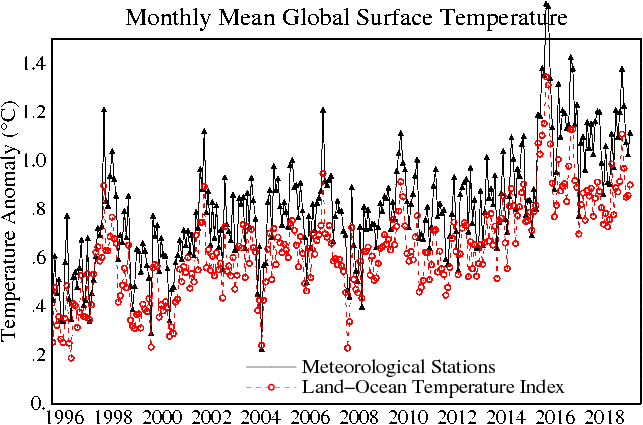
NOAA’s National Climate Data Center (NCDC) Annual Global Mean Temperature Anomaly Over Land & Sea – 1880 to Present;

the UK Met Office’s – Hadley Center – Climate Research Unit (CRU) Annual Global Average Land Temperature Anomaly – 1850 to Present;

and the UK Met Office – Hadley Center – Climate Research Unit (CRU) Monthly Global Average Land Temperature – 1850 to Present

Depending on the time frame, it certainly seems that Earth’s surface temperature has increased, though it does not appear to be “warming rapidly” and there are no indications of “an accelerating rate”. Furthermore, the surface temperature record is burdened with issues of questionable siting, changes in siting, changes in equipment, changes in the number of measurement locations, modeling to fill in gaps in measurement locations, corrections to account for missing, erroneous or biased measurements, and the urban heat island effect. Thus to see the big picture on the temperature Earth’s temperature, it helps to also look up.
Atmospheric Temperatures:
Since 1979 the temperature of Earth’s “climate” has also been measured via satellite. “The temperature measurements from space are verified by two direct and independent methods. The first involves actual in-situ measurements of the lower atmosphere made by balloon-borne observations around the world. The second uses intercalibration and comparison among identical experiments on different orbiting platforms. The result is that the satellite temperature measurements are accurate to within three one-hundredths of a degree Centigrade (0.03 C) when compared to ground-launched balloons taking measurements of the same region of the atmosphere at the same time.” NASA
The following are 4 Temperature Anomaly plots from Remote Sensing Systems (RSS), each one increases in altitude as is illustrated here:

RSS Temperature Lower Troposphere (TLT) – Brightness Temperature Anomaly- 1979 to Present;

RSS Temperature Middle Troposphere (TMT)- Brightness Temperature Anomaly- 1979 to Present;

RSS Temperature Troposphere / Stratosphere (TTS) -Brightness Temperature Anomaly- 1987 to Present;

RSS Temperature Lower Stratosphere (TLS) – Brightness Temperature Anomaly – 1979 to Present:

According to Remote Sensing Systems, “For Channel (TLT) (Lower Troposphere) and Channel (TMT) (Middle Troposphere), the anomaly time series is dominated by ENSO events and slow tropospheric warming. The three primary El Niños during the past 20 years are clearly evident as peaks in the time series occurring during 1982-83, 1987-88, and 1997-98, with the most recent one being the largest.” RSS
Also, the 2009 – 10 El Niño event is also called out on this RSS Latitudinal Temperature Lower Troposphere (TLT) Brightness Temperature Anomaly from 1979 to Present;

and the 1998 El Niño event, along with the tropospheric cooling attributed to the 1991 eruption of Mt Pinitubo, is called out on this University of Alabama – Hunstville (UAH) Lower Atmosphere Temperature Anomalies – 1979 to Present:

Note that in November the UAH Lower Atmosphere Temperature Anomaly was 0.12 degrees C above the 30 year average, and the RSS Lower Troposphere Brightness Temperature was 0.033 degrees C above the 30 year average. Keep this mind the next time you read that recent weather events were caused by Global Warming.

Furthermore, the Middle Troposphere, which follows a similar though flatter trend as the Lower Troposphere, recently dipped below the 30 year trend line i.e. RSS Temperature Middle Troposphere (TMT)- Brightness Temperature Anomaly- 1979 to Present:
There are also regional variations in Lower Troposphere that contribute nuance to the picture. For example, RSS Northern Polar Temperature Lower Troposphere (TLT) Brightness Temperature Anomaly;

shows a .338 K/C per decade increase, whereas the The RSS Southern Polar Temperature Lower Troposphere (TLT) Brightness Temperature Anomaly;

shows a .007 K/C per decade decrease. I am not aware of a compelling explanation for the significant divergence in temperature trends between the poles.
The satellite record seems to show slow warming of Lower and Middle Tropospheric temperatures, overlaid with the El Niño/La Niña Southern Oscillation (ENSO) cycle, including four comparatively large El Niño events. Lower Tropospheric temperatures appear to have flattened since the large El Niño in 1998 and offer no indication of “accelerating” warming.
Moving higher in the atmosphere, RSS Temperature Troposphere / Stratosphere (TTS) – Brightness Temperature Anomaly- 1987 to Present;
has been incredibly flat since, with a trend of just -.004 K/C per decade. The 1997-98 and 2009 – 10 El Niño events are still readily apparent in the plot, as is a spike from the 1991 eruption of Mt. Pinatubo. Note that the effect of Mt. Pinatubo is the opposite in the Lower and Middle Troposphere versus the Troposphere / Stratosphere (TTS), i.e. “Large volcanic eruptions inject sulfur gases into the stratosphere; the gases convert into submicron particles (aerosol) with an e-folding time scale of about 1 year. The climate response to large eruptions (in historical times) lasts for several (2-3) years. The aerosol cloud causes cooling at the Earth’s surface, warming in stratosphere.”
Ellen Thomas, PHD Wesleyan University
It is interesting that, incorporating the impact of three significant surface driven warming events, Troposphere / Stratosphere Temperatures (TTS) have been quite stable, however there is nuance to this as well.
RSS Northern Hemisphere Temperature Troposphere / Stratosphere (TTS) – Brightness Temperature Anomaly- 1987 to Present;

has been increasing by .054 K/C per decade, whereas the RSS Southern Hemisphere Temperature Troposphere / Stratosphere (TTS) – Brightness Temperature Anomaly- 1987 to Present;

has been decreasing by -.062 K/C per decade.
Moving higher still in the atmosphere, the RSS Temperature Lower Stratosphere (TLS) – Brightness Temperature Anomaly – 1979 to Present;
“is dominated by stratospheric cooling, punctuated by dramatic warming events caused by the eruptions of El Chichon (1982) and Mt Pinatubo (1991).” RSS
The eruptions of El Chichon and Mt Pinatubo are readily apparent in the Apparent Atmospheric Transmission of Solar Radiation at Mauna Loa, Hawaii:

“The stratosphere” … “in contrast to the troposphere, is heated, as the result of near infrared absorption of solar energy at the top of the aerosol cloud, and increased infra-red absorption of long-wave radiation from the Earth’s surface.”
“The stratospheric warming in the region of the stratospheric cloud increases the latitudinal temperature gradient after an eruption at low latitudes, disturbing the stratospheric-troposphere circulation, increasing the difference in height of the troposphere between high and low latitudes, and increasing the strength of the jet stream (polar vortex, especially in the northern hemisphere). This leads to warming during the northern hemisphere winter following a tropical eruption, and this warming effect tends to be larger than the cooling effect described above.” Ellen Thomas, PHD Wesleyan University
The Lower Stratosphere experienced “dramatic warming events caused by the eruptions of El Chichon (1982) and Mt Pinatubo (1991).” RSS “The long-term, global-mean cooling of the lower stratosphere stems from two downward steps in temperature, both of which are coincident with the cessation of transient warming after the volcanic eruptions of El Chichon and Mt. Pinatubo.” … “Here we provide observational analyses that yield new insight into three key aspects of recent stratospheric climate change. First, we provide evidence that the unusual step-like behavior of global-mean stratospheric temperatures is dependent not only upon the trend but also on the temporal variability in global-mean ozone immediately following volcanic eruptions. Second, we argue that the warming/cooling pattern in global-mean temperatures following major volcanic eruptions is consistent with the competing radiative and chemical effects of volcanic eruptions on stratospheric temperature and ozone. Third, we reveal the contrasting latitudinal structures of recent stratospheric temperature and ozone trends are consistent with large-scale increases in the stratospheric overturning Brewer-Dobson circulation” David W. J. Thompson Colorado State University
Above the Stratosphere we have the Mesosphere and Thermosphere, neither of which have I found current temperature time series for, but of note is that on “July 15, 2010” “A Puzzling Collapse of Earth’s Upper Atmosphere” occurred when “high above Earth’s surface where the atmosphere meets space, a rarefied layer of gas called “the thermosphere” recently collapsed and now is rebounding again.”

“This is the biggest contraction of the thermosphere in at least 43 years,” says John Emmert of the Naval Research Lab, lead author of a paper announcing the finding in the June 19th issue of the Geophysical Research Letters (GRL). “It’s a Space Age record.”
The collapse happened during the deep solar minimum of 2008-2009—a fact which comes as little surprise to researchers. The thermosphere always cools and contracts when solar activity is low. In this case, however, the magnitude of the collapse was two to three times greater than low solar activity could explain.
“Something is going on that we do not understand,” says Emmert.
The thermosphere ranges in altitude from 90 km to 600+ km. It is a realm of meteors, auroras and satellites, which skim through the thermosphere as they circle Earth. It is also where solar radiation makes first contact with our planet. The thermosphere intercepts extreme ultraviolet (EUV) photons from the sun before they can reach the ground. When solar activity is high, solar EUV warms the thermosphere, causing it to puff up like a marshmallow held over a camp fire. (This heating can raise temperatures as high as 1400 K—hence the name thermosphere.) When solar activity is low, the opposite happens.” NASA
In summary, Earth’s Lower and Middle Troposphere appear to have warmed slowly, overlaid with the El Niño/La Niña Southern Oscillation (ENSO) cycle, including four comparatively large El Niño events, and tempered by the cooling effects of the eruption of El Chichon (1982) and Mt Pinatubo (1991). Lower and Middle Tropospheric temperatures appear to have flattened since the large El Niño in 1998 and offer no indication of “accelerating” warming. Tropospheric / Stratospheric temperatures appear to have been influenced by at least three significant surface driven warming events, the 1997-98 El Niño, and the eruptions of El Chichon in 1982 and Mt Pinatubo in 1991, but to have maintained a stable overall trajectory. Stratospheric temperatures appear to have experienced two “dramatic warming events caused by the eruptions of El Chichon (1982) and Mt Pinatubo (1991).”, and “unusual step-like behavior of global-mean stratospheric temperatures” which has resulted in a significant stratospheric cooling during the last 30 years. Lastly, “during deep solar minimum of 2008-2009” “the biggest contraction of the thermosphere in at least 43 years” occurred and “The magnitude of the collapse was two to three times greater than low solar activity could explain.”
Ocean Temperatures:
“The oceans can hold much more heat than the atmosphere. Just the top 3.2 metres of ocean holds as much heat as all the world’s air.” Commonwealth of Australia – Parliamentary Library
As such, changes in Oceanic Oscillations, and Ocean Heat Content are critical to understanding “Earth’s Temperature”. Here is NOAA’s NODC Global Ocean Heat Content from 0-700 Meters – 1955 to Present;

and here is the same from Ole Humlum’s valuable climate data site Climate4you.com, NODC Global Ocean Heat Content – 0-700 Meters – 1979 to Present.

It seems apparent from the plots above that Global Ocean Heat has increased over the last several decades, however Global Ocean Heat doesn’t appear to be “warming rapidly”. Furthermore, there is no basis for the claim that warming is occurring at “an accelerating rate”. Decelerating would appear a more accurate label.
Ice:
A proxy often cited when measuring “Earth’s Temperature” is amount of Ice on Earth. According to the United States Geographical Survey (USGS), “The vast majority, almost 90 percent, of Earth’s ice mass is in Antarctica, while the Greenland ice cap contains 10 percent of the total global ice mass.” http://ga.water.usgs.gov/edu/watercycleice.html However, there is currently there is no generally accepted measure of ice volume, as Cryosat is still in validation and the accuracy of measurements from Grace are still being challenged.
As such, currently available global ice measurements are limited. Here is 20 Year Northern Hemisphere Snowcover with 1995 – 2009 Climatology

and here is Northern Hemisphere Winter Snow Extent – 1967 to Present:

While neither plot offers a global perspective, when looking at the Northern Hemisphere, there appears to have been a slight increase in Snowcover and Winter Snow Extent over the historical record.
Another ice based variable often cited as a proxy for “Earth’s Temperature” is Sea Ice Area, however there is significant evidence that the primary agent of change in Sea Ice Area is in fact wind and Atmospheric Oscillations. With this said, here are Global, Arctic & Antarctic Sea Ice Area from 1979 to Present;

Northern Hemisphere Sea Ice Area Anomaly, 1979 to Present;

Southern Hemisphere Sea Ice Area Anomaly, 1979 to Present;

and Global Sea Ice Area Anomaly – 1979 to Present:

There does appear to have been a negative trend in Northern Hemisphere Sea Ice Area, however there also appears to have been a positive trend in Southern Hemisphere Sea Ice Area. The resultant Global Sea Ice Area trend appears to be slightly negative, with no apparent acceleration. Based on the limited Global Ice measurements available, and noting the questionable value of Sea Ice Area as a proxy for temperature, not much inference can currently be drawn from Earth’s Ice measurements. However, there does not appear to be any evidence in Earth’s Ice measurements of rapid and/or accelerating warming.
Conclusion:
“Earth’s Temperature” appears to have increased during the last several decades, but there does not appear to be evidence that Earth’s climate is “warming rapidly”. Furthermore, there are no apparent signs of warming occurring “at an accelerating rate”.
Additional information on “Earth’s Temperature” can be found in the WUWT Reference Pages, including the Global Temperature Page and Global Climatic History Page
“Rab McDowell says:
January 1, 2012 at 6:58 pm
WUWT is one of the most respected climate sites because of its credibility. I note that Justthefacts is a regular contributor and often posts quite technical information.
Two questions
Given that he is not prepared to put his name to his contributions, what credibility can I put on his work?
What credibility can I put on a website that publishes supposedly informed comment without informing us who the poster is?”
“Rab“, how do I know that is your name? Sites like this allow any name to be used, only the validity of the e-mail address is tested. Your argument is based upon false logic, I therefore suggest you reconsider you value system in judging the value of information and comment on this site..
@ur momisugly Rab McDowell
‘What credibility ……….’
Other posters have given answers to you and I will try to give some other reasons for this.
In commerce when dealing with Clients or customers it is best to stay away from politics and religion. This avoids offence being caused and also keeps the relationship on a professional level and is good policy. Of course as the relationship changes views may be expressed however it is best to avoid these types of discussions.
In the uk an aggressive climate prevails in the fourth estate and public sector against skeptics which discourages fair debate and discriminates against those who do not follow the herd.
If I say to you that Pi is 22 divided by 7 and Pi times the diameter is the circumference of a circle, is it any less true because I remain anonymous?
Now turning to credibility does all of the public utterances of Honest Phil and his mates on the Fiddlestic Team make their statements credible? Of course not.
Happy New Year
Rab McDowell says:
January 1, 2012 at 6:58 pm
WUWT is one of the most respected climate sites because of its credibility. I note that Justthefacts is a regular contributor and often posts quite technical information.
Two questions
Given that he is not prepared to put his name to his contributions, what credibility can I put on his work?
What credibility can I put on a website that publishes supposedly informed comment without informing us who the poster is?
Oh Oh the brainless trolls are out in force after xmas. They must be bouyed by the turkey. Why can’t you people think for yourselves, too difficult?
Justthefactswuwt
I am missing a lot of the graphics as well.
I reconstructed CET back to 1538 and included a lot of graphs which will help to put your interesting article into its broader context.
.
Figure 15a shows GISS/Hadley/BEST and the hockey stick.
http://judithcurry.com/2011/12/01/the-long-slow-thaw/
Temperatures have been gently increasing for 350 years-with numerous advances and retreats-Glaciers have been melting since the 1750’s. The hockey stick is not a true representation of the long term temperature trend.
tonyb
So translated this means ~80-90% of the recent warm cycle (~150 years) is due to natural climate cycles, which increasingly look like they are about to trend negative, and ~10-20% due to the activities of man, which may include the impact of increased carbon dioxide levels.
Looks like a problem, which needs urgent action. We need to change the climate cycles, it will only cost a few trillion dollars per year, but we need to do it now!!!!!
Jee, thanks for this Ant’s. Basic question here wrt to your graphs – and golly gee whiz, there are a lot of them.
For all of your graphs for the middle to upper troposphere. and lower stratospherere., have you incluuded allowances for adjustments to these numbers on the basis of the cooling impact on temperature records of Stratospheic cooling
I just looked at my trusty hadcrut3 annual average global temperature dataset and calculated the trend in the 2nd derivative (acceleration) for the whole dataset ie 1850 to 2010 and I get -0.00518 deg K/year^2. So the rate of increase of temperature is slowing on average over the period and to look at more recent periods respecting the wishes of the 30 and 60 year brigades I looked at those trends a well
Whole period -0.005181275 deg K/year^2
Last 30 years -0.019668817 deg K/year^2
Last 60 years -0.002342623 deg K/year^2
Last 90 years -0.00454823 deg K/year^2
So warming is consistently decelerating not accelerating and that is in the face of rising anthropogenic CO2.
Good article “Just The Facts”
justthefactswuwt says:
January 1, 2012 at 10:47 pm
“alcheson says: January 1, 2012 at 8:12 pm
Should add sea level changes to the presentation as well.
I thought about it, but was worried that I was getting too wide-ranging.”
Glad you plan on adding it to the next update and look forward to it.. Seems to me that sea levels may be one of the most important metrics as to whether the earth is gaining or losing heat. If the earth is warming the sea levels should definitely be rising since the oceans expand with temperature and glaciers will be melting. I would also expect there to be a some lag between when the earth quits warming and the seas begin to contract again. When they do start falling again it is hard to imagine any way to explain it other than the earth must be cooling. Recent slowing in sea level rise and a possible start of sea level fall is totally consistent with no warming in the past several years. I would expect the climate scientists will do their utmost to hide and delay for as long as possible any indication of sea level reduction. Maybe I am a bit paranoid, but I can find no evidence of any sea level data from Envirosat for over 4 months.
“am not aware of a compelling explanation for the significant divergence in temperature trends between the poles”
Really Anthony? Maybe a little less bloging and a bit more reading….
Multiple papers published in the last 24 months. The BAS, and others. All around a central theme. The Antarctic Ozone hole, due to CFC’s. So less energy is absorbed in the stratosphere due to a lack of Ozone. As a consequence, more energy is making it down to energise the major lower atmosphere circumpolar air flow. The so-called Southern Annular Mode – unfriendly term. This has the real impact of isolating the circum-polar air-flow. So the Antarctic ends up more isolated from weather systems further north. So it doesn’t warm as much as it might other wise.would.
At what stage do we start pestering the Wiki to correct it’s inaccurate Global Warming data…?
alcheson says:
January 1, 2012 at 8:12 pm
“Nice article. Should add sea level changes to the presentation as well.”
Yes, but which one? Have you read this article?
http://www.climatechangefacts.info/ClimateChangeDocuments/NilsAxelMornerinterview.pdf
I added some lines to one of the above plots and deduced for two 33 year periods …
1909-1942 up 0.49 deg.C
1975-2008 up 0.54 deg.C
See: http://climate-change-theory.com/LandOcean.jpg
The latter is hardly an unprecedented warming rate, And it is still the same rise of 0.54 for the 36 years to 2011, this then making the rates each 0.015 degrees per year or 1.5 degrees per century. However, this is using the steep sections in a cherry-picking fashion best known to the IPCC. If instead we calculate the rate of increase in a more logical, albeit simplistic fashion, from the first maximum to the present maximum we get 0.43 degrees from 1942 to 2011, namely 0.62 degrees per century. I suggest we can’t extrapolate that far anyway, so I’d settle for about 0.3 degrees by 2058 which will bring us back up to about the 1998 peak. After that I expect the 900 to 1000 year cycle to start to decline.
We see all these lovely graphs. But what mathematician would draw a straight linear plot through them and claim that the straight linear line represents the trend?
It seems to me that the hysteria was brought about by some knucklehead plotting a straight linear line and claiming that was the trend. In so doing all cycular changes were over looked and as a result the manner in which climate changes was improperly assessed.
Simples ! (as the UK advert says. Unforunately, this last comment will be lost on our American audience who will not be familiar with the advert).
Glenn Tamblyn says:
January 2, 2012 at 2:44 am
/////////////////////
Glenn
Why doesn’t the well mixed CO2 kick in?
son of mulder says:
January 2, 2012 at 2:38 am
/////////////////////////////////
A good observation and one which severely dents the argument that CO2 is the main/dominant driver of global tempoeratures/climate.
“Rab McDowell says:
January 1, 2012 at 6:58 pm
////////////////////////////
It is the message, not the messenger that is important.
http://climate-change-theory.com says:
January 2, 2012 at 4:36 am
…”If instead we calculate the rate of increase in a more logical, albeit simplistic fashion, from the first maximum to the present maximum we get 0.43 degrees from 1942 to 2011, namely 0.62 degrees per century. I suggest we can’t extrapolate that far anyway,…”
—————————————————————————————
Good post, but a question. When you do the data for the 1942 peak are you using the data that was adjusted down? I have never seen a logical explanation for the downward adjustments of that trend, or for that matter of the upwards adjustments of the downward trend which followed the 42 peak to about 1976. i agree completely that 60 years is the minimum time frame one can use to begin to establish a trend.
Dodgy Geezer says:
January 2, 2012 at 2:48 am
At what stage do we start pestering the Wiki to correct it’s inaccurate Global Warming data…?
======================
Good luck with that
Rob Painting says:
January 1, 2012 at 5:02 pm
Where’s the graph of ocean heat data down to 2000 metres? Over 70% of the Earth’s surface is water, and over 90% of global warming goes into the oceans. Is there a recent update for the 2000 mtr data?
No handwaving required. Just the data.
—————————————
Rob you perfectly know that LWIR does not penetrate water at all.
So what is the mechanism that you know of bringing 90% of global warming into the oceans? The fact that 90 is missing? No handwaving pls, just the facts.
JTF
Thanks for lot of info, a very good reference page.
These two graphs
http://arctic.atmos.uiuc.edu/cryosphere/IMAGES/seaice.anomaly.arctic.png
http://arctic.atmos.uiuc.edu/cryosphere/IMAGES/seaice.anomaly.antarctic.png
are key to the understanding global climate change.
Well, here’s a chart that sure to stir the pot: http://climaterealists.com/?id=8902
Endersbee shows that if you plot the 21 year moving average of global solar sea surface temperature, against CO2 at Mauna Loa, you get a correlation of 0.9959. However, visually (i.e., no correlation number shown), a 12 month moving average – which he also shows – is nowhere near as highly correlated.
As the author puts it, “It is what we would expect from the normal solubility relation between carbon dioxide and water.”
Nothing like the actual physical gas laws to debunk the theory of AGW. The Law wins every time.
justthefactswuwt says:
January 1, 2012 at 10:01 pm
There are two classes of data providers
1) Those who want their data to be seen
2) Those who need advertising income to keep their sites active.
The latter class dislikes hot linking, especially to images, because it
means no advertising revenue.
The former wouldn’t mind, but they’re often smaller sites and
1) are interested in the pages views
2) often have an ISP account with a limited bandwidth, both rate and byte count.
When they get clobbered by a herd of WUWT readers, their monthly bandwidth can be gone in days.
Then there was the time Anthony used one of my web pages as a guest post and didn’t remove the page counter link that went to my home system. That was interesting. I spent a while watching the hits come in every few seconds for a while, fearful that Comcast would shut me down.
I assume RSS is a small business, but have no idea what their server is beyond it being a Windows box.
Glenn Tamblyn says: January 2, 2012 at 2:18 am
Basic question here wrt to your graphs – and golly gee whiz, there are a lot of them.
For all of your graphs for the middle to upper troposphere. and lower stratospherere., have you incluuded allowances for adjustments to these numbers on the basis of the cooling impact on temperature records of Stratospheic cooling
I know there’s a lot of graphs there, but if you try reading some of them, you might learn something and you might have noticed that the particular graphs you reference are products from RSS. RSS uses the following weighting for their data sets: http://www.ssmi.com/data/msu/graphics/plots/msu_wt_func.png
I don’t believe there to be any adjustments, nor should there be.
Glenn Tamblyn says: January 2, 2012 at 2:44 am
“am not aware of a compelling explanation for the significant divergence in temperature trends between the poles”
Really Anthony? Maybe a little less bloging and a bit more reading….
Ummm, more on the reading skills, Anthony didn’t write the article, as evidenced the “By” at the top of the article.
Multiple papers published in the last 24 months. The BAS, and others. All around a central theme. The Antarctic Ozone hole, due to CFC’s. So less energy is absorbed in the stratosphere due to a lack of Ozone. As a consequence, more energy is making it down to energise the major lower atmosphere circumpolar air flow. The so-called Southern Annular Mode – unfriendly term. This has the real impact of isolating the circum-polar air-flow. So the Antarctic ends up more isolated from weather systems further north. So it doesn’t warm as much as it might other wise.would.
I consider the whole Anthropogenic (CFC caused) “Ozone Hole” narrative to be highly suspect. I am doing some research into Polar Vortices;
http://wattsupwiththat.com/2011/10/29/new-wuwt-polar-vortex-reference-page/
and think that the Stratospheric Polar Vortex and associated Atmospheric Oscillation may offer a more plausible explanation for “Arctic Amplification” and “Antarctic Dampening”. Regardless the CFC hypothesis is far from a “compelling explanation” for the “divergence in temperature trends between the poles”.
Most of the tables are useless again,
because they donot tell me the why or where the extra heat came from and where it is going.
If you include the increases noted in maxima and minima a much better picture emerges.
http://www.letterdash.com/HenryP/henrys-pool-table-on-global-warming