
By WUWT regular “Just The Facts”
Often in the climate debate, generalities are used to address more nuanced issues, e.g. “There is broad scientific consensus that Earth’s climate is warming rapidly and at an accelerating rate.” from the Wikipedia for Scientific Opinion on Climate Change. But is this true? Let’s take a look.
Global Surface Temperatures:
Generally, when referring to Earth’s “climate” warming, proponents of the Catastrophic Anthropogenic Global Warming (CAGW) narrative, refer to Earth’s Surface Temperature, e.g. “Global warming is the unusually rapid increase in Earth’s average surface temperature over the past century primarily due to the greenhouse gases released by people burning fossil fuels.” NASA Earth Observatory
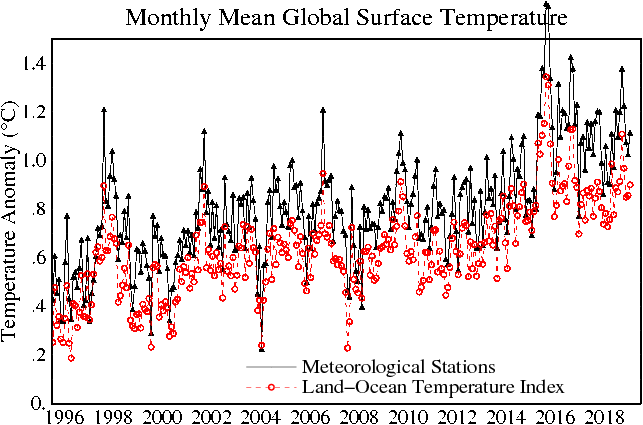
As such, here’s NASA’s Goddard Institute for Space Studies (GISS) Monthly Mean Surface Temperature Anomaly – 1996 to Present;
NOAA’s National Climate Data Center (NCDC) Annual Global Mean Temperature Anomaly Over Land & Sea – 1880 to Present;

the UK Met Office’s – Hadley Center – Climate Research Unit (CRU) Annual Global Average Land Temperature Anomaly – 1850 to Present;

and the UK Met Office – Hadley Center – Climate Research Unit (CRU) Monthly Global Average Land Temperature – 1850 to Present

Depending on the time frame, it certainly seems that Earth’s surface temperature has increased, though it does not appear to be “warming rapidly” and there are no indications of “an accelerating rate”. Furthermore, the surface temperature record is burdened with issues of questionable siting, changes in siting, changes in equipment, changes in the number of measurement locations, modeling to fill in gaps in measurement locations, corrections to account for missing, erroneous or biased measurements, and the urban heat island effect. Thus to see the big picture on the temperature Earth’s temperature, it helps to also look up.
Atmospheric Temperatures:
Since 1979 the temperature of Earth’s “climate” has also been measured via satellite. “The temperature measurements from space are verified by two direct and independent methods. The first involves actual in-situ measurements of the lower atmosphere made by balloon-borne observations around the world. The second uses intercalibration and comparison among identical experiments on different orbiting platforms. The result is that the satellite temperature measurements are accurate to within three one-hundredths of a degree Centigrade (0.03 C) when compared to ground-launched balloons taking measurements of the same region of the atmosphere at the same time.” NASA
The following are 4 Temperature Anomaly plots from Remote Sensing Systems (RSS), each one increases in altitude as is illustrated here:

RSS Temperature Lower Troposphere (TLT) – Brightness Temperature Anomaly- 1979 to Present;

RSS Temperature Middle Troposphere (TMT)- Brightness Temperature Anomaly- 1979 to Present;

RSS Temperature Troposphere / Stratosphere (TTS) -Brightness Temperature Anomaly- 1987 to Present;

RSS Temperature Lower Stratosphere (TLS) – Brightness Temperature Anomaly – 1979 to Present:

According to Remote Sensing Systems, “For Channel (TLT) (Lower Troposphere) and Channel (TMT) (Middle Troposphere), the anomaly time series is dominated by ENSO events and slow tropospheric warming. The three primary El Niños during the past 20 years are clearly evident as peaks in the time series occurring during 1982-83, 1987-88, and 1997-98, with the most recent one being the largest.” RSS
Also, the 2009 – 10 El Niño event is also called out on this RSS Latitudinal Temperature Lower Troposphere (TLT) Brightness Temperature Anomaly from 1979 to Present;

and the 1998 El Niño event, along with the tropospheric cooling attributed to the 1991 eruption of Mt Pinitubo, is called out on this University of Alabama – Hunstville (UAH) Lower Atmosphere Temperature Anomalies – 1979 to Present:

Note that in November the UAH Lower Atmosphere Temperature Anomaly was 0.12 degrees C above the 30 year average, and the RSS Lower Troposphere Brightness Temperature was 0.033 degrees C above the 30 year average. Keep this mind the next time you read that recent weather events were caused by Global Warming.

Furthermore, the Middle Troposphere, which follows a similar though flatter trend as the Lower Troposphere, recently dipped below the 30 year trend line i.e. RSS Temperature Middle Troposphere (TMT)- Brightness Temperature Anomaly- 1979 to Present:
There are also regional variations in Lower Troposphere that contribute nuance to the picture. For example, RSS Northern Polar Temperature Lower Troposphere (TLT) Brightness Temperature Anomaly;

shows a .338 K/C per decade increase, whereas the The RSS Southern Polar Temperature Lower Troposphere (TLT) Brightness Temperature Anomaly;

shows a .007 K/C per decade decrease. I am not aware of a compelling explanation for the significant divergence in temperature trends between the poles.
The satellite record seems to show slow warming of Lower and Middle Tropospheric temperatures, overlaid with the El Niño/La Niña Southern Oscillation (ENSO) cycle, including four comparatively large El Niño events. Lower Tropospheric temperatures appear to have flattened since the large El Niño in 1998 and offer no indication of “accelerating” warming.
Moving higher in the atmosphere, RSS Temperature Troposphere / Stratosphere (TTS) – Brightness Temperature Anomaly- 1987 to Present;
has been incredibly flat since, with a trend of just -.004 K/C per decade. The 1997-98 and 2009 – 10 El Niño events are still readily apparent in the plot, as is a spike from the 1991 eruption of Mt. Pinatubo. Note that the effect of Mt. Pinatubo is the opposite in the Lower and Middle Troposphere versus the Troposphere / Stratosphere (TTS), i.e. “Large volcanic eruptions inject sulfur gases into the stratosphere; the gases convert into submicron particles (aerosol) with an e-folding time scale of about 1 year. The climate response to large eruptions (in historical times) lasts for several (2-3) years. The aerosol cloud causes cooling at the Earth’s surface, warming in stratosphere.”
Ellen Thomas, PHD Wesleyan University
It is interesting that, incorporating the impact of three significant surface driven warming events, Troposphere / Stratosphere Temperatures (TTS) have been quite stable, however there is nuance to this as well.
RSS Northern Hemisphere Temperature Troposphere / Stratosphere (TTS) – Brightness Temperature Anomaly- 1987 to Present;

has been increasing by .054 K/C per decade, whereas the RSS Southern Hemisphere Temperature Troposphere / Stratosphere (TTS) – Brightness Temperature Anomaly- 1987 to Present;

has been decreasing by -.062 K/C per decade.
Moving higher still in the atmosphere, the RSS Temperature Lower Stratosphere (TLS) – Brightness Temperature Anomaly – 1979 to Present;
“is dominated by stratospheric cooling, punctuated by dramatic warming events caused by the eruptions of El Chichon (1982) and Mt Pinatubo (1991).” RSS
The eruptions of El Chichon and Mt Pinatubo are readily apparent in the Apparent Atmospheric Transmission of Solar Radiation at Mauna Loa, Hawaii:

“The stratosphere” … “in contrast to the troposphere, is heated, as the result of near infrared absorption of solar energy at the top of the aerosol cloud, and increased infra-red absorption of long-wave radiation from the Earth’s surface.”
“The stratospheric warming in the region of the stratospheric cloud increases the latitudinal temperature gradient after an eruption at low latitudes, disturbing the stratospheric-troposphere circulation, increasing the difference in height of the troposphere between high and low latitudes, and increasing the strength of the jet stream (polar vortex, especially in the northern hemisphere). This leads to warming during the northern hemisphere winter following a tropical eruption, and this warming effect tends to be larger than the cooling effect described above.” Ellen Thomas, PHD Wesleyan University
The Lower Stratosphere experienced “dramatic warming events caused by the eruptions of El Chichon (1982) and Mt Pinatubo (1991).” RSS “The long-term, global-mean cooling of the lower stratosphere stems from two downward steps in temperature, both of which are coincident with the cessation of transient warming after the volcanic eruptions of El Chichon and Mt. Pinatubo.” … “Here we provide observational analyses that yield new insight into three key aspects of recent stratospheric climate change. First, we provide evidence that the unusual step-like behavior of global-mean stratospheric temperatures is dependent not only upon the trend but also on the temporal variability in global-mean ozone immediately following volcanic eruptions. Second, we argue that the warming/cooling pattern in global-mean temperatures following major volcanic eruptions is consistent with the competing radiative and chemical effects of volcanic eruptions on stratospheric temperature and ozone. Third, we reveal the contrasting latitudinal structures of recent stratospheric temperature and ozone trends are consistent with large-scale increases in the stratospheric overturning Brewer-Dobson circulation” David W. J. Thompson Colorado State University
Above the Stratosphere we have the Mesosphere and Thermosphere, neither of which have I found current temperature time series for, but of note is that on “July 15, 2010” “A Puzzling Collapse of Earth’s Upper Atmosphere” occurred when “high above Earth’s surface where the atmosphere meets space, a rarefied layer of gas called “the thermosphere” recently collapsed and now is rebounding again.”

“This is the biggest contraction of the thermosphere in at least 43 years,” says John Emmert of the Naval Research Lab, lead author of a paper announcing the finding in the June 19th issue of the Geophysical Research Letters (GRL). “It’s a Space Age record.”
The collapse happened during the deep solar minimum of 2008-2009—a fact which comes as little surprise to researchers. The thermosphere always cools and contracts when solar activity is low. In this case, however, the magnitude of the collapse was two to three times greater than low solar activity could explain.
“Something is going on that we do not understand,” says Emmert.
The thermosphere ranges in altitude from 90 km to 600+ km. It is a realm of meteors, auroras and satellites, which skim through the thermosphere as they circle Earth. It is also where solar radiation makes first contact with our planet. The thermosphere intercepts extreme ultraviolet (EUV) photons from the sun before they can reach the ground. When solar activity is high, solar EUV warms the thermosphere, causing it to puff up like a marshmallow held over a camp fire. (This heating can raise temperatures as high as 1400 K—hence the name thermosphere.) When solar activity is low, the opposite happens.” NASA
In summary, Earth’s Lower and Middle Troposphere appear to have warmed slowly, overlaid with the El Niño/La Niña Southern Oscillation (ENSO) cycle, including four comparatively large El Niño events, and tempered by the cooling effects of the eruption of El Chichon (1982) and Mt Pinatubo (1991). Lower and Middle Tropospheric temperatures appear to have flattened since the large El Niño in 1998 and offer no indication of “accelerating” warming. Tropospheric / Stratospheric temperatures appear to have been influenced by at least three significant surface driven warming events, the 1997-98 El Niño, and the eruptions of El Chichon in 1982 and Mt Pinatubo in 1991, but to have maintained a stable overall trajectory. Stratospheric temperatures appear to have experienced two “dramatic warming events caused by the eruptions of El Chichon (1982) and Mt Pinatubo (1991).”, and “unusual step-like behavior of global-mean stratospheric temperatures” which has resulted in a significant stratospheric cooling during the last 30 years. Lastly, “during deep solar minimum of 2008-2009” “the biggest contraction of the thermosphere in at least 43 years” occurred and “The magnitude of the collapse was two to three times greater than low solar activity could explain.”
Ocean Temperatures:
“The oceans can hold much more heat than the atmosphere. Just the top 3.2 metres of ocean holds as much heat as all the world’s air.” Commonwealth of Australia – Parliamentary Library
As such, changes in Oceanic Oscillations, and Ocean Heat Content are critical to understanding “Earth’s Temperature”. Here is NOAA’s NODC Global Ocean Heat Content from 0-700 Meters – 1955 to Present;

and here is the same from Ole Humlum’s valuable climate data site Climate4you.com, NODC Global Ocean Heat Content – 0-700 Meters – 1979 to Present.

It seems apparent from the plots above that Global Ocean Heat has increased over the last several decades, however Global Ocean Heat doesn’t appear to be “warming rapidly”. Furthermore, there is no basis for the claim that warming is occurring at “an accelerating rate”. Decelerating would appear a more accurate label.
Ice:
A proxy often cited when measuring “Earth’s Temperature” is amount of Ice on Earth. According to the United States Geographical Survey (USGS), “The vast majority, almost 90 percent, of Earth’s ice mass is in Antarctica, while the Greenland ice cap contains 10 percent of the total global ice mass.” http://ga.water.usgs.gov/edu/watercycleice.html However, there is currently there is no generally accepted measure of ice volume, as Cryosat is still in validation and the accuracy of measurements from Grace are still being challenged.
As such, currently available global ice measurements are limited. Here is 20 Year Northern Hemisphere Snowcover with 1995 – 2009 Climatology

and here is Northern Hemisphere Winter Snow Extent – 1967 to Present:

While neither plot offers a global perspective, when looking at the Northern Hemisphere, there appears to have been a slight increase in Snowcover and Winter Snow Extent over the historical record.
Another ice based variable often cited as a proxy for “Earth’s Temperature” is Sea Ice Area, however there is significant evidence that the primary agent of change in Sea Ice Area is in fact wind and Atmospheric Oscillations. With this said, here are Global, Arctic & Antarctic Sea Ice Area from 1979 to Present;

Northern Hemisphere Sea Ice Area Anomaly, 1979 to Present;

Southern Hemisphere Sea Ice Area Anomaly, 1979 to Present;

and Global Sea Ice Area Anomaly – 1979 to Present:

There does appear to have been a negative trend in Northern Hemisphere Sea Ice Area, however there also appears to have been a positive trend in Southern Hemisphere Sea Ice Area. The resultant Global Sea Ice Area trend appears to be slightly negative, with no apparent acceleration. Based on the limited Global Ice measurements available, and noting the questionable value of Sea Ice Area as a proxy for temperature, not much inference can currently be drawn from Earth’s Ice measurements. However, there does not appear to be any evidence in Earth’s Ice measurements of rapid and/or accelerating warming.
Conclusion:
“Earth’s Temperature” appears to have increased during the last several decades, but there does not appear to be evidence that Earth’s climate is “warming rapidly”. Furthermore, there are no apparent signs of warming occurring “at an accelerating rate”.
Additional information on “Earth’s Temperature” can be found in the WUWT Reference Pages, including the Global Temperature Page and Global Climatic History Page
http://wattsupwiththat.com/2012/01/01/a-big-picture-look-at-earths-temperature/#comment-850605
Not bad
My estimate is 0.014 instead of your 0.015 since 1975
http://www.letterdash.com/HenryP/henrys-pool-table-on-global-warming
All a very interesting analysis. The next 10 years will be most telling, and even the next 5 will be quite interesting. With the quiet sun that we have (certainly a Dalton Minimum and possible and Maunder in the cards), increased aerosols, and a trend to a La Nina favored period, we have a great test for the kinds of forcing these can bring to counter any forcing from increased greenhouse gases. Many climate scientist will tell you that warming is being temporarily masked by these short-term forcings and could resume in earnest once these forcings are gone or reverse. I’m not sure I 100% agree with this, but it is possible, and I will be curious as to the response that will come from skeptics if we get a few record warm years between now and 2015? Moreover, I will be interested to see if the decade of 2010-2019 turns out warmer than the decade of 2000-2009, what the response of AGW skeptics will be? In a response I gave to Lord Monckton, in which he insisted a high level of certainty that the transient response from greenhouse gases being nearly equal to the equalibrium respsonse at our current levels of CO2, I pointed out that we’ve not yet seen the full earth-system response even to the current levels, so we can’t possibly know if the transient and equalibrium response are the same. The full range of sensitivity must consider both fast and slow feedbacks, and the slow feedbacks are still operating.
Is the earth warming rapidly? By normal geological standards the period of 1976 to 2010 was extraordinary, but the next 10 years or so will indicate a great deal. The natural forcing cards are stacked for a period of intense cooling. If we get only flat temps, or slight warming, it could indicate the potency of the additional greenhouse warming from the extra CO2, N2O, and methane that is being added to the atmosphere.
Gates: The natural forcing cards are stacked for a period of intense cooling. If we get only flat temps, or slight warming, it could indicate the potency of the additional greenhouse warming from the extra CO2, N2O, and methane that is being added to the atmosphere.
==========================================================
Or something else….truth is we still won’t know squat
Ammonite says:
Ammonite says:
…. Temperature is affected by short term effects such as ENSO (El Nino’s, La Nina’s), volcanic eruptions and solar activity. It is also affected by longer term effects like changes in aerosol load and composition, green house gas concentration, orbital change etc. When short term changes are backed out, the underlying trend for global temperature is statistically significant (and consistent) at +0.16C/decade for both terrestrial and satellite based measurements since the beginning of the satellite era. The globe is warming, consistent with AGW theory.
————————————————————–
Thanks for my laugh of the day. If you actually understood the article you would see that they assumed the ‘correct answer’ of +0.16C/decade and calculated what the effects of solar activity, volcanic eruptions, etc, “must have been” to produce the actual recorded temps. Of COURSE it was “consistent with AGW theory; it began with the ASSUMPTION that the theory was correct! I mean, really, does anyone claim to be able to put an actual value on the delta T that solar activity may be responsible for? Is there even an actual ‘consensus’ that recent solar (in)activity has had a measurable effect on global temps? It’s proof of nothing except the great reluctance some people have to doubt their pet theories when presented with contrary evidence. It reminds me of the alchemist who blamed his failure on God being mad at him – otherwise, that lump of lead would be pure gold. His alchemy theory could not possibly be wrong.
R. Gates says: January 2, 2012 at 10:30 am
I will be curious as to the response that will come from skeptics if we get a few record warm years between now and 2015?
I would not be at all surprised if this occurred. Given the tremendous complexity and uncertainty associated with Earth’s Climate system; http://wattsupwiththat.com/2011/06/30/earths-climate-system-is-ridiculously-complex-with-draft-link-tutorial/
I think it’s close to 50/50 whether temps go up or down from here. I think the response of the skeptics “if we get a few record warm years between now and 2015?” would be to assimilate these new data points and evaluate if they help to increase our understanding of Earth’s climate system.
Moreover, I will be interested to see if the decade of 2010-2019 turns out warmer than the decade of 2000-2009, what the response of AGW skeptics will be?
Similar to my prior point. Given the fact that temps have been increasing since the Little Ice Age, and that there hasn’t been a major volcanic eruption since Mt Pinatubo in 1991, I would expect that “the decade of 2010-2019 turns out warmer than the decade of 2000-2009”, unless some other variable; volcanic, oceanic, atmospheric, solar, anthropogenic, etc., comes into play.
Is the earth warming rapidly? By normal geological standards the period of 1976 to 2010 was extraordinary
Can you please describe these “normal geological standards”?
RSS Lower Troposphere Temperature has increased by a rate of .14K per decade since 1979. Can you offer a “normal geological standard” by which this rate of increase would be considered “extraordinary”?
Justthefactswuwt: “Lower Troposphere Temperature has increased by a rate of .14K per decade since 1979.”
I think we can lower this one a bit too. I estimate Roy Spencer’s curved trend for the lower atmosphere will continue its now downward trend when the December 2011 figures are added, as December was cooler than November. This will then give us a 33 year period of satellite measurements in which I estimate his trend will have increased just 0.27 to 0.28 degrees. So let’s call that about 0.083 or 0.084 degrees per decade. The models say the lower troposphere should warm at about 1.4 times the rate of sea surface temperatures, though of course I disagree with that because back radiation has now been shown to cause no warming whatsoever and the greenhouse effect is a physical impossibility as proved in Prof Claes Johnson’s “Computational Blackbody Radiation” and confirmed in Prof Nahle’s September experiment.
The year closed with 2011 sea surface temperatures lower than those for 2003 because, as both Spencer’s and Trenberth’s curved trends show, we passed a maximum around 2006 to 2008. As I keep reminding people, we should be weighting world temperatures not by relative surface areas of sea to land, but by relative thermal energy content, because it is the latter which affects climate and reflects temporary natural TOA radiative imbalance. Consequently, land temperatures should be weighted no more than about 6.5%. Perhaps WUWT could recalculate and publish some long term trends based on such a weighting.
Dodgy Geezer says: January 2, 2012 at 2:48 am
At what stage do we start pestering the Wiki to correct it’s inaccurate Global Warming data…?
Bill Marsh says: January 2, 2012 at 7:17 am
Good luck with that
It looks like someone changed the wiki entry for the “Scientific opinion on climate change.”
http://en.wikipedia.org/wiki/Scientific_opinion_on_climate_change
Previously it stated that;
“There is broad scientific consensus that Earth’s climate is warming rapidly and at an accelerating rate.”
now it states that:
“The predominant scientific opinion on climate change is that the Earth’s climate system is unequivocally warming and it is more than 90% certain that humans are causing it through activities that increase concentrations of greenhouse gases in the atmosphere, such as deforestation and burning fossil fuels.”
I’ll deal with the “90% certain” part another day, but the words “rapidly” and “accelerating” no longer appear in the body of the Wiki entry, which seems like forward progress. Let’s see if it actually stays that way…
JTF
“The warming trend in the Arctic is almost twice as large as the global average in recent decades. This is known as Arctic amplification. What’s the cause? Changes in cloud cover, increases in atmospheric water vapour, more atmospheric heat transport from lower latitudes and declining sea ice have all been suggested as contributing factors.”
Well I think that the Arctic Oscillation and Arctic Polar Vortex are probably contributing factors as well, so now we have 6 to choose from. Which one’s do you like?
And that’s only Arctic Amplification, what about the Antarctic Dampening, i.e. why is there a .007 K/C per decade decrease in Southern Polar Lower Troposphere Temperature?”
##############################################################
look you wrote the article and didnt even know about the publications on arctic amplification.
I dont care what what you think the contributing factors are. Go read the science or get the data and do your own science.
Why is there a .007C decrease in the Lower Trop? google is your friend
We do not know everything. one cannot draw any conclusion from that about our knowledge of anything else.
“Steven Mosher: You need to understand that SkS is a very biased site. (See some of my posts which they deleted because they had no answer: http://climate-change-theory.com/SkS_errors.html )”
The site has links to articles. read the science.
Also, as Smokey points out who cares who wrote the piece? its just the facts that matter
The Arctic is now cooler than it was in the 1930’s and the rise late last century was nowhere near the 4 degree rise between 1919 and 1939. There is absolutely no correlation with carbon dioxide levels in this plot: http://climate-change-theory.com/arctic1880.jpg
Why should anyone be worried anyway about the air temperatures up there when there are not many people around to feel a bit less frozen? It’s the temperature of the ocean currents and the rate of flow which are the main factors determining how fast ice melts or reforms, and any melting has negligible effect on sea levels because about 90% of the ice is already in the sea. And, by the way, those currents come in from the North Atlantic Ocean which exhibits natural cycles. There are links backing up all this on my site http://climate-change-theory.com
Steven Mosher says:
January 2, 2012 at 1:11 pm
“The site has links to articles. read the science.
Also, as Smokey points out who cares who wrote the piece? its just the facts that matter”
Why should somebody go to a biased site and try to filter out to get the science from there if any? Science should be presented and discussed without any bias, or at least openly and not insulting.
We can discuss about photons going through 2 separate slots at a time or neutrinos faster the light or not and we cannot discuss about heat transfer through gases?
If SkS wants normal people to read their site they should get rid of bias and discuss normally, let posts through, not change discussions post-hoc. To have the answer filtered out to leave the discussion run in the moderators way? What’s the use of it?
Steven Mosher says: January 2, 2012 at 1:09 pm
look you wrote the article and didnt even know about the publications on arctic amplification.
I didn’t say I’d never read an explanation, I stated that, “I am not aware of a compelling explanation for the significant divergence in temperature trends between the poles.” The SkS article you cited states that, “A new paper The central role of diminishing sea ice in recent Arctic temperature amplification (Screen & Simmonds 2010) (here’s the full paper) examines this question. The title is a bit of a give-away – the decline in sea ice is the major driver of Arctic amplification.” Here’s the abstract;
http://www.nature.com/nature/journal/v464/n7293/full/nature09051.html
The abstract states that, “Increased concentrations of atmospheric greenhouse gases have driven Arctic and global average warming; however, the underlying causes of Arctic amplification remain uncertain. The roles of reductions in snow and sea ice cover and changes in atmospheric and oceanic circulation cloud cover and water vapour are still matters of debate.” before claiming that, “Here we show that the Arctic warming is strongest at the surface during most of the year and is primarily consistent with reductions in sea ice cover.”
Here’s another paper, “Vertical structure of recent Arctic warming” by Rune G. Graversen, Thorsten Mauritsen1, Michael Tjernström, Erland Källén & Gunilla Svensson, Nature, 2008.
http://www.nature.com/nature/journal/v451/n7174/abs/nature06502.html
The abstract states that, “The underlying causes of this temperature amplification remain uncertain. The reduction in snow and ice cover that has occurred over recent decades may have played a role. Climate model experiments indicate that when global temperature rises, Arctic snow and ice cover retreats, causing excessive polar warming9, 10, 11. Reduction of the snow and ice cover causes albedo changes, and increased refreezing of sea ice during the cold season and decreases in sea-ice thickness both increase heat flux from the ocean to the atmosphere. Changes in oceanic and atmospheric circulation, as well as cloud cover, have also been proposed to cause Arctic temperature amplification. Here we examine the vertical structure of temperature change in the Arctic during the late twentieth century using reanalysis data. We find evidence for temperature amplification well above the surface. Snow and ice feedbacks cannot be the main cause of the warming aloft during the greater part of the year, because these feedbacks are expected to primarily affect temperatures in the lowermost part of the atmosphere, resulting in a pattern of warming that we only observe in spring. A significant proportion of the observed temperature amplification must therefore be explained by mechanisms that induce warming above the lowermost part of the atmosphere. We regress the Arctic temperature field on the atmospheric energy transport into the Arctic and find that, in the summer half-year, a significant proportion of the vertical structure of warming can be explained by changes in this variable. We conclude that changes in atmospheric heat transport may be an important cause of the recent Arctic temperature amplification.”
Here’s another paper, Arctic air temperature change amplification and the Atlantic
Multidecadal Oscillation, by Petr Chylek, Chris K. Folland, Glen Lesins, Manvendra K. Dubey, and Muyin Wang, Geophysical Research Letter, 2009:
http://www.lanl.gov/source/orgs/ees/ees14/pdfs/09Chlylek.pdf
It states that, “Analyzing temperature records of the Arctic meteorological stations we find that (a) the Arctic amplification (ratio of the Arctic to global temperature trends) is not a constant but varies in time on a multi-decadal time scale, (b) the Arctic warming from 1910–1940 proceeded at a significantly faster rate than the current 1970–2008 warming, and (c) the Arctic temperature changes are highly correlated with the Atlantic Multi-decadal Oscillation (AMO) suggesting the Atlantic Ocean thermohaline circulation is linked to the Arctic temperature variability on a multi-decadal time scale.”
So let’s stop there, you have three papers from the last three years that state that, “Arctic warming” “is primarily consistent with reductions in sea ice cover.” or “A significant proportion of the observed temperature amplification must therefore be explained by mechanisms that induce warming above the lowermost part of the atmosphere.” or “the Arctic temperature changes are highly correlated with the Atlantic Multi-decadal Oscillation (AMO) suggesting the Atlantic Ocean thermohaline circulation is linked to the Arctic temperature variability on a multi-decadal time scale.”
Do you find any of these to be “a compelling explanation for the significant divergence in temperature trends between the poles.” or would you agree with me that you are currently “not aware of a compelling explanation”?
We do not know everything. one cannot draw any conclusion from that about our knowledge of anything else.
No, but there are a lot of things we don’t know, and when there is still robust disagreement about a subject, it is better to accept the uncertainty, than to delude ourselves into thinking we know, when we do not.
jtom says: January 2, 2012 at 11:44 am
If you actually understood the article [Foster & Rahmstorf] you would see that they assumed the ‘correct answer’ of +0.16C/decade and calculated what the effects of solar activity, volcanic eruptions, etc, “must have been” to produce the actual recorded temps. Of COURSE it was “consistent with AGW theory; it began with the ASSUMPTION that the theory was correct!
Hi jtom. Foster & Rahmstorf did not assume AGW to be correct (though this is clearly their position). They assumed that the net affect of forcings operating over long time frames would act linearly over short time frames. By removing known short term impacts, albeit on a statistical basis, they narrow the time frame in which a trend may be considered statistically significant.
Perhaps you consider it a fluke that the two satellite and three terrestrial based residuals follow each other so closely across the entire record set, generating statistically significant trends down to ~5 years. An alternative assessment is that Foster & Rahmstorf provide predictive power across the next decade. Lets see which generates the best predictor, extrapolation from El Nino peaks to La Nina troughs as NetDr references above or F&R’s adjustment process applied with identical parameters to the ongoing temperature series. Which would you back?
A bit off topic, but I saw a docoumentary the other day which said the drop in Temp. during the Little Ice Age -LIA- was far larger than the drop in solar output, so shouldn’t we then be able to calculate the expected rise in Temp. from the increased solar output since the LIA (ie about 1750), meaning that we should be able to determine just how much the sun has caused T rise since about 1750, as compared to C02?
In other words the drop in T was about ~3 times as expected during the LIA, so we should expect a warmth of about ~3 times expected since 1750 from the solar increase. I reckon therefore about 70-90% of T increase since 1750 is from the sun, using the corresponding drop in solar output during the LIA.
While it may be technically correct to say that one can find the phrase “There is broad scientific consensus that Earth’s climate is warming rapidly and at an accelerating rate” in the Wikipedia article, that is because it is a quote from the American Academy of Pediatrics, appearing in a footnote, not in the main article. Note that the opening sentence of the Wikipedia article closely follows that wording, but specifically omits the “accelerating” phrase.
Phil
Phil says: January 2, 2012 at 3:37 pm
While it may be technically correct to say that one can find the phrase “There is broad scientific consensus that Earth’s climate is warming rapidly and at an accelerating rate” in the Wikipedia article, that is because it is a quote from the American Academy of Pediatrics, appearing in a footnote, not in the main article. Note that the opening sentence of the Wikipedia article closely follows that wording, but specifically omits the “accelerating” phrase.
Phil
That phrase appeared in the body of article until someone changed it in the last 24 hours. It still shows up in the Google search:
http://www.google.com/search?q=%E2%80%9CThere+is+broad+scientific+consensus+that+Earth%E2%80%99s+climate+is+warming+rapidly+and+at+an+accelerating+rate&ie=utf-8&oe=utf-8&aq=t&rls=org.mozilla:en-US:official&client=firefox-a#hl=en&client=firefox-a&hs=tOD&rls=org.mozilla:en-US%3Aofficial&sclient=psy-ab&q=%E2%80%9CThere+is+broad+scientific+consensus+that+Earth%E2%80%99s+climate+is+warming+rapidly+and+at+an+accelerating+rate%22&pbx=1&oq=%E2%80%9CThere+is+broad+scientific+consensus+that+Earth%E2%80%99s+climate+is+warming+rapidly+and+at+an+accelerating+rate%22&aq=f&aqi=&aql=&gs_sm=e&gs_upl=16438l16438l0l17140l1l0l0l0l0l0l0l0ll0l0&bav=on.2,or.r_gc.r_pw.,cf.osb&fp=9920b2d293cc72f&biw=1384&bih=758
justthefactswuwt says: January 2, 2012 at 4:06 pm (Edit)
That phrase appeared in the body of article until someone changed it in the last 24 hours.
It seems that our friend William Connolley, who has a history of altering climate Wikis;
http://wattsupwiththat.com/2010/10/14/willia-connolley-now-climate-topic-banned-at-wikipedia/
has been active on the page in question in the last couple days:
15:29, 2 January 2012 William M. Connolley
09:51, 1 January 2012 William M. Connolley
http://en.wikipedia.org/w/index.php?title=Scientific_opinion_on_climate_change&action=history
I have a more straightforward issue. The claim is that the Earth’s energy budget is being skewed by ‘Greenhouse’ gases which ‘trap’ the heat energy in the atmosphere. This is shown by excitedly plotting ‘global average atmospheric temperatures’. But atmospheric temperature DOES NOT equal atmospheric heat content
Let us take a cool humid afternoon in Louisiana after a rainstorm has just stopped and the air temperature is a relatively cool 25C (77F) but the humidity is close to 100% at the same time in the Arizona desert after several weeks of drought the temperature is a really hot 38C (100F) but the air is almost zero humidity. It may come as a surprise to some that the 25C atmosphere in Louisiana holds twice the energy 76.9KJ/Kg, as the dry 38C atmosphere in Arizona 38.3KJ/Kg . If there are actually droplets of water for example a post shower mist in the Bayou then the energy content of the 25C Louisiana atmosphere is considerably greater. This is due to the enthalpy difference between saturated and dry air. (see http://www.engineeringtoolbox.com/enthalpy-moist-air-d_683.html )
it makes no physics sense and is a gross ‘type’ error to average temperatures to assess heat content
Now take the case of a diurnal variation – early morning just after dawn the coldest temperature is also the highest humidity possibly also with radiation fog. The day warms the fog ‘burns off’ and the air saturation decreases as a function of temperature until the highest temperature of the day in late afternoon. Climate ‘scientists’ will average the minimum and maximum temperatures to assess the heat trapped by the atmosphere. But using the enthalpy calculation it is quite possible that the amount of heat energy as KJ/Kg in the atmosphere was constant or even reduced as the temperature rose.
Just because people have being keeping atmospheric temperature records does not make atmospheric temperature the correct metric. We should not join the climate ‘scientists’ under their lampost.
Lars – I can certainly confirm that Skeptical Science immediately deletes posts for which they have no response. Here are screen captures of some of mine which they deleted within a few minutes http://climate-change-theory.com/SKS111223d.jpg and http://climate-change-theory.com/SkS120101all.jpg
I have had to use eight separate email addresses and anonymous ID’s and two ISP’s as I have been banned that many times and now both my ISP’s have been blocked from even opening their site. As pay-back I am paying for views of this page documenting errors on the SkS site http://www.climate-change-theory.com/SkS_errors.html Watch the hit counter over the next few weeks!
It would be great if someone could get a post to stick on SkS regarding Arctic temperatures in the 1930’s being higher than now – feel free to copy mine above as I give up trying to post there – I just do so on their Facebook page as you may have noted.
JTF, I am always bothered by long term trend lines that clearly cut through changes in trend. Your tropospheric charts all show a change in trend at about 1997, going from clear warming to flat to slight cooling. similarly the stratosphere changes from cooling to statistically flat.
The whole AGW issue was started based on about 13 years of warming trend from ca 1975 to 1988. If that was so significant, then surely the years and trend from late 1997 to now are significant.
Foe questions of why the LIA was colder than explainable by solar effects alone, or what we might expect for mthe next couple of decades, or whether there may be more warming in store, please see my speculation at http://www.agwnot.blogspot.com.
At http://www.agwnot.blogspot.com. see the Chaotic Climate and the Next Ice Age entry.
Well said, Ian W. You soon find out what someone knows when you start talking about enthalpy, endothermic reactions etc.
In my view there really is no point in measuring or calculating anything other than sea surface and land temperatures and perhaps then weighting land temperatures by only about 6.5%. The thermal energy in the atmosphere is only about 4% of all that in the oceans, land surfaces etc anyway, and it can only warm the surface in rare situations when the lowest layers are actually warmer than the surface at any particular location.
Indeed we “should not join the climate ‘scientists’ under their lamp post” and there is no point in arguing about temperature trends, TOA radiative imbalance etc, or even acknowledging that those trace gases are “greenhouse” gases, because there is no physical basis for any greenhouse effect. Radiation from a colder atmosphere cannot add thermal energy to a warmer surface.
Even “back radiation” itself probably does not exist as such. Infra-red thermometers measure frequency and convert it to temperature using Wien’s displacement Law which says temperature is directly (linearly) proportional to frequency. You cannot then take that temperature for some unknown spot in the atmosphere and bung it into the SB equation to deduce radiative flux which would only be applicable if the rest of the atmosphere were a vacuum. The frequency of radiation cannot tell you anything about the volume of such radiation.
Lars P. says
January 2, 2012 at 2:41 pm:
“Rob you perfectly know that LWIR does not penetrate water at all.
So what is the mechanism that you know of bringing 90% of global warming into the oceans? The fact that 90 is missing? No handwaving pls, just the facts.”
Lars, Rob Painting would have answered your questions a while ago, but he had to run along back to Skeptical Pseudo-Science for some new talking points.☺
> R. Gates says:
> All a very interesting analysis. The next 10 years will be most telling, and even the next 5 will be
> quite interesting. … [snip]… I will be curious as to the response that will come from skeptics if we
> get a few record warm years between now and 2015? Moreover, I will be interested to see if the
> decade of 2010-2019 turns out warmer than the decade of 2000-2009, what the response of AGW
> skeptics will be?
If you’re interested in science, then YOU must be a skeptic, too. Do you care in the least for the scientific tradition of experimental falsification? If so, what about THIS PAST decade? Temperatures have NOT behaved as the climate models said they should. What do you think we can conclude from that? According to alarmists who wrote those models, the CO2 forcing was primary – solar forcings were laughed at as inconsequential. Were they wrong, or not? If they were wrong, were they wrong at a level that disqualifies all previous conclusions? Why, or why not?
Are you claiming we just need another 10 years to decide? Or maybe the models will be bulletproof by then? But then, how many years of correct predictions will a climate model need to make before we judge it beyond question? My answer would be many hundreds of thousands of years, at a minimum (YMMV). In fact, as a skeptic, I ask myself whether building a computer model that cannot be falsified by comparing it’s predictions to reality is the same thing as doing science. I say no. What do you think?.
murrayv says: January 2, 2012 at 5:46 pm
JTF, I am always bothered by long term trend lines that clearly cut through changes in trend. Your tropospheric charts
Ahhhhhhh!?! 🙂 I don’t have any tropospheric charts, they are all linked directly from their sources. Look at the bottom of the chart to see its source. Click on the chart to view it at its source. If you have issues with the charts, please direct them to the source who created them, which I’ve summarized here:
http://wattsupwiththat.com/2012/01/01/a-big-picture-look-at-earths-temperature/#comment-850434