
By WUWT regular “Just The Facts”
Often in the climate debate, generalities are used to address more nuanced issues, e.g. “There is broad scientific consensus that Earth’s climate is warming rapidly and at an accelerating rate.” from the Wikipedia for Scientific Opinion on Climate Change. But is this true? Let’s take a look.
Global Surface Temperatures:
Generally, when referring to Earth’s “climate” warming, proponents of the Catastrophic Anthropogenic Global Warming (CAGW) narrative, refer to Earth’s Surface Temperature, e.g. “Global warming is the unusually rapid increase in Earth’s average surface temperature over the past century primarily due to the greenhouse gases released by people burning fossil fuels.” NASA Earth Observatory
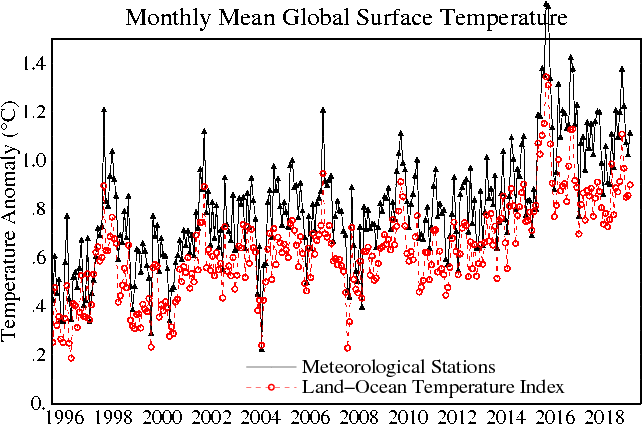
As such, here’s NASA’s Goddard Institute for Space Studies (GISS) Monthly Mean Surface Temperature Anomaly – 1996 to Present;
NOAA’s National Climate Data Center (NCDC) Annual Global Mean Temperature Anomaly Over Land & Sea – 1880 to Present;

the UK Met Office’s – Hadley Center – Climate Research Unit (CRU) Annual Global Average Land Temperature Anomaly – 1850 to Present;

and the UK Met Office – Hadley Center – Climate Research Unit (CRU) Monthly Global Average Land Temperature – 1850 to Present

Depending on the time frame, it certainly seems that Earth’s surface temperature has increased, though it does not appear to be “warming rapidly” and there are no indications of “an accelerating rate”. Furthermore, the surface temperature record is burdened with issues of questionable siting, changes in siting, changes in equipment, changes in the number of measurement locations, modeling to fill in gaps in measurement locations, corrections to account for missing, erroneous or biased measurements, and the urban heat island effect. Thus to see the big picture on the temperature Earth’s temperature, it helps to also look up.
Atmospheric Temperatures:
Since 1979 the temperature of Earth’s “climate” has also been measured via satellite. “The temperature measurements from space are verified by two direct and independent methods. The first involves actual in-situ measurements of the lower atmosphere made by balloon-borne observations around the world. The second uses intercalibration and comparison among identical experiments on different orbiting platforms. The result is that the satellite temperature measurements are accurate to within three one-hundredths of a degree Centigrade (0.03 C) when compared to ground-launched balloons taking measurements of the same region of the atmosphere at the same time.” NASA
The following are 4 Temperature Anomaly plots from Remote Sensing Systems (RSS), each one increases in altitude as is illustrated here:

RSS Temperature Lower Troposphere (TLT) – Brightness Temperature Anomaly- 1979 to Present;

RSS Temperature Middle Troposphere (TMT)- Brightness Temperature Anomaly- 1979 to Present;

RSS Temperature Troposphere / Stratosphere (TTS) -Brightness Temperature Anomaly- 1987 to Present;

RSS Temperature Lower Stratosphere (TLS) – Brightness Temperature Anomaly – 1979 to Present:

According to Remote Sensing Systems, “For Channel (TLT) (Lower Troposphere) and Channel (TMT) (Middle Troposphere), the anomaly time series is dominated by ENSO events and slow tropospheric warming. The three primary El Niños during the past 20 years are clearly evident as peaks in the time series occurring during 1982-83, 1987-88, and 1997-98, with the most recent one being the largest.” RSS
Also, the 2009 – 10 El Niño event is also called out on this RSS Latitudinal Temperature Lower Troposphere (TLT) Brightness Temperature Anomaly from 1979 to Present;

and the 1998 El Niño event, along with the tropospheric cooling attributed to the 1991 eruption of Mt Pinitubo, is called out on this University of Alabama – Hunstville (UAH) Lower Atmosphere Temperature Anomalies – 1979 to Present:

Note that in November the UAH Lower Atmosphere Temperature Anomaly was 0.12 degrees C above the 30 year average, and the RSS Lower Troposphere Brightness Temperature was 0.033 degrees C above the 30 year average. Keep this mind the next time you read that recent weather events were caused by Global Warming.

Furthermore, the Middle Troposphere, which follows a similar though flatter trend as the Lower Troposphere, recently dipped below the 30 year trend line i.e. RSS Temperature Middle Troposphere (TMT)- Brightness Temperature Anomaly- 1979 to Present:
There are also regional variations in Lower Troposphere that contribute nuance to the picture. For example, RSS Northern Polar Temperature Lower Troposphere (TLT) Brightness Temperature Anomaly;

shows a .338 K/C per decade increase, whereas the The RSS Southern Polar Temperature Lower Troposphere (TLT) Brightness Temperature Anomaly;

shows a .007 K/C per decade decrease. I am not aware of a compelling explanation for the significant divergence in temperature trends between the poles.
The satellite record seems to show slow warming of Lower and Middle Tropospheric temperatures, overlaid with the El Niño/La Niña Southern Oscillation (ENSO) cycle, including four comparatively large El Niño events. Lower Tropospheric temperatures appear to have flattened since the large El Niño in 1998 and offer no indication of “accelerating” warming.
Moving higher in the atmosphere, RSS Temperature Troposphere / Stratosphere (TTS) – Brightness Temperature Anomaly- 1987 to Present;
has been incredibly flat since, with a trend of just -.004 K/C per decade. The 1997-98 and 2009 – 10 El Niño events are still readily apparent in the plot, as is a spike from the 1991 eruption of Mt. Pinatubo. Note that the effect of Mt. Pinatubo is the opposite in the Lower and Middle Troposphere versus the Troposphere / Stratosphere (TTS), i.e. “Large volcanic eruptions inject sulfur gases into the stratosphere; the gases convert into submicron particles (aerosol) with an e-folding time scale of about 1 year. The climate response to large eruptions (in historical times) lasts for several (2-3) years. The aerosol cloud causes cooling at the Earth’s surface, warming in stratosphere.”
Ellen Thomas, PHD Wesleyan University
It is interesting that, incorporating the impact of three significant surface driven warming events, Troposphere / Stratosphere Temperatures (TTS) have been quite stable, however there is nuance to this as well.
RSS Northern Hemisphere Temperature Troposphere / Stratosphere (TTS) – Brightness Temperature Anomaly- 1987 to Present;

has been increasing by .054 K/C per decade, whereas the RSS Southern Hemisphere Temperature Troposphere / Stratosphere (TTS) – Brightness Temperature Anomaly- 1987 to Present;

has been decreasing by -.062 K/C per decade.
Moving higher still in the atmosphere, the RSS Temperature Lower Stratosphere (TLS) – Brightness Temperature Anomaly – 1979 to Present;
“is dominated by stratospheric cooling, punctuated by dramatic warming events caused by the eruptions of El Chichon (1982) and Mt Pinatubo (1991).” RSS
The eruptions of El Chichon and Mt Pinatubo are readily apparent in the Apparent Atmospheric Transmission of Solar Radiation at Mauna Loa, Hawaii:

“The stratosphere” … “in contrast to the troposphere, is heated, as the result of near infrared absorption of solar energy at the top of the aerosol cloud, and increased infra-red absorption of long-wave radiation from the Earth’s surface.”
“The stratospheric warming in the region of the stratospheric cloud increases the latitudinal temperature gradient after an eruption at low latitudes, disturbing the stratospheric-troposphere circulation, increasing the difference in height of the troposphere between high and low latitudes, and increasing the strength of the jet stream (polar vortex, especially in the northern hemisphere). This leads to warming during the northern hemisphere winter following a tropical eruption, and this warming effect tends to be larger than the cooling effect described above.” Ellen Thomas, PHD Wesleyan University
The Lower Stratosphere experienced “dramatic warming events caused by the eruptions of El Chichon (1982) and Mt Pinatubo (1991).” RSS “The long-term, global-mean cooling of the lower stratosphere stems from two downward steps in temperature, both of which are coincident with the cessation of transient warming after the volcanic eruptions of El Chichon and Mt. Pinatubo.” … “Here we provide observational analyses that yield new insight into three key aspects of recent stratospheric climate change. First, we provide evidence that the unusual step-like behavior of global-mean stratospheric temperatures is dependent not only upon the trend but also on the temporal variability in global-mean ozone immediately following volcanic eruptions. Second, we argue that the warming/cooling pattern in global-mean temperatures following major volcanic eruptions is consistent with the competing radiative and chemical effects of volcanic eruptions on stratospheric temperature and ozone. Third, we reveal the contrasting latitudinal structures of recent stratospheric temperature and ozone trends are consistent with large-scale increases in the stratospheric overturning Brewer-Dobson circulation” David W. J. Thompson Colorado State University
Above the Stratosphere we have the Mesosphere and Thermosphere, neither of which have I found current temperature time series for, but of note is that on “July 15, 2010” “A Puzzling Collapse of Earth’s Upper Atmosphere” occurred when “high above Earth’s surface where the atmosphere meets space, a rarefied layer of gas called “the thermosphere” recently collapsed and now is rebounding again.”

“This is the biggest contraction of the thermosphere in at least 43 years,” says John Emmert of the Naval Research Lab, lead author of a paper announcing the finding in the June 19th issue of the Geophysical Research Letters (GRL). “It’s a Space Age record.”
The collapse happened during the deep solar minimum of 2008-2009—a fact which comes as little surprise to researchers. The thermosphere always cools and contracts when solar activity is low. In this case, however, the magnitude of the collapse was two to three times greater than low solar activity could explain.
“Something is going on that we do not understand,” says Emmert.
The thermosphere ranges in altitude from 90 km to 600+ km. It is a realm of meteors, auroras and satellites, which skim through the thermosphere as they circle Earth. It is also where solar radiation makes first contact with our planet. The thermosphere intercepts extreme ultraviolet (EUV) photons from the sun before they can reach the ground. When solar activity is high, solar EUV warms the thermosphere, causing it to puff up like a marshmallow held over a camp fire. (This heating can raise temperatures as high as 1400 K—hence the name thermosphere.) When solar activity is low, the opposite happens.” NASA
In summary, Earth’s Lower and Middle Troposphere appear to have warmed slowly, overlaid with the El Niño/La Niña Southern Oscillation (ENSO) cycle, including four comparatively large El Niño events, and tempered by the cooling effects of the eruption of El Chichon (1982) and Mt Pinatubo (1991). Lower and Middle Tropospheric temperatures appear to have flattened since the large El Niño in 1998 and offer no indication of “accelerating” warming. Tropospheric / Stratospheric temperatures appear to have been influenced by at least three significant surface driven warming events, the 1997-98 El Niño, and the eruptions of El Chichon in 1982 and Mt Pinatubo in 1991, but to have maintained a stable overall trajectory. Stratospheric temperatures appear to have experienced two “dramatic warming events caused by the eruptions of El Chichon (1982) and Mt Pinatubo (1991).”, and “unusual step-like behavior of global-mean stratospheric temperatures” which has resulted in a significant stratospheric cooling during the last 30 years. Lastly, “during deep solar minimum of 2008-2009” “the biggest contraction of the thermosphere in at least 43 years” occurred and “The magnitude of the collapse was two to three times greater than low solar activity could explain.”
Ocean Temperatures:
“The oceans can hold much more heat than the atmosphere. Just the top 3.2 metres of ocean holds as much heat as all the world’s air.” Commonwealth of Australia – Parliamentary Library
As such, changes in Oceanic Oscillations, and Ocean Heat Content are critical to understanding “Earth’s Temperature”. Here is NOAA’s NODC Global Ocean Heat Content from 0-700 Meters – 1955 to Present;

and here is the same from Ole Humlum’s valuable climate data site Climate4you.com, NODC Global Ocean Heat Content – 0-700 Meters – 1979 to Present.

It seems apparent from the plots above that Global Ocean Heat has increased over the last several decades, however Global Ocean Heat doesn’t appear to be “warming rapidly”. Furthermore, there is no basis for the claim that warming is occurring at “an accelerating rate”. Decelerating would appear a more accurate label.
Ice:
A proxy often cited when measuring “Earth’s Temperature” is amount of Ice on Earth. According to the United States Geographical Survey (USGS), “The vast majority, almost 90 percent, of Earth’s ice mass is in Antarctica, while the Greenland ice cap contains 10 percent of the total global ice mass.” http://ga.water.usgs.gov/edu/watercycleice.html However, there is currently there is no generally accepted measure of ice volume, as Cryosat is still in validation and the accuracy of measurements from Grace are still being challenged.
As such, currently available global ice measurements are limited. Here is 20 Year Northern Hemisphere Snowcover with 1995 – 2009 Climatology

and here is Northern Hemisphere Winter Snow Extent – 1967 to Present:

While neither plot offers a global perspective, when looking at the Northern Hemisphere, there appears to have been a slight increase in Snowcover and Winter Snow Extent over the historical record.
Another ice based variable often cited as a proxy for “Earth’s Temperature” is Sea Ice Area, however there is significant evidence that the primary agent of change in Sea Ice Area is in fact wind and Atmospheric Oscillations. With this said, here are Global, Arctic & Antarctic Sea Ice Area from 1979 to Present;

Northern Hemisphere Sea Ice Area Anomaly, 1979 to Present;

Southern Hemisphere Sea Ice Area Anomaly, 1979 to Present;

and Global Sea Ice Area Anomaly – 1979 to Present:

There does appear to have been a negative trend in Northern Hemisphere Sea Ice Area, however there also appears to have been a positive trend in Southern Hemisphere Sea Ice Area. The resultant Global Sea Ice Area trend appears to be slightly negative, with no apparent acceleration. Based on the limited Global Ice measurements available, and noting the questionable value of Sea Ice Area as a proxy for temperature, not much inference can currently be drawn from Earth’s Ice measurements. However, there does not appear to be any evidence in Earth’s Ice measurements of rapid and/or accelerating warming.
Conclusion:
“Earth’s Temperature” appears to have increased during the last several decades, but there does not appear to be evidence that Earth’s climate is “warming rapidly”. Furthermore, there are no apparent signs of warming occurring “at an accelerating rate”.
Additional information on “Earth’s Temperature” can be found in the WUWT Reference Pages, including the Global Temperature Page and Global Climatic History Page
HenryP says:
January 3, 2012 at 11:32 pm
.”…. that there might be a difference in the actual infra red spectra of water and water vapor.”
========
That is a big part of what I am trying to learn here.
Henry@eyesonu
Sorry, it is not the infra red spectra that we should look at, if we want to study that problem of differing coloured clouds,
we should get the spectra in the visible area of water and water vapor.
Will try and find later, got to work now.
” that there might be a difference in the actual infra red spectra of water and water vapor.”
=======
George Smith may have already answered this in his reply above.
Are the responses that HenryP and George Smith have provided applicable to water vapor well below the saturated state, hence my reference to using 50% humidity. The question of the infra red sprectra as HenryP noted above would apply as well.
Water droplet and ice crystal absorption of heat from the sun (or any source) causes a state change to droplets then to vapor rather than a rise in temperature. So there is no heat to ‘re-radiate’ the energy has already been used for the state change. The heat will only be released at a later time when the water changes state back from vapor and releases the latent heat of condensation then fusion. This state change mechanism stabilizes atmospheric temperatures when there is sufficient water vapor content.
Henry@eyesonu
http://www.lsbu.ac.uk/water/vibrat.html#uv
quote
“This absorption spectrum of water (red light absorbs 100 times more than blue light), together with the five-times greater scattering of blue light over red light, contributes to the blue color of lake, river and ocean waters ”
Comparing this graph to the graph that compares solar irriadiance outside the atmosphere with the direct solar irradiance at sea level (cloudless day): Here I would say there are only two peaks of the water (vapor) in the visible area, at 800 and 700 nm, not continuous as noted in pure water. It also looks to me there is (almost?) no absorption at all of water vapor in the blue.
That explains (to me) why clouds containing more water / ice are darker then clouds still consisting mainly of just water vapor (and where water is still being formed). I had figured as much.
IanW says
So there is no heat to ‘re-radiate’
Henry says:
In the case of water there are a number of processes going on, including re-radiation of sunlight.
How else would you explain that we can measure that re-radiated light after it bounced back to earth from the moon!
see foot note here:
http://www.letterdash.com/HenryP/the-greenhouse-effect-and-the-principle-of-re-radiation-11-Aug-2011
To HenryP
Thank you very much for your answer and putting me back on the straight and narrow.. I have visited your site. You have put a hellof a lot of work in. I am still absorbing it.
I’m fully aware of the heat / energy relationship from condensation and air expansion / contraction and heat thus generated from any pressure changes
In trying to form my question to the responses. Some confusion as to my original question my be imparted. Let me restate question from scratch.
Case “A”:
Assume a 50% relative humidity. The water vapor is not at a saturated state, It will appear ‘clear’ to the human eye. Consider the incoming light / radiation from the sun.
Question 1: Will the sun’s rays heat this water vapor and in what way. Please expand on related concept.
Question 2: Will there be a difference in the actual infra red spectra of condensed water/ice vs water vapor? I am assuming here that the difference between water and water vapor will begin at the point of condensation. I’m avoiding using technical wording on my part as to not get to deep in physics terminology where I may say something that looses the main point of my interest, but to get the overall picture of just what is happening regarding the H2O in its varied states in the atmosphere with regards to incoming solar radiation.
Henry@Spen
Why, thanks.
I am always trying to explain the things I see happening in a way I can at least understand it myself, exactly because I think in that way other people might understand it also..
Myself, I am still discovering more things that shows that the warming caused by CO2 is a busted myth,
like here:
http://wattsupwiththat.com/2012/01/01/a-big-picture-look-at-earths-temperature/#comment-851327
(no reply received from anyone, on that one.)
“”””” eyesonu says:
January 3, 2012 at 11:15 pm
George E. Smith; says:
January 3, 2012 at 8:51 pm
Thank you for your reply.
A partial quote from your reply : “Of course it does, in several spectral bands starting at about 700 nm wavelength, beyond which about 45% of the solar energy exists, and those water bands seem to absorb about half of the total spectral range from there out to around 4.0 microns, beyond which, only 1% of solar energy remains.”
Would your reference to 4.0 microns be the condensate size (droplets) of the H20 ?
Would there be an effective ‘size’ to the H20 at say 50% humidity? “””””
Well eyesonu, that’s not quite the issue. I wish that someone with the tools to work on WUWT posts, could publish here some really good Solar spectra, and also a universal BLACK BODY RADIATION graph; ie the Planck radiation formula normalized.
The BB curve can be plotted on a (logarithmic) horizontal scale, that is wavelength divided by the spectral peak wavelength, ranging from about 0.1 to about 40 (times the peak), and the vertical axis is the ratio of the BB spectral irradiance in Watts per m^2 per micron of wavelength, divided by the peak spectral irradiance value; so that scale is simply 0.0 to 1.0 Now you can also do the same thing on a frequency scale, rather than wavelength, but wavelength seems more common among physicists, while chemists seem to like frequency.
In any case EVERYONE should know in their head some basic facts about the BB radiation curve.
First off, it is a function of Temperature (kelvins) times wavelength (metres) ONLY. So doubling the Temperature simply halves the wavelength scale. This in fact leads to the Wiens displacement law, which says that lambda max times Temperature is a constant. Specifically it is 2897.8 Kelvin.microns. Roughly 3,000, so if we say the sun is at 6,000 K, then the spectral peak wavelength should be about 0.5 microns in the green-blue. Or for the earth at say 300K, the presumed BB emission spectrum peak would be at 10.0 microns.
One then needs to remember some very basic facts about the shape of the BB curve.
1/ Almost exactly 25% of the energy is below the spectral peak wavelength, and 75% is above. I have never confirmed by integration whether this split is exact; but if it isn’t, it is so damn close to 25/75 that it doesn’t matter.
2/ Only 1% of the energy lies below HALF of the peak wavelength; so for the sun that would be 250 nm wavelength in the UV. The energy falloff at short wavelengths is quite precipitous.
3/ Only 1% of the BB spectrum energy lies above 8TIMES the peak wavelength; which for our sun would thus be 4.0 microns.
So for an ideal BB sun, 98% of the total energy would be emitted between 0.25 and 4.0 microns, and that’s why I referred to the 4 microns, so it is not related to water droplet size or anything like that.
The universal normalized BB spectrum is also plotted on a logarithmic vertical scale, which gives a very illuminating picture (pun intended). Instead og plotting the spectral irradiance to peak ratio from 0 to 1 on a linear scale it is often plotted from 1.0 to 10^-5 on a log scale, and the wavelength to peak ratio then goes from 0.2 to 40.0. So whereas only 1% of integrated energy is below 0.25, the spectral irradiance ratio drops to 10^-5 at 0.2, which is why I said the short end falloff is precipitous.
Some other numbers; at exactly 1.5 times the peak wavelength, the remaining energy at long wave lengths is about 47-48%,
So you see for the sun peaking at 0.5 microns, around half of the energy is above 750 nm, so the region where water starts absorbing IN GHG MOLECULAR MODE is about 750 nm to 4.0 microns. Now there are water bands above 4.0 microns, and also CO2 has its assymmetrical stretch mode at 4.0 microns, so CO2 also has some slight absorption at the tale end of the incoming solar spectrum; but it is somewhat smaller effect than for H2O.
Everybody knows that the total area under the BB curve (the Stefan -Boltzmann constant) goes as the 4th power of Temperature. It is less well known that the peak black body spectral irradiance varies as THE FIFTH POWER OF T.
This is important for earth cooling, since the tropical desert surface Temperatures can reach +60 C or 333.15 K instead of 288 K which is the supposed global mean Temperature.
So those tropical desert surfaces are emitting a peak spectral irradiance that is 2.07 times what the global average is, or 808 W/m^2, in place of Trenberth’s 390 W/m^2 number. In addition, the Wien’s law displacement due to that Temperature shift is 1.157, so the surface emission peak moves from 10.1 microns at 288 K to 8.73 microns at 333K. So that moves the emission AWAY from the CO2 15 micron band and at half that wavelength we have 4.365 microns, which is barely getting to the CO2 4 micron band (only 1% less than half the peak).
Furthermore, at 8.73 microns, the peak of the desert surface emission is also below the Ozone band at 9.6 microns.
So it is in the heat of the day in the hottest dry desert, where the earth is cooling like crazy, at around 800 W/m^2 and very little GHG containment from CO2, or O3, or even H2O
The polar regi
ons are quite ineffectual in cooling the earth, compared to the tropical deserts of Africa and the middle east.
For reference, I can highly recommend the Optics Textbook, Modern Optical Engineering, by the late Warren J Smith, for an excellent plot of the normalized BB spectrum curve. It is his fig 8.7 on page 194, in the 1966 edition of the book. Any University science library ought to have this book, as it is a standard Optics Text book. Warren J Smith was simply the biggest gun in the Optical engineering field; well other than the late Rudolph Kinglake of Eastman Kodak.
Smith worked for years, at Infra-Red Industries in Santa Barbara CA, so he was an acknowledged expert on BB and IR radiation.
Now I know that not all earth surface emit as black bodies, but the deep ocean waters should be very close, since the solar reflectance of the ocean is about 2% normal, and maybe 3% integrated over the whole hemisphere. Then water is extremely absorbing over the entire 2-100 micron wavelength range, which includes any possible black body like thermal emission spectra at any reasonable earth water Temperatures, so the oceans can be regarded as good BB emitters.
The lower troposphere graphs appear to show a step or ramp function in the late 1990s. Is this a real trend perhaps associated with the ENSO 0f 1997-98 or is it an instrumental or computational anomaly? It is interesting that this rise follows a decrease in the slope of the Keeling CO2 curve.
@ur momisugly HenryP and George Smith
Thank you for your responses. I have been and will continue to dig into the wavelengths of the ‘light ‘ bands. I was fairly knowledgable with regards to the color spectrum but had not looked at it from a wavelength standpoint which seems to be necessary to ‘see’ the infra red spectrum.
From scuba diving I knew that everything was blue at depth, but now I know why the sky is blue! Inquiring minds need to know so I will be loosing sleep over this one! Thanks again.
“”””” eyesonu says:
January 4, 2012 at 5:12 pm
@ur momisugly HenryP and George Smith “””””
The blue of the sky is a different process, eyeson, it is mostly due to Raleigh scattering, but there also is a process called Mie Scattering. I’m not certain but I believe Mie scattering is a consequence of “contaminants” or some sort of aerosols if you will; but as I said I’m not sure on that.
But Raleigh scattering, is what we call an “elastic” scattering process. it occurs right at the molecular and atomic level. The important thing is that it is the original solar photons that we are seeing in the blue sky; they are not absorbed and re-radiated, but are as they come from the sun, at the same wavelength (color). Think of those toys with the steel ball pendulums that bang together, and rebound to the same amplitude with essentially no loss of energy. Well air resistance robs the balls of a small amount of their energy. but the blue photons of sunlight are merely changed in direction, by passage close to atoms and molecules. The scattering angle is very wavelength dependent, and increases rapidly at shorter wavelengths. The scattering events are multiple, so ultimately the blue sky looks pretty much the same in any direction. It even looks the same looking down as you can see from a high flying commercial jet, and of course gives rise to the title” the blue planet”.
Actually, the earth is really the black planet, as the oceans look nearly black at visible and IR wavelengths. But the scattered blue sunlight hides the black oceans from our view, just as it obscures the black sky and stars that are visible, when sunlight is absent.
The Raleigh scattered blue sunlight is possibly the single largest loss of the incoming solar energy, that cuts the 1362 W/m^2 TSI down to about 1000 at the surface. The missing energy carved out of the solar spectrum, is the blue skylight. Half goes down and half goes up, so the earth is losing (by scattering) the same amount of blue light (high energy photons), as we see in the sky on a clear day.
Water is actually most transparent in the blue region near 520 nm. both shorter and longer wavelengths are more strongly absorbed, and scuba divers are familiar with the sequential loss or red, then orange, and yellow, with depth. At the minimum the water absorption coefficient is about 0.0001 cm^-1. That feeds into the equation t = t0 exp(-alpha.s), where s is the distance and alpha the absorption coefficient, So for an (s) of 100 metres, alpha.s is 1 so the transmission is 1/e or 37%.
That absorption climbs rapidly beyond the visible, until at 3.0 microns, its value is about 8-10,000 cm^-1, so now the 1/e penetration depth is only one to 1.25 microns, so five times that would be 5 to 6 microns, and the absorption would be 99%.
That is why LWIR does NOT penetrate the ocean depths. Now 3 microns is a narrow high absorption band but from 2 to 20 microns, the absorption coefficient is always at least 1,000 cm^-1, so ok it takes 50-60 microns of surface thickness to absorb 99% of the atmospheric LWIR down radiation.
The “white” reflectance of clouds, is actually not reflection at all, but strong refraction by spherical water droplets. A single rain drop, can refract a near parallel solar beam, into a nearly hemispherical cone of light, so just a few such refractions and you once again have an essentially isotropic light distribution, and once again it is an elastic scattering process, involving no change in photon wavelength from its solar origin.
The strong IR “reflected” down from clouds, is also not a reflectance. The LWIR is absorbed, and subsequently a different photon likely at a differnt wavelength is emitted. Such absorption re-emission processes are essentially isotropic, since there is NO preferred emission angle of the LWIR photons from the water molecules of the clouds ( or from the other GHGs such as CO2). This absorption/re-emission process could be described as an inelastic scattering process, in that the wavelength can change. There are other inelastic scattering processes where the photon energy is always lower after scattering from materials.
Well the white light emission from fluorescent lamps or white LEDs is an inelastic scattering process.
George said
Obviously CO2 is not symmetrical like H2 N2 O2 etc. I presume that the published reports of the laboratory measurements of its absorptance/emittance (at higher temperatures and pressures than that found in the atmosphere) are easily repeatable and not concoctions. As to the width of the radiation bands, to quote from the same textbook and page as before:
Given this, I would have strong doubts that CO2 emits a “continuum thermal radiation spectrum, that matches the Planck spectral irradiance..” If a measurement of back radiation was found that did measure such a spectrum, I would be curious as to how the effects of radiation from other emitters such as ground, clouds, water vapour and other GHG were removed.
George says:
The atoms are un-ionised and bound up in molecules. Ozone is not considered. There is a charge distribution across the molecule, although the whole molecule is electrically neutral. According to theory, It is the charge distribution that causes the electromagnetic emittance and absorptance at various wavelengths.
George said:
See the quote just a little previously. I think it indicates that the textbook conveys enough to allow an understanding of emission spectral width adequate to understand and undertake design calculations. I do not otherwise understand what you are getting at here. I have not bought up the subject of atomic spectral lines and their equivalence or not with the emission spectra of GHG gases. They do seem related though.
You seem to be convinced that the atmospheric has been measured by Bill Illis to have a black-body spectrum, with no indication of any CO2 spectra? I cannot find anything on this. From this you would conclude there is no enhanced back radiation from rising CO2 levels? And on that basis you reject my original post about rising CO2 levels possibly causing increased precipitation while not causing much temperature variation? If so, consider your point made.
Re. Henry@Spen
I have had another thought about your reply to my question. So the vertical bars on NOAA refer to the monthly range of the global mean temperature. Why should that range be significantly larger pre1950 than after 1950?
George E. Smith; says:
January 4, 2012 at 10:00 pm
I’m reading and rereading that info / knowledge that you have offered. I will continue to do so until I have a firm grasp on all that you have conveyed. I’m sure many others are gaining from it as well. I have now reread the original article and comments a few times and will likely do so again. Google search has also been quite busy on this one.
Thanks again for the additional knowledge. I’ll follow this thread as long as it’s active. I just gotta know how stuff works.! It seems that the more I know, the more I want to know. Is it some kind of addiction?
Henry@Spen
Yes the blue line is the average of the range of anomalies (for the average temperatures) that is being reported by the various stations in that year.
As to your question: Why should that range be significantly larger pre1950 than after 1950?
I think it has to do with the improvement in the accuracy in testing and test equipment during the past 50 or 60 years.
For example, with current equipment we can measure once every second during a day or even more.
In the past you did your readings at specific times of the day. And the thermometers got stuck at the max. and the minimum.
As for me, I also suspect that a large part of the 0.014 degree change per annum measured globally (past 35 years)
http://www.letterdash.com/HenryP/henrys-pool-table-on-global-warming
could be simply due to improvement in measurement, as the accuracy of the equipment might be more biased towards higher temps….
“”””” eyesonu says:
January 5, 2012 at 2:42 am
George E. Smith; says:
January 4, 2012 at 10:00 pm
I’m reading and rereading that info / knowledge that you have offered. “””””
I’m not always right; and sometimes I have goofed badly. But I will always give my honest assessment, as best as I know it or can get it from ancient text books.
And so long as just one person can gain some insight; I’m willing to take the time.
And most of this stuff is not that difficult to understand if presented properly. I figure, if I can describe it with a stick on a sandy beach, sans http://www.google.com or ficklepedia, then anybody can follow it.
George
“”””” peter_ga says:
January 5, 2012 at 12:57 am
George said
Well Peter the CO2 molecule is also quite charge symmetrical, just like those diatomic molecules H2, N2, O2, and not to mention Ar, it is NOT a polar molecule like H2O. So how then does CO2 emit a continuum thermal radiation spectrum, that matches the Planck spectral irradiance spectrum of a black body at the same Temperature ?
Obviously CO2 is not symmetrical like H2 N2 O2 etc. “””””
Well I must be seeing things, because every single text or paper I have ever seen about the CO2 molecule indicates it is quite symmetrical; as in O=C=O, or if you rotate it 90 degrees about its long axis you would see; O-C-O. I used to think that it should look more like this; O=C-O or like this ; O-C=O if you rotate it 90 degrees; but people who know far more than I do, insist that it is quite flat as in O=C=O. But nobody I know has suggested it is not symmetrical. For the life of me, I cannot possibly conceive of how such a shape can undergo bending, in two directions at right angles, and both at exactly the same frequency; well unless those two directions are at 45 deg rotation from the flat plane of the molecule.
But because CO2 contains three atoms, which according to Heisenberg’s principle cannot remain in a symmetrical configuration indefiniftely, then it can adopt an assymmetrical charge distribution.
It is not an assymmetrical charge distribution which results in emission or absorption; it is required to have the acceleration of charges in such an assymmetrical charge distribution. This happens when the CO2 molecule bends about the C, (15 micron band) or when the C moves off centre towards one or other of the O atoms (4 micron band).
In the case of the symmetrical homo diatomic molecules or monoatomic ones like Ar, they are charge symmetrical when in free flight, but not when they are busy colliding with another molecule or atom; then they become charge assymmetrical, and undergo charge acceleration in those collisions, during which time, they can absorb or radiate. And since those episodes are Temperature dependent, then the resulting emission spectrum, is a BB like thermal spectrum characteristic of the gas Temperature; which does not have to be high enough to cause ionisation.
Unfortunately, too many people post here at WUWT, and never ever read what has been posted before on the thread, so if you missed what Bill Illis said about the down radiation spectrum being a BB like spectrum, then you should go back and read what he posted. He did not say that GHG band spectra were absent, and nor did I; just that a continuum thermal spectrum is observed, and that cannot be explained by molecular resonance phenomena.
While it is fashionable to describe molecular spectra as “band spectra”, for example to say that CO2 absorbs everything from 13.5 to 16.5 microns, in its “15 micron” band, is to ignore the fact that this “band” is actually a group of narrow “line” spectrawhich don’t necessarily overlap or coalesce except at higher temperatures and pressures. Which is why CO2 and H2O bands can overlap, and yet both can absorb in non coincident lines of the appropriate spectra for each.
The continuous bands shown on many plots simply reflect the fact that some spectrometers, don’t have enough resolution to show the individual lines.
If the ordinary atmospheric gases were not radiating or absorbing, then the downward radiation would be only the characteristic band spectra of the GHG molecules, because there is nothing else up there to emit BB like thermal spectra.
Bill’s post is up there somewhere, because I commented on his assertion as soon as I read it.
I do not disagree with most of what George said. He has corrected me on the symmetry.
The only bone of contention I have to offer is that the principle of correspondence between absorptance and emission needs to be appreciated. These must be equal, given the frequency of the radiation, or a perpetual motion machine would be possible. I believe it would be possible to design a paint that would allow an object to become hotter and hotter in the presence of low frequency radiation. So if CO2 only emits along particular lines, then it could only absorb along such lines, and therefore it could only absorb fixed frequencies. There would be no response at all to broadband radiation, where the energy at any fixed frequency is nill. Experimentally, however, there is a response with CO2, but none with O2 etc. So CO2 must emit and absorb in bands, rather than fixed lines only, and the broadband radiation received from above cannot be emitted by O2 or N2 molecules, because they do not absorb such radiation.
Funny, Skeptical Science mirrored this article with their own “A Big Picture Look at Global Warming” yesterday;
http://www.skepticalscience.com/big-picture-global-warming.html
I leave it to you to decide which article is more factual.
“”””” Peter_ga says:
January 6, 2012 at 5:17 pm
I do not disagree with most of what George said. He has corrected me on the symmetry.
The only bone of contention I have to offer is that the principle of correspondence between absorptance and emission needs to be appreciated. These must be equal, given the frequency of the radiation, or a perpetual motion machine would be possible. “””””
Not really Peter. Kirchoff’s Law regarding the equality, and spectral equality of emission and absorption, ONLY applies to a closed system in thermal equilibrium . (everything at the same Temperature)
That is NEVER the case in the atmosphere. For a start, it isn’t a closed system, radiation comes in and goes out constantly so it doesn’t even approximate equilibrium conditions.
The important condition in the atmosphere is that the collision processes are quie chaotic, and unpredictable, and only statistical mechanics can explain what the average situation is, and the distribution of kinetic energies of the molecules.
Whereas the resonance spectra of molecular GHGs, are bands of much finer fixed frequency lines (not first order Temperature dependent (as to their frequencies)), the emision or absorption of molecules during a collision, is a short transient event, so it consists of random short pulses of EM radiation, which a Fourier transform can convert to a frequency domain spectrum, which is why it ends up as a continuum spectrum.
An amount of gas at a given temperature and pressure will have identical properties whether it is part of an “open” or “closed” system. This is purely a calculation artifice to indicate that when all inputs and outputs are considered, certain conservation rules apply.
The derivation of the theoretical spectrum of thermal radiation (Temperature dependent) is quite tricky, and some of the concepts are tricky to grasp; but not impossible. In classical physics, statistical mechanics was quite successful, in explaining the Maxwell-Boltzmann distribution of kinetic energies of gas molecules for example, as a function of Temperature, and Jeans was also successful in explaining the low Temperature specific heat of solids, which deviate from the Dulong and Petit law. The principle of equipartition of energy among the available degrees of freedom, was central to these derivations. The Dulong and Petit law on the specific heats (thermal capacities) of solids (metals) is itself dependent on the equipartition principle, that equal energy be assigned to each oscillatory degree of freedom (three translations, to rotations etc). The problem at low temperatures is the equipartition principle breaks down, some modes are just too weak to excite.
So when it came to trying to explain the thermal radiation of heated bodies; anything above zero Kelvins, Raleigh and Jeans, probably Wien as well thought they should apply the equipartition principle to the distribution of energy among all the oscillatory frequencies. So they argued that each frequency should have the same energy associated with it. Well the problem is there are an infinite number of frequencies, and in classical physics, it was assumed that each frequency could have ANY amount of energy assigned to it.
so the crux of the problem is this:-
1/ We have an infinite number of frequencies in the continuum.
2/ Any such frequency could have any value of energy assigned to it (equal of course) with the total energy being the sum of all.
Well the result of Jeans/Raleigh following that line of thought, led to the “ultra-violet catastrophe” where the energy all shifted up to infinite frequency, and the total energy became infinite. We all got discombobulated by a ulra gamma ray laser.
So now Max Planck gets into the picture, and he makes the following assumption; and this is the bit that is tricky to grasp; but essential to understand.
1/ Planck hung in with axiom #1; there STILL IS an infinite number of frequencies in the continuum; ergo the available frequencies are NOT quantized. So how different is that from the Atomic and Molecular resonance spectra, where the frequencies ARE quantized
2/ Planck required that the ENERGY assigned to EACH frequency IS quantized.
Specifically the energy assigned to any frequency is n.h.nu, or n.h.f if you wish; and (h) is of course Planck’s newly invented “quantum of action” and h.nu is the “photon energy” and you can have (n) photons at that frequency, such that the energy per frequency IS equipartitioned; but it can only change in quantum jumps, so the value of the equipartitioned energy at any FREQUENCY is some integer number of h.nu photon energies.
So you see that the frequency spectrum is still a continuum, in that all frequency values are allowed, but that frequency defines the photon energy, and you can only have an integer number of photons at any frequency. So for any frequency (or small frequency increment), you divide the total energy into the equipartitioned parts, but only the finite number of photons that fall under that level is allowed, so as you move to higher frequencies, where the quantized photon energy is larger, the number of photons at that frequency must diminish.
You see the photon energy and frequency or wavelength can still have any value at all, it’s continuous; but that energy must be an integer multiple of the h.nu energy for that frequency.
So if you can grasp that concept (took me a while (55 years ago)) then you are over the hump.
The ultra-violet catastrophe is avoided, and the mega gamma ray laser goes Ppfft ! and Planck ended up with his radiation formula which contains NO ARBITRARY PARAMETERS, just the newly coined (h) which simply adjusts the whole scale to the right size.
In my view, this insight by Max Planck is maybe the single greatest discovery in PHYSICS.
Well it’s on my top ten list.
Bottom line is that the black body radiation spectrum is truly a continuum, and not an infinitessimally close picket fence of narrow finite lines; but at any frequency, the roughly equipartitioned energy (for a true BB) consists of an integer number of photons at that frequency.
The Planck formula has been experimentally verified to the limits of experimental instrument capability; and is one of the crown jewels of modern Physics.
By the way; let me play salesman for a bit. If you are a Physicist or an X-scientist, or a savvy lay person, or just naturally curious; do yourself a favor and invest about $11 in a Dover paperback book that every person should own; (along with a copy of Chapman’s “Piloting, and Small Boat Handling.”)
George Gamow; “Thirty Years that Shook Physics.” The story of quantum theory.
I have the distinct privilege of knowing and talking occasionally with a gent who is older than me, and who actually worked with George Gamow, here in the USA.
Get it and read it; you’ll be glad you did. Amazon works, presumably other places too.
Thanks George, but I covered introductory quantum mechanics in second year physics at university too many decades ago now, and have my own reference books. The thing is, the absorptance and emmittance of anything has to have an identical spectrum, otherwise fundamental thermodynamic laws are broken.
Therefore a gas such as CO2 which absorbs broadband radiation in certain bands must also emit such radiation. Gases such as O2 and N2 that do not absorb any radiation do not emit any either.