
by Roy W. Spencer, Ph. D.
Here’s the global average sea surface temperature (SST) update from AMSR-E on NASA’s Aqua satellite, updated through yesterday, July 7, 2011:
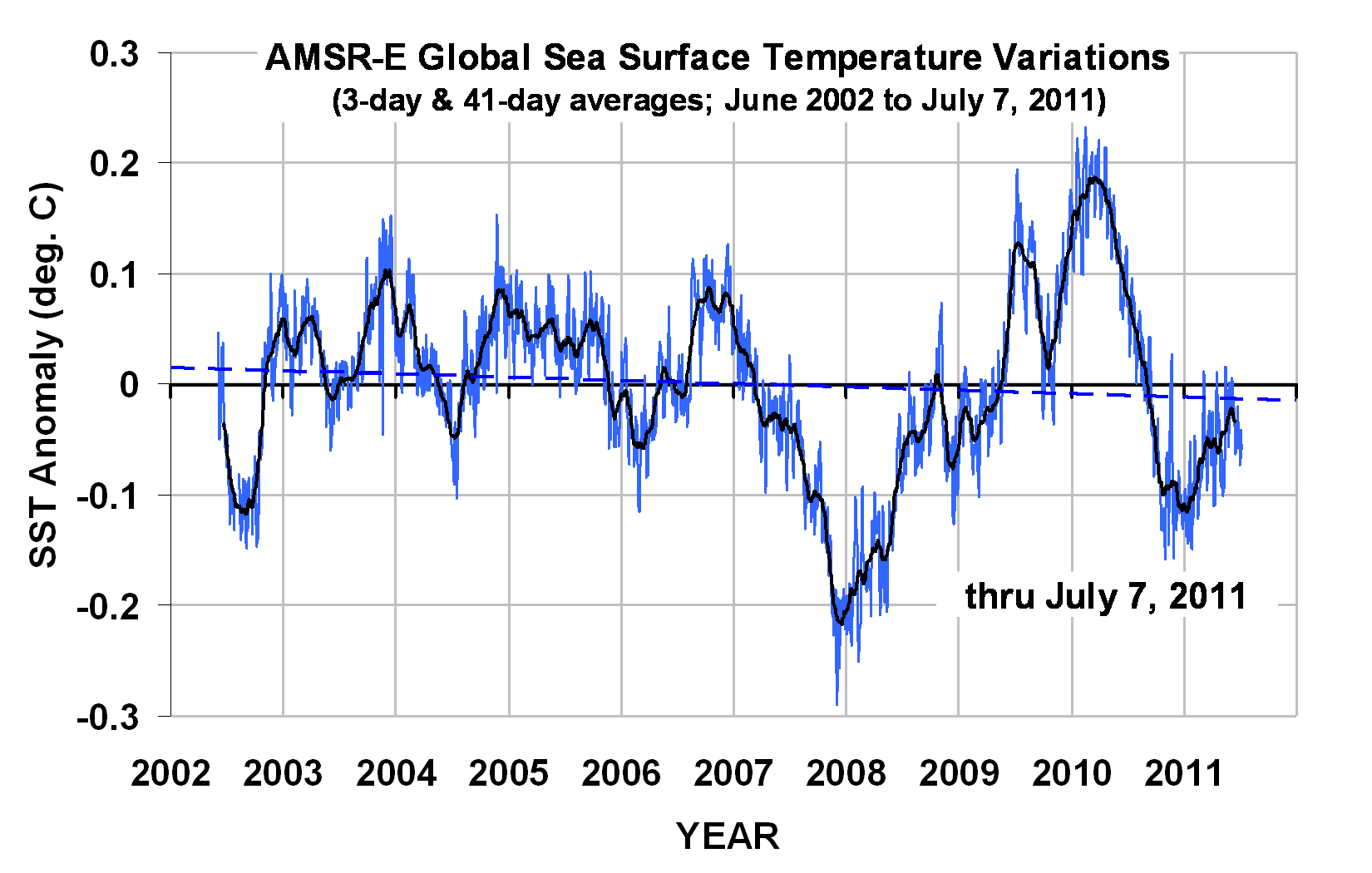
The anomalies are relative the existing period of record, which is since June 2002.
As can be seen, the SSTs have not quite recovered from the coolness of the recent La Nina.
Something else I track is the ocean cloud water anomalies, also from AMSR-E, which I have calibrated in terms of anomalies in reflected sunlight based upon Aqua CERES data:
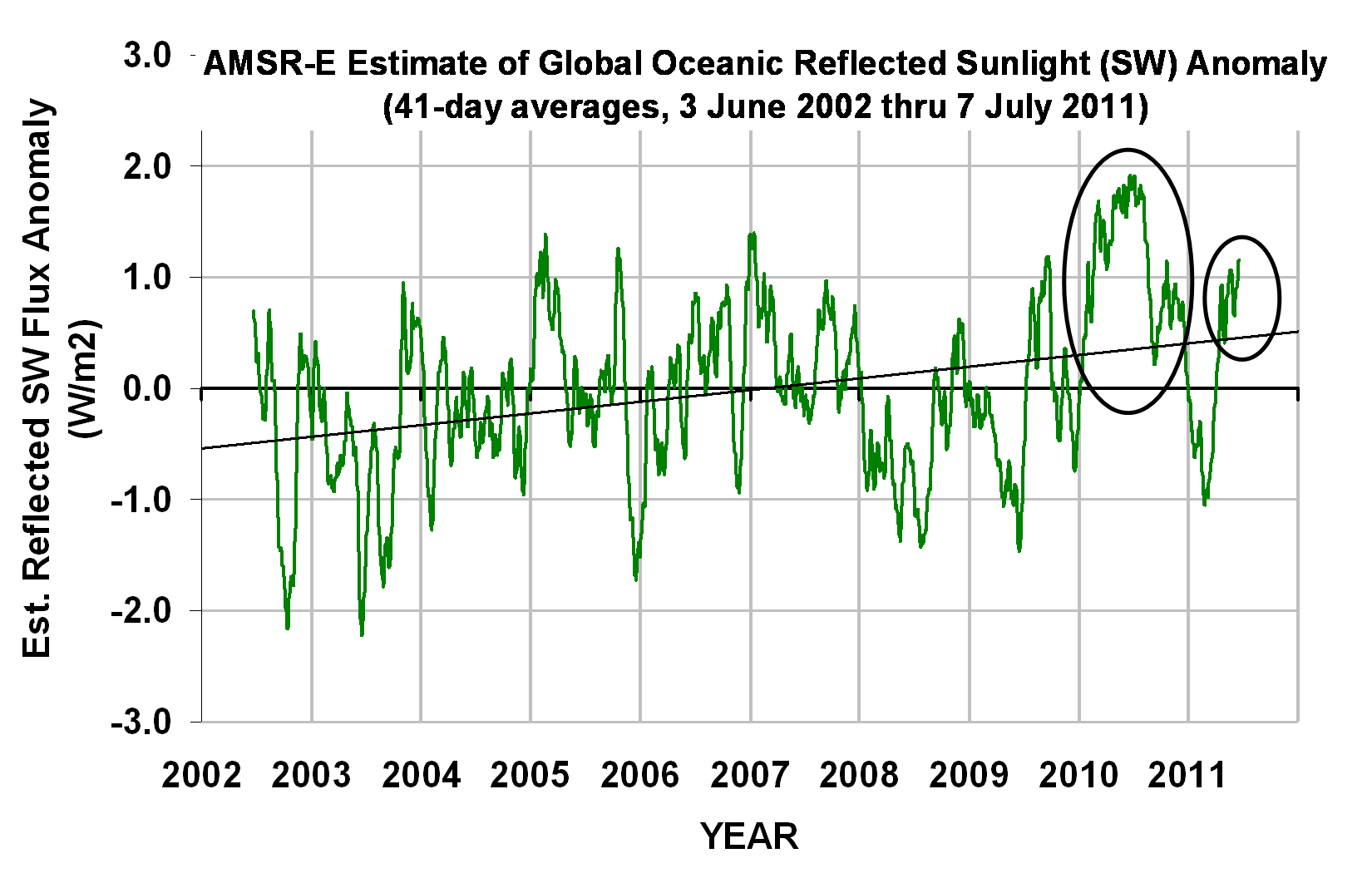
Why I watch this is it often predicts future SST behavior. For instance, the circled portion in 2010 shows a period of enhanced reflection of sunlight (thus reduced solar input into the ocean), and this corresponded to strong cooling of SSTs during 2010 as seen in the first graph.
So, the recent new enhancement of cloudiness (smaller circle) suggests a fall of SST in the next month or so. After that, it generally takes another month or so before ocean changes are transferred to the global oceanic atmosphere through enhanced or decreased convective overturning and precipitation.
==============================================================
See also this story on the sun: Solar activity report: the sun is still in a funk
Very interesting, these graphics should be together on a page. Maybe even as a single graph?
It sure looks like natural variation to me!
Not only are ocean temperatures cyclically normal, it appears that large reservoir of stored heat opined by Hansen et al. is completely false and in fact the mid ocean depths are colder than previously measured.
Thanks for the graph of oceanic reflected sunlight. This is the first I remember seeing it (so much data, so little attention span…).
It’s a shame the Aqua dataset is so short, but it’s interesting that we appear to have seen an approximate decrease of solar energy entering the oceans of 1w/m2; if I’ve read that correctly, then it’s a very significant drop in energy entering the oceans.
What is the believed forcing from CO2 during the 20th century?
Very interesting the cloud one fits in nicely with svensmark’s theory of cosmic ray, if of course cosmic rays are above the recent trends (10-15 years back)
The next step would be to tie the increased reflectance into the PDO going negative. The slope might be the straighter portion of the sine wave over 60 something years that the PDO swings through.
Interesting post as usual from Dr. Spencer. And an Interesting linked assumption in the title of this post…”While the sun’s in funk…”. The assumption being that the quiet period of the sun has had the influence of flattening SST’s? It could be true, or it could be the sun and/or several other factors completely unrelated to the sun.
I don’t understand. It seems like everyone these days is looking at the Sun as the driver of climate on the earth. I have thought that for at least 4 decades; but what is different now? When did even the MET decide to join in the fun? What’s up?
This is a chart of cosmic rays count since 2007. I would not have a clue what to make of it but seems to be on a steep down curve (not up) so what gives re Svensmark and solar activity maybe solar wind etc affects it too.
http://cosmicrays.oulu.fi/webform/query.cgi?startdate=2007/07/09&starttime=00:00&enddate=2011/07/09&endtime=00:17&resolution=Automatic%20choice&picture=on
I’ve presented a few posts that show that the satellite-era Sea Surface Temperature anomaly data rises only during significant El Nino events, and between those events the linear trends are flat. A link to my most current post on that subject is titled “Does The Sea Surface Temperature Record Support The Hypothesis Of Anthropogenic Global Warming?”:
http://bobtisdale.wordpress.com/2011/07/09/does-the-sea-surface-temperature-record-support-the-hypothesis-of-anthropogenic-global-warming/
The one-word answer to the title question is, No.
Also if SST are not changing why is this happening?
http://ocean.dmi.dk/arctic/icecover.uk.php
Unless its a mistake. Sometimes this happens and they correct it later.
Bob Tisdale
If you see this can you please email me at tonyATclimatereason.com in connection with my recent SST article.
thanks
tonyb
Arctic ice is not dependent on SST alone. There too are many processes taking place simultaneously including which direction the currents are moving for example.
Also, OHC in the Arctic region according to NODC have plummeted. That is a net loss of heat. Even the Catlin group acknowledge a drop in subsurface ocean temps, although appear to be grasping at straws to explain it.
Erik Styles says:
July 9, 2011 at 2:58 pm
There is a lot of high pressure at the moment around the Arctic circle, favouring sunny and less cold conditions. Good weather for melting sea ice at this time of year with solar levels at their highest of the year.
http://www.uni-koeln.de/math-nat-fak/geomet/meteo/winfos/arcisoTTPPWW.gif
SORCE TSI has not been updated since 2 June due to technical problems. Is there any more information about that situation?
The IPCC position is that the sun has nothing to do with global warming or climate change. Therefore, all the wild talk about a quiet sun, little ice ages, ocean cooling etc., and this article is just denier talk. Thank goodness the BBC, the Guardian, the Brit Government, the Australian government, The European Union, Obama and his merry band of Green magicians, (especially California) and their proxies are steaming full speed ahead – it’s Global Warming we MUST prepare for! Everyone knows that. Its settled science. And I’m only living close to a mile above sea level –
huishi says:
July 9, 2011 at 2:37 pm
What’s up is that there is a well-monied hypothesis out there that Man is responsible for an Earth-centered Climate, and that well-monied effort has spent the last 2 decades silencing the debate. I too was brought up with the understanding that the Solar System is Sun-centered, and that the Sun is the dominant source of energy … being that it is a star.
Now the big question here is: Does the Sun have enough variable star in it to overwhelm the local variations?
Bob Barker says:
July 9, 2011 at 4:14 pm
SORCE TSI has not been updated since 2 June due to technical problems. Is there any more information about that situation?
Their website says: Weekly Status reports have been removed to comply with ITAR restrictions.
In case you wonder what ITAR is: http://www.pmddtc.state.gov/regulations_laws/itar_official.html
In short: the information is classified [for ‘non-US persons’]. Now speculate why that would be so…
@ur momisugly Eric Styles
If you change the 2007 start date in your Oulu neutron monitor data to, say, 1977 you will see a kind of upside down solar activity chart – neutrons are high when the sun is quiet. You will also notice that, comparatively, the neutron count is still quite high compared with, say, 1991.
@rbateman says:
July 9, 2011 at 5:02 pm
What other incremental source of energy does this planet have?
and todays the day jula gillard tells australia on how she is going to save the world from burning up around sydneys time 12 pmand again6 pm on radio and tv .at the same time of her speech it is very cold in sydney and snow around 150 mts on our snowy mountains best snow since1990
correction 150 cm of snow not 150 mts dont worry gillard and the melon heads will save us . god help us australia needs all your help to
Erik Styles says @ur momisugly July 9, 2011 at 2:42 pm
And here is the same thing since 1964. And your point was?
Well, all that said, it seems that, according to the AQUA Satellite it’s now just as danged hot as it was this time last year.
http://discover.itsc.uah.edu/amsutemps/execute.csh?amsutemps