By WUWT regular “Just The Facts”
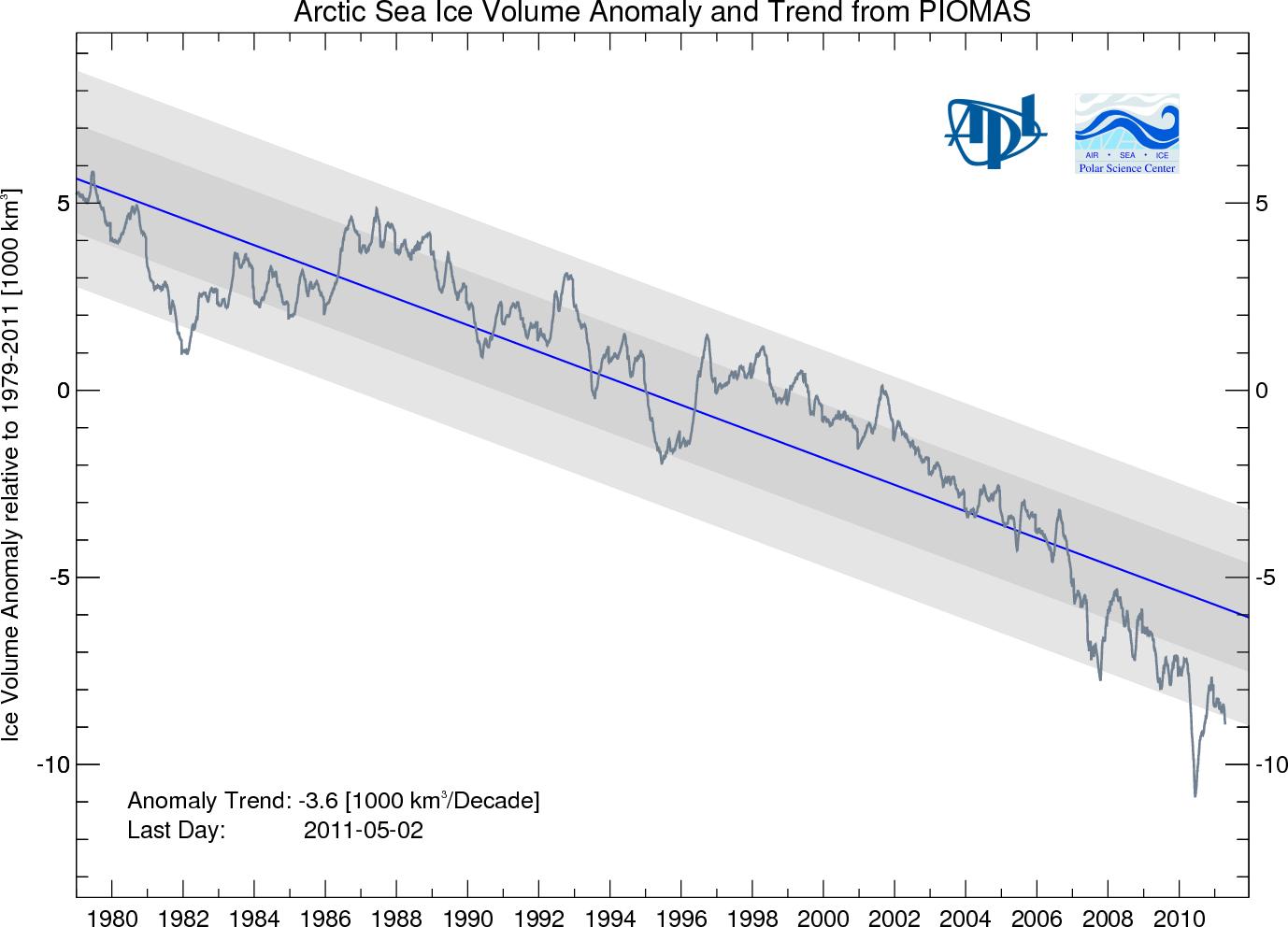
It seems that the Pan-Arctic Ice Ocean Modeling and Assimilation System (PIOMAS) Arctic Sea Ice Volume Model that generated the highly suspect chart above has been corrected to “show reduced errors over the prior version”. According to the University of Washington Polar Science Center website:
“New Version
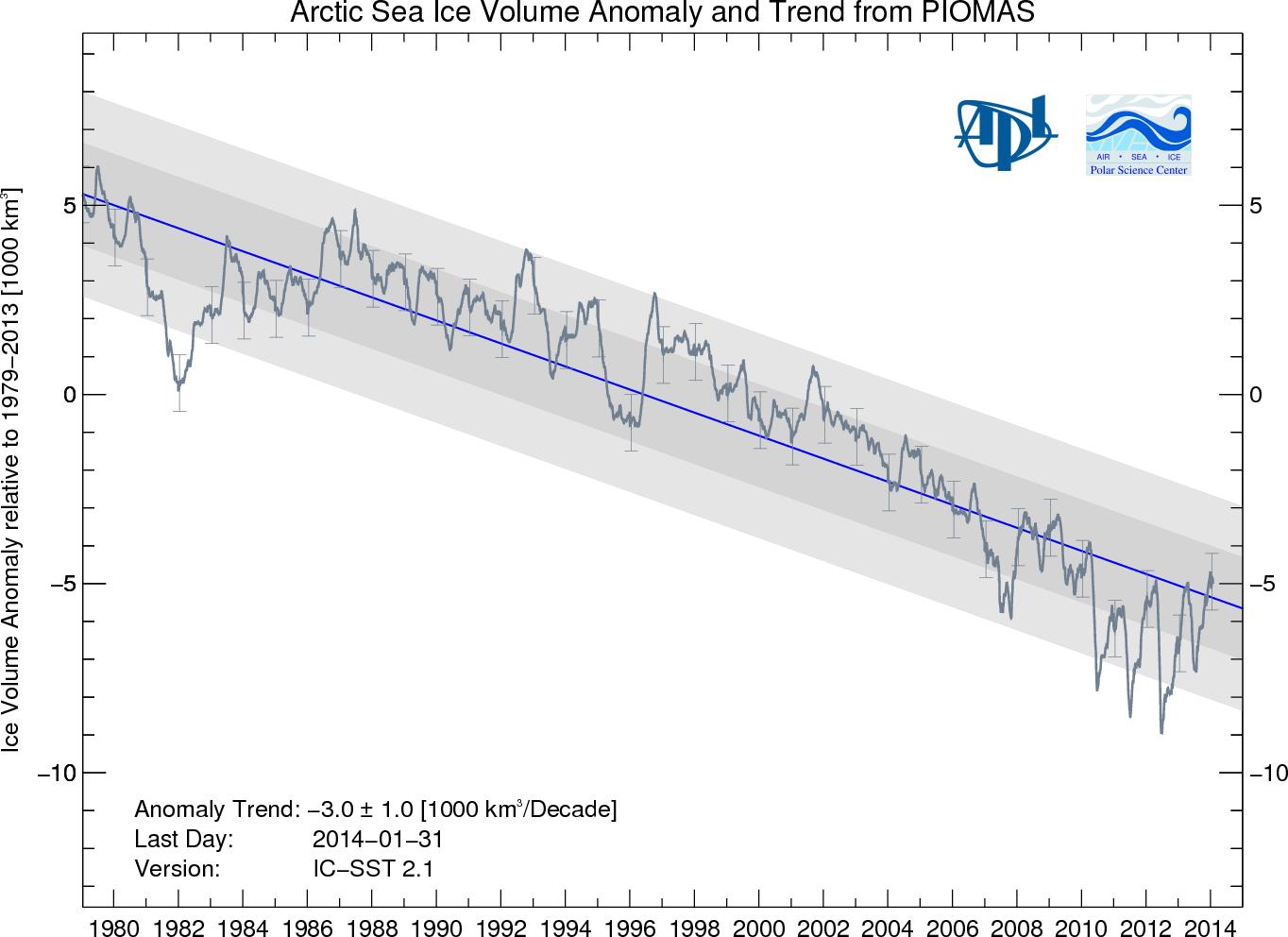
This time series of ice volume is generated with an updated version of PIOMAS (June-15,2011). This updated version improves on prior versions by assimilating sea surface temperatures (SST) for ice-free areas and by using a different parameterization for the strength of the ice. Comparisons of PIOMAS estimates with ice thickness observations show reduced errors over the prior version. The long term trend is reduced to about -2.8 103 km3/decade from -3.6 km3/decade in the last version. Our comparisons with data and alternate model runs indicate that this new trend is a conservative estimate of the actual trend. New with this version we provide uncertainty statistics. More details can be found in Schweiger et al. 2011. Model improvement is an ongoing research activity at PSC and model upgrades may occur at irregular intervals. When model upgrades occur, the entire time series will be reprocessed and posted.”
Here is the PIOMAS New Model Version:
and the chart below appears to show the original “Adjusted” version and the new unadjusted version:
Correction: Per this comment the chart below actually represents an “exercise” “not designed to correct potential model biases” when the “model appears to overestimate thin ice and underestimate thick ice.” The impact of this “exercise” is that the “downward decadal trend increases from -2.8×10³ km3/dec to -3.5×10³ km3/dec” which is the inverse of the impact when they “reduced errors over the prior version” and reduced the trend “to about -2.8 103 km3/decade from -3.6 km3/decade”, however the chart below does not show “the original “Adjusted” version and the new unadjusted version” as was incorrectly stated above.

If you look here you can see how Dr. Jinlun Zhang developed his suspect model. The page states that;
“Satellite sea ice concentration data are assimilated in GIOMAS using the Lindsay and Zhang (2005) assimilation procedure. The procedure is based on “nudging” the model estimate of ice concentration toward the observed concentration in a manner that emphasizes the ice extent and minimizes the effect of observational errors in the interior of the ice pack.”
According to this paper:
“Because of the errors in the summer Gice dataset ice concentration in the interior of the pack (as well as errors in summer ice concentration based on passive microwave observations), assimilation of ice concentration is accomplished in a method that emphasizes the extent over the concentration. The observations are weighted heavily only when there is a large discrepancy between the model and the observed concentration. Each day the model estimate Cmod is nudged to a revised estimate Ĉmod with the relationship.”
So it appears that to develop his model Zhang used an erroneous data set, weighted heavily when observations didn’t fit the model and then “nudged” its output to the results that he wanted.
Zhang has a history of contorting himself to help paint over the gaps in the Catastrophic Anthropogenic Global Warming Narrative. For example, in this NASA article/press release it states that:
“Jinlun Zhang, an oceanographer at the University of Washington, has pieced together a complex computer model that helps explain why Antarctic sea ice is expanding even with signs that ocean and air temperatures are on the rise.”
and in this paper titled “What drove the dramatic retreat of Arctic sea ice during summer 2007?” by Zhang, J., R.W. Lindsay , M. Steele, and A. Schweiger, Geophys. Res. Lett., 35, L11505, doi:10.1029/2008GL034005, 2008, it states that “Arctic sea ice in 2007 was preconditioned to radical changes” and this contributed to “The dramatic decline”. This is not objective science, rather it’s alarmist rhetoric.
Zhang was already looking for an Arctic Sea Ice tipping points in 2005, i.e. the title of this paper paper was “The thinning of arctic sea ice, 1988–2003: have we passed a tipping point?” by Lindsay, R. W. and J. Zhang, J. Climate, 18, 4879–4894, 2005.
In 2006 Zhang co-wrote a paper with Mark “Death Spiral” Serreze and Keith “the lack of warming … is a travesty” Trenberth, titled “The large-scale energy budget of the Arctic” by Serreze, M. C., A. P. Barrett, A. G. Slater, M. Steele, J. Zhang, and K. E. Trenberth, , J. Geophys Res., 112, D11122, doi: 10.1029/2006JD008230, 2007.
Zhang’s history of global warming advocacy aside, I give him credit for correcting his model to reduce the trend from -3.6 km3/decade in the last version to about -2.8 km3/decade in the New Model Version, so that is now less wrong. Then again, he is probably just hedging because, per this article, CryoSat is now generating maps of sea ice thickness and it is just a matter of time before Zhang’s model will be confronted by empirical evidence.
I wonder if all of the Warmist blogs that have used the old inaccurate PIOMAS chart will post updates/corrections to inform their readers of the good news…
To view more reliable sources of sea ice data please visit the WUWT Sea Ice Page.
Max Hugoson says:
June 28, 2011 at 12:49 pm
Nice going! Once again, IGNORE the shelf ice around Antartica. Combining that measurement (see UI Icecap page) gives nary a 3 or 4% change in 30 years. NOTHING worth worrying about, and most of that coming from the type of ERRORS in the Arctic ice mentioned in this article.
Untruth by 1/2 truth. Classic.
Max
————
Max, you are obviously new to the study of the cryosphere. There are very specific reasons why the Arctic sea ice has long been predicted to diminish before the Antarctic sea ice.
————
Steven Richards,
I consider PIOMAS to be a much better model than PIPS 2.O, and last year, when Steve Goddard made much ado about PIPS 2.0, he was predicting 5.5 million sq. km. for the summer minimum, and I was using PIOMAS and predicted 4.5 million sq. km. Guess what…I was closer.
But soon neither model will be all that important as we’ll have actual data.
R. Gates says:
June 28, 2011 at 4:01 pm
But soon neither model will be all that important as we’ll have actual data.
===========================================
Betcha we won’t have actual data. Tortured data, or massaged data at best would be my prediction.
1DandyTroll says:
June 28, 2011 at 3:48 pm
…The north pole was, apparently, ice free in some summers during the 1950′s …
?
Reference, please.
“When model upgrades occur, the entire time series will be reprocessed and posted.”
Shades of Hansen. Within ten years the adjusted data will show they were skating on sea ice off the Florida coast in 1980.
philincalifornia says:
June 28, 2011 at 4:29 pm
R. Gates says:
June 28, 2011 at 4:01 pm
But soon neither model will be all that important as we’ll have actual data.
===========================================
Betcha we won’t have actual data. Tortured data, or massaged data at best would be my prediction.
——————-
I think enough “boots on the ground” validation of CryoSat 2 measurement techniques have been done to feel confident in the results. Skeptics will always be just that, skeptical, and those who have their skepticism tempered by extreme politics will do what this mixture has always done…cllaim the data is tainted no matted how many independent confirmations you have and chalk it up to a vast conspiracy. The simple fact is, the Arctic sea ice is declining, has been for many decades, and shows no sign of reversing that trend. PIOMAS gave us a pretty decent, but not perfect, model for estimating the rate of the volume of the sea ice, and CryoSat 2, and in a few years, IceSat 2, are going to give us even better ideas of what ice volume is doing.
steven mosher says:
June 28, 2011 at 9:03 am
Do you accept the physics models that the CryoSat team uses to create those maps? including physics of the atmosphere?
No, “just a matter of time” could take several more years for us to build up a reasonable record, test, validate, scrutinize, etc., but I do think that PIOMAS’ days are numbered.
SSam says: June 28, 2011 at 1:41 pm
I imagine… that if you make a graph of Arctic Sea Ice extent vs Icebreaker commissioning, you will see a direct correlation.
It’s not just icebreakers, I would also include shipping, fishing and cruise ship traffic, I was considering an Arctic Ship Transit Tonnage Index, but there doesn’t appear to be a regularly updated data source to support it. I think ice breaker commissioning, Arctic Ship Transit Tonnage Index, wind, air temperature and ocean temperature, might provide reasonable correlation.
In terms of wind:
“Much of the record breaking loss of ice in the Arctic ocean in recent years is down to the region’s swirling winds and is not a direct result of global warming, a new study reveals.” including in the Guardian:
http://www.guardian.co.uk/environment/2010/mar/22/wind-sea-ice-loss-arctic
this 2011 paper submitted to The Cryosphere L. H. Smedsrud, et al.;
http://www.the-cryosphere-discuss.net/5/1311/2011/tcd-5-1311-2011-print.pdf
used “geostrophic winds derived from reanalysis data to calculate the Fram Strait ice area export back to 1957, finding that the sea ice area export recently is about 25 % larger than during the 1960’s.”
Additionally this paper;
http://journals.ametsoc.org/doi/abs/10.1175/1520-0442%282001%29014%3C3508%3AFSIFAA%3E2.0.CO%3B2
found that;
“Observations reveal a strong correlation between the ice fluxes through the Fram Strait and the cross-strait air pressure difference.”
“Although the 1950s and 1990s stand out as the two decades with maximum flux variability, significant variations seem more to be the rule than the exception over the whole period considered.”
“A noticeable fall in the winter air pressure of 7 hPa is observed in the Fram Strait and the Barents Sea during the last five decades.”
“The corresponding decadal maximum change in the Arctic Ocean ice thickness is of the order of 0.8 m. These temporal wind-induced variations may help explain observed changes in portions of the Arctic Ocean ice cover over the last decades. Due to an increasing rate in the ice drainage through the Fram Strait during the 1990s, this decade is characterized by a state of decreasing ice thickness in the Arctic Ocean.”
“Although the 1950s and 1990s stand out as the two decades with maximum flux variability, significant variations seem more to be the rule than the exception over the whole period considered.”
That would be ‘natural variations” – correct?
R. Gates says:
June 28, 2011 at 5:04 pm
I don’t see anything resembling a steady decline in Arctic Ice.
I do see a step down in Arctic Ice extent about 2006/2007 timeframe.
Similar conditions may have been responsible for the mission to check out the reports of the NW Passage being open, that led to the loss of 3 ships and crew, one of which was found in open water last year. So I suppose that when the Arctic decides to step up again, it will do so irregardless of any computer modeled trend lines that extend to zero.
I wonder how many daredevils the Arctic will claim next time around?
You’re not seriously considering sailing through there, are you?
rbateman says:
June 28, 2011 at 8:00 pm
R. Gates says:
June 28, 2011 at 5:04 pm
I don’t see anything resembling a steady decline in Arctic Ice.
I do see a step down in Arctic Ice extent about 2006/2007 timeframe.
Similar conditions may have been responsible for the mission to check out the reports of the NW Passage being open, that led to the loss of 3 ships and crew, one of which was found in open water last year. So I suppose that when the Arctic decides to step up again, it will do so irregardless of any computer modeled trend lines that extend to zero.
I wonder how many daredevils the Arctic will claim next time around?
You’re not seriously considering sailing through there, are you?
_____
Only way I’m going back to the Arctic is aboard the Healy:
http://www.uscg.mil/pacarea/cgcHealy/
Now that’s going in style…
But odd that you don’t see a steady decline in Arctic sea ice as every expert in the world has documented it going on for several decades now. Probably just natural variability, right? 🙂
:
R. Gates;
I followed the USCGC Healy’s trip to the Chuckhi and Beaufort seas last year. PIOMAS said there was 20cm ice in the area. When they got there they could barely move through the ice (she’s designed to break 1.5m) then they got out and had a game of football.
R. Gates says:
June 28, 2011 at 5:04 pm
I think enough “boots on the ground” validation of CryoSat 2 measurement techniques have been done to feel confident in the results.
===================================================
What’s the reference here ?? I’m not being sarcastic. I want to read this.
philincalifornia says:
June 28, 2011 at 9:18 pm
R. Gates says:
June 28, 2011 at 5:04 pm
I think enough “boots on the ground” validation of CryoSat 2 measurement techniques have been done to feel confident in the results.
===================================================
What’s the reference here ?? I’m not being sarcastic. I want to read this.
———–/
Good place to start:
http://www.nasa.gov/mission_pages/icebridge/news/spr11/index.html
R. Gates says:
June 28, 2011 at 8:39 pm
But odd that you don’t see a steady decline in Arctic sea ice as every expert in the world has documented it going on for several decades now. Probably just natural variability, right? 🙂
Wrong. I do not let others spoon feed me what they want me to think. I can paddle my own boat, and I look at the data just like the experts do. Since we do not have decades of reliable data on ice thickness, extent is going to have to do with a LOT of uncertainty attached to it.
We are just now learning the role of wind in blowing lots of ice out to where it can melt, so there is little use in making a big deal out of a single decade of a new baseline of Arctic Sea Ice. All the Sea Ice Extent measurements, like IMS, NANSEN, NORSEX, DMI, U of Bremen, JAXA all show the new baseline quite clearly, though they disagree on the numbers. The global sea ice anomaly is only down 5%, and amounts to even less of a big deal.
That’s what I think of the Sea Ice Extent.
It’s fun to watch and try to predict, but there’s nothing there to get all worried about.
Here’s a quick comparison I posted here a few days ago of PIPS-derived values for total volume and this newer version of the PIOMAS dataset,:
http://imageshack.us/photo/my-images/29/pipsvspiomascont.png/
PIOMAS in black, PIPS in red. It shows quite clearly reasonable agreement between the trends for the minimum volume, and a clear discrepancy for the maxima. That’s just as expected given the more limited extent of PIOMAS, with a direct comparison only possible in the summer.
That’s not really my question. In the end after it is validated you will have a data product.
That data product is not raw data or sensor measurements. rather It will be processed data.
Part of that processing is applying physics models about how radiation transfers through the
atmosphere. Part of the correction process involves using models of the atmosphere to correct the data and minimize retreival errors. If you accept that data product, you accept that physics. WRT corrections required to reduce the retrieval error. Do you accept the validity of the model that us used to supply those corrections? specifically the model used to handle the wet tropospheric correction?
huh? guess what kind of model is used to for the wet tropospheric correction over the arctic ocean? Guess what kind of model is used to correct the data ? If you want to accept the data, then you seem to be committed to accepting the models used to correct the data.
I’ll leave it as a mystery, but you would all recognize the initials of the model. Interested parties can read the relevant data processing, calibration, and validiation reports.
Here is the thing. ALL satillite data products depend entirely on the same physics used in GCMs.
All satilite data products are the results of models, physics models, simulations in some cases, being applied to raw sensor output to create meaningful data. Accept the data? then you accept that physics.
I have been surprised that so many are quick to believe the recently shown Cryosat ice thickness map. This map has not been validated. It has not been published in a peer-reviewed journal, it has not undergone any rigorous assessment for accuracy. It was released at an air show for publicity reasons.
Have you noticed that sea ice thickness in Baffin Bay is 3m? That is not possible from thermodynamic ice growth using observed Oct-Feb air temperatures (remember first-year ice is typically 1.5m). MODIS imagery suggests little compaction/ridging in that region, so it is likely that there is an overestimation of the ice thickness. While the thickness distribution follows what we already know to be true, the thickest ice is found north of Greenland, I wouldn’t be so quick to trust the actual thickness values. The main purpose of Cryosat is to look at interannual changes in thickness rather than provide a 100% accurate thickness value, and at the moment, the biggest unknown (snow depth) hinders the absolute accuracy of any sea ice thickness measurement from either laser or radar altimeter.
Indeed PIOMAS removed their adjustments for bias in the (sonar) submarine ice thickness validation measurements.
I’m not sure if that is realistic, since the submarine measurements as tested against actual in-situ measurements do reveal a bias :
http://psc.apl.washington.edu/wordpress/research/projects/arctic-sea-ice-volume-anomaly/validation/
As others have pointed out, these are quite possibly systematic errors in sonar measurements than a real bias in the model results and these adjustments won’t be repeated and possibly would have to reversed if actual measurements keep confirming the sonar bias.
Here is the (62 page) report that explains everything and more you ever wanted to know about PIOMAS and it’s validation techniques :
http://psc.apl.washington.edu/wordpress/wp-content/uploads/schweiger/pubs/IceVolume-2011-06-02-accepted-with-figures.pdf
And here is a graph of the ‘new’ PIOMAS volume numbers over time (this graph gets updated twice monthly, or whenever PIOMAS updates their results) :
http://img607.imageshack.us/img607/4533/piomastrnd4.png
So, is (adjusted for sonar bias or not) PIOMAS right ? Heck, we really don’t know. But at least their numbers seem to match past ICEsat measurements and on-going in-situ measurements of ice thickness quite nicely, and better than anything out there right now.
Julienne, I very much agree with your observations.
Of course, it is exciting that the Cryosat team finally presents sea ice thickness numbers from Cryosat’s data and validation results.
However, there seems to be a substantial difference between the validation numbers and this sea ice thickness map. For example :
http://blogs.esa.int/cryosat-ice-blog/2011/04/15/getting-off-the-ground/
April 14, location 85.6° N 69.8° W, ice thickness measured : 1.8 meter.
This same location (just north of Greenland) shows 3-4 meters of ice in Jan/Feb.
Can somebody explain how the ice could melt in half from Jan to April, while temperatures are still freezing beyond belief ?
Or is there another explanation for this significant inconsistency between in-situ measurements and the presented Cryosat Actic ice thickness map ?
steven mosher says: June 29, 2011 at 12:12 am
Julienne Stroeve says: June 29, 2011 at 12:42 am
Rob says: June 29, 2011 at 2:38 am
Your thoughts on CryoSat are all appreciated. At the moment I have to pack, work and head to DC, but I will dig into CryoSat further and prepare a post on what I find.
Steven, in terms of your question as to the confidence I will have in the future processed output, this will depend on how it’s done, who does it, how the resultant data sets compare and how well they withstand scrutiny.
i) The anomaly should be plotted as a ((x/X) – 1) where x = ice now, X = long term mean ice.
ii) The graph should include the mean period, for context.
Hmm, and, what % is it that we are dealing with here? has such a deviation from the mean behaviour ever occurred before? Hmm, I wonder!? Usual AGW BS.
Showing NH ice as an anomaly is fallacious since there is an upper limit, i.e. the whole basin can fill with ice but no more. It is not a Gaussian distribution.
For Derek Sorensen
http://stevengoddard.wordpress.com/2011/06/27/nyt-2000-never-before-been-seen-by-humans/
North pole ice-free in March 1959
None of this would be news worthy if it wern’t for the fact that the models of an extremely chaotic system with an as yet unknown number of parameters are expected to predict the future.
When will people realize that model regression = gradient descent = guessing until it looks right?
It’ it sad to read ESA fails to substantiate the first results of a promising mission, hopefully there is a study in the pipeline getting published soon and not behind a scientific paywall.
In the meantime the Arctic prepares to lower sea ice concentration:
http://www.arctic.io/observations/136/2011-06-28/8-N76-W160/Arctic-Ocean
Hundreds if not thousands “lakes” of open sea emerged in a triangle from North Pole to Chukchi Sea and Prudhoe Bay. Some of them have already miles in diameter.