Snowcover hangs tough…with warm Gulf of Mexico…spells spring trouble
By Joseph D’Aleo, CCM, WeatherBell
Snow as the first week of April drew a close was still extensive across Canada and Asia. It remains well above the normal as it did the entire winter.


Click images to enlarge
Meanwhile the Gulf of Mexico has warmed above normal due to the southeast ridge the last 6 weeks.


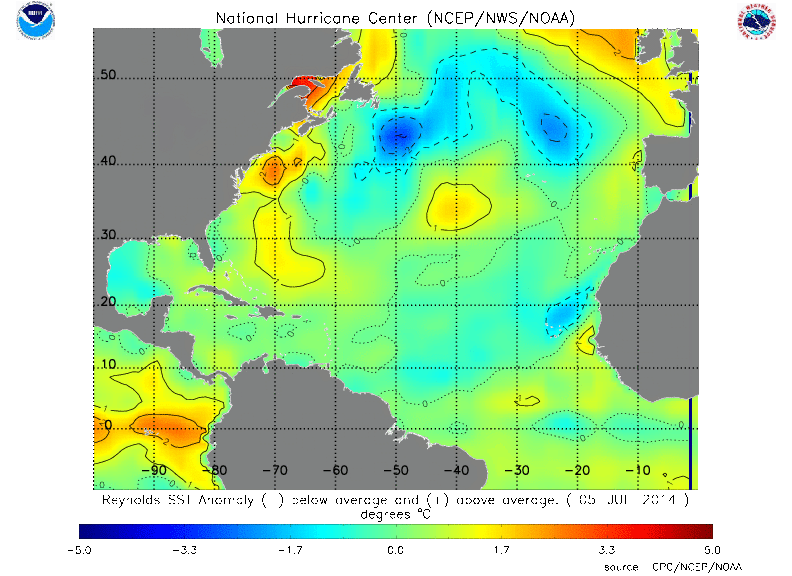
The means more then normal north to south contrast and moisture aplenty to help feed spring severe weather activity. Normally La Nina springs have more severe weather activity as have posted earlier.
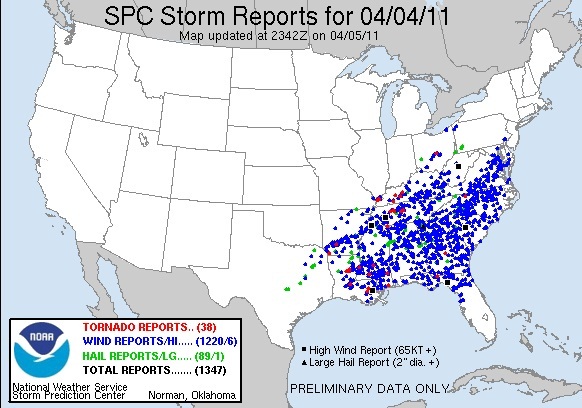
Last Monday, April 4th was one of the most active days in recent memory for the Storm Prediction Center and folks who live in the southeast with 1347 severe weather reports (1220 high wind, 89 hail and 38 tornado) from the Ohio River southeast to northern Florida. Virtually everyone in the southeastern United States felt the fury.
See this link for a listing of all the 1347 reports.

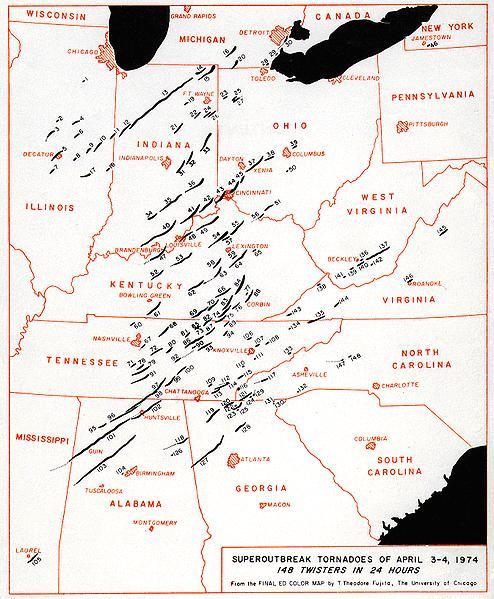
April and May should keep forecasters busy. In my first WeatherBell post, I discussed the potential for some very big severe weather days as is the case in La Nina years in a cold PDO (Pacific Decadal Oscillation). The Palm Sunday outbreak in 1965 and the Superoutbreak in 1974 were just two prime examples.
The Palm Sunday tornado outbreak on April 11, 1965 involved 47 tornadoes (15 significant, 17 violent, 21 killers) hitting the Midwest. It was the second biggest outbreak on record. In the Midwest, 271 people were killed and 1,500 injured (1,200 in Indiana). It was the deadliest tornado outbreak in Indiana history with 137 people killed. The outbreak also made that week the second most active week in history with 51 significant and 21 violent tornadoes. The tornado which hit Midway trailer park is disputed to be an F5, as 25 homes were literally and figuratively wiped off the face of the earth, with no signs of them ever found.

NOAA image for the famous Elkhart, IN double funnel tornado that hit the Midway Trailor Park.
The Super Outbreak of April 3-4, 1974 spawned 148 confirmed tornadoes across eastern North America and resulted in the second highest death toll (319) in the United States. Not only did it produce an exceptional number of tornadoes, but it was also an inordinately intense outbreak producing dozens of large, long-track tornadoes, including 7 F5 and 23 F4 tornadoes. More significant tornadoes occurred within 24 hours than any other week in the tornado record.

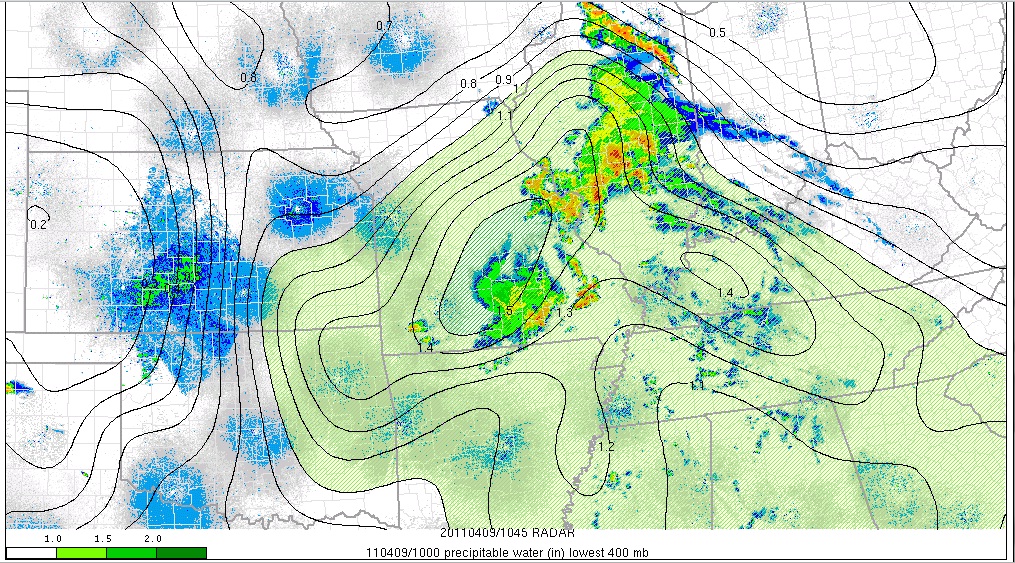
Severe weather is likely today and tomorrow with moderate risks both days.

You can see the moisture (precipitable water – total water in inches in the atmospheric column) in this early Saturday analysis with the radar showing showers and thunderstorms.


See more on WeatherBell posts by Joe Bastardi and I.
=========================================================
FYI, to stay ahead of storms, get alerts even ahead of the NWS, and to track storms and get ETA’s to your location, try this program that uses free data:
 Click image for details.
I spent one winter in Scotland and England. The nights were much longer than in New England. In fact, I was somewhat shocked by how swiftly the days grew shorter, and by November the sun barely seemed to rise before it was going down. By December it seemed the sun was only up at lunchtime, and it made life rough for a schoolboy like myself, used to fresh air and time-out-doors after school. The winter (1970-1971) was quite mild, compared to New England, but I found the darkness hard to endure. However the return of sunlight in the spring was completely wonderful. After much darkness, light is like a narcotic, or at least like wine.
Ever since then I’ve thought people who live up towards the pole must all be seasonally bipolar. December depressions give way to June euphorias.
So why not just enjoy a warm spell in April? Considering how cold and snowy December was in England, you certainly have earned some sunshine.
Turn off the doom-sayers who can’t enjoy the warmth, and have to see the end-of-the-world in everything. Read some Keats and Shelley instead.
Ref Caleb. You should have checked the latitude before leaving New England. 🙂 Keats to cheer you up? Start with “The Pot Of Basil”.
Pamela Gray says:
April 10, 2011 at 7:10 am
OK you Grumpy Old Man,
I admit that Basil Pot tale is pretty morbid, but Keats takes the tragic and invests it with the beauty of love that will not die. For example, Isabelle “waters the basil pot with her tears.”
Alarmists, on the other hand, take a beautiful spring day, and make it morbid.
However I think I’ll skip the Basil Pot poem, (though it has a great stanza about the shame the rich should feel for over-exploiting the poor, “Why were they proud?”)
Actually Keats is more focused on overcoming tragic situations, (Autumn and winter,) than on springtime, now that I think of it. However “A thing of beauty is a joy forever” is pretty nice, though very youthful and naive. (“Ode to Meloncholie” is the first version of “You gotta pay the dues if you’re gonna sing the blues.” ) What blows me away is the maturity he achieved before age 26.
However all in all I’d say you are right. I’ll skip to “Ode to a Skylark” by Shelley.