By Steven Goddard
The Arctic sun has now passed its peak, and is starting its decline towards the horizon over the next 90 days.

All four (JAXA NSIDC DMI NORSEX) ice extent measurements now show 2010 as below 2007. You can see in the modified NSIDC map below that the regions which are below the 30 year mean (marked in red) are all outside of the Arctic Basin and are normally ice free in September, so it is still too early to make any September forecasts based on extent data.

The modified NSIDC map below shows ice loss (in red) during the last nine days. There has been very little change in the Arctic Basin.

The modified NSIDC map below shows ice loss (in red) since early April. According to JAXA, this is about 5 million km².

The modified NSIDC map below shows ice loss (in red) since early April. According to JAXA, this is about 5 million km².
The modified NSIDC map below shows ice loss (in red) since 2007. According to JAXA, this is about 500,000 km². Areas in green have more ice than 2007.

There has been a strong clockwise rotation of wind in the Beaufort Gyre, which is pulling ice away from the land around the edges of the Beaufort, Chukchi and East Siberian and Laptev Seas.

http://www7320.nrlssc.navy.mil/pips2/archive/mag/2010/mag_2010062200.gif

The video below shows changes in PIPS ice thickness and extent during June. You can see the ice rotating clockwise and concentrating in the center of the Arctic Basin.
During the last 10 days, PIPS shows that Arctic Basin ice volume has dropped close to 2007 and 2009 levels. Volume has increased by about 40% since 2008.

Average ice thickness is now the highest for the date during the last five years. This is due to the compression of the ice towards the interior of the Arctic Basin.

Ice offshore of Barrow, Alaska is showing little signs of melt so far.
 ‘
‘
http://seaice.alaska.edu/gi/observatories/barrow_sealevel/brw2010/BRW_MBS10_overview_complete.png
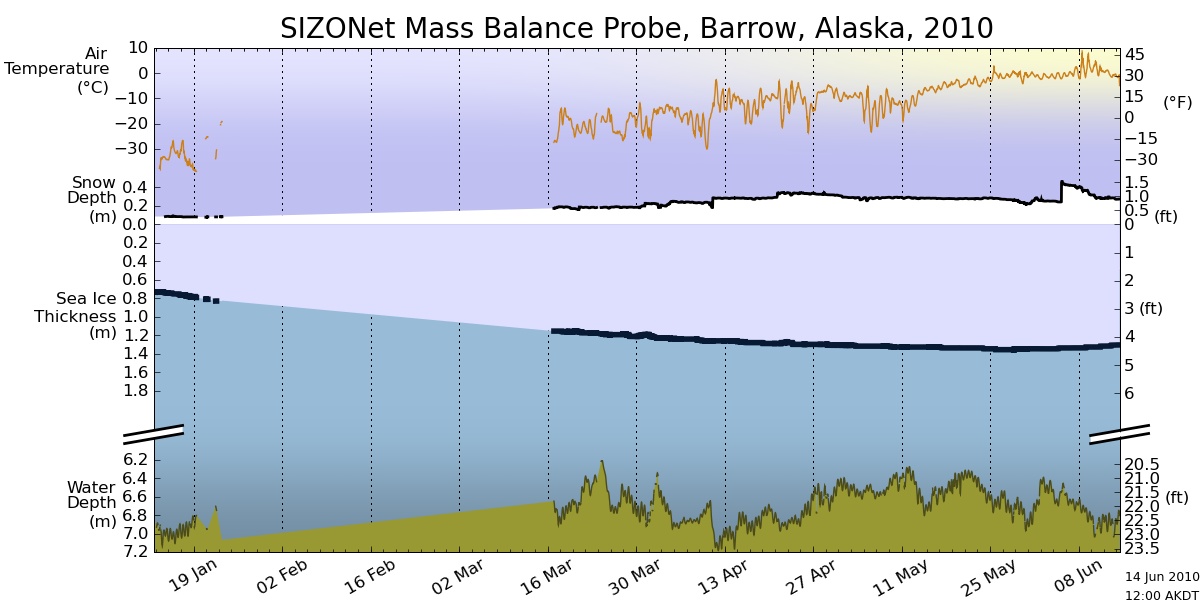
The current break up forecast calls for July 5.

http://seaice.alaska.edu/gi/observatories/barrow_breakup
Temperatures north of 80N have been persistently below normal this summer.

http://ocean.dmi.dk/arctic/plots/meanTarchive/meanT_2010.png
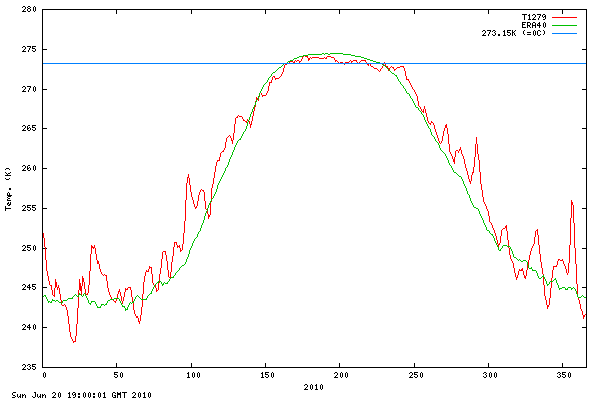
There are still no signs of melt at the North Pole, with temperatures running right at the freezing point – and below normal. Normally there has been surface melting for several weeks already.

http://psc.apl.washington.edu/northpole/webphotos/noaa2-sml.jpg

Arctic Basin ice generally looks healthier than 20 years ago.

I’m forecasting a summer minimum of 5.5 million km², based on JAXA. i.e. higher than 2009, lower than 2006.
Meanwhile down south, Antarctic ice is well above “normal” close to a record maximum for the date.

http://arctic.atmos.uiuc.edu/cryosphere/IMAGES/seaice.recent.antarctic.png

The video below shows the entire NSIDC Antarctic record for the last 30 years.It looks like a heart beating
And a correction, that’s the National “Snow” and Ice Data Center (NSIDC) not the National “Sea” and Ice Data Center.
Thanks Steven for another good sea ice update. Looks like the ice is better than we thought. Arctic-Roos are still showing area and extent tracking 2007/2008 coming out of the knot:-
http://arctic-roos.org/observations/satellite-data/sea-ice/ice-area-and-extent-in-arctic
Will be interesting to see where the minimum ends up – my guess is it will end up around the 5.9m km^2 level. The continuing quiet sun and cooler ocean will mean more ice than many of the ‘experts’ predict!
Zhang (using the PIOMAS model) is currently predicting 4.7m km^2. http://psc.apl.washington.edu/zhang/IDAO/seasonal_outlook.html
Last year Zhang was about 20% low
http://wattsupwiththat.com/2009/09/07/how-have-the-scientists-done-on-arctic-sea-ice-forecasts-this-year-maybe-not-so-good/
Most of the submissions to the Study of Environmental Arctic Change see more than 5m
http://www.arcus.org/search/seaiceoutlook/2010/june
A breakdown in the Beaufort Gyre – perhaps occurring in a multidecadal cycle – is one of the primary reasons for the extensive melt in 2007 in the Arctic Basin. A strong Beaufort Gyre combined with significant increases in ice thickness would suggest that melting in the Arctic Basin will be minimal this year.
Does area mean anything? How about thickness? http://network.nationalpost.com/np/blogs/fpcomment/archive/2009/05/04/lawrence-solomon-deep-arctic-ice-surprises-scientific-expedition.aspx
They are going about it all wrong. If they want to predict the melt in the Arctic Basin they should start measuring the flow of current through the Bering Strait and its water temperature. It is this warm water flowing through the Bering Strait that caused the record melt in 2007, and its annual fluctuations determine the variations observed. The other side of the Arctic Ocean is warmed by the Gulf Stream that annually eats up about a third of the sea ice that otherwise would exist in its absence.
Agree with Julienne about the significance of looking at a single day 20 years ago as an informative comparison. And to pick a nit, June 22 1990 was 21 years ago.
But if you want it, here is the ice concentration 20 years ago (June 22 1991)
http://tinyurl.com/27urrmy
And here is the the trend for May
http://nsidc.org/data/seaice_index/images/n_plot_tmb.png
geoff pohanka says:
June 23, 2010 at 1:59 pm
“It is quite amazing the focus on the Arctic sea ice extent. If all the Arctic sea ice melted, sea levels would not rise at all. ”
VILLABOLO RESPONDS:
Geoff, sea level rise is a non issue concerning the Arctic Ice Cap. The real issue is what the exposure of open seas will do to the weather patterns.
Since ice REFLECTS 80-90% of the sunlight while blue ocean ABSORBS 80% it’s evaporation will increase tremendously and cause a chain reaction of events that will affect the entire Northern Hemisphere.
Sorry ’bout the double post – my browser just vanished the post rather than showing ‘your comment is awaiting moderation.’
I plotted up the AMSR-E data for ice extent from June 1, 2002 to May 31, 2010. The data currently available, and the trend is slightly but insignificantly positive, at +79±132 km2/day. It is somewhat hard to see in the overlapped year lines on the AMSR-E standard plot in the side bar, but if you just plot the data as a straight series you can see how little change there has been over the last 8 years. there certainly has been a downward trend in the last forty years, but it is possible we are experiencing the flat trend at the minimum now.
Galane wrote,
“It’s nearly impossible to have more or less than 50% of whatever you’re measuring above or below the mean.
It’s very easy to have more than 50% above or below average or median.”
Just a typo I’m sure but that’s backwards. The median equals the 50th percentile, or value that (approximately) divides the data in half. The mean is a center of gravity, which in skewed distributions can be quite a ways from the median, i.e. above (or below) much more than 50% of the data.
Arno Arrak says:
June 23, 2010 at 3:06 pm
They are going about it all wrong. If they want to predict the melt in the Arctic Basin they should start measuring the flow of current through the Bering Strait and its water temperature. It is this warm water flowing through the Bering Strait that caused the record melt in 2007, and its annual fluctuations determine the variations observed. The other side of the Arctic Ocean is warmed by the Gulf Stream that annually eats up about a third of the sea ice that otherwise would exist in its absence.
———————
Arno, if it was all a result of ocean temperatures, then you would be more inclined to believe Dr. Maslowski’s predictions of when the Arctic would be ice free since that is what he bases his assessments on (the role of the warm Pacific water entering the Arctic Basin).
It’s important to understand that the warm SSTs in the Chukchi in 2007 were not shown to be a result of more warm water inflow through Bering Strait, but a result the timing of the retreat of the sea ice in that area. But earlier years have shown pulses of warm water entering the Arctic through Bering Strait that then circulate around the Arctic Basin. Rebecca Woodgate has many publications on this if you’re interested.
In general there is very little mixing of the warm Atlantic water with the sea ice because of the strong stratification in that part of the Arctic. But there was a recent paper that came out looking at how wave action could change that so it might be more important in the future as the ice cover declines. Ocean data do show a cooling of Atlantic water entering the Arctic the last few years (though it remains anomalously warm).
villa:
“The real issue is what the exposure of open seas will do to the weather patterns.”
Well, what do you think they will do?
Many would think that it would mean catastrophic run-away warming. In reality what will happen is that the North Pole will be ice free in late summer (September) after the days has begun to get shorter. An after September the ice will grow back. It is an incremental development, not a run-away thing. My bet? I have yet to see the run-away effect claimed by the CAGW-crowd.
Volume has increased by about 40% since 2008.
PIOMAS show something different:
http://psc.apl.washington.edu/ArcticSeaiceVolume/images/BPIOMASIceVolumeAnomalyCurrent.png
Who to believe, who to believe……… 😉
Arctic Basin ice generally looks healthier than 20 years ago.
That’s on top. It’s the underside that’s sick. 😉
Once again I see the need to remind folks that the Arctic comprises a multitude of variables and a multitude of sea ice areas that interact individually to these variables. I continue to be shocked regarding this obvious lack of knowledge. A case in point:
Keith Tax said:
“It looks to me that sea ice will make another record low this summer. People need to get off the oil addiction. The polution (sic) and warming is killing the planet.”
This kind of response reveals a near complete lack of knowledge (easily obtained) about individual arctic sea oscillations, topography, summer solstice variables, and individual arctic atmospheric oscillations. CO2 could not have warmed the incoming Atlantic current that is melting the edge of the ice next to Greenland. CO2 could not have caused the gyre to pull the ice from the land edges. The air over the Arctic basin is not any warmer and is in fact a bit colder than average right now.
Pollution and fossil fuels cannot be the cause. There is no mechanism that connects CO2 with Arctic melt.
I’m forecasting a summer minimum of 5.5 million km², based on JAXA. i.e. higher than 2009, lower than 2006.
That would be a continuing growing trend. And it would be more proof that the PIOMAS graph is wrong.
It would also mean it is even more unlikely that Al Gore’s prediction of an 2013 ice free Arctic will be happening.
It would also be more evidence that the ‘death spiral’ is not happening.
😉
I think it will pass the 2003 line when reaching the minimum… let’s wait and see!!!
“”Julienne says:
June 23, 2010 at 3:54 pm
In general there is very little mixing of the warm Atlantic water with the sea ice because of the strong stratification in that part of the Arctic.””
So you are basically saying all we need is frigid thick cloud cover, plenty of snow, and a quite sea, forget the currents, they don’t matter. Well, that’s much easier, pray it be so.
Indeed. Suppose we have a distribution of ten people, six of whom have no children, two each have one, two each have two, and the last has fourteen. The median is childless, but the mean is exactly two children.
Many people use the term “average” loosely, without defining whether they refer to the median, arithmetic mean, or something more exotic. If you don’t know by which definition someone means (heh) a word to be understood, then the sentence in which it’s used doesn’t convey a clear meaning.
Pamela, changes in temperatures can and do modify atmospheric and oceanic circulations. I can point you to a number of published studies and chapters in physics/atmospheric/oceanic text books that show this to be true if you are interested.
Air temperatures do remain anomalously warm over the Arctic, I am not sure where you are getting the information that says otherwise.
Barrow Sea Ice Web Cam:
http://seaice.alaska.edu/gi/observatories/barrow_webcam
…nary a death-spiral to be seen!
Keith Tax says:
June 23, 2010 at 2:23 pm
“It looks to me that sea ice will make another record low this summer. People need to get off the oil addiction. The polution and warming is killing the planet.”
Yeh, our desire for stuff like food and energy is just way out of line! And we know using oil causes ice melt and even though it’s happened before, we know ice melt is really, really bad! If for no other reason than if too much ice melts in Greenland, Canada, and Russia, they’d probably just use that extra land for farming and start using oil all over again!
Tangentially related, I was amused by this press release in the The Tasmanian Times related to Anthony’s trip:
http://tasmaniantimes.com/index.php?/weblog/pr-article/climate-activists-urge-people-to-pay-attention-to-the-science-not-the-clima/show_comments
I found this line particularly amusing:
“Real science is conducted through peerreviewed publications in respected journals”, said Phil Harrington from Climate Action Hobart.
If any of you were confused, apparently what’s going on in the thread isn’t science, rather when you manufacture a paper that supports your conclusions, and then submit it to a biased journal for review by biased reviewers, now that’s “real science”. How many of Einsteins papers were peer reviewed? “According to the physicist and historian of science Daniel Kennefick, it may well be that only a single paper of Einstein’s was ever subject to peer review.”:
http://www.abhishek-tiwari.com/2009/01/einstein-and-peer-review.html
Hmmm, so much for “real science”…
Steve,
Thanks for taking the time to assemble this data, it’s always useful as a point of departure for discussion. I won’t get into your use of the PIPS 2.0 data again, as we are all tired of that I’m certain. But your statement that arctic sea ice volume having increased by 40% since 2008 is, in my estimation, completely preposterous. I just don’t think the PIOMAS model could be that far off:
http://psc.apl.washington.edu/ArcticSeaiceVolume/images/BPIOMASIceVolumeAnomalyCurrent.png
But more than that, the PIOMAS based prediction for how the melt will progress this summer is pretty amazingingly accurate so far. Watch it, and compare to the current extent and concentration images:
http://psc.apl.washington.edu/zhang/IDAO/seasonal_outlook.html
I would tend to trust PIOMAS more than PIPS 2.0, and the difference between 40% more volume (your estimate based on PIPS 2.0) and what the PIOMAS model predicts means that one of them is going to be proven as horribly wrong when CrySat 2 starts to deliver data later this year. I would (and obviously do) tend to trust PIOMAS, and it’s accurate prediction so far for how the summer melt season will be progressing and the fact that it uses the CICE model gives me this confidence.
The video presentation I posted before given by a research team right in the Arctic this entire past winter, tells exactly why the estimates of volume given by measurements such as PIPS 2.0 are being fooled tremendously. I really would suggest that everyone watch this video if you have not, as it gives the latest update from a team that wintered over in the Arctic and was shocked by ice that they thought was 2.0 meters or greater, being far thinner (with much less mass as well) and weaker as well, as why it is so:
http://video.hint.no/mmt201v10/osc/?vid=55
This “on the ice” kind of reporting is very powerful and direct, and needs to be including in understanding how to more accurately interpret satellite data.
Also, you really need to stop even talking about the Mass Balance Probe in Point Barrow, as that probe has been recovered and is not longer transmitting any data since June 14th. In addition, the ice is all shore fast ice in the area, with open sea, and it ‘s pretty much irrelevent when this little narrow strip shore fast ice breaks up anyway.
We have now officially entered the heart of the melt season, with a good solid 8 weeks of strong melting in front of us. From today’s sea ice extent of 9.6 million sq. km., I think we’ll just a little over 5.1 million sq. km. more ice before the September low, putting right about the 4.5 million sq. km. mark. (the PIOMAS based projections are ranging anywhere from about 4.4 million sq. km. up to about 4.7 million).
Finally, I just “happened” to have been in Boulder today, and spent a few hours up at NCAR. It was a goregous day with more than the normal number of bicyclists out for bike to work day. But I did happen to be speaking with one of the staff members there who mentioned this new survey about the general consensus about AGW among the experts:
http://green.blogs.nytimes.com/2010/06/22/evidence-for-a-consensus-on-climate-change/
But I’d like to get a few of the other expert opinions on the accuracy of this survey. I thought the numbers felt a little high to me, but the person I was speaking with at NCAR felt they were probably about right.