By Steven Goddard
The Arctic sun has now passed its peak, and is starting its decline towards the horizon over the next 90 days.

All four (JAXA NSIDC DMI NORSEX) ice extent measurements now show 2010 as below 2007. You can see in the modified NSIDC map below that the regions which are below the 30 year mean (marked in red) are all outside of the Arctic Basin and are normally ice free in September, so it is still too early to make any September forecasts based on extent data.

The modified NSIDC map below shows ice loss (in red) during the last nine days. There has been very little change in the Arctic Basin.

The modified NSIDC map below shows ice loss (in red) since early April. According to JAXA, this is about 5 million km².

The modified NSIDC map below shows ice loss (in red) since early April. According to JAXA, this is about 5 million km².
The modified NSIDC map below shows ice loss (in red) since 2007. According to JAXA, this is about 500,000 km². Areas in green have more ice than 2007.

There has been a strong clockwise rotation of wind in the Beaufort Gyre, which is pulling ice away from the land around the edges of the Beaufort, Chukchi and East Siberian and Laptev Seas.

http://www7320.nrlssc.navy.mil/pips2/archive/mag/2010/mag_2010062200.gif

The video below shows changes in PIPS ice thickness and extent during June. You can see the ice rotating clockwise and concentrating in the center of the Arctic Basin.
During the last 10 days, PIPS shows that Arctic Basin ice volume has dropped close to 2007 and 2009 levels. Volume has increased by about 40% since 2008.

Average ice thickness is now the highest for the date during the last five years. This is due to the compression of the ice towards the interior of the Arctic Basin.

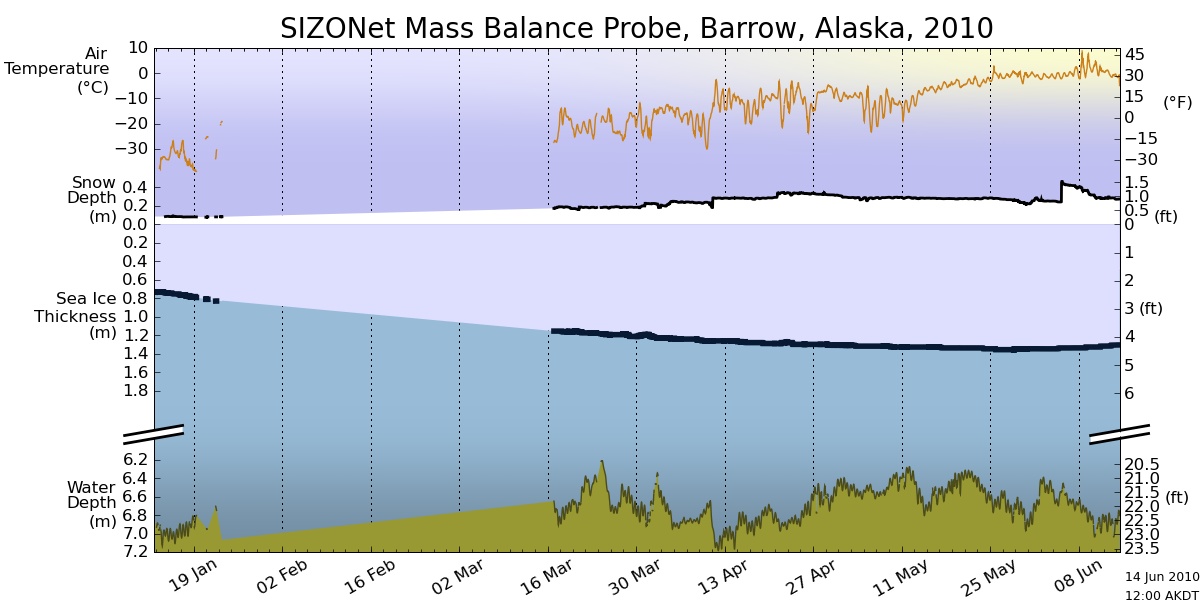
Ice offshore of Barrow, Alaska is showing little signs of melt so far.
 ‘
‘
http://seaice.alaska.edu/gi/observatories/barrow_sealevel/brw2010/BRW_MBS10_overview_complete.png
The current break up forecast calls for July 5.

http://seaice.alaska.edu/gi/observatories/barrow_breakup
Temperatures north of 80N have been persistently below normal this summer.

http://ocean.dmi.dk/arctic/plots/meanTarchive/meanT_2010.png
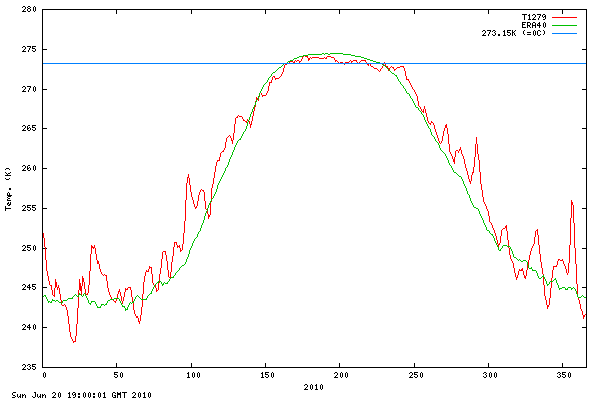
There are still no signs of melt at the North Pole, with temperatures running right at the freezing point – and below normal. Normally there has been surface melting for several weeks already.

http://psc.apl.washington.edu/northpole/webphotos/noaa2-sml.jpg

Arctic Basin ice generally looks healthier than 20 years ago.

I’m forecasting a summer minimum of 5.5 million km², based on JAXA. i.e. higher than 2009, lower than 2006.
Meanwhile down south, Antarctic ice is well above “normal” close to a record maximum for the date.

http://arctic.atmos.uiuc.edu/cryosphere/IMAGES/seaice.recent.antarctic.png

The video below shows the entire NSIDC Antarctic record for the last 30 years.It looks like a heart beating
Discover more from Watts Up With That?
Subscribe to get the latest posts sent to your email.
Just The Facts says:
June 23, 2010 at 5:17 pm
We must not mention that stuff!!! ‘Cause if we start talking about Einstein and peer-review, some one might mention people like Newton, Galileo, Pasteur, Copernicus……well, all those guys that didn’t have the “benefit” of their peers reviewing their work in the manner it gets “reviewed” today. We’d probably have to invalidate all knowledge gained prior to the 90s. …………………………………….. Have we come up with anything useful since then using the peer-reviewed method of discovery?
Who of any scientific significance is making this unqualified prediction? I’m guessing no one (except some lay people in blog threads).
Steve Goddard says:
June 23, 2010 at 2:05 pm
5.5 is the only estimate I have made.
++++
This is the piece I’m referring to, Steve: http://wattsupwiththat.com/2010/02/09/prediction-arctic-ice-will-continue-to-recover-this-summer/
If Anthony inartfully, and mistakenly, put you on the record for ~5.8M km/2 by saying you agreed it would be 500,000 km/2 greater than last year, and you corrected that later, then I missed it (always possible).
Hey, why no itty bitty teeny weenie 8-bit PIPS 2.0 Ice Thickness GIF images?
Here, let me help you;
http://www7320.nrlssc.navy.mil/pips2/archive/pips2_thick/2010/pips2_thick.2010033000.gif
http://www7320.nrlssc.navy.mil/pips2/archive/pips2_thick/2010/pips2_thick.2010062300.gif
48K km squared per day until Sept 15 and Steve is right.
64K km squared per day until Sept 15 and we will have a new record minimum.
100K km squared per day until Sept 15 and Gore will be the winner.
OK, I’m calling less than a million ice free, so sue me.
The current pace has been averaging 63K for the last month, and most
years, the early summer pace held on for the summer.
Except 2007, where it increased.
So, my dollar says 4.3 to 4.5, no new record but it will be close.
R Gates writes of David Barber’s excellent talk at the Oslo IPY conference:
“This ‘on the ice’ kind of reporting is very powerful and direct, and needs to be including in understanding how to more accurately interpret satellite data.”
I agree, Barber’s report from the ice makes a fine illustration of how field science complements the remote sensing and modeling work in climate research.
As if reinforcing Barber’s sea-level view, MODIS now shows huge areas of riddled ice in the Beaufort Sea and elsewhere that grow day by day.
barry says: June 23, 2010 at 6:04 pm
[And yet we are told that 2010 will beat 2007 in terms of melt.]
“Who of any scientific significance is making this unqualified prediction? I’m guessing no one (except some lay people in blog threads).”
Apparently Wilson and Maslanik, but they do appear to be outliers:
http://www.arcus.org/files/search/sea-ice-outlook/2010/06/images/summary/sioresultschartfig1rev_0.jpg
Julienne says: June 23, 2010 at 5:01 pm
“Air temperatures do remain anomalously warm over the Arctic, I am not sure where you are getting the information that says otherwise.”
This chart from DMI appears to show a negative anomaly;
http://ocean.dmi.dk/arctic/meant80n.uk.php
but I haven’t done much digging into Arctic temps. What data sources do you rely upon?
Why is this;
http://climateinsiders.files.wordpress.com/2010/06/uiucjune222010vsjune221990.jpg
Totally different from from the following two higher resolution two sea ice concentration images for the 20-year difference between 6/22/1990 and 6/22/2010?
http://arctic.atmos.uiuc.edu/cryosphere/IMAGES/ARCHIVE/19900622.png
http://arctic.atmos.uiuc.edu/cryosphere/NEWIMAGES/arctic.seaice.color.000.png
I mean 1990 looks way better than 2010, the small image you posted comparing 6/22/1990 and 6/22/2010 looks completely different for the current date, 6/22/2010.
Does this disclaimer “Sea ice concentrations less than 30% are not displayed in these images.” for the itty bitty teeny weenie Cryosphere image comparisonator have anything to do with this dramatic difference?
R, Gates,
you are biased. you make no attempt to be unbiased. Though you feign that you are unbiased.
In an thread yesterday you twisted something I said and tried to make it appear that was what I was actually meaning.
R. Gates says:
June 23, 2010 at 5:39 pm
as we are all tired of that I’m certain
You’re right, you are tiring.
And here you are again trusting in one climate model and ignoring EVERYTHING else.
Julienne says:
June 23, 2010 at 5:01 pm
Air temperatures do remain anomalously warm over the Arctic, I am not sure where you are getting the information that says otherwise.
Anomalously warm? This data says otherwise, doesn’t it?
http://climateinsiders.files.wordpress.com/2010/06/meant_2010-3.png?w=510&h=340
Julienne, I am sure you understand the properties of LW and SW infrared and its ability to warm air versus water. I hope you do. CO2 is a greenhouse gas that absorbs and re-radiates LW infrared, and is one of the gases (water vapor being king of course) responsible for keeping air temperatures warm (but not oceans) which is way desert air cools so rapidly at night (no water vapor to keep things warm). So given that LW cannot warm oceans (it only penetrates the surface tension layer of water and then the thin layer of heated water is quickly evaporated), please explain your mechanism that says it does.
Julienne,
DMI shows below normal temperatures north of 80N, and NOAA shows normal to below normal temperatures in the Arctic Basin for the last month.
Richard Lindzen makes an illustration that computer models are like Ouija boards:
The 2007 melt had little to go with global warming. Ice floes were directed towards a powerful shoot out Fram Strait where the ice melted outside of the Arctic. Kinda like a “duh” event. People who compare any year with that year as an argument for or against a long term trend position argues with an anomalous event, and thus weakens their argument considerably.
geo,
I think you are referring to a rough estimate Anthony made seven months ago. Looks like he may turn out to be amazingly close, particularly considering how early his estimate was made.
Ron,
You must be using the new maths. 2010 – 1990 = 20
BTW – the NSIDC graph you linked shows that 1990 was about the same as 2010.
http://nsidc.org/data/seaice_index/images/n_plot_tmb.png
I’m going to have to give you two strikes for that post.
Pamela Gray says:
June 23, 2010 at 7:48 pm
The 2007 melt had little to go with global warming. Ice floes were directed towards a powerful shoot out Fram Strait where the ice melted outside of the Arctic. Kinda like a “duh” event. People who compare any year with that year as an argument for or against a long term trend position argues with an anomalous event, and thus weakens their argument considerably.
And as in 2007 the thick, ‘old’ ice is ‘shooting out’ the Nares strait, so in that regard 2010 is as anomalous as 2007.
Pamela Gray says:
June 23, 2010 at 7:48 pm
and thus weakens their argument considerably
I agree with you.
What I’m putting next I know you know already. But I think there’s readers who don’t understand what global warming scientists are saying about Arctic ice being in a possible ‘death spiral’.
They view 2007 as evidence that global warming has warmed up ocean waters and that warmed waters flows in currents that travel under Arctic ice. That warmer water, they say, is melting away the underside of Arctic ice. So that though things look ok on the topside of Arctic ice there is something looming from the underside of the ice that is alarming.
The evidence is clear: this has been the fastest melt season thus far and we are now at the lowest extent for this time of year – almost 400,000 square kilometres lower than 2006 and around 500,000 square kilometres lower than 2007.
Does that mean that we will get a record? No. But it certainly means that a record is easier to acheive than otherwise.
So, those predicting something close to a record do have a significant basis on which to make that claim – the observations to date.
Sea Ice News #10
Posted on June 23, 2010 by charles the moderator
By Steven Goddard
Ice offshore of Barrow, Alaska is showing little signs of melt so far.
Probably because it stopped recording on June 14th! The little upkick in the snow depth on about the 5th June was caused by a Polar bear ‘playing’ with the equipment, data after that was compromised. That ice is in fact the ‘fast’ ice on shore, the ice offshore of Barrow has in fact gone:
http://rapidfire.sci.gsfc.nasa.gov/realtime/single.php?A101712310
Phil. says:
June 23, 2010 at 8:20 pm
And as in 2007 the thick, ‘old’ ice is ‘shooting out’ the Nares strait, so in that regard 2010 is as anomalous as 2007.
The Northern Ice Cube Maker can afford to do that. We in the Northern Temperate Zone, however, call ill afford to have the ice cubes lowering the Atlantic SST’s even further. As if the Eastern Pacific and the Northern Atlantic aren’t cooling fast enough already. Lastly, for all the ballyhoo about the Arctic, the Global Sea Ice Anomaly hangs right around zero.
Mercator Ice Thickness (which, oddly enough is quite similar to Pips 3.0, in that it adds Ice MOVEMENT to the raw concentration data from the microwave sats, see: http://www.mercator-ocean.fr/html/actualites/news/actu_glacedemer_en.html … Note that like Pips, they keep promissing to have “real-time” updates for the Buoy data. Instead they do a daily extrapolation from concentration alone = Pips 2.0, but do adjust it about every 2 weeks for the ice drift — which is, of course, better than Pips.):
… using their archive & plugging in past years::
http://bulletin.mercator-ocean.fr/html/produits/psy3v2/ocean/regions/bull_ocean_arc_en.jsp?nom=psy3v2_20100526_22060
I found an AVERAGE THICKNESS in one corner of the map:
18 June 2008: – – 3.2 meters
17 June 2009: – – 3.1 meters
18 June 2010: – – 3.0 meters
hmmm.
Visually, the difference in the thicker ice is GROSS. Looks like as LOT more drop than that.
Piomas’s new Update (getting to be 1 a month) is now almost 3000 km3 below 2007 !
– – as the 2009 minimum was 5800 – – that is HALF. And that would be IF it levelled out.
http://psc.apl.washington.edu/ArcticSeaiceVolume/IceVolume.php
The June Sea Ice Outlook that FergalR mentioned has >> ME << in it:
http://www.arcus.org/files/search/sea-ice-outlook/2010/06/images/summary/sioresultschartfig1rev.jpg
In the text: they put me last, but gave a truly proper summary of my position:
http://www.arcus.org/search/seaiceoutlook/2010/june
Wilson (No organization provided); [Prediction:] 1.0 Million Square Kilometers; [Methods:] Statistical and Heuristic
2007’s El Nino did three things to melt off 40% of ice volume relative to 2006:
(1) 2007 was hot, 2010 was more so; December was the highest monthly anomaly ever, February was 4th highest, March 10th highest, April 7th highest and the warmest April ever (these are figures from the Satellite (uah) Lower Troposphere breakout for N. Polar OCEAN).
(2) Winds pushed ice, though this will be critical mainly in July. 2007 and 2010 are unique in breaking the Nares Ice Dam, and 2010 broke it much worse.
(3) Cloudiness was 16% less than norm; if I am wrong, it will be here.
– – –
Frankly, if this were a Contest, except for the Clouds: Looks like I'll Lap the Field.
But I don't want to.
Rather not DIE, you see.
So Congrats again on the Barrow Cloud report Steve: – – KEEP THOSE CLOUDS COMING !
More Clouds = Live.
Here's the BEST graph showing how clouds, on average, reduce Sun, after May:
http://www.arcus.org/search/seaiceoutlook/2010/june
And Piomas WAS (past tense) the ONLY Ice-volume model to use actual Ice Thickness MEASUREMENTS … nothing I have seen can Overrule its accuracy for May 2008 to May 2010 (You all have been confused by the JUNE dates Steve gives – – ICESAT only charted Feb-March & October-November -to conserve its failing lasers – – so his 2008 figures are really BEFORE-the-2008-melt & are properly considered the results of 2007's Big Melt not 2008 – – also, those one-off accounts of 1 ship or 1 sub trip have wide variability: here is the TOTAL sub vs. Piomas :http://psc.apl.washington.edu/zhang/IDAO/retro.html#Submarine_ice … and just to show it kept dropping after that: ("Ra" is the subs, "MY" is multi-year FY = first year=thin ): Note the big Drop in 2007: Icesat http://www.arctic.noaa.gov/reportcard/figures/seaice2009fig4.jpg )
…. BUT:
… since May 1, no more "IceBridge" laser-equipped Airplane flights … & Piomas becomes an extrapolation just like the others (at least away from the shore where there are a few measurements).
Maybe it can't be trusted either.
I hope.
Meanwhile everyone else is confident they can Predict really reliably the September 8 Minimum …
… if they wait for the data from August the 28th.
Doesn't give a lot of time to stop it.
If the Great Melt Off happens = Warm Currents turn around = 300 mph Winds come February or so..
Currently I give it 15%
… times 6 Billion dead.
David Gould says:
June 23, 2010 at 8:28 pm
And if we get a record melt in the Arctic, it will be at the expense a monsterously-cold Northern winter, El Nino being exhausted.