Guest post by Steven Goddard
Scientific American recently reported on the dodgy concept that climate change causes volcanoes, when in fact it is quite the opposite.

Wikipedia : An early 19th-century illustration of Krakatoa
In 1883, Krakatoa produced massive amounts of ash during an eruption estimated to the equivalent of 200 megatons – or 13 times larger than the Hydrogen Bomb detonated at Bikini Island. Average global temperatures dropped by about 1.2°C during the following year as a result of ash blocking the sun.
It has been hypothesized by a volcanologist at Los Alamos, that the Dark Ages were triggered by agricultural collapse following the 535AD eruption of Krakatoa.
Modern history has its origins in the tumultuous 6th and 7th centuries. During this period agricultural failures and the emergence of the plague contributed to: (1) the demise of ancient super cities, old Persia, Indonesian civilizations, the Nasca culture of South America, and southern Arabian civilizations; (2) the schism of the Roman Empire with the conception of many nation states and the re-birth of a united China; and (3) the origin and spread of Islam while Arian Christianity disappeared. In his book, Catastrophe An Investigation into the Origins of the Modern World, author David Keys explores history and archaeology to link all of these human upheavals to climate destabilization brought on by a natural catastrophe, with strong evidence from tree-ring and ice-core data that it occurred in 535 AD.
With no supporting evidence for an impact-related event, I worked with Keys to narrow down the possibilities for a volcanic eruption that could affect both hemispheres and bring about several decades of disrupted climate patterns, most notably colder and drier weather in Europe and Asia, where descriptions of months with diminished sun light, persistent cold, and anomalous summer snow falls are recorded in 6th-century written accounts. Writings from China and Indonesia describe rare atmospheric phenomena that possibly point to a volcano in the Indonesian arc. Although radiocarbon dating of eruptions in that part of the world are spotty, there is strong bathymetric and volcanic evidence that Krakatau might have experienced a huge caldera eruption. Accordingly, I encouraged a scientific expedition to be led by Haraldur Sigurdsson to the area.
The expedition found a thick pyroclastic deposit, bracketed by appropriate radiometric dates, that suggests such a caldera collapse of a Proto-Krakatau did occur perhaps in the 6th century. Bathymetry indicates a caldera some 40 to 60 km in diameter that, with collapse below sea level, could have formed the Sunda Straits, separating Java from Sumatra, as suggested by ancient Javanese historical writings. Such a caldera collapse likely involved eruption of several hundred cubic kilometers of pyroclastic debris, several times larger than the 1815 eruption of Tambora. This hypothetical eruption likely involved magma-seawater interaction, as past eruptions of Krakatau document, but on a tremendous scale. Computer simulations of the eruption indicate that the interaction could have produced a plume from 25 to >50 km high, carrying from 50 to 100 km3 of vaporized seawater into the atmosphere. Although most of the vapor condenses and falls out from low altitudes, still large quantities are lofted into the stratosphere, forming ice clouds with super fine (<10 micrometer) hydrovolcanic ash.
Discussions with global climate modelers at Los Alamos National Laboratory led me to preliminary calculations that such a plume of ash and ice crystals could form a significant cloud layer over much of the northern and southern hemispheres. Orders of magnitude larger than previously studied volcanic plumes, its dissipation and impact upon global albedo, the tropopause height, and stratospheric ozone are unknown but certainly within possibilities for climate destabilization lasting years or perhaps several decades. If this volcanic hypothesis is correct, the global, domino-like effects upon epidemics, agriculture, politics, economics, and religion are far-reaching, elevating the potential role of volcanism as a major climate control, and demonstrating the intimate link between human affairs and nature.
More recent volcanic events which lowered global temperatures, were the 1991 eruption of Mount Pinatubo and the 1983 eruption of El Chichón.
http://www.woodfortrees.org/graph/uah/from:1978/plot/rss/from:1978
A 2002 study reported in Science demonstrated that feedback from water vapor in the atmosphere was largely responsible for the 1984 cooling.
Global Cooling After the Eruption of Mount Pinatubo: A Test of Climate Feedback by Water Vapor
The 1815 eruption of Mt. Tambora (the largest eruption in modern history) led to the Year Without a Summer in 1816.

The explosion is estimated to have been at scale 7 on the Volcanic Explosivity Index.[17] It had roughly four times the energy of the 1883 Krakatoa eruption. An estimated 160 cubic kilometers (38 cubic miles) of pyroclastic trachyandesite was ejected, weighing approximately 1.4×10¹⁴ kg (see above).This has left a caldera measuring 6–7 km (3.7–4.3 mi) across and 600–700 m (2,000–2,300 ft) deep.[2] The density of fallen ash in Makassar was 636 kg/m².[18] Before the explosion, Mount Tambora was approximately 4,300 metres (14,100 ft) high,[2] one of the tallest peaks in the Indonesian archipelago. After the explosion, it now measures only 2,851 metres (9,354 ft).[19]
The 1815 Tambora eruption is the largest observed eruption in recorded history (see Table I, for comparison).[2][4] The explosion was heard 2,600 kilometres (1,600 mi) away, and ash fell at least 1,300 kilometres (810 mi) away.[2] Pitch darkness was observed as far away as 600 kilometres (370 mi) from the mountain summit for up to two days. Pyroclastic flows spread at least 20 kilometres (12 mi) from the summit.
Mt. St Helens erupted 30 years ago next month. Like the Icelandic volcanoes, it was covered with thick ice and snow.

Mt. St. Helens prior to the eruption : Britannica Image
Meltwater from the ice and snow contacted the rising magma, leading to a huge amount of steam pressure and a massive explosion on May 18 following the collapse of the north flank.
I was involved in some experimental research around that time, which demonstrated that the amount of ash and the explosivity of volcanoes is primarily dependent on the amount of water which comes in contact with the magma underground. It can be concluded that the glaciers in Iceland are contributing to the ash, not the other way around – and that volcanoes cause climate change, not the other way around.
Brian J. Soden,1* Richard T. Wetherald,1 Georgiy L. Stenchikov,2 Alan Robock2The sensitivity of Earth’s climate to an external radiative forcing depends critically on the response of water vapor. We use the global cooling and drying of the atmosphere that was observed after the eruption of Mount Pinatubo to test model predictions of the climate feedback from water vapor. Here, we first highlight the success of the model in reproducing the observed drying after the volcanic eruption. Then, by comparing model simulations with and without water vapor feedback, we demonstrate the importance of the atmospheric drying in amplifying the temperature change and show that, without the strong positive feedback from water vapor, the model is unable to reproduce the observed cooling. These results provide quantitative evidence of the reliability of water vapor feedback in current climate models, which is crucial to their use for global warming projections.
rbateman\ nandheeswran jothi\sam bailey\Scarlet Pumpernickel
You may be interested in this then…
Solar Activity and Seismic Activity
Found this interesting paper on Solar Cycles and the effect on seismic activity. May be worth an article – especially in the light of recent Chinese quakes and the Icelandic volcano!
http://www.khalilov.biz/pdf/About%20possible%20influence%20of%20solar%20activity%20upon%20seismic%20and%20volcanic%20activities%203.pdf
Quote:“It has been determined that in the period of solar activity increase (11-year cycles) there increase seismic and volcanic activities in the compression zone of Earth and at the same time there decreases the activity in the tension zones of Earth. On the basis of the discovered stable 11-year and 22-year cyclicalities in the seismic and volcanic activities and their high correlation with solar activity there has been made the long-term forecast until 2018. The next maximum of seismic and volcanic activity with very high amplitude for the compression zones of Earth is forecasted for the period 2012-2015.”
Of course, more dust in the atmosphere will mean global cooling, I expect..
Totally OT. Look at the cold weather headed for Nevada on Wednesday afternoon.
http://www.weatherstreet.com/data/TEM_081.jpg
Is it possible that the grounding of aircraft in Europe was unneccessary?
An over-reaction or possibly an eco-warrier in a position of power who seized his chance?
I have no idea but I feel these questions should be asked, especially as it appears that test flights by various airlines including BA have found no problem.
Phil Hays (18:26:41) :
Positive feedback does not mean unstable. Loop gains between 0 (no feedback) and +1 are stable.
You fail to see that the positive feedback adds to the output of the system, otherwise it is not a feedback. Think compound interest.
Has the Met blotted its copy-book once again? Only ONE run of a ‘model’ was sufficient to close European airspace??
“Furious airline officials yesterday shattered the safety consensus which has grounded their planes.
The German carrier Lufthansa said it was ‘scandalous’ that it was ordered on the basis of a single computer simulation of the effects of the ash cloud.
The executives believe the Met Office computer model is flawed and pointed to the 20 test flights completed safely over the weekend.
http://www.dailymail.co.uk/news/article-1267116/Operation-volcano-Navy-armada-ready-pick-thousands-stranded-Britons-France-scuppers-DIY-rescue-mission.html
In 1894, Nansen sailed within 6 degrees (400 miles) of the North Pole.
http://en.wikipedia.org/wiki/Fridtjof_Nansen
Ice currently extends more than 800 miles in every direction from the pole.
Mike (13:57:16) :You (SG, the original poster) claim “that volcanoes cause climate change, not the other way around” is only part true.
Amino Acids in Meteorites (20:36:26) :
“You say climate change is sure to cause volcanic activity then you point to the Scientific American article that uses the word “may”. And you use the word “could”. You think the words “may” and “could” are observations.”
I did not use the the word “sure”. That is your fantasy. My point was mainly about logic. SG claims the since he has shown that A causes B, it follows that B cannot also cause A. This is false. In the case at hand Sci Am article explains how this could happen in the future and likely did happen in the past.
Atomic Hairdryer (02:38:19) : “There’s the downward pressure from the ice vs the upward pressure from the magma. It seems pretty obvious to me that the upward pressure is greater. Post normal science though seems to assign greater forcings to the melting ice than the normal forcings of being in an interglacial where we’d be expecting ice to melt and glaciers to retreat. The upward forcings still seem far greater to me than any minor differences in ice mass from man-made melting.”
If the volcano is not erupting then the downward pressure and upward pressure are in balance. A change in either direction could then produce an eruption. I thick ice glacier is pretty heavy. Take it away, and an eruption is now more likely.
Whether man-made melting will or won’t melt the glaciers of Iceland is a different issue. While I think AGW is real, my fear of more more volcanoes is not a major concern. If a couple of extra eruptions were the only likely outcome of AGW I would not worry about it and feel free to burn all the carbon I wanted.
Interestingly The Daily Telegraph reports today that airlines are now running test flights.
The article is here:
http://www.telegraph.co.uk/travel/travelnews/7603908/Volcanic-ash-cloud-test-flights-raise-hope-for-European-air-traffic.html
However, the Australian Telegraph has a different take on the story from the previous day:
http://www.dailytelegraph.com.au/business/breaking-news/no-uk-flights-until-tuesday-but-airlines-suspect-reasons-for-ban-is-unfounded/story-e6freuyr-1225855203278
The Australian Telegraph reports that the flight ban results from a computer model of ash movements and concentrations but not on any actual measurements.
The Volcanic Ash Information office is part of the MET office, I understand.
Somehow, MET Office and Computer models doesn’t exactly inspire confidence. If it should prove that the warning is ill founded I would suggest there are a lot of companies and organisations around the world from airlines to flower growers in Kenya who have been badly affected and who might consider suing the MET office.
Graham F
Solar Activity and Seismic Activity
thank you for the enlightening link. This enquiry was purely driven by a layperson’s curiosity through following posts here on the subject.
How much WUWT adds to my daily dose of fascination and comprehension about our real world cannot be measured (except by my continuing wonderment) This site has become an oasis of sanity in these times of cosmetic hype and cynical manipulation.
“Give us the data” – head of KLM in interview with Euronews
I am one of many thousands stuck on the continent with my kids, delayed but thankfully with alternative transport arranged for Wednesday, so I’m watching the news rather obsessively. The interview the head of KLM just gave to Euronews struck me as ironic*:
I am paraphrasing, there were too many interviews with the heads of Lufthansa, Air Berlin, British Airways etc to remember it all but the “Give us the data” speech was by far the most striking for me.
On the question of danger, here are two small bits of information of flights that weren’t so good:
Finnish jet fighters were caught out and badly damaged on Thursday
http://www.ilmavoimat.fi/index.php?id=1149
(Finnish Airforce news release, NOT English.)
http://www.flightglobal.com/articles/2010/04/16/340727/pictures-finnish-f-18-engine-check-reveals-effects-of-volcanic.html
and CNN interviewed this researcher, reporting on the skies above Britain:
He then added in a CNN TV interview, the concentration of ash measured over Southhampton today was at least four or five times higher than anything they measured on Thursday.
http://edition.cnn.com/2010/TRAVEL/04/18/volcano.ash.test.flights/index.html (halfway down the page for the online version of the statement by Gratton)
*Truthfully, laughing hysterically probably matches my mood better.
So what this clearly shows is that gasses that are emitted into the atmosphere can have a dramatic effect on climate, overpowering any other factor.
Can someone explain why the (very compressible) steam can move solid rock, when the (not compressible) liquid magma has failed to do so?
Gases compress over a large volume. Potential energy as expressed as the integral of PdV is much larger.
stevengoddard (05:44:00) :
You said: “I don’t think there is much question that the soil liquefaction on Mt. St. Helens was primarily due to the large amount of mud (liquefied soil) which accumulated there, as the heavy snow/ice pack melted in the weeks prior to the eruption”
Again, you’re close but I think you have the semantics wrong. Liquefaction is the process by which seismically induced cyclical stresses cause saturated, unconsolidated sediments to densify. Densification results in the expulsion of some of the water from the formation (and in some cases spectacularly to the surface as happened in the recent Baja earthquake) or results in increased pore water pressures when the water can’t escape fast enough. This results in the temporary near complete loss of shear strength of the material. The liquefied condition exists only as long as it takes the excess pore water pressure to dissipate. The amount of liberated water is relatively small and would not be enough to generate the tremendous volumes of lahars (volcanically generated debris flows) associated with the Mt. St. Helens eruption.
The process of formation of lahars is one of mixing of surface waters (snow/glacier melt, rainfall, river and lake waters) with volcanic ash and tephra. Melted snow mixes with ash and produces a fluid with a high suspended solids content. The resulting fluid has a significantly greater specific gravity than water and in combination with higher vicosity becomes very effective at entraining everything loose in it’s path into the flow. This process was recently seen on a small scale in the debris flows that were generated by normal winter rainfall on the slopes burned by last summer’s southern California forest fire.
While liquefaction of limited areal extent may have had a role in the initiation of the landslide which lead to the eruption, it was not responsible for the creation of the debris flows.
The Met Office states that a 15 minute run of their model is enough, though does admit to using other tools to make assessments too:
http://metoffice.com/aviation/vaac/forecasting.html
“The London VAAC forecaster provides the location, start time, release height and the top and bottom of the plume (if known) and the model is run. It takes about 15 minutes to complete….
The Volcanic Ash Detection Tool uses the brightness temperature difference between two spectral channels to detect, monitor and track the movement of volcanic ash.
The Volcanic Eruption Detection System uses a shape-matching technique to produce an automated alert that a suspected volcanic eruption cloud has been detected. “
It is interesting how fast the volcanic fe forced stimulus to phytoplankton is ,
Uk phytoplankton bloom saturday 17th April Modus (aqua)
http://i255.photobucket.com/albums/hh133/mataraka/ukphyotplanktonbloom.jpg
I believe the repetitive nature of local volcanic eruptions is indicative of an interrupted continual flow of geothermal energy from a source deep in the earth. I picture pressure building up as long as this flow is blocked until a surface failure occurs and then all energy built up since the last eruption is suddenly released in one or more short events. Finally the fracture is fully healed by solidifying magma and the cycle repeats.
With this model, the time of any given eruption may be influenced by surface stresses, but the overall rate of eruptions is determined by the magnitude of each source of subterranean geothermal energy. I believe that it is generally accepted that the expansion of dissolved gases in rising magma provides the primary impetus driving this magma upward with such force that it can eventually break through to the surface.
According to some scientists it’s the other way about: climate change can cause volcanoes…
http://www.telegraph.co.uk/earth/environment/climatechange/7604188/Volcanic-ash-cloud-Global-warming-may-trigger-more-volcanoes.html
Someone just had to link geological events to AGW at some point, didn’t they.
re: Mike (15:55:02) :
If the volcano is not erupting then the downward pressure and upward pressure are in balance. A change in either direction could then produce an eruption. I thick ice glacier is pretty heavy. Take it away, and an eruption is now more likely.
Whether man-made melting will or won’t melt the glaciers of Iceland is a different issue.
—
I think the issue is keeping a sense of perspective. We’re used to seeing natural variability having the AGW lable slapped on it, and we’ll see more in the run up to Earth Day. People have an awful lot of money and time invested in promoting ‘green’ initiatives and want their profits, so we get advertorials like this from Scientific American.
As I understand it, this eruption has been building for a long time. Initially it found a weaker path and erupted between the ice fields. Now, it’s erupted under the ice. The seems to indicate to me that the upward forcing is greater than the downward.
Bigger anthropogenic issue is the way it’s demonstrated our vulnerability to natural events, and whether we’re being overcautious with our calls to action to follow the precautionary principle.
I wonder if it is not more correct to just say that volcanic eruptions affect the weather as opposed to saying that they cause climate change. With the possible exception of supervolcano eruptions, I do not think anyone has demonstrated that any single volcano eruption has ever caused a long-lasting climate change.
Something, such as a major asteroid impact, that caused a worldwide change in the rate of volcanic activity might qualify, but I think most volcano eruptions just change the weather for a few years.
Gregg E. (00:48:29) :
All video is made up of a sequence of still images.
In reviewing this Icelandic volcano eruption situation, it seems to me that with the entire past world focus on manmade greenhouse gases only, we seem to have taken our eye off other natural planetary cycles and potential risks which are far more consequential and immediate.
Like VULCANISM[all locations and not just Iceland], EARTHQUAKES, UPCOMING GLOBAL COOLING, POSSIBLE IMPACT OF EARTH PASSING THROUGH A TAIL OF A COMET OR ASTEROID,and INLAND STORMS, just to name a few.
It also begs the question, how thoroughly were negative risk analysis done on possible other risk factors that might totally dwarf or wipe out any small amount of warming caused by manmade CO2.During the last 5 months we have already seen two significant world events or natural causes [like negative AO, EL Niño & changing jet stream patterns causing a very severe winter and now the Icelandic Volcanic eruptions].These could potentially in the future wipe out any global warming for the next several years. AMO and PDO are already trending to negative or cool and will only add to the possible cooling not to mention the low solar activity and possible La Nina.To be focused on global warming only when there could be much more imminent and consequential risks to mankind, I find hard to comprehend. How many other shocks do we need before we start to look at all risks in a more balanced way? Global warming threat seems to be overblown and may not turn out to be a problem at all while other risks turn out to be “black swans”
“”” Dr A Burns (13:53:37) :
“the importance of the atmospheric drying in amplifying the temperature change ”
In other words, positive feedback caused by water vapour causes temperature falls to increase at an accelerating rate; when temperatures rise, positive feedback causes an accelerating rate of increase. Models have conclusively proven we have an unstable climate system. It is amazing how climate still exists. “””
“”” Models have conclusively proven we have an unstable climate system. “””
That would be a first; to have a model prove something. Models are deliberately constructed to emulate something that has already been observed. Sometimes, models allow us to hypothesize as to the existence or reality of something that has NOT yet been observed. Only the subsequent observation of that something, can be offered as “proof” of anything; the models prove nothing.
“”” Allan M (16:41:46) :
Can someone explain why the (very compressible) steam can move solid rock, when the (not compressible) liquid magma has failed to do so? “””
Well I’m sure someone can Allan.
First of all, there is nothing that is NOT compressible; even magma. At best, one might say that magma is a liquid, and it has a specific Temperature coefficient of expansion; just the same as water has a specific Temperature coefficient of expansion. Once the magma has “expanded” per its TC, it can “push no more”.
The non-magma rock, however is a solid, just like steel is a solid. It too has a temperature coefficient of expansion; but in addition to that Solids also have both tensile and compressive strengths, in terms of a limiting strain (fractional change in dimension) governed by both its strength and its modulus of elasticity.
Ordinary structural steel for example (battleship plate) has a tensile strength (stress) of about 60,000 PSI, and a modulus of elasticity (Young’s Modulus) of 30 million PSI. Stress divided by Young’s Modulus, is the Strain or fractional elongation (or compression), so for steel that would be 60,000/30 million 1/500 or 0.2%. If you stretch steel by more than 0.2% it will distort in a non recoverable way and eventually fail (for the benefit of the materials scientists or structural engineers out there, I am looking at just the simple stuff).
So if the magma thermal expansion does not stretch the rock, more than its maximum strain to failure, then the rock simply stretches like a spring, and if the magma cooled down, the rock would recover. The rock would not fracture unless the magma was hot enough to expand beyond the strain limit of the rock.
Now enter the steam; which is a gas, and is NOT constrained as to volume like liquids and solids are; so it can keep on pushing and expand just as much as it wants to. Whereas the liquid magma has no more push to give after it reaaches its expansion limit set by the TC, the steam or any gas can keep on pushing. Once the solid reaches its “elastic limit”, which is the linear region where the strain is proportional to the stress, it enters a plastic flo region, where the strain increases but the modulus decreases, so a given stress increase results in a greater elongation; which of course is beyond the pushing limit of the liquid magma; but not of the steam; so the steam can keep on moving th3e rock till it fails completely.
Hey an everyday example of this difference is the DOT testing of Scuba diving tanks; or any other compressed gas cylinders.
To test the cylinder, they immerse it in a water bath, and then pump it up with water to the test pressure. If the tank fails, it simply goes “burp” and cracks open, letting a miniscule amount of the pressurized water to escape harmlessly.
If you were to apply the same internal pressure with a compressed gas; when the tank failed; it would explode catastrophically.
So that (sorry for the length) is why the steam can accomplish, what the magma can’t; the magma can only make it go “burp”.
Seems to me that some years back there was a “Disaster Movie” in the vein of Titanic, or Tornado, etc.
This one had the impressive title of:-
“Kakatoa, East of Java !”
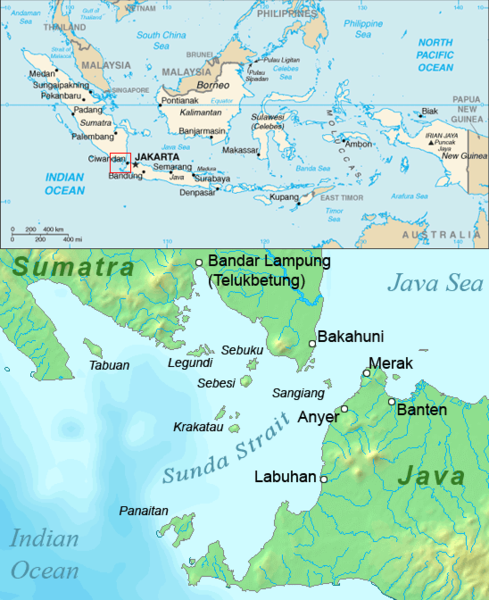
As can be seen plainly in the above map; Krakatoa is in fact West of Java.
Oh well; nobody ever said Hollywood producers were smart people.