Guest post by Steven Goddard
Scientific American recently reported on the dodgy concept that climate change causes volcanoes, when in fact it is quite the opposite.

Wikipedia : An early 19th-century illustration of Krakatoa
In 1883, Krakatoa produced massive amounts of ash during an eruption estimated to the equivalent of 200 megatons – or 13 times larger than the Hydrogen Bomb detonated at Bikini Island. Average global temperatures dropped by about 1.2°C during the following year as a result of ash blocking the sun.
It has been hypothesized by a volcanologist at Los Alamos, that the Dark Ages were triggered by agricultural collapse following the 535AD eruption of Krakatoa.
Modern history has its origins in the tumultuous 6th and 7th centuries. During this period agricultural failures and the emergence of the plague contributed to: (1) the demise of ancient super cities, old Persia, Indonesian civilizations, the Nasca culture of South America, and southern Arabian civilizations; (2) the schism of the Roman Empire with the conception of many nation states and the re-birth of a united China; and (3) the origin and spread of Islam while Arian Christianity disappeared. In his book, Catastrophe An Investigation into the Origins of the Modern World, author David Keys explores history and archaeology to link all of these human upheavals to climate destabilization brought on by a natural catastrophe, with strong evidence from tree-ring and ice-core data that it occurred in 535 AD.
With no supporting evidence for an impact-related event, I worked with Keys to narrow down the possibilities for a volcanic eruption that could affect both hemispheres and bring about several decades of disrupted climate patterns, most notably colder and drier weather in Europe and Asia, where descriptions of months with diminished sun light, persistent cold, and anomalous summer snow falls are recorded in 6th-century written accounts. Writings from China and Indonesia describe rare atmospheric phenomena that possibly point to a volcano in the Indonesian arc. Although radiocarbon dating of eruptions in that part of the world are spotty, there is strong bathymetric and volcanic evidence that Krakatau might have experienced a huge caldera eruption. Accordingly, I encouraged a scientific expedition to be led by Haraldur Sigurdsson to the area.
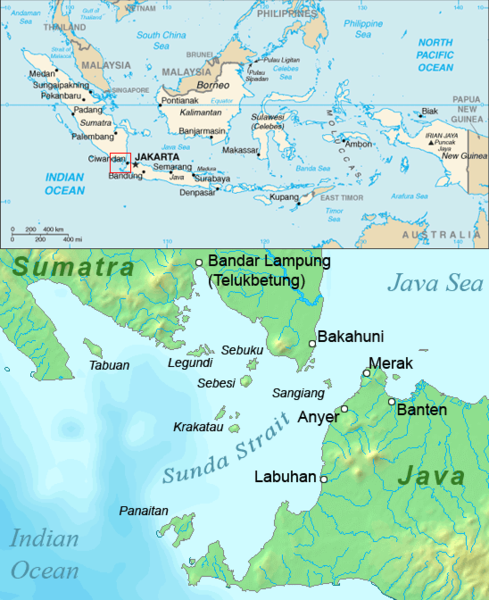
The expedition found a thick pyroclastic deposit, bracketed by appropriate radiometric dates, that suggests such a caldera collapse of a Proto-Krakatau did occur perhaps in the 6th century. Bathymetry indicates a caldera some 40 to 60 km in diameter that, with collapse below sea level, could have formed the Sunda Straits, separating Java from Sumatra, as suggested by ancient Javanese historical writings. Such a caldera collapse likely involved eruption of several hundred cubic kilometers of pyroclastic debris, several times larger than the 1815 eruption of Tambora. This hypothetical eruption likely involved magma-seawater interaction, as past eruptions of Krakatau document, but on a tremendous scale. Computer simulations of the eruption indicate that the interaction could have produced a plume from 25 to >50 km high, carrying from 50 to 100 km3 of vaporized seawater into the atmosphere. Although most of the vapor condenses and falls out from low altitudes, still large quantities are lofted into the stratosphere, forming ice clouds with super fine (<10 micrometer) hydrovolcanic ash.
Discussions with global climate modelers at Los Alamos National Laboratory led me to preliminary calculations that such a plume of ash and ice crystals could form a significant cloud layer over much of the northern and southern hemispheres. Orders of magnitude larger than previously studied volcanic plumes, its dissipation and impact upon global albedo, the tropopause height, and stratospheric ozone are unknown but certainly within possibilities for climate destabilization lasting years or perhaps several decades. If this volcanic hypothesis is correct, the global, domino-like effects upon epidemics, agriculture, politics, economics, and religion are far-reaching, elevating the potential role of volcanism as a major climate control, and demonstrating the intimate link between human affairs and nature.
More recent volcanic events which lowered global temperatures, were the 1991 eruption of Mount Pinatubo and the 1983 eruption of El Chichón.
http://www.woodfortrees.org/graph/uah/from:1978/plot/rss/from:1978
A 2002 study reported in Science demonstrated that feedback from water vapor in the atmosphere was largely responsible for the 1984 cooling.
Global Cooling After the Eruption of Mount Pinatubo: A Test of Climate Feedback by Water Vapor
The 1815 eruption of Mt. Tambora (the largest eruption in modern history) led to the Year Without a Summer in 1816.

The explosion is estimated to have been at scale 7 on the Volcanic Explosivity Index.[17] It had roughly four times the energy of the 1883 Krakatoa eruption. An estimated 160 cubic kilometers (38 cubic miles) of pyroclastic trachyandesite was ejected, weighing approximately 1.4×10¹⁴ kg (see above).This has left a caldera measuring 6–7 km (3.7–4.3 mi) across and 600–700 m (2,000–2,300 ft) deep.[2] The density of fallen ash in Makassar was 636 kg/m².[18] Before the explosion, Mount Tambora was approximately 4,300 metres (14,100 ft) high,[2] one of the tallest peaks in the Indonesian archipelago. After the explosion, it now measures only 2,851 metres (9,354 ft).[19]
The 1815 Tambora eruption is the largest observed eruption in recorded history (see Table I, for comparison).[2][4] The explosion was heard 2,600 kilometres (1,600 mi) away, and ash fell at least 1,300 kilometres (810 mi) away.[2] Pitch darkness was observed as far away as 600 kilometres (370 mi) from the mountain summit for up to two days. Pyroclastic flows spread at least 20 kilometres (12 mi) from the summit.
Mt. St Helens erupted 30 years ago next month. Like the Icelandic volcanoes, it was covered with thick ice and snow.

Mt. St. Helens prior to the eruption : Britannica Image
Meltwater from the ice and snow contacted the rising magma, leading to a huge amount of steam pressure and a massive explosion on May 18 following the collapse of the north flank.
I was involved in some experimental research around that time, which demonstrated that the amount of ash and the explosivity of volcanoes is primarily dependent on the amount of water which comes in contact with the magma underground. It can be concluded that the glaciers in Iceland are contributing to the ash, not the other way around – and that volcanoes cause climate change, not the other way around.
Brian J. Soden,1* Richard T. Wetherald,1 Georgiy L. Stenchikov,2 Alan Robock2The sensitivity of Earth’s climate to an external radiative forcing depends critically on the response of water vapor. We use the global cooling and drying of the atmosphere that was observed after the eruption of Mount Pinatubo to test model predictions of the climate feedback from water vapor. Here, we first highlight the success of the model in reproducing the observed drying after the volcanic eruption. Then, by comparing model simulations with and without water vapor feedback, we demonstrate the importance of the atmospheric drying in amplifying the temperature change and show that, without the strong positive feedback from water vapor, the model is unable to reproduce the observed cooling. These results provide quantitative evidence of the reliability of water vapor feedback in current climate models, which is crucial to their use for global warming projections.
Anyone?
If we assume an increase in volcanic activity over the next several years and have some major eruptions which cool down temperatures, should this be considered natural and not an excuse for CAGW advocates?
I heard a friend mention the Precession of the Equinoxes. What evidence does this bear on vulcanism and possible combined solar effects on our little planet I wonder? I would be most interested in some responses.
“The ghost of Big Jim Cooley (02:50:25) :
Just wanted to bounce something… DO JET AIRLINERS CAUSE CLOUDS?”
Not sure. But contrains from aircraft, apparently, do have some reflective properties similar to clouds.
Do like Richard Branson does; fight global warming, fly more!
A text extract concerning Krakatoa written 1992:
The oceans play a decisive role on how a volcanic eruption effects weather and climate. A significant aspect of Krakatoa was: “The hazy fog appears as a constant companion of the extraordinary optical phenomena in the atmosphere during the entire period of the atmospheric-optical disturbance”. Although it was quickly determined that the amount of solar energy received was clearly reduced for a period of several years, little attention was paid to the development of the atmospheric temperature. The blockage must have fluctuated strongly and have varied greatly, depending on the observation point. In total, the blockage effect has been calculated at an average of approximately 10% over a span of four years, whereby the reduction of solar energy in the northern hemisphere (Paris) was at its greatest in fall of 1885, reaching a value of 25%. It would seem that a reduction of solar radiation of such proportions would necessarily have a long-lasting effect on atmospheric dynamics. But supposedly the average temperatures fell only slightly and the atmospheric circulation in 1884 was above normal and did not sink to a strongly developed minimum until 1888. One could say – speaking non-technically – that Nature had “popped a lid over it” and so protected the oceans from cooling off too quickly. The lid consisted of ingredients provided by Krakatoa and water vapour provided by the ocean. As a result of the “dirtying” of the atmosphere by the volcano’s eruption, the atmosphere displayed characteristics and behaviour deviating from the norm.
More at: Chapter “2. Krakatoa – A Climatic Once-in-a-Century Event?” at http://www.whatisclimate.com/conditions-for-the-protection-of-the-global-climate.html
fhsiv (23:34:05) :
I don’t think there is much question that the soil liquefaction on Mt. St. Helens was primarily due to the large amount of mud (liquefied soil) which accumulated there, as the heavy snow/ice pack melted in the weeks prior to the eruption.
The top of the volcano averaged well over 100 inches of precipitation a year, almost all as snow. Here is a good page with references to Mt. St. Helens mudflows and Lahars.
http://vulcan.wr.usgs.gov/Volcanoes/MSH/Lahars/framework.html
http://www.angelfire.com/pa3/facts/
Volcano pictures;
http://sverrir.net/eldgos2010/
Here is a good link discussing cloud formation from jet contrails
http://www.wrh.noaa.gov/fgz/science/contrail.php?wfo=fgz
“The eruption is taking place under Iceland’s Eyjafjallajokull glacier, normally a popular hiking ground about 120 km (75 miles) southeast of the capital Reykjavik.
Kjartansson believes the volcano has melted about 10 percent of the glacier, but melting might have slowed in recent hours.”
Must be AGW, right?
With regards to the paragraph ‘Global Cooling After the Eruption of Mount Pinatubo: A Test of Climate Feedback by Water Vapor….These results provide quantitative evidence of the reliability of water vapor feedback in current climate models, which is crucial to their use for global warming projections.’
My interpretation of this paragraph is : The IPCC climate models use the idea that water vapour has a large positive feedback on the small increase in temperature due to CO2 heating. Their volcano model uses this idea in reverse, in that the drying caused by the the volcano reduces the water vapour and so leads to the observed cooling.Thus their model supports the IPCC models.
Firstly, the IPCC models do not correspond with real measurements so are invalid. If they can not model the current Earth there is no reason to suspect this will change in the next 90 years!
Secondly, research on the real atmosphere suggests that water vapour provides a negative feedback, so for a doubling of CO2 the rise in temperature will be limited to 0.5C.
The only conclusion is that both models are wrong.
The idea of having two models, which both require the same effect, as being confirmation of each other is bizarre, when neither corresponds to reality! If they had a real result then it should have given a specific value for the effect of water vapour, and they should then have been able to eliminate most of the IPCC models, but apparently their results were so vague they could not eliminate any of the wide range of IPCC models!
The phrase ‘lifting yourself up by your bootstraps’ comes to mind.
One theory which does agree with reality is Miskolczi’s :
http://www.landshape.org/dokuwiki/doku.php?id=introduction
http://miskolczi.webs.com/Answers_to_some_criticism.htm
Some interesting reading if you google “Europa tidal stress”. Lots of ice and volcanism to be found there.
Kum Dollison
Youasked
“Does anyone know where I can find some information on N. American/European temperatures the last time this happened? In 1821”
We were in the middle of the cold period of the Dalton Minimum[1790-1830] when both Katla and Eyjafjallajokull erupted last 1821-1823.[Katla eruption was june 1823 after Eyjafjallakull eruption from December 1821 -December 1822 was over] .We were also in a very cold period again in 1612 during the Little Ice age when they both went off . Katla’s eruption was October 1612 . A similar event happened during 920.[ near the end of the Dark Ages Cold Period] ]
@The ghost of Big Jim Cooley (02:50:25) :
“We’ve have had completely cloudless skies for three and a half days where I live. ”
Not sure where you are ghostof but here in Southern England the same has been the case, with the addition (and I do not think that I am imagining it) of a brownish haze across the full horizon (or at least as much of it as I can observe from my north facing kitchen window, atop a high ridge in coastal Sussex). I only normally notice haze of this type (in fine weather) roughly above London, 50 or so miles north from here, but the current extent appears very much greater.
Big Al (15:03:07) :
“An interesting note, Mt Pinatubo blew up in the middle of a typhoon . Was it low barometric pressure that triggered the explosion?
Or maybe rainwater from the typhoon that did it.
I’ve never heard a explanation for it.”
As you might expect, the eruption of Pinatubo didn’t happen suddenly. Increased activity on the volcano was underway for some time (I think at least 1 month, but could have been longer). That Pinatubo was a very dangerous is well known and due to the proximity of the US Air Base Clark (no longer active), the volcano was under active monitoring. Actually the eruption is a scientific success for eruption prediction and Clark Air Base was essentially abandoned before the main eruption based on prediction estimates. The monsoon was a very latecomer to the eruption cycle; evacuations from Clark had mostly been completed and there is no evidence that increased rainfall caused anything other than increased misery to Manila and the surrounding areas (lahars, wet soupy ash, etc.).
anticlimactic (06:34:29) :
Water vapour itself is a positive feedback. Clouds are probably a negative feedback, though all IPCC models calculate them as positive.
Apparently the decision to ground much of Europes aircraft past days is founded on computer simulations by Volcanic Ash Advisory Centre in London.
Source: Swedish SVT Teletext.
Lufthansa and others are now strongly questioning this decision.
An interesting article by Dr. Andrew Hooper, Delft University: on the possible duration of the eruption:
http://www.timesonline.co.uk/tol/news/environment/article7101084.ece
with a nod to the less ice/more magma idea.
One of the silliest things about volcanic ash is related to its Selenium content: Environmental anthropithecuses limit its content in effluent waters to 0,20 mg/lt or by weight 0.1 ppm, however, the best harvests are gotten from higher selenium content soils; there are many examples of these all around the world, specially the Sicily oranges, high quality garlic and onion crops all over the world, etc. All the people who had a vegetable garden in Seattle, after the Saint Hellen volcano eruption have witnessed this blessing from volcanic ashes.
So bad is Selenium (according to environ-mentalists) that the closest source you can find of it is at your closest drugstore, where it is sold as an anti-ageing drug (anti-free-radicals).
Patrik (08:33:18) :
Apparently the decision to ground much of Europes aircraft past days is founded on computer simulations by Volcanic Ash Advisory Centre in London.
Source: Swedish SVT Teletext.
Lufthansa and others are now strongly questioning this decision
You are correct. Air France and Lufthansa have made trial flights and found no ash at all. So, once again, the MET post-modern-normal-scientists-kool aid intoxicated anthropopithecuses- on the run!
Or…they just wanna take us ASAP back to medieval no fossil fuels paradise.
That would be nuts but possible.
MODERATOR ATTENTION:
The link in the first sentence of the article, “Scientific American recently reported on the dodgy concept that climate change causes volcanoes, when in fact it is quite the opposite.” , takes the reader to the comments section of the article rather than the article header. While not really a problem for regular readers, it may throw off new readers. Apologize if this has been pointed out, don’t have time to go through every comment.
FYI
RichieP (08:59:57) : From the link you just gave:
I and others at Delft University of Technology have been developing algorithms to push the limits of the technique
Those HOLY AL-GORE-ITHMS at work once again!
Airlines must SUE the governments that have enforced the “post normal science” of these pseudo-climate-scientists.
Hmmmm… more fun with climate models. Sorry if my attention wanders for a few minutes.
Well, if anything I have now learned a new term for volcanic mudflows, lahars. And found out this interesting bit:
Built on deposits 500 years old, lahars predicted every 500-1000 years… Now I know someplace else where I shouldn’t have a house. Besides where the several meters of warming-caused sea level rise will be soon rushing in, that is.
stevengoddard (08:19:06) :
I know you probably know about these videos with Roy Spencer showing negative feedback from clouds. But I want to post them for those who haven’t seen them
Part 1
Roy Spencer
Part 2
@ur momisugly Enneagram (09:33:43) :
“RichieP (08:59:57) : From the link you just gave:
Those HOLY AL-GORE-ITHMS at work once again!”
Missed that, got too involved with the deformation issue (having been reading Harris’ Pompeii, coincidentally, earlier this week).