Guest post by Steven Goddard
Scientific American recently reported on the dodgy concept that climate change causes volcanoes, when in fact it is quite the opposite.

Wikipedia : An early 19th-century illustration of Krakatoa
In 1883, Krakatoa produced massive amounts of ash during an eruption estimated to the equivalent of 200 megatons – or 13 times larger than the Hydrogen Bomb detonated at Bikini Island. Average global temperatures dropped by about 1.2°C during the following year as a result of ash blocking the sun.
It has been hypothesized by a volcanologist at Los Alamos, that the Dark Ages were triggered by agricultural collapse following the 535AD eruption of Krakatoa.
Modern history has its origins in the tumultuous 6th and 7th centuries. During this period agricultural failures and the emergence of the plague contributed to: (1) the demise of ancient super cities, old Persia, Indonesian civilizations, the Nasca culture of South America, and southern Arabian civilizations; (2) the schism of the Roman Empire with the conception of many nation states and the re-birth of a united China; and (3) the origin and spread of Islam while Arian Christianity disappeared. In his book, Catastrophe An Investigation into the Origins of the Modern World, author David Keys explores history and archaeology to link all of these human upheavals to climate destabilization brought on by a natural catastrophe, with strong evidence from tree-ring and ice-core data that it occurred in 535 AD.
With no supporting evidence for an impact-related event, I worked with Keys to narrow down the possibilities for a volcanic eruption that could affect both hemispheres and bring about several decades of disrupted climate patterns, most notably colder and drier weather in Europe and Asia, where descriptions of months with diminished sun light, persistent cold, and anomalous summer snow falls are recorded in 6th-century written accounts. Writings from China and Indonesia describe rare atmospheric phenomena that possibly point to a volcano in the Indonesian arc. Although radiocarbon dating of eruptions in that part of the world are spotty, there is strong bathymetric and volcanic evidence that Krakatau might have experienced a huge caldera eruption. Accordingly, I encouraged a scientific expedition to be led by Haraldur Sigurdsson to the area.
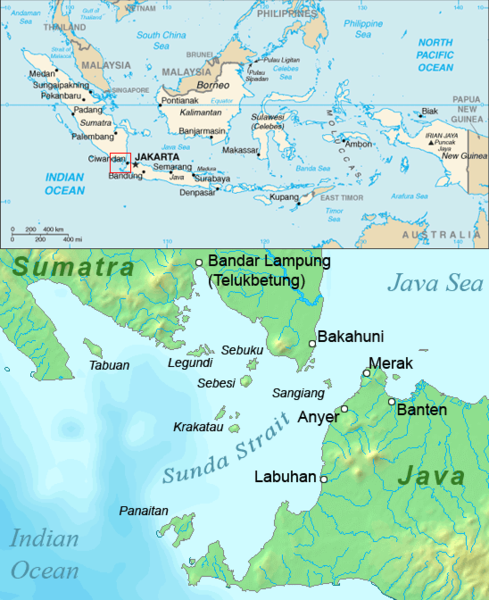
The expedition found a thick pyroclastic deposit, bracketed by appropriate radiometric dates, that suggests such a caldera collapse of a Proto-Krakatau did occur perhaps in the 6th century. Bathymetry indicates a caldera some 40 to 60 km in diameter that, with collapse below sea level, could have formed the Sunda Straits, separating Java from Sumatra, as suggested by ancient Javanese historical writings. Such a caldera collapse likely involved eruption of several hundred cubic kilometers of pyroclastic debris, several times larger than the 1815 eruption of Tambora. This hypothetical eruption likely involved magma-seawater interaction, as past eruptions of Krakatau document, but on a tremendous scale. Computer simulations of the eruption indicate that the interaction could have produced a plume from 25 to >50 km high, carrying from 50 to 100 km3 of vaporized seawater into the atmosphere. Although most of the vapor condenses and falls out from low altitudes, still large quantities are lofted into the stratosphere, forming ice clouds with super fine (<10 micrometer) hydrovolcanic ash.
Discussions with global climate modelers at Los Alamos National Laboratory led me to preliminary calculations that such a plume of ash and ice crystals could form a significant cloud layer over much of the northern and southern hemispheres. Orders of magnitude larger than previously studied volcanic plumes, its dissipation and impact upon global albedo, the tropopause height, and stratospheric ozone are unknown but certainly within possibilities for climate destabilization lasting years or perhaps several decades. If this volcanic hypothesis is correct, the global, domino-like effects upon epidemics, agriculture, politics, economics, and religion are far-reaching, elevating the potential role of volcanism as a major climate control, and demonstrating the intimate link between human affairs and nature.
More recent volcanic events which lowered global temperatures, were the 1991 eruption of Mount Pinatubo and the 1983 eruption of El Chichón.
http://www.woodfortrees.org/graph/uah/from:1978/plot/rss/from:1978
A 2002 study reported in Science demonstrated that feedback from water vapor in the atmosphere was largely responsible for the 1984 cooling.
Global Cooling After the Eruption of Mount Pinatubo: A Test of Climate Feedback by Water Vapor
The 1815 eruption of Mt. Tambora (the largest eruption in modern history) led to the Year Without a Summer in 1816.

The explosion is estimated to have been at scale 7 on the Volcanic Explosivity Index.[17] It had roughly four times the energy of the 1883 Krakatoa eruption. An estimated 160 cubic kilometers (38 cubic miles) of pyroclastic trachyandesite was ejected, weighing approximately 1.4×10¹⁴ kg (see above).This has left a caldera measuring 6–7 km (3.7–4.3 mi) across and 600–700 m (2,000–2,300 ft) deep.[2] The density of fallen ash in Makassar was 636 kg/m².[18] Before the explosion, Mount Tambora was approximately 4,300 metres (14,100 ft) high,[2] one of the tallest peaks in the Indonesian archipelago. After the explosion, it now measures only 2,851 metres (9,354 ft).[19]
The 1815 Tambora eruption is the largest observed eruption in recorded history (see Table I, for comparison).[2][4] The explosion was heard 2,600 kilometres (1,600 mi) away, and ash fell at least 1,300 kilometres (810 mi) away.[2] Pitch darkness was observed as far away as 600 kilometres (370 mi) from the mountain summit for up to two days. Pyroclastic flows spread at least 20 kilometres (12 mi) from the summit.
Mt. St Helens erupted 30 years ago next month. Like the Icelandic volcanoes, it was covered with thick ice and snow.

Mt. St. Helens prior to the eruption : Britannica Image
Meltwater from the ice and snow contacted the rising magma, leading to a huge amount of steam pressure and a massive explosion on May 18 following the collapse of the north flank.
I was involved in some experimental research around that time, which demonstrated that the amount of ash and the explosivity of volcanoes is primarily dependent on the amount of water which comes in contact with the magma underground. It can be concluded that the glaciers in Iceland are contributing to the ash, not the other way around – and that volcanoes cause climate change, not the other way around.
Brian J. Soden,1* Richard T. Wetherald,1 Georgiy L. Stenchikov,2 Alan Robock2The sensitivity of Earth’s climate to an external radiative forcing depends critically on the response of water vapor. We use the global cooling and drying of the atmosphere that was observed after the eruption of Mount Pinatubo to test model predictions of the climate feedback from water vapor. Here, we first highlight the success of the model in reproducing the observed drying after the volcanic eruption. Then, by comparing model simulations with and without water vapor feedback, we demonstrate the importance of the atmospheric drying in amplifying the temperature change and show that, without the strong positive feedback from water vapor, the model is unable to reproduce the observed cooling. These results provide quantitative evidence of the reliability of water vapor feedback in current climate models, which is crucial to their use for global warming projections.
kadaka (14:23:05) : “… protective ice cap.”
Debbie Reynonds in the movie “Mother” was the 1st to note the protective nature of ice in orange serbert where it had formed a frosty layer over the top. Albert Brook’s assessment of how effecitive it was, “It tastes like an orange foot!”
Volcanoes causing global warming and cooling and exploding thru the ice pale into insignificance because… today is World Moon Bounce Day, and nobody told me!
http://echoesofapollo.com/moon-bounce
“Ian H (18:34:42) :
The last supervolcano was Taupo in New Zealand, just over 2000 years ago. New Zealand was fortunately unpopulated at the time as the eruption significantly pasted most of the North Island.”
Which was so large that that volcano then is now a lake, the volcano is submerged and the lake levels are constantly monitored. I have a picture of the compressed ash layer from this eruption which I took while living in NZ. I’ll have to see if I can find it.
I used to work for a company that maintained and monitored the system that was used to detect lahars from Mt Ruapehu. It’s funny really because the system was so unreliable, running under Windows NT4, it was constantly down, “BSoD”, and not doing a lot.
What were European/N. American temperatures like in 1821 – 1824 time framne?
stevengoddard (19:02:57) :
Thank you for that. There has to be magma present in order for pressure/release to result in a volcanic eruption.
u.k.(us) (18:54:34) :
The mountain is flowing, because it is liquefied by meltwater from above and steam from below. Also because the rising magma made the slope steeper. The magma and steam is the cause of the explosion and the liquefaction of the ground.
rbateman (19:00:44) :
We aren’t talking about 2 miles of rock. We are talking about changes of a few meters of ice on an island with 500m peak thickness. This is what the author of the paper said:
“We believe the reduction of ice has not been important in triggering this latest eruption,” he said of Eyjafjallajokull. “The eruption is happening under a relatively small ice cap.”
Frankly, i do not believe ice encapsulates volcanic action under the ground surface in any way. Nor do I believe the ice weight accounts for much. Like Oceanic eruptions, which are generally invisible in the surface in depths of 300M, the magma is doing its mischief under the ice and out of site. The ice is meaningless in the grand scheme of the earth’s vulcanism and tectonic movement. After moving through 60 miles of hard rock, a few thousand meters of ice is hardly a show stopper. Not any more than the 12,000 feet of water that is over the Hawaii hot spot (which may move up magma from a far deeper depth. As we may be seeing in the Antarctic peninsula, the lava is flowing under the ice.
Mike (13:57:16) :
You claim “that volcanoes cause climate change, not the other way around” is only part true.
…………………………………………………………………………………………………………………
You say climate change is sure to cause volcanic activity then you point to the Scientific American article that uses the word “may”. And you use the word “could”. You think the words “may” and “could” are observations.
There is real observation in relation to volcanoes changing climate.
Observations do not come from the words “may” and “could”. You may not understand what observation of data is. “May” and “could” are not proof of anything. They are only opinions.
It appears that Katla might be entering into the equation…
http://en.vedur.is/earthquakes-and-volcanism/earthquakes/
and a 10 minute chart for the last few weeks…
http://hraun.vedur.is/ja/Katla2009/gosplott.html
RE: Les Francis (17:53:27) : “…Last super volcano? – Toba 75,000 years BPE. Toba sits in the middle of North Sumatra Island – Indonesia. Toba dropped up to six feet of ash over parts on India. Toba is also thought to have caused a bottleneck in human population (Ambrose).”
An alternative to the human population ‘bottleneck theory’ is the possibility that modern humans evolved rapidly as a very small isolated population who, at that time, were trapped in a remote and challenging environment. To disprove this speculation, one need only show that fully modern humans were widespread before the Toba event. Perhaps, one day, science will identify the location of this ancient Eden.
In regard to global warming induced volcanism, I believe that eruption cycles are largely determined by the rate a given magma chamber becomes less dense from the progressive net infusion of dissolved gases released deep within the earth. It seems reasonable that changes in the surface loading may advance or delay an impending eruption, but I believe the primary driver controlling these events is still subterranean.
Ian H says:
The thing about these particles in the troposphere is that they have a short residence time…i.e., they rain out pretty quickly. This is why it is only the volcanic eruptions that are powerful enough to send a significant amount of matter into the stratosphere (where it has a much larger residence time) that tend to have a significant climate effect. So, any significant seeding effect of the kind you are talking about is likely to be too short-lived to have a significant climatic effect.
In fact, a major reason that there is so much uncertainty regarding the radiative forcing due to aerosols is because of their complicated effects on clouds. And, I used to wonder how it was possible to use the Mt. Pinatubo eruption to conclude anything about climate sensitivity, given this uncertainty, until I understood the important distinction between the aerosols in the troposphere and those injected into the stratosphere.
Does anyone know where I can find some information on N. American/European temperatures the last time this happened? In 1821
Joel Shore (21:22:25) :
The thing about these particles in the troposphere is that they have a short residence time…i.e., they rain out pretty quickly. This is why it is only the volcanic eruptions that are powerful enough to send a significant amount of matter into the stratosphere (where it has a much larger residence time) that tend to have a significant climate effect. So, any significant seeding effect of the kind you are talking about is likely to be too short-lived to have a significant climatic effect.
Nature in her infinite wisdom decrees that opportunity should not be wasted,eg Langmann et al 2010
Volcanic ash as fertiliser for the surface ocean
Abstract
Iron is a key limiting micro-nutrient for marine primary productivity. It can be supplied to the ocean by atmospheric dust deposition. Volcanic ash deposition into the ocean represents another external and so far largely neglected source of iron. This study demonstrates strong evidence for natural fertilisation in the iron-limited oceanic area of the NE Pacific, induced by volcanic ash from the eruption of Kasatochi volcano in
August 2008. Atmospheric and oceanic conditions were favourable to generate a massive phytoplankton bloom in the NE Pacific Ocean which for the first time establishes a causal connection between oceanic iron-fertilisation and volcanic ash supply.
http://www.atmos-chem-phys-discuss.net/10/711/2010/acpd-10-711-2010-print.pdf
This brings three concomitant mechanisms into play,surface albedo,cloud nucleation due to dsmp, and co2 drawdown (from a biological POV),
The is visible in the airborne fraction ,eg Gloor et al 2010
http://i255.photobucket.com/albums/hh133/mataraka/AFPETURBATION.jpg
@ur momisugly Joel Shore (21:22:25) :
The thing about these particles in the troposphere is that they have a short residence time…i.e., they rain out pretty quickly. This is why it is only the volcanic eruptions that are powerful enough to send a significant amount of matter into the stratosphere (where it has a much larger residence time) that tend to have a significant climate effect. So, any significant seeding effect of the kind you are talking about is likely to be too short-lived to have a significant climatic effect.
I completely disagree.
I agree that the material does not linger long in the troposphere because it rains out (seeds clouds). It lingers for a lot longer in the stratosphere, but you didn’t think it stayed up there forever did you? It eventually drifts down into the troposphere where it seeds clouds. So long as there is material in the stratosphere there is a continual steady flux of cloud seeding material into the troposphere lowering the barrier to cloud formation.
I think you were trying to argue that the cloud seeding effect is merely transitory while the radiative shielding effect is long lived. However the two phenomena cannot be separated in this way. If you’ve got enough material in the stratosphere to cause radiative shielding you’ve got a sufficient flux of cloud seeding materials into the troposphere to cause widespread cloud seeding effects.
Note that cloud seeding effects do not require large amounts of material. So little is required to have a measurable effect that you can feasibly carry stuff up in a plane and seed clouds artificially.
Enneagram (18:42:43) :
That photo is worth more than a thousand words!
stevengoddard (19:53:28) :
You said: “The mountain is flowing, because it is liquefied by meltwater from above and steam from below. Also because the rising magma made the slope steeper. The magma and steam is the cause of the explosion and the liquefaction of the ground.”
You’re close! But I think a better way to describe what caused the initiation of the eruption at Mt. St. Helens is in terms of slope stabilty rather than liquefaction.
The high and steep slopes of the pre-eruption volcano were likely only marginally stable. As new magma was injected from below, a blister effect caused one side of the mountain to bulge and steepen even further. This slope configuration remained stable only under static conditions. However, when a pre-eruption earthquake associated with continuing magma movement generated seismic forces just large enough to temporarily exceed the strength of the forces resisting sliding, the slope became unstable. The result was a large scale landslide.
As the slide moved, the overburden pressure on a portion of the magma chamber was lowered just enough to allow the dissolved volatile constituents (H2O, CO2, Cl2,SO2,etc) in the nearest-to-the-surface magma to become unstable. The unstable volatiles immediately changed to the gaseous phase with an accompanying explosive volumetric increase and began a chain reaction which drove the eruption.
No meteoric water (meaning water derived from the earth’s atmosphere) was needed to drive the explosive eruption of the viscous, volatile rich, rhyolitic magma. However, infiltrating meteoric waters in the form of rainfall or melting snow likely contributed the slope instability which lead to the eruption-causing landslide. Steam and gas emissions from solidifying magma may have also contributed to pore pressure increases which increased slope instability.
@rbateman (18:46:57) :
“…Jim F (17:28:43) :
Have you examined the relationship between Solar Cycle Minima/Maxima and volcanic activity?…”
No, I’ll leave it to you to do the research and present the findings here. In my experience, volcanoes are things that exist and work over long periods of time. What solar phenomenon other than its gravitational field could speed, slow or otherwise influence the crustal or mantle processes involved in generating and feeding one of these fascinating geologic creations? Beats me.
Steven Goddard provided evidence of H2O’s presence in Mount St. Helens eruption. And there is some more evidence in this 44 minute documentary on Mount St. Helens. It is from 17:00 to 19:11 of the video.
How the Earth was made – Mount St. Helens
http://www.123video.nl/playvideos.asp?MovieID=684219
maksimovich (22:43:57) :
Volcanic ash can also used for human nutrition.
Aaron W. (16:23:31) : The earths temps should plummet once the La Nina arrives and th;e current ash in the atmosphere starts to reflect sunlight.
Right! This decade may be influenced by:
1. transition from positive to negative PDO, AO and NAO
2. transition from El Nino to La Nina
3. transition from strong to weak solar cycles
4. transition from silent to violent volcanos
Still, for temperature, we know the AGW message, The Only Way Is Up!
Re: Mike (13:57:16) :
You claim “that volcanoes cause climate change, not the other way around” is only part true. Yes, volcanoes effect climate, but that is no way negates the observation in the Sc Am article. Lots of other things can cause seismic activity.
—
Like harmonic tremors or low frequency vibrations? I’ve actually observed this one in a coffee cup from a mid-sized earth trembler located about 800m from an office I was working in. The vibrator in question was a solitary Enercon E-70 wind turbine. If there had been multiple vibrators, it may have made for more interesting patterns in my coffee cup. It may also help explain why some of the UK’s off-shore wind turbines are subsiding, and it may be interesting to observe the large planned wind farm on the Dogger Bank, epicentre of the UK’s largest recorded earthquake. We’ll have to wait and see there.
Rest is perhaps a nice demonstration of climate forcings. There’s the downward pressure from the ice vs the upward pressure from the magma. It seems pretty obvious to me that the upward pressure is greater. Post normal science though seems to assign greater forcings to the melting ice than the normal forcings of being in an interglacial where we’d be expecting ice to melt and glaciers to retreat. The upward forcings still seem far greater to me than any minor differences in ice mass from man-made melting.
Just wanted to bounce something… DO JET AIRLINERS CAUSE CLOUDS?
Here in the UK (because we’re a small island) we rarely have completely cloudless skies. We get a few, but usually wisps of cloud form and disappear. Well, not for the past three days now. We’ve have had completely cloudless skies for three and a half days where I live. Now that happens to coincide with three days of NO airliners flying. Is it coincidence? Do airliner’s engines seed clouds? For me, the idea of coincidence is too much. The only time we can get three completely cloudless days is in mid summer, but we’re into our showery month here.
Steven Goddard
Please note
uno2three4 (14:38:37) :
‘The eruption dates for El Chichon and Pinatubo are reversed in post. I think Pinatubo was in 1991 also’.
(Directly above your first graph)
[Fixed. ~dbs]
Re:
and
Indeed, that is a very important photo!
It’s on the top of the pages at E.M. Smith’s site, Musings from the Chiefio.
Thanks, I’ve been wondering where it came from.