Guest post by Steven Goddard
Scientific American recently reported on the dodgy concept that climate change causes volcanoes, when in fact it is quite the opposite.

Wikipedia : An early 19th-century illustration of Krakatoa
In 1883, Krakatoa produced massive amounts of ash during an eruption estimated to the equivalent of 200 megatons – or 13 times larger than the Hydrogen Bomb detonated at Bikini Island. Average global temperatures dropped by about 1.2°C during the following year as a result of ash blocking the sun.
It has been hypothesized by a volcanologist at Los Alamos, that the Dark Ages were triggered by agricultural collapse following the 535AD eruption of Krakatoa.
Modern history has its origins in the tumultuous 6th and 7th centuries. During this period agricultural failures and the emergence of the plague contributed to: (1) the demise of ancient super cities, old Persia, Indonesian civilizations, the Nasca culture of South America, and southern Arabian civilizations; (2) the schism of the Roman Empire with the conception of many nation states and the re-birth of a united China; and (3) the origin and spread of Islam while Arian Christianity disappeared. In his book, Catastrophe An Investigation into the Origins of the Modern World, author David Keys explores history and archaeology to link all of these human upheavals to climate destabilization brought on by a natural catastrophe, with strong evidence from tree-ring and ice-core data that it occurred in 535 AD.
With no supporting evidence for an impact-related event, I worked with Keys to narrow down the possibilities for a volcanic eruption that could affect both hemispheres and bring about several decades of disrupted climate patterns, most notably colder and drier weather in Europe and Asia, where descriptions of months with diminished sun light, persistent cold, and anomalous summer snow falls are recorded in 6th-century written accounts. Writings from China and Indonesia describe rare atmospheric phenomena that possibly point to a volcano in the Indonesian arc. Although radiocarbon dating of eruptions in that part of the world are spotty, there is strong bathymetric and volcanic evidence that Krakatau might have experienced a huge caldera eruption. Accordingly, I encouraged a scientific expedition to be led by Haraldur Sigurdsson to the area.
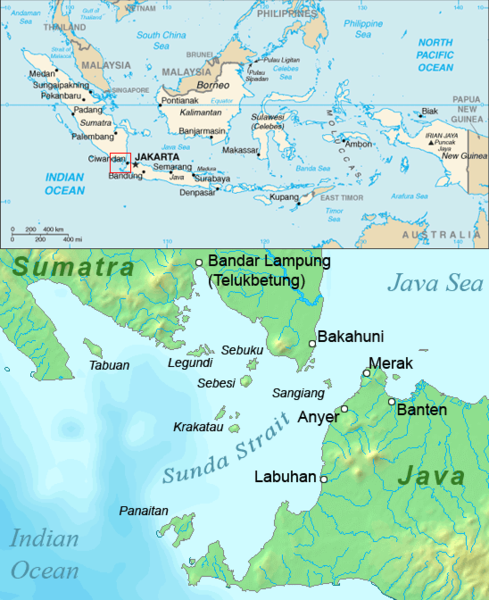
The expedition found a thick pyroclastic deposit, bracketed by appropriate radiometric dates, that suggests such a caldera collapse of a Proto-Krakatau did occur perhaps in the 6th century. Bathymetry indicates a caldera some 40 to 60 km in diameter that, with collapse below sea level, could have formed the Sunda Straits, separating Java from Sumatra, as suggested by ancient Javanese historical writings. Such a caldera collapse likely involved eruption of several hundred cubic kilometers of pyroclastic debris, several times larger than the 1815 eruption of Tambora. This hypothetical eruption likely involved magma-seawater interaction, as past eruptions of Krakatau document, but on a tremendous scale. Computer simulations of the eruption indicate that the interaction could have produced a plume from 25 to >50 km high, carrying from 50 to 100 km3 of vaporized seawater into the atmosphere. Although most of the vapor condenses and falls out from low altitudes, still large quantities are lofted into the stratosphere, forming ice clouds with super fine (<10 micrometer) hydrovolcanic ash.
Discussions with global climate modelers at Los Alamos National Laboratory led me to preliminary calculations that such a plume of ash and ice crystals could form a significant cloud layer over much of the northern and southern hemispheres. Orders of magnitude larger than previously studied volcanic plumes, its dissipation and impact upon global albedo, the tropopause height, and stratospheric ozone are unknown but certainly within possibilities for climate destabilization lasting years or perhaps several decades. If this volcanic hypothesis is correct, the global, domino-like effects upon epidemics, agriculture, politics, economics, and religion are far-reaching, elevating the potential role of volcanism as a major climate control, and demonstrating the intimate link between human affairs and nature.
More recent volcanic events which lowered global temperatures, were the 1991 eruption of Mount Pinatubo and the 1983 eruption of El Chichón.
http://www.woodfortrees.org/graph/uah/from:1978/plot/rss/from:1978
A 2002 study reported in Science demonstrated that feedback from water vapor in the atmosphere was largely responsible for the 1984 cooling.
Global Cooling After the Eruption of Mount Pinatubo: A Test of Climate Feedback by Water Vapor
The 1815 eruption of Mt. Tambora (the largest eruption in modern history) led to the Year Without a Summer in 1816.

The explosion is estimated to have been at scale 7 on the Volcanic Explosivity Index.[17] It had roughly four times the energy of the 1883 Krakatoa eruption. An estimated 160 cubic kilometers (38 cubic miles) of pyroclastic trachyandesite was ejected, weighing approximately 1.4×10¹⁴ kg (see above).This has left a caldera measuring 6–7 km (3.7–4.3 mi) across and 600–700 m (2,000–2,300 ft) deep.[2] The density of fallen ash in Makassar was 636 kg/m².[18] Before the explosion, Mount Tambora was approximately 4,300 metres (14,100 ft) high,[2] one of the tallest peaks in the Indonesian archipelago. After the explosion, it now measures only 2,851 metres (9,354 ft).[19]
The 1815 Tambora eruption is the largest observed eruption in recorded history (see Table I, for comparison).[2][4] The explosion was heard 2,600 kilometres (1,600 mi) away, and ash fell at least 1,300 kilometres (810 mi) away.[2] Pitch darkness was observed as far away as 600 kilometres (370 mi) from the mountain summit for up to two days. Pyroclastic flows spread at least 20 kilometres (12 mi) from the summit.
Mt. St Helens erupted 30 years ago next month. Like the Icelandic volcanoes, it was covered with thick ice and snow.

Mt. St. Helens prior to the eruption : Britannica Image
Meltwater from the ice and snow contacted the rising magma, leading to a huge amount of steam pressure and a massive explosion on May 18 following the collapse of the north flank.
I was involved in some experimental research around that time, which demonstrated that the amount of ash and the explosivity of volcanoes is primarily dependent on the amount of water which comes in contact with the magma underground. It can be concluded that the glaciers in Iceland are contributing to the ash, not the other way around – and that volcanoes cause climate change, not the other way around.
Brian J. Soden,1* Richard T. Wetherald,1 Georgiy L. Stenchikov,2 Alan Robock2The sensitivity of Earth’s climate to an external radiative forcing depends critically on the response of water vapor. We use the global cooling and drying of the atmosphere that was observed after the eruption of Mount Pinatubo to test model predictions of the climate feedback from water vapor. Here, we first highlight the success of the model in reproducing the observed drying after the volcanic eruption. Then, by comparing model simulations with and without water vapor feedback, we demonstrate the importance of the atmospheric drying in amplifying the temperature change and show that, without the strong positive feedback from water vapor, the model is unable to reproduce the observed cooling. These results provide quantitative evidence of the reliability of water vapor feedback in current climate models, which is crucial to their use for global warming projections.
Country with most active volcanos? – Indonesia.
Not many glaciers there – although I have seen some ice fields on some mountains in West Papua.
Last super volcano? – Toba 75,000 years BPE. Toba sits in the middle of North Sumatra Island – Indonesia. Toba dropped up to six feet of ash over parts on India. Toba is also thought to have caused a bottleneck in human population (Ambrose).
If Krakatoa were to erupt with the similar VE as 1883 the local consequences woul d be dire. Millions now live in the same areas where in 1883 thousands lived.
Vulcanologist Mike Rampino has studied Krakatoa quite extensively. Rent a disaster quote Bill McGuire was seen in the company of a film crew at Tanjung Karang /Telok Betung / Bandar Lampung who were making a documentary re Krakatoa.
Anyone?
If we assume an increase in volcanic activity over the next several years and have some major eruptions which cool down temperatures, should this be considered natural and not an excuse for CAGW advocates?
“Mr Tishkov, deputy head of the Geography Institute at Russian Academy of Science, said: ‘What we have been watching recently is comparatively fast changes of climate to warming, but within the framework of an overall long-term period of cooling. This is a proven scientific fact.
‘The recent warming – and we are talking tenths of a degree at most – is caused by human activity, like forest elimination, the changing of landscapes.
‘The greenhouse gases so much discussed now do not in fact play big role. We have to remember that all the impact of industrial enterprises in Russia cannot be compared with one volcano eruption on our planet.’ ”
Read more: http://www.dailymail.co.uk/news/worldnews/article-1260132/Russian-weatherman-strikes-blow-climate-change-lobby-announcing-winter-Siberia-coldest-record.html#ixzz0lVH2MHVu
A repost, but a relevant one.
” Leon Brozyna (13:35:14) :
That piece from Scientific American is a clear demonstration that climate change causes concept dyslexia”
Leon, those of us with dyslexia take a lot of crap anyway, so don’t add to it.
Les Francis (17:53:27) :
Indonesian volcanoes get their source of water from nearby subduction zones that drag seawater down with melting oceanic crust. As the magma rises, it already has a high water content. What appears on the surface is a semi-liquid mixture of basalt, granite and water which is called andesite.
“In other words, positive feedback caused by water vapour causes temperature falls to increase at an accelerating rate; when temperatures rise, positive feedback causes an accelerating rate of increase. Models have conclusively proven we have an unstable climate system. It is amazing how climate still exists.”
Positive feedback does not mean unstable. Loop gains between 0 (no feedback) and +1 are stable.
A volcanic event is going to influence cloud formation in a qualitatively different way to adding CO_2 to the atmosphere. The volcanic dust acts directly as nuclei seeding cloud formation in addition to any effect caused by upper atmosphere cooling, while CO_2 does not influence cloud formation in this direct manner. Because volcanic events influence climate via an additional mechanism I’d be very cautious about a study that claims to use the observed cooling due to a volcanic event to validate the imputed warming due to CO_2. The cloud seeding effect is a significant one, not a minor correction, and cannot be ignored.
I have not read the paper, but if it failed to correct for this extra direct effect of volcanic ash on cloud formation then I’d say the results actually prove that the amount of feedback in the CO_2 models is significantly overestimated. That is because the predicted cooling due to positive feedback alone would then have accounted for the observed cooling due to both positive feedback and cloud nucleation effects.
Good point it would be interesting to see if the Delta T between the core city thermometers and the airfield thermometers suddenly went down while all the planes were grounded. The volcanic ash and cloudiness would also mute the effects of the differences between tarmac and grass with regard to solar heating during the day.
Might be a very interesting data analysis.
Larry
Big Al (15:03:07) :
I saw video of what I recall as the main eruption of Mt Pinatubo, and it wasn’t raining at the time. Perhaps you’re thinking of Montserrat in the Carribean which did erupt during a tropical storm. There are enough tropical storms there and Montserrat has erupted enough that eruption and quake were bound to coincide one of these days.
I haven’t checked the facts, but I’m pretty confident of the Montserrat eruption.
“[…] the dodgy concept that climate change causes volcanoes, when in fact it is quite the opposite.” / “It can be concluded that […] volcanoes cause climate change, not the other way around.”
The coupling seems to run both ways – and on different timescales.
See the notes I’ve been adding here:
http://www.sfu.ca/~plv/VolcanoStratosphereSLAM.htm
Note particularly the results involving the Southern Ocean, the Southeast Pacific, ENSO, & the lunisolar harmonic spectrum.
I’ve added the following today (April 17, 2010):
http://www.sfu.ca/~plv/SAOT,DVI,VEI,MSI_SOI,L90,SOI+L90.png
Compare with this:
http://www.sfu.ca/~plv/SAOT_Lunar_aa_SOI.png
These insights raise some pretty serious questions – about several things.
@ur momisugly Les Francis :
Last super volcano? – Toba 75,000 years BPE. Toba sits in the middle of North Sumatra Island – Indonesia. Toba dropped up to six feet of ash over parts on India. Toba is also thought to have caused a bottleneck in human population (Ambrose).
The last supervolcano was Taupo in New Zealand, just over 2000 years ago. New Zealand was fortunately unpopulated at the time as the eruption significantly pasted most of the North Island.
May I submit:
4.(?) Honesty in politicians.
What about this?:
A volcano could be the result of underground “lightning.” Peratt and Dessler favorably compared the “volcano” Prometheus on Jupiter’s moon Io to the plume of a plasma focus device. The contours of the plume indicated that the center of discharge was about two kilometers below the surface….Are ideas of Earth’s “liquid core” and “magic mantle” simply artifacts of outdated premises? Are the mechanical deep layers of the Earth instead electrical double layers that convert pressure and displacement waves into electrical waves and back again? Do the “quake signals” that supposedly delineate magma chambers actually indicate coronal discharges around an underground plasma focus?
http://www.thunderbolts.info/tpod/2009/arch09/090408volcanoes.htm
Enneagram (18:37:00) : An image worths a thousand words: Chilean Chaiten Volcano eruption:
http://4.bp.blogspot.com/_SjBd7nY9Kp0/SCfJktNsxUI/AAAAAAAAAnQ/PBdoV_8D9-4/s400/Chaiten.jpg
Jim F (17:28:43) :
Have you examined the relationship between Solar Cycle Minima/Maxima and volcanic activity?
Lets look at scale.
To cause some global cooling a volcano need to get some aerosols high into the stratosphere where they will linger and disperse over a large area for a period of time.
St.Helens erupted around a cubic kilometer of debris laterally – i.e. sideways up to 26 miles away from the vent. Not up into the stratosphere.
Pinatubo 1992 erupted up 4 cu kilometers of debris into the stratosphere. Effect of a little cooling.
El Chincon and Galunggang 1982 around 2 cu kilometers of debris into the stratosphere.
Krakatoa 1881 around 20cu kilometers ejected – estimated 1.2 degrees celsius of global cooling. Global weather not bnack to considered normal until 1888.
Tambora 1815 100 cu kilometers of debris into the stratosphere – year without summer.
Toba 74,000BPE 800CU kilometers of debris into the stratosphere – super volcano – mini extermination event?
Richard Telford said (13:35:15) :
Contrary to what Goddard has written, there is a clear link between climate and volcanism, at least on Quaternary time-scales. Loading or unloading of the lithosphere by sea-level changes or ice-sheet growth and melting can promote volcanism by altering the stress on magma chambers and conduits to the surface.
See, for example, McGuire et al 1997. Correlation between rate of sea-level change and frequency of explosive volcanism in the Mediterranean. Nature 389, 473-476
———–
Thanks for that link. The point to be taken away from this is that there is much interaction between earth systems, and that causes can become effects and visa-versa. Undoubtedly volcanoes can cause cooling (and warming), and likewise, the isostatic rebound when glaciers melt can also cause an increase in volcanism….see for example:
http://www.springerlink.com/content/ng8276u453114154/
In general isostatic rebound is not well understood, but evidence for its effects are broad.
Another from the Redoubt volcano (Alaska ):
http://www.blog.thesietch.org/wp-content/uploads/2009/04/redoubt1_h.jpg
Enneagram (18:42:43) :
That image is interesting. The heat and water vapor coming out of volcanoes often creates thunderstorms. Particulates mixed in with the clouds also produce a lot of static charge as they rub up against other particles.
stevengoddard (17:45:59) :
“It is safe to assume that the explosion was due to the release of steam pressure. Liquids like magma have very low compressibility and can not store much mechanical energy.”
===================
With all due respect Steven, the video is an example of energy in motion. One of the few we have.
The mountain is flowing, as if, it was a liquid.
No models needed.
IMHO
David Keys “Catastrophe” is mentioned in the article above. I read this in the 1990’s and thought that it was common knowledge that Krakatau was the start of the Dark Ages and the demise of the then current civilizations. Key’s book put his theories of how it all played out.
This type of event will happen from time to time. A blast of solar energy wiping out the satellites and power distribution networks will have the same effect. Just a matter of when.
Business as usual. Pass along, ‘Nothing to see her’. As seems to be the current colloquial phrase………
R. Gates (18:49:51) :
For that matter, anything that loads/unloads pressure on rock causes it to fracture. Ice Sheets 2 miles thick is a lot of weight.
Every miner knows that when timber or support is removed from the back, the rock will soon fall.
R. Gates (18:49:51) :
I’m still baffled by ongoing claims that loss of glaciers causes more magma to form. Glaciers or the lack thereof are not a source of heat.
The loss of glaciers (like many other events) may cause a temporary increase in eruptions, which would necessarily be followed by a decrease – to regain the long-term equilibrium. That indeed seems to be what the paper you referenced is saying, that the last 2900 years have seen little volcanism.
Over long periods of time, glaciers have little or no net effect on the amount of energy coming up from the mantle.
stevengoddard (17:16:57) :
The mass of the oceans is about 1.3 × 10^21 kg
The mass of the mantle is 4.3 x10^24 kg
The mantle is nearly 4,000 times heavier than the oceans. Does anyone here seriously believe that a 0.03% change in the depth of oceans over the next century will have any meaningful effect on the energy flow, movement in the mantle, or plate tectonics? That is the argument people are making.
Changes in ice thickness have no long term effect on the amount of vulcanism. While the ice is melting, water pouring down into the magma chamber can affect the type, amplitude and frequency of eruptions.
——-
REPLY: Thank you, Steven, that would seem to be the correct analysis.
This link discusses a deep water volcano, 3 miles beneath the surface of the Caribbean:
http://www.cnn.com/2010/TECH/science/04/13/undersea.volcanic.vents/index.html
hmmm, that’s about 7000 psi down there. A bit more than a modest glacier would produce, I’d reckon.
Very interesting post, thanks!
pat (13:45:42) :
and generally to all others: Here is a series of scientific facts
smoke causes fire,
drinking causes thirst
heat causes freeze
cold causes sunstroke
antlers cause deer to fly.
elephants don’t fly as they are too light and probably wouldn’t land again