Guest post by Steven Goddard
Scientific American recently reported on the dodgy concept that climate change causes volcanoes, when in fact it is quite the opposite.

Wikipedia : An early 19th-century illustration of Krakatoa
In 1883, Krakatoa produced massive amounts of ash during an eruption estimated to the equivalent of 200 megatons – or 13 times larger than the Hydrogen Bomb detonated at Bikini Island. Average global temperatures dropped by about 1.2°C during the following year as a result of ash blocking the sun.
It has been hypothesized by a volcanologist at Los Alamos, that the Dark Ages were triggered by agricultural collapse following the 535AD eruption of Krakatoa.
Modern history has its origins in the tumultuous 6th and 7th centuries. During this period agricultural failures and the emergence of the plague contributed to: (1) the demise of ancient super cities, old Persia, Indonesian civilizations, the Nasca culture of South America, and southern Arabian civilizations; (2) the schism of the Roman Empire with the conception of many nation states and the re-birth of a united China; and (3) the origin and spread of Islam while Arian Christianity disappeared. In his book, Catastrophe An Investigation into the Origins of the Modern World, author David Keys explores history and archaeology to link all of these human upheavals to climate destabilization brought on by a natural catastrophe, with strong evidence from tree-ring and ice-core data that it occurred in 535 AD.
With no supporting evidence for an impact-related event, I worked with Keys to narrow down the possibilities for a volcanic eruption that could affect both hemispheres and bring about several decades of disrupted climate patterns, most notably colder and drier weather in Europe and Asia, where descriptions of months with diminished sun light, persistent cold, and anomalous summer snow falls are recorded in 6th-century written accounts. Writings from China and Indonesia describe rare atmospheric phenomena that possibly point to a volcano in the Indonesian arc. Although radiocarbon dating of eruptions in that part of the world are spotty, there is strong bathymetric and volcanic evidence that Krakatau might have experienced a huge caldera eruption. Accordingly, I encouraged a scientific expedition to be led by Haraldur Sigurdsson to the area.
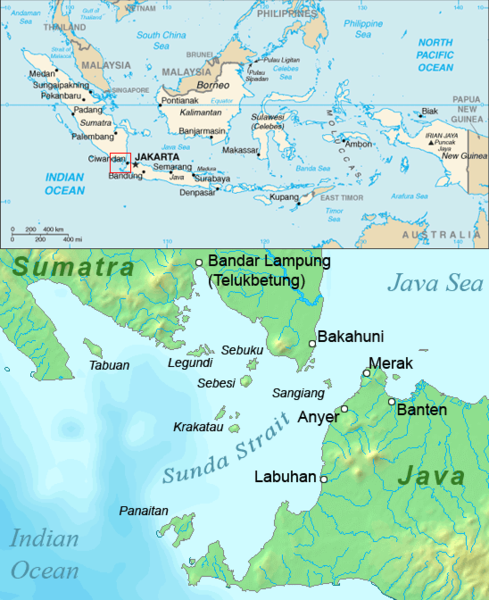
The expedition found a thick pyroclastic deposit, bracketed by appropriate radiometric dates, that suggests such a caldera collapse of a Proto-Krakatau did occur perhaps in the 6th century. Bathymetry indicates a caldera some 40 to 60 km in diameter that, with collapse below sea level, could have formed the Sunda Straits, separating Java from Sumatra, as suggested by ancient Javanese historical writings. Such a caldera collapse likely involved eruption of several hundred cubic kilometers of pyroclastic debris, several times larger than the 1815 eruption of Tambora. This hypothetical eruption likely involved magma-seawater interaction, as past eruptions of Krakatau document, but on a tremendous scale. Computer simulations of the eruption indicate that the interaction could have produced a plume from 25 to >50 km high, carrying from 50 to 100 km3 of vaporized seawater into the atmosphere. Although most of the vapor condenses and falls out from low altitudes, still large quantities are lofted into the stratosphere, forming ice clouds with super fine (<10 micrometer) hydrovolcanic ash.
Discussions with global climate modelers at Los Alamos National Laboratory led me to preliminary calculations that such a plume of ash and ice crystals could form a significant cloud layer over much of the northern and southern hemispheres. Orders of magnitude larger than previously studied volcanic plumes, its dissipation and impact upon global albedo, the tropopause height, and stratospheric ozone are unknown but certainly within possibilities for climate destabilization lasting years or perhaps several decades. If this volcanic hypothesis is correct, the global, domino-like effects upon epidemics, agriculture, politics, economics, and religion are far-reaching, elevating the potential role of volcanism as a major climate control, and demonstrating the intimate link between human affairs and nature.
More recent volcanic events which lowered global temperatures, were the 1991 eruption of Mount Pinatubo and the 1983 eruption of El Chichón.
http://www.woodfortrees.org/graph/uah/from:1978/plot/rss/from:1978
A 2002 study reported in Science demonstrated that feedback from water vapor in the atmosphere was largely responsible for the 1984 cooling.
Global Cooling After the Eruption of Mount Pinatubo: A Test of Climate Feedback by Water Vapor
The 1815 eruption of Mt. Tambora (the largest eruption in modern history) led to the Year Without a Summer in 1816.

The explosion is estimated to have been at scale 7 on the Volcanic Explosivity Index.[17] It had roughly four times the energy of the 1883 Krakatoa eruption. An estimated 160 cubic kilometers (38 cubic miles) of pyroclastic trachyandesite was ejected, weighing approximately 1.4×10¹⁴ kg (see above).This has left a caldera measuring 6–7 km (3.7–4.3 mi) across and 600–700 m (2,000–2,300 ft) deep.[2] The density of fallen ash in Makassar was 636 kg/m².[18] Before the explosion, Mount Tambora was approximately 4,300 metres (14,100 ft) high,[2] one of the tallest peaks in the Indonesian archipelago. After the explosion, it now measures only 2,851 metres (9,354 ft).[19]
The 1815 Tambora eruption is the largest observed eruption in recorded history (see Table I, for comparison).[2][4] The explosion was heard 2,600 kilometres (1,600 mi) away, and ash fell at least 1,300 kilometres (810 mi) away.[2] Pitch darkness was observed as far away as 600 kilometres (370 mi) from the mountain summit for up to two days. Pyroclastic flows spread at least 20 kilometres (12 mi) from the summit.
Mt. St Helens erupted 30 years ago next month. Like the Icelandic volcanoes, it was covered with thick ice and snow.

Mt. St. Helens prior to the eruption : Britannica Image
Meltwater from the ice and snow contacted the rising magma, leading to a huge amount of steam pressure and a massive explosion on May 18 following the collapse of the north flank.
I was involved in some experimental research around that time, which demonstrated that the amount of ash and the explosivity of volcanoes is primarily dependent on the amount of water which comes in contact with the magma underground. It can be concluded that the glaciers in Iceland are contributing to the ash, not the other way around – and that volcanoes cause climate change, not the other way around.
Brian J. Soden,1* Richard T. Wetherald,1 Georgiy L. Stenchikov,2 Alan Robock2The sensitivity of Earth’s climate to an external radiative forcing depends critically on the response of water vapor. We use the global cooling and drying of the atmosphere that was observed after the eruption of Mount Pinatubo to test model predictions of the climate feedback from water vapor. Here, we first highlight the success of the model in reproducing the observed drying after the volcanic eruption. Then, by comparing model simulations with and without water vapor feedback, we demonstrate the importance of the atmospheric drying in amplifying the temperature change and show that, without the strong positive feedback from water vapor, the model is unable to reproduce the observed cooling. These results provide quantitative evidence of the reliability of water vapor feedback in current climate models, which is crucial to their use for global warming projections.
The current record low geomagnetic status of the sun is responsible for most of the tectonic changes currently occuring chile china iceland etc good luck
Steve Goddard
Krakatoa’s little son is also dangerous along with the one in Iceland everyone is afraid that this latest one will set off.
The poor folks caught up in this. I’m almost positive they are holding some flights that probably would be fine to takeoff. But, these are different times than when I flew as a commercial pilot.
I too doubt that this data verifies the positive feedback that the climate models use to amplify a trivial warming into a major problem.
The clouds of ash acts as a seed to cause more rainfall which moves energy around the planet. CO2 induced warming would have o such seeds.
Nice try though !
Very interesting Steve.
It looks like the sun has also decided not to cooperate
http://solarcycle24.com/
at this rate solar maximum may reach ~50 confirming DA’s original prediction. He’s been wrong about temps but he should have waited at bit longer….there is probably a long lag effect
It’s silly to argue that the collapse of the north flank of St. Helens caused its explosive eruption. For several days the ground had been swelling, due to pressure from below, whether that was magma or some combination of magma and steam. There had also been a steady increase in earthquakes. This pressure and quaking caused the north flank to collapse, which collapse allowed the magma/steam to escape.
Vulcanism does increase when ice sheets dissappear. Of course at the current rate of ice loss greenland will take 5000 years to dissappear so not to much to worry about. Not to mention the obvious 4000 year cooling trend since since the holocene optimum.
You guys should know by now that driving your car causes everything bad that ever happens. Tusnamis, Earthquakes, Volcanoes, Meteor Strikes, Sun Spots… all of these are caused by you driving your car. Only by increasing funding to “leading climate institutions” and quashing descent and denial will we combat the greatest threat the universe has ever known.
Chocolate rations were increased today.
Carsten Arnholm, Norway (13:57:31) :
Thanks, I had the Pinatubo and El Chichon dates reversed.
stephan (16:29:03) :
The data for solar activity to vulcanism is tantalizing. It would also make for quite the topic.
Might as well have a go at it, because the warmologists are not going to let up on AGW causes volcanoes.
Rob J Mitchell (16:49:37) :
Are you suggesting that the amount of energy coming up from the mantle is a function of the amount of ice on the surface? That is going to be a tough argument to make.
Xi Chin (16:53:13) :
I thought it was modern day conveniences that caused everything that is bad in the earth.
😉
The water vapor positive feedback coment is a joke. The world doesn’t cool due to loss of water vapor. the world cools because atmospheric drying involves the formation of clouds that block off the energy supply. I have theory that high S02 volcanoes have a boom and bust effect, the SO2(which participates in cloud nuclei interations) intially causes cooling (and stratospheric warming) by increasing cloud, however this strips water vapor from the stratosphere which subsequently causes Stratospheric cooling. Through some mechanism (convective efficiency, jet streams, cloud nuclei from ice crystals?) the strotospheric temp controls the cloud albedo and hence the tropospheric temp. The increase in temp in the late 90s is clearly associated with a large 4% cloud decrease preceded by stratospheric cooling in the wake of the pinitubo eruption. It should also be noted that high steam-low SO2 volcanic events would produce the opposite effect, long term cooling by increase stratospheric temp due to increase H20. Multi decadal stratospheric temp regulation also overcomes the problem of short ocean response times, as the stratosphere is isolated by the tropopause.
Climate change does cause volcanos, but on a scale most people would call weather.
I have found a very clear link between temperature uplifts, and new volcanic activity.
On this basis I have successfully been forecasting new eruption periods for the last 1.5 years.
From the previous volcano thread;
“The eruptions are primarily due to temerature differentials, as with all eruptions.
A very cool month or so followed by a strong uplift in temperature is what triggers
volcanic activity. Katla eruptions:
http://www.volcano.si.edu/world/volcano.cfm?vnum=1702-03=&volpage=erupt
July 1999, cold June followed by hot July.
Late June 1955, very cool start to June, warms up at and of month.
Oct. 1918, Cool September, turns warmer in October.
May 1860, very cool Feb to April, then very warm May.
Late June 1823, same pattern as 1955.
It is hard to find many exceptions to this pattern of volacano eruptions occurring at a strong temperature uplift after a cold period, in the complete list of VEI 4+
events globally; http://www.volcano.si.edu/world/largeeruptions.cfm
Fears of Katla erupting this June; http://www.newscientist.com/article/dn18690-iceland-waits-for-volcanic-shoe-to-drop.html
are most likely misplaced. My solar based temperature forecast for this May and June is generally above above average, so I do not see any strong temperature differentials occurring through these months.”
I would add that I am forecasting a heat wave from around 12th June, this could promote some new activity, but temperatures prior to this period will be above average, so the differential will not be too severe.
So if one volcano’s emissions are sufficient to affect global climate, how can billions of cars’ and tens of thousands of power plants’ emissions not be sufficient?
The mass of the oceans is about 1.3 × 10^21 kg
The mass of the mantle is 4.3 x10^24 kg
The mantle is nearly 4,000 times heavier than the oceans. Does anyone here seriously believe that a 0.03% change in the depth of oceans over the next century will have any meaningful effect on the energy flow, movement in the mantle, or plate tectonics? That is the argument people are making.
Changes in ice thickness have no long term effect on the amount of vulcanism. While the ice is melting, water pouring down into the magma chamber can affect the type, amplitude and frequency of eruptions.
kadaka (14:23:05) :
“And this came out just before Copenhagen. Amazing timing it would have been too, if some brave whistle-blower hadn’t done the right thing…”
Yes, there were scary stories in Norwegian newspapers almost every day before Copenhagen.
Just like the kind of psycological warfare operations governments would engage in, when at war.
Thanks Steven, a good article.
It seems to me, if people knew more about human history, what people have experienced climate-wise, they would have a more realistic idea of what would be expected as ‘normal’. Mann’s hockey stick would never have been able to be marketed, let alone CAGW via CO2.
The glacier over this mountain is 800m thick, only 11% of Iceland is glaciers.
Greenland’s ice sheet is up to 2km thick, covering most of the island. If it disappeared, land would rise several 100m and the island would become bigger.
There is an order of magnitude difference. Were the Iceland glaciers retreating 150-100 years ago, before AGW?
Isn’t it about time for the down wind, ash-path Greenies to demand Crimes Against Humanity charges against Iceland for spewing their resources at them?
(Sorry, couldn’t resist a little bellows humor)
rbateman (15:37:47) :
I doubt there is any connection of volcanicity to any feature of solar activity, other than, potentially, tidal forces imposed on the earth. Volcanoes are driven by mantle processes and exist for long periods, hundreds of thousands to millions of years. There may be periodicities in the driving processes, but we don’t have the data to ferret them out.
In earlier discussions, some were suggesting that the removal of an ice cap would significantly affect volcanic eruptions. Magma rises because it’s hot and so less dense than the overlying rocks. Ice has a density, say of 1 g/cc; the rocks overlying the magma could vary around 2.0 – 2.6 g/cc. Therefore a 4000 foot-thick glacier amounts to a pressure burden equivalent to ~1500 to 2000 feet of rock. That’s substantial, but consider that lava traveled more than 35,000 feet from the base to the top of Mauna Loa or M. Kea (and rather farther from the place where it originated). The pressure decrease attendant on melting ice has little effect on the movement and extrusion of lava.
However, I believe that melting ice is the source of the explosiveness of this particular eruption. Icelandic volcanoes typically (like 95%+) extrude one or more forms of basalt, lavas containing no free quartz and so very fluid as lavas go. The basalts also are “anhydrous” containing little or no water. Thus they tend to erupt quietly, with minimal explosive action. If some water gets in the mix, then steam explosions can occur. The basalt is coming out at a temperature of ~1000-1300 degrees C. That will superheat steam in a hurry.
And these kinds of explosions can happen underwater. A good source is this article and pictures and video of a volcanic eruption 4000 feet below sea level. There are limited explosions aplenty. Nothing like this ongoing surficial eruption, however. (Here the source of the gas may be the lava, a primitive andesitic magma termed “boninite” for its type locale in the Bonin Islands).
http://geology.com/press-release/west-mata-volcano/
Enjoy!
What do you make of this graph labeled “Planes or Volcano? What’s emitting the most CO2 per day?”
http://ztzg.posterous.com/planes-or-volcano-16
Slightly OT, but there is an opportunity to check whether thermometers at air ports give higher or lower readings than the near by thermometers. With most of the European airports now shut down, the temps at the airports can be compared to surrounding weather stations to see if the heat from the planes has an impact. Still stuck with the measurement effect of the tarmac.
Paul Brassey (16:48:32) :
The images of mount St. Helen’s erupting show a huge plume of steam mixed with some ash.
http://cgz.e2bn.net/e2bn/leas/c99/schools/cgz/accounts/staff/rchambers/GeoBytes%20GCSE%20Blog%20Resources/Images/Plate%20Tectonics/Mount%20St%20Helens/MSH80_eruption_mount_st_helens_05-18-80_bw_med.jpg
It is safe to assume that the explosion was due to the release of steam pressure. Liquids like magma have very low compressibility and can not store much mechanical energy.
Rob J Mitchell (17:11:41) :
One of the main reasons that Antarctica is so cold is because there is almost no water vapour in the atmosphere. Thus a lot of LW radiation escapes without warming the atmosphere over Antarctica.