Guest post by Steven Goddard
Scientific American recently reported on the dodgy concept that climate change causes volcanoes, when in fact it is quite the opposite.

Wikipedia : An early 19th-century illustration of Krakatoa
In 1883, Krakatoa produced massive amounts of ash during an eruption estimated to the equivalent of 200 megatons – or 13 times larger than the Hydrogen Bomb detonated at Bikini Island. Average global temperatures dropped by about 1.2°C during the following year as a result of ash blocking the sun.
It has been hypothesized by a volcanologist at Los Alamos, that the Dark Ages were triggered by agricultural collapse following the 535AD eruption of Krakatoa.
Modern history has its origins in the tumultuous 6th and 7th centuries. During this period agricultural failures and the emergence of the plague contributed to: (1) the demise of ancient super cities, old Persia, Indonesian civilizations, the Nasca culture of South America, and southern Arabian civilizations; (2) the schism of the Roman Empire with the conception of many nation states and the re-birth of a united China; and (3) the origin and spread of Islam while Arian Christianity disappeared. In his book, Catastrophe An Investigation into the Origins of the Modern World, author David Keys explores history and archaeology to link all of these human upheavals to climate destabilization brought on by a natural catastrophe, with strong evidence from tree-ring and ice-core data that it occurred in 535 AD.
With no supporting evidence for an impact-related event, I worked with Keys to narrow down the possibilities for a volcanic eruption that could affect both hemispheres and bring about several decades of disrupted climate patterns, most notably colder and drier weather in Europe and Asia, where descriptions of months with diminished sun light, persistent cold, and anomalous summer snow falls are recorded in 6th-century written accounts. Writings from China and Indonesia describe rare atmospheric phenomena that possibly point to a volcano in the Indonesian arc. Although radiocarbon dating of eruptions in that part of the world are spotty, there is strong bathymetric and volcanic evidence that Krakatau might have experienced a huge caldera eruption. Accordingly, I encouraged a scientific expedition to be led by Haraldur Sigurdsson to the area.
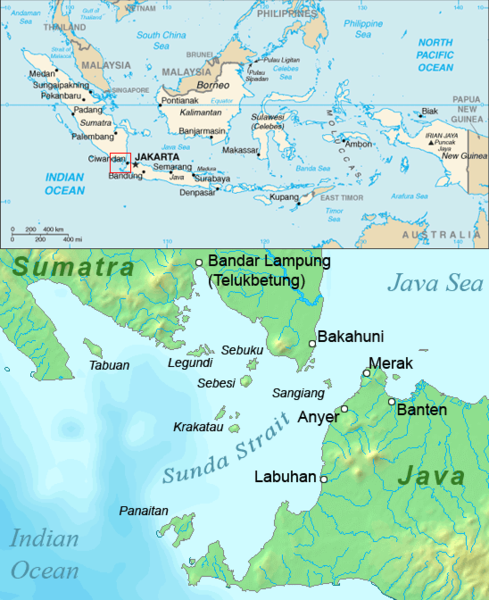
The expedition found a thick pyroclastic deposit, bracketed by appropriate radiometric dates, that suggests such a caldera collapse of a Proto-Krakatau did occur perhaps in the 6th century. Bathymetry indicates a caldera some 40 to 60 km in diameter that, with collapse below sea level, could have formed the Sunda Straits, separating Java from Sumatra, as suggested by ancient Javanese historical writings. Such a caldera collapse likely involved eruption of several hundred cubic kilometers of pyroclastic debris, several times larger than the 1815 eruption of Tambora. This hypothetical eruption likely involved magma-seawater interaction, as past eruptions of Krakatau document, but on a tremendous scale. Computer simulations of the eruption indicate that the interaction could have produced a plume from 25 to >50 km high, carrying from 50 to 100 km3 of vaporized seawater into the atmosphere. Although most of the vapor condenses and falls out from low altitudes, still large quantities are lofted into the stratosphere, forming ice clouds with super fine (<10 micrometer) hydrovolcanic ash.
Discussions with global climate modelers at Los Alamos National Laboratory led me to preliminary calculations that such a plume of ash and ice crystals could form a significant cloud layer over much of the northern and southern hemispheres. Orders of magnitude larger than previously studied volcanic plumes, its dissipation and impact upon global albedo, the tropopause height, and stratospheric ozone are unknown but certainly within possibilities for climate destabilization lasting years or perhaps several decades. If this volcanic hypothesis is correct, the global, domino-like effects upon epidemics, agriculture, politics, economics, and religion are far-reaching, elevating the potential role of volcanism as a major climate control, and demonstrating the intimate link between human affairs and nature.
More recent volcanic events which lowered global temperatures, were the 1991 eruption of Mount Pinatubo and the 1983 eruption of El Chichón.
http://www.woodfortrees.org/graph/uah/from:1978/plot/rss/from:1978
A 2002 study reported in Science demonstrated that feedback from water vapor in the atmosphere was largely responsible for the 1984 cooling.
Global Cooling After the Eruption of Mount Pinatubo: A Test of Climate Feedback by Water Vapor
The 1815 eruption of Mt. Tambora (the largest eruption in modern history) led to the Year Without a Summer in 1816.

The explosion is estimated to have been at scale 7 on the Volcanic Explosivity Index.[17] It had roughly four times the energy of the 1883 Krakatoa eruption. An estimated 160 cubic kilometers (38 cubic miles) of pyroclastic trachyandesite was ejected, weighing approximately 1.4×10¹⁴ kg (see above).This has left a caldera measuring 6–7 km (3.7–4.3 mi) across and 600–700 m (2,000–2,300 ft) deep.[2] The density of fallen ash in Makassar was 636 kg/m².[18] Before the explosion, Mount Tambora was approximately 4,300 metres (14,100 ft) high,[2] one of the tallest peaks in the Indonesian archipelago. After the explosion, it now measures only 2,851 metres (9,354 ft).[19]
The 1815 Tambora eruption is the largest observed eruption in recorded history (see Table I, for comparison).[2][4] The explosion was heard 2,600 kilometres (1,600 mi) away, and ash fell at least 1,300 kilometres (810 mi) away.[2] Pitch darkness was observed as far away as 600 kilometres (370 mi) from the mountain summit for up to two days. Pyroclastic flows spread at least 20 kilometres (12 mi) from the summit.
Mt. St Helens erupted 30 years ago next month. Like the Icelandic volcanoes, it was covered with thick ice and snow.

Mt. St. Helens prior to the eruption : Britannica Image
Meltwater from the ice and snow contacted the rising magma, leading to a huge amount of steam pressure and a massive explosion on May 18 following the collapse of the north flank.
I was involved in some experimental research around that time, which demonstrated that the amount of ash and the explosivity of volcanoes is primarily dependent on the amount of water which comes in contact with the magma underground. It can be concluded that the glaciers in Iceland are contributing to the ash, not the other way around – and that volcanoes cause climate change, not the other way around.
Brian J. Soden,1* Richard T. Wetherald,1 Georgiy L. Stenchikov,2 Alan Robock2The sensitivity of Earth’s climate to an external radiative forcing depends critically on the response of water vapor. We use the global cooling and drying of the atmosphere that was observed after the eruption of Mount Pinatubo to test model predictions of the climate feedback from water vapor. Here, we first highlight the success of the model in reproducing the observed drying after the volcanic eruption. Then, by comparing model simulations with and without water vapor feedback, we demonstrate the importance of the atmospheric drying in amplifying the temperature change and show that, without the strong positive feedback from water vapor, the model is unable to reproduce the observed cooling. These results provide quantitative evidence of the reliability of water vapor feedback in current climate models, which is crucial to their use for global warming projections.
“IMHO the reason Mt. St, Helens erupted so explosively, was the sudden collapse of the north flank of the volcano, which instantly depressurized the magma.”
There is a difference between depressurization causing liquefaction, as hypothesized in the article, and unburdening. Collapse of the flank might well have triggered a magma flow, but the explosion was the result of magma causing steam when it came in contact with water. That was also true of the Indonesian volcanoes.
I see no reason to assume that the water vapour response to tonnes of volcanic ash would be the same as the water vapour response to more CO2.
For example, rain drops require some sort of seed. An atomosphere with a lot of dust would have more seeds and could therefore be drier because the water forms into rain much faster.
The automatic presumption that the response to different forcings would be the same is evidence of the tunnel vision that infests the climate science community.
This is mildly OT but I find extremely worrying.
I’m in the UK and we are currently in an election period. I just posted a question on the BNP website. Now for those non UK residents on this site which are the majority, The BNP are widely viewed as a racist/facist site. I posted one message and was banned from the site. What question did I ask?
Has anyone seen any ash from the Icelandic eruption or is this a test run on shutting down EU airspace.
I know Anthony really dislikes ‘Nationalist/Racist’ organisations but this struck me as really strange. I think one of the moderators should post a similar question to various uk blog sites and see if you get banned.
Getting scary.
Don’t care if it’s snipped but follow it up please as this is very wrong.
Best regards
Peter Miller (14:04:57) :
The quote you gave wasn’t mine, it was from this article.
http://www.sciencemag.org/cgi/content/abstract/296/5568/727
What they are saying is that the volcano dried out the atmosphere, causing less of a greenhouse effect and further cooling. That is a positive feedback, which is what climate models predict for water vapor.
An interesting note, Mt Pinatubo blew up in the middle of a typhoon . Was it low barometric pressure that triggered the explosion?
Or maybe rainwater from the typhoon that did it.
I’ve never heard a explanation for it.
The concept that melting of ice cover over a volcano causes an eruption, is stark staring raving insane. Just for a start, the thickness of material over any eruption vent is highly variable, yet eruptions happen. The scale of the forces involved in an eruption is so immense, that removal of a 100 metres or so of ice is utterly trivial. As for the 6th Century eruption of Krakatoa, it may well be as suggested, but there are a very large number of volcanoes on this planet.
I used to be an avid reader of Scientific American, but gave up reading it as it began to concentrate on polemics rather than science.
Well.. I have been very interested in this.. now.. I think most reasonable minds.. would agree.. the link of tectonics(earthquakes..) and volcanism.. what is very important.. is the clustering of mega thrust quakes.. that seem to be more prevalent during slight spurts in solar activity.. during minimums.. or precedent to entry to a minimum.. bringing us full circle.. the sun.. inducing volcanic events.. now.. crrrrrazy yeah.. but….
If we assume an increase in volcanic activity over the next five years and have some major eruptions, and it cools down temperatures, should this be considered natural, and not an excuse for CAGW advocates?
For over 15 years we have had little in the way of volcanic eruptions of a magnitude capable of affecting worldwide temperatures. The recent lack of volcanic eruptions, as well as future increasingly frequent and intense eruptions, are “natural” and can not be discounted by any antropogenic position.
This will not stop pro CAGW advocates from making an excuse if temperatures drop, but that excuse will not be valid.
Richard Telford (13:35:15) :
You make the assumption the everything that happens in the earth is caused by co2. The paper you point out does not.
from 2/22/10
Joe Bastardi debates Bill Nye. They cover volcanoes for about 1/3 of the time. Bill Nye doesn’t seem to understand climate. Everything is co2 to him.
“An estimated 160 cubic kilometers (38 cubic miles) of pyroclastic trachyandesite was ejected, weighing approximately 1.4×10¹⁴ kg (see above)”
I believe the weight is being expressed in scientific notation, but the ten to the fourteenth is showing as 1014. Perhaps it would be better to express it as 1.4E14.
Scarlet Pumpernickel (14:41:55) :
That’s a good question for vulcanologists. Half of the distribution of volcano eruptions is purely random. A majority of the rest like to cluster around Solar Minimum, and less than a majority around Solar Maximum.
I’m not a math whiz to express the equation.
Maybe someone has already been there, done that, and never came up with anything, or maybe nobody has seen fit to bother with it.
MODERATOR ATTENTION
it looks like uno2three4 is correct
…………………………………………………………………………………………………………………
uno2three4 (14:38:37) :
The eruption dates for El Chichon and Pinatubo are reversed in post. I think Pinatubo was in 1991 also.
………………………………………………………………………………………………………………….
please fix the simple wording mistake in the post
stevengoddard (14:34:28) :
u.k.(us) (13:55:03) :
The timing of the eruption at Mt. St Helens was controlled by the collapse of the north face, but the mechanism was meltwater creating steam pressure.
===============
Thanks for the video link, very cool!
After watching it many times, i still say the eruption was due to the sudden release of the “cap”.
What caused the landslide?
I say the magma pushed the flank past it’s “tipping point”, which combined with some liquifaction?, and the known instability of volcanic structures, led to the sudden collapse and the uncontrolled expansion of the gases contained in the magma.
Then pour cold water on it, eh!
I was 18 when it happened, it still amazes me.
More recent volcanic events which lowered global temperatures, were the 1983 eruption of Mount Pinatubo and the 1992 eruption of El Chichón.
Should be
More recent volcanic events which lowered global temperatures, were in 1983 from the April 1982 eruption of El Chichón and in 1992 from the 1991 eruption of Mount Pinatubo.
El Chichón
http://en.wikipedia.org/wiki/El_Chich%C3%B3n
Mount Pinatubo
http://en.wikipedia.org/wiki/Mount_Pinatubo#1991_awakening
Cold kills. Warmer is better.
Interesting site blogging about the Iceland event… lots of links to photos and other aspects of this event. WUWT is highlighted on this thread…
http://scienceblogs.com/eruptions/2010/04/a_quick_note_on_thawing_ice_ca.php#comments
Jason everett (14:52:49) :
I think there is a precautionary principle at work, that does have some political gain, but you may be drawing a long bow here Jason.
There may be some financial gain to shipping and ground transport, as distributors and travellors find other ways to get from A to B, but shutting down Europes air travel will probably cost incredible amounts of Euro’s. Not something the E.U wants, its bad for business and bad for a taxation.
I would presume the Air Authorities are covering their backsides more than anything sinister, imagine being the guy who uneccessarily sent a jetliner to its doom, sobering thought.
OT but http://news.scotsman.com/scotland/Team-plans-to-row-to.6231705.jp
Maybe next year won’t be such a good idea!
There is a vast amount of energy contained by the mantle. The idea that climate change can precipitate the release of this energy via changes in surface loading (sea levels changes, ice loading changes, plates drifting, land masses rising/sinking) makes sense.
However, to argue that climate change in the 20th century has been sufficient to trigger increased vulcanism seems dubious at best. Sea levels have been increasing since the last ice age (120 meters and rising) and glaciers have retreated from as far south as New York/Pennsylvania. Changes of this magnitude over thousands of years may or may not be affecting vulcanism today. Sea levels increasing 3 mm year for short periods seems insignificant by comparison.
Our current period is of pretty low volcanic activity, despite the recent activity. We are due for another ice age. Perhaps the recent volcanic activity is a prelude of what is to come, perhaps not, but those aerosols in a period of low solar activity could make summer a bit cool.
Upon entering an ice age, the reduction in sea levels may release methane hydrates which would slow the cooling. Increased vulcanism serves to slow warming and increase cooling. Both released stored carbon.
Without vulcanism, our store of usable carbon on the surface would soon be depleted, and the carbon footprint would accelerate to zero. No carbon, no life, at least not as we know it. These climate cycles may be a necessary part of the carbon cycle.
Apologies to FZ.
Interesting! I guess the brackets took out the quote. I’ll try again;
‘But I said “Look here brother
who you jiving with that pyroclastik debris?”‘
Jason Everett
The BNP is making valiant (if probably futile) attempts to appear as a rational mainstream party during this campaign.
This probably explains why it is unhappy with fruitcake comments about “shutting down EU airspace”. There are enough real problems around at the moment without conspiracy theorists inventing any more.
sam bailey (15:10:59) :
i don’t know if it is crazy. does anyone jnow of any study that counts serious volcanic eruption to solar minima/maxima?
The earths temps should plummet once the La Nina arrives and the current ash in the atmosphere starts to reflect sunlight.