Guest post by Steven Goddard
Scientific American recently reported on the dodgy concept that climate change causes volcanoes, when in fact it is quite the opposite.

Wikipedia : An early 19th-century illustration of Krakatoa
In 1883, Krakatoa produced massive amounts of ash during an eruption estimated to the equivalent of 200 megatons – or 13 times larger than the Hydrogen Bomb detonated at Bikini Island. Average global temperatures dropped by about 1.2°C during the following year as a result of ash blocking the sun.
It has been hypothesized by a volcanologist at Los Alamos, that the Dark Ages were triggered by agricultural collapse following the 535AD eruption of Krakatoa.
Modern history has its origins in the tumultuous 6th and 7th centuries. During this period agricultural failures and the emergence of the plague contributed to: (1) the demise of ancient super cities, old Persia, Indonesian civilizations, the Nasca culture of South America, and southern Arabian civilizations; (2) the schism of the Roman Empire with the conception of many nation states and the re-birth of a united China; and (3) the origin and spread of Islam while Arian Christianity disappeared. In his book, Catastrophe An Investigation into the Origins of the Modern World, author David Keys explores history and archaeology to link all of these human upheavals to climate destabilization brought on by a natural catastrophe, with strong evidence from tree-ring and ice-core data that it occurred in 535 AD.
With no supporting evidence for an impact-related event, I worked with Keys to narrow down the possibilities for a volcanic eruption that could affect both hemispheres and bring about several decades of disrupted climate patterns, most notably colder and drier weather in Europe and Asia, where descriptions of months with diminished sun light, persistent cold, and anomalous summer snow falls are recorded in 6th-century written accounts. Writings from China and Indonesia describe rare atmospheric phenomena that possibly point to a volcano in the Indonesian arc. Although radiocarbon dating of eruptions in that part of the world are spotty, there is strong bathymetric and volcanic evidence that Krakatau might have experienced a huge caldera eruption. Accordingly, I encouraged a scientific expedition to be led by Haraldur Sigurdsson to the area.
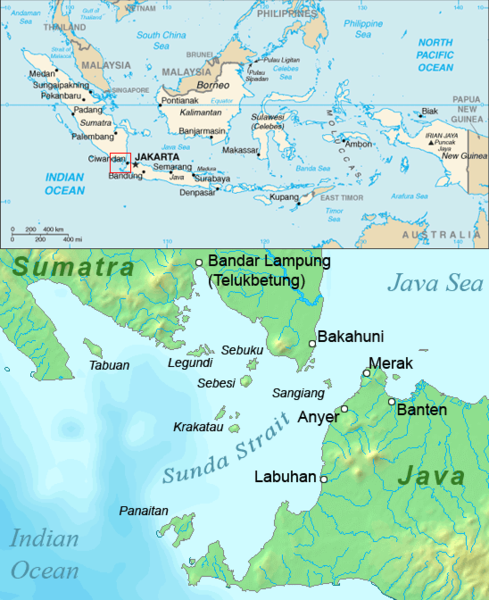
The expedition found a thick pyroclastic deposit, bracketed by appropriate radiometric dates, that suggests such a caldera collapse of a Proto-Krakatau did occur perhaps in the 6th century. Bathymetry indicates a caldera some 40 to 60 km in diameter that, with collapse below sea level, could have formed the Sunda Straits, separating Java from Sumatra, as suggested by ancient Javanese historical writings. Such a caldera collapse likely involved eruption of several hundred cubic kilometers of pyroclastic debris, several times larger than the 1815 eruption of Tambora. This hypothetical eruption likely involved magma-seawater interaction, as past eruptions of Krakatau document, but on a tremendous scale. Computer simulations of the eruption indicate that the interaction could have produced a plume from 25 to >50 km high, carrying from 50 to 100 km3 of vaporized seawater into the atmosphere. Although most of the vapor condenses and falls out from low altitudes, still large quantities are lofted into the stratosphere, forming ice clouds with super fine (<10 micrometer) hydrovolcanic ash.
Discussions with global climate modelers at Los Alamos National Laboratory led me to preliminary calculations that such a plume of ash and ice crystals could form a significant cloud layer over much of the northern and southern hemispheres. Orders of magnitude larger than previously studied volcanic plumes, its dissipation and impact upon global albedo, the tropopause height, and stratospheric ozone are unknown but certainly within possibilities for climate destabilization lasting years or perhaps several decades. If this volcanic hypothesis is correct, the global, domino-like effects upon epidemics, agriculture, politics, economics, and religion are far-reaching, elevating the potential role of volcanism as a major climate control, and demonstrating the intimate link between human affairs and nature.
More recent volcanic events which lowered global temperatures, were the 1991 eruption of Mount Pinatubo and the 1983 eruption of El Chichón.
http://www.woodfortrees.org/graph/uah/from:1978/plot/rss/from:1978
A 2002 study reported in Science demonstrated that feedback from water vapor in the atmosphere was largely responsible for the 1984 cooling.
Global Cooling After the Eruption of Mount Pinatubo: A Test of Climate Feedback by Water Vapor
The 1815 eruption of Mt. Tambora (the largest eruption in modern history) led to the Year Without a Summer in 1816.

The explosion is estimated to have been at scale 7 on the Volcanic Explosivity Index.[17] It had roughly four times the energy of the 1883 Krakatoa eruption. An estimated 160 cubic kilometers (38 cubic miles) of pyroclastic trachyandesite was ejected, weighing approximately 1.4×10¹⁴ kg (see above).This has left a caldera measuring 6–7 km (3.7–4.3 mi) across and 600–700 m (2,000–2,300 ft) deep.[2] The density of fallen ash in Makassar was 636 kg/m².[18] Before the explosion, Mount Tambora was approximately 4,300 metres (14,100 ft) high,[2] one of the tallest peaks in the Indonesian archipelago. After the explosion, it now measures only 2,851 metres (9,354 ft).[19]
The 1815 Tambora eruption is the largest observed eruption in recorded history (see Table I, for comparison).[2][4] The explosion was heard 2,600 kilometres (1,600 mi) away, and ash fell at least 1,300 kilometres (810 mi) away.[2] Pitch darkness was observed as far away as 600 kilometres (370 mi) from the mountain summit for up to two days. Pyroclastic flows spread at least 20 kilometres (12 mi) from the summit.
Mt. St Helens erupted 30 years ago next month. Like the Icelandic volcanoes, it was covered with thick ice and snow.

Mt. St. Helens prior to the eruption : Britannica Image
Meltwater from the ice and snow contacted the rising magma, leading to a huge amount of steam pressure and a massive explosion on May 18 following the collapse of the north flank.
I was involved in some experimental research around that time, which demonstrated that the amount of ash and the explosivity of volcanoes is primarily dependent on the amount of water which comes in contact with the magma underground. It can be concluded that the glaciers in Iceland are contributing to the ash, not the other way around – and that volcanoes cause climate change, not the other way around.
Brian J. Soden,1* Richard T. Wetherald,1 Georgiy L. Stenchikov,2 Alan Robock2The sensitivity of Earth’s climate to an external radiative forcing depends critically on the response of water vapor. We use the global cooling and drying of the atmosphere that was observed after the eruption of Mount Pinatubo to test model predictions of the climate feedback from water vapor. Here, we first highlight the success of the model in reproducing the observed drying after the volcanic eruption. Then, by comparing model simulations with and without water vapor feedback, we demonstrate the importance of the atmospheric drying in amplifying the temperature change and show that, without the strong positive feedback from water vapor, the model is unable to reproduce the observed cooling. These results provide quantitative evidence of the reliability of water vapor feedback in current climate models, which is crucial to their use for global warming projections.
The Daily Mail has a pretty interesting radar photo of 3 craters at the Eyiafjallajokull Volcano that is currently erupting.
http://www.dailymail.co.uk/sciencetech/article-1266403/Iceland-volcano-space-The-dramatic-ash-plume-engulfing-Britain-seen-above.html
In particular, this photo of the 3 craters. http://i.dailymail.co.uk/i/pix/2010/04/16/article-1266403-0928E978000005DC-548_964x571.jpg
That piece from Scientific American is a clear demonstration that climate change causes concept dyslexia, otherwise known as putting the cart before the horse.
Let’s hope that the big one in Iceland doesn’t blow, else we’ll have more to worry about than some minor air traffic hiccups.
Contrary to what Goddard has written, there is a clear link between climate and volcanism, at least on Quaternary time-scales. Loading or unloading of the lithosphere by sea-level changes or ice-sheet growth and melting can promote volcanism by altering the stress on magma chambers and conduits to the surface.
See, for example, McGuire et al 1997. Correlation between rate of sea-level change and frequency of explosive volcanism in the Mediterranean. Nature 389, 473-476
Dodgy? LOL. The idea is insane. Scientific American has become The Loony Scientist.
There are other far more serious climatic events associated with volcanoes. it is now hypothesized the Permian Extinction might be one. A huge rift eruption. And scientists are relooking at the North American mammalian extinctions of 40,000 BP.
The catastrophic eruption of Mt St Helens on May 18th 1980 (Blimey, was it really that long ago??) has been attributed to an earthquake, causing the bulging north face to collapse and thus releasing pressure on the magma chamber.
What all of these eruptions do show, is that it is cold that kills us, not a steadily warming enviroment!
“the importance of the atmospheric drying in amplifying the temperature change ”
In other words, positive feedback caused by water vapour causes temperature falls to increase at an accelerating rate; when temperatures rise, positive feedback causes an accelerating rate of increase. Models have conclusively proven we have an unstable climate system. It is amazing how climate still exists.
Does anyone have a list of things climate change doesn’t cause?
It must be getting pretty short.
IMHO the reason Mt. St, Helens erupted so explosively, was the sudden collapse of the north flank of the volcano, which instantly depressurised the magma.
I.E. you unscrew the the cap on a warm soda bottle SLOWLY, unless you want to be wearing it.
I’ll bet the same thing happened at Tambora and Krakatoa.
I am not sure what your point is. The Sc Am article, taken from Reuters, merely pointed out that if certain Icelandic glaciers should melt – from whatever cause – this decrease in pressure could trigger volcanic activity. The potential for volcanic activity is obviously already present.
http://www.scientificamerican.com/article.cfm?id=ice-cap-thaw-iceland-volcanoes
That volcanoes can cause short term climate change is well known.
http://www.realclimate.org/index.php/archives/2006/05/current-volcanic-activity-and-climate/
You claim “that volcanoes cause climate change, not the other way around” is only part true. Yes, volcanoes effect climate, but that is no way negates the observation in the Sc Am article. Lots of other things can cause seismic activity.
http://www.nyx.net/~dcypser/induceq/ris.html
http://www.scientificamerican.com/article.cfm?id=geothermal-drilling-earthquakes
BTW, the Science article you cite confirms that general circulation models work pretty well. “These results provide quantitative evidence of the reliability of water vapor feedback in current climate models, which is crucial to their use for global warming projections.” http://www.sciencemag.org/cgi/content/abstract/296/5568/727
More recent volcanic events which lowered global temperatures, were the 1983 eruption of Mount Pinatubo and the 1992 eruption of El Chichón.
The Pinatubo eruption was in June 1991 (I remember it because of a missed a plane from Philippine Airlines due to that event). El Chichon erupted in March/April 1982 according to several sources on the web.
Is this water vapor feedback described here meant to be distinct from cloud feedback, or not?
Can we expect different magnitudes for different feedback mechanisms, resulting from volcano heat/aerosol forcing as compared to the slow heating by CO2?
Yes, the eruption of Krakatoa coincided with a darkening of European skies and regular sightings of yellow snowfall over China and Japan.
As the Roman empire was converted to Christianity at this time, many thought that a day of judgement was near (they also thought this in the year 666 AD) and so anarchy broke out in pockets of the empire, which began to crumble and lose control over their Asian and North African holdings. This allowed the wealthy Arabs of Mecca and Medina to ally themselves with Nabatean Christians to conquer Roman territories under the pretext of freeing people from European rule. As the Arab conquests grew they had to stop calling themselves Christians to disassociate themselves with Europeans and rebranded themselves as Muslims along with creating an origin story for their new movement.
It took a couple of centuries of this climate and political change for Europeans to realise the world was not ending and that they were instead being conquered. But by then the world had changed for the worst and we’re still fighting over this medieval meme a thousand years later.
Steven
Your comment:
Then, by comparing model simulations with and without water vapor feedback, we demonstrate the importance of the atmospheric drying in amplifying the temperature change and show that, without the strong positive feedback from water vapor, the model is unable to reproduce the observed cooling. These results provide quantitative evidence of the reliability of water vapor feedback in current climate models, which is crucial to their use for global warming projections.
Are you trying to say that at current temperatures water vapour acts as a temperature stabilising mechanism by radiating away heat? That seems to fly in the face of conventional physics.
Jungles on the same latitudes as deserts have much more stable temperatures over any 24 hour period.
Am I misunderstanding something?
TallDave (13:54:57) :
Does anyone have a list of things climate change doesn’t cause?
It must be getting pretty short.
1. Increases in Intelligence
2. Increases in Common Sense
3. Tax cuts
That’s all I have. Anyone else?
Dr A Burns says:
No, the word is “amplify”. The water vapor roughly doubles the temperature change due to the forcing alone. It is not an instability. And, it is not the models saying this…It is the data. Or, to put it another way, the models only agree well with the empirical data when the feedback is included and not when it is “turned off” in the models.
The Eyjafjallajökull eruption in 1821 lasted 2 years. If it happens again it might cause a little climate change over Western Europe. :o)
The last time Iceland’s Eyjafjallajökull erupted in 1821 it lasted 2 years. If it happens again it might cause a little climate change over Western Europe. :o)
http://icelandreview.com/icelandreview/daily_news/?cat_id=16567&ew_0_a_id=360723
Apparently this concept was floated around before. From Nature, published online Sept 17 2009:
And this came out just before Copenhagen. Amazing timing it would have been too, if some brave whistle-blower hadn’t done the right thing…
Richard Telford (13:35:15) :
The large amount of ice loss at the end of the last ice age affected the timing of eruptions, because of the rapid unloading of pressure. However, the total amount of volcanism over time is controlled by the amount of energy being introduced from underneath (rising magma) minus the amount of heat dissipated through diffusion and fluid flow (in the case of eruptions.) Glaciers introduce no energy to the system.
At the end of the last ice age, sea level was rising at about 1.5 meters per century, which is at least five times faster than at present.
Recent ice loss has been much less. Heat flows very quickly out of 1200C rock near the surface. Without the constant introduction of new energy from the hot spot underneath Iceland, all volcanism would rapidly cease.
You might want to read this quote from the Scientific American article:
http://www.scientificamerican.com/article.cfm?id=ice-cap-thaw-iceland-volcanoes
u.k.(us) (13:55:03) :
The timing of the eruption at Mt. St Helens was controlled by the collapse of the north face, but the mechanism was meltwater creating steam pressure.
This guy is one of the leading experts on the subject of explosive vulcanism.
http://www.ees1.lanl.gov/Wohletz/Publications.htm
Worth reading his papers.
The eruption dates for El Chichon and Pinatubo are reversed in post. I think Pinatubo was in 1991 also.
The only time volcanoes really were affected by glaciers was towards the end of Snow Ball earth, when there was too much Ice, they came back with a vengeance?
PS why doesn’t Mnt Kilimanjaro erupt? All that climate change I mean land clearing has made the glacier melt, so why is it dormant??????
Here are some new front covers for our bringers of leading science!
http://cdn-www.i-am-bored.com/media/5557_unscientificamerican.jpg
http://encefalus.com/wp-content/uploads/2008/10/old-scientist.jpg
Richard Telford (13:35:15) :
I thought some more about the article you linked.
Of course there was an increase in explosive volcanic activity at the end of the last ice age. There was massive amounts of glacial melt water infiltrating into magma chambers, causing Mt. St. Helens style eruptions. I would say that the author came to the wrong conclusion about the cause.
Nevertheless, the total amount of heat dissipated is controlled by the first law of thermodynamics. Over time, volcanoes can’t release any more energy than they receive from the mantle underneath.