
Guest Post by Steven Goddard
Steve McIntyre points out that NOAA’s Susan Solomon saw fit to exclude a statement of measurements from IPCC WG1. With such certainty then, it’s no wonder she’s certain that our current situation is “irreversible”. Well then, let’s not worry about it if one of NOAA’s lead scientists says the effects are well nigh irreversible. What she’s serving up is pure alarmism.
NOAA has issued a warning to the occupants of (some) planet :
Global warming has reached the point of no return, a study published in the Tuesday edition of the Proceedings of the National Academy of Sciences by a joint team of the U.S., French and Swiss researchers concludes. Even if the world reduces emissions of CO2 to the level before the industrial revolution, it will take at least 1,000 years to reverse the climate change effect that have already taken hold, AP on Sunday quoted the team as saying. Dr. Susan Solomon of the U.S. National Oceanic and Atmospheric Administration’s Earth System Research laboratory led the study. “People have imagined that if we stopped emitting carbon dioxide the climate would go back to normal in 100 years, 200 years; that’s not true,” she said, adding the effects are well nigh irreversible.
That got me wondering what she meant by “back to normal.” Perhaps it means sea ice at normal levels? No that can’t be it, because sea ice area has already recovered to “normal.”


http://arctic-roos.org/observations/satellite-data/sea-ice/observation_images/ssmi1_ice_area.png
Perhaps she means violent weather, like strong tornadoes? Longing for a return to the 1970s, when there were lots more of them?

http://lwf.ncdc.noaa.gov/img/climate/research/tornado/tornadotrend.jpg

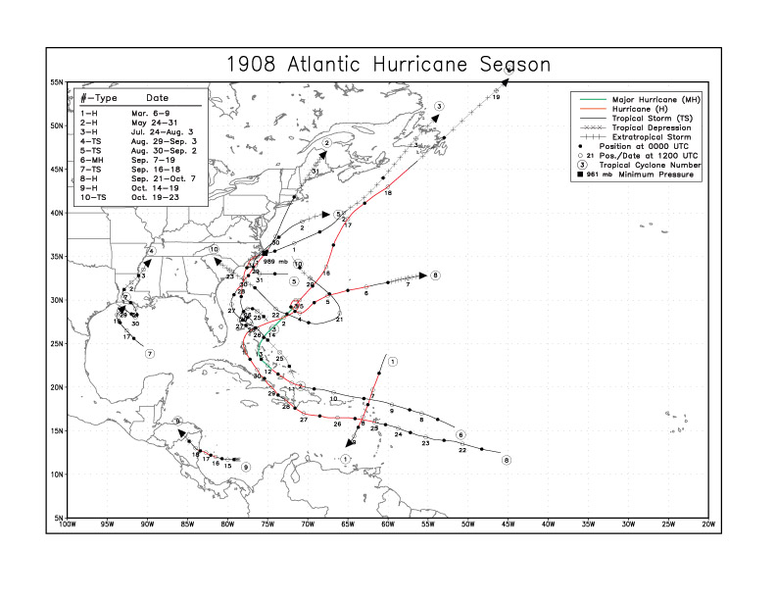
In 1908, a hurricane formed on March 6, the earliest on record. Ah, for the good old days of early spring hurricanes…..
http://en.wikipedia.org/wiki/File:1908_Atlantic_hurricane_season_map.png

In 1954, Hurricane Alice formed on December 30, the latest on record. Nothing like a New Year’s hurricane to brighten up the holidays.

http://en.wikipedia.org/wiki/File:1954_Atlantic_hurricane_season_map.png

In 1961, Hurricane Carla made landfall in Texas. It was the most intense hurricane to ever hit the US.

http://en.wikipedia.org/wiki/Hurricane_Carla
In 1900, a hurricane killed 8.000 people in Galveston, Texas.

http://en.wikipedia.org/wiki/Galveston_Hurricane
In 1780, a hurricane killed more than 27,500 people in the Carribean.

http://en.wikipedia.org/wiki/Great_Hurricane_of_1780
In 1960, 60% of the farmland in China received no rain. Somewhere between 20 and 43 million people died due to extreme weather and mismanagement by the socialist government.
In the 1930s, the US suffered extreme heat and drought, resulting in the dust bowl. It was the warmest decade on record in the US (at least before USHCN cleverly adjusted it downwards.)

http://www.giss.nasa.gov/research/briefs/hansen_07/fig1x.gif


http://en.wikipedia.org/wiki/Dust_bowl
I think that we should use Susan Solomon’s [ NOAA’s] “the effects are well nigh irreversible.” against any carbon taxes etc. What is RC’s position on her statement? These fools keep DIGGING HOLES.
TimiBoy (13:26:45) :
If the Artic nearly all melted a couple of years ago, of course there’s not much multi year ice.
Yup. And notice how we don’t find Arctic ice that’s centuries or even decades old, even over the many decades of assorted measurements and anecdotal reports. That indicates the ice gets “churned” and both old and new ice goes away over time.
It will take a few years for new ice to get old, won’t it? or should it age itself “quickly”? Maybe Solomon thinks so.
I’m still not exactly sure what makes “multi-year” ice so special, other than it survived the summer melt. Thick multi-year, thick new, does it matter much which it is?
New ice and 2 year ice are on the uptick. They will be multi year ice one day soon, at least where I come from…
Technically there is some right now, we’re just waiting for there to be lots more multi-year ice. Which sure looks like it’s on the way.
@George…I am assuming you understand why the CO2 rose AFTER the temperatures in the ancient past. And I am assuming you also understand what is causing the CO2 to reach the levels it is currently at. I can’t imagine you would dispute that humans are putting a lot of CO2 into the atmosphere at present, that’s just basic knowledge.
So I don’t get your argument. Since it takes several hundred years for the oceans to release their carbon under a warming world, and then once the CO2 is at high levels, the temperatures warm even more, and stay warm until the earth shifts and the solar input distribution changes, what are you trying to say? Today, WE are putting the CO2 into the atmosphere and the temperatures are responding. Once the ocean gets to releasing it’s carbon (which it will eventually as it keeps getting warmer), the planet will warm even more.
I really don’t understand what you are trying to say. Makes no sense to me.
LOL – and she’s wearing a NOAA badge
There should be a jar on the counter with the label “Tipping Point” : )
RickA (11:41:01) :
“I am pretty sure she is talking about the CO2 level returning to around 280 ppm. That is what ‘normal’ means (I think).”
Actually, she is talking about the climate itself, not the CO2 level. Here is another version of the story from NPR:
http://www.npr.org/templates/story/story.php?storyId=99888903
Solomon added:
“We’re used to thinking about pollution problems as things that we can fix. Smog, we just cut back and everything will be better later. Or haze, you know, it’ll go away pretty quickly.”
“The sea level rise is a much slower thing, so it will take a long time to happen, but we will lock into it, based on the peak level of [carbon dioxide] we reach in this century,”
“I guess if it’s irreversible, to me it seems all the more reason you might want to do something about it. Because committing to something that you can’t back out of seems to me like a step that you’d want to take even more carefully than something you thought you could reverse.”
So when she says normal, she is definitely referring to changes in the climate brought on by the increase in CO2. And just for smiles, since I’ve been on hiatus, here’s a bit of fun I had last month before going into hiding:
http://mediamatters.org/mmtv/201003020043#756308
Anthony, feel free to use that next February (or sooner) if Punxutawney Al emerges from his alarmist hole again (hi-res available if needed). Complete with the GoreYear Carbon Credit blimp. Cheers!
Ben Kellett (14:01:02) Hey, you are like my grandaughter: She likes horror stories instead of beautiful ones. BOOOOO!
…nothing that a little solar-cell paint wouldn’t fix!!
Well, heck… if it’s irreversible then what’s the fuss and worry? Eat, drink, and be merry for tomorrow we all may… ummmm… cook in the Gore-Bull warming?
Let’s just admit that “climate change” truly is irreversible, that is, it can’t be stopped. It’ll always be with us. And even if “change” could be stopped no one can agree on where the “right” stopping point even might be. I like the summer heat here in TX, my neighbor hates it.
Hey Susan Soloman, did you hug your iceberg today? You twit.
George E. Smith (13:56:18) :
I’m definately taking a shower after representing AL. I tried to sound sincere!
Anyway, I saw it calculated here some where @WUWT of what the PPM would be of CO2 if we combusted all the known reserves of coal, Gas and Oil. Does anyone recall that figure or what thread it was on?
Perhaps we could get Susan Solomon to clarify:
Is global warming irreversible because of C02 or despite it?
As in object in motion continues until acted upon externally by another force. What, if anything, is she advocating here?
Remember, folks: Global Warming is just another term for “Ah, finally some nice weather”.
Jimbo notes: “Susan SolomonPh.D. University of California, Berkeley, 1981”
Ah, Berkeley 1981. Far out, man.
Like, wow, this bong is just like the atmosphere.
The reason why it is “too late” is the fact that THEY know that CO2 has little or no effect on climate….QED
p.s. I knew that they would use the “facts” in this way as not only weather systems have “spin” and climate patterns their ups and downs…..:-(
Ben Kellett (14:01:02) :
One thing that has become clear the last few years is that the experts don’t understand the Arctic climate. No one predicted the negative AO this winter and the associated changes in ice conditions.
If the AO remains negative, then we should expect to see increases in Arctic ice volume over the next few years.
Yes if the AO in winter remains negative there may be an increase in Arctic ice volume for a few years….BUT…eventually natural variability will once again be in phase with the anthropogenic changes and WHAM! a lot of ice will disappear again. People constantly conflate weather with climate. The long term trends are likely not going to change if we don’t start taking better care of our ONLY planet!!
What is the harm in promoting renewable energy (and new jobs)? Doesn’t it make more sense on all levels? Of course oil and gas are still going to be around for a while, but eventually we will run out. Thus, investing in renewable energy/research is the right direction regardless of whether you believe in warming caused by US or by other factors. I’m not saying we stop today with fossil fuels, but that we start investing in alternatives. that is the SMART thing to do.
I would like to go back to the normal days of the dinos. Then I would bring one back, a meat eating one. A real dinos dino.
Then I’d feed him the hobnobs who thinks the world is over populated. Haha see what I did there.
1DandyTroll (14:51:58) :
“Then I’d feed him the hobnobs who thinks the world is over populated. ”
Anyone who thinks the world isn’t overpopulated has probably never spent any time in, for example, Mumbai…
jeff brown (14:51:26) :
Yes, go ahead Jeff. Please do all that and report to me your progress.
Just dont force me to pay tax to the government projects.
jeff brown (14:51:26) :
I was not aware that temperature was the cause of ice loss in the Arctic in 2007. It was the wind that did it.
What has trace C02 concentrations to do with the wind direction?
We would prefer conservation of energy choices be made willingly, not with a stick of shame and a bottle of fear.
oh those good old days!!! I was a 9th grader in 1968-69. we had such a huge famine in india. people died of hunger and starvation. govt of india did not count all the deaths…. intentionally. so, if someone says “a couple million” people died in india during that time due to starvation, don’t believe it. it was probably an undercount of over 90%. but it was not just 1968-69. we had famine and hunger and death most of 50s and 60s.
the 1990s was the deepest, longest drought in india. but thanks to all the modern techniques, machines and yes, all those carbon based fuels, nobody even noticed we should have been having a serious famine. and we did not. everytime someone says “we have to control CO2”, i remember all those famine and hunger and death.
so, NO, NO, NO. i don’t know what it was like in other countries. But, surely, i don’t want to go back to those “good Old Days”, no matter how hard this nit-wit greenies want us all to go back to those days.
May Ms Solomon some day follow in the footsteps of Phil Jones: click
Tim Blair’s commentators are not very nice to Dr Jones…
I wish science would get back to normal. This voodoo science BS is getting tiresome.
Pardon my ignorance, but is this pure satire or is there a real paper that’s been released? PNAS and NOAA doen’t seem to have it.
SomeThoughts on All of This.
I put a lot of time in thinking about how this CO2 global warming works.
I read here from time to time, anecdotal stories from people who live in Alaska or the Pacific Northwest; or someplace else; and they offer that when it is cloudy it is nice and warm and toasty. Ergo clouds warm the surface. What could be easier than that ?
Now Trenberth et al say that the whole earth is at 288 K (15 deg C, or 57 deg F), and therefore it is constantly emitting radiation at about 390 Watts per square metre; which is the Black body radiation total for +15 deg C.
You could actually construct an ersatz “black body radiator” if you got a piece of aluminum tubing about a foot in diameter, and say three feet long. It’s used for making concrete pilings, and also amateur telescope tubes. You could put a bottom and a top on it, to make a sort of bucket out of it. Then you get out yourt belt sander, with a carborundum belt, and you grind a rough surface on the outside, and paint it flat Kodak black; that photographic black that you use for the inside walls of your dark room. That will make a fairly good black radiator.
So now you can fill this up with tap water, which will likely be about 68 deg F, so you need to add a lot of ice to cool that down to 57 F. So now you have a BB radiator; sort of, which is at about 57 deg F or 288 K, and it is emitting 390 Watts/m^2 from that black surface.
When you get out of the shower, you can stand in front of this energy source to keep warm; knock yourself out getting almost free heat out of tap water.
Of course your body temperature is about 98.6 or 37 deg C or about 310 Kelvins.
I haven’t actually tried this but I have stood around in parking lots that were at about 57 deg F, and I don’t remember being warm at any time I did that. I know that thing is emitting strongly at about 10.1 microns peak wavelength; but somehow, that does not fit my idea of “heat”.
I have a quartz radiant heater; and that thing doesn’t look black to me, and yet it does heat me if I stand in front of it. . It actually looks sort of orange red to me.
If you think about a Helium Neon red laser, that is 632.8 nm wavelength and is a decent red. It’s handy to rememebr that a He/Ne laser emits pretty close to two electron Volt photons. My quart radiant heater is a bit more orange than that; maybe around 600-610 dominant wavelength.
I don’t have the foggiest idea what spectral wavelength my body thinks is “heat” but it most certainly is not 10.1 or even 15 microns of CO2 fame.
Have you got that; LWIR emission from CO2 do not make me feel warm.
But let’s assume that Trenberth is correct, and the typical earth surface is typically emitting 390 W/m^2 at 10.1 microns or so. Typically a BB radiator emits in a Lambertian or Cosine angular radiant Intensity pattern. Since the projected area of the source surface, also shrinks as cosine of the angle (off-axis), the Radiance, which is Radiant Intensity per unit area, is a constant. In light parlance we would say it is equally bright in all directions.
We can talk about the etendue of such a source in a medium of refractive index (n) as e = (n.h.u)^2 where (n) is the refractive index, (h) is the source size (height) and (u) is the cone half angle of the radiant emission from the surface. Etendue with a squiggle over the e, is a fancy French word that roughly translates as “throughput”. (h) and (u) are here assumed to be small. In geometrical optical parlance we would describe this as a paraxial region, of small objetcs, and ray angles near the optical axis of some optical system.
The quantity (n.h.u) is also known as the Lagrange invariant (and other names). It is a quantity that is conserved under ordinary optical transformations such as reflection and refraction.
Outside the paraxial region for larger oject sizes, and larger ray cone angles (higher Numerical Aperture, or smaller f/number) this expression is replaced by (N.H.Sin(U)), and this too is conserved in Optical transformations. It is often referred to as the “Optical Invariant”.. The quantity (N.H.Sin(U))^2 is a measure of the total power emitted by the source within that solid angle.
It is a fundamental property of the Optical Invariant, that no Optical system, can form an image that has a higher invariant value than the object being imaged.
This result was reported by numerous early Optical workers; but one of the earliest derivations was by the German Thermodynamicist Clausius; who actually derived it from the Second Law of Thermodynamics; rather than from Geometrical Optics.
I’m rather partial to Clausius’ form of the Second Law. Which roughly translates as :-
“No reversible machine can have no other effect, than to transport heat, from a source at one temperature, to a sink at a higher temperature.”
Clausius imagined an emitting Black body at a certain temperature; emitting radiation in accordance with the above etendue relation; and then assumed some optical system, could somehow increase the value of N.H.Sin(U), and so create an image that was “brighter” than the source. Well if this brightened image was incident on a second black body which absorbed all the radiation; then the BB radiation law, would require that the second black body would heat up to a temperature higher than the source; which the second law says is impossible; thus falsifying the assumption that an image could be made brighter than the object.
Ok so now we have out little plot of ground emitting as a BB into our optical system; which is simply the atmosphere above the ground; maybe including even a high cloud or two. So we now know that it is not possible for the image formed on the cloud, of our ground plot, to have an Irradiance that is higher than the Radiance of the ground which is irradiating it.
It then follows that there is no way, that the ground can raise the temperature of the cloud up to whatever the ground temperature is. Clausius form of the second law prohibits that.
Now if you have been following this; you have probably caught that the energy is being transmitted from the ground to the cloud in the form of electromagnetic radiation; or LWIR thermal photons. It is not being transmitted in the form of “heat” which is mechanical vibrations. There could of course be conduction and convection going on in addition to all of this; but we are not concerned with that right now..
Clausius says that even as radiation, we can’t overheat the cloud. He does not say the cloud can’t absorb the radiation if something else should also heat the cloud so its temperature is higher than the ground..
So the transfer of energy is permitted; even from the earth surface to the surface of the sun; but by itself the earth will not heat the sun up to 6000 K.
Now if the cloud is high, then it is very likely that it is cold up there anyway, and even with direct solar heating it can still be a lot colder than the ground.
The cloud is most likely to be almost totally absorbing of our LWIR from the ground so it will warm a little from our source; but most likely will still be colder than 57 deg F.
The cloud then, will also now radiate much like a black body, so it will emit thermal radiation corresponding perhaps to a BB at some temperature that is lower than 57 deg F, and also at less than 390 Watts per m^2.
This cloud emission is likely to travel in all directions, some upwards towards space, and some downwards towards the ground; retracing our atmospheric Optical system. And the Optical Invariant tells us that the new image it forms on the ground must be no brighter than the cloud (in the LWIR), and consequently it is not likely to make our patch of gound any more comfortable than it was originally as a 288 K black body heater.
So if you really want to believe that those high clouds, is what makes it warmer down at ground level; be my guest; and then build yourself a 57 deg F heater to keep you warm when you get out of the shower.
jeff brown (14:51:26) :
Windmills are making a mess out of the countryside in the UK.
Colorado has great potential for passive solar, but everyone builds their houses N-S in order to get a view of the mountains. Usually the view gets blocked by another house or a tree within a few years, and then they are stuck with a house that is cold and dark in the winter and hot and sunny in the summer.
Fusion power is where we should be headed.