By Steven Goddard
Last month we discussed how NASA continues to spread worries about the Antarctic warming and melting.
A January 12, 2010 Earth Observatory article warns that Antarctica
“has been losing more than a hundred cubic kilometers (24 cubic miles) of ice each year since 2002” and that “if all of this ice melted, it would raise global sea level by about 60 meter (197 feet).“
[Note that is continental ice, not sea ice, – Anthony]

NASA’s 1982-2007 map showing Antarctica warming

But NSIDC seems to be thinking differently in their March 3, 2010 newsletter. They say Antarctica is cooling and sea ice is increasing (makes sense – ice is associated with cold.)
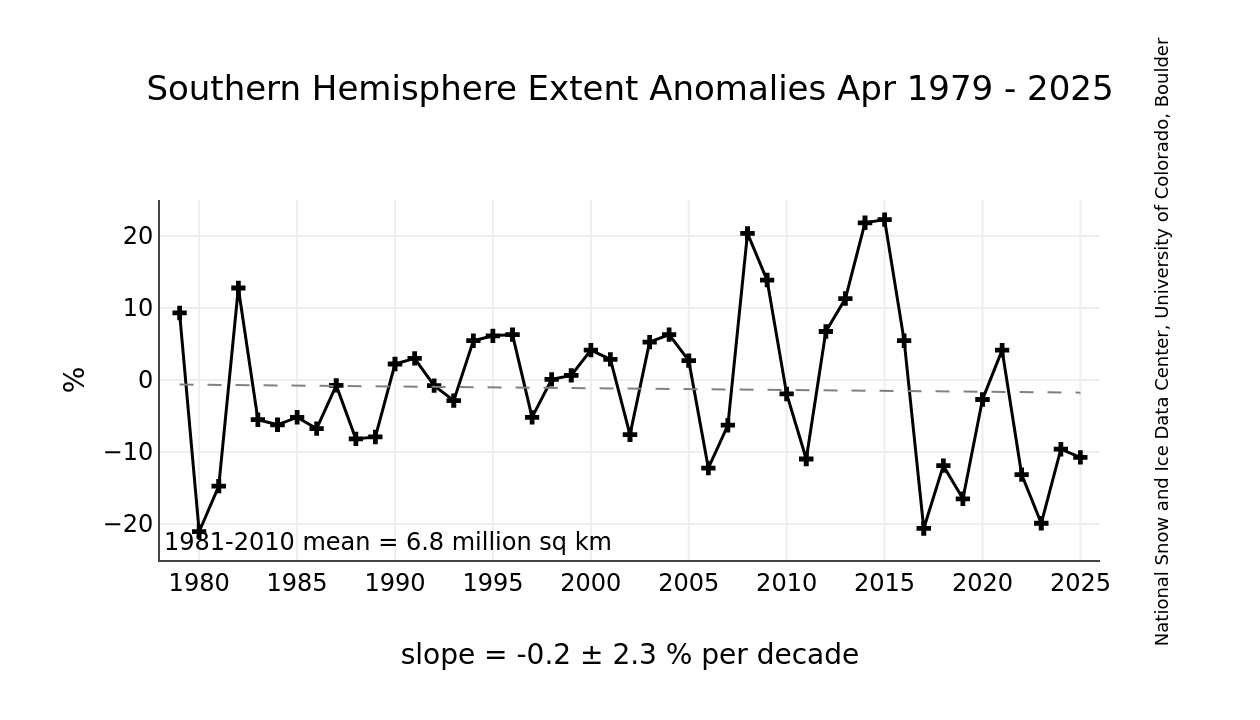
Sea ice extent in the Antarctic has been unusually high in recent years, both in summer and winter. Overall, the Antarctic is showing small positive trends in total extent. For example, the trend in February extent is now +3.1% per decade. However, the Amundsen and Bellingshausen Seas show a strong negative trend in extent. These overall positive trends may seem counterintuitive in light of what is happening in the Arctic. Our Frequently Asked Questions section briefly explains the general differences between the two polar environments. A recent report (Turner, et. al., 2009) suggests that the ozone hole has resulted in changes in atmospheric circulation leading to cooling and increasing sea ice extents over much of the Antarctic region.
The NSIDC graph below shows the upwards trend in Antarctic Sea Ice. Some recent years have shown anomalies as high as +30%.

http://nsidc.org/data/seaice_index/images/s_plot_hires.png
UAH satellite data also shows Antarctica cooling, as seen in their map below. (This map is dated November, 2006 – if anyone knows where to get a more recent version, please let me know.)


UAH 25 Year Temperature Trends
Perhaps NASA should have stuck with their original 2004 map below, showing Antarctica’s interior cooling?

NASA’s 1982-2004 map showing Antarctica cooling

While there’s no dispute that there’s some sea ice loss in the Antarctic peninsula, all signs seem to point in the opposite direction of what some what have you believe about Antarctica as a continent.
Sponsored IT training links:
We offer self paced 312-50 training with up to date 642-611 dumps and 70-450 practice test to provide guaranteed success in first dive.
You did say “far above the 20 year average in tropospheric temps at all levels.” The troposphere is wrapped around the whole Earth last time I looked out the window. Let me look again….wait for it….yes, still there. You did say “at all levels”, so that appears to indicate the whole of the Earth’s troposphere AT ALL LEVELS. So, which is it, you did or did not mean the whole Earth’s troposphere at all levels?
I suppose you are correct in observing that “The troposphereic temperature data is exeptional useful and important” when you are trying to convince readers that “it is diplaying exactly what we’d expect” in anything, contrary to the real world abhorrence for any perfection in human miscalculations. Of course, when you assert every positive and negative event is proof of Global Warming and Climate Change caused by mankind, it makes it kind of easy to claim “it is diplaying exactly what we’d expect” in anything.
I think R. Gates makes an interesting point about AGW models.
It is his contention that the models are correct, so following this logic the record warm Troposphere temperatures in Jan, Feb and March actually corresponds with a very cold Northern Hemisphere on the ground.
So if the Troposphere temperatures are “as expected” by the AGW models then following his logic, all in the NH must prepare for very cold weather in the future.
Is this what the AGW models predict? certainly sounds catastrophic!
Dear Sirs,
I might be worth noting that according to Peter Huybers (presently Harvard Earth Sciences, I think) Ph.D. Thesis under Carl Wunsch, a lead-lag study of 018 (isotopic temp. proxy) values in ice cores from both poles show a syncopation of 018 signals at CENTURY-level time-scales through the later Pleistocene, based upon Greenland and Antarctic data (Peter Huybers models a 210 y Antarctic lead in this, the thesis is well-written, readable, and available on-line). The point is that under NATURAL conditions, differences between arctic and antarctic temps. are perhaps usual rather than unusual (perhaps because of mechanics of Global, and esp. N. Atlantic deep-water formation and other oceanographic factors?). The present pole/anti-pole situation would appear to conform with expactations of non-anthropogenic climate change mechanisms. Much empirical work still needs to be completed by the British Antartic survey, but my gut feeling is that natural agencies will be seen to be primary factors, once climate science returns to reason. This site does a good job on that score.
Bruce M. Albert, Ph.D., PDRA, Durham University, UK
wes george (21:38:17) wrote:
What does one call a hypothesis that fails to yield useful predictions of observed data?
*********************************************
Well, I think a “Climate Change Scientist” (h/t to rob @ur momisugly 03:28:33) would call it “Results!”
How good are these satellite measurements of Antarctic ice gravity loss? We’ve been in situations before where errors were found in satellite measurements. GRACE has only been going for 8 years, so how do they even know if they are in any way accurate?
Remember what the doormouse said;
“Keep YOUR HEAD
Actually he said “Feed your head”, but that’s ok.
I have now canceled my order of a castle in the sky at 14,000 ft.
Thank you all.
I look at the 25 year UAH anomaly map and I see 3 ‘hot’ areas in the Arctic.
Each is fairly close to the three biggest sources of industrialisation in the the last 25 years: US/Canada, Europe, Japan/S Korea. One big feature of this period is the rise of transportation and in particular (sic) the use of diesel.
Methinks a few 10 micron particulates surveys might be in order. On the other hand there ain’t much black soot in Antarctica.
SandyInDerby (11:44:09) :
Leif Svalgaard (09:49:19)
“Not wishing to divert a private discussion, but what about unknown unknowns?”
Not private at all, very public ..
Whatever any calculations may show, and there are number of unknowns, one fact is well known: the GMF Z component today at the centre of the Beaufort gyre is about 17% less today (57.1 micro Tesla) than it was around 1650 (at deepest LIA, 68.5 micro Tesla), hence any possible effect would change accordingly.
Hey, thanks for the link to UAH satellite datafrom the linked story, “NASA Still Spreading Antarctic Worries”. I hadn’t realized the North Pole ocean warming trend was 0.50 deg C/decade – that’s worse than I thought.
I wish UAH and RSS would resolve their differences in data processing – they use the same NOAA polar orbiting satellite data, but come to different temperatures. RSS also makes clear that the satellite coverage is only to 82.5 deg latitude, south and north – UAH just calls the data South Pole and North Pole.
http://www.remss.com/data/msu/monthly_time_series/RSS_Monthly_MSU_AMSU_Channel_TTS_Anomalies_Land_v03_2.txt
Too bad the satellites can’t overlap some of the temperature stations at the South Pole below 82.5 deg latitude (and corresponding latitudes in the north)
http://blackmaps.files.wordpress.com/2009/03/antarctica-map.jpg
And both UAH and RSS use the same baseline period of 1979-2000 for their temperature anomalies – then why does RSS, for the month of Feb 2010, get a temperature anomaly of 0.151 for Land, -82.5 to -60 deg latitude, and UAH gets 1.05 deg C for the “South Pole land” ?
And for the North Pole ( 60 to 82.5 deg latitude), RSS gets 3.481 deg C anomaly, and UAH gets 1.91 deg C land temp. anomaly ?
I think the problem is not NASA’s, but one of the groups analyzing the satellite data. Hasn’t UAH been fixing a lot of errors recently ?
http://nsstc.uah.edu/data/msu/t2lt/readme.05Mar2010
Another absolute butchering of scientific data.
First off, Steven, you’re comparing NSIDC sea ice “extent” to NASAs “mass”. Two different metrics, obtained by different scientists, using different methods.
Second, NSIDC merely mentions a study that proposed an ozone hole-related cooling process. Conveniently, you ignore the entire FAQ section in which NSIDC clearly explains the scientific consensus (inclusive of NSIDC) on Antarctic sea ice, warming, cooling, etc. Here’s a particularly illuminating line:
“In terms of sea ice, climate model projections of Antarctic sea ice extent are in reasonable agreement with the observations to date. It also appears that atmospheric greenhouse gases, as well as the loss of ozone, have acted to increase the winds around Antarctica. Perhaps counter intuitively, this has further protected the Antarctic from warming and has fostered more ice growth.”
http://nsidc.org/arcticseaicenews/faq.html#wintertimeantarctic
R. Gates (12:18:14) said:
There is an alternative explanation: That the energy to heat up the troposphere is coming from the oceans …
“In terms of sea ice, climate model projections of Antarctic sea ice extent are in reasonable agreement with the observations to date. It also appears that atmospheric greenhouse gases, as well as the loss of ozone, have acted to increase the winds around Antarctica. Perhaps counter intuitively, this has further protected the Antarctic from warming and has fostered more ice growth.”
So it is not melting, they know it is not melting, and even if was melting it would take most of forever to do it.
So why do they keep coming out with all those estimates of how much
water would be over everything if did melt and inundate us all ? Isn’
the whole thing rather disingenuous ?
The next time some numbskull starts railing at me about how Pittsburgh and Denver will be coastal cities by August I will spit on their shoe, and say
“Are you drowning yet ?” or “I refute it thus”.
vukcevic (13:27:40) :
Z component today at the centre of the Beaufort gyre is about 17% less today (57.1 micro Tesla) than it was around 1650 (at deepest LIA, 68.5 micro Tesla), hence any possible effect would change accordingly.
So, any [negligible] effect today would be even less than in 1650. Do yourself a favor then, and study the material I have provided. Here is another study of this: http://www.leif.org/EOS/JC076i015p03476.pdf
Wren
If you won’t answer the simple question… than lay off. We know you want to take one possible piece of data from one source and pretend it has some huge meaning above all other observations. We get that, enough already.
The supposed loss of continental ice is a rediculously small trend and is NOT enough to validate the models or show any warming at all it is less that would be expected during an interglacial and so small it is doubtful that it exists at all.
EdP (12:38:16) :
I don’t get is that just about 100% of your posts end up with either a condescending or derisive comment.
I hope my comments are illuminating the errors and fallacies committed and sometimes even providing positive and factual information. I only comment [or try to, at least] on things that I know something about and there is a lot of nonsense dished out on this [and other blogs], and I call that as I see it. That you see many negative comments from me is perhaps a [sad] measure of the degree of nonsensical speculation that comes this way. Vuk’s latest [which he peddles regularly] is a sterling example.
Phil M,
Very nice straw man post. You are arguing with yourself, not my article.
I have a homework assignment for you.
1. Essay question (50 points) Propose a physical model where sea ice is freezing and adjacent continental ice is melting. Since you seem to believe it can occur.
2. True/False (25 points) NSIDC says Antarctic sea ice is increasing.
3. True/False (15 points) UAH says Antarctica is cooling and the NSIDC sea ice news explains why.
4. True/False (10 points) Sea level will rise 2-25 metres this century as Hansen has forecast.
-79F in Vostok on this fine summer day.
NSIDC: ‘It also appears that atmospheric greenhouse gases, as well as the loss of ozone, have acted to increase the winds around Antarctica.’
– that’s a joke isn’t it?
Ryan Stephenson (02:56:07) : Sea ice is floating on warm water, the base of the ice being in thermal equilibrium with the sea water. If that water gets just a little bit warmer, you’re going to get a lot more melting, with the floating ice turning into more water.
Warm water? Remind me to never ask you to draw a bath.
note:Phil and De Witt Payne are two that just cannot wait to see sea ice melt. LOL I would say 100% belief in AGW. Everytime the graph goes down they suddenly appear here or at CA ice thread. I of course appear when it goes up! A bit of a farce indeed! I am a very proud D#####r LOL.
My argument, Steve, is with you intentionally and repeatedly miscasting the data. I’ve pointed out your errors and missteps numerous times. All this talk about cherry picking – here’s a good line from NSIDC, which you inadvertently overlooked, I suppose:
“Wintertime Antarctic sea ice is increasing at a small rate and with substantial natural year-to-year variability in the time series. While Antarctic sea ice reached a near-record-high annual minimum in March 2008, this does not indicate a significant long-term trend.”
That’s quite an important point you left out there, son. Maybe it’s you that should be doing homework, if you’re not too busy counting pixels somewhere.
Leif Svalgaard (13:56:23) : “So, any [negligible] effect today would be even less than in 1650.”
You got that wrong way around (effect in 1650 would be, if linear 17% greater than today
“Do yourself a favor then, and study the material I have provided. Here is another study of this: http://www.leif.org/EOS/JC076i015p03476.pdf”
Thanks for the link: maths is mind boggling, and as Tesla said tendency of scientists to substitute maths for science. However I noticed following:
“The present analysis shows that the induced electric field can be a complicated function of the velocity field. The electric field responds to both the local and large-scale character of the flow. Presently it is easier to make electric, as opposed to magnetic, field measurements for long periods.”
In mean time let’s put some simple facts together:
– GMF Z component has a dip in the exact area of the strongest polar (Beaufort) gyre
http://www.vukcevic.talktalk.net/LFC15.htm
I suggest this is due to counter MF created by electric currents generated by gyre’s circulation in the strong Earth’s MF of the area.
– There is a proven correlation between the ocean transport index and GMF variation (be GMF small or large).
http://www.vukcevic.talktalk.net/LFC5.htm
– one fact is well known: the GMF Z component at the centre of the Beaufort gyre is about 17% less today (57.1 micro Tesla) than it was around 1650 (at deepest LIA, 68.5 micro Tesla), hence any possible effect on slowing down gyre’s circulation would change accordingly.
– Beaufort gyre regulates flow of the transpolar curent into Labrador Sea.
http://www.whoi.edu/cms/images/dfino/2007/2/ArcticCurrents-labels_41043.jpg
The warm water current branching of the North Atlantic Current and combination of the transpolar current create Labrador Sea current; this tightly governs the strength of the Subpolar gyre’s circulation, which is the engine of the heat transport across the North Atlantic Ocean.
Result: Strong correlation between GMF of polar regions and North Atlantic temperature anomaly.
http://www.vukcevic.talktalk.net/LFC8.htm
I wish you good night.
Richard Sharpe (13:46:23)
“There is an alternative explanation: That the energy to heat up the troposphere is coming from the oceans.”
Absolutely right but only for so long as the current El Nino lasts.
And also only while the sun’s surface remains quiescent. From 1975 to 2000 the run of strong El Ninos was largely offset by the active sun which allowed a faster venting of the oceanic energy to space. Now with a quiet sun and an El Nino the excess energy from the oceans is restrained from being vented fast enough and some of that energy is being redirected downward in the Arctic and Antarctic Oscillations to give cold mid latitudes and heavy snowfalls.
Leif Svalgaard ( 14:09:312)
Leif, as you should know I regard you as the master in all matters solar. However I think you are as adrift as anyone else when it comes to recognising the variety of interactions in the Earth’s processing of that solar energy.
Correct me if I’m wrong but I think you see the Earth system as a black body radiating out to space at the appropriate rate for a body at some so called global temperature.
I don’t think you have a grip on the internal variability of the Earth system which is composed of numerous layers in both oceans and air all of which introduce their own variations in the rate of energy flow back out of the system once it has been received from the sun.
It’s not just a matter of radiative physics straight in and straight out. There are the matters of convection and conduction and the irregular block transfers of energy upwards and downwards by the phase changes of water and the albedo variability introduced by changes in cloudiness and snow/ice cover.
As you must accept, the thermosphere can warm or cool whilst other layers change in the opposite direction. The stratosphere seems to warm and cool opposite to the troposphere and the oceanic energy content increases as the troposphere cools and vice versa.
All those phenomena can only be explained by varying rates of energy transfer between layers.
Bob Tisdale is right with his concept of discharge and recharge between sun sea and air but I would extend that globally and over centuries and possibly millennia.
Willis’s thermostat hypothesis is right but I would also extend that globally and over centuries and millennia.
Some of the ideas from tallbloke, Erl Happ and Svensmark are on the right lines as regards the energy flow effects of chemical changes in the atmosphere but personally I think that is a second order effect compared to oceanic variability.
I wouldn’t even entirely exclude the ideas of vukcevic and those who support length of day and gravitational effects because they could influence the oceanic variability that the observational evidence strongly supports.
It really doesn’t seem right for you to be so dismissive of thoughts and ideas that relate to internal Earth system variability on the basis of your undoubted solar expertise.
I think that is why we have not been able to have a full meeting of minds.
Richard Sharpe said:
“There is an alternative explanation: That the energy to heat up the troposphere is coming from the oceans …”
Indeed, and much of it likely is, especially in an El Nino year, and that’s why you look at long term trends, for there is only so much energy to be released during any given El Nino period, but over time, you’d expect the average global temperatures from one El Nino period to the next (according to AGW Models) to increase, and that’s one reason that the Met office and others are projecting 2010 to be the warmest year on instrument record, we have an El Nino going on, plus we have a greater CO2 concentration than 1998, the last big El Nino year– though that year was a stronger El Nino. 1998 was also at a different point at the beginning of solar cycle 23, with a more active sun, and though this effect is marginal, it gave 1998 even more warming potential.
Phil M,
You are again arguing a straw man. This article is about the March 3 Sea Ice News, which says the paragraph below. If they have inconsistent statements somewhere else on their web site, what does that have to do with this article? I quoted exactly what they said, in it’s entirety.
“Sea ice extent in the Antarctic has been unusually high in recent years, both in summer and winter. Overall, the Antarctic is showing small positive trends in total extent. For example, the trend in February extent is now +3.1% per decade. However, the Amundsen and Bellingshausen Seas show a strong negative trend in extent. These overall positive trends may seem counterintuitive in light of what is happening in the Arctic. Our Frequently Asked Questions section briefly explains the general differences between the two polar environments. A recent report (Turner, et. al., 2009) suggests that the ozone hole has resulted in changes in atmospheric circulation leading to cooling and increasing sea ice extents over much of the Antarctic region.”
“the original 1956 South Pole Station suffered the same fate of snow buildup and has long since been crushed under 30 feet of ice.”
“eight inches of snow continues to accumulate every year”
http://www.ferrarochoi.com/casestudies/southpole/index.html