By Steven Goddard
Last month we discussed how NASA continues to spread worries about the Antarctic warming and melting.
A January 12, 2010 Earth Observatory article warns that Antarctica
“has been losing more than a hundred cubic kilometers (24 cubic miles) of ice each year since 2002” and that “if all of this ice melted, it would raise global sea level by about 60 meter (197 feet).“
[Note that is continental ice, not sea ice, – Anthony]

NASA’s 1982-2007 map showing Antarctica warming

But NSIDC seems to be thinking differently in their March 3, 2010 newsletter. They say Antarctica is cooling and sea ice is increasing (makes sense – ice is associated with cold.)
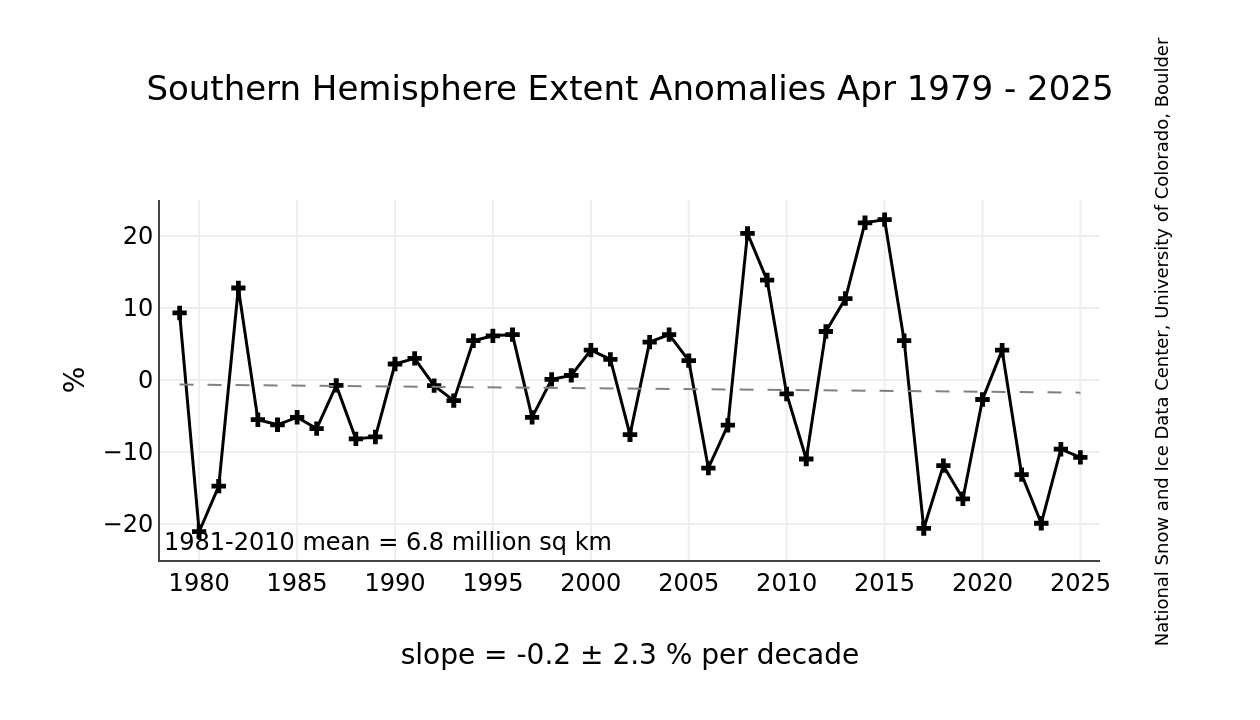
Sea ice extent in the Antarctic has been unusually high in recent years, both in summer and winter. Overall, the Antarctic is showing small positive trends in total extent. For example, the trend in February extent is now +3.1% per decade. However, the Amundsen and Bellingshausen Seas show a strong negative trend in extent. These overall positive trends may seem counterintuitive in light of what is happening in the Arctic. Our Frequently Asked Questions section briefly explains the general differences between the two polar environments. A recent report (Turner, et. al., 2009) suggests that the ozone hole has resulted in changes in atmospheric circulation leading to cooling and increasing sea ice extents over much of the Antarctic region.
The NSIDC graph below shows the upwards trend in Antarctic Sea Ice. Some recent years have shown anomalies as high as +30%.

http://nsidc.org/data/seaice_index/images/s_plot_hires.png
UAH satellite data also shows Antarctica cooling, as seen in their map below. (This map is dated November, 2006 – if anyone knows where to get a more recent version, please let me know.)


UAH 25 Year Temperature Trends
Perhaps NASA should have stuck with their original 2004 map below, showing Antarctica’s interior cooling?

NASA’s 1982-2004 map showing Antarctica cooling

While there’s no dispute that there’s some sea ice loss in the Antarctic peninsula, all signs seem to point in the opposite direction of what some what have you believe about Antarctica as a continent.
Sponsored IT training links:
We offer self paced 312-50 training with up to date 642-611 dumps and 70-450 practice test to provide guaranteed success in first dive.
Barry Kearns (17:10:28) :
“Leif Svalgaard (13:56:23) : “So, any [negligible] effect today would be even less than in 1650.”
vukcevic (15:00:23) :
“You got that wrong way around (effect in 1650 would be, if linear 17% greater than today”
Assuming a linear response, and values of 68.5 in 1650 versus 57.1 today, we could say that the effect today is about 17% less than it was in 1650 (actually about 16.64% less)”
I agree with you. It was a bit late, rounded it off to17% , and somewhat carelessly followed Dr. S. comment, but here is my original statement:
vukcevic (13:27:40) :
Whatever any calculations may show, and there are number of unknowns, one fact is well known: the GMF Z component today at the centre of the Beaufort gyre is about 17% less today (57.1 micro Tesla) than it was around 1650 (at deepest LIA, 68.5 micro Tesla), hence any possible effect would change accordingly.
Thanks for the up-date Willis. Nothing unusual happening here.
Norsex Arctic sea-ice extent has just hit the monthly 1979 – 2006 average – bottom left graph on the Artic-Roo’s website here:-
http://arctic-roos.org/observations/satellite-data/sea-ice/ice-area-and-extent-in-arctic
Please keep up the good work.
Woops! – my above post should have been on Willis Eschenbach’s UPDATED Congenital Climate Abnormalities Thread here:-
http://wattsupwiththat.com/2010/02/13/congenital-climate-abnormalities/
Sorry about that.
vukcevic (23:42:24) :
Whatever any calculations may show, and there are number of unknowns, one fact is well known: the GMF Z component today at the centre of the Beaufort gyre is about 17% less today (57.1 micro Tesla) than it was around 1650 (at deepest LIA, 68.5 micro Tesla), hence any possible effect would change accordingly.
How is it that we know these measures? The center of the BG seems to be fairly mobile. Determining it in the present would seem to be a bit of a challenge, determining it 360 years in the past would seem highly unlikely.
R. Gates (09:23:41) :
“Gail said:
“In other words when Dr. Roy Spencer showed high satellite temperature records in January 2010 it is actually show the earth is COOLING down…”
??? Now that is an interesting twist. Higher temps=cooling. I can see why so many people are confused…”these are not the droids you’re looking for” or “this is not the higher temps you think they are”. Very funny!”
REPLY:
That was taken out of context. Read the WHOLE exchange. Oh wait you are a AGW type so taking it out of context to make fun of someone is the politically correct move. Excuse me for thinking you might be interested in the science.
JimAsh (13:55:02) :
“….The next time some numbskull starts railing at me about how Pittsburgh and Denver will be coastal cities by August I will spit on their shoe, and say
“Are you drowning yet ?” or “I refute it thus”.”
Do not forget this article in the Geological Society publication http://www.geolsoc.org.uk/gsl/site/GSL/lang/en/page7209.html
“…It is also worth noting the geometry and age of the great icecaps. The Greenland, East Antarctica and West Antarctica ice sheets occupy kilometre-deep basins, and the ice cannot possibly slide downhill – it has to flow uphill. In simple numbers the Greenland icecap has existed for three million years and the Antarctic Ice sheets 30 million….”
So what you would have if the glaciers melted are inland seas not the oceans rising to algorest heights. Think of the finger lakes in New York that are artifacts of the last glaciation.
R. Gates (12:18:14) : The troposphereic temperature data is exeptional useful and important, and my whole point in even mentioning it is because it is diplaying exactly what we’d expect in January, February, and now into March 2010, if, as the Met Office has stated, and I also believe, there is a good chance that 2010 will be the warmest on instrument record. A warm troposphere is exactly what AGW models predict, ..
Yes but R gates – correct me if I am wrong the AGW models didnt just predict the tropospheric hotspot in Jan and Feb 2010. Staistically I suppose sometime it was bound to happen and you leap in and say – aha – AGW, while in the meantime the Artic ice is normal and there are blizzards on the mediterranean coast.
Leif Svalgaard (15:48:59) :
“Nonsense, science today is mathematical, and the math is elementary….
That is because you [and he (vukcevic)] do not understand the physics….
I spent the first five years at the University in Copenhagen studying Geophysics and Atmospheric physics and worked four years at the Danish Meteorological Institute, so I do know something about all that. [This is my real field – the solar bit came later]”
I have looked at the paper again.
http://www.leif.org/EOS/JC076i015p03476.pdf
15 pages of maths to justify “This research was supported by the Office of
Naval Research contract N00014-66-C0241.”
But the conclusion is the most revealing :”The present results suggest that considerable new information about ocean currents can be obtained from electric and magnetic measurements.”
No actual data, just mathematical modelling, and we have come across these before,
Well, I have great respect for University of Copenhagen, since my daughter spent a postgraduate year there studding the European Union law.
Elsewhere, commenting on my pointing out at high correlation in the trends of the North Atlantic temperature anomaly (NATA) you said:
“My point was precisely that without specifying the location, your graph has no value.”
It appears that the University in Copenhagen, Geophysics and Atmospheric physics dept. and at the Danish Meteorological Institute, in view of the fact that Denmark owes a great chunk of land within the Arctic circle, have failed to familiar their students with the fact that there is a reversed proportionality between the GMF in the Arctic and the North Atlantic temperature anomaly.
This diagram may be of some help.
http://www.vukcevic.talktalk.net/LFC16.htm
Diagram shows the GMF along the transpolar current route, main factor controling the North Atlantic temperature anomaly.
See also: http://www.vukcevic.talktalk.net/GandF.htm
Anu (19:17:23) :
“…It seems that glaciers speed up and thin out on the way to dumping their ice into the ocean, after the ice shelf damming them breaks.
They’ve seen this with the dramatic Larsen B ice shelf breakup in 2002:
http://nsidc.org/news/press/20040921_acceleration.html
In the wake of the Larsen B Ice Shelf disintegration in 2002, glaciers in the Antarctic Peninsula have both accelerated and thinned en route to the Weddell Sea. The findings indicate that ice shelf breakup may rapidly lead to sea level rise…..The Larsen B shelf was about the size of Connecticut…”
You quote a lot of alarmist “rapidly sea level rise” information. I have a couple of problems with it. Given the size of the Larsen B shelf there should have been a measurable effect in increase of sea ice and sea level rise to prove the theory correct.
First the Larsen B Ice Shelf disintegration took place in 2002. A look at the global sea ice variation shows no real impact. http://noconsensus.files.wordpress.com/2008/12/global-sea-ice-area-variation-nasateam-algorithm.jpg
A look at the sea level rise at Funafuti, Tuvalu and other points around the world shows no impact. http://www.appinsys.com/GlobalWarming/SeaLevelRising.htm
I notice the articles talk about “accelerated and thinned” they do not talk about the total volume of ice going into the sea per unit time. Perhaps this is why there has been no impact. The glaciers are moving faster but due to thinning the amount of ice dumped into the sea remains about the same.
Ref – EdP (12:38:16) :
Leif Svalgaard
“…I think it’s time for you to lighten up.”
___________________________
EdP- Leif is like a smoke detector or geigercounter. He let’s us know when things might not be as they seem.
PS: TMDE (Test Measurement Diagnostic Equipment) are sensitive, do not throw, drop, beat, scratch, or expose to too much BS -lest they explode:-)
I suggest that all climate alarmists are REQUIRED to read Cliff Ollier’s article in the March issue of Geoscientist (linked by Gail Combs above).
Once again, it gives us ‘we know we’re right but not quite sure why’ sceptics an easily understood explanation as to why the ’60m rise in sea level’ predictions are so much cobblers.
Incidentally – re the Arctic sea ice – about now the extent should be decreasing – but it will be interesting to watch the JAXA chart to see whether this horrible Northern Hemisphere winter has any effect on the rate..!
vukcevic (04:29:13) :
the fact that there is a reversed proportionality between the GMF in the Arctic and the North Atlantic temperature anomaly.
This is not a fact of causation, but just a coincidence, and I have repeatedly pointed out that your proposed explanation doesn’t work. Read Shermer’s book: “Why People Believe Weird Things”.
Dave Wendt (02:35:11) :
How is it that we know these measures? The center of the BG seems to be fairly mobile. Determining it in the present would seem to be a bit of a challenge, determining it 360 years in the past would seem highly unlikely.
Of course centre of the BG can an probably does move, but since gyre is more than 1000km across, and the dip in GMF covers most of it, it may not make great deal of difference.
http://www.vukcevic.talktalk.net/LFC15.htm
It appears that there is a reversed proportionality between the GMF in (the wider area of Arctic) and the North Atlantic temperature anomaly as can be seen in this diagram.
http://www.vukcevic.talktalk.net/LFC16.htm
Diagram shows the GMF along the transpolar current route, one of the main factors controlling the North Atlantic temperature anomaly.
See also: http://www.vukcevic.talktalk.net/GandF.htm
vukcevic (04:29:13) :
just mathematical modelling
I can understand that you are mathematically challenged, so we’ll try some hand waving instead:
Moving a conductor [sea water] through a magnetic field induces an electric current which heats the sea [immeasurably – but let that slide]. If the magnetic field is weaker, the electric current is weaker and the heating less. The field is some 17% weaker today than in 1650, so the heating today is correspondingly less [still apart from not being measurable].
irishspecialistnurseries,
CO2 freezes at -109.3° F. Antarctica gets down to -128.6 °F . Sorry that you don’t understand what the freezing point is, and that you feel the need to misrepresent what I wrote.
You may like to note that the highest mountains in the Alps have mean summer temperatures at -2Celsius but maximum summer temperatures of +10Celsius. Even this is not enough to ensure that the glaciers at the top of such mountains melt away to nothing during the summer. Therefore, what chance is there of such glaciers melting in Antartica where the temperatures are never greater than -30Celsius in the Summer? Very low surely. Of course, those glaciers close to the coast where the ice has a chance of slipping into the sea will melt on reaching the warmer ocean, but the vast majority of the ice is on the Antartic plateau with no obvious route to the ocean. Furthermore, the melting of glaciers in the Alps tends to be at its highest not due to warm days per se but due to warm Summer rain falling onto the glaciers – a process physically impossible in the Antartic.
I submit that it is not physically possible for significant levels of land ice in Antartica to melt and thus contribute to sea level rise as a result of AGW, even if such exists. The mean temperatures are far too low for AGW to raise the temperature up to melting point. Some ice may flow to the sea in glaciers, but it is a tiny proportion of the total, and readily replaced by precipitation inland that is always in the form of snow. We should perhaps be glad that the glaciers do indeed flow to the ocean and melt, because otherwise Antartica would act as a kind of precipitation trap, with snow falling on Antartica and staying there.
Richard said:
“while in the meantime the Artic ice is normal and there are blizzards on the mediterranean coast…”
Arctic sea ice is not normal, still showing a negative anomaly, and has not been at or above normal since 2004. Where do you get your data?
And the moisture for the the blizzards in Europe came directly from a very warm Caribbean…which I pointed out was headed toward Europe several days ago. This moisture combined with continued cold air being pushed down from the warmer than usual arctic (especially near Greenland). Warmth induced moisture + negative AO index=blizzards. The exact thing that happened to our east coast this winter happened to Europe, and has two factors:
El Nino + negative AO index
And neither of these is indicative of planetary cooling, and in fact, as we all know, the troposphere has been near, or above 20 year record temps this year.
To no one in particular:
None of us alive today has any first hand knowledge of an Ice Age or even a Little Ice Age. What we are about is best guessing within our little present age the nature of climate change that leads to another Ice Age or the end of the Ice Ages and the beginning of a Global Hothouse Age (A’la Dino d’Dinosaur); neither of which is going to be very pleasent for anyone –but which is completely natural and unavoidable, despite anything that Jones, Mann, or Fat Albert says.
R. Gates (07:08:42) :
So, how does the mid-upper troposphere undergo such a dramatic warming as it dumps this warmth into space from the preciptiatation of rain, frozen rain and snow without contributing to the cooling of the Earth? Oh, right, you’ve repealed the fundamental laws of thermodynamics just to satisfy your special pleading. Silly us.
Pascvaks (07:38:45) :
You do have first hand experience of an ice age. You are experiencing it right now with the composition of the air you breathe, the experience of snow and snow cover, the presence of the ice caps at the poles, the lifeforms present in the biosphere, and so much more.
Even in other glacial periods of the other ice ages there has seldom been an ice cap at the North Pole, or an ice cap which has extended as far south as the most recent 2 million years. This is an extremely unusual and cold event and experience for the Earth this past 20-30 million years. Do not underestimate its danger with respect to a collapse of the biosphere in the event of the carbon dioxide levels in the atmosphere falling too low at 150ppm and less.
Leif Svalgaard (06:57:59) :
“If the magnetic field is weaker, the electric current is weaker and the heating less. The field is some 17% weaker today than in 1650, so the heating today is correspondingly less [still apart from not being measurable].”
You were obviously in the wrong department there (Danish Meteorological Institute).
Heating of the sea water by induced electric currents is of no consequence here, it is the reverse MF impacting on velocity.
Velocity of the gyre’s rotation controls relationship of deep saline currents (from North Atlantic and Bering Sea) and fresh surface waters inflow (from Northwest Canada and Far East Siberia).
http://www.whoi.edu/cms/images/halocline_18008_56197_56788.jpg
It is this relationship that has an effect on salinity on the resultant transpolar current encountering the Gulf Stream at the shores of Greenland and Labrador Sea., where the stored heath of the Gulf Stream is released into atmosphere in the subpolar gyre.
As you can see from the above illustration there are number of smaller warm water gyres in the Arctic and each of them is affecting the transpolar current, hence the graph of the GMF Z along the way.
http://www.vukcevic.talktalk.net/LFC16.htm
The warm water current branching of the North Atlantic Current and combination of the Arctic cold currents create Labrador Sea currents; which tightly governs the strength of the Subpolar gyre’s circulation, which is the engine of the heat transport across the North Atlantic Ocean. This is heat absorbed in Equatorial Atlantic, and not any kind of heat due to induced currents (which indeed is negligible).
vukcevic (06:38:42) :
Of course centre of the BG can an probably does move, but since gyre is more than 1000km across, and the dip in GMF covers most of it, it may not make great deal of difference.
http://iabp.apl.washington.edu/research_seaiceageextent.html
This paper suggests that in the late 80s the BG shifted significantly toward the Alaskan – Canadian corner of the Arctic, that the radius decreased almost a half, and that it stayed mostly in that configuration for the majority of the intervening years, confined to the area on the North American side of the antimeridian with its center well away from the center of GMP dip you linked to. From what I’ve seen the state of knowledge on the previous history of the BG is none too robust, but this type of shift seems to be viewed as not exceptional.
vukcevic (08:10:07) :
reverse MF impacting on velocity.
OK, so you change the story. Fair enough. So, you are now saying that the Earth magnetic field is slowing the ocean current, so a weaker magnetic field [as today] should slow the current relative to 1650. The ocean current now being slower meaning more warm water flowing to the pole.
Leif Svalgaard (08:33:57) :
vukcevic (08:10:07) :
reverse MF impacting on velocity.
OK, so you change the story. Fair enough. So, you are now saying that the Earth magnetic field is slowing the ocean current, so a weaker magnetic field [as today] should slow the current relative to 1650. The ocean current now being slower meaning more warm water flowing to the pole.
or do I have that backwards? it is hard to figure out what you are saying. Let me try again to explain what I think you are saying:
Electric currents induced by the gyre moving in the Earth’s magnetic field brakes the gyre. The magnetic field now being lower should mean less braking and hence stronger flow, etc.
Now, this comes down again to a calculation of the Lorentz force on the gyre and again that force is unmeasurably small and in the wrong direction. Try it: F = q * v x B, or rather dF = q* v x dB. dB is 1/1000 of B. q is the electric charge [depends on the conductivity of sea water]. B is vertical, v is horizontal along latitude, so F is horizontal along longitude. Try to explain which forces your are talking about, which directions they have, etc. Be specific.
vukcevic (06:38:42) :
Here is a link to a map that shows a more current representation of the BG and TPD
http://www.amap.no/?main=http%3A//www.amap.no/mapsgraphics/go/graphic/the-predominant-currents-in-the-arctic-ocean-and-their-major-routes-around-the-basin-edges-of-the-artic