By Steven Goddard
Last month we discussed how NASA continues to spread worries about the Antarctic warming and melting.
A January 12, 2010 Earth Observatory article warns that Antarctica
“has been losing more than a hundred cubic kilometers (24 cubic miles) of ice each year since 2002” and that “if all of this ice melted, it would raise global sea level by about 60 meter (197 feet).“
[Note that is continental ice, not sea ice, – Anthony]

NASA’s 1982-2007 map showing Antarctica warming

But NSIDC seems to be thinking differently in their March 3, 2010 newsletter. They say Antarctica is cooling and sea ice is increasing (makes sense – ice is associated with cold.)
Sea ice extent in the Antarctic has been unusually high in recent years, both in summer and winter. Overall, the Antarctic is showing small positive trends in total extent. For example, the trend in February extent is now +3.1% per decade. However, the Amundsen and Bellingshausen Seas show a strong negative trend in extent. These overall positive trends may seem counterintuitive in light of what is happening in the Arctic. Our Frequently Asked Questions section briefly explains the general differences between the two polar environments. A recent report (Turner, et. al., 2009) suggests that the ozone hole has resulted in changes in atmospheric circulation leading to cooling and increasing sea ice extents over much of the Antarctic region.
The NSIDC graph below shows the upwards trend in Antarctic Sea Ice. Some recent years have shown anomalies as high as +30%.

http://nsidc.org/data/seaice_index/images/s_plot_hires.png
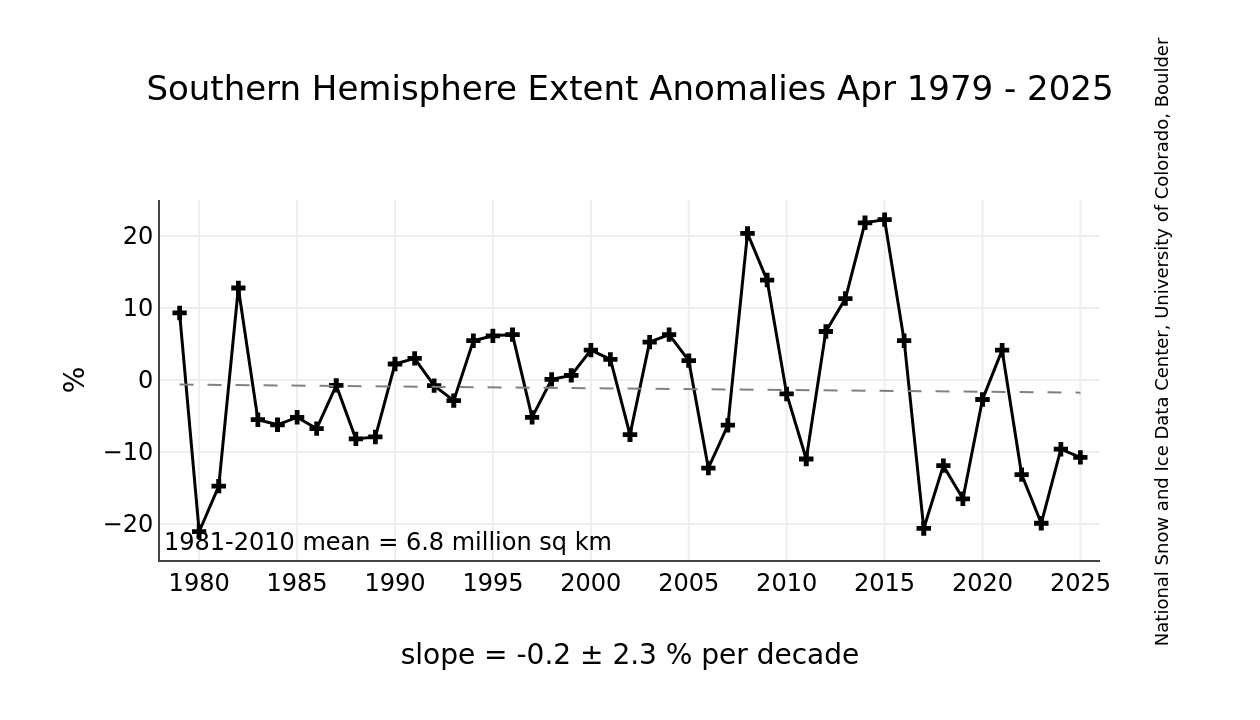
UAH satellite data also shows Antarctica cooling, as seen in their map below. (This map is dated November, 2006 – if anyone knows where to get a more recent version, please let me know.)


UAH 25 Year Temperature Trends
Perhaps NASA should have stuck with their original 2004 map below, showing Antarctica’s interior cooling?

NASA’s 1982-2004 map showing Antarctica cooling

While there’s no dispute that there’s some sea ice loss in the Antarctic peninsula, all signs seem to point in the opposite direction of what some what have you believe about Antarctica as a continent.
Sponsored IT training links:
We offer self paced 312-50 training with up to date 642-611 dumps and 70-450 practice test to provide guaranteed success in first dive.
Willis Eschenbach (22:59:29) :
For those talking above about a warming arctic and about sea ice, see my analyses here (in the Updates).
Reply:
A super summation, thanks. I missed it the first time round but now I have it bookmarked.
I guess to put all this in perspective, one should really compare the two anomaly charts between the arctic and the antarctic. First look at the arctic chart:
http://arctic.atmos.uiuc.edu/cryosphere/IMAGES/seaice.anomaly.arctic.png
And then compare it to the antarctic chart:
http://arctic.atmos.uiuc.edu/cryosphere/IMAGES/seaice.anomaly.antarctic.png
Now ask yourself, which, just as a casual observer, appears to show a more dramatic slope up or down? If you said the arctic you’d be right, and furthermore, the arctic has not has a positive anomaly since 2004, whereas the antarctic had a NEGATIVE one just a few months back, which is hardly indicative and any dramatic sea ice growth for the region, and that is exactly the case– the year-to-year sea ice growth in the antarctic is not dramatic, but certainly merits monitoring. I think once more, this is a case of over-hyping the case, when a more moderate “interesting but not dramatic” stance is warranted.
Wren (23:00:13) :
Steve Goddard (22:29:04) :
Wren,
Suppose for a moment that the NASA claim of 24 cubic miles per year was correct. It would take 300,000 years for the ice to melt.
http://wattsupwiththat.com/2010/02/03/nasa-still-spreading-antarctic-fud/
================
Who said it’s all going away soon?
Reply:
Isn’t that what Al Gore has been trying to tell everyone in all his talks about sea level rising and flooding cities???
Southern Hemisphere annular mode – SHAM.
How ironic.
I just posted this over at skepticalscience:
MaxL (22:20:07) : Whenever displaying linear regressions it should be mandatory to give both the standard error of the estimate and the correlation coefficient (r).
Bravo! Furthermore there should be a estimate of the autocorrelation of the residuals. Time and time again these climate “anomaly trend” charts exhibit linear regressions onto what appear to be manifestly autocorrelated time series. When the series is autocorrelated any temporal trend has a much larger error bar than that for independent and identically distributed data (which is what linear regression is designed to work on).
And while we’re at it, can we stop these ad-hoc moving averages (8 years? 13 months? why?) that are supposed to “illustrate” the underlying trend.
PeterB
I WANT a barbecue summer… because I like barbecues!
We haven’t had a good summer in England since 2003. Cut us some slack here.
wayne (00:03:55) :
“Why does no one mention the very possibility that Antarctica could be subsiding 0.7 mm/year instead of assuming loss of ice over the continent? Or could it possibly be a combination of both? The satellite is measuring height. That 0.7 mm would, over 14,000,000 km, equate to 100 cubic kilometers of ice loss also but would mean no ice has actually been lost. Can the Grace satellite’s instruments measure to this incredible precision. That is to 9 or 10 digits. Don’t know, will have to read the Grace instruments user, calibration, and specification manuals and procedures; NASA usually makes these public. And Grace was launched in 2002 which is when the ‘trend’ began. What? That questions immediately a possible secular drift. Just don’t foolishly accept statements tossed without concrete backup.”
There is also sublimation and compaction due to age… The amount of Ice is dependent on how much it snows vs how much melts due to warm temperatures, compacts, sublimates or melts due to the weight of the ice. To me the amount of continental ice would be a function of how much snow falls and the data says not much snow does fall at least in the interior.
From the Antarctica Connection Website
Coldest Temp:
-129°F (-89°C) on July 21, 1983
Location: Vostok Station
Warmest Temp:
+59°F (+15°C) on Jan 5, 1974
Location: Vanda Station
Mean Temps:
Winter: -40 to -94°F (-40 to -70°C)
Summer: -5 to -31°F (-15 to -35°C)
Why is Antarctica so Cold?
Several factors combine to making Antarctica one of the coldest and least hospitable places on the Earth:
* Unlike the Arctic region, Antarctica is a continent surrounded by an ocean which means that interior areas do not benefit from the moderating influence of water.
* With 98% of its area covered with snow and ice, the Antarctic continent reflects most of the sun’s light rather than absorbing it.
* The extreme dryness of the air causes any heat that is radiated back into the atmosphere to be lost instead of being absorbed by the water vapor in the atmosphere.
* During the winter, the size of Antarctica doubles as the surrounding sea water freezes, effectively blocking heat transfer from the warmer surrounding ocean.
* Antarctica has a higher average elevation than any other continent on Earth which results in even colder temperatures.
Blizzards:
Blizzards are a typical Antarctic phenomenon in which very little, if any, snow actually falls. Instead the snow is picked up and blown along the surface by the wind, resulting in blinding conditions in which objects less than a meter away may be invisible….
http://www.antarcticconnection.com/antarctic/weather/index.shtml
Wren,
Hansen says it is “going away soon.”
http://www.physics.utoronto.ca/news_repository/will-oceans-surge-59-centimetres-this-century-or-25-metres
Here’s the most recent UAH anomaly map I’ve found so far.
http://climate.uah.edu/map_thumb/1208.jpg
R. Gates (08:22:32) : “I guess to put all this in perspective, one should really compare the two anomaly charts between the arctic and the antarctic. First look at the arctic chart:.”
Thanks for that. I was going to agree with you until I superimposed both graphs and realised that the difference at the beginning is very similar to that at the end. In anycase the overall variation is still well within the decadal noise margin so it really isn’t possible to come to any really meaningful conclusion.
Another decade at the current trends and I think you will have a case, but until then let’s just wait and see!
Once again, global sea ice area is at the 30 year mean.
http://arctic.atmos.uiuc.edu/cryosphere/IMAGES/global.daily.ice.area.withtrend.jpg
Leif Svalgaard (06:14:30) :
“…..No, it is not possible. The electric currents induced by weak conductor of sea water moving through the Earth’s magnetic field is MUCH to weak to have any effect…..”
But of course one cannot totally exclude possibility that you also could be wrong. As this diagram shows there is a definite correlation between the ocean transport index and GMF variation.
http://www.vukcevic.talktalk.net/LFC5.htm
D. Patterson (01:37:51) :
“As water goes through a phase change from a gaseous vapor to a liquid and from a liquid to a solid snow and ice, it liberates an extraordinary amount of thermal energy. When this phase change from a warmer water vapor or liquid to a colder solid snow and ice occurs in the troposphere, a certain amount of that thermal energy must be radiated into space….. In other words, when the Earth is cooling it must radiate elevated levels of thermal energy to space where the satellite instruments can record the thermal emissions resulting from the cooling.”
In other words when Dr. Roy Spencer showed high satellite temperature records in January 2010 it is actually show the earth is COOLING down by radiating more thermal energy thanks to the record snow and rainfall. Is that correct?
http://wattsupwiththat.com/2010/02/04/january-uah-global-temperature-warmest/
Stephen Singer,
Thanks for the map. What I am really looking for is the long term trend map, not the monthly anomaly map.
R. Gates (07:48:54) :
“How could we be ‘on track’ for a record warm year in early March?”
January and February running far above the 20 year average in tropospheric temps at all levels, with much of the time spent above the 20 year record highs for tropospheric temps.
From NOAA’s National Environmental Satellite, Data, and Information Service, January 2010 — my emphasis:
* The global land surface temperature for January 2010 was 0.83°C (1.49°F) above the 20th century average of 2.8°C (37.0°F)—the twelfth warmest January on record. Land areas in the Southern Hemisphere were the warmest on record for January. In the Northern Hemisphere, which has much more land, comparatively, land surface temperatures were 18th warmest on record.
* The worldwide ocean surface temperature for January 2010 was the second warmest—behind 1998—on record for January, 0.52°C (0.94°F) above the 20th century average of 15.8°C (60.5°F). This can be partially attributed to the persistence of El Niño across the equatorial Pacific Ocean. According to NOAA’s Climate Prediction Center (CPC), El Niño is expected to continue through the Northern Hemisphere spring 2010.
http://www.ncdc.noaa.gov/sotc/?report=global
February’s data isn’t posted yet, and the archives only go back to 1998 — but it appears that the *surface* temperatures don’t justify a prediction that we’re in for “a record warm year.”
Gail said:
“In other words when Dr. Roy Spencer showed high satellite temperature records in January 2010 it is actually show the earth is COOLING down…”
??? Now that is an interesting twist. Higher temps=cooling. I can see why so many people are confused…”these are not the droids you’re looking for” or “this is not the higher temps you think they are”. Very funny!
RockyRoad (04:22:37) :
NASA says
“The answer boils down to the fact that ice can flow without melting.”…..
————–
Reply:
That’s a rather weird sentence; melted ice isn’t ice at all; it is water.
Should Antarctic ice loss be factual, I see several possibilities:”
Two other commentors have pointed to this article from the Geological Society that addresses the science. http://www.geolsoc.org.uk/gsl/site/GSL/lang/en/page7209.html
The really interesting point made is
“It is also worth noting the geometry and age of the great icecaps. The Greenland, East Antarctica and West Antarctica ice sheets occupy kilometre-deep basins, and the ice cannot possibly slide downhill – it has to flow uphill. ..”
And yes they do consider ice a “rock” with plastic characteristics
“The threshold boundary between non-flowing ice and flowing ice marks the yield stress level. The brittle upper ice in an alpine glacier is a solid being carried along on plastic ice beneath.”
Veronica,
How about sunny and 25C for at least half of the days in summer both there and here in the Midwest of the US. Not so hot that the alarmists will bother us, but warm enough to barbeque and perhaps play a little golf. Sound good?
Since some “scientists” claim that humans can control the weather, I think they should get right on that for us!
vukcevic (09:03:35) :
But of course one cannot totally exclude possibility that you also could be wrong.
You can make the calculation and show me wrong. The correlation means nothing.
R. Gates (08:22:32),
As Don B shows a few posts up, global ice cover is at its long term average, debunking your anomaly chart. Since the alarmist scare is global warming, not Arctic warming [which is offset by Antarctic cooling], your claim is contradicted by the chart of global ice extent. And the chart in the article here shows steady growth in Antarctic ice.
Want more? Didn’t think so, but let’s look anyway. This chart compliments the chart in the article: click
And here’s NASA’s own chart showing global ice cover rising above its long term average: click
Here’s a picture of Antarctic ice cover showing the increase over the past three decades: click. [Note the figures showing the increase]
Finally, here is a picture of the past three years of summer Arctic ice cover by the University of Bremen. A close inspection shows that Arctic ice cover is actually increasing: click. Makes you wonder if the NSIDC is fudging the numbers like NOAA does.
Since the alarmist claim is that there soon may be no Arctic ice at all is debunked like all the other global warming scares, maybe it’s time you moved on to the scare du jour, methane. That scare will be debunked too, because there is nothing unusual happening with the planet – despite what Romm, tamino, Schmidt and the rest of the rent-seeking tax suckers want you to believe.
So, as we know from our observations of the sun, global cooling is coming. I noticed here in Pretoria, South Africa that last winter was colder than usual; in fact one of our solar panels froze up. Freezing weather is strange for Pretoria. I will let you know if this winter will be colder than usual again.
Steve Goddard,
Thanks for the reply to my post, it puts the whole thing in perspective when the margin of error is many times the supposed anomoly. In my mind that isnt measurement its guess work, a 0.1 degree measurement with a three degree margin of error means that the anomoly map is little more than a politically motivated stunt.
A useless map to gauge a useless differential with no other use than to scare children and reinforce a belief system.
Btw what possible scientific use is a 0.1 degree change in an average temperature, what pysical changes will this tiny fractional change have on such a massive enviroment?
Cassandra,
The bottom line with Antarctica is that it is not doing what Hansen predicted in 1984, in fact it is doing the opposite of what he predicted.
http://www.epa.gov/climatechange/effects/downloads/Challenge_chapter2.pdf
Why can’t they just admit that they are wrong, instead of making increasingly ridiculous claims about future sea level rise?
Some interesting questions arise when from the POV of an observer that antarctic glacier recession seems to have been occurring when the SH temperatures in the 19th century were “supposedly” colder then present.
Notes from transactions of the Royal society of NZ 1910.
Note on Glacier-Recession, By T. V. Hodgson.
A great deal has been said and written about the retreat of the ice from north to south, and the glaciers from low to the higher levels. This has been based upon the fact that the edge of the Great Ice Barrier is some miles further south than it was when seen by Ross in 1839–40.
The various sledge parties encountered many glaciers the extremities of which do not reach the sea, or even come within reasonable distance of it. One fact must impress the Antarctic explorer, and that is the thinness of the ice-sheet and the large proportion of exposed rock. The thickness of the ice on the inland plateau is purely conjectural, and with the appliances of the average sledge party it would be impossible to measure it. Theoretical calculations have shown that ice cannot exist at a greater thickness than 3,000ft., and one feels—for one can do nothing else—when in those regions that there is no reason to believe that it might possibly be more than this.
I would ask, what right have we to accept so readily the assumption that the temperature-conditions are becoming less severe, and that therefore the ice-cap is receding? It appears to me that the evidence is very weak at the best.
To begin with the Barrier, the amount of recession is small compared to its enormous area. It is greatest on the eastern side, where we have absolutely no knowledge whatever as to the source of supply. As compared to the mountains of the west, King Edward VII Land, from the little that has been seen of it, is low-lying country, and if such should ultimately prove to be the case it may also prove to be the larger feeding-ground
http://rsnz.natlib.govt.nz/image/rsnz_43/rsnz_43_00_0523_0494_ac_01.html
http://rsnz.natlib.govt.nz/image/rsnz_43/rsnz_43_00_0524_0495_ac_01.html
Sometimes these things just happen in a random sort of way,and exhibit historical behavior without being recurrent.