By Steven Goddard
Last month we discussed how NASA continues to spread worries about the Antarctic warming and melting.
A January 12, 2010 Earth Observatory article warns that Antarctica
“has been losing more than a hundred cubic kilometers (24 cubic miles) of ice each year since 2002” and that “if all of this ice melted, it would raise global sea level by about 60 meter (197 feet).“
[Note that is continental ice, not sea ice, – Anthony]

NASA’s 1982-2007 map showing Antarctica warming

But NSIDC seems to be thinking differently in their March 3, 2010 newsletter. They say Antarctica is cooling and sea ice is increasing (makes sense – ice is associated with cold.)
Sea ice extent in the Antarctic has been unusually high in recent years, both in summer and winter. Overall, the Antarctic is showing small positive trends in total extent. For example, the trend in February extent is now +3.1% per decade. However, the Amundsen and Bellingshausen Seas show a strong negative trend in extent. These overall positive trends may seem counterintuitive in light of what is happening in the Arctic. Our Frequently Asked Questions section briefly explains the general differences between the two polar environments. A recent report (Turner, et. al., 2009) suggests that the ozone hole has resulted in changes in atmospheric circulation leading to cooling and increasing sea ice extents over much of the Antarctic region.
The NSIDC graph below shows the upwards trend in Antarctic Sea Ice. Some recent years have shown anomalies as high as +30%.

http://nsidc.org/data/seaice_index/images/s_plot_hires.png
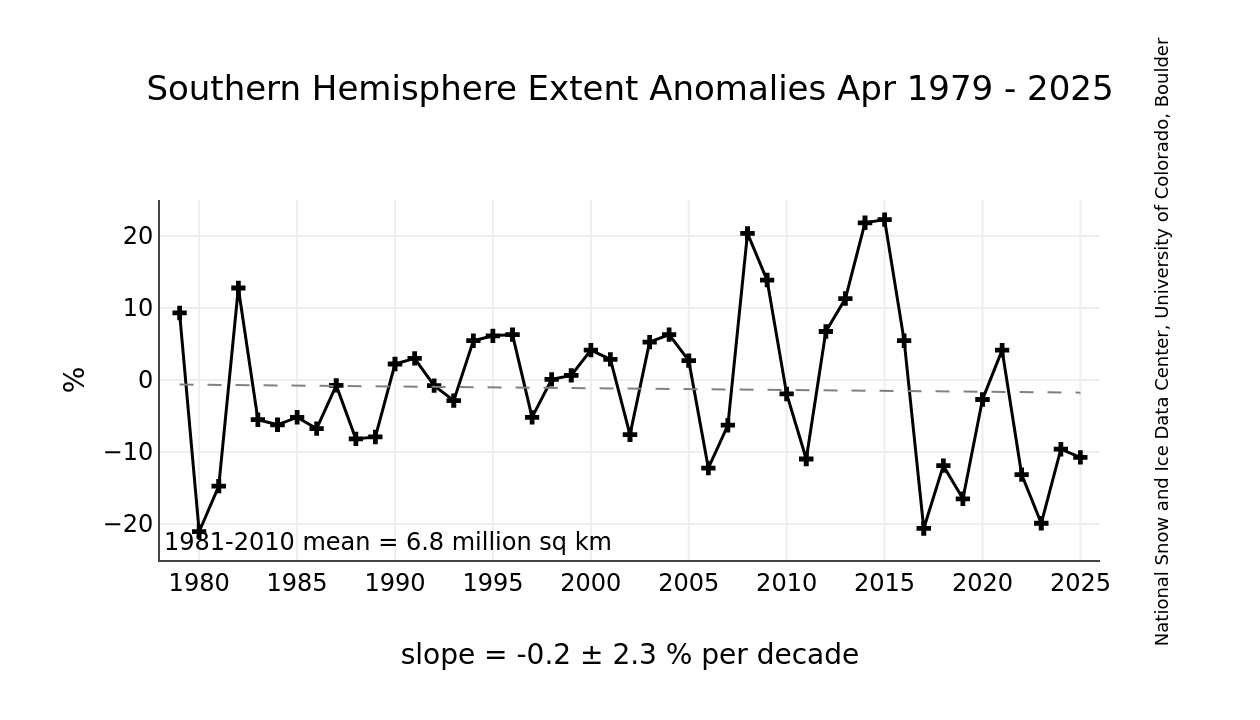
UAH satellite data also shows Antarctica cooling, as seen in their map below. (This map is dated November, 2006 – if anyone knows where to get a more recent version, please let me know.)


UAH 25 Year Temperature Trends
Perhaps NASA should have stuck with their original 2004 map below, showing Antarctica’s interior cooling?

NASA’s 1982-2004 map showing Antarctica cooling

While there’s no dispute that there’s some sea ice loss in the Antarctic peninsula, all signs seem to point in the opposite direction of what some what have you believe about Antarctica as a continent.
Sponsored IT training links:
We offer self paced 312-50 training with up to date 642-611 dumps and 70-450 practice test to provide guaranteed success in first dive.
So. It seems that Nature, at one time, allowed scientific debate:
Brief Communications
Nature 432, 290-291 (18 November 2004) | doi:10.1038/432290b; Published online 17 November 2004
Atmospheric science: Early peak in Antarctic oscillation index
Julie M. Jones1 & Martin Widmann1
The principal extratropical atmospheric circulation mode in the Southern Hemisphere, the Antarctic oscillation (or Southern Hemisphere annular mode), represents fluctuations in the strength of the circumpolar vortex and has shown a trend towards a positive index in austral summer in recent decades, which has been linked to stratospheric ozone depletion1, 2 and to increased atmospheric greenhouse-gas concentrations3, 4. Here we reconstruct the austral summer (December–January) Antarctic oscillation index from sea-level pressure measurements over the twentieth century5 and find that large positive values, and positive trends of a similar magnitude to those of past decades, also occurred around 1960, and that strong negative trends occurred afterwards. This positive Antarctic oscillation index and large positive trend during a period before ozone-depleting chemicals were released into the atmosphere and before marked anthropogenic warming, together with the later negative trend, indicate that natural forcing factors or internal mechanisms in the climate system must also strongly influence the state of the Antarctic oscillation.
1. Institute for Coastal Research, GKSS Research Centre, 21502 Geesthacht, Germany
Correspondence to: Julie M. Jones1 Email: jones@gkss.de
SkepticalScience has picked up on the Antarctic Ice extent discussion here, but Berényi Péter has tried to set them straight.
http://www.skepticalscience.com/Watts-Up-With-That-ignorance-regarding-Antarctic-sea-ice.html
cassandra,
In the NASA article with the red map, they say the error is +/- 3 degrees. In other words an admission that the choice of red color was arbitrary, at best.
Stephen Wilde
Quote: “”ii) The reason for the two poles behaving differently is that one is an ocean surrounded by land and the other is land surrounded by ocean as I have explained elsewhere.””
exactly
The Arctic is effected by wind, water. It’s mostly floating.
Glaciers expand and flow towards the ocean (like in Antarctica and Greenland) when their mass is increasing in the interior. Diminishing glaciers are characterized by retreat, not expansion.
As far as the gravity measurements go, they are very questionable, because there is no bedrock reference point under the ice for the vast majority of the continent. The tiny measured gravity changes could be due to isostasy or tectonic movement rather than ice loss.
Vukcevic (05:25:59) :
it is possible that above referred variations, would have (electro-magnetic) effect on the saline currents velocities, and so have noticable impact on the regional temperatures anomaly.
No, it is not possible. The electric currents induced by weak conductor of sea water moving through the Earth’s magnetic field is MUCH to weak to have any effect, as any electric engineer [or just high-school science] could have told you.
Since the Ozone Hole is caused by excessive GCRs (Galactic Cosmic Rays) which go along with this solar minimum, cooling makes sense.
wilt,
I don’t buy the ozone theory. The positive Antarctic ice anomaly appears during times of year when the ozone hole isn’t even present.
http://arctic.atmos.uiuc.edu/cryosphere/IMAGES/seaice.recent.antarctic.png
What if the water cycle is not closed but opened?. During summer time above the pole and due to increased radiation, atmosphere´s oxygen is turned into Ozone (O3), which during winter time and specially when there are proton flares from the sun or increased cosmic rays, as during solar minimums (mainly composed of protons-90%-, which, btw, we must remember are Hydrogen Nucleii), then these react with ozone to produce water 2H+…O3=H2O+O2 and increase the “Ozone Hole” once again , then snow fall increases ice. So we have an ice cube making machine over there.
I would suggest that its time to go back to the drawing board, when you have one of the worlds leading scientific organizations quoting 0.7 mm on a land mass larger than Australia, is this not comic strip science ? The weight of the ice would be enough to double this, were are they basing there calculations, from the earths diameter ? bedrock ? the earths center ? water level ? or maybe a model ? No, its a satellite measurement, and that is it. 0.7 mm is about the space of the 2 mm’s I know this is 2010, but we are still waiting for Buck Rodgers !
Given the current Ice extent in the Arctic, I’m not sure what they’re talking about
http://nsidc.org/data/seaice_index/images/daily_images/N_timeseries.png
Looks like the currents and wind patterns have changed and the Arctic is recovering quite nicely.
BIG NEWS:
CO2 can be transformed into CO with visible light:
http://pubs.acs.org/doi/abs/10.1021/ja910091z
wayne (02:13:52) :
Thanks! I see my error. Antarctica is melting at 100 cu km/yr and, assuming no further accumulation, sea level will rise .000810 feet per year. Then, sense 2002 we could have had a sea level rise of 8 X .00081 ft or .00648 ft. rise. Or reverting to metric, .00648 ft X 30.48 cm/ft = .1975 cm sea level rise. AH!! HA!! The editors, writers and peer reviewers at Earth Observatory can’t distinguish between .197 cm and 197 ft. As a former Math and Science teacher I had students like that… but none of them had PhD’s… Perhaps I was wrong in believing they never would.
Derek Walton (02:15:29) :
Many thanks for the reference to the description of how ice really deforms.
http://www.geolsoc.org.uk/gsl/site/GSL/lang/en/pid/7209
I recommend the review to all who post here.
Cassandra King (05:47:06) : It seems supremely idiotic and not a little desperate to resort to measuring in tiny fractions and using the red/blue colours to enhance the effect
That reveals NASA involvement in the international “climate change” conspiracy, and the same conduct is found in many official institutions around the world, as was found in the world connections of climate-gate emails: There were “partners”-presumably well funded too-everywhere.
From: http://nsidc.org/arcticseaicenews/
“Antarctic sea ice reached its summer minimum, near the average for 1979 to 2000.”
Near the average for 1979 to 2000? Wow.
I wondered how they could portray the recent gains in a negative light and it appears they have just retrenched on the average for 1979 to 2000 line.
Note the graph on the top of the page showing the blue 2009-2010 line approaching the new Marginot line. Now how to portray that in a negative way….
Then towards the end, a little blurb on Double-dip Arctic Oscillation and how it will keep the ice from melting as much during the summer and setting up a reason for increased ice at the September extent.
The cherry on the top (well, at the bottom actually), is a chart of the average ice sea area on Canada’s east coast with a nice little red bar for 2010 at up to 1/6th of the height of previous years…
Steve Goddard said:
“This article is about sea ice, but it should be apparent that it would be impossible for a region of sea ice to be growing and nearby continental ice to be melting.”
This is incorrect. The two form by completely different processes and dynamics. Sea ice formation is an annual process, much more closely governed by short term fluctuations. Continental ice, i.e. glaciers, is much longer term process. The growth of shrinkage of one does not necessarily indicate the status of the other. Also, as I’ve pointed out several times when AGW skeptics get all excited about the relatively modest year-to-year growth of Antarctic sea ice, the southern sea ice has had negative anomalies within the past few years, whereas the arctic sea ice has not had a positive anomaly since 2004…i.e. the northern sea ice is shrinking faster than the southern sea ice is growing.
Having said this, I do believe it is possible for the first time since 2004 that the arctic may see a positive anomaly in the next few weeks. I’ll watch this closely, and if the arctic begins to have more frequent positive anomalies, that last more than just a year, it will strongly diminish my belief in the accuracy the AGW hypothesis. The reason I want to see if the positive anomaly (should it occur in the arctic sea ice) last more than just a year, is I believe the recent long and deep solar minimum and la nina certainly had some effect on the arctic, as well as the very negative AO index this winter. So though we may not see a new record low for arctic sea ice this summer, if we actually begin to see positive anomalies for an extended period of time, this would be very damaging to the AGW hypothesis.
R. Gates,
How could we be “on track” for a record warm year in early March?
GISS showed 2007 warmer so far, and that turned out to be a cold La Nina year. You don’t have enough information to make statement like that.
In a recent article concerning record drought in SW Australia, they explain that record snowfall at Law Dome in Antarctica is unprecedented in 750 years is likely tied to the drought. I had not read about that before but googling “law dome”+750 produces lots of results. I’ve learned (I think) that the anomaly has been going on for decades and it is this decadal +ve anomalous snowfall that breaks the 750 year record.
So, if sea ice is increasing, and snowfall (in parts) is at record levels, why does some warming in the west dominate the news? WUWT? What is the truth?
It looks like the sun has gone to sleep again, official sunspot number = 0. Not sure how long that will last this time, as it at least appears that the sun was trying to become a bit more active. Still it is interesting that we are back at 0.
This is probably upsetting to the people who perversely want a “barbeque summer” this year just to resurrect some AGW hysteria among the general public, but as even they should know by now, nature does not always cooperate with human desires.
On a slightly different topic, has anyone studied the correlation between surface temperature and tropospheric temperature to see how well they correlate? I would like to see that if it has been done.
So far it looks like the only thing that has passed a tipping point and gone exponential is the number of hits per day on Anthony’s site here, which is a good thing!
Steve Goddard said :
“R. Gates,
How could we be “on track” for a record warm year in early March?”
January and February running far above the 20 year average in tropospheric temps at all levels, with much of the time spent above the 20 year record highs for tropospheric temps. Every day in March has been above the 20 year record high for tropospheric temps at 14,000 ft for example. So my projection is based on the current trend, which if it continued, would make 2010 the warmest on instrument record. The only mechanism to cool the year would be a Mt. Pinatubo type eruption, or a sudden and strong la nina developing. In this regard, I agree with the Met office, who also still predicts 2010 will be the warmest year on record.
R. Gates,
Again, Antarctic sea ice forms at lower latitudes, elevations and temperatures than continental ice. If sea ice is expanding, then temperatures are getting colder in Antarctica, as UAH and NSIDC have confirmed. Glacial ice will not melt under conditions where sea ice is growing.
I loved the SkepticalScience article. He conveniently forgot to attribute the cooling/expanding ice statements to NSIDC.
Scummy blogs like that are why people are losing interest in their religion.
michael hammer (21:28:42) :
“The radius of Earth is 6400km so the surface area is 3.14*4*6400^2 or 5e8 sq km. if 70% is ocean thats 3.5e8 sqkm of ocean surface. 100 cubic km of ice per year will raise the sea level by 100/3.5e8 km = 2.9e-7km which equals 0.29mm per year.”
Excellent work Mr Hammer. Putting some numbers on the warmers claims certainly puts things in perspective.
R. Gates,
Again, GISS surface measurements show 2007 so far warmer than 2010, and that turned out to be a cold year. I’m still waiting to hear why satellite data shows huge spikes during ENSO events that are much smaller in the surface record.