By Steven Goddard
Last month we discussed how NASA continues to spread worries about the Antarctic warming and melting.
A January 12, 2010 Earth Observatory article warns that Antarctica
“has been losing more than a hundred cubic kilometers (24 cubic miles) of ice each year since 2002” and that “if all of this ice melted, it would raise global sea level by about 60 meter (197 feet).“
[Note that is continental ice, not sea ice, – Anthony]

NASA’s 1982-2007 map showing Antarctica warming

But NSIDC seems to be thinking differently in their March 3, 2010 newsletter. They say Antarctica is cooling and sea ice is increasing (makes sense – ice is associated with cold.)
Sea ice extent in the Antarctic has been unusually high in recent years, both in summer and winter. Overall, the Antarctic is showing small positive trends in total extent. For example, the trend in February extent is now +3.1% per decade. However, the Amundsen and Bellingshausen Seas show a strong negative trend in extent. These overall positive trends may seem counterintuitive in light of what is happening in the Arctic. Our Frequently Asked Questions section briefly explains the general differences between the two polar environments. A recent report (Turner, et. al., 2009) suggests that the ozone hole has resulted in changes in atmospheric circulation leading to cooling and increasing sea ice extents over much of the Antarctic region.
The NSIDC graph below shows the upwards trend in Antarctic Sea Ice. Some recent years have shown anomalies as high as +30%.

http://nsidc.org/data/seaice_index/images/s_plot_hires.png
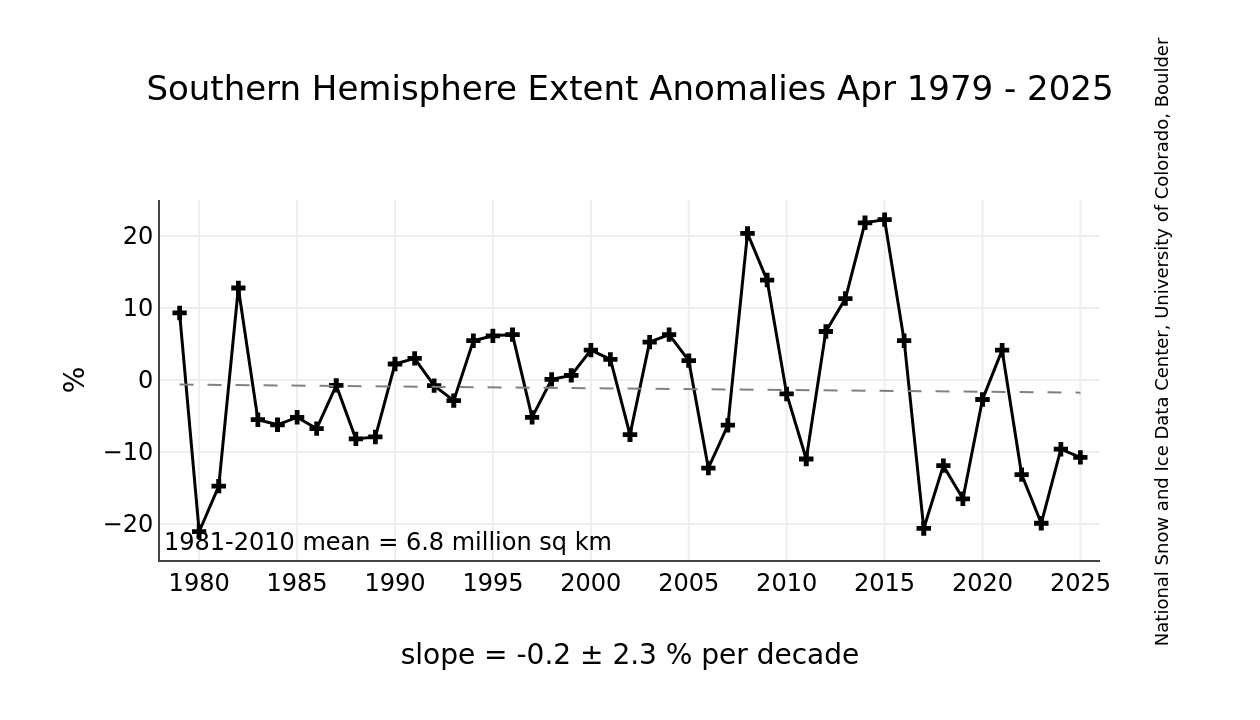
UAH satellite data also shows Antarctica cooling, as seen in their map below. (This map is dated November, 2006 – if anyone knows where to get a more recent version, please let me know.)


UAH 25 Year Temperature Trends
Perhaps NASA should have stuck with their original 2004 map below, showing Antarctica’s interior cooling?

NASA’s 1982-2004 map showing Antarctica cooling

While there’s no dispute that there’s some sea ice loss in the Antarctic peninsula, all signs seem to point in the opposite direction of what some what have you believe about Antarctica as a continent.
Sponsored IT training links:
We offer self paced 312-50 training with up to date 642-611 dumps and 70-450 practice test to provide guaranteed success in first dive.
Wren (21:37:09) :
NASA’s Explanation about Antarctic ice volume changing, ‘The answer boils down to the fact that ice can flow without melting’.
It can also flow without much heat change. So what is the importance of ice extent measurements anyhow?
This article says, ‘A January 12, 2010 Earth Observatory article warns that Antarctica
“has been losing more than a hundred cubic kilometers (24 cubic miles) of ice each year since 2002” and that “if all of this ice melted, it would raise global sea level by about 60 meter (197 feet).“’
This pair of apparently linked quotes seems erroneous on its face (8 years x100 cubic km of ice couldn’t possibly raise global sea levels 60m). But the article quoted does not actually say this, as the “this ice” of the second quote refers not to the 800 cubic km of the first quote, but instead refers to the total ice overburden of East Antarctica, making it a much more plausible assertion:
“Two-thirds of Antarctica is a high, cold desert. Known as East Antarctica, this section has an average altitude of about 2 kilometer (1.2 miles), higher than the American Colorado Plateau. There is a continent about the size of Australia underneath all this ice; the ice sheet sitting on top averages at a little over 2 kilometer (1.2 miles) thick. If all of this ice melted, it would raise global sea level by about 60 meter (197 feet).”
Mr. Goddard’s article should be rewritten to correct this unfortunate (I hesitate to say deliberate) quoting error.
That article contains the following statement:
But this is contradicted by:
http://wattsupwiththat.com/2010/01/11/antarctic-sea-water-shows-no-sign-of-warming/
I calculate the surface area of water on earth at 70 % of a sphere with radius 4000 miles= .7 X 4 X 3.14159 X 4000 X 4000 =140,743,232 sq miles. 24 cubic miles of ice has .9 X 24 X 5280= 114,048 sq miles by one foot of water. Dividing 114,048 sq mi ft by 140,743,232 sq mi gives (sq mi divides out) .000810 ft of rise in sea water… or is there an error in my calculations. With that in mind, 197 ft (estimated rise) divided by .000810 ft (calculated rise) gives an error of (feet divide out) 243,111 X 100 or 24,311,100%. with this in mind would it be a gross under statement to say Earth Observatory made a gross overstatement of the rise in sea level caused by melting ice??
Geoff Sherrington (00:13:54) :
Wren (21:37:09) :
“NASA’s Explanation about Antarctic ice volume changing, ‘The answer boils down to the fact that ice can flow without melting’.”
It can also flow without much heat change. So what is the importance of ice extent measurements anyhow?
It can also disappear without melting. Good ol’ sublimation happens in dry air, and when fresh snowfall doesn’t replace the sublimated ice, the result is — a net loss of ice volume.
Question: Does NASA track annual total snowfall in Antarctica?
It seems to me that reading both the pros and cons that the “honest” climatologist’s answer should be “we don’t know, but we’re working on it”.
And how can we say anything intelligent about something, the climate, that has 22 000 year cycles after 40 years of accurate measurements?
What, to me is disproved, it that co2 is causing “runaway” global warming.
And I would like to know how people are already saying that 2010 will be record hot, when it’s only March. Are they astrologers or something?
The “Global Warming” Machine Just Keeps Running…
The world will almost certainly fail to draw up a new treaty on climate change this year, the minister in charge of last year’s Copenhagen summit has admitted, delivering a heavy blow to hopes for a swift global settlement.
Connie Hedegaard, the Danish minister who masterminded the summit of world leaders on global warming last year and is now the European commissioner for climate change, says negotiations were not progressing fast enough for a treaty to be signed soon. She also gave warning that pushing too hard for a treaty this year could be counterproductive.
“To get every detail set in the next nine months looks very difficult,” she said. “Europe would love that to happen, and I would love that to happen … but my feeling is that it is going to be very difficult to get a treaty.”
Governments had been hoping to forge a final treaty at a global conference this December in Mexico, after failing to do so in Copenhagen. However, Ms Hedegaard said this was more likely to happen at a follow-up meeting next year in South Africa. That would still allow governments to meet their self-imposed deadline of forging a new agreement before the end of 2012, when the current provisions of the world’s only existing treaty on greenhouse gas emissions, the 1997 Kyoto protocol, expire.
Ms Hedegaard defended the Copenhagen summit, which attracted loud criticism, especially for the chaotic way in which it finished. She said that calling world leaders to the long-running negotiations had ensured rapid progress towards the end, when for the first time developed and developing countries mutually agreed limits on their emissions. But she said there would not be another Copenhagen-style summit. “You can do such a thing one time,” she said. The price of failure, if diplomats attempted to force an agreement this year, was too high, Ms Hedegaard said. “People would say let’s skip that idea, let’s skip the UN thing,” she said.
She also defended climate scientists, saying the handful of flaws in the 2007 report by the UN’s Intergovernmental Panel on Climate Change and the e-mails in which scientists talked of concealing data did not affect the large body of scientific evidence amassed over decades.
The UN climate talks have been going on since 1992, when world governments signed the first legally binding treaty aimed at avoiding dangerous levels of climate change. The Kyoto protocol failed because it did not impose obligations on developing countries and was rejected by the U.S.
***************************************************************************
If the majority of political leaders are stupid enough to still believe in all the lying propaganda about man-made global warming, then maybe it’s time for the cockroaches to have a go.
G.L. Alston (23:16:48) : (responding to R. Gates (21:19:02)) Popper would say “Nonsense!” My less charitable retort…
Thank you, GLA; I needed that response.
Spread over the 14 million km2 of Antarctica, that amounts to an average reduction of ice thickness of just over 0.7 mm. Anyone who believes it is possible to accurately measure so small a loss of ice from a satellite is kidding themselves IMHO.
As long as we are calculating… Wikipedia says “The total area of Greenland is 2,166,086 km2 (836,109 sq mi), of which the Greenland ice sheet covers 1,755,637 km2 (677,676 sq mi) (81%) and has a volume of approximately 2,850,000 cubic kilometres (680,000 cu mi).” then 680000 cu m X 5280 ft/mile = 3,590,400,000 sq mi ft of ice. Then 3,590,400,000 sq mi ft X .9 (density of water) divided by (see above) 140,743,232 sq mi = 23 ft. rise in sea level. Provided all the ice in Greenland melted and every one with beach front property built a levee of 25 feet… now don’t you feel better ? But to stay on topic, on order to get a 197 foot rise in sea level, we would need to melt the equvalent of 197 divided by 23 or 8.5 times the ice on Greenland.
NOAA knows
How it goes
By the tingle in its toes
And the frost along its nose
As water goes through a phase change from a gaseous vapor to a liquid and from a liquid to a solid snow and ice, it liberates an extraordinary amount of thermal energy. When this phase change from a warmer water vapor or liquid to a colder solid snow and ice occurs in the troposphere, a certain amount of that thermal energy must be radiated into space. Consequently, a satellite in orbit around the Earth whose instruments are used to detect the emission of thermal energy is going to see this radiation of thermal energy being radiated from the cooling water precipitates. Since the Northern and Southern Hemispheres have both been experiencing colder than usual weather and record precipitation of rain, snow, and ice in recent months; it must be expected that an orbital satellite must see extraordinary emissions of thermal energy to correspond with the extraordinary cooling of the precipitates. In other words, when the Earth is cooling it must radiate elevated levels of thermal energy to space where the satellite instruments can record the thermal emissions resulting from the cooling.
It can also disappear without melting. Good ol’ sublimation happens in dry air, and when fresh snowfall doesn’t replace the sublimated ice, the result is — a net loss of ice volume.
The argument is not whether the Antarctic is losing ice. It is whether it is getting warmer.
Adding extra sea ice is pretty much contradictory to it getting warmer. If you want to show warming, then you need to answer this directly, not change the subject to another area.
Speculation of sublimation causing the loss of shelf ice doesn’t do that. It may well be that because it is colder, in general, that less snow is falling, as the air passing over is less moist. Which means the losses to wind are not being replaced. So losses of shelf ice to sublimation could well be proof of cooling. You need to show otherwise, not speculate.
(BTW the vapour pressure of water at Antarctic temperatures is pretty low. I bet more actually just blows off.)
Question: I have heard Ian Plimer et al claiming that the ice on Greenland and that in Antarctica is in a basin. If this is so, surely all one would end up with if it all melted is a couple of huge inland seas, would it not? I am sure there would be a few valleys thro which water could escape, but for it all to escape to the sea would be highly unlikely. Besides, as others have calculated it would take around 300,000 years to melt, meaning that it wouldn’t happen at all as three ice-ages would have occurred in the meantime, followed by three inter-glacials, and likely three new human civilizations to boot (Or whatever we mutate into in that time frame)!
Never before in human history have so many world leaders come so close to looking like total prats. They all know this climategate affair came within a hair’s breadth of becoming the biggest scientific and political scandal in world history and one which would forever stain the hands of those who went to the Jokenhagen Circus. Think about it! 50 trillion dollars being thrown away on the say so of a few “scientists” so incompetent they threw away vital data and couldn’t e.g. answer simple FOI requests. And these world leaders got to walk away into the snow storm without serious collateral damage.
Who was really responsible for the mess at the CRU and US meddling? It was Brown and Obama, and if the sceptics had really been the superb big-oil backed lobby machine, these two wouldn’t been held directly accountable for the mess their governments created and more than likely one or the other would have been forced to resign.
They know they got away with it by the skin of their political teeth, and they know they probably will not get away so lightly next time!
Naturalverities (00:26:16)
“Mr. Goddard’s article should be rewritten to correct this unfortunate (I hesitate to say deliberate) quoting error.”
The extended quote you base this assertion upon includes this tidbit
There is a continent about the size of Australia underneath all this ice;
The area of Australia is about 7.7 million km2, Antarctica’s area is somewhere close to 14 million km2. You may not find that this kind of basic ignorance damages your confidence in the scientific abilities of these folks, but I’m not so sanguine.
Well, as long as I am still awake… from Wikipedia again “Greenland ice sheet covers 1,755,637 km2 (677,676 sq mi) (81%) and has a volume of approximately 2,850,000 cubic kilometres” and “The Antarctic ice sheet… covers an area of almost 14 million square km and contains 30 million cubic km of ice.” then 30,000,000 divided by 2,850,000 = 10.52 times as much ice on Antarctica as Greenland. So, we would have to melt 73% of the ice on Antarctica and Greenland to get a 197 ft rise in sea level, if and only if everyone with beach front property built a levee of 200 ft height. The conclusion is Earth Observatory needs an editor who can distinguish the difference between 100 cu km of ice and 23,980,500 cu km of ice.
DocWat (00:54:18) :
… or is there an error in my calculations.
You’re basically correct, but 197 ft (estimated rise) divided by .000810 ft/yr = 243,000 years at this rate to melt Antarctica if it never snows again. (watch units)
Shona is right on. What do 40 years or so of observations of weather say about climate? Only that the pace of “change” (I prefer the term evolution) is well within the historical proxy parameters of the last 2,000 years, ie the natural variability that brought us the LIA, various minimums and the MWP.
This, in and of itself, is counter to the implications of the AGW hypothesis which predicts unprecedented warming MUST be occurring since circa 1950 well outside of historical precedents…rationally, that this is not the case is reason enough for falsification.
What does one call a hypothesis whose forecasts are not confirmed by observed events?
There is an interesting “review” article regarding collapsing ice sheets in this months Geoscientist magazine. This is the Geological Society’s popular magazine rather than a journal, but interesting none the same.
http://www.geolsoc.org.uk/gsl/site/GSL/lang/en/pid/7209
The bye line is “Cliff Ollier takes issue with some common misconceptions about how ice-sheets move, and doubts many pronouncements about the “collapse” of the planet’s ice sheets”.
Even Hollywood snubs Global Warming
“HOLLYWOOD, Calif., March 9 /PRNewswire-USNewswire/ — The month of Avatar versus Hurt Locker Oscar predictions came to a close on March 7th with the Hurt Locker overtaking Avatar for Best Picture and Kathryn Bigelow trumping James Cameron for Best Director, causing environmentalists to see red. If you are one of the dozen people who haven’t seen Avatar yet, the environmental message shines through the jaw-dropping special effects – the dangers of global warming, respecting Mother Nature, and environmental resource management.”
http://www.prnewswire.com/news-releases/oscars-avatar-snub-sparks-voting-frenzy-at-green-globe-film-awards-87099587.html
I heard the news and it didn’t twig until afterwards – particularly as I’ve not seen Avatar. But when it gets pointed out: environment versus war movie, and the war movie won!! There’s even a book out with some maniac climate scientists as the baddy. What next? A film of climategate whereby some weatherman saves the world from the clutches of man and evil scientist hell-bent on taking over the world?
As a Louisiana boy (and proud fan of the Saints) The elevation of my home is about 100 ft above sea level. So I worry about high water. From Wikipedia: “The surface of the state may properly be divided into two parts, the uplands and the alluvial. The alluvial region includes low swamp lands, coastal marshlands and beaches, and barrier islands that cover about 20,000 square miles (52,000 km²). 100 cu km of ice (24 cu mi) or 114048 sq mi ft divided by 20000 = 5.7 ft. so with proper terracing we could cover the entire state of louisiana with 5.7 feet of water. Hey! that is great! I am 6 feet tall.
Weather!
What makes Antarctic land ice grow? Snow and rain!
What makes it move? Gravity!
What makes it melt? Warming!
What makes it to freeze? Cooling!
So how does the boring disregarded weather affect both ices. Cooling for sea ice! Snow and temperarutres below zero for land ice.
Weather made arctic ices disappear 2007 strong long similar winds transported the ice out of the straight.
Do we now how much the weather increased/decreased the landice in Antarctica? No! Do we now how long the “delay in or more rapid movement is conected with landice? Wheather plays an extreme important role in how the poles changes. The proof is at hand in the Arctic this year!
Can anyone remeber the time long long ago before the “climate hype” when observations of the weather ment anything and explanined everything?
Now adays tables are turned…”Climate” is explaining weather? Climate is supposed ti explain shifts in the poles.Its time to go back to basics! Weather is basic!
NOAA doth know
All above, all below
By the tingle in its toes
And the way the wind blows
Antarctic is a dynamic system, like australia it is a desert with only about 100mm of ice per year accumulating at the pole up to 1m at the coast , up .45 m of ablation occurs annually due mainly to wind blown ice particles flowing into the oceans.
” A database of accumulation values for 5365 gridpoint locations with 50 km spacing is interpolated from the isopleth map, giving a bulk accumulation of 2151 Gt a−1 and a mean of 159 kg m−2a−1 for an area of 13.53 × 10⁶ km2. Following the implementation of deflation and ablation adjustments applicable to sectors of the coastal zone, the accumulation values are reduced to 2020 Gt a−1 and 149 kg m−2a−1.”
glacial ice flows move glacier ice to the oceans at rates up to 2m per day so between ice flow & ablation for the antarctic ice sheet to remain static 2100 gigatons of ice has to flow off the continent each year. ie 2100 billion cu m.
the coastline of the antarctic is about 15000 km.
thats a lot of icebergs say 300 sq km per annum at 100m thick.
http://www.ingentaconnect.com/content/igsoc/agl/2000/00000031/00000001/art00028
http://bprc.osu.edu/Icecore/kees99-1.pdf