Guest post by Steven Goddard

The climate panic headline this week has been that the warming Arctic is burping out dangerous quantities of greenhouse gas Methane.
Published on Friday, March 5, 2010 by Agence France Presse
Huge Methane Leak in Arctic Ocean: Study
WASHINGTON – Methane is leaking into the atmosphere from unstable permafrost in the Arctic Ocean faster than scientists had thought and could worsen global warming, a study said Thursday. From 2003 to 2008, an international research team led by University of Alaska-Fairbanks scientists Natalia Shakhova and Igor Semiletov surveyed the waters of the East Siberian Arctic Shelf, which covers more than 772,200 square miles (two million square kilometers) of seafloor in the Arctic Ocean. “This discovery reveals a large but overlooked source of methane gas escaping from permafrost underwater, rather than on land,” the study said. “More widespread emissions could have dramatic effects on global warming in the future.”
Methane is 30X more potent a greenhouse than CO2, so this sounds very alarming. Or does it? From the New York Times:
Dr. Shakhova said that undersea methane ordinarily undergoes oxidation as it rises to the surface, where it is released as carbon dioxide. But because water over the shelf is at most about 50 meters deep, she said, the gas bubbles to the surface there as methane. As a result, she said, atmospheric levels of methane over the Arctic are 1.85 parts per million, almost three times as high as the global average of 0.6 or 0.7 parts per million.
The first problem with the statement is that it is incorrect. The average global methane concentration is ~1.8 ppm, (1786 ppb) not 0.6 ppm as seen below in this graph from NOAA:

http://www.noaanews.noaa.gov/stories2008/images/methanetrend.jpg

The author also says that the Arctic is belching out nearly eight million tons of methane per annum.
She estimated that annual methane emissions from the East Siberian Arctic Shelf total about seven teragrams. (A teragram is 1.1 million tons.)
Sounds like a big number – except that burping/flatulating cattle produce ten times more methane than the Arctic. According to the EPA:
Globally, ruminant livestock produce about 80 million metric tons of methane annually
Is 1.85 ppm a large number? Let’s look at an analogy of what a population concentration of 1.85 parts per million really represents. If the population of Wyoming (544,270) represented all the molecules in the atmosphere, there would be only one methane molecule in the entire state. At 1.85 ppm, there would be fifteen methane molecules in New York City, out of population eight million. There would be on average zero in Nunavut, Canada.
I wonder how much methane Taco Bell indirectly generates per annum? I also wonder why so many Arctic/Greenland studies include only the years 2003-2008. Perhaps they are only interested in reporting data from unusually warm years in the Arctic?
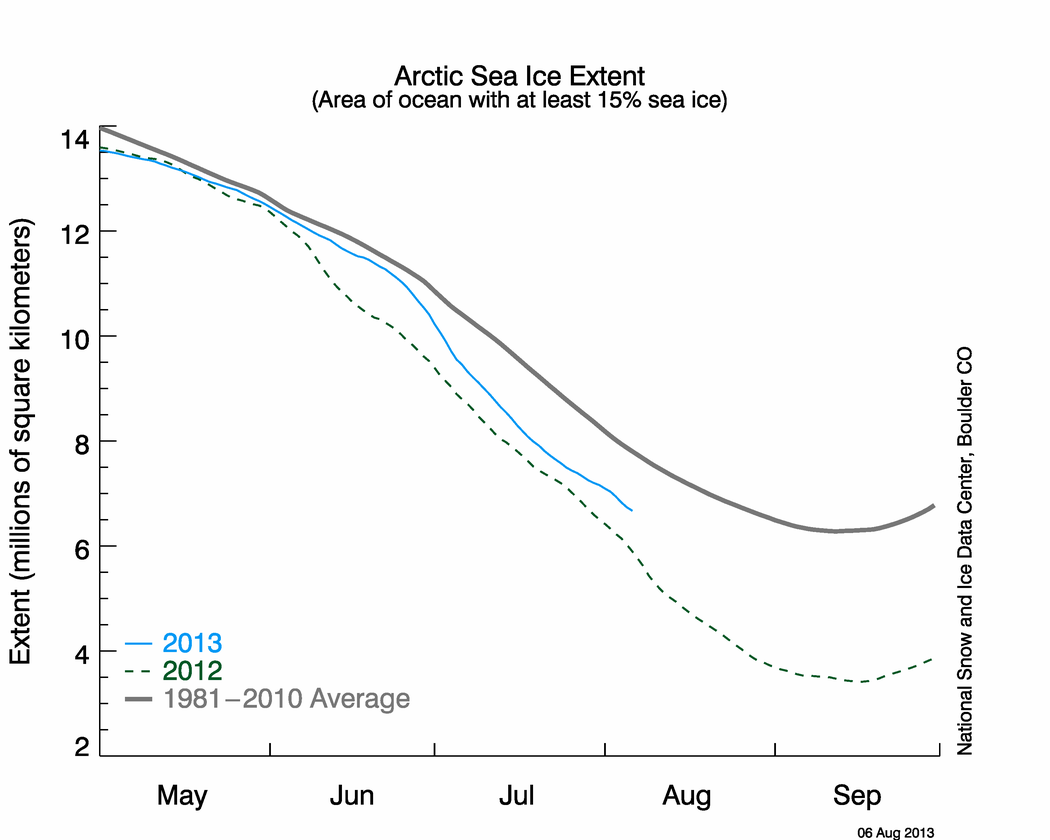
Speaking of the Arctic. What is up with this?

http://nsidc.org/data/seaice_index/images/daily_images/N_timeseries.png
Methane, The Panic Du Jour
The climate panic headline this week has been that the warming Arctic is burping out dangerous quantities of greenhouse gas Methane.
Published on Friday, March 5, 2010 by Agence France Presse
Huge Methane Leak in Arctic Ocean: Study
WASHINGTON – Methane is leaking into the atmosphere from unstable permafrost in the Arctic Ocean faster than scientists had thought and could worsen global warming, a study said Thursday. From 2003 to 2008, an international research team led by University of Alaska-Fairbanks scientists Natalia Shakhova and Igor Semiletov surveyed the waters of the East Siberian Arctic Shelf, which covers more than 772,200 square miles (two million square kilometers) of seafloor in the Arctic Ocean. “This discovery reveals a large but overlooked source of methane gas escaping from permafrost underwater, rather than on land,” the study said. “More widespread emissions could have dramatic effects on global warming in the future.”
Methane is 30X more potent a greenhouse than CO2, so this sounds very alarming. Or does it? From the New York Times:
Dr. Shakhova said that undersea methane ordinarily undergoes oxidation as it rises to the surface, where it is released as carbon dioxide. But because water over the shelf is at most about 50 meters deep, she said, the gas bubbles to the surface there as methane. As a result, she said, atmospheric levels of methane over the Arctic are 1.85 parts per million, almost three times as high as the global average of 0.6 or 0.7 parts per million.
The first problem with the statement is that it is incorrect. The average global methane concentration is 1.8 ppm, not 0.6 ppm.
http://www.noaanews.noaa.gov/stories2008/images/methanetrend.jpg
The author also says that the Arctic is belching out nearly eight million tons of methane per annum.
She estimated that annual methane emissions from the East Siberian Arctic Shelf total about seven teragrams. (A teragram is 1.1 million tons.)
Sounds like a big number – except that burping/flatulating cattle produce ten times more methane than the Arctic. According to the EPA:
Globally, ruminant livestock produce about 80 million metric tons of methane annually
Is 1.85 ppm a large number? Let’s look at an analogy of what a population concentration of 1.85 parts per million really represents. If the population of Wyoming (544,270) represented all the molecules in the atmosphere, there would be only one methane molecule in the entire state. At 1.85 ppm, there would be fifteen methane molecules in New York City, out of population eight million. There would be on average zero in Nunavut, Canada.
I wonder how much methane Taco Bell indirectly generates per annum? I also wonder why so many Arctic/Greenland studies include only the years 2003-2008. Perhaps they are only interested in reporting data from unusually warm years in the Arctic?
Speaking of the Arctic. What is up with this?
http://nsidc.org/data/seaice_index/images/daily_images/N_timeseries.png
Steve save ice image they tend to ALWAYS bring them down after this happems
I like menthanol cigs, do I have to give them up?
:)~
also save this one bet they will change it soon if it keeps going up
http://arctic-roos.org/observations/satellite-data/sea-ice/ice-area-and-extent-in-arctic
me = mr paranoia
Smokey (20:54:27) :
Methane! Everybody Panic!! click>>
If you had just told the story, I would not have believed you. I had to see it with my own eyes. I’m somewhere between shock, disbelief and just anger.
So tomorrow AM, to make myself feel better, I am going to call PETA. I am going to tell them that the methane story is a hoax being perpetrated by Greenpeace to pressure everyone into becoming vegetarians and that their plan is to slaughter all the cattle and I want to know about their plan to SAVE THE CATTLE.
Then I am going to phone the WWF and tell them that PETA is planning to release all the cattle into the countryside to prevent Greenpeace from slaughtering them, and I want to know what they are going to do because the countryside can’t support that many cattle and they will eat all the natural vegetation. I will ask what they are going to do to SAVE THE VEGETATION.
Then I am going to phone Greenpeace and tell that there’s a new study out showing that natural grasslands produce 1000 times as much methane in bison, deer and antelope than domestic hay does. I will ask them what they are going to do to get rid of the natural vegetation and and how they are going to raise money to SAVE THE DEER AND BISON AND ANTELOPE.
Should be a good day.
Smokey (20:54:27) :
Methane! Everybody Panic!!
Well Smokey, since we have started the {GASP} tipping point of methane ice melting that predicted 80 meter sea level rise should start immediately and we will have absolute proof of CAGW.
Of course if the sea levels don’t rise by 80 meters, or even 80 centimeters in the near term the AGW scientists are going to have to come up with another load of bovine output and labeled it science.
Time to bookmark both of these articles so we can unearth them next year for a good laugh. We will probably need it.
Hopefully this methane will save us from the next Ice Age, a mere 3,000 years away using averaging. It is easy to forget that the temperature of the earth would be 50 to 55 F without Fauna , volcanoes, and geologic captured gases. Our atmosphere is a bit thin for huge heat retention.
“Ray Boorman (19:47:47) :
I bet “big oil” will look at this research as indicating large reserves of gas & oil which are seeping slowly to the surface. …”
————————————————-
You beat me too it. This was my first thought when reading this post. I’m a believer in the abiogenic theory of oil creation.
I’m surprised there is permafrost on the ocean floor. How is that possible?
Regards methane. Here in Australia, we have about one million feral camels. According to the UN carbon auditing method, the methane from feral camels is NOT considered for auditing purposes. BUT, the few thousand domestic camels, well, their methane IS counted. Feral farts are different from domestic farts apparently.
Here on my small farm, I tried an experiment. (with disasterous results) I tied a pilot light to a steers backside to burn off the methane, but….. lots of fences to repair.
Regards “it’s worse than we thought”.
Australias own climate scientist, David “I’m not a media tart” Karoly, stated in an interview on the ABC radio that he and collegues had just finished a year long study of the affects of humans on climate and……..it’s worse than we stated in the IPCC 2007 report. Glaciers are melting faster due to warmth, permafrost is melting yada yada yada.
First I laugh, then I shake my head, then I get angry. Best I go fix those fences and settle me down.
DocWat (18:17:35) :
If Methane ice is held in solid form in the Gulf of Mexico, How does methane escape from the Arctic??
Teleconnection.
Better get up there and start drilling to relieve the pressure.
.
Ian H (21:48:26) :
…As most of our greenhouse gas emissions come from burping and farting animals, New Zealand is pinning its hopes on meeting these targets on fixing the problem. Significant progress has been made with several different approaches about to enter field trials. These include a vaccine and a genetically modified grass.
You realize that if you modify the grass (Frankengrass?), you will not be able to export wool to Europe. They frown mightily on G.M. anything.
You all have it wrong. It is the methane from my food scraps in landfill that will cause the end of the world.
Junk science, junk press release writing. It has made the rounds in the German media as well. Greenpeace researchers?
There was an eco thriller published recently, ‘Frozen Fire’ by Bill Evans & Marianne Jameson, published July 2009 which covered this very theme. Is research imitating art, or is this a new kind of marketing?
The ‘unlocking frozen methane under the sea’ meme was I believe first explored in the 1978 book ‘Weather War’ by Leokum and Posnik. Ah, those were the days, when such tomes were listed next to Erich Von Daniken’s offerings, and not in ‘non-fiction’.
The NYT article is incorrect, Shakhova states Methane levels over the last 400000 years have globally averaged 0.6-0.7 ppm during warm periods, not that the current Global levels are 0.6-0.7 ppm.
@Steamboat McGoo (18:13:59) :
“The phase angle between Warmists and Objective Reality has got to be approaching Pi over two.”
———
Good analogy. It could also be stated that the Warmist’s reality is expressed as “i”, the square root of -1. Punch that equation into your calculator and see what you get.
4 Billion,
The summary doesn’t give any explanation as to what supports their theory. Was the proposed melting of sub-ocean permafrost in this area observed/measured? Why did they feel this was unprecedented and could not be explained by natural processes – which should, after all, be the null hypothesis right?
I posted this comment at Real Climate just yesterday evening GMT.
———
#89 “From Co2 to methane, then what?
Water Vapour, 40,000 parts per million.
CO2, 360 parts per million
Methane, 1.7 parts per million
Comment by Jimbo — 7 March 2010 @ur momisugly 6:25 PM”
———
This is good news! It’s progress.
Everyone can now breath a sigh of relief.
However, don’t fart — that just proves you don’t love the planet.
As long as it is parts per billion and has an average 8 years in the atmosphere I shall quell my panic.
Looks to me that they’re giving up the climate angle. The Grauniad is onto peak oil now.
http://www.guardian.co.uk/environment/cif-green/2010/feb/10/oil-crunch-peril
“Oil crunch peril”. AArgh!
Subsea permafrost froze during the last glaciation, when sea levels were up to ~120m lower than today, and what is now the sea floor was exposed. It is a type of relict permafrost, insulated from melting by the sediment cover above it. There are other areas of relict permafrost south of the main band of permafrost in the Arctic.
Nick B,
From Spiegel, 2008,
“Data from offshore drilling in the region, studied by experts at the Alfred Wegener Institute for Polar and Marine Research (AWI), also suggest that the situation has grown critical. AWI’s results show that permafrost in the flat shelf (ESAS) is perilously close to thawing. Three to 12 kilometers from the coast, the temperature of sea sediment was -1 to -1.5 degrees Celsius, just below freezing. Permafrost on land, though, was as cold as -12.4 degrees Celsius. “That’s a drastic difference and the best proof of a critical thermal status of the submarine permafrost,” said Shakhova.”
As to if this is normal, depends if you think the warming is normal.
…And this methane has been leaking from the sea bed for – how long, exactly..? Something new, is it..?
Its probably at its highest level ‘since records began’….
As we speak – Al Gore must be trying to work out how he can make some money out of this – and the UK government will no doubt be working out how we can all be TAXED for it…
I’ve seen a couple papers that used spectral analysis of downwelling longwave radiation, the principle element of the greenhouse effect, to determine the contribution of the various GHGs to the total signal. Based on the global avg numbers for CO2 and CH4, the measured values suggest the multiplier for CH4 relative to CO2 is somewhere between 6 and 10, nowhere near the 30 times that is always flouted. Admittedly the papers didn’t measure the atmospheric composition, so there might be some local variations in play, but unless local variability ranges over an order of magnitude or more, the 30X multiplier doesn’t look too good.
JAXA satellite imagery, methane concentration, September 2009
http://blog.sme.sk/blog/560/215098/JAXA_methane.JPG
Where is all that methane leaking from Arctic?
SST in Arctic: the same as in 30-40ties, heading down again;
http://climexp.knmi.nl/data/ihadsst2_0-360E_66-90N_na.png
What is so special in todays Arctic climate?