Guest post by Steven Goddard

The climate panic headline this week has been that the warming Arctic is burping out dangerous quantities of greenhouse gas Methane.
Published on Friday, March 5, 2010 by Agence France Presse
Huge Methane Leak in Arctic Ocean: Study
WASHINGTON – Methane is leaking into the atmosphere from unstable permafrost in the Arctic Ocean faster than scientists had thought and could worsen global warming, a study said Thursday. From 2003 to 2008, an international research team led by University of Alaska-Fairbanks scientists Natalia Shakhova and Igor Semiletov surveyed the waters of the East Siberian Arctic Shelf, which covers more than 772,200 square miles (two million square kilometers) of seafloor in the Arctic Ocean. “This discovery reveals a large but overlooked source of methane gas escaping from permafrost underwater, rather than on land,” the study said. “More widespread emissions could have dramatic effects on global warming in the future.”
Methane is 30X more potent a greenhouse than CO2, so this sounds very alarming. Or does it? From the New York Times:
Dr. Shakhova said that undersea methane ordinarily undergoes oxidation as it rises to the surface, where it is released as carbon dioxide. But because water over the shelf is at most about 50 meters deep, she said, the gas bubbles to the surface there as methane. As a result, she said, atmospheric levels of methane over the Arctic are 1.85 parts per million, almost three times as high as the global average of 0.6 or 0.7 parts per million.
The first problem with the statement is that it is incorrect. The average global methane concentration is ~1.8 ppm, (1786 ppb) not 0.6 ppm as seen below in this graph from NOAA:

http://www.noaanews.noaa.gov/stories2008/images/methanetrend.jpg

The author also says that the Arctic is belching out nearly eight million tons of methane per annum.
She estimated that annual methane emissions from the East Siberian Arctic Shelf total about seven teragrams. (A teragram is 1.1 million tons.)
Sounds like a big number – except that burping/flatulating cattle produce ten times more methane than the Arctic. According to the EPA:
Globally, ruminant livestock produce about 80 million metric tons of methane annually
Is 1.85 ppm a large number? Let’s look at an analogy of what a population concentration of 1.85 parts per million really represents. If the population of Wyoming (544,270) represented all the molecules in the atmosphere, there would be only one methane molecule in the entire state. At 1.85 ppm, there would be fifteen methane molecules in New York City, out of population eight million. There would be on average zero in Nunavut, Canada.
I wonder how much methane Taco Bell indirectly generates per annum? I also wonder why so many Arctic/Greenland studies include only the years 2003-2008. Perhaps they are only interested in reporting data from unusually warm years in the Arctic?
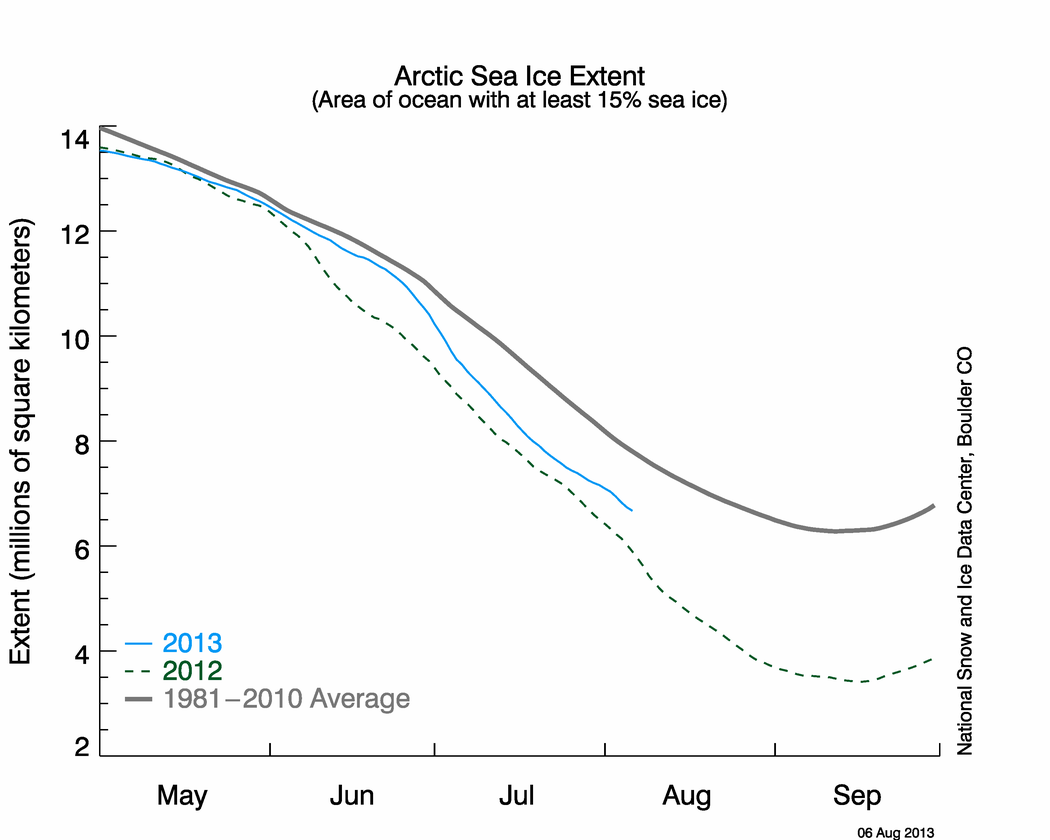
Speaking of the Arctic. What is up with this?

http://nsidc.org/data/seaice_index/images/daily_images/N_timeseries.png
Methane, The Panic Du Jour
The climate panic headline this week has been that the warming Arctic is burping out dangerous quantities of greenhouse gas Methane.
Published on Friday, March 5, 2010 by Agence France Presse
Huge Methane Leak in Arctic Ocean: Study
WASHINGTON – Methane is leaking into the atmosphere from unstable permafrost in the Arctic Ocean faster than scientists had thought and could worsen global warming, a study said Thursday. From 2003 to 2008, an international research team led by University of Alaska-Fairbanks scientists Natalia Shakhova and Igor Semiletov surveyed the waters of the East Siberian Arctic Shelf, which covers more than 772,200 square miles (two million square kilometers) of seafloor in the Arctic Ocean. “This discovery reveals a large but overlooked source of methane gas escaping from permafrost underwater, rather than on land,” the study said. “More widespread emissions could have dramatic effects on global warming in the future.”
Methane is 30X more potent a greenhouse than CO2, so this sounds very alarming. Or does it? From the New York Times:
Dr. Shakhova said that undersea methane ordinarily undergoes oxidation as it rises to the surface, where it is released as carbon dioxide. But because water over the shelf is at most about 50 meters deep, she said, the gas bubbles to the surface there as methane. As a result, she said, atmospheric levels of methane over the Arctic are 1.85 parts per million, almost three times as high as the global average of 0.6 or 0.7 parts per million.
The first problem with the statement is that it is incorrect. The average global methane concentration is 1.8 ppm, not 0.6 ppm.
http://www.noaanews.noaa.gov/stories2008/images/methanetrend.jpg
The author also says that the Arctic is belching out nearly eight million tons of methane per annum.
She estimated that annual methane emissions from the East Siberian Arctic Shelf total about seven teragrams. (A teragram is 1.1 million tons.)
Sounds like a big number – except that burping/flatulating cattle produce ten times more methane than the Arctic. According to the EPA:
Globally, ruminant livestock produce about 80 million metric tons of methane annually
Is 1.85 ppm a large number? Let’s look at an analogy of what a population concentration of 1.85 parts per million really represents. If the population of Wyoming (544,270) represented all the molecules in the atmosphere, there would be only one methane molecule in the entire state. At 1.85 ppm, there would be fifteen methane molecules in New York City, out of population eight million. There would be on average zero in Nunavut, Canada.
I wonder how much methane Taco Bell indirectly generates per annum? I also wonder why so many Arctic/Greenland studies include only the years 2003-2008. Perhaps they are only interested in reporting data from unusually warm years in the Arctic?
Speaking of the Arctic. What is up with this?
http://nsidc.org/data/seaice_index/images/daily_images/N_timeseries.png
rbateman (20:25:57) said:
“Here is something unalarming:
http://www.robertb.darkhorizons.org/TempGr/AshOre1.GIF
Ashland, Ore. from 1888 to 2009 High/Average/Low
Looks like a long-term 45-55 year cycle on the high temps.
Dec. 2009 is estimated, so it will probably go lower.
Dagnabbit, I can’t find no AGW.”
Well of course, Rob. You can’t merely rely upon real-world observations.
You have to look at the models. Has this data set been extrapolated through the Global Circulation Models? If not, it is worthless.
Real-time, real world data is not important. Everybody knows that the GCMs are predicting catastrophic warming, so it does not matter what the observations tell us.
Also, in regards to the allowable methane budget for Ashland… Please provide a list of the gas-producing joints located there [Del Taco….etc]…as we need to evaluate whether or not the town has eclipsed its methane budget for the year.
Also, new EPA law dictates that sensitive state of the art fart-monitors shall be placed within a 10 mile radius of the town, or the town will lose its federal “damage” funding for all the business and revenue lost in complying with the new CO2 rules and regs.
Thank you for your compliance.
Chris
Norfolk, VA, USA
Shakhova and Semiletov might be suffering from the same “exposure deficit syndrome” as Jane Ferrigno of USGS
Like the Russians, Jane was recycling 3-year old data to say it’s “worse than we thought”, the loss of Antarctic sea ice is “happening faster than ever before”, and could “cause sea level to rise 62 meters”. Jane reported the loss of “20,000 sq km of ice over 20 years” which is “bigger than Texas”
Except it is not . . . . not even close by an order of magnitude.
Also like the Russians, Jane presents no evidence that air temps in Antarctica have anything to do with sea ice but asserts there must be a cause-effect connection. Gee, don’t you just think sea water would be a bit more effective in melting ice than sub-zero air?
And BTW the reported loss is a pittance against 13 million sq km average ice extent.
Cry WOLF! Cry WOLF!
The last fart of the Warmists.
Methane! Everybody Panic!! click
…or not.
Watts up with Arctic Sea Ice?
Just the highest extent in 6 years:
http://hockeyschtick.blogspot.com/2010/03/arctic-sea-ice-extent-highest-in-past-5.html
henry,
Good question about H2O. Water vapor varies a lot, but assuming a not atypical concentration of 1%, there would be over five thousand molecules in the Wyoming analogy – compared to one molecule of CH4.
Gary P (20:04:02) : “I know there is a difference between aerobic and anaerobic conditions, but what happens to the grass that the cows do not eat and that decays under the snow? Or all the dead leaves. Does this stuff not emit methane as it decays?”
Oh, but Gary, it’s rottin’ methane.
Excellent summary -despite some usual stylistic rhetorics- of the Methane question on… yes, Realclimate!!!
http://www.realclimate.org/index.php/archives/2010/03/arctic-methane-on-the-move/
I quote David Archer:
“Is now the time to get frightened? No. ”
“What’s missing from these studies themselves is evidence that the Siberian shelf degassing is new, a climate feedback, rather than simply nature-as-usual, driven by the retreat of submerged permafrost left over from the last ice age. ”
“The concentration held steady in 2008, meaning at least that interannual variability is important in the methane cycle, and making it hard to say if the long-term average emission rate is rising in a way that would be consistent with a new carbon feedback.”
“Anyway, so far it is at most a very small feedback. The Siberian Margin might rival the whole rest of the world ocean as a methane source, but the ocean source overall is much smaller than the land source. ”
“For methane to be a game-changer in the future of Earth’s climate, it would have to degas to the atmosphere catastrophically, on a time scale that is faster than the decadal lifetime of methane in the air. So far no one has seen or proposed a mechanism to make that happen.”
So perhaps all the MSM that propped up this study as the new scare should, for once, have read realclimate…
Thanks climategate!
savethesharks (20:46:09) :
That’s just raw COOP data with Grants Pass, Ore data adusted up or down to fit the 365 day graphs for missing months when I can’t find any monthly AMS data. Otherwise I do like E.M.Smith suggests, and figure a missing day in between the previous and following days.
I might do Crescent City, CA next to see the N. Pacific Ocean effect.
100 yr+ data tends to shut the trends up.
Oops, can’t get no AGW stuff that way.
And do we really need to worry about methane from cattle? The historic population of bison in North America was upwards of 75 million. There are currently 96 million cattle in America. Doesn’t seem this disparity would account for much more methane.
Want to point fingers? How ’bout India? They’ve got 281 million cattle, for almost 30% of the world cattle population. But they produce green, renewable energy in the form of dung, which is burned for fuel.
Now that’s green energy!
You know, water at depth should always be the same temperature of 4C …assuming it’s deep enough. What was this? 50M? Hmmmm. Even if there were deeper areas, you would think a carpet of 4 degree water would be hovering along the ocean floor, even if migrating to a lower depth.
More methane would have been released from bombed gas mains in one month of World War two. Nothing much happened in those years except some very cold winters. mmm
The methane burping livestock is a bust. Total bovine numbers were higher in the iceage and all past eras. Thanks to our great efforts to control feral bison numbers, etc we now have more domestic cattle than wild equivalent. The numbers in total should be down thanks to desertification and the fact that most cattle don’t live to maturity, yum. Hard numbers are hard to come by for many reasons.
The major source of methane in Australia is termites in the subtropical northern savannah. Lets see the greenies fumigate hundreds of square kilometres of savannah.
Also wont the big freeze in the northern hemisphere have chilled down the permafrost and stoped the methane powered doomsday clock? Or at least put it on snooze for awhile.
NickB.
“Was there any proof offered that this release “has only just started” or is it conjecture?”
Shakhova et al 2007,
“Until recently, due to slightly negative annual temperatures within the water column and the lid-type coverage of shelf sediments by sub-sea permafrost, old organic carbon buried on the Siberian Arctic shelf was considered completely isolated from the modern carbon cycle.”
East Siberian Arctic Shelf is a similar size to the Siberian traps region, the Siberian traps event vented enough GHG’s to be linked to Permian–Triassic extinction event.
So if the ESAS vents a large percentage of it’s Methane we may be in for interesting times, as the Siberian traps event gives some precedence for this scale of release.
pat (20:52:54) : “The last fart of the Warmists.”
fartum iustum stultorum
You guys are really gonna feel stupid when Joel signs on in a few minutes and explains that this is a very valuable study by Boris and Natasha…
I hope Rocky and Bullwinkle will be ok…
http://nsidc.org/data/seaice_index/images/daily_images/N_timeseries.png
Where is the version with the +/- 1 sigma lines?
You folks are missing the obvious implications of methane clathrates in the arctic …
As a greenhouse gas, methane is at least an order of magnitude more powerful than carbon dioxide. If we don’t do something, and soon, it will escape into the atmosphere. Therefore, what we need is a crash program to capture this pernicious substance and turn it into something more benign.
I propose that the U.S. government subsidize ExxonMobil and other energy companies to mine methane clathrates — as much as we can, as soon as we can — pipe the methane south, and burn it in American power plants, so that the harmful CH4 becomes (relatively) harmless CO2. Of course, doing this will also reduce our dependence on foreign oil.
Let’s do it! It’s a win-win solution!
And anyone who disagrees with me is a Global Warming Denialist.
A fairly minor investment in a few of those large boxes of matches should do the trick. Don’t you have any kids who would embrace the project ?? CO2 is so last year !!!
Methane. No conclusions….but maybe the rise in modern times is related to the human population explosion, and that of our food supply.
http://www.esrl.noaa.gov/gmd/education/lesson_plans/Methane%20and%20Populations-What's%20the%20connection.pdf
Okay…..so we are “forced” to learn to adapt, like every other species has to do.
I have heard about the brontosaurus farts and other scary smelly things. And if that is what did them in, then what a way to go, LOL.
Nah in all seriousness, the overall impression…is that the earth self-regulates, and if the methane rise might be a wakeup call, then we need to adjust. But such “readjustments” have to be reasonable.
Because I ain’t giving up my occasional flank or t-bone steak.
That is not to say I should not attempt to reduce my “footprint” on this planet. I should, and I DO, and most rational humans agree that less pollution is good.
The answer is EDUCATION.
We are an opportunistic species and, frankly, from this standpoint, we are no better than fire ants, mold, or cockroaches.
Rather….we are WORSE….because we have evolved consciences and rational brains and have a good sense of right and wrong….so there is NO excuse whatsoever.
From that standpoint, I take to heart that the methane counts are higher than they have been in 400,000 years.
But I also take to heart that we have earned our right to exist on this planet…and, without going overboard, we need to learn to adapt WITH nature….not against it.
The point in all this is that, if methane is that high, and a good portion of it is truly anthropogenic (or “bovinepogenic”) then perhaps it is THIS tree we should be barking up, not the CO2 one.
I can see Gore now….forming a new corporation that will be based upon the profit from the taxes imposed upon CH4.
Just make sure your new book “Our Choice II” does not have a tropical cyclone spinning the wrong direction, or nobody would read it.
Also….you might want to change your look, Al…as you look like you produce alot…ALOT…of methane.
Again….to conclude….the real “inconvenient” truth is that Mother Earth self-regulates herself.
Hopefully our limited time here as a species will not be a passing belch.
Chris
Norfolk, VA, USA
Great post, Steve! Thanks, you beat me to it!
This is getting embarrassing…if the desperate climatologists wanted to find methane, all they had to do was discuss the methane flux from Asian rice paddy agriculture (which was once identified on the UNFCCC website as the largest single source of anthropogenic climate change gases).
*sigh* I had to explain to some of my panicked, liberal family today why this is NOT cause for suicidal ideation! As the AGW models continue to collapse, watch out for more of this stuff.
New Zealand was foolish enough to take the IPCC at its word and signed up for big greenhouse gas reductions. As most of our greenhouse gas emissions come from burping and farting animals, New Zealand is pinning its hopes on meeting these targets on fixing the problem. Significant progress has been made with several different approaches about to enter field trials. These include a vaccine and a genetically modified grass.
If methane is a real problem, there is a fix on the way.
Worse? In what sense “worse”? What is the moral content of atmospheric methane at all realistically projected levels of concentrations? Does it not provide a buffer against cataclysmic upward and downward changes of temperature? Is it a potential resource to be mined by some future technology? Is it a poorly understood nutrient of the ecosystem?
I’ll leave that as an open question. I have a divergent thought about sea ice: I have tried for ages to come up with a clear way of quantifying concisely what it means to say that global sea ice area really doesn’t show any trend. There is a detectable downward drift in the period for which data is recorded. One person will say it is simply a random walk while another will say, here we go over the falls…
But what I’ve observed about the sea ice anomaly time series, which can be found here at Cryosphere Today is the following:
In EVERY year since satellite data has been available, the sea ice anomaly statistic has both risen above and dropped below the 1979-2000 mean. That is, in any one calendar year during this period, one can find a day for which it is correct to say that the recorded global sea ice extent for that day is greater than the mean extent on that day during the baseline period, and another day for which the extend is less than the mean on that day during the baseline period.
I say “baseline period” because that is what it is. To call this reference point the “normal” extent, as is often done, begs the question: what is so “normal” about the years 1979-2000 that argues for that period as a point of reference from which to measure cataclysmic change. But even if we grant such a thing, it is evident from the above observation that sea ice extent is not changing dramatically, as it does not wander from this “standard” in any year without returning to it in the same year and wandering for a period in the other direction too.
Even RC is engaging in a little bit of eye-rolling re the Methane thing.
The AO has gone from strongly negative to slightly positive in the last several days. . . and that’s why you’ve got that extent spike –the rubber band is snapping back a little.
Or maybe “compressed spring” would be a little more apt metaphor.
Methane, The Panic Du Jour?
Apparently, Dr. Shakhova’s isn’t panicking over her methane study. The NYTimes concludes the article on the study with the following statements from her:
But, “I am not the person to judge” whether the Arctic findings suggest that estimates of climate change in coming decades should be rewritten, she added.
“I would not go so far as to suggest any implications,” she said. “We are at the very beginning of research.”
If Dr. Shakhova isn’t panicking over her methane study, who is?