Guest post by Steven Goddard

The climate panic headline this week has been that the warming Arctic is burping out dangerous quantities of greenhouse gas Methane.
Published on Friday, March 5, 2010 by Agence France Presse
Huge Methane Leak in Arctic Ocean: Study
WASHINGTON – Methane is leaking into the atmosphere from unstable permafrost in the Arctic Ocean faster than scientists had thought and could worsen global warming, a study said Thursday. From 2003 to 2008, an international research team led by University of Alaska-Fairbanks scientists Natalia Shakhova and Igor Semiletov surveyed the waters of the East Siberian Arctic Shelf, which covers more than 772,200 square miles (two million square kilometers) of seafloor in the Arctic Ocean. “This discovery reveals a large but overlooked source of methane gas escaping from permafrost underwater, rather than on land,” the study said. “More widespread emissions could have dramatic effects on global warming in the future.”
Methane is 30X more potent a greenhouse than CO2, so this sounds very alarming. Or does it? From the New York Times:
Dr. Shakhova said that undersea methane ordinarily undergoes oxidation as it rises to the surface, where it is released as carbon dioxide. But because water over the shelf is at most about 50 meters deep, she said, the gas bubbles to the surface there as methane. As a result, she said, atmospheric levels of methane over the Arctic are 1.85 parts per million, almost three times as high as the global average of 0.6 or 0.7 parts per million.
The first problem with the statement is that it is incorrect. The average global methane concentration is ~1.8 ppm, (1786 ppb) not 0.6 ppm as seen below in this graph from NOAA:

http://www.noaanews.noaa.gov/stories2008/images/methanetrend.jpg

The author also says that the Arctic is belching out nearly eight million tons of methane per annum.
She estimated that annual methane emissions from the East Siberian Arctic Shelf total about seven teragrams. (A teragram is 1.1 million tons.)
Sounds like a big number – except that burping/flatulating cattle produce ten times more methane than the Arctic. According to the EPA:
Globally, ruminant livestock produce about 80 million metric tons of methane annually
Is 1.85 ppm a large number? Let’s look at an analogy of what a population concentration of 1.85 parts per million really represents. If the population of Wyoming (544,270) represented all the molecules in the atmosphere, there would be only one methane molecule in the entire state. At 1.85 ppm, there would be fifteen methane molecules in New York City, out of population eight million. There would be on average zero in Nunavut, Canada.
I wonder how much methane Taco Bell indirectly generates per annum? I also wonder why so many Arctic/Greenland studies include only the years 2003-2008. Perhaps they are only interested in reporting data from unusually warm years in the Arctic?
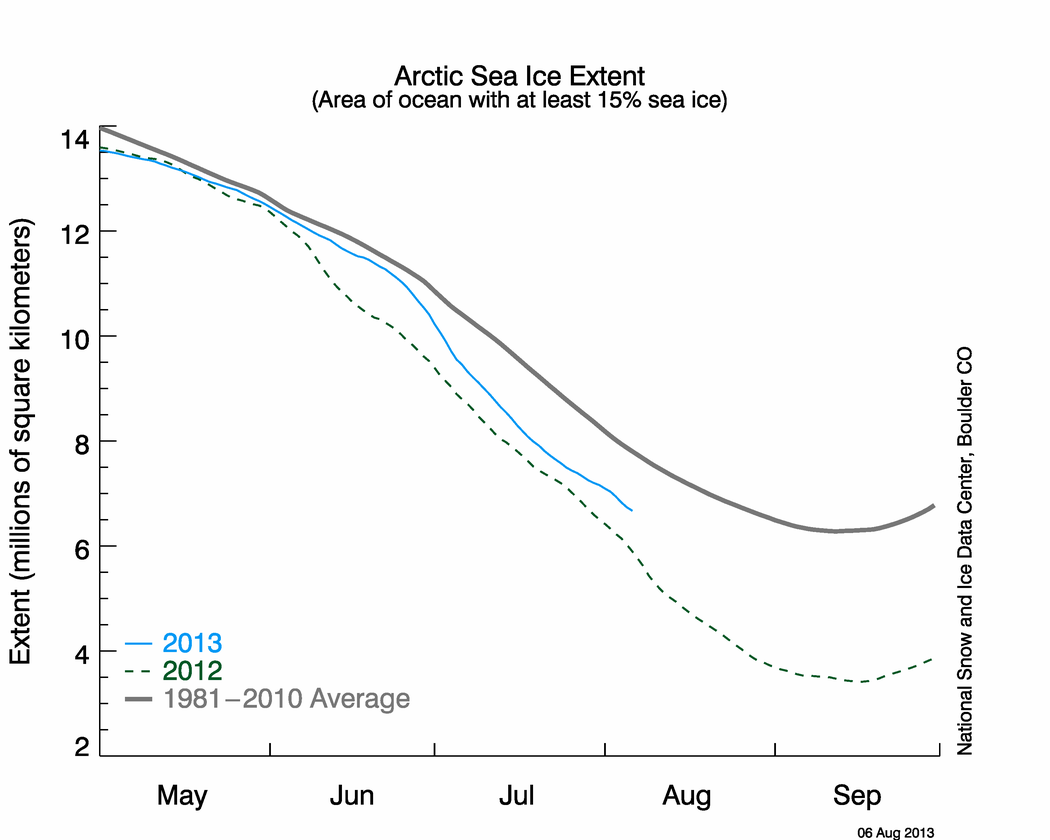
Speaking of the Arctic. What is up with this?

http://nsidc.org/data/seaice_index/images/daily_images/N_timeseries.png
Methane, The Panic Du Jour
The climate panic headline this week has been that the warming Arctic is burping out dangerous quantities of greenhouse gas Methane.
Published on Friday, March 5, 2010 by Agence France Presse
Huge Methane Leak in Arctic Ocean: Study
WASHINGTON – Methane is leaking into the atmosphere from unstable permafrost in the Arctic Ocean faster than scientists had thought and could worsen global warming, a study said Thursday. From 2003 to 2008, an international research team led by University of Alaska-Fairbanks scientists Natalia Shakhova and Igor Semiletov surveyed the waters of the East Siberian Arctic Shelf, which covers more than 772,200 square miles (two million square kilometers) of seafloor in the Arctic Ocean. “This discovery reveals a large but overlooked source of methane gas escaping from permafrost underwater, rather than on land,” the study said. “More widespread emissions could have dramatic effects on global warming in the future.”
Methane is 30X more potent a greenhouse than CO2, so this sounds very alarming. Or does it? From the New York Times:
Dr. Shakhova said that undersea methane ordinarily undergoes oxidation as it rises to the surface, where it is released as carbon dioxide. But because water over the shelf is at most about 50 meters deep, she said, the gas bubbles to the surface there as methane. As a result, she said, atmospheric levels of methane over the Arctic are 1.85 parts per million, almost three times as high as the global average of 0.6 or 0.7 parts per million.
The first problem with the statement is that it is incorrect. The average global methane concentration is 1.8 ppm, not 0.6 ppm.
http://www.noaanews.noaa.gov/stories2008/images/methanetrend.jpg
The author also says that the Arctic is belching out nearly eight million tons of methane per annum.
She estimated that annual methane emissions from the East Siberian Arctic Shelf total about seven teragrams. (A teragram is 1.1 million tons.)
Sounds like a big number – except that burping/flatulating cattle produce ten times more methane than the Arctic. According to the EPA:
Globally, ruminant livestock produce about 80 million metric tons of methane annually
Is 1.85 ppm a large number? Let’s look at an analogy of what a population concentration of 1.85 parts per million really represents. If the population of Wyoming (544,270) represented all the molecules in the atmosphere, there would be only one methane molecule in the entire state. At 1.85 ppm, there would be fifteen methane molecules in New York City, out of population eight million. There would be on average zero in Nunavut, Canada.
I wonder how much methane Taco Bell indirectly generates per annum? I also wonder why so many Arctic/Greenland studies include only the years 2003-2008. Perhaps they are only interested in reporting data from unusually warm years in the Arctic?
Speaking of the Arctic. What is up with this?
http://nsidc.org/data/seaice_index/images/daily_images/N_timeseries.png
Clutching. At. Straws.
It is really just getting pathetic…
The article says that earlier studies had looked at methane on land. So this is the first time they’ve looked at these waters. So they don’t know what is normal there.
Mankind must die or we are all doomed…wait…uh oh…
Does anyone here know where that assessment in the factsheet comes from that methane is 30 x stronger a greenhouse gas than carbondioxide?
That would suggest that there is research done on carbon dioxide that has been (deliberately?) hidden for most of us.
OK I found some references:
http://www.timberbuysell.com/Community/DisplayNews.asp?id=3168
http://www.iitap.iastate.edu/gcp/studentpapers/1996/atmoschem/brockberg.html
http://www.epa.gov/ttn/chief/ap42/ch14/final/c14s02.pdf
http://www.uwsp.edu/geo/faculty/ritter/geog101/textbook/atmosphere/atmospheric_composition_p2.html
http://blog.ridpest.com.au/2007/termites-global-warming/
Seems to me from a quick skim that this isn’t all that well understood.
I went out yesterday and ate: 1 Xtra-garlic white pizza, three wheat
laden beers, 2 hard boiled pickeled eggs and some chile for desert.
I want to appologise for doubling the planets Methane……….
Roger
Again with the theoretical feedback mechanisms! If methane from melting permafrost was going to cause dangerous runaway global warming it would have already done so in the Medieval Warm Period. We would now be boiling, which is clearly not the case. This arctic methane study looks at a five year period in a localized area, with apparently no empirical, non proxy data for the same area in prior periods. The alarmists seem to be running out of even partially plausible material. The relative stability of Earths climate over thousands of years, with periods both slightly warmer and slightly cooler than today should be indication enough that these claims of dangerous feedbacks have no basis in reality.
I just explained to my German Shepherd dog, Charlie, that by being a stinker he not only stinks but contributes a terrible greenhouse gas that will bring all of us to the point of no return and mass extinction.
He was listening with apparent interest and attention, ears up.
Then, he made three valid points:
1) You’ve been telling me I can’t stink in the house, all these years. Now you are telling me I cannot do it outside, too? Where, then, I am supposed to do it? Are you going bunkers or something?
2) Who are you to tell me all this, armchair geezer? Let’s go for a walk, or let me go chasing cats or do something worthwhile, instead of listening to your crazy monkey blah-blah.
3) Now you know why dinosaurs died out. Just imagine, how much methane they produced! Experts have spoken, science is settled.
Great post, Steven, as always.
I am mystified by this where Dr. Shakhova would utter a glaring mistake. The quote: “As a result, she said, atmospheric levels of methane over the Arctic are 1.85 parts per million, almost three times as high as the global average of 0.6 or 0.7 parts per million.”
Perhaps she was misquoted. Or is she misinformed? What gives? Steven….any explanations?
Chris
Norfolk, VA, USA
Question???
Is there perma frost in the ocean? I thought this is a land based event.
Cartoon says it all…If you can’t hide it, Change It!!
“Methane is leaking into the atmosphere from unstable permafrost in the Arctic Ocean faster than scientists had thought”
A strange confession from a scientists. To me, this indicates we need scientists with larger imaginations since the present scientists can not accept current data.
One wonders how the earth managed to survive before all the climate researchers were on the scene to worry about it.
Not just cows for methane emissions. Several areas around the world have natural methane seeps, some from the ocean floor and some on land. There were literally Pillars of Fire when static electricity ignited the methane vents on land.
One such methane vent is / was offshore Santa Barbara, California. Others occur regularly in the seas around Indonesia. The methane bubbles around Indonesia at times were so great that ships lost their buoyancy and sank.
“Gas escaping from ocean floor may drive global warming. Press release (dtd 19 July 2006) from U.C. Santa Barbara. “Gas escaping from the ocean floor may provide some answers to understanding historical global warming cycles — and provide information on current climate changes according to a team of UCSB scientists. The findings are reported in the July 20 on-line version of the scientific journal, Global Biogeochemical Cycles. Remarkable and unexpected support for this idea occurred when divers and scientists observed and videotaped a massive blowout of methane from the ocean floor near Santa Barbara.” ” http://www.eurekalert.org/pub_releases/2006-07/uoc–gef071906.php
Other natural methane sources are decomposing organic matter.
So, how much is that methane from the Arctic, compared to all these?
“I also wonder why so many Arctic/Greenland studies include only the years 2003-2008. ”
didn’t the gravy train pull into the station around 2003 and start taking on passengers? 🙂
Looking up perma frost and came across this.
How thawing permafrost could release methane.
http://www.azocleantech.com/Details.asp?newsID=8995
Published Date: 6/3/2010
The sea ice extant delta suggests there’s been a windy couple days up north. So I checked:
http://squall.sfsu.edu/scripts/nhemjetstream_model.html
The only remaining question is do I blame George Bush or global warming?
Steven,
Both scares, CO2 and Methane are pushed.
CO2 = energy
Methane = meat = food
Energy Tax, Meat Tax, and so on and so on.
Government is on it’s way to become man’s worst enemy (again).
Oh Yes, the other scare: plastic!!!!
I bet “big oil” will look at this research as indicating large reserves of gas & oil which are seeping slowly to the surface. They claim a small rise in atmospheric temperatures causes the bottom of the sea 50 metres down to warmup? This has been going on since the end of the last ice age, but they have only now discovered it, & in their stupidity think it is a new phenomenon. Tripe!
It seems that not all the spectral data of methane is known or published, especially in the UV range. There is absorption in the near infra red, meaning it also cools. They can measure it as it bounces back from the moon:
http://www.iop.org/EJ/article/0004-637X/644/1/551/64090.web.pdf?request-id=76e1a830-4451-4c80-aa58-4728c1d646ec
Does anyone here know where that assessment in the factsheet comes from that methane is 30 x stronger a greenhouse gas than carbondioxide?
That would suggest that there is research done on carbon dioxide that has been (deliberately?) hidden for most of us
Even if it is true that methane is 30 times stronger than CO2, we now know that the warming caused by CO2 is very little or nothing, and as far as the concentration is concerned: 1.8 ppm even at x 30 is still not that much compared to 390 ppm CO2
Re
“Speaking of the Arctic. What is up with this?”
I have been comparing the slope of thr arctic ice extent with the DMI Polar temperature changes lately and (not a total surprise) they have been tracking well. Large changes in temperature seems to coincide with changes in slope of the extent curve’ Note the recent temperature drop on this DMI plot:
http://ocean.dmi.dk/arctic/meant80n.uk.php
and the sharp increase in the slope of the extent curve.
Of course other considerations like wind and ocean currents cannot be ignored
Henry Pool (19:11:36) : “Does anyone here know where that assessment in the factsheet comes from that methane is 30 x stronger a greenhouse gas than carbondioxide?”
I’ve seen this sort of claim for years, and finally decided to look it up:
http://en.wikipedia.org/wiki/Global_warming_potential
If a gas stays in the atmosphere a long time, absorbs at IR wavelengths not already absorbed by the atmosphere, and is at the low end of its approximately logarithmic absorption curve (i.e. its effect isn’t saturated), then it has a relatively high “global warming potential”. Methane’s direct GWP, however, is a relatively short-lived effect, because its half-life in the atmosphere is on the order of 7 years.
And since I’m a whimsical kind of guy, that inpired a vision of a buxom Hollywood starlet watching the DVD of “An Inconvenient Truth”; the phone rings, she answers, and a raspy voice says “You will die in seven years.” 🙂
You gotta just love science by press release! Observe the careful wording linking “unstable permafrost” & “global warming” into a methane discharge in the ocean waters. Do we have any comparison to previous levels of discharge in the same area? And by the way, how does methane leak from permafrost under the water?
Fie on the media outlets that have the stupidity to pick this piece of garbage up.
as to the ice increasing in size/area, whatever you want to call it, it will be adjusted soon.
http://arctic-roos.org/observations/satellite-data/sea-ice/ice-area-and-extent-in-arctic
back in mid-late Feb. had a big jump up, then a few days later, whala!! gone! maybe they finally figured out that maybe that it was real ice and are trying to put it back now.
but its just rotten anyways…
What about ‘calthates’? These wanky Lefty people won’t stop until they have their tax-grab, big Government in place, Worldwide.
I’m sure this has never occurred ever in the entire history of the planet earth, and I know it’s worse than we thought! Furthermore, I’m sure it’s all bad, and that humans are most definitely responsible!