Guest post by Steven Goddard

The climate panic headline this week has been that the warming Arctic is burping out dangerous quantities of greenhouse gas Methane.
Published on Friday, March 5, 2010 by Agence France Presse
Huge Methane Leak in Arctic Ocean: Study
WASHINGTON – Methane is leaking into the atmosphere from unstable permafrost in the Arctic Ocean faster than scientists had thought and could worsen global warming, a study said Thursday. From 2003 to 2008, an international research team led by University of Alaska-Fairbanks scientists Natalia Shakhova and Igor Semiletov surveyed the waters of the East Siberian Arctic Shelf, which covers more than 772,200 square miles (two million square kilometers) of seafloor in the Arctic Ocean. “This discovery reveals a large but overlooked source of methane gas escaping from permafrost underwater, rather than on land,” the study said. “More widespread emissions could have dramatic effects on global warming in the future.”
Methane is 30X more potent a greenhouse than CO2, so this sounds very alarming. Or does it? From the New York Times:
Dr. Shakhova said that undersea methane ordinarily undergoes oxidation as it rises to the surface, where it is released as carbon dioxide. But because water over the shelf is at most about 50 meters deep, she said, the gas bubbles to the surface there as methane. As a result, she said, atmospheric levels of methane over the Arctic are 1.85 parts per million, almost three times as high as the global average of 0.6 or 0.7 parts per million.
The first problem with the statement is that it is incorrect. The average global methane concentration is ~1.8 ppm, (1786 ppb) not 0.6 ppm as seen below in this graph from NOAA:

http://www.noaanews.noaa.gov/stories2008/images/methanetrend.jpg

The author also says that the Arctic is belching out nearly eight million tons of methane per annum.
She estimated that annual methane emissions from the East Siberian Arctic Shelf total about seven teragrams. (A teragram is 1.1 million tons.)
Sounds like a big number – except that burping/flatulating cattle produce ten times more methane than the Arctic. According to the EPA:
Globally, ruminant livestock produce about 80 million metric tons of methane annually
Is 1.85 ppm a large number? Let’s look at an analogy of what a population concentration of 1.85 parts per million really represents. If the population of Wyoming (544,270) represented all the molecules in the atmosphere, there would be only one methane molecule in the entire state. At 1.85 ppm, there would be fifteen methane molecules in New York City, out of population eight million. There would be on average zero in Nunavut, Canada.
I wonder how much methane Taco Bell indirectly generates per annum? I also wonder why so many Arctic/Greenland studies include only the years 2003-2008. Perhaps they are only interested in reporting data from unusually warm years in the Arctic?
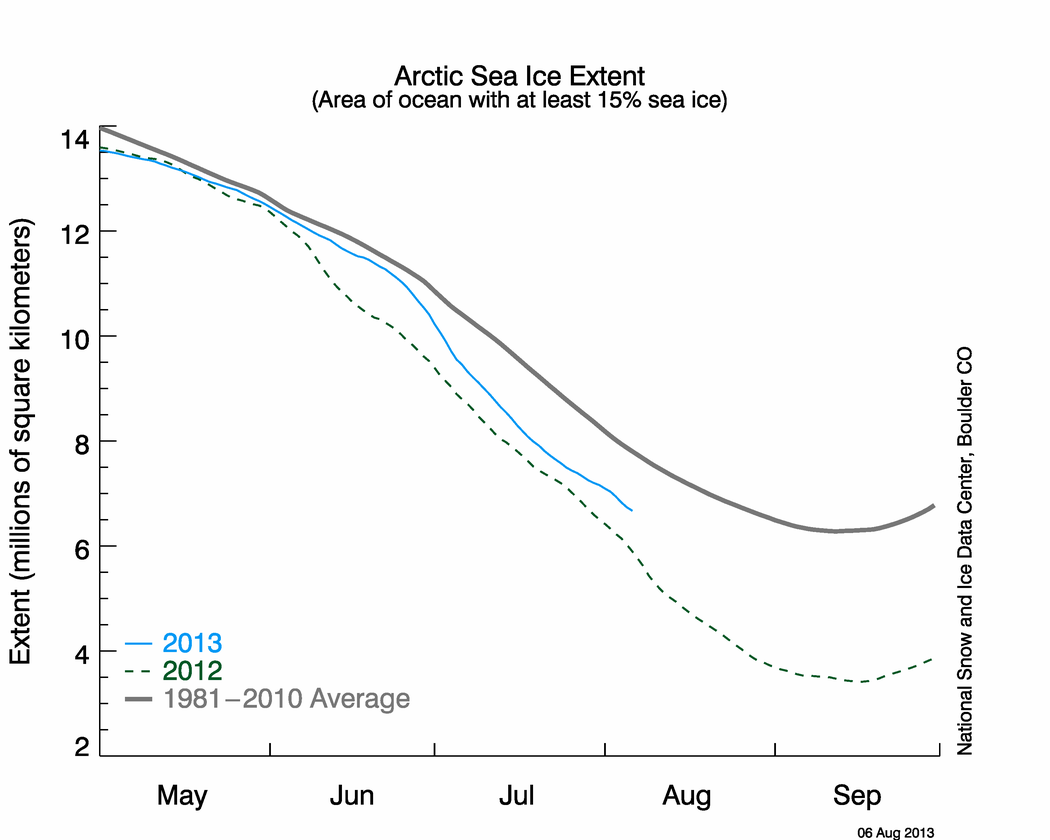
Speaking of the Arctic. What is up with this?

http://nsidc.org/data/seaice_index/images/daily_images/N_timeseries.png
Methane, The Panic Du Jour
The climate panic headline this week has been that the warming Arctic is burping out dangerous quantities of greenhouse gas Methane.
Published on Friday, March 5, 2010 by Agence France Presse
Huge Methane Leak in Arctic Ocean: Study
WASHINGTON – Methane is leaking into the atmosphere from unstable permafrost in the Arctic Ocean faster than scientists had thought and could worsen global warming, a study said Thursday. From 2003 to 2008, an international research team led by University of Alaska-Fairbanks scientists Natalia Shakhova and Igor Semiletov surveyed the waters of the East Siberian Arctic Shelf, which covers more than 772,200 square miles (two million square kilometers) of seafloor in the Arctic Ocean. “This discovery reveals a large but overlooked source of methane gas escaping from permafrost underwater, rather than on land,” the study said. “More widespread emissions could have dramatic effects on global warming in the future.”
Methane is 30X more potent a greenhouse than CO2, so this sounds very alarming. Or does it? From the New York Times:
Dr. Shakhova said that undersea methane ordinarily undergoes oxidation as it rises to the surface, where it is released as carbon dioxide. But because water over the shelf is at most about 50 meters deep, she said, the gas bubbles to the surface there as methane. As a result, she said, atmospheric levels of methane over the Arctic are 1.85 parts per million, almost three times as high as the global average of 0.6 or 0.7 parts per million.
The first problem with the statement is that it is incorrect. The average global methane concentration is 1.8 ppm, not 0.6 ppm.
http://www.noaanews.noaa.gov/stories2008/images/methanetrend.jpg
The author also says that the Arctic is belching out nearly eight million tons of methane per annum.
She estimated that annual methane emissions from the East Siberian Arctic Shelf total about seven teragrams. (A teragram is 1.1 million tons.)
Sounds like a big number – except that burping/flatulating cattle produce ten times more methane than the Arctic. According to the EPA:
Globally, ruminant livestock produce about 80 million metric tons of methane annually
Is 1.85 ppm a large number? Let’s look at an analogy of what a population concentration of 1.85 parts per million really represents. If the population of Wyoming (544,270) represented all the molecules in the atmosphere, there would be only one methane molecule in the entire state. At 1.85 ppm, there would be fifteen methane molecules in New York City, out of population eight million. There would be on average zero in Nunavut, Canada.
I wonder how much methane Taco Bell indirectly generates per annum? I also wonder why so many Arctic/Greenland studies include only the years 2003-2008. Perhaps they are only interested in reporting data from unusually warm years in the Arctic?
Speaking of the Arctic. What is up with this?
http://nsidc.org/data/seaice_index/images/daily_images/N_timeseries.png
“Speaking of the Arctic. What is up with this?”
Jaxa tends to run a little ahead of NSIDC and the spike in their chart looks like it may be starting to flatten;
http://www.ijis.iarc.uaf.edu/en/home/seaice_extent.htm
But Arctic temps are still below average;
http://ocean.dmi.dk/arctic/meant80n.uk.php
And if you check out the 10 day weather forecast for Anchorage;
http://www.weather.com/weather/tenday/USAK0012
Arctic Sea Ice may have several more days to grow…
I know there is a difference between aerobic and anaerobic conditions, but what happens to the grass that the cows do not eat and that decays under the snow? Or all the dead leaves. Does this stuff not emit methane as it decays?
6 March: Hindustan Times: Global Warming has no impact on Himalayas claims Wadia Director
Senior scientists at the Wadia Institute of Himalayan Geology (WITG) has rejected the Global Warming Theory and told that the Himalayas are quite safer zone on earth, where Global Warming has no role in controlling the conditions.
In an exclusive chat with HT, Director WIHG Dr AK Dubey has said that the conditions of Himalayas are controlled by the winter snowfall rather than external factors like much hyped Global Warming. He told that for a concrete result, at least 30 years of continuous research with steady outcome is needed to confirm the actual impact.
“According to a data for over 140 years available with a British weather observatory situated in Mukteswar (2311m) in Almora has actually revealed that temperature in that region witnessed a dip of .4 degrees,” he said….
http://www.hindustantimes.com/india-news/northindia/Global-Warming-has-no-impact-on-Himalayas-claims-Wadia-Director/Article1-515763.aspx
savethesharks,
Thanks. I don’t know if the 6ppm error is the error of the report authors or the NYT authors. I also suspect that the level of alarm has been amplified by the press – as usual.
The phase angle between Warmists and Objective Reality has got to be approaching Pi over two.
Getting closer to Pi imo.
Well, I gather no one has ever made measurements of methane in this region before, so this is a baseline measurement. The question, is the amount of methane increasing, stable, or decreasing compared to previous times? Considering the region has been under water for >7,000 years following the ice melt during the early Holocene Optimum, I predict that someone will devise a computer prediction model to demonstrate the change of methane release over time, past and future. Does anyone doubt it will have a hockey stick shape?
“More widespread emissions could have dramatic effects on global warming in the future.”
===============
More widespread arrogance will cost you
your senate/house seat, and have dramatic effects
on global warming policy in the future.
Plants emit CH4 in the sun’s ultraviolet light:
“Recently, Keppler et al. (2006) published results
from laboratory experiments indicating that living plants,
plant litter and the structural plant component pectin emit
methane to the atmosphere under aerobic conditions. These
findings are heavily debated, since they have far-reaching implications,
mainly for two reasons: (1) It is generally believed
that the reduced compound CH4 can only be produced naturally
from organic matter in the absence of oxygen, or at high
temperatures, e.g. in biomass burning, and in fact no mechanism
for an “aerobic” production process has been identified
at the molecular level. (2) The first extrapolations from the
laboratory measurements to the global scale indicated that
these emissions could constitute a large fraction of the total
global emissions of CH4.”
http://www.biogeosciences.net/5/937/2008/bg-5-937-2008.pdf
Also: “Looking at methane sources in the right light”
http://www.physorg.com/news131120248.html
Re: Permafrost – At pressures found over extensive portions of the ocean bottom, water molecules can freeze around the nucleus of a methane molecule. Frozen mixture is known as clathrate.
Here is something unalarming:
http://www.robertb.darkhorizons.org/TempGr/AshOre1.GIF
Ashland, Ore. from 1888 to 2009 High/Average/Low
Looks like a long-term 45-55 year cycle on the high temps.
Dec. 2009 is estimated, so it will probably go lower.
Dagnabbit, I can’t find no AGW.
I’ll take climate apocalypses for 100 Art.
“…faster than scientists had thought…”
What are METHANE apocalypses?
I’ll take climate apocalypses for 200 Alex…
4 Billion,
Was there any proof offered that this release “has only just started” or is it conjecture?
It sounds a lot like the breathless reports of “more polar bears seen swimming in open ocean” that just so happened to coincide with more scientists in the arctic looking for signs of global warming.
As far as I’m concerned this is another Summer of the Sharks story until proven otherwise.
Geoffery Lean of the Daily Telegraph, UK, covered this one
http://blogs.telegraph.co.uk/news/geoffreylean/100028633/methane-from-fozen-seabeds-could-accelerate-global-warming-new-research-suggests/
(h/t Richard North at EuReferendum)
Don’t bother reading the article, just scroll down to the comments. It gives an interesting perspective on the public’s current perception of these alarmist stories.
er….methane
Two greenhouse gasses, both in the Arctic
Methane: CH4 (lighter than air)
Ozone: O3 (unstable)
CH4 + 2 O3 -> 2 H2O + CO2 + O2
H2O: strong green house gas, but low residence time in atmosphere
CO2: weaker greenhouse gas than CH4
O2: not a greenhouse gas
So, does methane in the arctic reduce the greenhouse effect?
Sea ice is pulling a hockey stick?
About the second chart (ice extent):
How long will it be before they include the “lowest ever” ’06-’07 season in with a new average?
How would the current season look if the averaging period went from ’79 to 2008/09 (closer to a 30 year period instead of the current 21 years)?
In other words, how much lower would the average period go if the data started earlier and ended later? Are they only breaking out the latest years to show the alarm?
This is the problem with those who hold the data – they can do the averages and charts to show the “worst ever” ideas.
Steve Goddard said: “I also suspect that the level of alarm has been amplified by the press – as usual.”
Yeah the press really does inject undue amplification, do they not?
They take a weak ember and unnaturally fan it…until it is a forest fire.
They know all about positive feedback [at least from a misinformation standpoint, they invented it]….as that type of “forcing” is the only way the story can survive.
Sheesh. Maybe just like carbon taxes, industries like Taco Bell [haha….I caught that….very funny] should be forced to pay methane credits.
Maybe every authentic Mexican restaurant in the USA and abroad should be levied the “bean tax.”
Etc…..ad nauseum…..and ad “fartum”…..
Chris
Norfolk, VA, USA
And to continue the methane scare – compare it to a more potent greenhouse gas: H20.
How much more potent is that?
Use your population of Wyoming scenario to show water molecules. How many there?
So now cows will have to be classified as Weapons of Mass Destruction?
Or perhaps Weapons of Gastric Ruption?
I feel a dodgy dossier coming on…
savethesharks (19:31:06) :
Great post, Steven, as always.
I am mystified by this where Dr. Shakhova would utter a glaring mistake. The quote: “As a result, she said, atmospheric levels of methane over the Arctic are 1.85 parts per million, almost three times as high as the global average of 0.6 or 0.7 parts per million.”
Perhaps she was misquoted. Or is she misinformed? What gives? Steven….any explanations?
Chris
Norfolk, VA, USA
==============
In the official news release, she doesn’t say atmospheric levels of methane over the Arctic are almost three times as high as the global average.
http://www.eurekalert.org/pub_releases/2010-03/nsf-mrf030410.php
I think the NYTimes misread the news release, but it wasn’t entirely the writers fault. The way one paragraph in the release was written, the “0.6 or 0.7 parts per million” could be interpreted as the current global average.
Alarmism is alarmingly on the rise amongst the scientific and media communities.
When a ‘worse than imagined’ natural source of greenhouse gas emissions is found. Doesn’t that automatically imply that the human source of greenhouse gas emissions must be ‘less than imagined’. Have have all the climate models now been recalibrated to account for this previously underestimated source of greenhouse gas.
Some comments and estimates by Luboš Motl re Methane:
see here
/dr.bill
I did actually mean ‘Methane Clathrate’
http://en.wikipedia.org/wiki/Methane_clathrate