NOTE: This writeup is from an acquaintance of mine who wrote some powerful meteorological software, Digital Atmosphere, that I use in my office. He used that software (and others) to analyze the Air France 447 crash from the meteorological perspective. h/t to Mike Moran – Anthony
by Tim Vasquez
Air France flight 447 (AF447), an Airbus A330 widebody jet, was reported missing in the equatorial Atlantic Ocean in the early morning hours of June 1, 2009. The plane was enroute from Rio de Janeiro (SBGL) to Paris (LFPG). Speculation suggested that the plane may have flown into a thunderstorm. The objective of this study was to isolate the aircraft’s location against high-resolution satellite images from GOES-10 to identify any association with thunderstorm activity. Breakup of a plane at higher altitudes in a thunderstorm is not unprecedented; Northwest Flight 705 in 1963 and more recently Pulkovo Aviation Flight 612 in 2006 are clear examples.
Back in the 1990s I did flight route forecasting for the Air Force. One of my assignments in summer 1994 was forecasting was the sector between Mombasa, Kenya and Cairo, Egypt for C-5 and C-141 aircraft. The Sudan region had tropical MCS activity similar to this with little in the way of sensor data, so this incident holds some special interest for me as one of our C-5s could easily have followed a very similar fate. Using what’s available to me I decided to do a little analysis and see if I could determine anything about the fate of AF447 and maybe through some circuitous, indirect means help give authorities some clues on where to look.
1. Reports and evidence
Reports indicate AF447 reported INTOL (S01 21.7′,W32 49.9′ or -1.362,-32.832) at 0133Z and was to proceed to TASIL (N4 00.3′,W29 59.4′, or +4.005,-29.990) in 50 minutes (a true track of 28.1 deg) (source) indicating that it flew high altitude route UN873 (see below).

Enroute High Altitude Caribbean and South America H-4, 30 AUG 2007 (National Geospatial-Intelligence Agency) |
Though the actual flight plan data was not accessible to me, this corresponds well with an actual flight plan found on the Internet for a Varig B767 from Rio de Janeiro to Frankfurt:
|
I decided to project the flight forward from INTOL. An altitude of FL350 and speed of 520 mph was given. Presumably this is ground speed according to the ACARS specification. Compensating for a 10 kt headwind as given by the SBFN sounding this yields an airspeed of M.80, which correlates well with the A330’s typical early cruise profile. This yields the following aircraft coordinates:
|
2. Meteorological analysis
Surface analysis showed the suspected crash region to be within the intertropical convergence zone (ITCZ), which at this time of year is usually found at about the 5-10N parallel. A region of strong trade winds covered most of the tropical North Atlantic and this kept the ITCZ in a somewhat southerly position. The linear convergence along the ITCZ and the unstable atmospheric conditions combined to produce scattered clusters of thunderstorms.

Surface analysis for 0000Z. (NCEP) |
Using McIDAS I acquired satellite GOES-10 satellite data from UCAR and centered it over the region between INTOL and TASIL. I then plotted the waypoints using McIDAS’s built-in coordinate entry panel. Since the source satellite images are georeferenced NOAA/GINI datasets, the points shown here are very accurate and are NOT placed by hand but by lat/long coordinates to the nearest 0.001 deg (0.06 mile). In the image below, the stationary southerly point in blue is INTOL and the aircraft’s estimated location from the above table is marked with a cross. Graticule spacing is 5 degrees. For the orange temperature plots I used the NCL/3aw curve; the sharp gradient of the enhancement from dark to light occurs at 243K (-30 deg C), indicating a cloud top of FL310 assuming the satellite pixel is completely overcast with that layer (which is not always true).
NOTE: If you have trouble seeing some of the large images, the source link is here -Anthony
| Frame Controls | Satellite images |
|---|---|

Loop Mode:
Adjust Speed:
Dwell First/Last:
Frame No: Omit Frame: 1 2 3 4 5 6 7 8 9 |
 |


(Hit reload if you don’t see the satellite images in the looper above)
Raw infrared images are also available here: 0145Z, 0200Z, 0215Z, 0230Z.
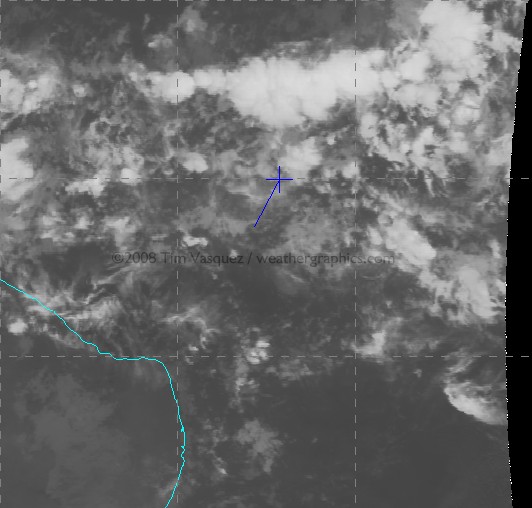
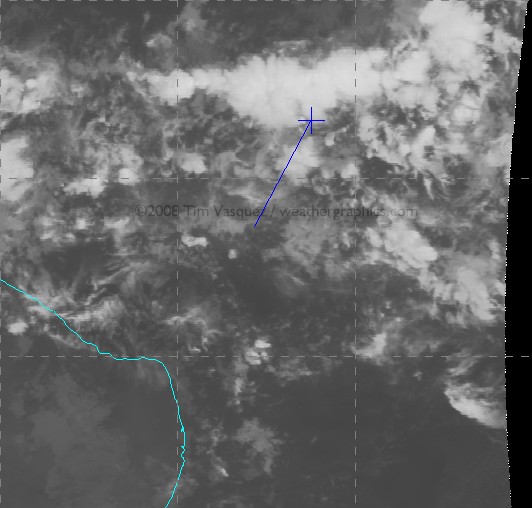

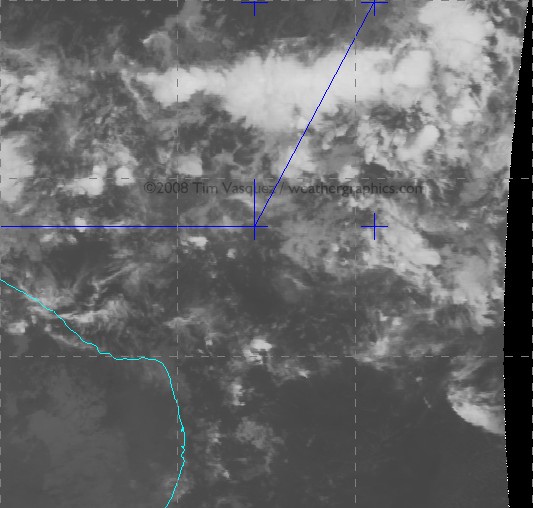
And finally this image shows a zoomed image at 0215Z when AF447 made its last transmission:

click for a larger image
About 90% of the cloud material seen on this image is actually multiple levels of convective debris fields from dying storms and activity that occurred previously during the day, with only scattered cirrus fields at flight level. The active thunderstorm areas are defined by small-scale mottled areas of cold cloud tops. Compare with this structural diagram below of a similar tropical MCS in the same area in 1977. It illustrates that planes inflight are clear of most dangerous weather throughout a tropical system except when directly above an active updraft area.

Schematic of a typical tropical MCS observed in the Atlantic southwest of Dakar on 4 Sep 1974. (Structure and Dynamics of a Tropical Squall-Line System, R. A. Houze Jr., Mon. Wea. Rev., 105, 1540-1567) |
It appears AF447 crossed through three key thunderstorm clusters: a small one around 0151Z, a new rapidly growing one at about 0159Z, and finally a large multicell convective system (MCS) around 0205-0216Z. Temperature trends suggested that the entire system was at peak intensity, developing rapidly around 2300-0100Z and finally dissipating around dawn. From a turbulence perspective, these cold spots would be the areas of highest concern as they signal the location of an active updraft producing new cloud material in the upper troposphere.
The last communication from the plane was at 0214Z (12:14 am local meridian time). This was an automated ACARS message reporting an electrical fault and pressurization problem. This would be about the time the plane was beginning to exit the cluster, but not before having flown for 75 miles of numerous updrafts. The exact aircraft location cannot be determined with certainty, however, since a 1-minute time error in position or reporting time translates to 9 miles of spatial error.
The Fernando de Noronha sounding is available here and shows typical tropical conditions with modest positive energy throughout the column from the surface up to 45,000 ft. There is what looks like anvil level material above 25,000 ft. The significant dry mid-level air is somewhat unusual and suggests the potential for enhanced evaporational cooling in the upper troposphere enhancing downdraft production, and any synoptic-scale lift (if present) enhancing instability through adiabatic cooling of the layer.
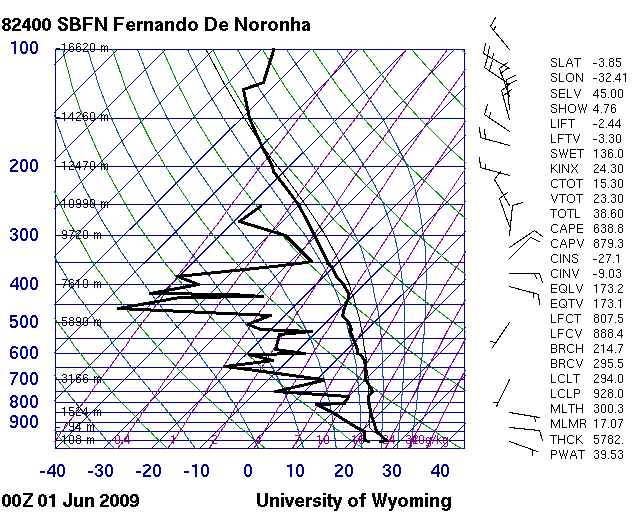
I modified this sounding (see below) using the prevailing temperature/dewpoint field across that part of the ocean and modifying for some cooling due to nighttime loss of heating. This is my best guess at the parcel profile that fed this storm. It yields a worst case instability of 1048 J/kg of CAPE, which is moderately strong but considered borderline for typical severe weather. Vertical velocity can be obtained by w=2*CAPE^0.5 yielding a maximum possible updraft speed contribution of 45.8 m/s or 102 mph, though in reality this is usually much less (on the order of half or less) due to precipitation loading and other factors.

3. Conclusions
The satellite imagery indicates that numerous cumulonimbus towers were rising to at least 51,000 ft, and were embedded in extensive stratiform anvils with tops of 35,000 to 45,000 ft. This kind of configuration is actually quite normal for equatorial storms due to the higher tropopause height, but it emphasizes that the aircraft was certainly within the bulk of an extensive cumulonimbus cloud field for a significant amount of time and that storms could indeed have been a contributing factor to the crash.
I’ve edited this section Monday night to cut down on the speculation about the accident chain, especially since I don’t know a whole lot about A330 systems. The airliners.net board and other sites cover the aircraft and CRM systems quite well. What I will try to do, however, is summarize what the aircraft probably encountered based on the data and my own experience.
* Turbulence — Turbulence is a definite candidate as a contributing factor. There is an isolated storm at (1.6,-31.5) that appears suddenly at 0200Z just as the A330 enters the main MCS cluster. From a turbulence perspective it is by far the most dangerous formation found on the loop. However it is 10-25 km to the left of UN873 and it is doubtful the crew would have been deviating at this time. Other cells like this one embedded within the main MCS may have caused severe turbulence. Young updrafts are particularly dangerous to flights because they contain significant rising motion yet precipitation fields have not yet fully developed and airborne radar signatures are weak, reducing the likelihood the crew will deviate around the cell. Another concern is the extensive upper-level dry air shown on the SBFN sounding (not counting the anvil debris at 350-300 mb), which may have contributed to enhanced evaporative cooling in and around the anvil and aggravated the turbulence experienced by the flight, especially around the margins of anvil clouds and towers. It is worth considering that cumulative periods of heavy turbulence crossing through the cluster may have caused minor internal damage that progressed in some way into an emergency.
* Icing — With a flight level temperature of -43 deg C suggested by the proximity sounding the A330 would have been flying mostly in rime ice and possibly some clear ice and graupel. At -43 deg C, water cannot exist even in supercooled form (see here for an explanation). The equivalent potential temperature throughout the profile is absolutely insufficient to bring warmer air with supercooled water to flight level. Without the supercooled water there is very little ice buildup on the airframe. My conclusion is that unless the plane descended below FL300 icing would not be the culprit.
* Lightning — Due to the high cloud tops and freezing level at 16,000 ft, there was extensive precipitation by cold rain process and it is likely the MCS was electrified. Lightning of course being considered with good reason since the A330 is one of the most computerized and automated airliners in service. I will say based on my 25 years of meteorology the storms were almost definitely producing lightning. As far what a strike would do to the A330, I have to leave that to to the avionics experts. Some answers might be found at http://www.airliners.net/aviation-forums/.
* Precipitation — A dual engine flameout due to precipitation or ice ingestion is a noteworthy possibility as has been discussed on other sites (specific to the A330 type too). The precipitable water content in any tropical weather system can run very high. However a rain-induced flameout is not possible because supercooled water cannot exist at the -43C cruise altitude and insufficient equivalent potential temperature exists, even in updraft cores, to bring warmer air beyond a few degrees change to the flight level. Therefore the plane at FL350 was completely within some mixture of rime ice, graupel, or small hail. But again, as the link indicates, even ice poses risks to the engine.
* Hail — I got a few comments about hail. I am not entirely convinced that structural hail damage is a factor, partly because I can’t recall hearing much about large damaging hail at altitude in my experience with equatorial flight operations. This would require strong instability, which I’m not yet sure we have, not only to grow the stones but to loft large hailstones from the embryo “nursery” at FL200-250 up to flight level. A value of 1000 J/kg CAPE is really on the fence but not out of the question. The other problem is the mounting body of evidence (see SPC studies) suggesting well-sheared storms (this profile is poorly sheared) are the ones conducive to structures that support hail growth. Finally, another issue is airborne radars are be highly sensitive to hail because of the very high backscatter values of ice, making evasive action likely, and the “young updrafts” I pointed out earlier as a threat would not have provided the residence times necessary yet to contain hailstones; their main threat would be severe turbulence. I am not sure about the hail hypothesis, but I believe there is a high probability of graupel, small ice pellets, or small hail at FL350 in the storm complex (see Icing above).
Overall what we know for sure is weather was a factor and the flight definitely crossed through a thunderstorm complex. There is a definite correlation of weather with the crash. However the analysis indicates that the weather is not anything particularly exceptional in terms of instability or storm structure. It’s my opinion that tropical storm complexes identical to this one have probably been crossed hundreds of times over the years by other flights without serious incident.
Still, in the main MCS alone, the A330 would have been flying through significant turbulence and thunderstorm activity for about 75 miles (125 km), lasting about 12 minutes of flight time. Of course anything so far is speculation until more evidence comes in, and for all we know the cause of the downing could have been anything from turbulence to coincidental problems like a cargo fire.
My own opinion of the crash cause, as of Monday night, based on the complete lack of a HF radio call and consideration of all of the above, suggests severe turbulence (see the BOAC 911 and BNF 250 tragedies) combining in some unlikely way with CRM/design/maintenance/procedural/other deficiencies to trigger a failure cascade. We can almost certainly count on some unexpected surprises once the CVR is recovered. Until then, all we can do is await the investigation and hope that the world’s flight operations stay safe until AFR447’s lessons are revealed.
E.M.Smith (18:52:53) wrote:
Per the tail fin: I have a big problem with a design that breaks apart if you move the rudder to full deflection. The “fix” of “don’t do that” did not inspire confidence… (Yes, you really can “break the tail off” by the simple expedient of moving the rudder to it’s normal full deflection position… so if you learned to fly in any of the thousands of airplanes where that is OK, it isn’t exactly obvious that moving the control surfaces as you normally would to control the plane in an emergency can break the airplane… IMHO, unforgivably bad human factors problem…)
It was iMHO incredibly poor design, one which Airbus didn’t fix:
Preliminary calculations by Safety Board and Airbus engineers show that large sideloads were likely present on the vertical stabilizer and rudder at the time they separated from the airplane. Calculations and simulations show that, at the time of the separation, the airplane was in an 8° to 10° airplane nose-left sideslip while the rudder was deflected 9.5° to the right. Airbus engineers have determined that this combination of local nose-left sideslip on the vertical stabilizer and right rudder deflection produced air loads on the vertical stabilizer that could exceed the airplane’s design loads. The Board notes that, at the time the vertical stabilizer and
rudder separated from the airplane, the airplane was flying at 255 knots indicated airspeed (KIAS), which is significantly below the airplane’s design maneuvering speed of 273 KIAS.
The rudder control system was also problematical:
at 250 knots, when the limiter restricts rudder travel to about +/-9.3°, a pilot force of about 32 pounds is required to move the rudder pedals about 1.3 inches. The rudder system on the A300-600 uses a breakout force of about 22 pounds. Thus, at 250 knots, the rudder can reach full available travel (9.3°) with a pedal force of only 10 pounds over the breakout force.
See NTSB Recommendation.
As noted previously, pilots were trained after this crash to not do the above, but there are limits to training and maybe the composite tail was strengthened on the 330, but then the forces are much more severe at high speed and extreme turbulence.
I’m not saying this is what caused it, but then it wouldn’t be like this was the first time that a structural failure brought down an Airbus in the last decade either and it does appear that the plane broke up in flight and the only two things likely to cause that is an explosion or structural failure.
Arthur
E.M.Smith (18:52:53) :
I’ve noticed that at the top of the solar max we had a couple of years with nearly no accidents, then with this sudden drop of solar output we’ve had a spike of plane crashes
But it is a pattern…
You noticed it too. Glad it’s not just me.
I didn’t know there are no mechanical controls on Airbus.
Not much hope of flying one if the computer goes down.
I’m going with the GCR’s as suspect, and I’m NOT getting on an airplane until they settle back down.
@rbateman: Check out the June 2 page for spaceweather.com. Look at the bright night photo from Poland on May 31 at 20:48 UT. They said it was a meteroid, but it was totally unexpected and no one identified a projectile. This AF break-up was in the wee hours of June 1. We finally have a significant sunspot extant. I wish the EM nature of the sun/universe were fully on the table. There might be a connection. We could learn a lot.
If it is true that the automated message said that the entire electrical system had failed,what could have caused it?I don’t believe weather alone could cause that.Could the pilot do something wrong that would cause such a failure?I am guessing that the pilot or co-pilot(there is talk that the pilot was on a break)reacted the wrong way to a situation,but in that Qantas incident the pilot temporarily lost control because a malfunction in the computer caused the plane to nose dive.I am worried that there is a problem with the software in the computers of these planes,they can’t ground them all because of the cost,but I wouldn’t travel in one.
anonymoose:
I discounted methane only because it is so unlikely. I certainly don’t doubt that flying into enough methane would produce some odd and undesirable event.
To my limited imagination that event would either be explosion or loss of lift.
Explosion requires the right mixture. Up there any methane bubble would be very cold and the pressure very low. It don’t think an external explosion would occur; a real engineer may calculate and find I am wrong.
Inside the plane it is warmer and the pressure is higher. Methane inside would be far worse.
Nor am I sure how much loss of lift would occur. Again, how much has the methane mixed with the air. But LOL would give the pilots time to radio. And control might well be regained anyway. Neither happened.
Satellites were used during the Cold War to monitor the Earth for covert atomic tests. A sizeable explosion at night at altitude would be detectable if the detectors still operate. But that night there was a lot of lightning, not every flash is an explosion.
For now we can only offer somewhat intelligent guesses. At least I hope we can.
For E.M. Smith and Adoucette –
Part 23 certified aircraft (read here – airliners) are not required to withstand full stop-to-stop rudder displacement. Boeing does not – cannot – guarantee that a 777 could withstand such a maneuver. Nor does Airbus. Most of us in the industry (myself included) didn’t fully understand this at the time. Its not written intuitively in the regs. The A300 vertical stab lugs WERE designed poorly, but that was just icing on the cake. The American crew exceeded the DESIGN limitations of the aircraft, no differently than if they performed such a flight control input in a 777 or 747, etc.
The gotcha to the American crash was that AA produced a training manual written by Airbus which taught a full stop-to-stop maneuver during alternate gear extension (trying to get the landing gear to extend when it doesn’t want to). Therefore, Airbus was actually teaching – and thereby sanctioning – operators to perform a maneuver for which the aircraft was expressly not engineered or tested for. OOPS!
As for GCRs destroying 3 separate Flight Control Computers – its a horse guys, not a zebra. I would sooner bet money on a bad line of code or a nasty thunderstorm. Personally, the Airbus FBW system scares the S*** out of me.
TheAnalyst-
The A330/340 are a completely new design, not a derivative of the A300. Different engineering. Also, the A300 is an old school mechanically controlled aircraft. The A330 is Fly By Wire.
What intrigues me is the that the French authorities are saying “there is no hope of finding the black box”. Why so gloomy, they haven’t even started looking!
dano (14:46:57),that was an interesting ,if data hungry link that you provided. I was surprised at this……” thunderstorm updrafts have been known to initiate strong gravity waves aloft that have generated moderate to severe turbulence.”
Gravity waves ? Really ? Is the search finally over ?
“A methane bubble is far-fetched and is only an unlikelyhood due to the seismic event.”
Methane bubble? You HAVE to be kidding me, right? That plane was six and a half miles up. That would have to be one HUGE methane bubble.
“As I understand it the Airbus is completely fly-by-wire, no mechanical controls at all for the pilots, so loss of flight control computers would be disastrous.”
Mechanical systems are known to have serious flaws too. That L-1011 that crashed in to Sioux City (United 232) being an example. One engine failure took out three hydraulic systems.
The beauty of “fly by wire” is that if you think of the aircraft as a giant printed circuit board, you can have a myriad of redundant paths. As long as a server gets a signal, it will act, no matter which path the signal took.
In many ways fly-by-wire can be much safer than hydraulic or mechanical controls. You can forget about mechanical controls on a plane that large flying that fast anyway. You would have to be a serious jock to move a control surface against that kind of wind.
Hydraulic systems have one or more pumps (generator), reservoir (battery), lines (wires), and a hydraulic motor that operates the control surface or gear or whatever. If you cut a hydraulic line (short circuit) you have to go to a backup system. With an electrical system you can blow a breaker to conserve what is left of power. Multiple redundant paths are possible with electrical systems. And while it might normally be controlled by a major high-tech computer, there can also be a final emergency mode that is basically an analog servo system. You move a control, it changes a voltage that moves a control surface. I believe I would rather fly a well-designed fly-by-wire system than a mechanical or hydraulic system.
You can design in a dozen different electrical paths. You can have it all using pretty much digital communications like a computer network and if a path fails, traffic between the controller and controlled is taken from a different path. And if that system fails, you can fall back on an analog dc system that is basically changing potentiometers that change analog voltages that correspond to control positions and the servos act accordingly.
The more I read about this accident the more it looks like a cascading structural problem. The seeds for such a failure could have been sown in an earlier flight or hard landing. If I were Air France and the black boxes are not retrieved, I would bit the bullet and take two aircraft out of service with similar age and flight history and perform destructive testing on them. Shake them apart and see what falls off first.
If they don’t get those boxes and there is another failure of this sort on the same airframe, it is going to be a major hit on their business.
For someone in New Zealand every flight is a long distance flight, every second flight ive been on we seem to be diverting around weather of one sort or another. I dont know what the flight rules are for Air France out of South America giving the pilot discretion to divert around bad weather. But I know both Quantas which I usually fly and Air NZ give pilots a lot of latitude and use of GPS to route around turbulence, their weather radar and satelite feeds assist in choosing the best route. That freedom for the pilot can cost extra fuel etc, some airlines are a lot more cost consious, and discourage actions which increase operational costs.
It appears that the airframe broke up at some altitude, with the loss of electric power early in the event, suggests major structural failure regardless of the cause. The fly by wire design of the Airbus series saved a bucket of money in the manufacturing process, but has introduced the risk of complete loss of control, add to that some design limitations in the airframe, plus the european (especially french) willingness to sweep problems under the carpet; this crash might force Airbus to be a little more honest about the integrity of the Airframe design.
Great Post though; the range and quality of opinion in the comments makes WUWT one of the must read sites.
A very similar series of events seems to have happened to BOAC Flight 911 in 1966. This 707 flew past Mount Fuji, and was torn apart by turbulence from winds of only 60-70kt. See http://en.wikipedia.org/wiki/BOAC_Flight_911
This accident was well witnessed from the ground. The turbulence tore off the vertical stabiliser first, followed by the rest of the tailplane and the engines. The remainder of the aircraft spun in, disintegrating as it fell. The 707 left a debris trail 10 miles long, including spraying fuel over a wide area. This matches the reports of the demise of flight 447 closely.
This also suggests that vertical stabilisers take the brunt of turbulence-related stress, and may fail in any aircraft design. I don’t think there is any need to look for alternative and more obscure causes for the crash..
…Yes, us slaves in the data mines often joke aboot a stray alpha particle that flipped a crucial bit in our otherwise immaculate data… Wayne Findley
A long time ago I was working in a virus lab, and had a rig where the entire system memory was being monitored for changes as we ran suspected malicious software. On one occasion a researcher reported ( and had the printout to prove it) a single bit change in a 4Mb memory pack which was completely uncommanded. So it happened, at least once, but we never found out if it was a hardware glitch, a cosmic ray, a monitoring artifact…..
Also a very old and not so bold ex-commercial pilot.
I can recall being in a Cb in a DC3 going up at 4000 ft /min with both throttles at idle.
Thunderstorms are monsters that you treat with the utmost of respect and some of my old buddies that flew with QANTAS tell me that they have diverted up to 200 nm to avoid them.
At this stage there will be a lot of conjecture and we will only know the facts if and when the black boxes are found. But some of the wreckage will certainly give a clue as to a bomb or structural failure.
There was a QANTAS Airbus incident recently that some-one referred to earlier involving passenger electronics. The incident was actually a faulty air data inertial reference unit which supplies information such as air speed, altitude and position and led the aircraft’s Flight Control Primary Computers to incorrectly determine the airliner was climbing when actually in level flight. As a result, the aircraft’s nose pitched down losing thousands of feet, critically endangering the aircraft and injuring many passengers. I understand this was also crew and procedures related as there had earlier been a warning light on the autopilot.
I am sure that our investigation team will be closely looking at this incident as aircraft accidents are often a chain events and history has a habit of repeating itself. Commiserations to Air France and all involved and for the sake of world aviation safety good luck with the investigation.
Strange that the computer controlling the gear shift (6 gears) in my car went pear shaped about that time. Had to go back to the dealer to be reprogrammed.
I guess car systems don’t need complicated voting systems to protect against random IC failures. It’s likely CRs present a risk with satellite systems.
Spending my working life in the clouds, I have not, and never will set foot on a ‘airbus’ product, it is a accident waiting to happen ! Pieces are made all over Europe and are not a product, but a political wet dream, wings in one country, tail in another, electronics and engines all come from different countries and if you are lucky, get assembled in order, it has been common knowledge that these aircraft suffer from chronic electronic and political problems, not one would ever fly if it was not for hundreds of billions of taxpayers money, expect some real interesting lawsuits in the near future.
I think Pierre Sparaco got it right on Monday when he pointed out that airplane disasters, like most complex system failures, are not typically caused by a single event. It won’t be much of a surprise if this was a sequence of failures, faults, errors, etc. A design flaw, bad weather, human error, an unforseen sequence of failure… Even when something breaks, there isn’t
The China Airlines 747 the broke-up in flight experienced catastrophic failure of of a 20 year old repair. Which was done incorrectly, and never detected by inspections which are created specifically to find problems of that nature.
The Lufthansa A320 that overshot the runway when landing, killing the cockpit crew and some of the 1st class passengers, overshot because the thrust reversers never deployed, because software was looking for a switch closure indicating weight on the main gear legs, because the wind reversed to a strong tailwind and the plane had been coming in faster than it should have, so it wouldn’t stop flying.
In one case we’d all say “Bad repair/skin patch”, in the second is clearly a software design/requirements issue. But it really wasn’t just the one thing, it was a chain of events, including something high profile so I can drink a Coke from time to time.
Cheers!
Bill IV
AnonyMoose … the seismic event occurred on Sunday, May 31, 2009 at 00:47:04Z … the aircraft disappeared at approximately 02:20Z on June 1 (23:20 local on May 31 in Brazil).
Gas emissions from volcanoes are primarily water vapour, carbon dioxide and sulphur products … if there was an emission could it have created severe thunderstorms in the area? Just speculation but worth checking out.
Cheers,
Jon
Great Blog! But with no means to cause offence do you think you can change your profile image? it is blurry and is kind of off putting everytime it comes up as the number 1 hawt post… if not i totally understand.. its been a long day
Further clues:
Air France Flight 447 ‘may have stalled at 35,000ft’ Times Online June 4, 2009
An onborad explosion has to remain a concern:
The pilot of a Spanish airliner flying near where the Airbus is believed to have gone down reported seeing a bright flash of white light that plunged to the ocean, said Angel del Rio, spokesman for the Spanish airline Air Comet.
“Suddenly, off in the distance, we observed a strong and bright flash of white light that took a downward and vertical trajectory and vanished in six seconds,” the pilot wrote in his report, del Rio told the AP.
Arthur
To Mr. Alan Cambell: You might as well not step into a Boeing product either because they too use parts from all over the world. Seattle or Witchita or Long Beach are just assembly points.
Also, I used to monitor HF Transoceanic frequencies quite often. To deviate around thunderstorms using HF and the procedures required seems always to take forever (probably 10 minutes) from the time of request to checking with Gander, Shanwick, Santa Maria, Dakar and then to not being able to hear the transmissions clearly so everything needed to be repeated. Quite different from when overland where radar is tracking.
I stopped monitoring these frequencies because I thought by now we had gone to GPS and satellite transmissions. How wrong I was!
What about the Kenya Airways (a new 737- 800)flight out of Douala (last year) which crashed 30 secs after take off. There was deinitely a severe thunderstorm involved here. The black boxes were apparently found. What were the findings?
To anyone who has had the misfortune to experience severe turbulence whilst inside a jet airliner, it seems of little comfort that turbulence should not be able to bring down an aeroplane. I experienced this in December 2000 whilst flying a Continental 777 from Houston to London – somewhere over Arkansas or Tennessee. It was horrific- people screaming, everything flying around. I remember getting dripped on afterwards – the drinks had hit the ceiling ! It seemed incredible that the plane was designed to withstand such treatment … and we didn’t even have anyone injured ! Sometime flights end up with hospitalisations of 30-40 people – how bad must that be ?
http://www.chron.com/CDA/archives/archive.mpl?id=2003_3678096
Once you have expereinced the total violence of such turbulence, no amount of scientific assurance will convince you the ‘planes are designed for it’. Personaly I think the Air France tragedy is the result of such a scenario.
Of coures with global warming making storms worse, we can all expect this to happen more often.
Bill Abbott (04:15:29) wrote :
The China Airlines 747 the broke-up in flight experienced catastrophic failure of of a 20 year old repair. Which was done incorrectly, and never detected by inspections which are created specifically to find problems of that nature.
The Lufthansa A320 that overshot the runway when landing, killing the cockpit crew and some of the 1st class passengers, overshot because the thrust reversers never deployed, because software was looking for a switch closure indicating weight on the main gear legs, because the wind reversed to a strong tailwind and the plane had been coming in faster than it should have, so it wouldn’t stop flying.
I believe you were referring to the JAL – 123 flght.
The improperly repaired rear bulkhead failed, which caused an explosive decompression, loss of the vertical stabilizer and severed all 4 of the hydraulic lines. The plane flew about 30 minutes, using variable trust on the engines to steer the plane (much like the United DC-10 crash at Sioux City)
http://en.wikipedia.org/wiki/Japan_Airlines_Flight_123
http://en.wikipedia.org/wiki/United_Airlines_Flight_232
As to the A320 crash, this sounds almost identical to the crash of a Piedmont 737 at Charlotte, and was caused by a hot landing, and then the inability of the pilot to deploy the thrust reversers because the “squat switch” didn’t engage because the plane was travelling too fast. (In this case the pilot had also set the spoilers to automatically deploy, but their deployment was also based on the squat switch being triggered, so they didn’t automatically deploy.)
http://aviation-safety.net/database/record.php?id=19861025-0
Arthur
any news about survivors?
Imran wrote:
“no amount of scientific assurance will convince you the ‘planes are designed for it’.”
Maybe this will help:
This is the destructive test of a 777 wing, note that 100% is the design limit load, meaning the highest load the wing is expected to reach in flight, even in severe turbulance. The wing survives more than 150% of this load.
Arthur