 This post on sea level reality came up in comments, posted by the author of the Climate Sanity website, Tom Moriarty.
Tom did an excellent job of visually illustrating the history of Boston Harbor and man’s plight in dealing with it, so I thought it would be worth sharing here for WUWT readers. In fact I’m so impressed, I’ve added Tom to the WUWT blogroll.
Of all the talk about sea level rise, it is interesting to point out that at least in Boston, man has easily outraced the sea. The worry about sea level is real, but the ability of man to adapt is clearly illustrated in the comparative maps. Just a note, I’ve modified the original blink comparator animation to make it a bit easier to watch. – Anthony
From Climate Sanity:
Boston, you have been warned. Sea levels are rising , and if one of the IPCC’s five scenarios is correct, the world’s oceans will rise somewhere between 18 and 59 cm (7 to 23 inches) by 2100. If that isn’t terrifying enough for the people living on the New England coast, the Boston Globe now tells us that the ocean near Boston will rise 8 inches more than the world average. How will the hapless rubes of Boston cope with this onslaught of Atlantic water?
I wouldn’t lose to much sleep worrying about the folks in Boston when it comes to pushing back against the ocean. Excerpts from the following maps were used to make an animation of the changing coastline in Boston:
- A 1775 map showing the Boston area with the rebel military works. Note especially the isthmus, known as Boston Neck< that connects the town of Boston to the mainland.
- An 1838 George W. Boynton engraving of Boston area from a Thomas G. Bradford atlas.
- USGS map of Boston area.
- A 2009 satellite image from Google Earth
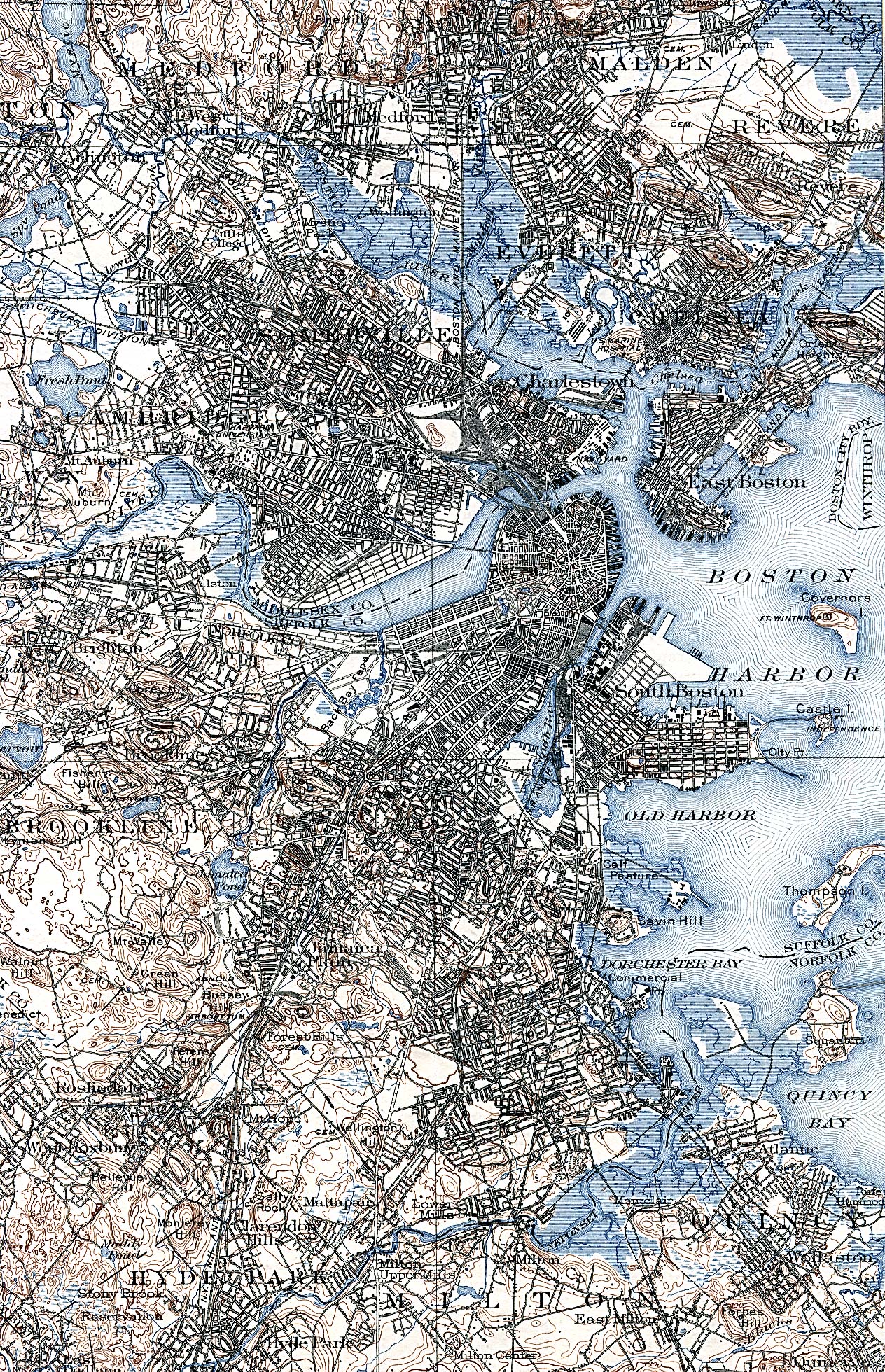
The top of the animation shows the maps after photoshopping to make the land and water more obvious. The bottom of the animation shows the unaltered excerpts of the maps or images.

The panic prone will argue that our Bostonian ancestors dealt with a static ocean, not a rising ocean. Not so fast. Check out the NOAA graph below (click inside graph to see it in context at NOAA site). It shows a sea level rise rate of 2.63 mm/yr for the last 100 years in Boston. At that rate it will rise 23.9 cm (9.4 inches) by 2100.

Boston sea level rise data from NOAA. Click in image for view in context.
Anyone who panics over the IPCCs 100 year projections of rising sea levels does not understand the perseverance and ingenuity of free people. Then there are others, like James Hansen, who enjoy the feeling of panic so much that that they exagerate the probable sea level rise for this century to get their thrills. But that is a story for another day…
I’m Dutch, I live in the Netherlands, and I don’t know anybody at all that is worried about sealevel rise. Living with the sea is something we’ve always done, we pay a separate tax for the ‘waterschappen’ which is the regional organization that is keeping us dry. These organizations are centuries old, and do a pretty good job.
If the sea level should rise, we’ll just increase the height of the dikes. That costs money, we’ll pay it, it’s necessary. Similarly with river flooding. We’re setting aside some polders for overflow situations, so that no property loss occurs when there’s too much water coming out of the Alps.
All in all, water is something that’s quite manageable, and the New Orleans disaster has provoked many Dutch water management engineers to talk about amateur sea defenses (See the article in Scientific American a few years ago). If you really want to see what it takes to keep a sea at bay, have a look at this http://images.google.nl/images?q=afsluitdijk
How much sea rise is actually down to thermal expansion? And, with the cooling trend kicking in, will we be seeing a slowing or even a drop in level some time in the not too distant future? Sorry if this is a retarded post but I’m not a scientist.
@ur momisugly Bart van Deenen
‘If the sea level should rise, we’ll just increase the height of the dikes. That costs money, we’ll pay it, it’s necessary.’
Really, and how will that money be paid? Through a tax? Will you stand for this? Will you allow the government to restrict your freedom to spend YOUR money the way YOU see fit? Come on, freedom-loving Americans, tell this weak-kneed European how wrong he is.
Anyway, I hope you’re not living on the Maasvlakte. 😉
Bart, as a fellow Dutchman I was about to post a similar comment but there is no need now after what you said.
Bart van Deenen (02:52:11) :
I’m Dutch, I live in the Netherlands, and I don’t know anybody at all that is worried about sealevel rise. Living with the sea is something we’ve always done, we pay a separate tax for the ‘waterschappen’ which is the regional organization that is keeping us dry. These organizations are centuries old, and do a pretty good job.
A curtsy to those organizations.
If the sea level should rise, we’ll just increase the height of the dikes. That costs money, we’ll pay it, it’s necessary. Similarly with river flooding. We’re setting aside some polders for overflow situations, so that no property loss occurs when there’s too much water coming out of the Alps.
All in all, water is something that’s quite manageable, and the New Orleans disaster has provoked many Dutch water management engineers to talk about amateur sea defenses (See the article in Scientific American a few years ago). If you really want to see what it takes to keep a sea at bay, have a look at this http://images.google.nl/images?q=afsluitdijk
I first became aware of AGW when I read about the 6 meter inundations predicted by Al Gore a few years ago. At the time I had read nothing on the science and had no reason not to believe the claims of something so official as the IPCC. These 6 meters would be bad for modern Greece since we have thousands of kilometers coastline ( displaying the fractal nature of coasts very nicely, thank you) and I started thinking of measures. Then I thought one could “gate” Gibraltar and keep the Mediterranean at whatever level is desired; with the EU and the Dutch know how within it, no problem :). It was some time later that the hockey stick led me to complete disillusionment with IPCC projections etc.
Bruce Cobb (13:29:21) :
“Building in flood-prone areas, the opposite of adaptation is just plain dumb, as is blaming “carbon”.
so the millions of people in third world countries that produce a lot of the worlds food by farming flood plains should commute 100s of miles each day in their non existent cars?
Bart van Deenen,
Now you guys are just being silly. You must immediately start sending all those waterwhatever taxes to Raj over at the UN. Why build dikes and other things when you can just stop using electricity, gasoline and diesel? It seems to me that the Dutch are being very selfish. (Joking)
Seriously, the Dutch are another of the many examples of the things that free people can accomplish. Thanks for reminding us that sea level rise is a small problem for the free. Freedom brings wealth and the wealth of the people brings the means to adapt.
Mike
Just watched 60 Minutes here in Australia. Apparently, the Maldives are “sinking” thanks to AGW and rising sea levels (Approx 1m apparently). Trouble is, we would see similar levels of sea encroachment in other low lying areas, but we don’t. The coral reefs are “bleeching” due to the warming too.
I don’t get it. The article states that sea levels are rising, but the counter argument is simply “we’ll adapt”? herm…
It appears that Bangladeshis aren’t completely helpless.
http://www.nytimes.com/2009/03/20/world/asia/20bangla.html
Ed Darrell (18:49:39) :
lichanos (14:00:32) : It’s a different business to respond to sea level changes in an 18th and 19th century city while it’s growing than to retro-fit a built out 20th century city with all of its infrastructure to new sea conditions.
Ed, please notice that I was responding to the idea that a “20th century with all of its infrastructure” could not respond. Since apparently you didn’t bother to read the link I posted, I’ll quote some of here for your edification. Notice, for example, that the project was still getting some work in the 1960s. I think you will find that Galveston was not a “rubble pile” in 1960…
Oh, yeah, that’s possible in Boston. All we’d have to do is bulldoze the city, as the 1900 hurricane destroyed all but a small handful of buildings on Galveston.
Try 1/3 destroyed. That leaves 2/3 to be lifted. You posting seems long on hyperbole and short on facts. (See quote below for the 1/3 source.)
then we’d need to spend 20 years hauling in soil, jacking buildings up 20 feet to do it.
The rate is entirely discretionary. You could take 20 years, or 50. Geologic ocean hight changes are very slow things. 20 feet? Galveston did that to deal with the exceptional storm surge they naturally get so I would expect Boston to only choose to raise things by whatever degree they felt was a real risk. While I personally think that’s about zero, some folks estimate it at a couple of feet. Catastrophists like Gore and Hansen think 10 feet+ (per their speeches) but ought not to be taken seriously since they have been entirely wrong to date.
BTW, jacking up buildings is a very well established and fairly easy thing to do for modest sized buildings. (Bigger ones it’s easier to put a barrier around them). But somehow I doubt that ALL of Boston is built at 2 feet of elevation… And since for Boston, unlike Galveston, we’re not talking about a sandbar in front of a hurricane; I’d expect the “problem” to be restricted to the (20 feet?) of setback from the shore that IS at a couple of feet elevation.
Now I don’t know about where you live, but every major city I’ve ever been in does not build major skyscrapers next to the ocean at 2 feet elevation. They have a “setback” (for visual reasons if nothing else) and while the basements are often sunk a ways down (and usually built as a waterproof bathtub due to ground water) the land is graded up to the foundation so that rainwater runs away. (Heck, my suburban home has about a 2 foot drop of grade from front porch to street for the same reason…) So my best guess is that we’re talking wharfs and warehouses, mostly, as things built at / near sea level. (Fond memories of the best chowder I’ve ever eaten — at the “No Name” restaurant in Boston. Front door had no sign and you were certain you were entering a random warehouse on the pier… hope it’s still there.)
So my advice to you is: “DON’T PANIC!” At most it would take a bit of a sea wall (2 feet? 5 feet?) and jacking up a few building around the edges of the city where it approaches water. At best, which I think is most likely, it will take nothing as coastal cities tend to already be built to deal with waves, tides, and storms and frankly, a few inches higher ocean aint nothing compared to a giant storm. It’s lost in the error band of the storm surge.
And, I suppose news from Texas doesn’t get much outside the state, but we learned last year that it didn’t work. Another hurricane scoured a good chunk of the island again.
It didn’t work? Galveston is GONE? And I missed it?! (Or at least, I failed to notice 😉
Oh deary me. What has our news system come to when we can lose Galveston (at least, more than 1/3 of it since “it didn’t work” must mean that damage at least as bad as the original event happened…) and no body notices. Guess we got used to it with New Orleans.
Yeah, we can jack up some of the buildings in small towns like Galveston. But it won’t work against rising seas and more violent storms.
280,000 population is a “small town”? Well, it IS Texas …
And which “more violent storms” would those be? The ones like the Labor Day storm in the Keys in 1935, or the N.Y. killer storm or 1938, or… no, wait, we haven’t had any storms worse than that in 70 years…
Thanks for the reminder: People who scoff at nature should go check out Galveston today.
Here is some information from my prior link to help that “checking out”:
Incorporated in 1839, Galveston quickly became the most active port west of New Orleans and the largest city in the state.
On September 8, 1900, Galveston was battered by what stands as the most deadly natural disaster to strike this country, still called the Great Storm more than 100 years later. More than 6,000 people were killed of the town’s 37,000, almost one in six. One-third of the city’s buildings were completely destroyed. Many survivors fled the city without even packing their belongings. The 1900 Storm looms large in the island’s collective memory as Galveston families pass down stories of survival – and loss. For the complete dramatic story, the film The Great Storm (shown daily at Pier 21 Theatre in The Strand district) is well worth seeing.
Gee, “most deadly natural disaster” … guess we ARE still waiting for “stronger storms”… and will be for quite a while…
In the aftermath of the hurricane, city leaders decided that if the city was to be rebuilt, it needed strong protection from the sea. To that end, the city built a seawall seven miles long and 17 feet high and began a tremendous project to raise the grade of the entire town. The project was completed in 1962, and the total cost of the seawall was $14,497,399. Today, the seawall stretches for more than 54,790 feet and protects one-third of Galveston’s ocean-front.
Hmmm… completed in 1962. I guess it is possible to do with a 20th century city. 7 mile sea wall, $14 million. Or about what we pay per mile for a major freeway. Not too bad.
During the grade raising, homes were jacked up, and dredges poured four to six feet of sand beneath them. Structures that could not be raised, such as 1859 Ashton Villa at 23rd Street and Broadway, had fill poured around their foundations. Residents used elevated wooden sidewalks to walk through town during the eight years it took to complete the raising of the 500 city blocks.
Gee, at least 500 city blocks were raised, and life kept on keeping on during the process. “homes were jacked up” … I can only presume they were not so silly as to be jacking up rubble, and that the homes were intact survivors.
Building the seawall saved the city from both the devastation of future hurricanes and from being a memory of Texas history. Galveston quickly gained notoriety across the country for the efficiency and determination it displayed while building the seawall. The engineering feat was noted as an example of how a city should respond after a disaster such as the 1900 hurricane.
(Interesting note: The engineer responsible for this remarkable feat was Henry Martyn Robert, who also developed Robert’s Rules of Order.)
The grade raising was so successful that when another hurricane as ferocious as the 1900 storm swept down on Galveston in 1915, the city was safe and only eight people were killed.
Gee… it did work … who knew… But you said it didn’t and now Galveston has been scoured from the sandbar and is no more, RIP. I’ll have to drive over and see if I can get some of that nice scrubbed clean beach to put up a fishing shack… /sarc>.
UK Sceptic (03:18:28) : “How much sea rise is actually down to thermal expansion? And, with the cooling trend kicking in, will we be seeing a slowing or even a drop in level some time in the not too distant future?”
http://climatesci.org/2009/01/07/sea-level-budget-over-2003%E2%80%932008-a-reevaluation-from-grace-space-gravimetry-satellite-altimetry-and-argo-by-cazenave-et-al-2008/
“The steric sea level [the thermal expansion component of sea level] estimated from the difference between altimetric (total) sea level and ocean mass displays increase over 2003-2006 and decrease since 2006. On average over the 5 year period (2003-2008), the steric contribution has been small (on the order of 0.3+/-0.15 mm/yr), confirming recent Argo results (this study and Willis et al., 2008).””
Anyone, like Ed, who brings up the obvious dangers of living in a river delta should realize that is a very different issue from slow gradual sea level rise. In Bangladesh they have to cope with metres of flooding in a few days, followed by mudslides. All that happens without any sea level rise. Would a sea level rise make things worse? Maybe by about 0.001%. But then since it is a fact that Bangladesh is gaining territory the feet are taken from that slim argument too. One thing that is certain is that cutting down trees for firewood, overpopulation on the coast and deliberate destruction of the protective mangroves makes things a lot worse. Global warming is a distracting non-issue for Bangladesh. Their real problems are here and now, not in 100 years time, and they have nothing whatsoever to do with global warming.
JamesG (16:08:43) : ie the storminess caused by the cool period caused land loss which was reversed by the later warmer, less stormy period. Adding that finding to the Sahara shrinking, the natural land reclamation in Bangladesh and the overall greening of the planet in our recent warm period, warming very often seems to have the opposite effect from the doomsayers predictions. Nature is a lot more complex than some people like to believe and it just loves warmth.
James, you have it exactly right. The Climate Catastrophists forget that major storms are a kind of heat engine, and they depend on the temperature differential between hot and cold places to drive them. It’s not just warming that matters, it’s the warm / cold differential.
When the planet is warmer in general, it’s generally more warm in the colder places (i.e. there is less temperature differential) and when the planet gets cold, as we are doing now, we tend to get very cold at the poles first while the tropics stay warm.
That is, the “heat engine” has more temperature differential to work with between the tropics and the very cold poles.
So I would assert that with the PDO flip and the poles headed for colder, and with the residual thermal energy stored in the tropics, we will be seeing some strong storms in the next few years. Probably not as strong as in the past (we have a lot of cooling off to do before we can reach that point) but stronger than we’ve had in the last 30 years.
I would also expect that the Climate Catastrophists will point their fingers at the storms and shout “Global Warming!” despite the dropping temperatures. Much as they now shout “Arctic Melting!” despite record polar ice totals and the fact that the Arctic doesn’t melt, it breaks up and floats away due to wind and currents.
This is also part of why I think the idea of a Global Average Temperature is broken. “Averages hide more than they reveal. -emsmith” and in this case they are hiding the quantity of temperature differential that storms have to work with. Far more useful would be a comparison of the tropical average highs to the polar average highs (lows to lows ought to work too; and it could be interesting to look at tropical high vs polar low as the extreme case to see if it has more or less information in it.)
This fact has been demonstrated to me this year. When we are under the polar side of the air mass (jet steam has cold air on top of us) we are very cold compared to the ‘average’. We also have a blustery kind of wind pattern that is not typical. More turbulent. When we are on the warm side (as today – At LAST, a couple of warm days! Tomatoes have flowers and may actually get some fruit set… a month late, but better late than never!) we get a calm still air mass with lots of pleasant warmth and a calm nature. Maybe still a degree or two above ‘average’, but that will drop over a few years as the tropics cool down.
The net result will be spending more time under the cold side of the jet stream with ever colder and ever stronger storms / wind; and less time under the warm side with ever lower peak temperatures. It will take 20 or 30 years, but that’s what I’m expecting to happen. For the next few years, the hot side will still be “hotter than average” since the average is 30 years and we’ve only been cooling for 10. The Climate Catastrophists will howl and holler “LOOK a HIGH Temperature! Global Warming!!” and dismiss the cold side of the jet stream as just weather.
But as the -30 to -20 part of the moving average drops off, and as we add another 10 years of tropical cooling, the effect will be very clear and hard to deny. In 5 years, that 30 year average will be dominated by the 20 years centered on 1998 and there will be ever more reports of “below average” temperatures.
The tendency of catastrophists to be “exactly wrong” is startling, and I don’t know if it’s due to a tendency to not think deeply enough (not working through all the steps), not able to handle the perverse inversions that happen in complex systems (such as Jevons Paradox), or just a tendency to let their fear run away with their minds (folks love a good scare – Hitchcock made a fortune out of that human trait…) but the fact is, they are “exactly wrong”. Oh well.
In stock trading, an exactly wrong indicator is just as good as an exactly right one, you just change your response to it. (For example, when everyone “knows” the market is the place to be, you sell. When the paper has a giant headline “Market CRASH! RUN AWAY!!!” you step in and buy.) The bulk evaluation of the market state is typically “exactly wrong” and thus a useful indicator. So I just look at the Climate Catastorphist claims and ask “Which of these can I invert and make money from them?”
If I had the cash, I’d be buying out those shallow islands in the Pacific that everyone seems to think are going to flood… A bit of sea wall (decorative, of course) and a nice bamboo theme bar with beach chair rentals and … Ah, the mind wanders…
Mike Jonas
Thanks for the link. If I understand the information correctly we still have a slight annual rise but the rate has been slowing since 2006. That makes sense of my personal observations and experience.
According to Hansen and the IPCC I should have converted my garage into a boathouse by now and raised my house on stilts I only live a few hundred yards from the beach you see but I’ve yet to register a significant rise in sea level. Heysham nuclear power station, several miles across the bay from me, hasn’t floated out to sea yet either. The fact that a third reactor, to replace the aging Heysham 1, is being planned also gives lie to New Labour’s apparent belief in rising sea levels. Either that or they are completely round the bend. I can’t rule out the latter. 😀
“The rubbish is coming.”
I would ask, “Is it still there?” As a tourist in ’76, I was driving out into Boston’s lower harbor on a little used road…looking for a place to launch a canoe. I noticed that the island was actually a tall landfill. Where wave action had cut into the edge, amidst the motley; I could see automobile tires, circa 1920.
Will this island also be protected?
Pragmatic(10:49:48): “They build breakwaters. They build sea walls. When erosion wins the battle, they move to higher ground and build again.”
Here’s the rub. Do you build the sea walls around the harbor and up the rivers for the 2100 sea level rise? Or, do you move out now, because you can’t afford the sea walls that you’d need for the even higher levels in the future?
Apart from the concrete, how do you protect the system from terrorists?
1. if by land; or 2. if by sea.
CodeTech (16:14:30) : Building cities at sea level made sense when shipping only involved ships, but has slightly less importance today. Building cities on major rivers used to make sense too, other than a water supply we don’t need to do that anymore.
Quite so. A lot of the ‘homes near the wharf at sea level’ came about from folks walking to work in the 1800s. No longer important. One of my major complaints about New Orleans reconstruction is the idea that they want to rebuild the same 1800’s way. At / below sea level near the water. They could raise the land (as Galveston did). They could simply relocate the residential district inland and uphill a bit and put in a great freeway / commuter rail system to the city core. Lots of solutions. So what are they doing? Rebuilding the same broken design in the same place.
“Intelligence is limited, but stupidity knows no bounds. – emsmith”
A fundamental part of economics says that cities form where two or more transportation systems meet. Traditionally, one of these was shipping (sailing ships, barges), the other land (wagons). That is why we have so many cities located at ports and where rivers meet seas.
Today; rail, freeways, and airports are major important drivers in the same process (and we can easily commute to a port facility for the folks who need to work in it). So the simple answer to New Orleans (and anywhere else similarly afflicted) would be to put the freeway, rail, and airport a bit more inland and higher up (and let the city grow around those, there) with a rail spur to the port (that must deal with sea and storms, but does not need to have 100,000 folks living near it at sea level nor does it need hospitals built in the path of hurricanes…)
We are humans. We change the environment to suit ourselves… […] I have a hard time believing that dealing with small regular sea level rises has to be any different. (disclaimer: I live at 3500 feet and am a 12 hour drive from the nearest ocean… sea level rise will never have a direct effect on me)
And in fact we have regularly moved cities around. They change even faster than the geologic time scale changes. Look at Manhattan. How much of it is unchanged from 100 years ago? Even 50 years? So what makes folks think it will be the same in 100 years from now?
My “home town” is at 32 FEET elevation. I live MAYBE 10 miles from the waterline. IFF there is “sea level rise” it will effect me. So I put a fair amount of effort into making sure I’ve got it right. So far, over the 40 years of so I’ve lived around here, the “sea” (SF Bay) has consistently receded. 30 years ago I was looking for a place to berth my live aboard sail boat and checked out Alviso Marina (it had boats in it then and a fair number of illegal live aboards in the near by slough). 20 years ago it was closed to boats and marshy, but at least I could cast a line in and fish. 10 years ago it became a mud flat / grassy area that occasionally flooded (no point in fishing). Now? Haven’t looked lately, but the picture who’s link I posted shows the “gate” to one of the “docks” with what sure looks like grassland / reeds as far as the camera “eye” can see.
Land “accumulates”. It’s a geology thing… FWIW, my “parkway” also accumulates land. Don’t know if it’s dust, or roots, or what. Hauled out a pickup load or two to “level it” about 25 years ago (it was about 6 inches above the sidewalk). Now it’s back to ‘above the walk’ again… And the part around the street tree (that was not leveled 25 years ago) is now 12 inches up… To account for a mm scale sea level rise but not account for an inches scale “dirt rise” is simply false accounting. (I use a ‘mulching mower’ so the clippings stay and add to the soil. I don’t ship cubic feet of stuff away with each lawn mowing as many folks do…)
Ed Darrell (18:26:25) : So, rather than do his job as he swore an oath to do, rather than correct the science as the law required him to do, despite his having Civil Service protection for his job status to prevent his being fired for doing his job, he stayed quiet.
Please provide some evidence to support your wild claims. Note that you make a self contradictory claim that he could fire Hansen yet he was protected via Civil Service from firing. Pick one. Civil Service protects both, or neither.
Exactly what law specifies that science must be correct? I’d like to shove it down Hansens’ GIStemp…
He lied then when he had to violate the law to do so — and we’re supposed to trust him now?
As near as I can tell, from personal observation of NASA and experience as a manager, you are simply making this up and blowing smoke. What “lie”? There is none. He had a marginal employee and couldn’t find a practical way to dump him. EVERY manager faces that. It’s what layoffs are used for (AND why governments grow without bound accumulating incompetence – you never have a ‘lay off’ so you can’t weed out the ‘marginally incompetent but not consistently so’). Yeah, you lose some good folks in layoffs too, but it is Gods Gift to the manager with That Marginal Guy who screws up a lot, but manages to clean up his act just enough to not be fireable for cause.
If you want to terminate someone, there is a very long and painful process to go through. You must “show cause” and it must be uncorrected. If, at any time, the cause is “corrected”, no matter how briefly, you get to start over again and need to get the 3 steps done again starting over at step one. (warn with corrections required, warn of failure to correct and re-explain, final warning with HR present / involved to document completeness of process; then, and only then, if STILL uncorrected, you can proceed to firing. Yes, there are exceptions such as physical violence, but they don’t apply here).
So we had an administrator with a PITA employee who had friends in high places with a marginal case for corrective action against him. You want to make that a criminal act? Really?
And, isn’t this the same guy who confessed that he didn’t really have firing authority over Hansen?
I think you are confusing things here, perhaps deliberately. IIRC he was the managers manager. Did not have direct authority, only indirect. And as a manager of managers, you learn that you must let your folks take their own lead a fair amount (or else you are micromanaging with all its failures). Bypassing a direct report to fire someone below him is very hard to do (usually done, again, in layoffs – where you “suggest” who do dump…)
So you want this guy to start a cat fight with a major political figure, piss off his direct report, violate chain of command, start a difficult to marginal termination for cause case with HR, and what all else again? In a Civil Service context? Now, decades later, he sees where (what at the time looked like a minor nuttiness) has lead the country. Now he has reasonable regrets. Now he knows that the cost / benefit ratio that looked like it wasn’t worth it (then) now shows maybe he ought to have taken on that grief. For that you want to beat the guy up?
Yes, we ought to trust him. He is clearly a well balance manager who knows a lot more of the truth than the rest of the world does…
Ed Darrell (19:22:32) :
“So the only problem I see is that we need to manage the sediments a bit better… and maybe not build on dynamic alluvial flood plains below / at sea level…”
Fantastic advice! You’re only about 4,000 years late.
Well, since were presently building in New Orleans, it looks timely to me. And since every city gets ‘renewed’ on a regular basis, it looks timely to me. And since sediments are arriving every single minute of every single day, it looks timely to me. You seem to think that nothing ever changes other than the climate.
You are wrong.
Oh, and what major city in North America was built 4000 years ago? And what 4000 year old buildings are we still using in Asia and Europe? I seem to have missed that in my history books…
(If you are going to Troll, can you at least have some grounding in facts and truth? Hyperbole is vaguely entertaining, but poor technique.)
JamesG (07:13:37):
One thing that is certain is that cutting down trees for firewood, overpopulation on the coast and deliberate destruction of the protective mangroves makes things a lot worse.
Unbelievably, I agree with your assertion, except on overpopulation of coasts.
I’ve witnessed how the land expansion for harvesting, cattle raising (herding) and construction of urban areas has modified the local climatic conditions. Those practices have worsened the erosive effects of rainfalls and winds and increased the heat island effect. Through an investigation on “red winds” in Mexico, I found that they were due to around 90 m/s Southwest winds which dragged the fertile layer of ground from very extensive lands which had been stripped off of wild plants for using them for maize and beans cropping.
Nevertheless, I attribute the problem to ignorance and to the poor attention of governments on those activities. In brief, the problem is not the human activities because they are essential for our subsistence, but a wrong planning of those human activities.
Of course, climate changes due to deforestation are not global, but local and/or regional. I’m sure on one thing: It’s not the CO2 what causes warming of the atmosphere or global climate changes. I perfectly know what I’m saying.
Lets try this again, with the proper close to the bold and italics… (Maybe I need to use my reading glasses in the morning so I can see those little tiny slash characters better 😉 “Proof Reading” a blurry image has it’s issues…
CodeTech (16:14:30) : Building cities at sea level made sense when shipping only involved ships, but has slightly less importance today. Building cities on major rivers used to make sense too, other than a water supply we don’t need to do that anymore.
Quite so. A lot of the ‘homes near the wharf at sea level’ came about from folks walking to work in the 1800s. No longer important. One of my major complaints about New Orleans reconstruction is the idea that they want to rebuild the same 1800’s way. At / below sea level near the water. They could raise the land (as Galveston did). They could simply relocate the residential district inland and uphill a bit and put in a great freeway / commuter rail system to the city core. Lots of solutions. So what are they doing? Rebuilding the same broken design in the same place.
“Intelligence is limited, but stupidity knows no bounds. – emsmith”
A fundamental part of economics says that cities form where two or more transportation systems meet. Traditionally, one of these was shipping (sailing ships, barges), the other land (wagons). That is why we have so many cities located at ports and where rivers meet seas.
Today; rail, freeways, and airports are major important drivers in the same process (and we can easily commute to a port facility for the folks who need to work in it). So the simple answer to New Orleans (and anywhere else similarly afflicted) would be to put the freeway, rail, and airport a bit more inland and higher up (and let the city grow around those, there) with a rail spur to the port (that must deal with sea and storms, but does not need to have 100,000 folks living near it at sea level nor does it need hospitals built in the path of hurricanes…)
We are humans. We change the environment to suit ourselves… […] I have a hard time believing that dealing with small regular sea level rises has to be any different. (disclaimer: I live at 3500 feet and am a 12 hour drive from the nearest ocean… sea level rise will never have a direct effect on me)
And in fact we have regularly moved cities around. They change even faster than the geologic time scale changes. Look at Manhattan. How much of it is unchanged from 100 years ago? Even 50 years? So what makes folks think it will be the same in 100 years from now?
My “home town” is at 32 FEET elevation. I live MAYBE 10 miles from the waterline. IFF there is “sea level rise” it will effect me. So I put a fair amount of effort into making sure I’ve got it right. So far, over the 40 years of so I’ve lived around here, the “sea” (SF Bay) has consistently receded. 30 years ago I was looking for a place to berth my live aboard sail boat and checked out Alviso Marina (it had boats in it then and a fair number of illegal live aboards in the near by slough). 20 years ago it was closed to boats and marshy, but at least I could cast a line in and fish. 10 years ago it became a mud flat / grassy area that occasionally flooded (no point in fishing). Now? Haven’t looked lately, but the picture who’s link I posted shows the “gate” to one of the “docks” with what sure looks like grassland / reeds as far as the camera “eye” can see.
Land “accumulates”. It’s a geology thing… FWIW, my “parkway” also accumulates land. Don’t know if it’s dust, or roots, or what. Hauled out a pickup load or two to “level it” about 25 years ago (it was about 6 inches above the sidewalk). Now it’s back to ‘above the walk’ again… And the part around the street tree (that was not leveled 25 years ago) is now 12 inches up… To account for a mm scale sea level rise but not account for an inches scale “dirt rise” is simply false accounting. (I use a ‘mulching mower’ so the clippings stay and add to the soil. I don’t ship cubic feet of stuff away with each lawn mowing as many folks do…)
Ed Darrell (18:26:25) : So, rather than do his job as he swore an oath to do, rather than correct the science as the law required him to do, despite his having Civil Service protection for his job status to prevent his being fired for doing his job, he stayed quiet.
Please provide some evidence to support your wild claims. Note that you make a self contradictory claim that he could fire Hansen yet he was protected via Civil Service from firing. Pick one. Civil Service protects both, or neither.
Exactly what law specifies that science must be correct? I’d like to shove it down Hansens’ GIStemp…
He lied then when he had to violate the law to do so — and we’re supposed to trust him now?
As near as I can tell, from personal observation of NASA and experience as a manager, you are simply making this up and blowing smoke. What “lie”? There is none. He had a marginal employee and couldn’t find a practical way to dump him. EVERY manager faces that. It’s what layoffs are used for (AND why governments grow without bound accumulating incompetence – you never have a ‘lay off’ so you can’t weed out the ‘marginally incompetent but not consistently so’). Yeah, you lose some good folks in layoffs too, but it is Gods Gift to the manager with That Marginal Guy who screws up a lot, but manages to clean up his act just enough to not be fireable for cause.
If you want to terminate someone, there is a very long and painful process to go through. You must “show cause” and it must be uncorrected. If, at any time, the cause is “corrected”, no matter how briefly, you get to start over again and need to get the 3 steps done again starting over at step one. (warn with corrections required, warn of failure to correct and re-explain, final warning with HR present / involved to document completeness of process; then, and only then, if STILL uncorrected, you can proceed to firing. Yes, there are exceptions such as physical violence, but they don’t apply here).
So we had an administrator with a PITA employee who had friends in high places with a marginal case for corrective action against him. You want to make that a criminal act? Really?
And, isn’t this the same guy who confessed that he didn’t really have firing authority over Hansen?
I think you are confusing things here, perhaps deliberately. IIRC he was the managers manager. Did not have direct authority, only indirect. And as a manager of managers, you learn that you must let your folks take their own lead a fair amount (or else you are micromanaging with all its failures). Bypassing a direct report to fire someone below him is very hard to do (usually done, again, in layoffs – where you “suggest” who do dump…)
So you want this guy to start a cat fight with a major political figure, piss off his direct report, violate chain of command, start a difficult to marginal termination for cause case with HR, and what all else again? In a Civil Service context? Now, decades later, he sees where (what at the time looked like a minor nuttiness) has lead the country. Now he has reasonable regrets. Now he knows that the cost / benefit ratio that looked like it wasn’t worth it (then) now shows maybe he ought to have taken on that grief. For that you want to beat the guy up?
Yes, we ought to trust him. He is clearly a well balance manager who knows a lot more of the truth than the rest of the world does…
Ed Darrell (19:22:32) :
“So the only problem I see is that we need to manage the sediments a bit better… and maybe not build on dynamic alluvial flood plains below / at sea level…”
Fantastic advice! You’re only about 4,000 years late.
Well, since were presently building in New Orleans, it looks timely to me. And since every city gets ‘renewed’ on a regular basis, it looks timely to me. And since sediments are arriving every single minute of every single day, it looks timely to me. You seem to think that nothing ever changes other than the climate.
You are wrong.
Oh, and what major city in North America was built 4000 years ago? And what 4000 year old buildings are we still using in Asia and Europe? I seem to have missed that in my history books…
(If you are going to Troll, can you at least have some grounding in facts and truth? Hyperbole is vaguely entertaining, but poor technique.)
Mike McMillan (19:09:53) : The pace of rise runs about a foot per century. Those unwilling to fight the level change will simply have to move to the next lot inland over their lifetime.
Mike, don’t you mean that their heirs will have to move one lot inland? Or are you envisioning a lot more folks over 100 years old in the future 😉
DJ (15:29:30) : 200 million people live within 1m of sea level.
(2 x 10 ^ 6 ) / ( 6 x 10 ^ 8 ) = 1/3 x 10 ^ -2
or about .33 of ONE PERCENT. So this is a problem for 1/3 % OR LESS of the world population. I think we can cope.
Frankly, as someone who was a “live aboard” once and would like to be one again, I wonder what fraction of those folks are currently living on their boats? Given the few thousand such boats – some legal, some not – in the S.F. Bay alone despite the laws against it; I’d guess a fair fraction…
Let’s speculate: 1000 cities at / near sea level with harbors. 1000 boats each. that’s 1 million right there. Now if we have 2 folks per boat, that’s 2 million. Oh, but wait, we have cultural areas where living over / at the water is the norm, like along the Amazon, the Marsh Arabs of Iraq, and in Asia… I’m sure those folks would just hate to have more places of the sort where they choose to live… So i’d guess that we’re looking at less than 1/4 of a percent and maybe even less than 1/8 of a percent where it would be “an issue” rather than “a feature”.
Heck, if Alviso became a harbor again I might even get a new boat and live on it again. (Though I’d get a big Cat this time – still good in the shallows but a lot faster 😎 Expensive to rent dock space, though, since they take an end slot because of the width and those are rare… Too bad shallows become land rather than becoming deeper water; I’d like to buy a chunk of “marsh becoming bay”… if only it existed anywhere.
E.M.Smith (10:14:39) : Your comment is awaiting moderation
DJ (15:29:30) : 200 million people live within 1m of sea level.
(2 x 10 ^ 6 ) / ( 6 x 10 ^ 8 ) = 1/3 x 10 ^ -2
or about .33 of ONE PERCENT. So this is a problem for 1/3 % OR LESS of the world population. I think we can cope.
Oh Dear! MY BAD
That ought to be / ( 6 x 10 ^ 9 ) to be 6 Billion people… so it/s 1/10th of 1/3 of ONE PERCENT or .0333 % of population… Now I’m sure we can cope.
“Large-scale land reclamation has been undertaken in different parts of Singapore since the 1960s…This was an increase of 51.5km square, which made up 8.9% the total land area. With continuing land reclamation, land area in Singapore will increase by about another 100km square by the year 2030
http://library.thinkquest.org/C006891/reclamation.html
“Due to previous reclamation along the coastline, Macao’s total land area has grown from 11.6 square kilometers in 1912, when measurements were first taken, to 28.6 square kilometers”
http://www.china.org.cn/china/2008-04/07/content_14407917.htm
Posts like this one make me wonder what those who came before us would say in response to today’s climate alarmism. I wonder if it would be: “Maybe we shouldn’t have bothered”.