 This post on sea level reality came up in comments, posted by the author of the Climate Sanity website, Tom Moriarty.
Tom did an excellent job of visually illustrating the history of Boston Harbor and man’s plight in dealing with it, so I thought it would be worth sharing here for WUWT readers. In fact I’m so impressed, I’ve added Tom to the WUWT blogroll.
Of all the talk about sea level rise, it is interesting to point out that at least in Boston, man has easily outraced the sea. The worry about sea level is real, but the ability of man to adapt is clearly illustrated in the comparative maps. Just a note, I’ve modified the original blink comparator animation to make it a bit easier to watch. – Anthony
From Climate Sanity:
Boston, you have been warned. Sea levels are rising , and if one of the IPCC’s five scenarios is correct, the world’s oceans will rise somewhere between 18 and 59 cm (7 to 23 inches) by 2100. If that isn’t terrifying enough for the people living on the New England coast, the Boston Globe now tells us that the ocean near Boston will rise 8 inches more than the world average. How will the hapless rubes of Boston cope with this onslaught of Atlantic water?
I wouldn’t lose to much sleep worrying about the folks in Boston when it comes to pushing back against the ocean. Excerpts from the following maps were used to make an animation of the changing coastline in Boston:
- A 1775 map showing the Boston area with the rebel military works. Note especially the isthmus, known as Boston Neck< that connects the town of Boston to the mainland.
- An 1838 George W. Boynton engraving of Boston area from a Thomas G. Bradford atlas.
- USGS map of Boston area.
- A 2009 satellite image from Google Earth
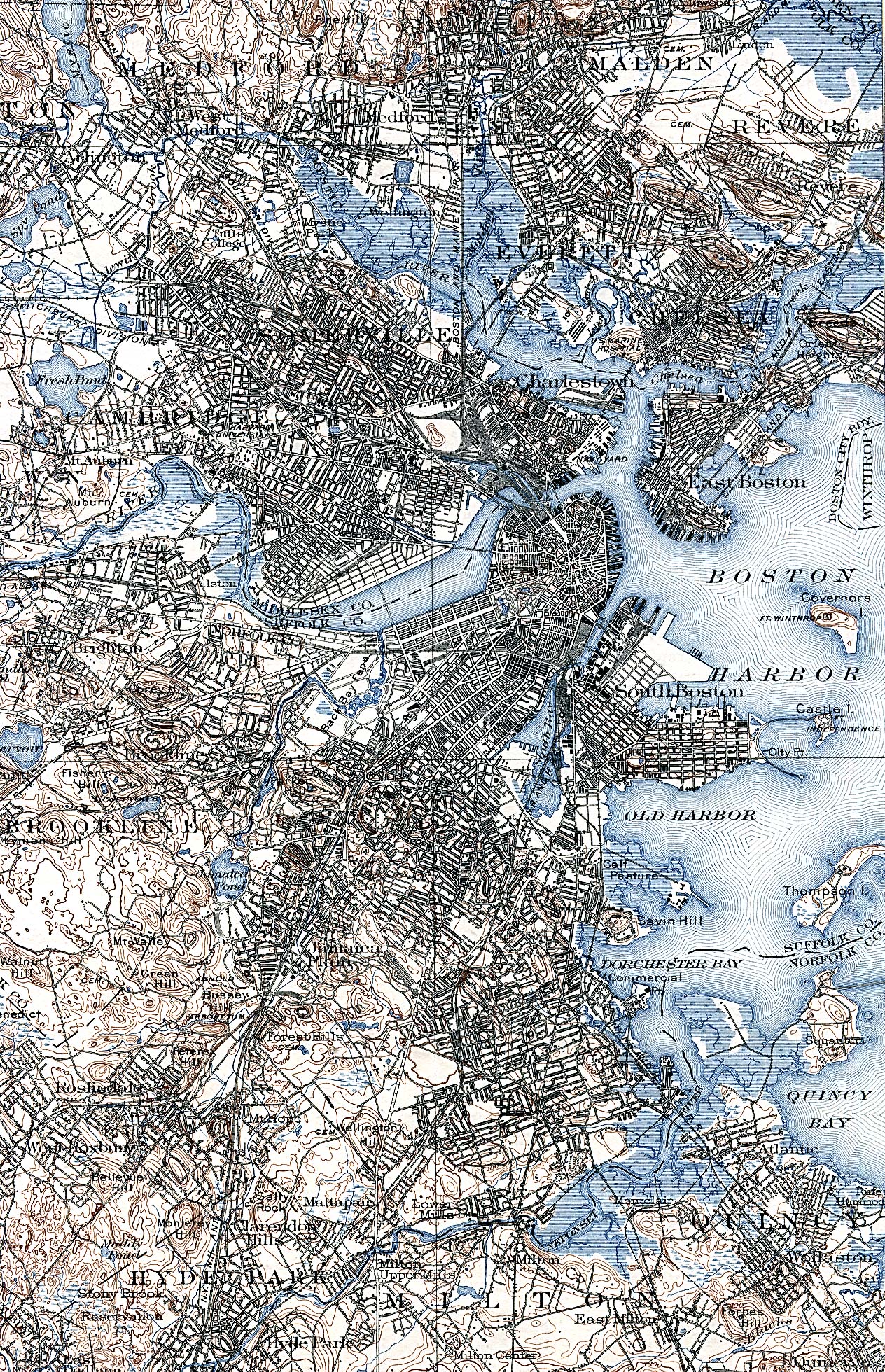
The top of the animation shows the maps after photoshopping to make the land and water more obvious. The bottom of the animation shows the unaltered excerpts of the maps or images.

The panic prone will argue that our Bostonian ancestors dealt with a static ocean, not a rising ocean. Not so fast. Check out the NOAA graph below (click inside graph to see it in context at NOAA site). It shows a sea level rise rate of 2.63 mm/yr for the last 100 years in Boston. At that rate it will rise 23.9 cm (9.4 inches) by 2100.

Boston sea level rise data from NOAA. Click in image for view in context.
Anyone who panics over the IPCCs 100 year projections of rising sea levels does not understand the perseverance and ingenuity of free people. Then there are others, like James Hansen, who enjoy the feeling of panic so much that that they exagerate the probable sea level rise for this century to get their thrills. But that is a story for another day…
So, rather than do his job as he swore an oath to do, rather than correct the science as the law required him to do, despite his having Civil Service protection for his job status to prevent his being fired for doing his job, he stayed quiet.
He lied then when he had to violate the law to do so — and we’re supposed to trust him now?
And, isn’t this the same guy who confessed that he didn’t really have firing authority over Hansen?
The Sydney Opera house is on “reclaimed” land. The Napier Range in the Kimberley was once a coral reef. Tasmania was once joined to the Australian mainland. Sea levels and the land itself can both go up and down. Sometimes you gain land, sometimes you lose it. Sometimes shifting dirt works, sometimes it doesn’t.
In the US the average life span of a building is said to be 22 years. In China, they say 30 years. If a city has to move further inland over a few hundred years. or move its port further out as the sea recedes, it’s no big deal. Cities have even been abandoned in the past, and the world just carries on.
E.M.Smith (14:09:09) : to open a link in a new window (tab), hold CTRL while clicking the link. If your browser doesn’t support this, update it or try Firefox or Google Chrome (both free).
E. M Smith said:
Oh, yeah, that’s possible in Boston. All we’d have to do is bulldoze the city, as the 1900 hurricane destroyed all but a small handful of buildings on Galveston. then we’d need to spend 20 years hauling in soil, jacking buildings up 20 feet to do it.
And, I suppose news from Texas doesn’t get much outside the state, but we learned last year that it didn’t work. Another hurricane scoured a good chunk of the island again. It took down a massive, weather-hardened chunk of the University of Texas hospital on the island, crippling health care and the medical school on the site. Rebuilding is going fast, but it’s a long ways from being done. Insurance rates across the state are rising.
Yeah, we can jack up some of the buildings in small towns like Galveston. But it won’t work against rising seas and more violent storms.
Thanks for the reminder: People who scoff at nature should go check out Galveston today.
DJ you are always reminding us of this warm temperature or that one without ever saying anything about the source, driver, or cause. If you need it, I can supply you with links to sites that provide these explanations. They are rather technical so you may need to book up. You say that April was warm. Okay. Why? You say that we are likely headed for record warm. Once again. Why? What parameters have been and are getting into place that would explain this weather pattern variation?
I don’t get it Ed.. You are talking about rivers. What does that have to do with ocean’s exactly?
But to your point, I am certain that the cost of keeping your feet dry would be far less (world wide) than the cost of Cap’N Trade. If the ocean’s rise even an inch per year (way above current rate), do you think you won’t be able to out run it?
Personally, I am getting sick and tired of hearing this doomsday sea level rise BS (bad science). It’s all bunk!
And a whole lot cheaper and more effective than Cap’N Trade I might add…
Moving cities and people is a whole lot cheaper than Cap’N Trade schemes. People have been moving since the beginning of time. Likewise, if this is such a problem, then why do people (like Al Gore) continue to buy and build on waterfront property? If they are so concerned about sea level rise, that seems rather stupid to me. If sea level is going to rise so much, why bother rebuilding and protecting New Orleans? That also seems quite stupid to me.
I think too many people have been watching too many movies like “The Day After” .. thinking that some huge tidal wave is going to rip through their land in the middle of the night. “Stupid is as stupid does” .. “Your wealth of ignorance is astounding”
Ed Darrell (14:08:27) :
Oh, that’s right — I’d forgotten the Bush administration’s effort to fill in New Orleans and elevate it 20 feet, like the Galveston Islanders did after the 1900 hurricane. /sarc off
All shoreline is above sea level, Mike. When sea level rises, so does the shoreline. It’s the land that gets covered by water we worry about.
Well, you caught me. I should have placed my “/sarc” closer to that statement of the obvious.
My point is that much of the shoreline of the Mississippi and its current delta are threatened by rising ocean levels. Unless one has had to deal with communications, or oil and gas pipelines, or bird conservation, or hunting, or fishing, or keeping one’s house dry, or unless one reads the newspapers, I suppose one wouldn’t know.
You raise a good point in your mention of New Orleans. Yes, it isn’t threatened by rising sea levels, as the Mississippi runs at plus 14 ft at N.O., but rather by poor maintenance of the levees holding back the river and Lake Pontchartrain. This ties in to the Boston, New York, Galveston, and Holland situations in that those efforts against the sea level were made by people and governments that took responsibility for their own fate.
New Orleans’ levees were built by such people, but decades and generations of dependence on others (the Corps, the Feds) led to an indolence that tolerated slacker local and state officials who ignored their own responsibility to maintain the levees.
Had the mayor or governor ever insisted, the Corps would have let contracts for maintenance, but allocated monies went to “other” priorities, other pockets. That’s usually the case in single party states. When the hurricane breached the levees, how quickly the finger pointed to Washington in order to divert blame. The Clinton admin did nothing to insist the the levees be maintained, nor did either Bush one, nor did Reagan nor Carter. It wasn’t their job.
Louisiana has a reform governor now, and the levee problems will have priority.
Unless one has had to deal with communications, or oil and gas pipelines, or bird conservation, or hunting, or fishing, or keeping one’s house dry, or unless one reads the newspapers, I suppose one wouldn’t know.
The oil and gas interests are fully capable and willing to deal with a sea that’s been rising since the ice age. In that, they are quite like the people of Boston, as are the others you mention.
The pace of rise runs about a foot per century. Those unwilling to fight the level change will simple have to move to the next lot inland over their lifetime.
As to reading newspapers, if I were that incurious a person I’d be over on Real Climate instead of WUWT.
Ed may be referring to river delta shorelines, which are indeed expansive along the Mississippi and rise along with sea level.
Fantastic advice! You’re only about 4,000 years late.
Tom in Florida,
It’s not a problem, I do the same thing too. And I am in 100% agreement with your statement: “Can we say ‘thanks and great job’ to Anthony et al too often? I think not.”
Anthony does a most excellent job by providing a site where we can all express our opinions. That’s how we sift out the truth — the same way that detectives arrive at the truth in solving crimes; not just through evidence, but through repeated conversation.
I used to think that CO2 was causing global warming, too. But then I got educated by posters at WUWT.
“Squidly (18:57:11) :
And a whole lot cheaper and more effective than Cap’N Trade I might add…”
Since we will be crushed under the weight of this new tax, perhaps we should call it Cap’n Crunch…
Ed Darrell (19:22:32) :
So the only problem I see is that we need to manage the sediments a bit better… and maybe not build on dynamic alluvial flood plains below / at sea level…
“Fantastic advice! You’re only about 4,000 years late.”
So since we are so late we must obviously bankrupt the world in order to have no effect whatsoever on a beneficial trace gas. Now you’re thinking!!!
No one is arguing to bankrupt the world. That you appear to have such a weak grasp of the issues and the economics only reinforces my perception that denialists will say or do anything, no matter how irrational, to avoid looking at the evidence.
Sure, we can prevent future construction where the waves will get it — but I’ll wager not one out of every 25 AGW ~snip~ favors Coastal Zone Management. After all, it’s promoted by the same people who warn us of the dangers of climate change. Al Gore was a chief proponent. I don’t really expect AGW ~snip~ to go back on their principles at this point and argue for less development in dangerous areas. That would bankrupt some developers (it is claimed)! It’s unfair to underdeveloped nations like Bengla Desh, who could have beachfront hotels in a few years (it is claimed)!
Sure, humans adapt. One of the things Anthony Watts failed to mention is that one of the great fill-ins shown in the animation was done in one day, by the New England hurricane of 1938.
It’s foolish to think we can beat Mother Nature, at least, not without a lot more understanding. That understanding will require study, study ~snip~ don’t want to happen, ~snip~ the denialists ~snip~.
” Mike Bryant (19:31:09) :
Since we will be crushed under the weight of this new tax, perhaps we should call it Cap’n Crunch…”
Try Cap’n Crack, since the money wont be spent on carbon sequestration, but on funding the democrats patronage networks via welfare programs.
To bring the discussion back to Boston. I like to go wade fishing in Boston harbor for striped bass. This requires a certain amount of care and planning since the daily tides average 9.5 feet, with spring tides (that means the sun and moon are aligned, not the season) up to 13 feet. People with property along the water front also have to take into account the Northeasters that hit fairly regularly and bring storm surges of five to ten feet, especially nasty if they come at high tide. (For those of you who have never experienced one, it’s essentially a tropical cyclone parked out in the North Atlantic with wind speeds of 60 to 70 mph.) Weather and tidal sea level fluctuations are far bigger and more dangerous than a slow rise of one foot per century.
E.M.Smith (14:09:09) :
BTW, Anthony, if after the BRACKEThttp=QUOTElinktextQUOTE part of the link, you put QUOTEtarget=QUOTE UNDERSCOREblankQUOTE then the link will open in a new window rather than leaving WUWT. For folks, like me, on slow links; it lets us open the window and leave it loading while we swap back to the WUWT page to keep reading your article… A nice feature (even if it does take a bit more time to type the target=”_blank” part…
Well, if you right click on any link there is the option of opening a new tab, or a new window, so you never lose the current one.
That and the devastating floods of 1927 which left most states along the Mississippi fiscally incapable of rebuilding. Have you ever heard of Boston’s Big Dig?
As disasters get bigger, we need bigger governmental groups to deal with them.
But then, nothing in Boston was done to avoid disaster, and in fact much of the filling in tended to promote environmental disaster (for which all of America pays these days). If you want to make a case that humans can stay ahead of environmental disaster, it seems to me you shouldn’t use landfills, part of which caused environmental disaster, and part of which were caused by weather catastrophe (Deer Island to Deer Peninsula), to make the point. How about talking about an example where humans actually worked to stave off environmental disaster instead?
Boston? Boston??
nothing to it, check out the Netherlands!!!
http://en.wikipedia.org/wiki/Netherlands#Geography
Hey no wonder the sea is rising it is being filled in!
lol
Look who is talking !!
Ed Darrell (20:58:36) :
It’s foolish to think we can beat Mother Nature, at least, not without a lot more understanding. That understanding will require study, study denialists don’t want to happen, study the denialists deny.
Here the world is being stampeded into economic suicide by the supporters of AGW who believe that the tiny contribution of anthropogenic CO2 is beating Mother Nature to heat death, with no need of studies that warmist do not want to happen>
Jumping Jupiter, as they used to say sometime.
Shawn Whelan (13:09:43) :
Just wait till the 1938 hurricane the hit NYC repeats.
Shawn, I’m not sure of the point of your post. The USLHPP boosts its near-term projection by 1 percentage point. Its 50 year projection is above 90% and seems to be based in the logic that “if we didn’t get one this year, then the odds of next year are improved”. That’s the same logic that is making the Pequots and Mohicans wealthy. If New York or New England gets hit by a hurricane this year, are we supposed to repent of our heretical, denialist ways? If we don’t get hit, will Gavin Schmidt and James Hansen come over to the dark side? Do you really think that the 2009 North Atlantic Hurricane Season will be the defining proof/disproof for AGW theory? You might want to consider this post from an ignorant nobody named Ryan Maue:
http://wattsupwiththat.com/2009/03/12/global-hurricane-activity-has-decreased-to-the-lowest-level-in-30-years/
It just ain’t that simple.
DJ (15:29:30) :
200 million people live within 1m of sea level. I wonder how those 200 million feel about your posts.
DJ, cool statistic. Please be kind enough to cite it. I’m constantly on the look-out for reliable sources of information like that. As to how they would feel about these posts….. I wonder how they would feel about being depicted as cringing, helpless victims? By the way, citations for your “near record warm April” and “top 3 warm year” would be helpful. If 2009 is NOT among the “top 3 warm year” will YOU be willing to repent of your troll ways and join the dark side? Didn’t think so. Projections trump observations every time.
“Ed Darrell (20:58:36) :
No one is arguing to bankrupt the world.”
You are correct, they’re not arguing about it, they are simply doing it.
Ed Darrell (21:31:31) :
. . .That and the devastating floods of 1927 which left most states along the Mississippi fiscally incapable of rebuilding.
Bit before my time. Anything in this millennium?
Have you ever heard of Boston’s Big Dig?
Big government project, isn’t it? How’s that working out?
As disasters get bigger, we need bigger governmental groups to deal with them.
I don’t know what environmental disaster was caused by making a causeway out to that island in Boston harbor. Nor do I know of many instances where government is efficient at doing anything, wars and the fire department excepted.
Government does have a propensity to screw things up environmentally, though. DDT bans spreading malaria, water saving toilets that take two flushes, mercury filled cfl light bulbs from China, pregnancy insurance for moi (and at my age!), etc.
This current regime’s insane spending binge will cause many disasters. And won’t do a thing to fix Social Security and Medicare going broke. If government would butt out, both society and the environment would do just fine. The sea level will continue to creep up at 3.2 mm/yr and we’ll just have to fight or get out of its way.
When the sea Quits rising and starts down, then we’ll have the real disaster.
Ed Darrell:
“As disasters get bigger, we need bigger governmental groups to deal with them.”
What a foolish statement.
Galveston, Texas was destroyed by a hurricane in 1901. They didn’t go sniveling to big government like New Orleans did after Katrina, and they quickly rebuilt on their own.
Anyone who believes in big government has the makings of a serf. How does it feel to be a serf, Ed?
Folks, did you know that the sea level of Osaka bay, Japan, has risen by as much as 2.6 m (a bit over 100 inches) in the past 100 years?
http://cais.gsi.go.jp/cmdc/center/graph/kaiiki5.html
Sorry for the caption in Japanese. The graph No. 2415, reached by one or two scrolls, is for Osaka, with a current population of 2.6 million.
Of course the tremendous “sea level rise” has nothing to do with AGW, but almost totally reflects the course of urbanization. Before WW II the ciry was rapidly urbanized and increase in the number of heavy concrete buildings caused ground subsidence. Several years after WW II we were unable to continue that, but thereafter, during the post-war industrialization up to the 1970s, the ground sank again to reach a near plateau, corresponding to the end of substantial urbanization.
Despite such a significant “sea level rise”, nobody worries about some impending disasters, because the important coastlines in Japan, frequently struck by typhoons, have been consolidated with a height margin of about 4 m.
Compared to this, the 9.4 inches as expected (?) by the AGW camp in coming 100 years for Boston would be nothing!