Guest post by Steven Goddard
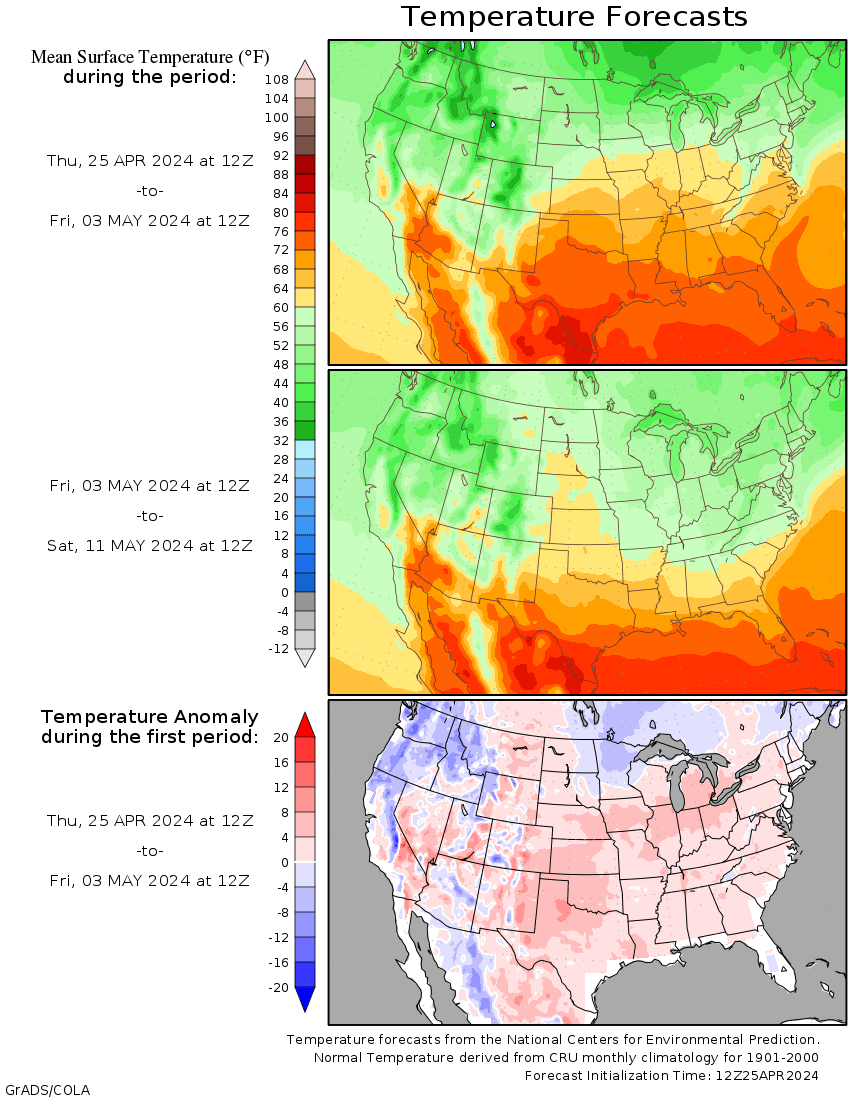
Weather is not climate, but 49 out of 50 states agree – spring is getting off to a cold start.
How will these blue states vote on “cap and trade?” Someone needs to take responsibility for this runaway global warming, which is purported by a top scientist from the University of Colorado to be killing off the ski industry .
Tuesday, December 16, 2008
DENVER – A study of two Rocky Mountain ski resorts says climate change will mean shorter seasons and less snow
Winter 2007-2008 was the snowiest ski season on record in Colorado.
Eight Colorado ski resorts see record snow
Silverton Mountain, which stopped running lifts Sunday, reported the greatest record-breaking snowfall, with 550 inches. Steamboat came in second, with 489 inches.
January, 2008 was the snowiest month on record in the Northern Hemisphere, with nine out of the last eleven January’s above normal.

Source: http://climate.rutgers.edu/snowcover/png/monthlyanom/nhland01.png
So how is the current ski season looking? Wolf Creek ski area in southwestern Colorado has received a paltry 10 metres of snow so far this winter.
Summit Base Depth : 110 inches
Last 24 Hours : 1 inch
Last 48 Hours : 2 inches
Last 72 Hours : 2 inches
Midway Base Depth : 105 inches
Last 7 Days : 20 inches
Latest Storm : 2 inches
Year to Date : 398 inches
with lots more snow on the way.
Accuweather snow forecast for this weekend
But remember – weather is not climate. and computer models should always supersede observation.
Adolfo Giurfa
Costs per kwh are interesting, and debatable. They also change over time with several factors (fuel price changes, plant is paid for, maintenance costs increase, etc).
But, typically we see at the moment that unsubsidized, new, nuclear is the most expensive at 30 to 40 cents, wave is too early to tell (has not yet entered the mass production and economy of scale effects) but will likely come in around 10 to 12 cents, wind is around 4 to 9 cents depending on how steady the wind is, solar may be 20 to 30 cents, natural gas is around 7 to 9 cents (with natural gas at $7), and coal is around 8 cents unless carbon capture and sequestration is required, then it is around 12 cents.
All these are subject to great debate, as I said. The utility or generating plant owner may have higher or lower requirements for borrowing money, debt and equity financing, for example.
I try to use consistent financial criteria, such as capital cost, historic construction time, construction loan interest rate, debt/equity financing ratio, cost of debt (long-term bond interest rate), cost of equity (preferred stock paying a consistent annual dividend), then adjust each technology’s output according to realistic and not optimistic percentages.
On that basis, nuclear generates at around 90 percent on-stream, but cannot follow the load.
Natural gas generates at around 95 percent, but must be reduced as it is one of the few that can follow the load.
Coal runs very high also, at more than 90 percent for a baseload plant.
Solar thermal can only generate around 25 percent, perhaps 40 to 50 percent with thermal storage.
Solar photovoltaics generate only about 25 percent.
Wind in California generates about 25 percent, other areas may have higher or lower depending on the wind.
Wave is expected to generate at around 75 percent, again depending on location.
Ocean current is expected to generate close to 95 percent, but no one really knows yet how corrosion and maintenance will impact that figure.
Geothermal runs at high capacity in California, typically over 90 percent.
Bio-mass power can run at 90 percent or more, and does in California.
I recommend Severance’s paper on nuclear plant costs, and for a methodology for evaluating all power generation projects on a consistent basis.
see This Link
Roger Sowell (and others)
very interesting discussion. thanks
a bit ago there was a mention of micro-nuclear power plants. is there anything more for or against that you could recommend? or I am I just making too much of popular reporting.
@Mark_0454 (18:38:49) :
Any micro-nuclear power plant must be approved and receive a license for construction and operation from the NRC. From NRC’s website,
“The U.S. Nuclear Regulatory Commission (NRC) was created as an independent agency by Congress in 1974 to enable the nation to safely use radioactive materials for beneficial civilian purposes while ensuring that people and the environment are protected. The NRC regulates commercial nuclear power plants and other uses of nuclear materials, such as in nuclear medicine, through licensing, inspection and enforcement of its requirements.”
“The Atomic Energy Act of 1954, as amended, requires that civilian uses of nuclear materials and facilities be licensed, and it empowers the NRC to establish by rule or order, and to enforce, such standards to govern these uses as “the Commission may deem necessary or desirable in order to protect health and safety and minimize danger to life or property.” ”
http://www.nrc.gov/about-nrc.html
Getting a micro-nuke design approved and licensed would take years, if such approval were ever issued, and ensuring the public safety from one of those would pose serious problems. IMHO, about the only good thing about a 1200 MW nuclear power plant is that it is huge, heavy, all in one place, and can be guarded fairly easily. The suitcase-sized micro-nukes are likely never to meet the NRC standards, and as such are very likely just a dream. I may be proven wrong, but nuclear fissionable materials are just too dangerous to ever be allowed to proliferate as micro-nuclear proponents would like.
Come over to Europe – we seem to be having a milder, warmer start to spring.
We’ve had a coolish winter, but 1947 was a very cold one and the summer after was warm and sunny.
Odds on the same happening again?
Roger,
as usual lots of interesting information to digest.
Thanks too for the html primer. I must have a go at bold and italics from your easy link. Lack of time (to find out/understand how) has been a problem but seems easy.
Weather IS climate. Weather pattern variations are the basis of the range of temperature extremes, plus everything in-between, that bracket zonal climate ecosystems. This is why plants are rated for frost and heat kill by climate zone. As long as you buy plants that tolerate your particular weather pattern variation extremes in your climate zone, you have a plant that will survive the 30 or more years that it can live. Why do plants include this information but everyone else says that weather is not climate? Because agriculture understands that weather patterns vary within climate zones, including hitting the extremes on multi-decadal scales. What we grow requires a large initial investment, then yearly costly care, that cannot be redone every few years without us going out of business. I know of several newby farmers that put spring wheat in a notoriously cold wind-swept mesa in Wallowa County. It has frost-killed every year for the past 3 years. Yet they still re-plant. I guess they don’t know that winter red wheat is hardy and is much more suited to our climate zone, especially in open places like flat high mesas. Weather defines climate in agriculture and will always do so.
Anyone who does not know the weather extremes of the climate area they wish to farm is simply playing Russian roulette with their farm investment.
Ellie in Belfast,
Top o’ the mornin’ to you, lassie! (I know, it’s afternoon in the Emerald Isle, but we are still shaking off the early morning freeze here on the Left Coast! )
That little html primer is a gem. I love the words across the top: “Print it, fold it, put it in your pocket.”
Here is another favorite website, for Irish sayings:
http://tacomaweekly.tripod.com/Irish-Quotations.html
Ellie in Belfast,
Just re-read your comments from above. Very astute observations; are you in the energy business? (was going to write “energy field,” but that just does not look right).
Roger, I’m not in the energy business but work on the periphery of it and sometimes know where to put my hands on useful facts. I’ll drop you a direct email with more information if you like.