Guest post by Steven Goddard
Weather is not climate, but 49 out of 50 states agree – spring is getting off to a cold start.
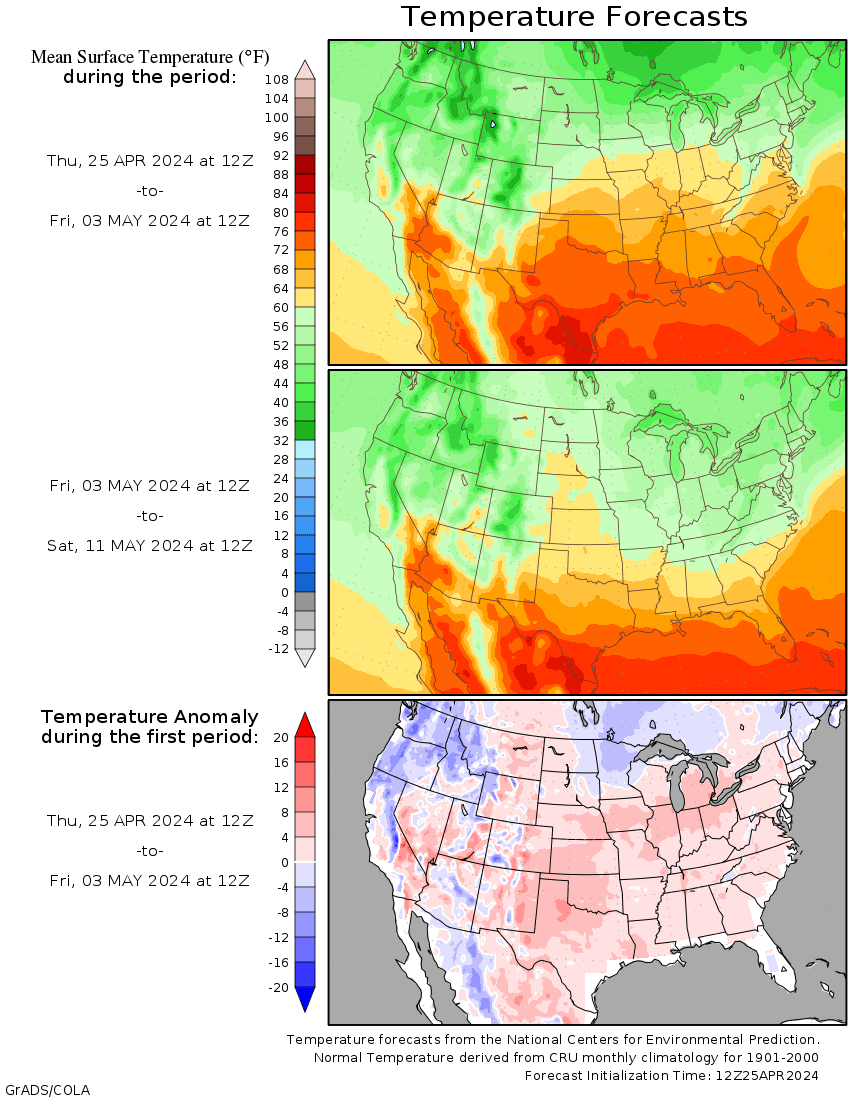
How will these blue states vote on “cap and trade?” Someone needs to take responsibility for this runaway global warming, which is purported by a top scientist from the University of Colorado to be killing off the ski industry .
Tuesday, December 16, 2008
DENVER – A study of two Rocky Mountain ski resorts says climate change will mean shorter seasons and less snow
Winter 2007-2008 was the snowiest ski season on record in Colorado.
Eight Colorado ski resorts see record snow
Silverton Mountain, which stopped running lifts Sunday, reported the greatest record-breaking snowfall, with 550 inches. Steamboat came in second, with 489 inches.
January, 2008 was the snowiest month on record in the Northern Hemisphere, with nine out of the last eleven January’s above normal.

Source: http://climate.rutgers.edu/snowcover/png/monthlyanom/nhland01.png
So how is the current ski season looking? Wolf Creek ski area in southwestern Colorado has received a paltry 10 metres of snow so far this winter.
Summit Base Depth : 110 inches
Last 24 Hours : 1 inch
Last 48 Hours : 2 inches
Last 72 Hours : 2 inches
Midway Base Depth : 105 inches
Last 7 Days : 20 inches
Latest Storm : 2 inches
Year to Date : 398 inches
with lots more snow on the way.
Accuweather snow forecast for this weekend
But remember – weather is not climate. and computer models should always supersede observation.
More O/T
No report for the Caltin crew tonight yet — 10:40 Pacific time.
Usually there is an update on the stats by now.
Roger Sowell (21:30:47) : –
“And wind does and will work. Have a little faith in the engineers!”
I’m not sure what you’re getting at here. I am quite happy to accept that engineers can make wind generation more efficient. However, even the most brilliant engineer in this field can’t make power when there is no wind at all and, at least here in the UK, the coldest parts of winter coincide with large steady high pressure areas sitting over the country.
Whilst I’m not particularly a cheerleader for nuclear energy but baseload has to be supplied from somewhere. Ideally it should come from a variety of sources. However, the problem we have here is that, whilst we are sitting on hundreds of years supply of coal, our government has been taking too much notice of Hansen and seems unwilling to allow us to start replacing our life-expired coal-fired generating capacity. Instead we are putting up gas-fired power stations which leaves us dangerously reliant on imports from Russia to keep our grid alive. If they turn the supply off (and history shows that that scenario is not that unlikely) we could be in trouble without another alternative.
Moderator – This may well get snipped here,but use it if fitting elsewhere
There is an Irish ditty along the lines of:-
“Pity the Englishman’s worship
And his protestations of faith
For the foundation stones of his temple
Are the bollocks of Henry the Eighth”
One might argue the firmness of the foundation stones of AGW relative to this scale
Reply: ‘Bollocks’ doesn’t have the emotional impact in the U.S. that it does in the U.K. Sort of like Fanny being just a woman’s name over here. ~ dbstealey, mod.
Warm=bad, cold=good.
Yesterday I watched a documentary entitled “Global Warming”. They have shown climatic changes throughout the Earth history and somehow managed to link every warming event with mass deaths of species and catastrophs. There was not a single mention of mature thriving under warm climate. There was not a single mention about the possible impact of glaciations or even Snowball Earth on species wellbeing.
When they got to the end of the last ice age (11.500 yrs ago), it was linked to the death of big mammals and woolly mammooths. There was a guy in the cave showing, that the pre-11.500 layers were full of bones and teeth and after there was nothing. And another guy talked about corals growing quicker in the warm periods and showed (IMO quite shamelessly) that in 1725 (LIA, anyone?) the corals grew much slower and implied, that the recent quick growth is a very bad thing… I waited for some more coral info, perhaps about the time of Medieval optimum, but nothing was given.
And as an icing on the cake, there was Lonnie Thompson darkly musing about these pesky Chinese, who abandoned their bicycles and now aspire to drive cars on 6-way highways…
@Tom in Texas (16:19:15) :
“Squidly (14:23:23) : “…temperatures could rise 11 degrees in the next 100 years…”
Was that °C or °F?”
It’s degrees of arc. Al’s always been known to list to port ;o)
As predicted by top scientists, more bad news for the Colorado ski industry due to global warming. After yesterday’s dump, Wolf Creek Ski Area now has received 410 inches of snow with only 10 feet of snow on the ground. Sweltering spring time temperatures are kicking in at 10F (-12C.)
http://www.wolfcreekski.com/snow.asp
We know from official reports that the Arctic melt season has begun at -38C, so imagine how fast the snow must be melting in the Rockies at -12C!
Mr Green Genes (01:17:18) :
“. . . I am quite happy to accept that engineers can make wind generation more efficient. However, even the most brilliant engineer in this field can’t make power when there is no wind at all and, at least here in the UK, the coldest parts of winter coincide with large steady high pressure areas sitting over the country.”
My experience with wind and other renewables is that each has its place, each has a degree of reliability. With proper storage, wind can be made reliable for a few days; with longer storage increasing the average cost. On another thread, I advocated for wave power and ocean current power for the U.K., as there is plenty of both and they are much more reliable than wind.
As for natural gas dependency, has U.K. considered importing LNG, from various countries? If it were up to me, I would not rely on one foreign source of energy, even if it is cheap and convenient via pipeline.
The proper solution (IMHO), is to elect MPs who will promote coal.
“I am quite happy to accept that engineers can make wind generation more efficient. However, even the most brilliant engineer in this field can’t make power when there is no wind at all and, at least here in the UK”
That is one of the problems. The other problem is that the estimated energy potential has been hyped beyond all possible reality by the wind power advocates to the point where most wind generation hasn’t approached even 10% of promoted “potential”.
Notice that you can not find figures for actual wind generated kilowatt hours anywhere. You CAN fund numbers for “capacity” installed. But the “capacity” numbers have been inflated to garner support for the projects and are falling well short of those numbers in actual generated power.
If you are going to start pumping water around, people are going to start to rely on that supply. If people are relying on the supply you need a reliable way to provide it. Wind is not reliable.
I could provide a reasonable estimate of what grid demand for power is going to be next Thursday at 3pm. I can NOT give a reliable estimate of what wind generation will be providing next Thursday at 3pm. I can give an estimate of the nuclear generation next Thursday at 3pm. Wind can never be relied upon to give any predictable amount of energy to the grid at any specific time. Wind is a “nice to have” addition to the grid when it is available that can allow us to reduce fossil fuel use when it is available but it is not a replacement for the fossil fuel plants that must still be available when wind is not.
How many windmills does it take to power a single electric steel mill?
Mr Green Genes (01:17:18) :
Actually wind does work well in the UK, it is just that we tend to pay attention more to the (all too rare) times when we have calm high pressure and the blades are not turning. The wind maps (speed, frequency) for UK and Ireland that the wind industry uses (and on which the finance of each project is based) show just how much time you can expect good levels of power and that is a very high % of the time in the UK.
Rodger is also correct in advocating increased gas use for the UK. At the moment we have more energy than you would suppose being generated from landfill gas and sewage gas. Biogas is set to joint these in the coming years (again more is possible than you would think). At present these renewable gases generate electricity directly, but are compatible with LNG after upgrade. Direct use in fuel cells is also possible, which will increase efficiency of production. Wave turbines and marine currents are set to become big.
In Ireland where there is high agricultural production we have the potential to generate 20% of current (non-transport) energy needs from biogas, even without growing energy crops. Another point too is that the feedstocks for biogas production are currently wastes which if we do thisngs wrong, we will end up injecting energy into their treatment instead of using a net-energy-positive process such as biogas.
Wow this is working into a monster storm. Here in East Nebraska we have winds from the East averageing in the 20mph range and some gusts hitting 60. I was looking at the map and noticed that this stom has 4 total fronts, and it apears to have a second swirl like there was a second smaller low pressure system nestled into the first.
http://www.weather.com/maps/maptype/currentweatherusnational/index_large.html?from=hp_main_maps
I did save the picture and I imagine the link will change over time
Just to aid in answering my question above:
Nucor (used to be Nuclear Steel Corp) uses electric furnaces exclusively and is the largest steel producer in the United States.
One plant would require a minimum of 200MW of power 24×7. (1,747,200 MWh per year … almost two billion kilowatt hours. I still can find no documentation of actual power generated by wind. I can find articles that tell how much “capacity” is installed, how many kilowatt hours are “estimated” to be produced in the future … but ACTUAL generation numbers seem to be a closely guarded secret. I wonder why.
Roger Sowell (09:04:51) :
“My experience with wind and other renewables is that each has its place, each has a degree of reliability. With proper storage, wind can be made reliable for a few days; with longer storage increasing the average cost. On another thread, I advocated for wave power and ocean current power for the U.K., as there is plenty of both and they are much more reliable than wind.”
Very true – the river Severn for example has one of the largest tidal differences in the world. Unfortunately the same people who argue against almost any kind of development of alternative energy sources also argue against harnessing this as it may have an adverse impact on wading birds etc.
“As for natural gas dependency, has U.K. considered importing LNG, from various countries? If it were up to me, I would not rely on one foreign source of energy, even if it is cheap and convenient via pipeline.”
Recently the first major shipment of LNG came into port, to a chorus of disapproval from … guess who – see above!
“The proper solution (IMHO), is to elect MPs who will promote coal.”
We have many MPs (particularly in the governing Labour Party) who, one might consider, should be supportive of a thriving domestic coal industry. Sadly, they have more interest in toeing the party line and keeping their jobs than in doing the right thing. Also, of course, successive governments have handed over more and more of our decision making powers to an unelected dictatorship (aka the European Union) which certainly doesn’t have our national interests at heart.
PS If I could only master the art of italics on here this would be a whole lot easier to read, so apologies to all.
“we have the potential to generate”
And I say those “potential” numbers are bogus. I am not aware of a single “potential” number that has proved out in practice.
Ellie in Belfast (10:12:48) :
I’m sorry but I simply do not buy your argument about wind power. The point I was making is that the times of high pressure in the winter are the times when the temperature is at its lowest and therefore when the power demand is at its highest.
Having considered further though, and taking Roger’s point about engineers in particular, if those guys could crack the storage issue, that would definitely make a difference. Moving lakes works – we should do more of that for example, but there will, I’m sure, be a more efficient solution along before too long.
As for gas – you’re right of course, it’s just that we in the UK don’t actually do much of that. In fact we don’t seem to do much of any of the other things you mention, all of which are good. We simply sign more contracts with foreign governments to import more energy, thus putting us in more peril for the future.
Ok, best I can find so far … US has 9,149 MW installed capacity. Actual generation is between 10% and 35% of capacity. So erring on the optimistic side, we are looking at about 3,202 MW of actual generation while the best actual numbers I have seen are closer to 10% or 915MW … so all the wind power in the US replaces the output of 1 or 2 coal power plants.
“California continues to face snow shortage:”
Roger,
The way I understand it, even if California had adequate snowpack, they do not have enough catchments and reseviors to store the extra water -much of the snowmelts will end up in the Pacific. The Greenies have made sure of this.
Also, Senator Boxer and Feinstein have put the kabosh on using the Mohave for solar panels and windmills. So much for alternative energy. Hope there are not any heatwaves in Cali this year.
The Left does a lot of talking, not much else.
crosspatch,
Some hard numbers on wind are available from California:
This shows 6,802 GWhrs in 2007 (works out to roughly 25 % of installed capacity running 24/7)
http://energyalmanac.ca.gov/electricity/total_system_power.html
The percentage is expected to increase as new technology replaces the old, probably maximizing at around 35 percent of capacity. That all depends on the wind, though.
Offshore Corpus Christi, Texas, the generation as percent of capacity is likely to be more than 50 percent. That wind is very steady.
Also, the US Dept of Interior, Minerals and Mining Service (MMS) is to offer leases for wind, wave, and current power systems in the Outer Continental Shelf. Their current assessment shows there is a great amount of power available from these renewables:
MMS has not published the potential for power generation due to ocean currents, but states the greatest potential is 8 miles off the coast of Miami, FL, in the Gulf Stream. That ocean current is huge, consistent, and we have the technology. Companies are jumping at the chance to bid on those leases.
see pg. 13 of This document
Mr Green Genes,
I too had trouble with italicizing, so perhaps this may help.
Type (without the spaces and “then”) before the italicized portion, then to close, type .
Can also do bold by substituting b for i.
I agree that tidal power systems are blocked by the enviros, but ocean current and river current systems are gaining traction. We have river current systems underway in New York, I believe in the Hudson River.
Mr. Green Genes,
LOL… that did not work! re the italicizing and bold.
maybe this link will explain better: (see Physical styles)
http://www.w3schools.com/html/html_quick.asp
Mr Green Genes, you are absoulutley right that calm days are a problem especially in winter, however they are less of a problem than most people imagine simply because extended periods of completely calm weather are quite rare in the UK. Averaged over 10 years calm days are about 8% in the south west, less in the north. October to March provides 60% of the wind.
Grid management and the generation mix for the future will be very different, and yes there will have to be spare capacity for those cold calm days, however I think this is percieved to be more problematic by those who don’t realise the current power difficulties we live with everyday in some parts of the UK where the grid and transmission system requires updating too.
Crosspatch:
Wind turbines are designed to reach rated power (installed MW) at a hub height wind speed of 12-18 m/s (33-40 mph). The percentage of continuous output at maximum capacity actually achieved (capacity factor) for UK wind projects is typically about 25-35%. Figures of approximately 35-40% are achievable on some offshore sites and in exposed UK northern locations.
JPK (11:20:35) :
The subject of new dams in California is given much study, and apparently there are few suitable canyons available that can be dammed and used as lakes. The ideal canyon is deep and wide, with a narrow mouth, and extends for miles.
Hence, my proposal to pump water from the Missouri River and Mississippi River during spring flooding, uphill and into the Colorado River tributaries. The existing lakes Powell and Mead can store a lot of water, and generate power when the water is released.
Even without the Mojave desert, there is a lot of land available for solar power plants. There are two other major wind corridors in Altamont Pass, and near Palm Springs. Tehachapi is near Mojave, but it is unclear to me how much of that is off-limits to windmills.
Our last critical heat wave was Sept 2 and 3, 2007. We were lucky, as that was Labor Day weekend and the system made it through ok. Had that been on normal work days, we would have had trouble. Since then, the weather has cooperated, and we have built more power plants. We are in pretty good shape for this summer, according to our utility planners. Also, the recent rains and snows in the Northwest have added to the hydroelectric availability, from where we import power.
The situation in three or four years may be grim, though, given a new development in obtaining permits to build new power plants. A state judge ruled late in 2008 that the pollutant permit system is invalid in the Los Angeles area (SCAQMD) and new power plants are on hold until this is resolved. The case is being appealed, and new legislation will be introduced to allow critical public services to be constructed.
The greenies are livid. Their attorneys (NRDC, National Resources Defense Council) filed the lawsuit; while they are ecstatic that they won, they are plenty unhappy that the realists are appealing and seeking legislative solutions. NRDC also filed a similar lawsuit in Federal court, and that one has not been decided.
Roger Sowell (11:54:07) :
Mr. Green Genes,
LOL… that did not work! re the italicizing and bold.
maybe this link will explain better: (see Physical styles)
You mean like this, I hope.
(Mods, please feel free to delete, I’m just testing)
Roger, many thanks.
There is a great deal of weather information on:
http://www.skitiger.com/
This site compiles and updates weather and snow conditions form ski areas in western states from the Rockies to the Pacific and BC and Alberta. Check it out.
Mr. Green Genes,
You are welcome. Smokey and E.M.Smith and others showed me how to do this stuff a few months ago when I first discovered WUWT. Happy to pass it on.
Roger Sowell
What about the comparative cost per kwh?, What about the replacement of thousand of spare parts for those “windmills of your mind”?
I think we should have to send the “El Quijote” to fight against those windmills.:)