Guest post by Bill Illis
We have often wondered what really causes the El Nino Southern Oscillation (ENSO) climate pattern. It is generally understood and this post will demonstrate that it is really driven by the Trade Winds over the ENSO region.
The Trade Winds blow East to West at the equator. Most of us living in other latitudes expect the wind and the weather to primarily come from the West but, at the equator, the weather comes from the East.
When the Trade Winds are stronger than average for a sustained period of time, the Trades literally blow or drag the warm surface water across the Pacific and it is replaced by colder upwelling ocean water from below. If the Trades are strong enough for a long enough period of time, we have a La Nina.
When the Trades are weaker than average for a long enough period of time, the ocean surface stalls in place and gets heated day after day by the equatorial Sun and we have an El Nino. Sometimes, this stalling even results in warmer ocean water from the Western Pacific moving backwards into the Nino region and this also contributes to El Nino conditions.
Let’s look at the data to see how true this assertion is.
Here is a chart of the Nino 3.4 region temperature anomaly (which is the most consistent measure of ENSO conditions) versus the Trade Winds from 120W to 175W. The Trade Wind data is for 850 MB pressure or about 3,000 feet.

Click for a larger image
To see this correlation a little better, I’ve reversed the sign so that weaker Trade Winds are shown as positive values and stronger Trade Winds are shown as negative values. I’ve reduced the anomaly in meters per second by half as well so the scale is roughly the same as the ENSO.

Click for a larger image
I can’t imagine seeing a better explanation of what drives the ENSO than this.
For some perspective on the Nino regions and the latitude, longitude figures in question here, this is a map of the region produced by the Climate Prediction Centre.

I think you can see this impact in action if you watch an animation of the ENSO region over time. Let this SST anomaly animation load up, then speed it up as fast as your computer will allow and you can see the Nino region waters and temperature anomalies literally move across the Pacific with the Trades.
http://www.osdpd.noaa.gov/PSB/EPS/SST/anom_anim.html
But what drives these Trade Winds? I don’t really have an answer for that question.
The Southern Oscillation Index (SOI) was previously used as an indicator of these winds over the Nino regions. The SOI is a measure of the difference in air pressure between Tahiti and Darwin, Australia. The theory being that high pressure blows toward lower pressure which can provide some indication of the Trade Winds in the Nino region. There is certainly a correlation of this measure to the Nino 3.4 anomaly. In fact, the measure even lent its name to the ENSO.
I’ve found, however, the SOI consistently lags a little behind the Nino region temperatures and the Trade Wind measures so I believe it is more a result of the overall climate pattern rather than a leading indicator. I’ve also found no real correlation to the Pacific Decadal Oscillation or any of the other Oscillation Indices which are sometimes used to predict or measure the ENSO.
There is one leading indicator, however, which provides some predictive power – the Trade Winds just to the West of the Nino area. These Winds are, most often, concurrent with the Nino region Trade Winds but occasionally, they provide a ramp-up which might kickstart the ENSO. The West Trade Winds were a leading indicator of the Super El Ninos of 1982-83 and 1997-98 for example.

Click for a larger image
Unfortunately, I don’t know what drives these Western Trade Winds either, but they are currently pointing to a strengthening of the La Nina conditions which currently exist.
I also wanted to show more closely how the ENSO impacts global temperatures.
The warm or cold ocean conditions of the ENSO eventually impact the Tropics troposphere temperatures and this seems to be quite a direct impact with a lag of 2 to 3 months.

Click for a larger image
The Tropics temperatures then propagate out to the rest of the world with a small lag that may be up to 1 month but is more commonly concurrent with the Tropics anomalies.


Click for a larger image
The Trade Winds drive the ENSO, and the ENSO directly impacts the Tropics temperatures and the Global temperatures.
Who would have thought that Winds in some small region of the Globe could be so important. You can keep track of these Trade Winds on a daily basis at the Climate Prediction Centre.
http://www.cpc.ncep.noaa.gov/products/precip/CWlink/daily_ao_index/zw/zw.obs.gif
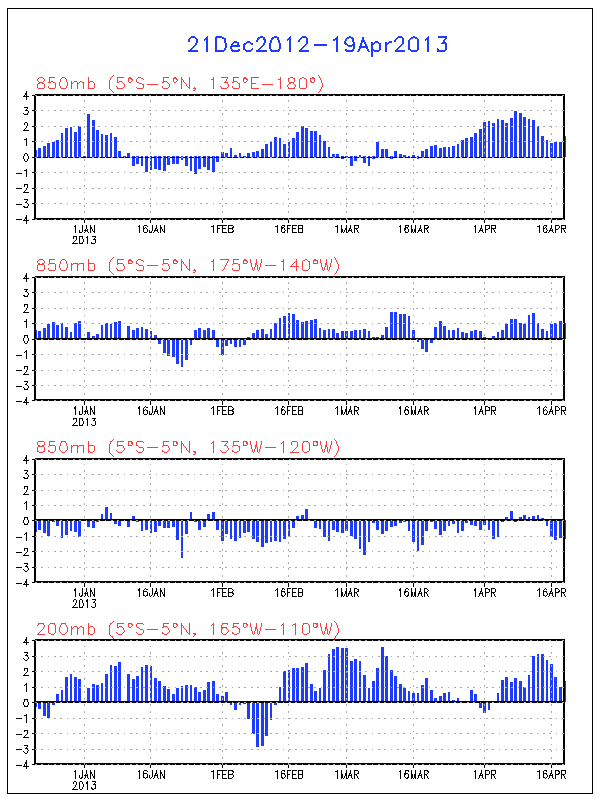
So, I think that provides a nice perspective on the ENSO.
The data used in this post can be obtained here.
http://www.cpc.ncep.noaa.gov/data/indices/
http://www.cpc.ncep.noaa.gov/data/indices/sstoi.indices
Gary, thanks for the info.
Tallbloke,
“I estimate that would be at 11,000-20,000ppm”
Hmmm… but we don’t have enough fossil fuel reserves to come close to that amount of atmospheric CO2. I don’t have time to look at Bill Illis’ link right now, but I will. Thanks for your insight.
The Stratosphere has started cooling rapidly now after the record Warming event.
From the blue blob on the right of this time series all the way to the top, temps are now well below normal for this time of year. While the big red/brown blob on the left in January recorded the event.
http://www.cpc.ncep.noaa.gov/products/stratosphere/strat-trop/gif_files/time_pres_TEMP_MEAN_ALL_NH_2009.gif
The high stratosphere temps are now closing in on record low temperatures.
http://www.cpc.ncep.noaa.gov/products/stratosphere/temperature/02mb9065.gif
What an up and down for the 10 hpa level.
http://www.cpc.ncep.noaa.gov/products/stratosphere/temperature/10mb9065.gif
The surface was not affected by this event very much. It appears there was some slight warming during the event at the surface (the red/brown blob at the 1,000 hpa surface level in the timeseries map above which is unusual for January but common during the SSW events.
The troposphere was also affected more than the surface during the SSW. Going by the impact of these events historically, there will now be some cooling in the northern mid-latitudes for about 6 weeks at the surface.
tallbloke (12:38:29) :
No, the response is logarithmic, the first 20 parts per million co2 accounts for about half it’s effect. Every time it doubles, the amount of extra heating it causes drops.
Leif Svalgaard estimates another 5-6 doublings would lead to another 5-10 degrees centigrade. I estimate that would be at 11,000-20,000ppm or 1-2%co2
check your math, you are off by a zero or two. My estimate is empirical: when the CO2 concentration was 30-50 times [32 is 5 doublings, 64 is 6 doublings] higher than today, the temperature was 5-10 degrees higher.
Energetic particle precipitation effects on the Southern Hemisphere
stratosphere in 1992–2005
Randall et el 2007
[1] Measurements from several different satellite instruments are used to estimate
effects of energetic particle precipitation (EPP) on NOx (NO + NO2) in the Southern
Hemisphere stratosphere from 1992 to 2005. The focus is the EPP Indirect Effect
(IE), whereby NOx produced in the mesosphere or thermosphere via EPP (EPP-NOx)
descends to the stratosphere during the polar winter, where it can participate in
catalytic ozone destruction. EPP-NOx entering the stratosphere is found to vary in
magnitude from 0.1 to 2.6 gigamoles per year, with maximum values occurring
in 1994 and 2003. The interannual variation correlates strongly with several measures of EPP activity, including auroral and medium energy electron hemispheric power, and satellite measurements of thermospheric NO. This represents the first estimation of EPP-NOx contributions to the stratospheric odd nitrogen budget using observations over an entire solar cycle. The results will be useful for evaluating and constraining global models to investigate coupling of the upper and lower atmosphere by the EPP IE, including any influences this might have on ozone trends and possibly on climate.
Key Extracts
1 )Energetic particle precipitation (EPP) has long been known to cause increases in NOx (NO + NO2) in the high latitude mesosphere and thermosphere via a cascade of dissociation, ionization, and recombination processes [e.g., Thorne, 1980; Rusch et al., 1981]. In the sunlit middle mesosphere and above, NOx has a lifetime of days or less. In the lower mesosphere, however, and during the polar winter throughout the mesosphere and into the thermosphere, lifetimes are long enough that there is sufficient time for the NOx to descend to the stratosphere where it can participate in catalytic processes controlling ozone. This mechanism for coupling the upper and lower atmosphere, referred to here as the EPP Indirect Effect (IE),
2) Two-dimensional model results of Callis et al. [1998b] suggested that variations in stratospheric NO2 measured by the Stratospheric Aerosol and Gas Experiment (SAGE) II from 1985 to 1987 were due to variations in EPP effects, and that the EPP IE causes changes in stratospheric O3 that are of the same magnitude as variations caused by solar UV flux variations. Randall et al. [1998, 2001] presented evidence from the Polar Ozone and Aerosol Measurement (POAM) II and III instruments for stratospheric O3 reductions caused by the EPP IE, showing depletions of 40–45% in middle stratospheric O3 mixing ratios.
EPP IE variations do not occur smoothly over the solar cycle, nor are the maximum and minimum IE separated by a typical solar cycle period. Thus the EPP IE cannot be consistently referenced to the solar cycle. The EPP IE interannual variability correlated very well, however (correlation coefficient of 0.85–0.90), with auroral and medium energy hemispheric power, and with column NO measured by the SNOE satellite instrument from 97 to 150 km. As discussed by Kozyra et al. [2006], the EPP IE variability described here is likely related to the occurrence of high-speed solar wind streams [see also Callis et al., 2002].
The most important attribute of changes in the Ozone column are the second order effects such as CH4 reduction. eg ipcc CHAPTER 7
“The observed decrease in stratospheric ozone and the resultant
increase in UV irradiance (e.g., Zerefos et al., 1998; McKenzie
et al., 1999) have affected the biosphere and biogenic emissions
(Larsen, 2005). Such UV radiation increases lead to an enhanced
OH production, reducing the lifetime of CH4 and influencing
tropospheric ozone, both important greenhouse gases
Due to decrease of stratospheric O3, ultraviolet radiation in troposphere increases => increased OH
Crutzen, 1995.
An important atmospheric sink for methane is the OH (hydroxyl) radical. The reaction of methane with OH radicals is the first step in a series of reactions which eventually leads to compounds that are readily removed from the atmosphere by precipitation or uptake at the surface. OH radicals also act as a chemical sink for other trace gases. For this reason, OH radicals are known as “the detergent of the atmosphere
Leif,
A query if you please
Looking at the data at http://hirweb.nict.go.jp/sedoss/solact3/do?d=2009%2c01%2c01
Which, if any, best reflects the impact of coronal holes. Is it the solar wind velocity?
Bill Illis (14:02:35) :
70hPa temperatures over the Arctic are have just fallen below the point where record maxima are seteach day.
http://www.cpc.ncep.noaa.gov/products/stratosphere/temperature/70mb9065.gif
70hPa temperature over the Equator is plumbing the depths:
http://www.cpc.ncep.noaa.gov/products/stratosphere/temperature/70mb2525.gif
Is there an explanation for this contrasting behaviour in the literature anywhere?
maksimovich (15:16:46) :
Thanks for filling in the details as below:
The EPP IE interannual variability correlated very well, however (correlation coefficient of 0.85–0.90), with auroral and medium energy hemispheric power,
the EPP IE variability described here is likely related to the occurrence of high-speed solar wind streams
“The observed decrease in stratospheric ozone and the resultant
increase in UV irradiance (e.g., Zerefos et al., 1998; McKenzie
et al., 1999) have affected the biosphere and biogenic emissions
(Larsen, 2005)
Due to decrease of stratospheric O3, ultraviolet radiation in troposphere increases.
Ozone loss in the stratosphere and the consequent increase in penetration of UV into the upper troposphere tends to reduce the differential between the atmospheric pressure in the stationary high pressure cell East of Chile and the low over Indonesia tending to move the atmosphere towards a constant El Nino orientation.
Here is the high pressure cell off Chile: http://www.ecmwf.int/products/forecasts/d/charts/medium/deterministic/msl_uv850_z500!Wind%20850%20and%20mslp!168!South%20America!pop!od!oper!public_plots!2009022100!!/
And a nice overall view of southern hemisphere synoptics that in their variation will determine the strength of the Easterly winds:
http://www.ecmwf.int/products/forecasts/d/charts/medium/deterministic/msl_uv850_z500!Wind%20850%20and%20mslp!168!South%20hemisphere!pop!od!oper!public_plots!2009022100!!/
Bill Illis (07:05:33) : I see from what you say that you are a sceptic. That’s healthy.
“The ENSO is only lightly correlated with Southern Hemisphere temperatures (you might not have heard that one before).
The ENSO has 10 times bigger impact on the Northern Hemisphere than the Southern Hemisphere and 20 times the impact in the Tropics than in the Southern Hemisphere.
I guess that makes sense since the ENSO is a Tropics phenomenon and the ENSO / PDO system are mainly a northern Pacific phenomenon.
Another little piece of the puzzle.”
Reasons for this:
Although I talk of the high pressure cell off South America as the origin of pressure differences you will see that there are plenty of high pressure cells in the subtropics of both hemispheres. The one off California seems to have a very strong influence as well and yes, the variability in sea surface temperature in the northern tropical Pacific is more extreme than the variability to the south. Each of the northern oceans is a closed loop returning waters to the equator for further warming. By contrast , the southern ocean is very large, Antarctica is a countervailing sink of cold that cools as the tropics warm and there is no closed loop. In addition much of the Equatorial flow from both hemispheres is diverted northwards due to the configuration of the continents. It is no accident that the North Pacific and North Atlantic seem to be the cockpits for climate change. It’s no wonder that the PDO manifests as strongly as it does.
SorenF (13:29:21) :
Indeed the cause of these mid winter warmings is a puzzle. One thing I note from my reading of Labitzke and van Loon is that the westerlies can not enter the vortex zone and tend to be driven into the stratosphere which is at 6km or less in the winter hemisphere. In the process they may entrain some high ozone content air from the lower stratosphere. As that air ascends it will be strongly heated so long as it is outside the dark zone. There are two locations where ozone tends to concentrate. One is over the Kamchatka peninsula and Sea of Japan where 30hPa temperatures are anomalously high all winter and in the southern hemisphere there is a zone between Australia and Antarctica. In the Antarctic animation that is where the warm air sits at the start of the process.
However, the strong fall in temperature throughout the stratosphere over the Equator that accompanies these winter events over the poles points to a solar influence. I hypothesise a wholus-bolus shift in the atmosphere, thinning it over the winter Pole and thickening it over the Equator. I think a Coronal Hole might do that.
erlhapp (16:02:34) :
Which, if any, best reflects the impact of coronal holes. Is it the solar wind velocity?
I don’t know what you mean by the ‘impact’. If you mean on the Earth, then the Ap, Kp, or similar indices [after you remove the sporadic storm component, if you know how to – the Dst index might be a part of that] best measures the ‘impact’.
Otherwise, a coronal hole would produce a high solar wind speed and [often a high total magnetic field]. If you are looking at a ‘single’ indicator [and don’t want to be bothered with messy reality] it would be the solar wind speed.
To erlhapp,
There are a few papers on these Sudden Stratospheric Warming events but there isn’t many since each one of these events seems to have different impacts to none whatsoever. But they are more common that some of us (including me) understood originally.
How about 2008 when there 4 of them.
http://www.cpc.ncep.noaa.gov/products/stratosphere/strat-trop/gif_files/time_pres_TEMP_MEAN_ALL_NH_2008.gif
My understanding of the issue comes mainly from a UK weather board where there are a lot of experts on the weather (have you noticed that the internet discussion boards and blogs are creating a huge number of layman PhDs in just about every single issue there is in the world – from knitting to particle physics).
http://www.netweather.tv/forum/index.php?s=ae0f3625dc994413105ec3dc8f304679&showtopic=50299
To tallbloke and Leif Svalgard,
I previously built another chart which shows the temp impacts over a greater CO2 range which will probably help.
http://img440.imageshack.us/img440/3291/co2tempgeotnc8.png
erlhapp (16:37:13) :
I hypothesise a wholus-bolus shift in the atmosphere, thinning it over the winter Pole and thickening it over the Equator. I think a Coronal Hole might do that.
No, there is no mechanism for doing this, and the energy isn’t there either. Remember the solar wind impacts the Earth with the force of one BigMac w/Fries every second, and even less during a coronal hole [the speed may be high but the density is way down, so the total mass flux is smaller].
To erlhapp,
On the ENSO and why it affects the Northern Hemisphere more than the Southern Hemisphere,
I think Bob Tisdale nailed it down in a post he did today. Read my comment as well.
http://bobtisdale.blogspot.com/
Leif Svalgaard (17:12:51) :
Sorry, I will try to be more specific. Recent work suggests atmospheric inflation related to coronal hole passes. Inflation is linked to muon counts and sudden stratospheric warmings. Muon counts increase as density falls. UV penetration should also vary with muon counts.
What in your view is the consequence for atmospheric dynamics of the passage of a coronal hole in earth facing position and could the current state of the sun be expected to support phenomena of interest.
Erlhap,
About 35° of latitude marks the boundary between energy gain from short wave incoming radiation exceeding energy loss from outgoing long wave. There is an accumulation of energy in the tropical ocean and to a lesser extent in the atmosphere at lower latitudes. This is transported to higher latitudes. Without this transfer latitudes greater than 35° would be much colder, especially in winter and the tropics would be rather hotter.
The 18.6 year Lunar tidal oscillation produces a “standing wave” pattern (with a peak to peak height ~ 16 mm) in the Atlantic and Pacific oceans that has nodes at +/- 35 degrees of latitude and anti-nodes near +/- 70 to 90 degrees and on the Equator.
This global tidal “standing wave” leads to a long term disspation of tidal power of ~ 1 terra Watt which is sufficent to provide about 1/2 of the total power needed to drive the up welling of cool water from the deep oceans.
This is more than sufficient reason to propose that it is a tiidally driven PDO that is reinforcing the shorter term ENSO.
lgl (05:13:15),
The Earth’s LOD is also influenced by the gravity of the Moon, Jupiter and Venus.
If you can wait for our Russian paper to come out in the next few months, you will see that we have addressed the very important points that you have made about long-term (billions of years) influnece of the Jupiter and Venus on the shape of the Lunar orbit and how this indirectly affects the long term effects of changes in Lunar tides upon theh Earth’s oceans.
Bill Illis (17:24:40) :
Those 1998 Arctic warmings were also associated with cooling in the Equatorial stratosphere as you see here:
http://www.cpc.ncep.noaa.gov/products/stratosphere/strat-trop/gif_files/time_pres_TEMP_ANOM_ALL_EQ_2008.gif
So this is a consistent phenomenon.
Thanks for the netweather site and reference to Bobs observations. I will follow up.
If there is a closed circulation in the Pacific the shape of South America tends to make the Atlantic a closed loop too with all the Southern Hemisphere water finishing up in the Gulf of Mexico along with the North Atlantic circulation. Bob’s post shows the result in terms of accelerated temperature increase.
There is a big accelerator factor going up but it applies equally on the way down.
Leif Svalgaard (17:32:06) :
What else could explain the pattern whereby the equatorial stratosphere cools as the polar stratosphere warms.
erlhapp (18:25:11) :
Recent work suggests atmospheric inflation related to coronal hole passes.
I wish you would use words that I can understand. I’m sure the papers did not not the word ‘inflation’. Perhaps you mean the increased height of the upper atmosphere.
Inflation is linked to muon counts and sudden stratospheric warmings. Muon counts increase as density falls. UV penetration should also vary with muon counts.
This muon count is a red herring, if there ever was one. It simply means that the mouns have to travel a bit longer if the temperature is higher and the upper atmosphere is more extended. Since the muons have a very short lifetime more decay during the longer travel, so the muon count can be used to measure the temperature in the upper atmosphere, but has otherwise no significance.
What in your view is the consequence for atmospheric dynamics of the passage of a coronal hole in earth facing position and could the current state of the sun be expected to support phenomena of interest.
Coronal holes have higher solar wind speed and create geomagnetic activity, so Ap [and other indices] and POES particle precipitation will be higher. This affects the termosphere and the upper mesosphere, but not much else. The UV [and Xrays] and ozone production will be down when we are looking into a dark coronal hole. Cosmic rays are not affected, because the CRs depends on an average over the whole heliosphere over about 6 months.
erlhapp (19:13:25) :
What else could explain the pattern whereby the equatorial stratosphere cools as the polar stratosphere warms.
You have not explained anything, just posited something. If you actually had a viable explanation, who would object?
Bill and Leif,
Icecap has published the following article:
Feb 20, 2009
Satellite Data Show No Warming Before 1997. Changes Since Not Related to CO2
By Arno Arrak
He he makes the following statement:
“Satellite records show that global temperature does not vary randomly but oscillates with a peak‐to‐peak amplitude of 0.4 to 0.5 degrees Celsius and a period of three to five years about a mean value that remains constant. Examination of land‐based data indicates that such temperature oscillations have been active, with some irregularities, as long as records have been kept.
The mean temperature about which these oscillations swing remained the same during the eighties and nineties, showing absence of global warming for this period. But simultaneous land‐based measurements
(HadCRUT3) show a warming of 0.2 degrees Celsius for that same period. Both cannot be correct.
Cause of these global temperature oscillations is a periodic movement of ocean waters from shore to shore, associated with the El Nino – Southern Oscillation or ENSO system. This is accompanied by massive back and forth transfers of heat between the oceans and the atmosphere which was previously unsuspected and which shows up in all world temperature records. The absence of this major
atmospheric phenomenon from IPCC global circulation models (GCMs) invalidates such models. Hence, any climate assessment based on these models is based on nothing more than GIGO.
Normal ENSO temperature oscillations were suddenly interrupted from 1997 to 1999 by a giant warming peak, attributed to the “1998 super El Nino.”
Since the energy of that 1998 warming peak did not come from the ENSO system it is entirely unaccounted for and could well be cosmogenic. Gamma ray burst GRB 971214 is a possible candidate source”.
Is this Gamma ray burst theory viable in your opinion?
Ron de Haan (21:51:24) :
Since the energy of that 1998 warming peak did not come from the ENSO system it is entirely unaccounted for and could well be cosmogenic. Gamma ray burst GRB 971214 is a possible candidate source”.
Is this Gamma ray burst theory viable in your opinion?
That would be a long shot, indeed. What specific mechanism does the suggestor have in mind?
Leif,
He does not specify the mechanism.
He is just looking for an external source to explain the super el nino from 1998.
The PDF and graphs can be downloaded from the article at ICECAP.US
I think we can conclude that it’s a long shot.
Thanks Erl, also for references; I will study it 🙂 /Soren
“This muon count is a red herring, if there ever was one. It simply means that the mouns have to travel a bit longer if the temperature is higher and the upper atmosphere is more extended. Since the muons have a very short lifetime more decay during the longer travel, so the muon count can be used to measure the temperature in the upper atmosphere, but has otherwise no significance.”
Have you got this the right way round? See http://planetearth.nerc.ac.uk/news/story.aspx?id=300
Quote:
When the atmosphere heats up, it expands, and this means fewer mesons are destroyed by hitting air molecules. This in turn means more mesons are available to decay naturally into muons, which are less likely to interact with the atmosphere and so more likely to make it to Earth and be picked up by the MINOS detector.”
My comment: So, I would expect more muons to be detected at high latitudes during a SSW and, due to the cooling of the stratosphere (increasing density) over the equator less muons to be detected at the surface near the equator.
If the heating over the Arctic (from whatever cause) lowers the atmospheric density there, is it not reasonable to expect that density will increase elsewhere ? If you don’t like the word ‘density’ perhaps ‘optical path’ might suit. There is a change in the amount of material that a light ray has to traverse on its path to the surface.
One might also suggest that concurrent heating in the mid latitudes where the high pressure cells are rich in ozone will tend to displace air towards the equator. So, I think that the behaviour of the atmosphere under the stimulus of a coronal hole is of interest. I believe an increase in temperature has been detected when the holes appear. See http://www.cosmosmagazine.com/node/2433/full
Also: C/NOFS has observed the top of the ionosphere at solar minimum
continuously for the first time. It is a surface that “breathes” – up
during the day and down at night. The degree of expansion relates to magnetic field lines.
“This muon count is a red herring, if there ever was one.”
You are confused. The muons have less distance to travel.
“when the CO2 concentration was 30-50 times [32 is 5 doublings, 64 is 6 doublings] higher than today, the temperature was 5-10 degrees higher.”
You are lost. The maximum level reached over the last 2 billion years was 3000ppm which was known back when you matriculated to recur with Pangea formations owing to ocean circulation.
Leif
tallbloke (12:38:29) :
No, the response is logarithmic, the first 20 parts per million co2 accounts for about half it’s effect. Every time it doubles, the amount of extra heating it causes drops.
Leif Svalgaard estimates another 5-6 doublings would lead to another 5-10 degrees centigrade. I estimate that would be at 11,000-20,000ppm or 1-2%co2
check your math, you are off by a zero or two. My estimate is empirical: when the CO2 concentration was 30-50 times [32 is 5 doublings, 64 is 6 doublings] higher than today, the temperature was 5-10 degrees higher.
Today is 387ppm. One doubling is 774, two is 1548 three is 3096, four is 6192, five is 12384, six is 24768ppm. I underestimated, but i wasn’t off by “one or two zeros”. 24768ppm is equivalent to 2.47% of the atmosphere. Or have I made a stupid mistake? (Entirely possible :o)
According to the Scotese et al graph posted by Anthony on the Hansen thread, the temperature was about 10C higher when the co2 level was at 8000ppm 550M years ago. When was the co2 level ever at the 30-50 times you state? (Pardon my ignorance)
The models suggest around 3C/doubling. This seems way high if you estimate 5-10C for 5-6 doublings.
Bill Illis’ figure of 1.6C seems nearer the mark.
At present Carbon approximates its crustal abundance in the atmosphere and oceans. What conceivable cause could raise this30-50 times, boiling oceans following asteroid collision?
tallbloke (05:52:23) :
According to the Scotese et al graph posted by Anthony on the Hansen thread, the temperature was about 10C higher when the co2 level was at 8000ppm 550M years ago. When was the co2 level ever at the 30-50 times you state? (Pardon my ignorance)
8000 ppm / 300 ppm [pre-industrial value] = 27 times and earlier than 550 Ma the concentration was even higher. Possibly 100-1000 times higher in the first billion years [to compensate for a Sun being 35% dimmer than today.
gary gulrud (05:09:19) :
You are lost.
This blog tries to maintain a decorum of civility. You, sir, are one of the worst offenders against that goal.