
A few days ago I wrote in State of the Sun for year end 2008: all’s quiet on the solar front – too quiet that “No new cycle 24 predictions have been issued by any solar group (that I am aware of ) in the last couple of months.” Coincidentally and shortly after that, NASA’s David Hathaway updated his solar prediction page here. He’s made a significant backtrack over previous predictions, and now for the first time he is claiming cycle 24 will be less than cycle 23, not greater.
Kudos to our WUWT resident solar physicist Leif Svalgaard for his foresight. He has been saying for many months that cycle 24 would be significantly reduced, and not greater than 23.
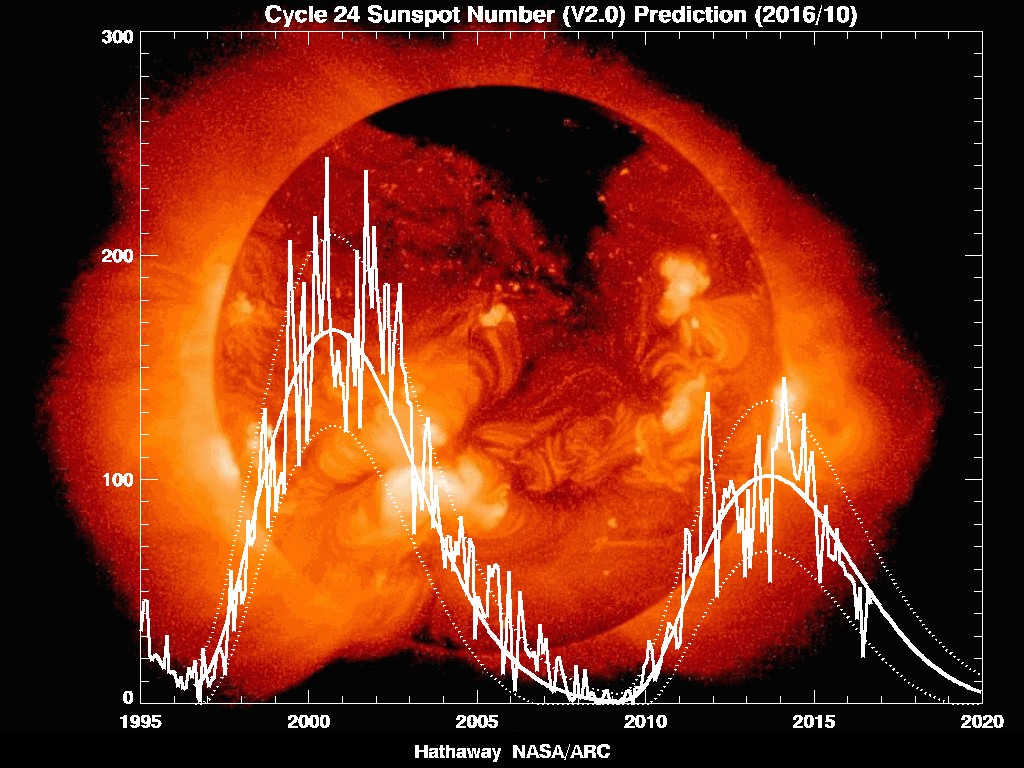
Here is Hathaway’s most familiar graphic, which has an active sun in the background. Perhaps it is time to update that background to something more reflective of the times…..oh wait, read on.
Click for a larger image
Here in this graphic, from Klimadebat.dk we can see how much has changed since Hathaway’s last prediction update in October 2008:
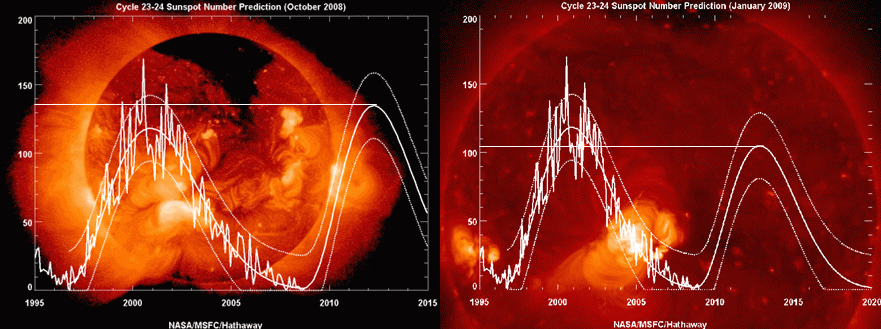
Click for a larger image
Note that Hathaway did indeed change background graphics from October to January. Its just not quite the smooth and nearly featureless ball we see today.
Courtesy of Mike Smith, here is the March 2006 prediction graphic:

Click for larger image
Hathaway’s predicted Cycle 24 maximun in March 2006: 145
Hathaway’s predicted Cycle 24 maximun in October 2008: 137
Hathaway’s predicted Cycle 24 maximun in January 2009: 104
I’d say that represents a sea change in thinking, but the question now is: How low will he go?
I was looking for a substantial quote from Hathaway in his prediction page, but it appears he is being quite conservative in his language, focusing mostly on methodology, not the prediction itself. I don’t blame him, he’s in a tough spot right now.
Meanwhile we’ve had an entertaining episode with the most recent Cycle 24 transient sunspot/sunspeck that appeared briefly yesterday then disappeared almost as fast as it appeared. See the area on the lower right of the sun:

In response to my query asking if he concurred with my assessment of it being an SC24 speck, (he did) Leif wrote to me: “Seems that it has received even a region number 11010. Somewhat ridiculous.”
Then about 12 hours later: “And SWPC has withdrawn the number. No numbered region after all.”
It will be interesting to see which organization counts this event, or not, in the month end tally. Up until this point, we had 25 consecutive spotless days. Now we have more, or not.
h/t to Frank Lansner for the Klimatdebat.dk graphic link and a bunch of other commenters who made note of the Hathaway page
“Policies adopted and called for in the name of ‘fighting global warming’ are unnecessary.”/NIPCC
And they would almost undoubtably produce a “disease” worse than that imagined by the AGW Religion to attatch to Global Warming – excluding those policies advancing the use of Nuclear Energy and energy efficiency, of course.
Hear me, my People, from where the Sun now sits*,We must beat the AGW Horse until it is dead, and perhaps even then some!
h/t Chief Young Joseph, Nez Perce/Nimi-i-pu.
As long was we are on the subject of Dr. Hathaway I wanted to comment on the gaps which appear in the good Doctor’s Sunspot predictions. For period from October 25, 2005 to January 7, 2007 Dr. Hathaway had the following messages on his Sunspot Prediction page:
“Lost our Funding – No more Updates 10/25/05”
“(Lost our funding, no more updates until further notice)”
Starting on January 11, 2007 Dr. Hathaway began making prediction again, apparently without funding, as the following messages would suggest:
“(Updating inspite of our loss of funding! Updated 2007/01/11)”
“(Updating inspite of our loss of funding! Updated 2007/02/06)”
“(Updating inspite of our loss of funding! Updated 2007/03/06)”
Starting about May 3, 2007 Dr. Hathaway resumed normal Sunspot prediction updates without commentary as the following message indicated.
“(Updated 2007/05/03)”
The detailed archived page images can be found at these links in the Wayback Machine.
http://web.archive.org/web/%2a/http%3a//science.nasa.gov/ssl/PAD/SOLAR/sunspots.htm
http://web.archive.org/web/%2a/http%3a//solarscience.msfc.nasa.gov/predict.shtml
The current page link is here:
http://solarscience.msfc.nasa.gov/predict.shtml
The original page link is here, which is no longer functional:
http://science.nasa.gov/ssl/PAD/SOLAR/sunspots.htm
I check news source and found that during the time period when Dr. Hathaway was posting his protest messages and not making Sunspot predictions, there were budget cuts at NASA to fund the manned mission to the moon in 2018.
Scientists, researchers feel pain of NASA budget cuts
http://www.usatoday.com/tech/science/space/2006-04-03-nasa-budget-programs_x.htm
Mike
Maybe we should start a new loto… my bet is that cycle 24 won’t get much higher than 40-50. Then it will collapse in 2015 and enter into a minimum that will last a long time.
The tone Dr. Hathaway’s solar cycle predictions is evolving. Last year, it was a “public service announcement” with the bells/whistles of the arrival of solar cycle 24.
Now, being what it should have been all along, it is only a prediction.
Unfortunately, his model is “fairly reliable once the cycle is well underway (about 3 years after the minimum in sunspot number occurs.)” From that statement, it isn’t much good predicting when it starts.
vukcevic (15:03:27) :.
See my post: vukcevic (14:28:24)
For polarity reversals (global solar and sunspot magnetic field) see:
http://hal.archives-ouvertes.fr/docs/00/28/98/80/PDF/Hypothesis.pdf
OK, will do. I’ve tried to stay away from the ‘magnetic’ and particle mediated theories for no good reason other than my own biases. Guess it’s time to wander down the magnetospheres path (my brain wants more caffein now 😉
Does anyone know if the Sun’s ‘Great Conveyor’ has slowed more since this 2006 NASA article? Just curious.
http://science.nasa.gov/headlines/y2006/10may_longrange.htm
Hathaway ain’t no Hansen.
Hathaway is open with the way he makes predictions. I think he makes it possible for all of us lay-folk to learn from his work. Hansen, well, you know…
Having said that, Hathaway’s discusses how one piece of his prediction for SC24 comes from the observation that a 1st order trend line for SC4 through SC23 shows an up trend – way too basic for me. Also, I do not understand why Hathaway would critisize the current dynamo models since they don’t run cycle to cycle, but rather have reset points between cycles. I’ll put my money on one of the dynamo models (even though the two models discussed disagree by a mile) before I’ll go by the wave matching attempts we have from Hathaway.
So many rich posts, so little time.
One more time, guys: http://www.angryflower.com/bobsqu.gif
I’d rather have ten Hathaways bravely and transparently making predictions that fail repeatedly than one Hansen with his secret devil-box models, mask and juju stick.
Re: Sunspot 1010: I had a dog that could leave bigger spots than that.
Solar Cycle 24 has been cancelled:
http://solarcycle24com.proboards106.com/index.cgi?board=general&action=display&thread=94
jk. And, Leif, thanks for being here.
Also curious to know if Livingston and Penn’s trend has continued from their 2006 paper with the latest observations (if the spots/specks are sizeable enough to provide useful data.)
Another protospot in latest SOHO Continuum Image 2009/01/09/00:23
this time in the northern hemisphere.
20 miles to the Sunspot by Willy Makeit and Betty Wont.
DaveE (18:35:14) :
“Assuming there wouldn’t be a flame war, wouldn’t it be nice to get Theodore Landscheidt & Dr. Hathaway to contribute to the blog?
DaveE”.
DaveE,
Theodore Landscheidt passed away in 2004.
So, if the cycle has been cancelled, should I expect to pick up the newspaper one day and read about SC24 in the obituaries?
I will hereby submit that the probable cause of termination was drowning.
It sank out of sight in the primordial plasmodic solar ooze.
(Maybe if we get it really ticked off it will jump up and try to bite us, yes?).
Leif Svalgaard (15:11:59) :
E.M.Smith (14:15:18) :
Interesting graph. What made for the difference? Method change, better data, improved approach? Does TSI include UV and other non-visible?
The ‘T’ is TSI means the Total irradiance [i.e. ALL wavelengths].
Unfortunately, one of the things I’ve learned here is the need to ask if “all” is really “all” and if ‘sound data’ are really sound and if “total” is really “total”…
Thanks for the assurances that total really is (nice to know someone can be trusted to use words accurately…)
The planetary hypothesis was generally accepted 100-150 years ago as the most likely, but once Hale discovered the magnetic cycle, the planetary hypothesis was dropped as it cannot explain the polarity reversals.
Great! I’m only 100 years behind you! Darned near nothing in geologic time 😉
Thanks for the details.
Michael Ronayne (19:07:36) Thanks for your positive feedback on my graphic. Here is a 07-2004 to 01-2009 blink comparison from the images on your link. I use Photoshop Elements 2, for pixel work, it was cheap and is simple to use. I started graphics back in ’82, as part of teaching myself programming for data collection so I could display my results. The animation is via MS’s Gif Animator, it’s free. After running a sign shop for eight years, I prefer vector graphics, but had deal with and print a lot of pixel files.
http://i40.tinypic.com/2lj5emh.jpg
Anthony, feel free to pass my email on to Michael, and I can append the earlier dates.
Michael Ronayne (19:07:36) I did nothing to the images other than adjusting the x-axis so the scale is the same on all pictures. I did create an intermediate image, showing the previous image with a 50% transparency of the next image on it, and filled in the background with black (I missed one it looks like, I’ll fix it on the next go round).
This may be related
Nasa have found to their amazement that the level of the ionosphere has dropped to previously unsuspected levels and that this drop is due to the lack of activity in the sun
http://www.nasa.gov/topics/earth/features/outer_atmosphere.html
Solar activity such as magnetic storms heats the ionosphere and this is not happening now
Bet that that isn’t any GCM
Spare some sympathy for Dr Hathaway. He’s only making predictions using models
http://lasp.colorado.edu/science/solar_influence/index.htm
http://www.ngdc.noaa.gov/stp/SOLAR/ftpsolarirradiance.html
These both have some nice sources of TSI info. Unfortunately, it looks like the “total’ in TSI isn’t really total. I’ve not yet been able to nail it down (and it may be that there are variations over time) but it looks like there is a cut off in the UV range somewhere around 400 to 200 nm with 300 nm being seen a couple of times. There also is a cutoff at 25xx nm or so but I don’t know if there is any long wave stuff that matters out there.
OK, so we either can’t (because the >200 nm is absorbed in the air) or don’t (for historical reasons?) include things shorter than ‘long’ UV in TSI.
Given that UV can change a lot more than “TSI” and isn’t included in “TSI” doesn’t that give the lie to arguments of the form “There isn’t enough change in TSI to do [foo] ” ? Ought that not be rephrased as:
“There isn’t enough dTSI to do [foo] but their might be enough dUV”?
Especially with UV driving O3 that then modulates IR windows? I can easily see a hypothetical where UV could suffer some kind of collapse way out of line with TSI during severe minimum events and we wouldn’t know to expect it since we’ve never had one instrumented.
Lief, is there any theoretical argument that can put this paranoid UV daemon back into a bottle? Similar to the paper you cited on planets vs other solar momenta but showing UV is somehow clearly proportional to TSI and TSI is a decent proxy for it? I’m on the verge of scaring my self 😉
( I really wish that ‘total’ meant total and that ‘data’ didn’t mean ‘pasturized processed data food’ and that … )
E.M.Smith (23:13:45) :
Lief, is there any theoretical
My apologies, that ought to be Leif…
E.M.Smith (15:03:43) :
vukcevic (13:09:57) :
http://xxx.lanl.gov/ftp/astro-ph/papers/0401/0401107.pdf
since Jan 2004.)
Another nice graph. Thanks! Still left with the mystery of why the correlation is so high but no mechanism is clear. Oh well, that’s where the fun starts…
I think concentrating on the gravity alone is a waste of time. Gravitation forces alone could not regulate the Hale’s polarisation cycle. Thus, another factor (with a magnetic polarity property) must be in the play, which has to be related to the planetary orbital periods. That could only be the existence of the planetary magnetospheres, which not only control (or override) solar polarity but trough negative feedback suppress the solar activity, result: solar minima during period of the strongest feedback. The crucial question is how is this feedback achieved; I believe it could be through the heliospheric current’s negative feedback due to disturbances (or interactions) within asymmetric central plane of the helioshheric current sheet, by the magnetospheres orbital paths.
For magnetosphere factor see:
http://www.vukcevic.co.uk/ links for solar current and subcycle
See also:
http://www.vukcevic.co.uk/combined1650.gif
http://www.vukcevic.co.uk/GrandMinima.gif
http://www.vukcevic.co.uk/combined.gif
All this could be a coincidence (as some claim) but I believe that:
‘the nature is adverse to a coincidence, it is ruled by a cause and the consequence’
Late to get to this one folks. Friday morning senior moment!
At the risk of being seen as a little boy allowed to stay up late & listen in to a grown-ups conversation, as I have probably said before, I would love to listen to Lief Svalgaard & David Archibald discussing the current solar situation (crisis/catastrophe/disaster/nothing unusual – delete as appropriate for media release).
As an engineer, I use, & sadly to some extent, rely upon computer technology for my work. However, I used to do stuff by hand using my own skill, knowledge, & judgement, so using a computer I hopefully would know by “feel” if what I got out was right or wrong. However, with Climate & Solar activity, which we have not attempted to study in such detail before 35 years ago, I suspect there were no people expert enough to do such computations by hand. Is it just possible we have reached the limit of our knowledge & technology, & our reliance upon & belief in computers to “predict” events past certain timescales, is slowly coming to light as folly? Perhaps too many Star Trek fans are in the mix! I am well aware that “what the mind of man can conceive, man can achieve”, but we’re not there in that place yet. Surely we must step back & think about what is actually happening, study the past, observe the present, then conclude with modest certainty.
Perhaps we know a lot less than we think we do about our solar system, its Sun, the planets around it, & more importantly, our own planet & how it is affected by the things around it, & certainly how the Sun affects us? I would be interested to see another chart in a years time with perhaps a third or fourth curve predicting a range of timescales for ramping up of Cycle 24, which would suggest that the models can’t cut the mustard, & it becomes a second guessing game. Herschell must be spinning in his grave by now, poor old fella! If keelyside et al’s model were to be put together with Mr Hathaway’s, perhaps Solar Cycle 24’s peak would be around 2015-18 to coincide with the renewed “predicted” Global Warming.
I genuinely have a lot of sympathy for Mr Hathaway, it is very difficult to be brave & come to the fore, make predictions with confidence based upon reasonably sound science about natural events, then see them not happen. One could start to feel rather uncomfortable & lose confidence in one’s own abilities.
PS It’s still cold here!
Heres an interesting forecast from Landscheidt in 2001:
“Forecast experiments are the best way to check whether science is sound. Such forecasts are available for the next crucial phases in the course of the PDO around 2007 (Coolest period in a cool regime) and 2016 (Regime shift from cold to warm). Wait and see will be the procedure in the second part of the experiment.”
So far so correct. It’s difficult to argue against someone who predicts a cool dip in a warming trend 6 years in advance, after also having correctly predicted el niños several years in advance. It seems to me, when you correctly predict things that the “experts” cannot then you should be taken seriously even if your ideas are not mainstream. Whatever the cause of el niños and the pdo, they can easily be presumed to be the dominating factor in medium-term weather predictions, and perhaps long-term too. In saying so, Landscheidt is not the first scientist, nor the only, and he won’t be the last. Coming up with a cause necessarily involves speculation but regardless of the cause, if his predictions are correct then it could be the key to more accurate short-term climate prediction. Science is full of people who were right for the wrong reason ie people who derived a correct empirical relationship but couldn’t fully explain the Physics. Faraday’s ideas needed Maxwell’s equations and Stefans empirical relationship needed Boltzmann’s maths. Calling someones theory nonsense might actually be correct but missing the main point – that whatever the cause (and there must be a non-Tsi, non-CO2 cause for ENSO and the pdo) the effect just might be predictable.
Like Anthony, I’m not convinced by Leif’s often-given opinion that an inactive Tsi closes down any debate about external impacts on our weather. My own particular line of thought is that since clearly the rotation fluctuations of the planet and ENSO are connected in some way, as confirmed by NASA, external factors bear some closer investigation, even if only to give better medium-term prediction capabilities.
Indeed an extreme oddity in this debate is how climate scientists will continually claim that exceedingly tiny changes in the content of the atmosphere from manmade GHG’s can have huge effects, yet they simultaneously fail to consider the logical counter-argument that therefore tiny changes elsewhere (say Tsi, solar wind, cosmic rays, weakening magnetic fields, Jovian influences, planetary wobbles, etc.) might, by exactly the same argument, also have a disproportionate effect. Leif falls right into this category too. If any tiny change is deemed a priori unimportant then you have to also rule out CO2 as an influence on climate since that is also a tiny change in a trace gas. Conversely if one tiny change is deemed important then we should consider all such tiny changes. Not doing so seems to be more political or dogmatic than scientific.
http://www.foxnews.com/story/0,2933,478024,00.html
Hansen was probably too busy defending vandals in UK courts. While he was out, he left his PC on without the password-protected screensaver. Someone snuck into his office and sent this, along with an email to George Bush saying:
“Georgie, I really, really, really, really, really, REALLY like you. Would you like to go out sometime?
Yours, Jimmie.”
It happens.
I’ve been voting exclusively for CA, since WUWT is getting a lot of support and is several furlongs ahead of the pack.
Reply: This is no time to be complacent, and hubris is always dangerous. Remember that last year thousands of votes were generated at the last minute, forcing a tie. Please continue the daily voting, and we can relax on Tuesday. Thanks. ~ dbstealey, mod.
E.M.Smith (23:13:45) :
Unfortunately, it looks like the “total’ in TSI isn’t really total.
LASP also measures the Solar Spectral Irradiance, i.e. how much we get at different wavelengths and SSI indeed have some gaps in it. Don’t confuse those with TSI.
From http://lasp.colorado.edu/sorce/data/tsi_data.htm:
“The Total Irradiance Monitor (TIM) measures the total solar irradiance (TSI), a measure of the absolute intensity of solar radiation, integrated over the entire solar irradiance spectrum”
How more precise can one be?
The instruments are ‘Active Cavity Radiometers’, which means that you let sunlight [all wavelengths because we are out in space] in to a ‘cavity’ where it heats a sensor, then you heat another sensor electrically until the two sensors show the same radiation flux. You measure how much current is needed to establish equality, and that current [calibrated of course] is a measure of TSI.
is there any theoretical argument that can put this paranoid UV daemon back into a bottle?
different UV bands vary in different ways over the solar cycle [some bands even vary in antiphase, i.e increase when solar activity goes down], but integrated UV does follows TSI.
You can play with integrating UV here: http://lasp.colorado.edu/cgi-bin/ion-p?page=input_data_timeseries.ion
Good limits to try are 242 to 310 [check ‘integrate’ box]
Here is what you might see: http://www.leif.org/research/Erl70.png
Note how the near UV 242-310 nm band actually goes UP about 0.5 W/m2 from solar max to solar min.