
A few days ago I wrote in State of the Sun for year end 2008: all’s quiet on the solar front – too quiet that “No new cycle 24 predictions have been issued by any solar group (that I am aware of ) in the last couple of months.” Coincidentally and shortly after that, NASA’s David Hathaway updated his solar prediction page here. He’s made a significant backtrack over previous predictions, and now for the first time he is claiming cycle 24 will be less than cycle 23, not greater.
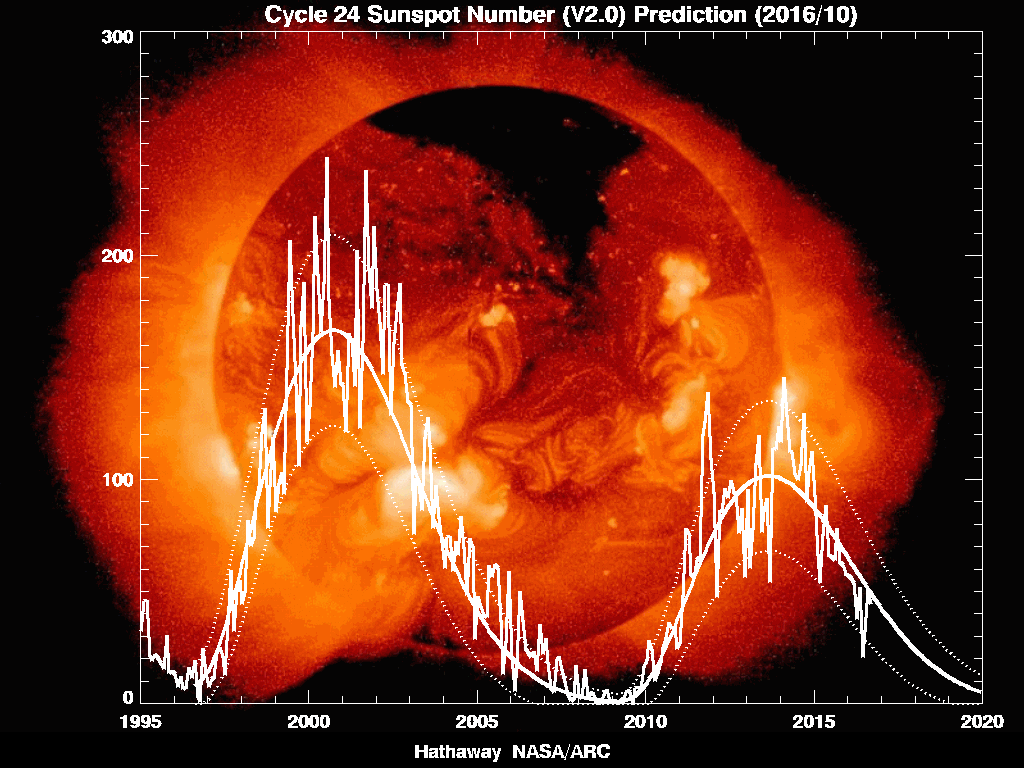
Kudos to our WUWT resident solar physicist Leif Svalgaard for his foresight. He has been saying for many months that cycle 24 would be significantly reduced, and not greater than 23.
Here is Hathaway’s most familiar graphic, which has an active sun in the background. Perhaps it is time to update that background to something more reflective of the times…..oh wait, read on.
Click for a larger image
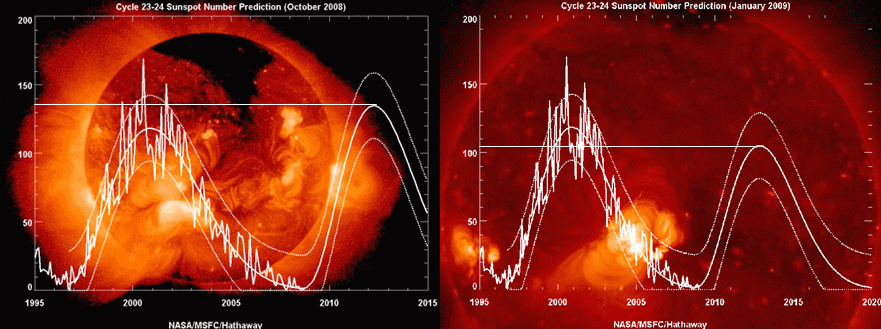
Here in this graphic, from Klimadebat.dk we can see how much has changed since Hathaway’s last prediction update in October 2008:
Click for a larger image
Note that Hathaway did indeed change background graphics from October to January. Its just not quite the smooth and nearly featureless ball we see today.
Courtesy of Mike Smith, here is the March 2006 prediction graphic:

Click for larger image
Hathaway’s predicted Cycle 24 maximun in March 2006: 145
Hathaway’s predicted Cycle 24 maximun in October 2008: 137
Hathaway’s predicted Cycle 24 maximun in January 2009: 104
I’d say that represents a sea change in thinking, but the question now is: How low will he go?
I was looking for a substantial quote from Hathaway in his prediction page, but it appears he is being quite conservative in his language, focusing mostly on methodology, not the prediction itself. I don’t blame him, he’s in a tough spot right now.
Meanwhile we’ve had an entertaining episode with the most recent Cycle 24 transient sunspot/sunspeck that appeared briefly yesterday then disappeared almost as fast as it appeared. See the area on the lower right of the sun:

In response to my query asking if he concurred with my assessment of it being an SC24 speck, (he did) Leif wrote to me: “Seems that it has received even a region number 11010. Somewhat ridiculous.”
Then about 12 hours later: “And SWPC has withdrawn the number. No numbered region after all.”
It will be interesting to see which organization counts this event, or not, in the month end tally. Up until this point, we had 25 consecutive spotless days. Now we have more, or not.
h/t to Frank Lansner for the Klimatdebat.dk graphic link and a bunch of other commenters who made note of the Hathaway page
“” James Hastings-Trew (11:19:08) :
Question:
Now that 2008 is over and done with we have all the temperature data. Was Tamino right? Was 2008 one of the hottest 10 years of the last decade? “”
I think that Tamino probably slipped a typo in there; he probably meant to say that 2008 was one of the coolest years of the last decade; so was 2007, so that indicates a trend for sure.
I can’t tell about 2003 though it could be one of the hottest or one of the coolest; but the most I can venture here is that it certainly was one of the years of the last decade !
Speaking of cool, I always understood sunspot to be solar refrigerators, in that they were hundreds of degrees cooler than the surrounding surface. Now from what I learned about Optical Pyrometry, cool spots always look black against a warmer background; so is NASA saying the whole damn sun turned into a sunspot, and that little bright white patch on the lower right, is the only normal region in the picture; or is that some new kind of “anti-sunspot”?
Just asking !
Leif Svalgaard (10:15:42) :
But the ‘above graph’ is an obsolete reconstruction of solar irradiance that is not consider valid today. For a more probable reconstruction that reflects what we have learned the past decade see the red curve on: http://www.leif.org/research/TSI-LEIF.png
In your graph it shows that the TSI seems to have a lower level that it can drop to, 1365,6w/m2, and change very little if we have had a grand minimum or a strong cycle.
If you look on the graph in a PDF that Hathaway has made, see page 5/47 in link below, he shows that TSI has droped to a record low of 1365.1W/m2 and it looks like it is still dropping.
Also, we are not in a grand minimum as far as we know now but if the sun would stay all quiet for decades, it looks to me that sun certainly can drop a bit lower than 1365W/m2 in the light of the last years TSI meassurments during a long minimum.
How does this new data fit into your reconstruction? Are you showing the same thing but with different smoothing or is your graph out of date?
Are you using different datasets for TSI so that is what causing the difference?
When was your TSI reconstruction made?
Link to Hathaway PDF( large ~11Mb)
http://sprg.ssl.berkeley.edu/RHESSI/napa2008/talks/MonI_Hathaway.pdf
Retired Engineer (13:21:47) :
Seems that a windmill was struck by a UFO, knocking one blade off and mangling another one. With no trace of the missing blade.
So, does the lack of sunspots confuse their navigation systems, or are aliens just lousy drivers? (it couldn’t be due to any bias at the reporting source…)
I was reading about this today. Seems they have found the blade now and there is an investigation going on as to what happened. Dr Peter Schubel, from the University of Nottingham suggests it’s a mechanical failure of sorts. Fraser McLachlan, chief executive of GCube, which insures more than 25,000 wind turbines worldwide, said such incidents occurred about five or six times a year. Safety first!!
Leif, How does the parcel become less under pressure? Wouldn’t other material be added to it under pressure and compacted where is the escape route for this material?
If I crushed an egg in a container with increased air pressure the only time the egg or anything else would escape (with a good seal) is when I released the pressure. So there is a need for another lifting force. The planets.
Ed
E.M.Smith (14:38:59)
A strong point of criticism to the planetary hypothesis is that no physical mechanism has yet been forwarded for explaining polarity reversal by planetary motions.
Doesn’t close it down completely, but does raise the bar rather a long ways.
See my post: vukcevic (14:28:24)
For polarity reversals (global solar and sunspot magnetic field) see:
http://hal.archives-ouvertes.fr/docs/00/28/98/80/PDF/Hypothesis.pdf
vukcevic (13:09:57) :
http://xxx.lanl.gov/ftp/astro-ph/papers/0401/0401107.pdf
since Jan 2004.)
Another nice graph. Thanks! Still left with the mystery of why the correlation is so high but no mechanism is clear. Oh well, that’s where the fun starts…
Forget Global Warming we have something new to worry about
Report: Powerful Solar Storm Could Shut Down U.S. for Months
http://www.foxnews.com/story/0,2933,478024,00.html
E.M.Smith (14:15:18) :
Interesting graph. What made for the difference? Method change, better data, improved approach? Does TSI include UV and other non-visible?
The ‘T’ is TSI means the Total irradiance [i.e. ALL wavelengths].
The difference is that [as you can see from the progression with time 2000->2005->2007] the idea of a ‘background’ TSI that rises [and on top of which the solar cycle runs] with time has fallen out of favor because the various reasons for the background have been shown not to hold up. E.g. the Lean2000 rise was deduced from a comparison with ‘sun-like’ stars. More detailed measurements then showed that the stars used were not all that sun-like after all. The Wang2005 tried to match the ‘doubling of the sun’s magnetic field the last 100 years’ which we now know didn’t happen, and so on. The current thinking is that there may not be any background at all.
I did note that the author did not say ‘total nonsense’ but rather took a more reasonable approach
First, of course, in a scientific paper one does not express one’s opinion that strongly, but is IMHO warranted when claiming an effect resulting from accelerations three orders of magnitude too small. Second, the nonsense part was specifically directed at the Landscheidt ‘paper’, that rambles uncritically all over the place. Just a small example: the 166-year period vs. the 179-year period usually claimed.
The planetary hypothesis was generally accepted 100-150 years ago as the most likely, but once Hale discovered the magnetic cycle, the planetary hypothesis was dropped as it cannot explain the polarity reversals. The ‘modern’ variant is that the cycle IS due to an internal solar dynamo but is modulated by the planets. As [if] we getter better in explaining the solar cycle using sound physics, the planetary hypothesis can still live: one simply reduces the size of the modulation accordingly. In this way it can never be falsified.
Bill Illis (14:37:38) :
I know the SORCE satellite is not showing a reduction in TSI which is consistent with the decline from Virgo.
I think [hope] you mean that the it is consistent with a degradation of Virgo, causing it to report erroneously lower values.
Here is an up-to-date [almost] comparison, showing the degradation of PMOD [Virgo]: http://www.leif.org/research/Diff-PMOD-SORCE.png
WUWT has 4,999 votes right now. Would someone please push the total over 5,000?
Thanks: click
Ah, that’s the spirit! Last vote count: 5,012.
Jerker Andersson (14:50:01) :
If you look on the graph in a PDF that Hathaway has made, see page 5/47 in link below, he shows that TSI has droped to a record low of 1365.1W/m2 and it looks like it is still dropping.
As discussed in the post just above the TSI series referred to by Hathaway is derived from the PMOD [Virgo] data that seems to be slowly degrading.
The whole issue with TSI is whether the is a ‘background’ value that goes up and down and on top of which the solar cycle rides. See page 9 of http://www.leif.org/research/GC31B-0351-F2007.pdf . In short, my reconstruction does not include this dubious ‘background’.
George E. Smith (14:45:20) :
whole damn sun turned into a sunspot, and that little bright white patch on the lower right, is the only normal region in the picture; or is that some new kind of “anti-sunspot”?
All spots [especially when seen near the limb] are surrounded by brighter material that actually comes before the spot is born and lasts long after the spot is dead. It is those brighter areas that make the Sun shine 0.1% brighter at sunspot maximum in spite of the darker spots.
I expect the next announcement from NASA to say that SC24 has been canceled and we will be moving directly to SC25.
Leif said
“The planetary hypothesis was generally accepted 100-150 years ago as the most likely, but once Hale discovered the magnetic cycle, the planetary hypothesis was dropped as it cannot explain the polarity reversals.”
The same pull from the planet’s Jupiter Saturn on the opposite side of the sun explains polarity reversals. If I unblock the sink with a suck from underneath, the water spins if I sucked water up the other way with a straw from the top of the sink trying to empty it the water would spin in the other direction. The planets are the sink and the straw when on different sides of the sun (obviously with variations) and creating the two polarities.
Ed
Leif Svalgaard (15:11:59) :
The ‘T’ is TSI means the Total irradiance [i.e. ALL wavelengths].
From http://science.jrank.org/pages/6875/Total-Solar-Irradiance.html
Total solar irradiance is defined as the amount of radiant energy emitted by the Sun over all wavelengths that fall each second on 11 sq ft (1 sq m) outside the earth’s atmosphere.
By way of further definition, irradiance is defined as the amount of electromagnetic energy incident on a surface per unit time per unit area. Solar refers to electromagnetic radiation in the spectral range of approximately 1-9 ft (0.30-3 m), where the shortest wavelengths are in the ultraviolet region of the spectrum, the intermediate wavelengths in the visible region, and the longer wavelengths are in the near infrared. Total means that the solar flux has been integrated over all wavelengths to include the contributions from ultraviolet, visible, and infrared radiation.
OK, the further definition contradicts the initial paragraph. The second paragraph includes “light” but not other electromagnetic energy (ex. radio).
If irradiance implied “light”, the second definition fits TSI. But if TSI means the Total irradiance [i.e. ALL wavelengths], shouldn’t their page be fixed?
Regards,
Bob
Leif,
Is there an link where I can find CME rates and intensities? Sorry if a little OT
I wanted to see a blink comparison and made one of the above three images:
http://i42.tinypic.com/mueet2.jpg
The one Michael Ronayne (12:59:57) links to is too slow, the axes don’t match, etc. I inserted 50% transparencies into mine so they fade into one another, and matched the axes. I will download the complete set of images and make one with all, probably by late tonight (1/8) or early am.
MartinGAtkins (15:27:25) :
I expect the next announcement from NASA to say that SC24 has been canceled and we will be moving directly to SC25.
Already been suggested by someone at SolarCycle24 who suggested that 24 was a ‘stutter’ cycle when what appeared to be an SC23 spot appeared.
DaveE.
E.M.Smith (13:57:44) :
Um, I think it is science. Make a hypothesis, test it, find it wrong, make a new hypothesis. That his prediction did not work is as valuable to a real scientist as when it does work…
Put me in the group that lauds him for putting it out there for folks to see and for being willing to change his mind when the data change. Very refreshing compared to the “cooling is the new warming” behaviour of others…
As someone who makes a living making forecasts from noisy, underconstrained, non-unique datasets (geology & geophysics , looking for new oil & gas deposits), I second E.M.Smith ! Until you have tried it, do not underestimate how humbling it can be. You can think you the best hypothesis with a lock tite model to explain the observed data to date & mother nature will come along & completely kick your a** !! I respect anyone who is willing to put it out there & adjust as needed. I have no respect for those who will not adjust their ideas as new data comes in,but stick to their hypothesis & ignore the data …. I think we all know the types I am refereing to.
OT: Remember that Flying Pig monent a few days ago when Harold Ambler got a piece critical of AL Gore published on the Huffington Post? Well we can all rest easy now. The world has returned to normal:
Arianna Huffington:
“…I would not have posted it. Although HuffPost welcomes a vigorous debate on many subjects, I am a firm believer that there are not two sides to every issue, and that on some issues the jury is no longer out. The climate crisis is one of these issues….”
Aren’t we lucky to be living in a world where celebrity journalist can settle scientific questions!
http://gristmill.grist.org/story/2009/1/7/134728/5150
Nature, Not Human Activity, Rules the Climate
http://www.sepp.org/publications/NIPCC_final.pdf
Nongovernmental International Panel on Climate Change (NIPCC)
When new errors and outright falsehoods were observed in the initial drafts of AR4, SEPP set up a ‘Team B’ to produce an independent evaluation of the available scientific evidence.
We donated our time and best efforts to produce this report out of concern that the IPCC was provoking an irrational fear of anthropogenic global warming based on incomplete and faulty science.
Global warming hype has led to demands for unrealistic efficiency standards for cars, the construction of uneconomic wind and solar energy stations, the establishment of large production facilities for uneconomic biofuels such as ethanol from corn, requirements that electric companies purchase expensive power from so-called ‘renewable’energy sources, and plans to sequester,
at considerable expense, carbon dioxide emitted from power plants. While there is absolutely nothing wrong with initiatives to increase energy efficiency or diversify energy sources, they cannot be justified as a realistic means to control climate. In addition, policies have been developed that try to hide the huge cost of greenhouse gas controls, such as cap and trade, a Clean Development Mechanism, carbon offsets, and similar schemes that enrich a few at the expense of the rest of us.
Seeing science clearly misused to shape public policies that have the potential to inflict severe economic harm, particularly on low-income groups, we choose to speak up for science at a time when too few people outside the scientific community know what is happening, and too few scientists who know the truth have the will or the platforms to speak out against the IPCC.
The correlation between temperature and carbon dioxide levels is weak and inconclusive.
Computer models don’t provide evidence of anthropogenic global warming.
This mismatch of observed and calculated fingerprints clearly falsifies the hypothesis of anthropogenic global warming (AGW). We must conclude therefore that anthropogenic GH gases can contribute only in a minor way to the current warming, which is mainly of natural origin. The IPCC seems to be aware of this contrary evidence but has tried to ignore it or wish it away.
To sum up: This NIPCC report falsifies the principal IPCC conclusion that the reported warming (since 1979) is very likely caused by the human emission of greenhouse gases. In other words, increasing carbon dioxide is not responsible for current warming. Policies adopted and called for in the name of ‘fighting global warming’ are unnecessary.
I think [hope] you mean that the it is consistent with a degradation of Virgo, causing it to report erroneously lower values.
Here is an up-to-date [almost] comparison, showing the degradation of PMOD [Virgo]: http://www.leif.org/research/Diff-PMOD-SORCE.png
Proof enough for me.
To reinforce Leif’s comments (and he is still 10 for 10 on this website), here is TSI from SORCE over the last solar cycle – maybe varying by 0.9 Watts/m2 over the solar cyle (as would be expected with Leif’s theories).
http://lasp.colorado.edu/cgi-bin/ion-p?ION__E1=PLOT%3Aplot_tsi_data.ion&ION__E2=PRINT%3Aprint_tsi_data.ion&ION__E3=BOTH%3Aplot_and_print_tsi_data.ion&START_DATE=0&STOP_DATE=2300&TIME_SPAN=24&PLOT=Plot+Data
If we plot Angular Momentum created by the solar system above the sunspot cycles it clearly shows a correlation in solar cycle modulation strength as well as timing of grand minima….we are approaching “phase catastrophe” mode.
http://landscheidt.auditblogs.com/files/2008/12/ultimate_graph2all.jpg
http://landscheidt.auditblogs.com/archives/58
OT
More weather trivia. Seems tropical cyclone activity in 2008 was below average and total cyclone energy was near the record low. (It’s a short period though, going back only to 1980.) Still, not what Mr. Gore is predicting.
http://www.wunderground.com/blog/JeffMasters/comment.html?entrynum=1176
One of the biggest problems today is identifying which data sources can be trusted. That is a very sad comment about today’s scientific research, but that is the environment in which we are forced to live with.
Leif’s data is something that I trust…
Leif, Yes to TSI but what about the solar flares e.t.c
“The IPCC’s judgement that the solar factor is negligible is based on satellite observations available since 1978 which show that the Sun’s total irradiance, though not being constant, changes only by about 0.1 percent during the course of the 11-year sunspot cycle. This argument, however, does not take into account that the Sun’s eruptional activity (energetic flares, coronal mass ejections, eruptive prominences), heavily affecting the solar wind, as well as softer solar wind contributions by coronal holes have a much stronger effect than total irradiance.” Theodore Landscheidt, New Little Ice Age
Instead of Global Warming?
Ed.