reposted from ICECAP
By Dr. Richard Keen, University of Colorado
I’m the NOAA co-op observer for Coal Creek Canyon, Colorado, elevation 8950 feet, in the foothills NW of Denver. Here is a graph of average temperatures for the past ten years. 2008 is by far the coldest year in the past decade, with an average of 39F.

See larger image here.
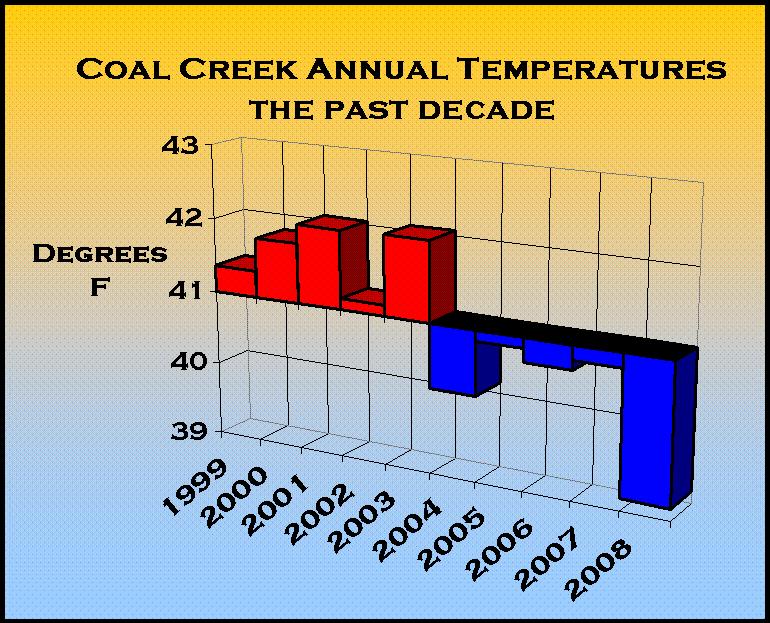
That’s full 3 degrees F colder than 2003. Each of the past five years is colder than any of the previous five years.
This is only one station of the thousands in the NOAA co-op network, but I thought I’d show you the data before it’s adjusted and homogenized by the usual suspects.
Here’s a photo of the station in January 2007, in the midst of a record round of snow storms in Colorado.

See larger photo here.
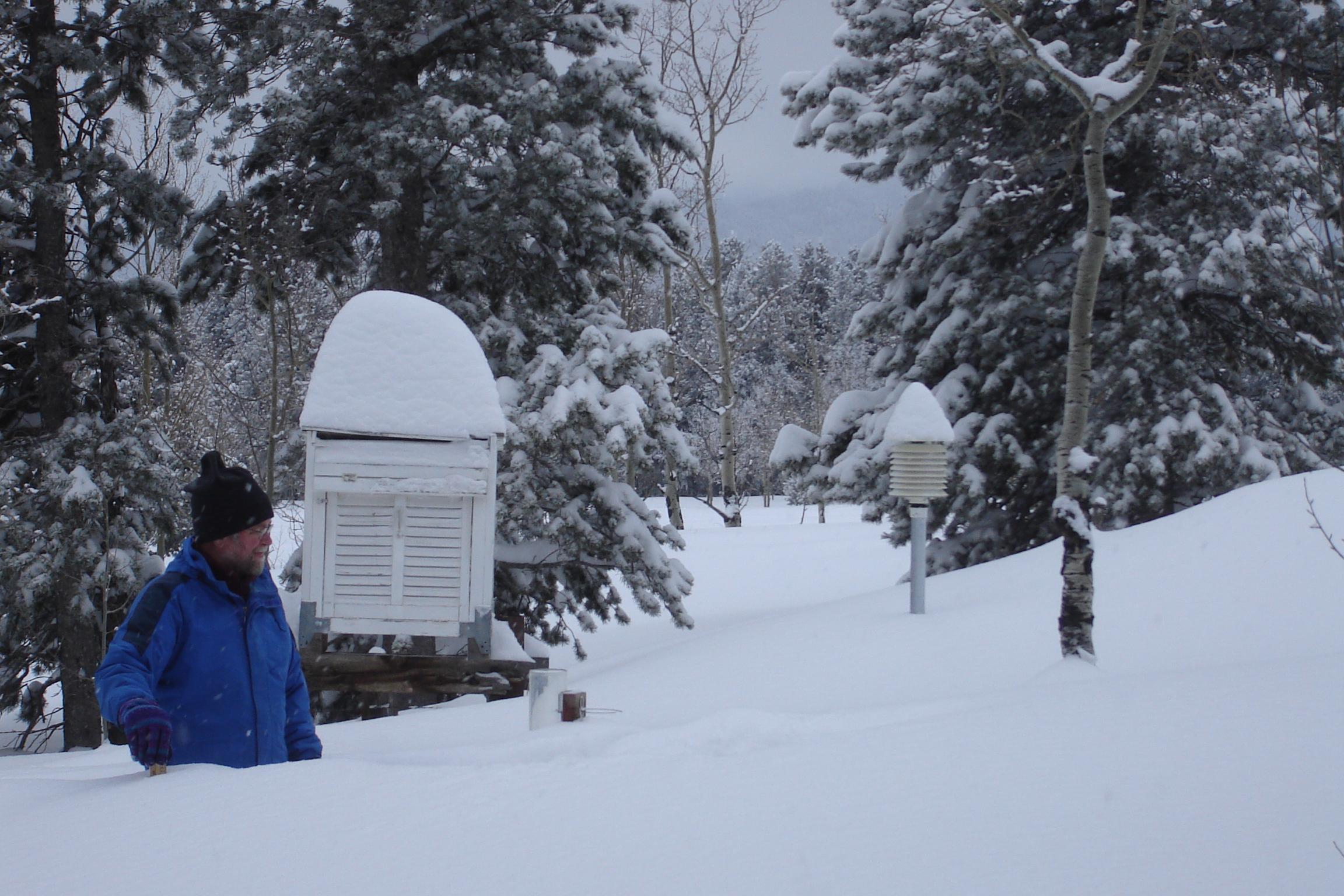
On the other hand, I suspect that snow on top of this unit is nothing unusual.
Re: the_Butcher (23:37:32)
So New Zealand is experiencing high temperatures? In summer? Wow. Think you may be confusing weather with climate…
The record was set thusly:
Rangiora, South Island, 42.4°C, 7th of February 1973. Just under 35 years ago.
*RATS!* “Just under *36* years ago”. It’s early for me, sorry… :).
@Anthony, i came here looking for good counterpoints to my own belief – that humans are affecting our environment, and one consequence of that will be warming of the earth. i believe that good arguments can be made. if this blog’s aim is simply to deal with individual stations, then that’s fine. it just seems that you are trying to make larger inferences to the globe from individual data points – the NCDC post was temperatures for 2% of the earth’s surface over 10 years, now it’s a single point over 5.
i half expect a recount of last weekend in austin, tx to show up here. it was 80 one day and the two days later i was having to wear a sweater and a hat. maybe it’s just been the past couple posts, but i was looking for stronger arguments. that being said, i’m not going to give up on you just yet, and i may post snark when i feel it’s warranted. 🙂
“So we’ve got global warming, Coal Creak is on the globe so why is it colder? There could be plenty of reasons, but you don’t say.” -davidc
i’m not disputing the data, but your comment doesn’t make much sense, for instance people say the US economy is in bad shape right now, but i just got a job, so i say it’s good! my getting a job doesn’t make the economy any better than it already is, nor does the fact that thousands of people are losing their jobs mean that my paycheck doesn’t benefit me.
REPLY: Perhaps you’ve missed what we do. See http://www.surfacestations.org This blog has had a long history of looking at individual stations, and we are collecting quality control data on the entire USHCN network, something that has never, ever, been done before. Yes we’ve had the old “but the USA is only 2% of the landmass” argument tossed at us thousands of times…so what?
If I stopped to listen to critics who tossed out the same objections you have, we’d not be anywhere in the project. But we are now more than halfway done in surveying the 1221 USHCN network.
The USA has the lions share of weather stations, and “supposedly” has the best network. We can’t do the entire world at once, so we are focusing on the USA (and it’s data set) to see just how well the premise holds up. So far it hasn’t done very well. However, the impact that the survey has had already is being felt worldwide, and has resulted in many useful findings. NOAA has even made an effort to fix some of the worst stations. For example I just got word that they moved Detroit Lakes away from the swamp and air conditioners. 😉
Be critical, point out flaws, we’ll learn from those as we have been doing all along. However, I’m going to continue to examine and showcase individual stations here, regional trends, global trends, short trends, long trends, and yes, even single station trends, plus anything else I and my readers find interesting. If the content does not suit you, read elsewhere. – Anthony
That station looks to be out of compliance with standard siting criteria. The trees are too close. Shading and elevated humidity probably skew the temperatures a bit. That might be tolerable for a comparison of temps at this one location over the years, but not so good for comparison to other stations. I might trust it to estimate local skiing conditions, but not much else. FWIW, this station isn’t in the USHCN and has only been active since 1993.
looks like the WUWT margin has increased 🙂
http://2008.weblogawards.org/polls/best-science-blog/
Of course, it may well be that the legitimate point that is being made that a significant freeze up may be succeeded by a huge melt. However it is somewhat of an odd way to make the point. If suddenly skipping back a year is legit, why not fifteen or twenty?
Whether it is weather that has held off the freeze North of Iceland should become clearer soon, as the North European high has shifted South, and weakened, presaging the usual round of intense winter lows across the North Atlantic, which should bring air from Northern Canada across Greenland, cooling the whole area a lot. So the hypothesis predicts significant ice growth in the areas North and East of Iceland over the coming month to six weeks. Let’s see…
I bet they were grilling hotdogs next to that collection site in the past! It can’
t be cold, the people calling us ASS said it’s not.
Also Sprach der Sessel!
(I meant me)
I see there are trees close the the thermometers. I’ve always wondered about the proper siting for the temperature gauges in a forested region. Shouldn’t they be located in the forest? The site rating for this post is irrelevant as it was stable over the last 10 years with no artificial heat sources.
It’s kind of hard to keep the thermometer clear of snow when it snows a foot overnight. Would you use heater to keep it snow free? 😉
Eyeballing the graph, it looks to be about a 1.5F drop over the 10-year period, or about the same amount as the global warming the past century. By itself, not all that significant, but when added to the growing evidence of cooling, then yes, certainly it is at least noteworthy, “ak”. No UHI effect, either, so the temperature record would seem to be far more accurate than other locations.
It would be nice to know if the snow on top of the housing has any significant effect, and/or if removing the snow is standard procedure or not.
Well, need to fire up the snowthrower, to clear a bunch of “global warming” off my driveway. Ski season here in NH is off to a flying start (last year’s was a record-breaker).
Dr. Richard Keen:
From the graph, I’d say 2007 was warmer than 2004. Did you mean to say “Each of the past five years was colder than the year five years before?” E.g. 2007 was colder than 2002.
Ah, or did you mean “Each of the years from 2004 to 2008 was colder than each of the years from 1999-2003?” That’s a more meaningful comparison.
I’ve lived in Breckenridge, CO since Fall 2005. The first three winters were frigid, snowy and long-lasting and this winter is looking the same. Breckenridge just had one of its snowiest Decembers on record. Beaver Creek just had its snowiest winter on record. When I was in Crested Butte last February the snow was a settled eight feet deep in town. I’ve had so many powder days I can’t even remember all of them. Snow levels are not rising. Temperatures are not rising. The winters are starting in October and ending in June. I don’t think the ski industry needs to fear manmade “climate change”.
Dr. Keen or Anthony,
I didn’t find Coal Creek in the Surfacestations gallery (nor a placeholder). Would this station qualify for inclusion in the gallery (record of sufficient duration)? Also, how free of microsite bias would you say this station is, and has been, over the duration of the record? I see it’s on a slope, but assume that’s fairly representative of the general area. Thanks for the post!
REPLY: It is not a USHCN station, simply a COOP station. The reason it is not USHCN is duration of record. – Anthony
I read somewhere that igloos, made of snow, must be torn down when they start icing as the interior temperature drops, and the insulator effect is lost. That would make me tend to think that AVV is correct and the powder snow on the station is insulation against nighttime lows.
P.S. – Yes, I realize the duration of the record doesn’t matter for the purpose of this thread since the thread is only talking about a decade worth of history.
It’s always nice to hear from a station observer. I wonder what sort of instruction they are given about what to do about icecicles covering the slats, snow on the roof, etc.
Interesting observations there in Coal Creek Canyon.
I live just a few miles north east of that area and also have seen a general trend for colder weather over the last few years in mid winter. For some time it was rare to see seriously sub zero temps during the winters but the last few years we have gone back to a more normal winter cycle that occasionally dips into the -10 to -15 deg range.
Your post got me to browsing around and I found the following site that allows you to pull up median monthly temps for states going back 100 years.
The Colorado Data shows no significant trend over the past 108 years of data.
The trend line is nearly flat from 1910 to 1990 then a slight upward trend from 1990 to 2005 followed by a sharp dip over the last 3 years, 2009 data is not available yet.
Here is the data for the last 50 years, temps are in deg F, these are state mean temps for the state of Colorado.
2008, 19.9
2007, 18.3
2006, 29.5
2005, 30.1
2004, 25.5
2003, 31.6
2002, 25.2
2001, 24.1
2000, 29.3
1999, 30.0
1998, 27.8
1997, 24.0
1996, 23.9
1995, 26.2
1994, 26.2
1993, 23.1
1992, 22.9
1991, 20.8
1990, 25.9
1989, 23.4
1988, 18.3
1987, 24.2
1986, 31.2
1985, 21.1
1984, 18.7
1983, 27.1
1982, 23.6
1981, 30.4
1980, 23.6
1979, 14.1
1978, 22.7
1977, 20.9
1976, 22.9
1975, 22.0
1974, 18.8
1973, 18.8
1972, 23.9
1971, 25.4
1970, 24.3
1969, 27.9
1968, 22.2
1967, 26.1
1966, 19.9
1965, 27.6
1964, 22.7
1963, 16.5
1962, 18.3
1961, 24.3
1960, 21.4
1959, 24.6
1958, 24.6
Hopefully I made not typo’s in transcribing the data from that web application.
Larry
Sorry I forgot the source page:
http://www.ncdc.noaa.gov/oa/climate/research/cag3/cag3.html
Larry
Hotrod, Anthony, anyone.. Where the heck is Coal Creek Colorado?
REPLY: Here is a Google Maps link to the station lat/lon
http://maps.google.com/maps?q=39.8958,-105.3847&oe=utf-8&client=firefox-a&ie=UTF8&ll=39.896041,-105.384979&spn=0.608981,1.455688&t=h&z=10&iwloc=addr
BTW your question prompted my search which serendipitously led me to a previously unknown NOAA resource for COOP stations. Thanks for being the catalyst. – Anthony
King of Cool (23:54:10) : “Because the daily extent chart now shows the winter of 2006 to 2007 (dashed green line) not 2007 to 2008. NSIDC say that the graph will continue to show 2007, which went on to reach the lowest summer minimum in the satellite record.”
How can there be any credibility with climate data? It is no longer scientific, rather it is manipulated, without explanation. No objective scientist would adjust a graft without, at a minimum, notifying the viewer of the change made and the reasons why. This is incredulous. It has been politicized beyond all recognition. It is POO-BAR!
Hansen and his cohorts will soon learn the wisdom of Abe Lincoln:
“You can fool some of the people all of the time and all of the people some of the time but you cannot fool all of the people all of the time.”
Common sense (as in….it is really cold out there) is telling the general population that perhaps they should put into question the dire warnings of climate change “experts”. The momentum behind this opinion change is building very quietly since mainstream media embraces AGW.
I saw the same thing happen during Clinton’s first term. The Liberals took charge, massive federal programs and controls were proposed and if you read the newspapers or watched TV news, you would have thought the general population was completely supportive. But the true feelings of the public came out at the mid-term elections when the Democrats were soundly defeated.
I cannot predict weather or climate change, but I will predict that we will soon witness “deja vu all over again” as the climate models continue to vary from reality and the so-called experts are forced into ever greater and thus more obvious data manipulation in an effort to justify their politically, financially & emotionally driven belief systems.
It should be fun theater. Many thanks to AW, SM, Drudge and many others for “keeping it real”!
Kevin B (04:19:04)
I wonder if the light might be the rising sun reflected off the blade.
========================================
Emergency teams are trying to restore power to thousands of homes in the south of France after the worst blizzard conditions in two decades.
http://news.bbc.co.uk/2/hi/europe/7817124.stm
The Met Office warns of more dangerous hot weather, as Britain suffers it’s coldest winter in 30 years.
http://www.guardian.co.uk/uk/2009/jan/08/summer-aid