
Guest essay by Eric Worrall
The Guardian has promoted an idea for a new climate friendly financial system, to permanently halt economic growth.
To deal with climate change we need a new financial system
Abolishing debt-based currency isn’t a new idea, but it could hold the secret to ending our economies’ environmentally damaging addiction to growth.
When it comes to global warming, we know that the real problem is not just fossil fuels – it is the logic of endless growth that is built into our economic system. If we don’t keep the global economy growing by at least 3% per year, it plunges into crisis. That means we have to double the size of the economy every 20 years, just to stay afloat. It doesn’t take much to realise that this imperative for exponential growth makes little sense given the limits of our finite planet.
…
The question is what to do about it. How can we redesign the global economy to bring it in line with the principles of ecology? The most obvious answer is to stop using GDP to measure economic progress and replace it with a more thoughtful measure – one that accounts for the ecological and social impact of economic activity. Prominent economists like Nobel Prize winner Joseph Stieglitz have been calling for such changes for years and it’s time we listened.
…
One way to relieve the pressure for endless growth might be to cancel some of the debt – a kind of debt jubilee. But this would only provide a short-term fix; it wouldn’t get to the real root of the problem: that the global economic system runs on money that is itself debt.
…
The responsibility for money creation would be placed with an independent agency that – unlike our banks – would be democratic, accountable, and transparent, so money would become a truly public good. Commercial banks would still be able to lend money at interest, but they would have to back it dollar for dollar with their own reserves. In other words, there would be a 100% reserve requirement.
This is not a fringe proposal. It has been around since at least the 1930s, when a group of economists in Chicago proposed it as a way of curbing the reckless lending that led to the Great Depression. The Chicago Plan, as it was called, made headlines again in 2012 when progressive IMF economists put it forward as a strategy for preventing the global financial crisis from recurring. They pointed out that such a system would dramatically reduce both public and private debt and make the world economy more stable.
…
I haven’t been able to locate the original text of the Chicago Plan memorandum, but the IMF revival of the Chicago plan is available here.
The main thrust of the plan appears to be to nationalise all personal retail bank deposits. When proponents of the plan talk about forcing banks holding a “100% reserve”, they don’t just mean physical cash – government bonds also count as cash. When you deposit cash into a bank under this scheme, you will effectively be buying government bonds, lending the money straight to the government. Other than holding physical cash, lending to the government would be the only option for earning an income from bank deposits.
Would this plan stop economic growth? It would certainly cause a lot of harm. Replacing private lending with government lending schemes has been tested to destruction on countless occasions. It turns out civil servants who don’t face personal consequences if the loan goes bad tend to do a poor job of checking the creditworthiness of applicants. Printing new cash to cover losses from poor centralised banking decisions is not a recipe for prosperity.
I suspect what this plan would do, if implemented, is accelerate the ongoing growth of the shadow banking sector.
Governments are rapidly losing control of the global currency system. Digital currencies like Bitcoin exist because their proponents want to liberate currency from the control of governments. While almost untraceable Bitcoin is undoubtably the currency of choice for scammers, terrorists, drug traffickers, and other assorted filth, it is also the currency of people who want to circumvent unfair restrictions on money.
Thanks to Bitcoin and similar digital currencies, even communist China can’t control currency movements anymore. One of the main reasons the value of Bitcoin has surged in recent years, is mainland businesses discovered they could use Bitcoin transactions to circumvent Chinese currency controls, to shift their profits out of China.
There is nothing new or mysterious about how Bitcoin and other digital currencies work. Bitcoins are simply the latest incarnation of the long history of informal value transfer systems, a tradition as old as tax collection.
The powers that be want an unelected one world government and cash to be outlawed. They also want open borders.
What can possibly go wrong??
Noble cause corruption. Dangle power and control (in the name of “the cause”) in front of people and “the cream” isn’t what rises to the top.
https://youtu.be/Wss6vvFOoeY
Turds float, too.
Eric Worrall:
This, of course, is totally unlike bankers who don’t face personal consequences if the loan goes bad who always …. oh wait, what was it that brought down Layman Bros. and nearly caused the whole international banking system to collapse and needed the US govt ( ie tax payers ) to throw one TRILLION DOLLARS into an anonymous black whole?
Even the most ultra-liberal economists of the Chicago school who were behind changes in the Regan era no longer think pure, unregulated free-market capitalism is a good idea since they have seen where it leads.
It seems that our Eric is a bit behind the curve with his black / white logic.
All the major banks that went under in the UK and needed a similar per capita state bale out using tax payer funded national debt were all privately owned commercial banks.
Nice ultra-liberal rant Eric but it just does not fit the facts.
Lloyds Bank was the sixth safest bank in the world according to ‘Global Finance’ magazine on 4 September 2008 and then Gordon Brown told them he had a plan … (They bought HBOS, the Chairman got a peerage, my mother’s shares became worthless and her dividend income zero.)
Greg,
Not disagreeing, but, in this era of sensitive souls/humans, may I politely venture that your
“black / white logic” may be a little better received as – at – ‘0/1 logic’?
Possibly.
Auto – a blunt seaman.
Greg, I love the way socialists go out of their way to not understand how the private sector works.
Yes, private sector bankers sometimes make mistakes. And when they do, they go out of business, as Leyman et. al. should have done, except your socialists decided to bail them out.
What can possibly go wrong??………
There’s not much left
Insane, that man is.
Nope….they are perfectly sane…..they are getting away with it
…we are the ones that are insane….sitting back and letting them get away with it
Latitude, the problem is that we have reached the point where a majority of people are receiving money from the government while a minority is paying for it all.
This will only get worse until the final collapse occurs.
And there is nothing these arm-chair economists can do about it. Thankfully, I’m old enough that: “At this point, what does it matter?”
“…. what difference does it make?”
They don’t have the guts to say up front their aim is to terminate human population growth, and maybe a good part of the humans; with of course them being among the survivors.
Seems to me that humans like other animals tend to adjust their birth rates according to the resources available to them and their life cycles.
The more primitive a society is, the larger the number of offspring they seem to need to keep their system going. Once they get past the continual starvation threat they can then evolve other activities, and technology can maintain the essentials for survival with fewer people involved.
That allows time to develop more things in other ways.
Starving a culture of readily available energy is not a formula for success.
Money has a nasty habit of inhibiting politicians from giving away the store to maintain themselves in power. Without the need for money; the altitude of government largesse, would have no limits.
G
“””””….. curbing the reckless lending that led to the Great Depression. …..”””””
So you replace reckless lending with the reckless printing like we have now.
We could always go back to barter, where you exchange an item that has a real value, for another item that has a real value.
You can still get inflation even in barter, because different persons will place a different valuation on an item, depending on their own needs, or desires. Somebody who just has to own the Mona Lisa will offer almost anything he has to own it.
I remember eons ago, a chap started with a shiny new 4 inch nail, and traded it for something like a match stick (unused). He kept on his swapping, until he had finally obtained a motor scooter; at the time his story was published.
He said he was holding out for a house.
Obama has printed more money than all of the Presidents who preceded him. And George W Bush gave him the license to do it.
G
“The responsibility for money creation would be placed with an independent agency that – unlike our banks – would be democratic, accountable, and transparent”
You mean like Hillary, Bill and Obama ?? No thanks….
What you mean is everything should be controlled by people who have no skin in the game. Those would be perfectly unbiased decision makers.
Spare me the curse of the un-biased.
G
Banks do not create money. Never have. Fractional reserve deposits just allow the banks to lend out some of the money that you deposit in them.
To be fair, the Gruaniad has consistently supported any political party which was doing it’s best to halt economic growth.
No, the Guardian has always supported the Labour Party, irrespective of policy, even when is it was practising Thatcherite economic policies under Blair and Brown and selling off the nation’s gold reserve at rock bottom prices.
The Guardian is the mouth piece of the Parliamentary Labour Party in the UK. That is different from the Labour Party itself, consisting of the paying signed up members.
Greg,
“No, the Guardian has always supported the Labour Party, irrespective of policy, even when is it was practising Thatcherite economic policies under Blair and Brown and selling off the nation’s gold reserve at rock bottom prices. ”
And how!
Not merely flogging the gold at rock bottom – but HM Government having announced – in advance – that that was what Brown’s Treasury would do.
And poor hapless economically illiterate Blair let them get on and impoverish the UK.
That lot should never again be trusted to play ‘Snap’ for farthings . . . . .
Not even if some of the money is their own!
Auto
Despite what they claim, and despite what the myrmidons believe, socialism has always been anti-growth.
“When you deposit cash into a bank under this scheme, you will effectively be buying government bonds, lending the money straight to the government.”
That is pretty much the way it is right now. And we have the economic growth that goes withit.
As for bitcoin. Like all existing government money, its value derives from the promises of the people behind it. Only in the case of bitcoin, they are anonymous. Why I should trust them is not apparent to me.
Remember, the the era of low growth started when the US government severed the l;ast link between the dollar and gold.
Like I said, who do you trust?
I certainly don’t trust an unaccountable government bureaucracy, that’s for sure. Corruption simply grows over time when government agencies are not held accountable. The American VA (Veteran’s Administration) is a good example of that. I read about one employee who broke all kinds of rules, destroyed paperwork that resulted in the deaths of veterans who couldn’t get timely care, and even called the police on her boss for harassment when he asked her to do some work. When the VA scandal broke, she was finally fired from her job. Weeks later, she was rehired by the VA in Phoenix, Arizona. When her past was brought to the attention of the Phoenix VA, they claimed there was nothing they could do because union rules required them to give top priority to union members over other applicants, and even over veterans, applying for open positions.
Corruption in government just grows over time because no one is really held accountable anymore, and there’s no one to stand up for the taxpayer. The idea that private sector employees and management are evil while government workers and management are angels is a complete myth. High level government administrators often enjoy a revolving door between large private corporations like Goldman Sachs and top government jobs. They don’t suddenly become saints when they leave private employment to come to work for the government. So why should we trust them more once they put on their government hats?
And that was when it all became a massive Ponzi scheme. Like all Ponzi schemes they eventually collapse that is why such schemes are illegal in most countries ( with a nice little exception for the banks ).
The system has been “stabilised” for a few years but it is still a giant Ponzi on the point of collapse and when that happens we will all start looking like Greece , or worse, total anarchy and civil war.
Whatever the merits of this scheme we’d better work out a better way that what we have BEFORE the shit hits the fan.
Greg.
“All the major banks that went under in the UK and needed a similar per capita state bale out using tax payer funded national debt were all privately owned commercial banks.”
While much of what Greg says is true. This is not quite the whole story.
Two major banks went under. Both were Scottish, The Royal Bank of Scotland and the Bank of Scotland, which had some years earlier been merged with Halifax (a former building society) to form HBOS.
Because the Labour (Scottish) Prime Minister and Chancellor of the Exchequer were worried about losing the party’s support in Scotland, the government bribed Lloyds Bank to take over HBOS. Until then Lloyds would not have required recapitalisation by the government but could have relied on private Funding, as did its less well-capitalised rivals, Barclays and HSBC.
Incidentally, the sub-prime mortgage problems which brought down these banks, together with Merrill Lynch, Lehmans and other US banks originated as by-products of legislation initiated by Carter and enforced by Clinton, both with good intentions but oblivious to the foreseeable consequences.
Greg –
I seem to recall that Mrs. Thatcher’s think tank once mooted a proposal to allow all banks to issue their own currency. This is not too different to primitive arrangements which emerged at the dawn of capitalism. The idea was never going anywhere. Far too many vested interests, the biggest of all being the Government, which likes to promise folk all kinds of goodies in return for their votes, and then has to try to deliver something towards those promises. Competing currencies would make this a bit more difficult, and QE positively hazardous.
The idea has more merit than might be immediately obvious, though. Honest currencies would gain value and attract solid custom, debased ones would actually fail, with consequences.The government couldn’t just go on increasing the money supply which, let’s face it, in the long term robs savers and rewards the profligate.There is no such thing as inflation, except that which the Government creates. Everything else is just a price change.
Well inflation means “inflation of the currency” (of money).
If you bring new money into an economy; but you don’t increase the productivity of that economy to provide more goods and services, then the prices asked for the existing goods and services will rise to absorb the new money.
If a new cowboy arrives in town with a load of gold, and the town has only a limited supply of hay. the new money can buy up the available hay which drives up the price of hay. Maybe some entrepreneur will get bust and grow some more hay.
When the Spanish pirates looted the riches of meso-America, and took all that gold and silver and gems back to Europe, that provided the Europeans with more money than there were goods and services, so Europe experienced a period of inflation where the CPI went up by a factor of six during the 1500s (Elizabethan times).
What the English Pirates like Frank Drake and his pals, took from the Spanish pirates got grabbed by Queen Elizabeth and throw into the Royal coffers instead, so England did not experience that first period of sustained inflation in history. The CPI returned to a level value at the new 6x level up until the USA went off the gold standard, and the same inflation spiral took off again and has been going ever since.
Currency, unsupported by products and services of value, causes inflation.
G
Walter:
“As for bitcoin. Like all existing government money, its value derives from the promises of the people behind it. Only in the case of bitcoin, they are anonymous. Why I should trust them is not apparent to me.”
The whole point about bitcoin and similar cryptocurrencies is that there isn’t anyone behind them, anonymous or otherwise. The records of every transaction that has ever occurred in the bitcoin system are freely available. Trust in bitcoin results from the fact that millions of independent and otherwise unconnected people around the globe are prepared to accept it as a medium of exchange. Moreover, it is a medium of exchange that is practically impervious to private or public theft, the latter category including any form of government control. If correctly designed, as bitcoin is, it is also inflation-proof. Quite the reverse in fact; the value of an individual bitcoin only goes up as more and more people use the system.
What defines the value of any medium of exchange is simply that large numbers of people are prepared to accept it as a medium of exchange. If everyone in the world woke up tomorrow and said to themselves “you know, I’m not going to accept the US dollar as a medium of exchange any more” then the US dollar would cease to have any value other than that of the paper it was printed on.
I think we are going to see more and more financial transactions being conducted via one form or other of cryptocurrency, for the very reason that it is impervious to, potentially corrupt, government control.
The government, being a non profit making enterprise of course has no possible way of earning the money to pay off its debts (bonds) let alone any interest on them.
So it ultimately must steal from someone else (taxpayers) to pay those debts.
The US Constitution authorizes the Congress to raise taxes to pay the national debts, and to pay for the common defense ( and welfare) of THE UNITED STATES (not tom, dick and harry).
But it doesn’t say much about what they can spend other than how the bills are paid .
So that creates a loophole that you can drive a Mack truck through. The government can spend anything it wants to write an appropriation for, and that puts it onto the National debt which now they can raise taxes to pay.
So unfortunately Article I, section 8 Clause I does not limit the Congress ability to tax and spend, as it intended.
G
That scheme is flawed from the beginning:
Hands off these Government-issued bonds, the holders of Argentinian bonds can tell you why.
Close but not 100%.
Anything that is AAA rated is considered good as cash when it comes to banks calculating there reserves.\
Investments that are less than AAA are devalued based on how far from AAA they are.
It doesn’t mean that Treasuries are cash, it just means that whether a bank has $10million in cash or $10million in Treasuries, they both count the same for accounting purposes.
One of the big worries is that if the US government ever loses it’s AAA rating, then the billions now being held by banks will have to be discounted, and the banks will have to stop lending until they can rebuild the total accounting value of their reserves.
There is a nihilist thread in both the green movement and socialism, and yes, I know, they overlap. Proposing something unworkable and destructive satisfies their sense that society is inherently unsatisfactory, and deserves to be destroyed.
While they claim to want a just society, they hate the current situation even more. I think that is why doom-mongers like Paul Ehrlich survive making predictions of imminent catastrophe, as there is a market that at some level wants his claims to come to pass.
As to the proposal itself, didn’t Pol Pot try something similar?
TH
I believe you have hit the existential nail on the head for the eco-Socialists. I further believe that this mindset derives from their inability to make personal progress in the modern world. They nearly all come from the humanities and feel alienated from the forces of money and technology that are such a massive force in the world. Really, they want a simpler world where everyone eats organically and we all share and omelettes are made without breaking eggs. They’re just confused and scared….and these notions are very dangerous to the billions who just don’t have enough.
No, you said it right the first time, “we all share…”
They see an imperfect World of bell curves and random natural selection through their simplistic and reductionist view, as the endless challenge of re-distribution.
That they aren’t rich, despite the fact that they view themselves as virtuous hard working people justifies to them, their belief that the system itself is corrupt.
After all, if capitalism values engineers more highly than it values eco-warriors like themselves, that’s just proof that capitalism is broken and needs to be replaced.
Seems to me a rehash of certain ideas of Gottfried Feder, who was a proponent of similar ideas. He helped the National-Socialists aka Nazis to come to power.
I like the idea of halting “economic growth”, if that implies halting population growth. I’m not at all worried about climate change though.
Economic growth does not encourage population growth. Quite the contrary. The lowest birth rates are in the wealthiest nations (per capita basis). Low birth rates are the outcome of rising wealth, not the driver. Even according to the UN we are currently on course to reach a peak population of 11 billion or so somewhere between 2030 and 2050.
Based on the UN’s climate predictions, I’m skeptical of any of their predictions.
@Flyoverbob
Their climate predictions serve to advance their political agenda. Their population predictions actually run counter to their interests so I find them more plausible. YMMV.
The UN’s population estimates serve to support the UN’s drive to curb human population.
Regardless, there are several fatal flaws built into the UN’s population models.
The two biggest are a belief that any country in which the population growth rate is falling, that rate will stabilize when the rate reaches the replacement level ~2.1 live births per woman.
The second is a belief that any country currently below replacement level will quickly return to that level.
In the real world, neither of these scenarios has ever played out.
That’s why every 10 years when they issue a new forecast, the new date for peak human is earlier and lower than it was 10 years previous.
If the population starts to fall, then each person can be responsible for more CO2 without the total amount of CO2 being emitted going up. Crisis delayed if not outright averted. All without government control of energy.
If the population starts to fall, then according to the fixed pie model that most socialists use, there are more resources available for everyone, and less need for government control of the economy to ensure a “fair” division.
I can’t see how pushing a belief that the population is growing faster than it is does anything but help the UN in all of it’s goals.
You go first Greg.
g
Why do you hate people. There is no rational reason why anyone would want to halt population growth?
PS: Even the UN believes the world’s population will top out in another 30 years or so and then start falling.
PPS: The UN as always is wrong, peak population is only 15 to 20 years off.
Unless I am mistaken, Eric, you have grossly mis-read the purpose of the Chicago plan.
Unless this “remake” specifically proposes to “nationalize” deposits, you have simply misinterpreted.
The essence of the Chicago plan was to eliminate Fractional Reserve banking. That is, to require banks to only invest money that is actually in their possession… not the “creation” of artificial funds that don’t actually exist, which is the current practice.
Currently banks only need to hold a fraction of their liabilities in actual assets. What that means in practice is: most of the money on the books exists only on the books… and nowhere else.
Let me give you an example. Say the Federally required reserve is 10%. (In practice it’s 0%-10%, depending on several factors.)
You deposit $1000 in the bank. Since the reserve is only required to be 10%, the bank can now loan or otherwise invest $900 of that money. It only has to keep $100 in its vaults.
So the bank loans that $900 to person X. Person X takes that money, and deposits it in another bank. (So now the original $1000 has become $1900 according to the books… one person “has” $1000 in the bank, and X “has” $900 in a different bank.)
So the second bank keeps $90 in the vault, and loans $810 to person Y… who deposits that in a third bank. The “money” supply has now grown to $1900 + $810 = $2710.
Bank 3 keeps $81 in the vault and loans $729 to person Z. And so on.
Now, to people who are not familiar with Fractional Reserve banking, this all sounds like a bunch of BS. But I can assure you it is true. By the time all is said and done, that $1000 has “created” many thousands of dollars… on the books.
Those dollars do not exist in physical form. They have been “created” from nothing. And, if there were a run on the banks, by people wanting “their money” back, it can disappear overnight. Faster than it was created.
Regardless of what this “remake” of the plan proposes, the original Chicago plan did not “nationalize” anything. It simply eliminated Fractional Reserve banking, and would require banks to back up any of their investments with real assets, rather than a fraction of those assets. In other words, money in the economy would no longer be “created” out of thin air, but then nor would it be able to disappear overnight… as it did for example in 2008.
Which brings up: the stock market currently “creates money” if a fairly similar way. It isn’t exactly the same but the basic principle works more-or-less the same way.
All this artificially “created” money leads to bubbles and instability. Especially when markets get unduly inflated due to bad fiscal policies. Thus, events like the 2008 crash in which lots of “money” simply vanished.
Make no mistake: a large part of this is due simply because Fractional Reserve banking, and analogous system within the stock market, and the Federal Reserve all exist. At all.
Nobody — nobody I know at any rate — is proposing to eliminate either banks or the stock market. Instead they would simply require banks and the markets to only invest real assets… actual money or hard assets that are actually on hand.
That would reduce irresponsible, risky investing and the creation of “bubbles”.
What they did propose, and are proposing, is the elimination of the Fed. The existence of which would be far less necessary (if it ever was) if these other proposals were to be implemented.
Another aspect of the Fed, which is mentioned in the Chicago plan, is that every U.S. dollar currently “printed” by the Fed comes with built-in interest due. You heard that right: when the government “creates” money, every dollar it creates comes with a built-in debt to the Fed.
If these systems — I’ll call them “fiscally stupid” systems because that’s what they are — were eliminated, our money supply would be much more sound. But those aren’t proposals to “nationalize” your money. On the contrary: the idea is to give you much more control over your own actual money, and not let others use it to invest irresponsibly or inflate it out of existence.
Systems that let others get rich off of your money while simultaneously reducing its value to you are indeed stupid. It’s time we recognized them for what they are.
Disclaimer: I am not a climate alarmist, and I am about as far from a “Progressive” as one can get.
The Chicago plan was simply a sound plan to establish a more-sound money supply. I am no fan of the IMF but from what I have read so far, the proposal was simply a re-statement of it. I haven’t seen anything in it that “nationalizes” currency, except to return it to a market-valued system rather than a Fed-valued system.
If anyone sees otherwise in the cited document, by all means correct me.
Great post.
An intermediate proposal that I have seen is to not abolish fractional reserve banking but limit it naturally by making stock holders liable for corporate losses up to 100% of purchase value of their share holdings. Then there would be much greater shareholder assessment of directors, corporate responsibility and proper risk assessment for loans as opposed to the rubber stamping that goes on today.
But getting rid of federal reserve banks and going back to a commodity backed standard is the key to preventing (or at least limiting) bubble economics. The share market bubble is only a reflection of the monetary policies that have been enacted by federal reserve banks. Banks issuing private notes, backed by them with liability against a commodity may slow global trade but that is a small price to pay for fiscal restraint and responsibility.
Anne,
“If anyone sees otherwise in the cited document, by all means correct me.”
Um . . you didn’t notice that the whole thing is about fighting climate change?
“With such extreme events becoming more commonplace, few deny climate change any longer. Finally, a consensus is crystallising around one all-important fact: fossil fuels are killing us. We need to switch to clean energy, and fast.”
If you want to argue that the Chicago plan involved basing the value of everything on it’s supposed impact on an arbitrary goal X (like fighting cavities, or “Climate Change”), etc, I’m all ears . . but so far it seems to me you missed the whole boat here, so to speak.
“The responsibility for money creation would be placed with an independent agency that” is not the IMF.:)
😎
And here I thought that “money” was supposed to be a standard of exchange for things or services that were actually worth something.
Aren’t those who actually do the work and produce something and those that exchange their work that produced something for what someone else produced the ones that “create money”?
Anne Ominous,
I am not an economist, nor do I remotely have any connections to the financial sector (if you don’t believe me, ask my wife). But this was an excellent and informative post. For what it’s worth I’ve been reading recently the book, The Monster From Jekyll Island, about how the Federal Reserve was created. It discusses fractional reserves vs. having 100% assets to back their loans. As long as they can create money, I think the bankers are happy. I used to have ethics, but FWIW my oldest son is in college (business and finance) and I’m subtlely pushing him to follow the money.
Anne Ominous,
I was per se, intrigued, with your commentary on “fractional banking” because it reminded me of a similar subject that I have often pondered about ….. and which, for lack of a name, I will paraphrase you and call it “fractional sales taxing”. (like a 5% or a 6% State Sales Tax on purchased goods)
In your $1k example of “fractional banking”, sooner or later, all of the money ends up in the “hands” of the bankers.
In my $1k example of a (xx%) “fractional sales taxing”, sooner or later, all of the money ($1,000) ends up in the “hands” of State Tax Department.
Anne Ominous
+11 an excellent post, save one item. The fractional reserve is not 90%, but 10%. Run the math with your example and it quickly becomes obvious that this enables banks to lend out many times as much money as they have, driving growth in the good times and quickly collapsing in the bad times:
https://www.federalreserve.gov/monetarypolicy/reservereq.htm
My I also add, the sub-prime melt down took banks all over the world with it, but Canada’s banks came out clean. Why? They’re run pretty much along the lines of this proposal. It works, governments all of the world have been studying it, including the UN. It doesn’t have the downside that Eric seems concerned about.
Samuel C Coger
sooner or later, all of the money ($1,000) ends up in the “hands” of State Tax Department.
No it doesn’t. The taxes are used to buy goods and services, so they wind up right back in the economy from which they were skimmed. Sometimes the government gets value (roads, bridges, fighter planes) and sometimes the government gets ripped off ( solar fields, windmills, fighter planes). But the money goes back into the economy, just into a different mix of pockets from whence it came.
Ya know, fighting climate change is also a great way to help the most vulnerable people, according to the UN folks . . and surely you believe if we turn over control to them, that’s what they will do, right? And preserve the environment, bring social justice, and fix the banking system too!! . . and who knows what other wonderful things . . if we just agree to let go of that nasty old sovereign Country idea without a fuss . .
JohnKnight commented: “….. if we just agree to let go of that nasty old sovereign Country idea without a fuss . .”
And that’s why Brexit succeeded.
Now what are you telling me, that sooner or later, when all of the money ends up in the “hands” of the Scrooge McDuck bankers, …… that’s where it stays?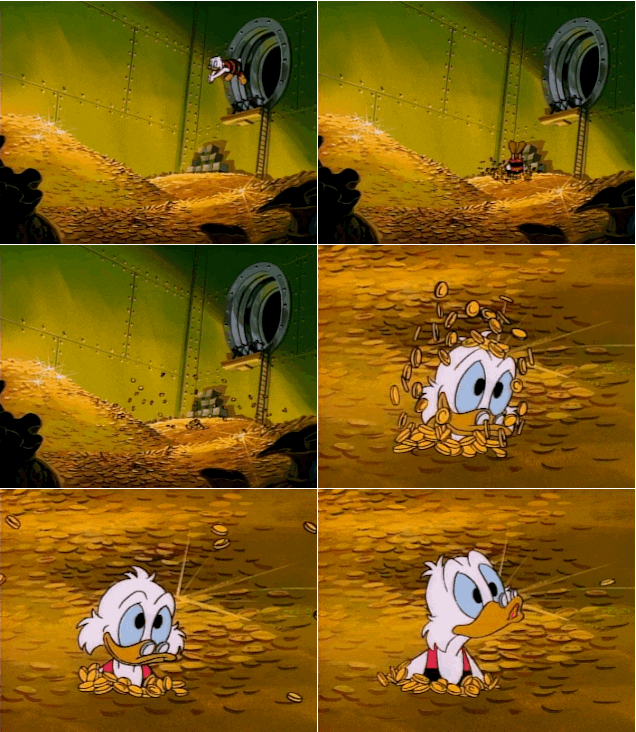
How on earth can the Chicago plan preserve any semblance of “banking” as we’ve come to know it? If I deposit my $1,000 in the bank and it’s required to keep a reserve of 100%, how do they make any loans? How can they pay me interest if they make none of their own?? It would be no different than stuffing my money in my mattress.
By differentiating between demand deposits and time deposits.
With a demand deposit account, and that’s the term used for normal checking accounts, you can “demand” your cash at any time. But checking accounts are part of the fractional reserve setup, so if all depositors demanded their deposits at the same time, the bank would not be able to perform its contractual obligation. Sound money advocates point out that there’s a simple term for this. That term is “fraud.”
With a time deposit, and that’s the term used for what used to be called savings accounts, the contract with the bank can limit the number and amount of withdrawals over time. If all the savings customers of a bank attempted to withdraw all their money as quickly as contractually allowed, the bank would still be unable to satisfy them, but it would have time to attempt to satisfy the demand to a larger degree.
You implied statement that the Chicago plan would make what we call “banking” impossible is quite true. The banking industry would have to undergo torturous change to shift to what would be more akin to money warehouses and the practice of money lending would take on a totally different nature.
Has anyone else seen “It’s a Wonderful Life”?
there’s this thing called COLLATERAL
in this sense it means something of value that backs a promise to repay a loan.
sometimes collateral can be much more valuable than the loan
D.J.,
If you deposit $1,000 in a bank, are you more concerned that the bank can lend your money to someone else, or that you can get your $1,000 back when you go to the bank to withdraw it?
Exactly DJ.
Not only that, but you would have to pay the bank to administer you account, as they would have no other revenue
And none of us would be able to take mortgages out to buy homes, or HP for new cars etc.
@ur momisugly Paul of Alexand
Yes! The finest description of how banking should act to advance the well-being of the community and why fractional reserve banking can be a good thing. And notice that the savings and loan in that case was owned by the depositors.
@ur momisuglyForrest Gardener
First, you are correct in principal regarding the sliding scale that could be adopted. However, in the context of this piece it looks like the green loons are pushing for 100%, so that’s what should be the focus here.
Second, term deposits don’t wall away your money. You can always break the terms and take the penalties, usually around 10% the last time I paid attention. So unless someone changes the penalty level to 90% it means the bank can only lend 10% of my deposit. I’d be lucky not to get a negative interest rate, not even accounting for inflation.
@ur momisuglygnomish
Collateral is almost always ill-liquid. No one will loan you the full value of your collateral because there is always a risk they can’t liquidate it on favorable terms. And suppose everyone is making their payments on time? Will the bank try to seize the home of someone adhering to the terms of their mortgage in order to give me my money?
@ur momisuglyPhil R
Personally I’m most concerned that I can withdraw my funds at need. I’m not sure I understand the point of your question.
@ur momisuglyPaul Homewood
Yes, I didn’t want to bring up administration fees, mostly because we pay them anyway. My mattress has never charged me a nickel 😉
Anne,
The issue you overlook is whether there is collateral involved, and/or third party insurance in case of default.
But you indirectly point out that our economic system runs on trust. Sometimes that is not enough though and banks runs can happen. That is what happened in the early 1930’s… bank runs based on rumor. The FDIC was created by Congress. FDIC exists Not to protect the depositors, but to protect the bank from the contagion of bank runs by spooked depositors.
Bingo, we have a winner
Anne,
Go on and explain the creation, distribution, and destruction of wealth via the stock market.
Someone suggested, recently, that George Soros bought shares of coal companies as they crashed, not because he was investing, but because he was covering “short” positions. If so, I wonder how much of his own cash went into that?
can you say carbon credit derivatives?
If GS was covering shorts as the stocks crashed, he made money. He “shorted” (promised to deliver) coal stocks at a market price. If he then bought when the stocks (to deliver) dropped 50%, he doubled his money.
JPMorgan, et. al., have been playing this game with silver and gold for years.
This has been a gripe of mine for some time. Banks often acted independent of government as they did here in Australia, leading to a free for all of unsecured ‘money’ that saw house prices in Melbourne rise in 1890 to the point houses in that city were priced in the millions – of course none of those promisory notes were backed by anything of value and the whole system collapsed wiping out banks and lives. The government stepped in and said no bank can print money. It all went fine and dandy again until the same thing occurred again in the 1930’s, and again the government stepped in and heavily regulated the banks. In the 80’s the left wing government of Paul Keating deregulated the banking industry to ‘create wealth’ and now we in Aus have a 8 trillion dollar economy backed by 32 billion in printed cash – all backed by a whole 320 million in gold reserves. Tell me how this will end well ??
I did some other calculations too – Pre-deregulation the banks were careful about lending money.. their investments were strictly regulated and meant they could only buy land, develop and sell houses to make a profit. The other control was interest went both ways depositors earned interest and were effectively the banks shareholders, and borrowers paid interest – leading to a two way flow. Post deregulation the banks were sold off, the bank’s ‘shareholder’ (depositor) base were renamed ‘customers’ and they started charging to handle your money. By my conservative estimate based on the number of mortgages and the amounts being borrowed, this meant the banks owned ALL the money inside three years.
If you’re up for it, you can read a presentation by one of the big banks where they quite proudly explain how they inject money into the system by creating money – it’s the same as money printing, when you take out a loan that ‘money’ is invented on the spot.. but this avoids breaking the laws about printing currency. It has the same effect though and is assisted by the new digital banking systems. They then go on to claim this money is secured by the asset it was used to purchase – Looks good on the books and it’s great for jacking up prices.. as long as they always go up.
This also allows them to reduce effective debt. Lend a guy 100 grand today you have 100 grand debt. Lend someone a million the next day for a similar house, that 100 grand debt becomes effectively a ‘smaller’ fraction of debt than it was before – rising house prices are used to shield and protect them from earlier debts.
On another, earlier page I did some calculations about the amount of money versus the house values in play and found that in Oz, selling a mere 6 suburbs worth of houses (not apartments, land or any other building) would take all the cash out of the Australian economy. This was the lightbulb moment that made me realize how flaky and fragile our monetary system is and how precariously balanced it is atop a mountain of non-money.
Finally this isn’t new, Mackay warned about the collapse of finances in his book Popular Delusions and the Madness of Crowds which I think every school kid should read. But go way, way back to Sumerian times and the story goes the banks as a separate entity also ended up a few times owning all the wealth due to interest only flowing one way. It’s all cycles, and without the banks being firmly regulated they WILL always end up owning all the wealth resulting in a population of debt slaves.
The other downside to rampant inflation is, your past deeds are devalued. You work an hour, earn $1 put it away for a rainy day.. inflation means that hour of your life, your labor that you saved is now near worthless. it penalizes sensible savers and devalues the work and effort of the past – and this is wrong.
The alternative is contrary to human nature.. wages and prices consistently go down as the population increases. A fixed money supply means savers and past labors are rewarded. It won’t work though, we’re wired to reject it. To illustrate offer a young kid 1 $100 note or 50 $1 notes and you’ll discover we’re wired to think more is better. they’ll take the 50 $1’s. Imagine a population of 100 people earning $1 a week which they spend – now double the population.. wages drop to half, prices drop to half (the retailer who sticks to high prices goes to the wall) – there’s no depreciation of assets or wealth in any way shape or form. Anyone wo saved money is wealthier than they were before.. it encourages saving, something the banks REALLY hate people doing (they get rich by turning you into an interest paying debt slave).. but it means old folk who are careful are able to truly put aside part of their life hours (in money) to protect them in their dotage. but to truly work, the money needs to be held by the owner – cash in the form of metals, silver and gold.. copper and zinc in hour hand. Sure people argue metals have no true inherent value, but metals are rather damned useful and have the ability to be transformed more than most other materials.
inconvenient to transport and look after though .. Here, take this piece of paper instead say the banks, it’s worth the same amount they tell us. No wait they say, take this pretend money and this plastic card and we’ll take all of that annoying metal from you they promise. And we, en mass hand over our coins and take the convenient plastic and complain when it doesn’t go our way. Mackay was right, but sadly we’ve not learned.
Banking in particular, and economics in general, is every bit as contentious as climate change 🙂
I agree people are hardwired to stack precious metal coins as sort of a savings instinct just like squirrels are hardwired to stack acorns, and the transition away from hard money to electronic currency and ZIRP is an attempt by banks to destroy the savings instinct, leaving only speculating and spending instincts behind. The true inherent value of gold and silver is as honest money and savings … very important things and something even the greenies want but can’t quite bring themselves to admit because their lefty friends would lose their welfare and entitlement programs under true honest money.
Nowhere near correct; it is much worse than that. if the reserve requirement is 10% (I think it is more like 14%) and I deposit $1,000 in the bank, the bank immediately makes a paper entry of $9,000 of “assets”, so they can loan out all $10,000 at 15 or 25% interest, giving them an effective interest rate as much as 250% on the Real $1,000 that was deposited in that bank (for safe keeping).
The FDIC of course guarantees that the taxpayers will pick up the tab if the bank loses the $1,000 you deposited with them (up to some limited amount maybe 100k per depositor or account.)
It’s just flat out fraud.
G
It’s not a paper entry, as the loan has value. They deduct the $9000 that they loan from one account, and add $9000 as an investment in another account.
Sigh. All that fractional reserve does is allow banks to lend the money that has been deposited in them.
It never has permitted them to lend money they don’t have.
PS, even allowing banks to buy treasuries only is still fractional reserve banking.
Hey great idea! Central planning and control, by effectively abolishing capitalism , and private ownership and personal incentives, (or as some like to call it “greed”).
So in other words ,total destruction, closely followed be mass starvation, and anarchy. If limited growth is the objective, then it should be a resounding success.
If you want interest on your money, you allow the bank to loan your money. You share in the profit (and the risk). Interest becomes less important if your money doesn’t continually lose value, which is the case currently.
This is partly true. See Eugene von Baum-Bawerk, Carl Menger, and Ludwig von Mises. Interest arises from the time discount of money. Money in hand right now is the most valuable money (and all economic valuations are personal and subjective … something is worth right now only what someone else is willing to pay for it in trade, right now. Nothing else matters, though other things influence the valuations, for example, manias and panics). Banks in the US are owned by the government, and those under the Federal Reserve hold US Federal Treasury bonds directly and indirectly.
Fractional reserve banking is the kind governments want *because* governments benefit most from the resulting inflation; where inflation is the result of altering the supply of and/ or the demand for money. Credit is a money substitute. Note well that inflation does not require rising prices. There is inflation where economic conditions are such that prices should be falling but aren’t; such as today’s economy. The CPI does not and cannot measure inflation.
As others have said, the key distinction is demand deposits. Fractional reserving allows or compels the banks to lend out parts of the demand deposit assets. This works as long as the day-to-day transactions match asset life to liability life. A fully reserved bank cannot lend against demand deposits. It can lend against its shares or time deposits. Such a bank cannot fail under a bank run on the demand deposits. It may still fail through investment losses. By the way, all investments are speculative, for all economic decisions must be made under uncertainty.
I highly recommend people read Theory of Money and Credit and Human Action.
The problem with these pie-in-the-sky ideas is that they require everyone to be honest and hardworking. That simply is not true. Dangling all the worlds currency in front of a small group of people will quickly result in corruption. Economic growth helps offset the inevitable corruption of the system. Without economic growth, money will quickly be redistributed to those in power and their allies. Since there is no economic growth, those in charge will be richer while everyone gets poorer. And poor people care not about the earth but about surviving until tomorrow. There will be incentive to better yourself because there is no economic growth and thus it would be futile to try. The few special rich individuals will only spend on their own selfish desires.
You don’t have to dig deep in history to find individuals who do horrible things to people. The Nazi holocaust is a recent example, but by no means unique. People were burned at the stake, and those who saw they suffer slept well at night. The Assyrians did terrible things to their captors. The point of all this is that in a world without economic growth, the rich will sleep well at night even though they know the poor are hungry and cold. Their conscience will not be bothered.
The problem with a great number of laws and ideas is that it pretends people are honest and will not look for loopholes. Always think how an idea can be abused, because it will be abused.
“Always think how an idea can be abused, because it will be abused.”
Most especially to apply to the idea that it is legitimate and necessary for some people – those designated as the State and / or its agents – to do things which, by common moral consent, would be considered criminal acts if anyone else did them.
Lord Acton observed that power corrupts, true enough, but I think it is more important that power draws to it corrupt ambitious men.
This would be guaranteed to end in tyranny.
I can only see one tiny glitch, how do you convince people to deposit their money if it is going to be nationalised?
A starker but more accurate term for nationalized is STOLEN!
easy – you announce that new currency is to be issued which is red instead of green
you allow exchange for a very limited period.
you severely limit the amount which can be exchanged.
in one swift maneuver you steal 90% of the liquid capital.
90% of all the savings (whether under the mattress or in the bank) vanishes
the remaining 10% is in the bank because hoarding cash just got punished harshly.
(i remember when russia did that)
John Lennon mocked these peoples back in 1968. Yet they have made no intellectual progress at all since then.
You say you want a revolution
Well, you know
We all want to change the world
You tell me that it’s evolution
Well, you know
We all want to change the world
But when you talk about destruction
Don’t you know that you can count me out?
Don’t you know it’s gonna be
Alright?
Alright?
Alright?
You say you’ve got a real solution
Well, you know
We’d all love to see the plan
You ask me for a contribution
Well, you know
We are doing what we can
But if you want money for people with minds that hate
All I can tell is, brother, you’ll have to wait
Don’t you know it’s gonna be
Alright?
Alright?
Alright?
You say you’ll change the constitution
Well, you know
We all want to change your head
You tell me it’s the institution
Well, you know
You’d better free your mind instead
But if you go carrying pictures of Chairman Mao
You ain’t gonna make it with anyone anyhow
Don’t you know it’s gonna be
Alright? [Repeat: x6]
Read more: John Lennon – Revolution Lyrics | MetroLyrics
Maybe the unit of money should have been: [Joule] – energy
I owe you 1 Giga Joule of work – that kind of currency would be hard to inflate.
It would also re-distribute most of the word’s wealth to China and India.
Don’t be silly.
Or maybe the watermelon version: – I owe you a green certificate.
(Just kidding) #:-) –
Wikipedia:
“Green certificates represent the environmental value of renewable energy generated.”
While the idea of labor as a unit of currency is not necessarily bad, making it solely based on physical energy would not be workable.
Some work is more valuable than other work. A doctor’s time is more valuable than a ditch-digger’s time… even though the ditch-digger may have expended vastly more energy.
I would dig ditches for a month for an hour of a doctor´s time – if I really needed him
(or her -I´m married to one) #:-)
A doctor would treat patients for a few day´s – to get someone perform a service on his car.
However, I would not promise to dig ditches for a 1000 years for an hour of a doctor’s time.
Thus money. It’s really nothing more than man-hours normalized for time-worth.
We already have labor as a unit of currency – it’s called salaries and wages.
the standard of value is human life.
we trade it in fragments for everything good.
ppl sell hours of their lives daily,
for some toy to be there somebody had to spend his time making it instead of exhorting neighbors to do it.
money is a token that represents the standard of value
it should be easy to disntinguish
it should be impossible to counterfeit
it should be indestructible
it shoulde be rare
The Soviet Union tried this in its first few years. They quickly gave it up as unworkable.
Did they? That´s the beauty of a serious mistake – we don´t have to try it again.
Link please. 🙂
Science or Fiction, November 5, 2016 at 5:11 pm
You neglected the caveat, in a rational world.
Trouble is that energy is a property, not a “thing.” Things have energy, but with lots of variables. The potential energy of a bowling ball depends on how high you can lift it, for example. And every time work is done, energy is lost, the Second Law.
And as we see with renewables, energy is notoriously difficult to manage without storage. So the only thing that make sense is to exchange some form of stored energy – oh, like coal or oil, or natural gas or nuclear fuels. Hey wait – isn’t that what this web site is all about? Forget gold, we should be on the coal standard! /sarc
We would probably wind up with a lot of competing currency alternatives, including digital currencies and things like gold. If you’ve read the science fiction Snow Crash,it brings back thoughts of a rather chaotic world, but maybe a bit more honest.
Why all that trouble? I thought ecosex was saving the planet. LOL. You know, find a log bare the hog and get to it.
The discussion has got sidetracked onto the
creation of money
While There is some merit in those discussions
The interesting issue is the main objective
of stopping economic growth which is the
main objective of far left greenies
The same greenies are also on favour of
Welfare and open borders
How do they think the welfare is going tobe
paid for or how the millions of refugees and immigrants who will flood in are going tofind jobs without economic growth?
Nutters
They expect the global population to go down to the “ideal” value of ~850M. Starvation is a tactic. So is warfare / civil war / revolution.
This from the newspaper that wets itself any time the word Brexit comes up because we might not grow as fast as we would have if we’d voted to remain. They should be cheering our imminent impoverishment. Or maybe they fear most it will be a success? It galls them that Brexiteers put their future on the line and voted for a different society, whereas warmist supporters can’t even contemplate a reduction in their air miles to reduce CO2.
It turns out civil servants who don’t face personal consequences if the loan goes bad tend to do a poor job of checking the creditworthiness of applicants. ….
Liberals never think liberals are crooked or worthless.
I suspect what this plan would do, if implemented, is accelerate the ongoing growth of…..socks
…I gotta sock
The whole thing about lending, is lending out the capital with only a fraction held as reserve. If 100% is held as reserves, there’s nothing to lend out.
It doesn’t have a damn thing to do with climate. It’s global governance/fascism/dictatorship designed to make everyone poor and dependent on a privileged few.
“The common enemy of humanity is man. In searching for a new enemy to unite us, we came up
with the idea that pollution, the threat of global warming, water shortages, famine and the like would fit the bill. All these dangers are caused by human intervention, and it is only through changed attitudes and behaviour that they can be overcome. The real enemy then, is humanity itself.”
– Club of Rome – The first global revolution
The green agenda
I wonder what will transpire when it becomes more widely known that CO2 has no significant effect on climate and much of the warming, now countering global cooling, is from rising water vapor. The rising water vapor is nearly all from irrigation, for food and the water table is declining rapidly, world wide. What happens when the fresh water becomes scarce?
Actually H2O is a major coolant in the Earth’s atmosphere as evidenced by the fact that the wet lapse rate in the troposphere is significantly less than the dry lapse rate. There is no real evidence that a radiant greenhouse effect caused by the LWIR absorption properties of so called greenhouse gases exists either in a real greenhouse, in the Earth’s atmosphere, or anywhere in the solar system.
Fresh water is already becoming scares in some areas of the world.
I assume you mean scarce. By fresh water do you mean low salt content, or non-polluted, or something else? With the noted (elsewhere at this site) greening of the world’s deserts it would seem that plant friendly (fresh) water is becoming more available.
Fly – It is the approximately 2.5E15 kg/yr being pumped out of the ground for irrigation that is lowering the water table about a foot a year in the Ogallala Aquifer (US) and much more in India (4.6 ft/yr) and the middle east
It costs about 15 times as much to get the salt out compared to removing ordinary pollution.
The arid areas are greening because of increased CO2 which, besides being plant food, decreases their need for water.
Those who believe in GW have a moral duty to stop using gasoline, natural gas, electricity, and anything else created from fossil fuels. They should not have children, and they should stop using our health care system. They should be encouraged to end their own lives early for the good of the planet.
this is a really funny post.
And WE/Skeptics are being called conspiracy theorists?
The financial crisis in 2008 was wholly due to banks driven by greed and bonuses lending money to other banks without adequate reserves or credit checking. We survived only because central banks printed money to recapitalise the system. It is abundantly clear that trusting banks to operate prudently is simply naive, and more state control over bank regulation and margins in needed.
However using money supply to suppress growth is frankly daft. But changing perceptions of what constitutes success and improvement in well-being has some merit. Gross GDP is a very crude measure which has only a passing relationship with the wealth of human happiness.
For those on low incomes or lacking in basic facilities absolute income may be important. If we can detach ourselves from the somewhat shallow attachment to gross consumption driven by brand advertising, low self esteem and social pressure, those on mid and upper incomes may be happy to trade a little income for longer vacations or 35 rather than 50 hour weeks.
In the US, the Housing Bubble was driven by giving loans to people who could not qualify for traditional loans in the name of “Fairness”. This was driven by Progressive politics. The banks just went along for the (very profitable) ride.
Lending standards were relaxed and ultimately eliminated. “No Doc, Subprime” loans became more common, then the norm.
When Obama took office, he punished, blamed and extorted money from the banks who were simply complying with the Progressive agenda.
Reg Nelson commented: ‘…When Obama took office, he punished, blamed and extorted money from the banks who were simply complying with the Progressive agenda….”
+1 But he also bailed them out. No harm no foul.
markl November 5, 2016 at 6:31 pm
Reg Nelson commented: ‘…When Obama took office, he punished, blamed and extorted money from the banks who were simply complying with the Progressive agenda….”
+1 But he also bailed them out. No harm no foul.
——
TARP was passed by Bush before Obama took office.
Obama takes credit for it, of course, and blames Bush for the increase in the Federal Debt that resulted. He then bench-marked that year to justify his exponential, exploding deficit spending.
I didn’t think I needed the /sarc tag. 🙂
“Lending standards were relaxed and ultimately suspended. . .”
True.
Wall Street-sponsored legislation helped them pull the real estate plug on America and the world and qualify people that a loan shark wouldn’t touch for billions in loans to buy millions of homes they couldn’t afford.
The Street then mixed, bundled, certified, and insured these loans with what buyers thought were reputable ratings past corrupt regulatory agencies and sold and resold this worthless paper to thousands and thousands of banks, trusts, investment funds, retirement funds—you name it—worldwide. Who in turn sliced, diced, and resold the bundles to others. . .
Not only did they do this with worthless mortgages, they did it with all manner of things financial. Called them “derivatives, CDS’s, LBO’s, etc., etc..”
.
$600 trillion fictitious dollars worth by one estimate. Over a quadrillion by the Bank of International Settlements’ (BIS) estimate.
All “toxic” (worthless) paper backed with no assets brought about by “moral hazard” (theft, greed, fraud, lies).
The world’s GDP is only around $75 trillion.
All the money in the world comes short of $600 trillion.
And they want you and me on the tax hook “loans” to go the financial bail for these lying, thieving, con-artist-criminal-stump-jumping-shuck-and-jive-the-sky-is-falling-paper-money financial scammers? The ones who knowingly and deliberately set this $600 trillion giganticus raticus fornicus loose on the rest of us?
Wall Street insiders who revolved into government financial positions have enriched their executive friends still on Wall Street with tax dollars; enabling their buddies to pay themselves kingly bonuses and their companies largess to purchase other banks and businesses for pennies on the dollar.
America and the world watched in disbelief as these thieves and their confederates and enablers—our elected flim-flammers (through deliberate legislation)—went public with their scam; printing and throwing “bailout” money around the world like confetti at a V-Day parade before stepping into into their limousines and and handing humanity the tab for tens of trillions of QE that their central banks printed and the goyim cannot repay.
Ever.
So we stand out here with our noses pressed against the bank window and watch a bunch of financial criminals running around inside looting money; pausing, occasionally, to flip us off and let us know they’re doing ‘god’s work’.
Which was the whole idea from the start. Suck the last drop of blood from the financial system, hook it up to QE life support, and jerk the plug whenever they’re ready to crash and spring the New Financial System on humanity with–would you believe?–themselves in charge by virtue of the fact they’ve been doing this for centuries and have stolen the most loot; thus making them the most qualified to run their so-called “new world order”. . .
Pigs fly, too.
Look close. The Internet’s sunlight is beginning to shine in the ship’s hold. See these Marxists bilge rats yet?
Reg, the TARP that was passed under Bush was the same TARP as executed by Obama.
“Wall Street-sponsored legislation”
No matter how badly government messes up, the socialists will always blame the capitalists.
I actually don’t know anybody who measures their well being in terms of GDP.
Do you know people who measure their well being by their standard of living? Job creation and retirement income tend to move in the same direction as GDP. I wonder why?