By Larry Kummer, from the Fabius Maximus website
Summary: The peak oil hysteria provides rich lessons for us today about learning from activists and the value of listening to our major professional institutions. Easy cynicism led people to believe outlandish forecasts, wasting valuable time and resources. Worse, we have had many such barrages by doomsters — aided by their clickbait-seeking enablers in the media — which have left us almost immune to warnings, no matter how well-founded. We can do better.

Where were you during the peak oil hysteria? It began in 2005 and died in 2013, marked by the opening and closing of The Oil Drum website. Despite their analysis and forecasts proving to be mostly wrong, most of their authors are still “experts” publishing elsewhere (see this bizarre example). That follows the pattern of modern American doomsters, such as those who in the 1970s predicted global catastrophes from pollution and famine. Perhaps the activists predicting a climate catastrophe will add their names to this list in the next decade.
It’s not just historical trivia. We must learn from these bouts of irrationality if we have any hope of regaining the ability to govern ourselves.
Maximum World Oil Production Forecasts
Memories have faded, but a decade ago the predictions of end of oil were hot news. Comment threads overflowed with people terrified of the future. Conferences were held and books sold trumpeting certain disaster as the lifeblood of our industrial civilization dried up. Many of the following names were highlighted in journalists’ Rolodexes as the go-to people for hot quotes. Then as now, the names least often consulted proved to have the more accurate forecasts.
- 2005 – Pickens, T. Boone (Oil & gas investor).
- 2007 – Bakhitari, A.M.S. Oil Executive ((Iranian National Oil Co. planner).
- 2007+ – Groppe, H. (Oil / gas expert & businessman).
- 2007 – Herrera, R. (Retired BP geologist).
- 2008+ – Westervelt, E.T. et al (US Army Corps of Engineers).
- 2009 – Deffeyes, K. (retired Princeton professor & retired Shell geologist).
- 2009 – Simmons, M.R. (Investment banker; see the posts about his work).
- 2010 – Goodstein, D. (Vice Provost, Cal Tech).
- 2010 – Wrobel, S. (Investment fund manager).
- 2010 – Bentley, R. (University energy analyst).
- 2010 – Campbell, C. (Retired oil company geologist; see the posts about his work).
- 2010 – Skrebowski, C. (Editor of Petroleum Review).
- 2011 – Meling, L.M. (Statoil oil company geologist).
- 2012 – Koppelaar, R.H.E.M. (Dutch oil analyst).
- 2012 – Pang Xiongqi (Petroleum Executive, China).
- 2015 – Husseini, S. (retired Saudi Aramco).
- 2020 – Laherrere, J. (Oil geologist , France).
- 2020+ – CERA Energy (consultants).
- 2020+ – Wood Mackenzie (consultants).
- 2025+ – Shell.
- 2030+ – EIA and IEA.
- No visible peak – Lynch, M.C. (Energy economist).
These predictions were made during 2003 – 2008 (collected by Robert Hirsh; most sources are listed here). Most were given with qualifying language expressing uncertainty about the dates. Some of these people, especially those associated with the Peak Oil movement, had given different dates — moving them out as time passed. Most of these are documented, but details of some have been lost over time.
The forecasts of major energy agencies’ look good a decade later. Much as with climate change, activists disparage (often contemptuously) analysis of the professional institutions — but in hindsight it is clear who we should have listened to.
Let’s look at these predictions in the context oil production history.
Forecasts of Oil Production made in 2008
The following table shows the actual production of crude oil and liquid fuels — and the IEA forecast for production in 2015 from their World Energy Outlook 2008, published as energy prices were on their way to a record high? Eight years later, how accurate was IEA’s forecast? It was eerily accurate — somewhat accidentally, as the IEA did not foresee the 2008-09 global recession and so over-estimated GDP growth.
The IEA and EIA use similar definitions for “liquid fuels”.
World Production vs. the WEO 2008 Forecast
(million barrels/day)
| Year | 2005 | 2006 | 2007 | 2008 | 2009 | 2010 | 2011 | 2012 | 2013 | 2014 | 2015 |
| Crude Oil | 73,864 | 73,478 | 73,164 | 74,062 | 72,871 | 74,653 | 74,734 | 76,160 | 76,248 | 77,833 | N/A |
| Liquid Fuels | 85,099 | 85,135 | 85,130 | 86,515 | 85,703 | 88,099 | 88,532 | 90,466 | 91,014 | 93,201 | 97,900* |
| WEO 2008 | 86,000 | 96,000 |
Historical data from the EIA website.
* The 2015 total is for Q3.
The bottom line: liquid fuel production increased by 15% during the decade after 2005, so that prices have plunged (exacerbated by the Saudi price war). Prices will remain under pressure unless OPEC reestablishes its control, production coming online from investments in the giant fields of Iran and Iraq, the spread of fracking to other nations, and new tech (e.g., hybrid and electric cars).
Also note the increasing difference between production of crude oil and all liquid fuels. The rise in crude oil and, more broadly, liquid fuels were driven by new sources whose potential was mostly ignored by the Peak Oil doomsters). Crude production rose from deepwater and fracking wells, plus mining bitumen (aka oil sands, which technically does not produce crude oil). Liquid fuels production rose from production of natural gas liquids, biodiesel, ethanol, and those converted from coal and gas. Most numbers you see for “world oil production” are for all liquid fuels.
While in 2008 the IEA accurately estimated liquid fuel production for 2015, they over-estimated demand. As a result, the WEO 2008 price forecast for 2015 was too high.
“The era of cheap oil is over … The average IEA crude oil import price, a proxy for international prices, is assumed in the Reference Scenario to average $100 per barrel in real year-2007 dollars over the period 2008-2015 and then to rise in a broadly linear manner to $122 in 2030.”
Conclusions
As many of us predicted during the peak oil hysteria, high oil prices had three great effects — all predictable…
- Increased efficiency of energy use — as consumers and businesses invested to increase the efficiency of the more expensive energy (and R&D produced more ways to do this).
- Increased production of oil (boosted by R&D making more “resources” into usable “reserves”. Today’s $30 oil shows that production growth has exceeded demand.
- New sources of liquid fuels — including both new hydrocarbon-based supplies (bitumen in Canada and Venezuela), new carbon-based fuels (e.g., coal to oil, although oil prices never rose to make this viable), and new carbohydrate-based supplies (e.g., ethanol from corn).
Only time will tell about the IEA’s forecast for 2030 of $122 oil (in 2007 dollars). But today’s oil glut gives us an opportunity to prepare alternative supplies in an inexpensive and orderly manner, not only reducing the risk of energy price shocks but also reducing pollution and the risk of unpleasant anthropogenic climate change. Let’s make use of the gift.
Equally important is that we learn from this experience with the peak oil movement. Activists and enthusiasts have terrible track records at long-range forecasting, despite their confidently loud predictions of doom — echoed by clickbait-seeking journalists . That does not imply that we should blindly trust major institutions (as the scandal about Flint’s water supply shows), but skepticism pays large dividends and allows more rational preparing for the future.
For More Information
For a deep look at these issues see Exxon’s new report “The Outlook for Energy: A View to 2040“. Also see these…
- Important: Recovering lost knowledge about exhaustion of the Earth’s resources (such as Peak Oil).
- When will global oil production peak? Here is the answer!
- The three forms of Peak Oil (let’s hope for the benign form).
- Peak Oil Doomsters debunked, end of civilization called off!
- Prepare now, for oil prices will rise again.
To learn about the minerals that power our world, and will for many years more, I recommend reading the IEA report Resources to Reserves 2013. Here is a brief slidedeck of its contents. For a deeper look, see the IIASA’s Global Energy Assessment (a widely cited source document, including by the IPCC’s AR%). Here is a 113 page summary.
Discover more from Watts Up With That?
Subscribe to get the latest posts sent to your email.
The first reference to “Peak Oil” I ever came across came from the mid-19th century, when the shale oil industry made Scotland the World’s biggest petroleum producer and exporter.
http://www.scottishshale.co.uk/index.html
I have a WWII engineering textbook which asserts that the World’s oil would run out by the 1960s.
Some things never change.
There is Hubbert’s theory form 1956, and even older predictions:
“The idea that the rate of oil production would peak and irreversibly decline is an old one. In 1919, David White, chief geologist of the United States Geological Survey, wrote of US petroleum: “… the peak of production will soon be passed, possibly within 3 years.””
This is for US oil production though, not worldwide.
https://en.wikipedia.org/wiki/Peak_oil
Unfortunately what is true for one well does not extend effectively for an entire region, let alone the globe, especially when there are decades of improving technology and price incentives involved. This is not unlike people trying to build macro-economic models from micro theory … the system is simply too complex to model effectively. Too many unknowns, or poorly knowns, leads to a highly unstable and unrealistic model. I remember venturing to The Oil Drum a couple times to debunk some of their silliest comments but it was a feral echo chamber. Not unlike some warmist sites that spring to mind.
Substitutes for much of oil’s markets will arise long before depletion becomes a significant issue. It has always been thus and this time is no different. The onus is on the doomsayer to disprove the null hypothesis. So far, from Malthus to IPCC, they have all failed, at least in scientific terms. The latter has had some political success …
Likewise, the real experts have been proving them wrong since the early 20th century.
http://archives.datapages.com/data/bulletns/1949-52/data/pg/0036/0012/2200/2231.htm?doi=10.1306%2F5CEADBD8-16BB-11D7-8645000102C1865D
There is enough petroleum in the Green River Formation alone to make peak oil nothing but an economic issue. However, it is an economic issue. These cheap energy prices won’t last forever and when they do increase it could be ugly.
The US oil industry simply won’t be a very good swing producer. OPEC as the swing producer works (when they cooperate) because they have the ability to flip a switch and increase/decrease production. Operators in the US, however: receive capital, plan where to invest it, plan how to do it, ask the government permission, wait, drill, wait, complete, then hope the investment pays off soon.
Increasing oil production in the US, once the price starts to correct, will take longer than OPEC flipping a switch. It will be interesting to see how eager the nervous investors are to get back to drilling. I think it will need to look like it did while everyone was drilling, $80+/bbl. How far above the price correction will determine how fast the rigs get back to drilling.
I could see U.S. production dropping to 7.5 M/day sometime in 2017 and that is more than enough to turn the surplus into a deficit.
When oil does start to run out, it will do so gradually. We won’t go from $30/brl oil one year to $300/brl oil the next. We are pumping the cheap sources first, as those run out, we switch to more expensive sources. As the mix of sources gradually shifts from cheap to expensive, prices to will gradually rise.
As a result, we will adapt.
That ignores the history of the price of oil. It’s been volatile in the past, but as the U.S. acting as the swing producer, it will be more so.
@MarkW
Actually, while the literal text of your statement is correct, I don’t agree with the notion of “$300 oil” or “$30 oil”.
The price of oil, much as with real estate and many other assets, is priced at the margins. $147 oil occurred because emerging market oil consumption grew faster than oil production capacity; the fall since then is because of reduced demand from same *as well as* increased production.
The cure for cheap oil is…cheap oil.
The cure for high oil prices is…demand reduction and production increases.
This particular downturn in price, IMO, is because of US shale producers and Saudi Arabia both locked in respective junk bond and social spending traps – which prevent either from production cuts. Only if you posit that the Saudis are stupid would they be attempting a price war vs. a shale industry which *has* to pump to survive – it is far from clear that Saudi Arabia’s reserves can outlast the junk bond covenants of enough of the US shale industry to matter. Unlike Russia, Saudi Arabia cannot cut its imports to match export earnings due to its vast repressed majority. I’ve noted elsewhere that Saudi Arabia’s GDP per person and population have both increased 50% since 2000 – this gives Saudi Arabia a cost profile which is more than double what it was even 15 years ago.
The possibility of stupidity is non-zero – however – since Saudi Arabia’s historical gambits did work to affect oil major production and drilling.
One factor undermining the credibility of Hubbert’s ideas – one can scarcely dignify his views with the word “hypothesis” – is that among his many predictions he had exactly one success. U.S. oil production.
Of course with that single, successful prediction he needed no others but pointing out that Hubbert had no other successful predictions didn’t make me an especially popular fellow with Peak Oil adherents.
Since there wasn’t any substantive response to that shortcoming I was inevitably treated to a blizzard of invective each time I brought the subject up. At the time I didn’t see the response as a tacit admission of defeat but I do now.
While the price of oil is volatile, it always swings above and below it’s true price. The true price will change gradually meaning the next absurd high will be a little higher and the next absurd low will likewise be a little higher.
allen: And even that one “success” was only true for awhile. The current increases in production negates even that one “success”.
My Children’s Encyclopedia from the 50s predicted that the world would run out of coal by 2000.
How about 1892:
the US oil industry brought us to within a stone’s throw of achieving the nation’s longstanding stated goal of energy independence, only to be thrown under the bus and vilified when foreign interests undermined the industry.
It’s just a matter of political will.
I’ve advocated for a “Flexible Tariff” to prevent such predatory pricing.
The notion is to put a price floor under imported oil, but leave domestic prices open.
So you pick a price that prevents predation, call it $50/bbl. The Flex Tariff is set at:
( $50 – import market quote ).
Say Opec oil is trading at $40, the tariff would be $10/bbl.
Say Opec oil us trading at $80, since 50-80 is a negative number, the tarrif is zero.
That is, the tariff does nothing until a price war happens, then it protects the domestic producers from ruinous price wars and predatory pricing.
I’d either apply it to OPEC production since they are the cartel that does the predation, or alternatively, have it be NAFTA wide on all outside producers (protecting Canadian and Mexican producers too).
Fairly easy stabilization method, IMHO.
US oil production peaked in the mid 1970s, and has never recovered compared to the demand requirements of the US. The US doesnt have any super giant fields left to give it energy independence.
“The US doesnt have any super giant fields left to give it energy independence”.
-not true, unless you limit your thinking to conventional production.
Steve R, you need to read up on the USGS and EIA estimates of TRR from all unconventional US oil. TRR is technically recoverable reserves, AT ANY PRICE. Guess what. Only about 15-18Bbbl. It has nothing to do with political will. Its simple petroleum geophysics, which anyone should be able to comprehend if not calculate. If only they would bother to. You apparently have not. See more details downthread. Or read my two ebooks on this. Illustrated, like for elementary school.
This could be said of any resource with a narrow definition of what constitutes the resource. Sulphide nickel will eventually give way to laterite (oxide) nickel deposits, but not so much at current prices. There are a few laterite producers on the brink right now, but nothing a price hike won’t fix. So it is with crude oil … heck convert coal to liquid fuel if the price is right and there is enough coal to do that for a long, long time. But there is not much point in doing this for the foreseeable future. Besides fusion can’t be that hard, right? Got to crack it eventually.
BTW as an aside, reps for Saudi and Russian are meeting shortly. They are probably going to discuss how to avert the crippling race to the bottom of the barrel.
http://www.wsj.com/articles/saudi-russian-oil-ministers-head-to-qatar-to-discuss-production-1455566388
Apologies for the awful pun…
Define field. The entire Bakken shale could be called a field, and it is certainly super giant. We have not even tapped numerous other good frackable source layers. At $80 we can swim in oil a long time.
It costs money to prove up reserves. This is a point that the academics missed when I was a senior in Chemical Engineering and was advised to avoid the oil industry as there was only fifty years of proven reserves. That was back in 1952. Who would spend money to prove up reserves more than fifty years in advance?
Similarly, TRR relies on studies that cost money to carry out. My guess is that the estimates fall far short of actuality.
Doug. Let me give you two fairly precise definitions for different circumstances, so that you might learn. A ‘field’ within a basin is a stratigraphic overlying trap where oil ( or gas) might migrate and be trapped over geologic time. Big, small, tall, short, wide, narrow, fractured or faulted…usually identified by seismics based on ‘hollow’ echoes.
A basin is a source rock ‘pan’. North Slope, North Sea, Bazhenov, Permian in Texas. You would benefit by learning the oil production differences.
Daily U.S. oil production set the record in 2015, however, the low price of oil will have a negative impact in 2016.
Correct. It has capital destroying shale formations with just enough core areas to allow the scam to continue.
“heck convert coal to liquid fuel if the price is right and there is enough coal to do that for a long, long time. But there is not much point in doing this for the foreseeable future.”
Negative ERoEI. Interesting how so many people ignore this basic concept of physics because they dont understand it.
” Besides fusion can’t be that hard, right? Got to crack it eventually.”
Fifty years and counting, still no solution. Thorium Reactors is our best hope, yet completely ignored for political reasons.
“Define field. The entire Bakken shale could be called a field, and it is certainly super giant. We have not even tapped numerous other good frackable source layers. At $80 we can swim in oil a long time.”
Bakken will give up less than 3% of it’s in-situ oil. Plus the rate of extraction is pathetic. Unlike a conventional deposit, production from a tight shale well doesnt follow a bell curve. It follows a decay curve. That means you have to drill exponentially more wells just to keep the flow rate constant.
You are incorrect, the development of unconventional oil has produced a resurgence in us oil production with production levels matching those of the 1970’s and current US oil consumption is LOWER than in 1970.
Off topic but of relevance to the Ocean climate and perhaps a few readers here:
According to the ‘Voice of Russia’:
“Radiation levels in Albacore tuna have tripled post-Fukushima, according to Oregon State University (OSU) researchers. The scientists came to that conclusion after conducting a study on fish caught off the coast of Oregon.
According to Delvin Neville, a graduate research assistant at OSU, these trace levels are too small to be a realistic concern. “A year of eating albacore with these cesium traces is about the same dose of radiation as you get from spending 23 seconds in a stuffy basement from radon gas, or sleeping next to your spouse for 40 nights from the natural potassium-40 in their body,” said Mr. Neville.
However, researchers with the National Oceanic and Atmospheric Administration (NOAA) and the GEOMAR Research Center for Marine Geosciences say the worst is yet to come and that the most highly radioactive water hasn’t reached US shores yet.
Regardless, all scientists apparently agree that the radioactive contamination is still traveling in ocean currents, the long-term effects of which remain to be seen.”
the radioactive contamination is still traveling in ocean currents, the long-term effects of which remain to be seen.
Yadda yadda. The long term effects of Hirosohima, Nagasaki and Chernobyl and decades of atmospheric testing have been seen. Or rather they haven’t.
Like the dog that barked in the night, the interesting fact is that there are no long term effects.
Tripled, but from what level.
You seem to be one of those people who actually believes that any increase in radiation is by definition bad and will kill people.
Only a complete idiot would label those waters highly radioactive, even while they were off Japan, and they have been diluted by many orders of magnitude since then. Not to mention the effect of half-life decay.
This is just my opinion, but spread the rumour/news about “radioactive Tuna” far and wide. Maybe people will stop eating Tuna and other ocean fish and they will have a chance to increase their populations. I believe we are overfishing the oceans. (It makes Global Warming a non-issue.) A moratorium would be a good thing. Like turtles, we need to start farming fish and let the ocean recover. (I hope that doesn’t label me as a left wing econut – if it does, read some of my other posts. (I am a centrist) I think we need more protection of the oceans. End rant.
Three times miniscule is still miniscule. Fact is natural levels of radioactivity are very variable. In the UK there are areas where the old Central Electricity Generating Board realized they could never build nuclear power stations because the natural background radiation level exceeded the max level allowed for their nuclear workers.
@Leopold Danze Smith
You can say ‘Yadda, yadda’ all you want. It is still a relevant issue. To me, the issue carries some very personal relevance. In 1942 my grandparents moved from Minnesota to Tonopah, Nevada, where within a hundred miles, during the1950s and 1960s the U.S. Military and the Atomic Energy Commission conducted very many above ground atomic tests. This was prior to a full understanding of fallout and all the damage the various radioactive isotopes had on living organisms.
Both of my grandparents died of cancers, my grandpa at 47 and my grandmother first got uterine and bladder cancer in the 60s and died of it 15 years later. My uncle died of problems associated with thyroid cancer, my aunt has severe, unusual nerve problems now. Countless young kids died of leukemias and many ranchers in the area who weren’t themselves suffering from their own or their family members problems with various, sometimes mysterious illnesses had to deal with cattle, horses and sheep with all of the same, including burns from radioactive fallout on their backs… Milk tainted with radioactivity, etc, etc. There are stories of children who were simply just playing outside in their yards for a few minutes and who came inside with severe burns, like sunburn, on their backs or where any fine film of dust settled.
St. George, Utah, a place which was hit with fallout on a regular basis, was the site where a famous John Wayne movie was filmed and a very many of the cast and crew were exposed to the dust in the area by the winds and all the dust kicked up by the horses in the filming and all the wrestling in the dirt they did for the filming. Over a few years after the film was released, a very many of that cast and crew died from various forms of cancer and other unusual illnesses. Including, later, the man himself, John Wayne.
So, ‘yadda, yadda, Leo. I am a proponent of Nuclear energy as a wonderful source of power for us and believe it should be our main source of clean power here in the U.S. As long as all the safeties are in place. But I do have a good reason to be concerned about the consequences of accidental releases of radioactive isotopes traveling around in our food chain, and closer to our fishing grounds here on the Pacific coast.
And as far as your bonehead statement that exposures to radioactivity have no long term effects, that is just, simply ignorant. Go live in a house in an area where Radon is a problem and just laugh it off as a no consequence situation for as long as you can and then tell me it has no effects.
D
Dahquist:
You do realize you are comparing exploding dozens of fission bombs in the atmosphere with generating electricity with fission power and the few leakages that have happened? There is a difference.
“the US oil industry brought us to within a stone’s throw of achieving the nation’s longstanding stated goal of energy independence,..”
Really? If that were true, why would the pure shale producers be showing large negative free cash flows even when prices were over $90? And note that when the North Slope production came on-line it was just a blip on the American production curve. Shale is exactly the same. A lot of scam artists made money by selling equities in money-losing operations and in the end the taxpayers will have to bail out the financial institutions that made loans that should never have been made. What gets to me is the fact that shale company managers were honest about the funding gaps all along the way but investors and analysts ignored them because production was going up and prices of the shares were doing well. Now that the balance sheets are impaired and restatements are on the way shareholders are about to get wiped out and bondholders will get pennies on the dollar of investment.
“As many of us predicted during the peak oil hysteria, high oil prices had three great effects — all predictable…”
Great post. Thanks.
If I had to guess, I would wager the author understands the Austrian School of Economics. Heck, he may even have read Mises and Rothbard. (just a guess)
Mark,
That’s a remarkable guess, and spot on. I’m in finance, so a basic understanding of economics is essential.
Mark, I’ve been following your site for a while and I’ve learned a lot. Keep up the good work!
We are nowhere near the ‘peak debt” that equals a peak reduction of CO2 emissions.
Look at Greece. This country will be the new ‘peak debt’ normal. Who in that country can now afford to buy the same amount of petrol for instance as they did before the crippling austerity measures were introduced.
We need to start talking about “peak debt” which is governed by ‘peak stupid’. 🙂
From http://finance.yahoo.com/news/us-rig-count-falls-both-190007032.html
“Analysis of the Data
Weekly Summary: Rigs engaged in exploration and production in the U.S. totaled 541 in the week ended Feb 12, 2016. This was down by 30 units from the previous week.
The current nationwide rig count is still less than half the prior-year level of 1,358. Notably, the count had risen to a 22-year high in 2008, peaking at 2,031 in the weeks ended Aug 29 and Sep 12.
From: https://mises.org/library/our-money-based-debt
” Marriner Eccles was the Governor of the Federal Reserve System in 1941. On September 30 of that year, Eccles was asked to give testimony before the House Committee on Banking and Currency. The purpose of the hearing was to obtain information regarding the role of the Federal Reserve in creating conditions that led to the depression of the 1930s. Congressman Wright Patman, who was Chairman of that committee, asked how the Fed got the money to purchase two billion dollars worth of government bonds in 1933. This is the exchange that followed.
ECCLES: We created it.
PATMAN: Out of what?
ECCLES: Out of the right to issue credit money.
PATMAN: And there is nothing behind it, is there, except our government’s credit?
ECCLES: That is what our money system is. If there were no debts in our money system, there wouldn’t be any money.2″
Peak oil is governed by peak debt.
Money is created out of debt.
Whilst everything is funded by money printing with more than enough to go around, ‘peak oil’ demand is approached and thus ‘peak oil’ supply cannot match demand.
If the central banks stop supplying cheap debt/money, or are not able to print the debt/money fast enough, then the movement is ‘away’ from ‘peak oil’ and the supply increases outstripping demand.
And therefore, economic crisis equals a reduction in CO2 emissions. An economic boom equals an increase in CO2 emissions.
Peak oil demand is governed by the rate of money/debt printing. In turn, this governs anthropogenic CO2 production.
When the printing presses are turned on, CO2 emissions increase, and conversely, when the debt money printing presses are turned off, the CO2 emissions decrease.
Well, I read (or, more accurately, tried to read) von Mises. Dry and too academic.
Let’s get back to economic reality. Money is debt when you can trade it for something of intrinsic value, like gold or silver, or oil, though it’s a bit slippery to put into your pocket. Money stuck out there with nothing backing it will eventually crash when people lose confidence in it. And Eccles was the village idiot on the Goon Show, the great British radio comedy in the 1950’s.
JimB,
If von Mises is too academic (he was academic all right) then perhaps Walter Block would please you much more. (and he still lives and teaches)
Rothbard never said that we would have unlimited amounts of whale oil. He just said that if the demand were there, investors looking to make a buck would figure out a way to come up with alternatives.
But that is the problem that you guys miss; Rothbard assumed a relatively unhampered market, not one that would starve investors of capital because a huge credit bubble created by the Fed sucked all of the available funds into malinvestments. The marginal producers need oil to be well over $100 and most producers can’t make an economic profit under $50. And if you know your Rothbard you would know that he did not think very highly of aggregate data. A barrel of light sweet produces a great deal more gasoline and jet fuel than a barrel of heavy oil, which is better at producing bunker oil and asphalt. Looking at the aggregates gives you a very different picture and muddies the waters. Looking at the SEC filings tells you a very different picture because it showed that shale was not profitable even when oil was over $90 a barrel. If you have a well in the core areas of the better shale formations you can make a lot of money. But those areas are a tiny percentage of those formations; when the rest of the formation is developed capital is destroyed.
The Austrians would benefit a great deal if they paid a bit more attention to the points that Strauss made about the nature of politics and the ruling class. It actually fits beautifully with Mises’ praxeology but for some reason the Austrians want no part. I guess that they have yet to figure out that Lebron James showed that Rothbard was wrong when he published his letter to Cleveland fans announcing that he was coming back.
Rewind to 1986 when ALL the experts (CEO’s, geologists, geophysicists, etc) told us that the world’s gas resources would be TOTALLY EXHAUSTED by 1995.
Too Right, Mate,
“to 1986 when ALL the experts (CEO’s, geologists, geophysicists, etc) told us that the world’s gas resources would be TOTALLY EXHAUSTED by 1995.”
Can you give us some supporting citations for that? That’s an odd date for such a thing. In 1985 the Saudi’s opening the spigot and began the 1980s oil glut: https://en.wikipedia.org/wiki/1980s_oil_glut
More broadly, geologists have known for many generations that there is an inverse relationship between ore quality and quantity, so that once the world is fully explored costs will rise over time — offset by better tech that lowers the cost of extraction and refining (details here).
At some unknowable point in the future either the balance will tip so that rising prices force lower production (aka peak oil and demand destruction) — or new forms of energy replace oil. The EIA and IEA put that data at beyond 2030 — that is, beyond our visible horizon.
…” Despite their analysis and forecasts proving to be mostly wrong, “..shouldn’t that be ” proven ” not proving ?
Marcus,
“proving to be wrong”
“Proving” is correct (or at least good enough), since the process of predictions being shown to be wrong continues today.
Hundreds of years away really. And we can always build nuclear and simply plug in our cars forever in a pinch with today’s tech.
…Your 2nd paragraph..
..Thanks Fabius, my bad ! lol
Editor of FM.
, I can not recall the publications, but I was a senior executive with ARCO at that time (retired soon after). Internally we found it amusing as Prudhoe Bay was going great guns and we knew the Ruskie territory was ripe, BUT that’s what the “EXPERTS” (and the press) were saying.
If you do a press search, they will give the names of the relevant “experts”.
Editor,
Please note I am talking about gas, not oil.
But isn’t “peak oil” the underlying basis for “Global Warming/Climate Change” and the IPCC ?
If “Global Warming/Climate Change” were truly about the atmosphere mix of greenhouse gases, why would any body ever consider bio-mass/ethanol/bio-fuels ?
It’s about sustainability and “peak oil”.
That was then, this is now. But it does illustrate the modus operandi in situations like this: Hype the fear, publicize it endlessly, get political programs pushed through based on the fear, and then, when it all falls apart – change the subject and say “oh that’s old news, nobody wants to talk about that anymore.”
And ridicule anyone who does try to talk about it for “dwelling in the past”. The “Peak Oil” scare served exactly the purpose it was meant to serve, and now that its over the people who pushed it will just go on to a new scare.
We cannot say this enough – ALL of these scares, at their core, are about nothing but power, and those who seek to use them to seize power for their own purposes.
Started by The Club Of Rome in the 70s via Limits To Growth by Meadows et al and continued by them into the UN IPCC and the Agenda 21 crowd (also UN driven).
It is an organized effort over generations to gain economic control, and has been succeding.
Definitely most at The Oil Drum were AGW catastrophists that didn’t see or understand the revolution of fracking. They lost the argument and went home.
They kicked me out because I always questioned and challenged their AGW stance.
I was always amused by the number of people I met on the Internet who were simultaneously “Peak Oilers” and “Global Warmers” and didn’t even see how one contradicted the other.
Odd, because the ones who were not AGW catastrophists are the ones still publishing.
Beware of bigotry – just because warmists are wrong about AGW, doesn’t make them wrong about everything.
I am sure even Mann can tell left from right. Mostly.
Being wrong about AGW shows that your judgment is at best questionable. Which in turn puts any other pronouncements in doubt.
If finally just occurred to me what to do about ethanol- The EPA must require that any ethanol produced from edible crops only be produced without using fossil fuels. That would put a cork in it!
Leo Smith,
Thanks for that. Nothing is worse than meeting someone who stuffs a manifesto in your mouth after hearing you voice one opinion.
If I said something about rescue cats, it wouldn’t mean I’m against hunting.
If I were against hunting, it wouldn’t mean I’m against the second amendment.
If I were against the second amendment, it wouldn’t mean I voted for Obama.
If I voted for Obama, it wouldn’t mean I supported his plan for health care reform.
If I supported his plan for health care reform, it wouldn’t mean I’m a socialist.
People hop right over this s–t and assume that if I say something about rescue cats I have nude photos of Joseph Stalin in my wallet. Don’t assume! (or I won’t let you see the photos)
If you support a socialist solution to a major problem, you might not be a socialist. You might just be an idiot.
Those milk toasts will really melt down with peak TRUMP…
As will the country.
The real issue is when we will see peak subsidy?
Yes, the sooner we stop spending on ‘unreliables’ such as solar and bird mincers the sooner we can concentrate on really feasible solutions such as in-situ coal gasification, molten salt, fusion, and more efficient extraction methods for the really huge quantities of methane hydrates that carpet the floor of the oceans.
catweazle666:
If you think in-situ coal gasification will become technically feasible in any foreseeable future then please contact me because I know a bridge you may want to buy.
Richard
The Macondo blowout and subsequent efforts to cap the well provided a very public and well known example of what industry insiders have known for a log time…methane hydrates are a nightmare to work with…they tend to be sticky and clog pipes and other devices.
Anyone have any update on recent progress in the Japanese effort to extract methane hydrates from the sea floor sediments?
Mining comets and asteroids may be easy compared to getting some stuff out of sea floor sediments that are under miles of very cold water.
Not until the entire system collapses.
About the same time we hit peak stupidity.
I might add to this collection of peaksters one Jeff Rubin. Amazon describes Mr. Rubin, “Jeff Rubin is the chief economist and chief strategist at CIBC World Markets. He was one of the first economists to accurately predict soaring oil prices back in 2000 and is now one of the world’s most sought-after energy experts. He lives in Toronto.”
His book was published in 2009, and the partial description on Amazon says:
“What do subprime mortgages, Atlantic salmon dinners, SUVs and globalization have in common?
They all depend on cheap oil. And in a world of dwindling oil supplies and steadily mounting demand around the world, there is no such thing as cheap oil. Oil might be less expensive in the middle of a recession, but it will never be cheap again.
Take away cheap oil, and the global economy is getting the shock of its life.”
Oops.
http://www.amazon.com/Your-World-About-Whole-Smaller-ebook/dp/B0031TZ9QW/ref=sr_1_3?s=books
Rubin predicted a minimum oil price of $150/bbl.
incorrect:
The thing all those items have in common is private central bank money printing.
Central bank money printing controls everything including its price in printed money terms.
Thank you Eric for highlighting Gail Tverberg’s nefarious rubbish.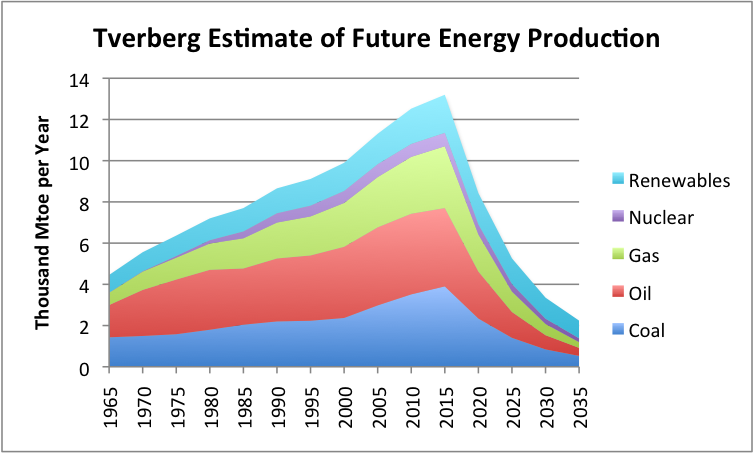 ?w=640&h=385
Gail Tverberg’s prediction:
Nuttier than a scorched peanut bar.
But people sucked in by her were always going to sucked-in by someone like her. She just feeds them the extremist doom sludge they’re addicted to and amps the confirmation-bias feedback.
It’s evident from her record of postings, over years, that she promotes a twisted anti modernity agenda and is not the slightest bit interested in accurate oil production forecasting. Just a deplorable crank that gets off repeatedly screaming “Fire!” in a crowded theater, and acting-out histrionically to see if she can whip-up a stampede, specifically to cause as much needless harm for others as possible.
Even the boy who cried wolf was eventually right. This article, though correct on the production side, failed to include issues of oil production, such as Energy Returned on Energy Invested. Simply, the net energy of a field. That has been dropping considerably since 2005. For example, the Alberta oil sands production is in the range of 1:8. That is, it takes one joule of energy to get eight back. (Natural gas consumption to make the oil from the bitumen is more than all heating requirements in all of Canada, homes and businesses). That’s one of the worst paybacks on the planet. A far cry from the 1:100 return in the 1960s. This is crucial as once a field drops below 1:4 you are no longer getting any return from the oil you extract.
Current oil prices is a geopolitical issue, coupled with a drop in world demand. The over production is only about a million barrels per day, compared to the 95 million barrels consumed. That can turn on a dime. What’s happening with production is a political game of chicken, waiting for someone to blink. Then watch the price swing entirely in the other direction.
Richard – Thanks for this extremely important issue.
(Readers see papers on
Energy Return on Investment Oil Production)
Until this declining trend is solved, the future will grow bleaker.
J. Richard,
“failed to include issues of oil production…”
Is this weird rebuttal day at WUWT? The world’s greatest energy expert could write ten thousand words — or a hundred thousand — and get that rebuttal. This is a thousand word post about one specific subject — not the Britannica’s entry on petroleum.
“The over production is only about a million barrels per day”
What is this “over production”, and where is it stored? World storage has not risen at anything close to a million barrels/day. US storage has increased 61 million barrels over the past 8 months (there are no reliable totals for world commercial storage). https://www.eia.gov/dnav/pet/pet_stoc_wstk_dcu_nus_w.htm
Spare capacity (the oil taps throttled below full) is unusually low, probably 1 – 2 m/b day.
http://wolfstreet.com/wp-content/uploads/2015/12/2015-12-08-Kummer-EIA-OPEC-spare-capacity.png
This is the first financial world war. Bet on the Saudi Princes to win. Before this is over, Alaska and Texas will be begging to join OPEC (exaggeration for effect).A revitalized OPEC could push spare capacity back up to 3 or 4 million b/d. That would jack the price up fast. To $80? $100? The Saudi princes need $100 to pay the bills, so that’s probably their goal.
Details here: http://fabiusmaximus.com/2015/12/08/saudi-arabia-oil-war-91758/
They claim $80 as a stable price target. Above that price they have increasing competition from non-conventional sources.
Menicholas,
The Saudi Princes are playing high-stakes poker with us. I suggest not taking the other players too seriously when they tell you their plans.
Good Point. I only meant to note they have mentioned this price consistently for many years now.
If one believes what is said about peak oil, a good strategy would be for anyone with money to be buying up oil hand over fist and thee prices and pumping it into underground reservoirs.
I doubt it will stay cheap like it is now for very long…the problem is that in the investment world, one can never be certain just how long “very long” really is.
Many people who have accurately called trend reversals went broke because they erred in the timing.
Sorry, should be “…at these prices…”
$80 also seems to have been the most often quoted price at which many sources become profitable to produce, Athabasca tar sands for one.
An awful lot of people have lost their shirt in the current price decline, due to their believing that this factoid (if it even is one…I do not really know) meant that the price could never get much below this price unless demand dropped sharply.
For example, the Alberta oil sands production is in the range of 1:8. That is, it takes one joule of energy to get eight back. (Natural gas consumption to make the oil from the bitumen is more than all heating requirements in all of Canada, homes and businesses).
what’s the world average? You compare an anecdote (one of the worst cases) to a 1960s average. What’s 2015 average compared to 1960s average?
World average is around 1:24.
A couple of years ago I thought the lower limit was about $40/bbl because that was the cost of production for fracking. Indeed, with the lower price we’re seeing widespread bankruptcy of frackers. So, a bunch of oil and gas isn’t being fracked until the price goes over $40 again. A bunch more will come on stream at $50. And so forth …
IMHO it will be a very long time until oil approaches $100/bbl again, if ever. I note that the Chinese have made great progress in fusion. The stone age didn’t end because we ran out of stones and that may also be true for oil.
Commie Bob,
“So, a bunch of oil and gas isn’t being fracked until the price goes over $40 again. A bunch more will come on stream at $50.”
That’s a natural opinion, since it’s often said in the news. It’s almost certainly wrong, for several reasons.
“I thought the lower limit was about $40/bbl because that was the cost of production for fracking.”
Articles about oil economics routinely cite as “costs” what are in fact “project operating costs” — ignoring other costs: capital costs (capex to develop the field), overhead (got to run the company) and the cost of capital.
Companies relying on fracking produced little free cash flow even with natural gas (Henry Hub) at $3.50 – $4.00 and WTI oil at $90 – $100 — as they were for most of 2013 – 2014. And that was with an absurdly low cost of capital provided by lenders (too low, as will be proven by the bankruptcies that are just starting).
Once the well is completed, they need only produce enough cash to cover its operating costs (shutting down the well often voids the lease) — so production continues at prices far below that needed to justify new wells. As well production declines (fracked wells have fast decline rates), then field production drops.
When prices rise again, exploration & production will increase — but requiring higher price points than during the past boom.
(a) Company CFO’s will write checks only for projects that will produce profits at current prices with conservative assumptions — no more “field of dreams” capex.
(b) Lenders will demand higher interest rates, as the memories of the coming defaults will last a long time. The coal bankruptcies, now starting to become serious, will further entrench the reputation of energy lending as high-risk.
Second, natural gas prices are more significant than oil for fracking — and for overall US hydrocarbon (in layman’s term, petroleum) production. See this EIA graph for 2014.
Here’s the graph:
http://www.eia.gov/energyexplained/images/charts/us_primary_energy_production_by_major_source-2014-large.jpg
Indeed. If oil were $100/bbl some of the Bakken wells might be economical for as much as thirty years. As it stands, many of them are good for less than one year because of high LOE (lease operating expense). In other words, even if you can get a bankrupt well for free, you still might not be able to economically run it.
So, production continues but maybe not for long. Here’s a link to a story that was written 133 weeks ago when they were still talking about $100/bbl. Here’s a link to a recent story where they are talking about $1.50/bbl for North Dakota sour.
EROI: the notion than one BTU is economically equivalent to every other BTU, regardless of its source. In other words, crackpot-ism on par with obsessing about the Federal Reserve being “privately” owned.
I’ve been hearing about Peak Oil all of my life. You are right, though, that the hysteria really started ramping at the turn of this century when the BRICs embraced free enterprise to lift their people out of poverty. I remember reading at article about a decade ago in which Darla Moore talked about how her husband, Richard Rainwater, woke up every day and the first thing he did was see what had been published at the Oil Drum website. So some sophisticated people bought into it at the time. Matt Simmons used to come on CNBC all the time pushing how markets had always failed to properly price oil given its apparent scarcity.
One of the things you fail to mention, though, is that our estimates of reserves keep improving. The Atlantic article I link to below is mostly about the potential of methane hydrate, but one interesting tidbit the author mentions is about the Kern River an oil field 100 miles from Los Angeles that has been pumping oil for over 115 years. In 1949, after they’d been pumping oil from the field for over 50 years, analysts estimated the remaining reserves at 47 million barrels. That was wildly off. Over the next 40 years they pumped 945 million barrels from it and the new estimate in 1989 was that 697 million barrels remained in the ground. Well, over the next 20 years, from 1989-2009, the field produced an additional 1.3 billion barrels. And now with the best technology and knowledge available, they estimate there are still 600 million barrels remaining.
And that is just one field.
http://www.theatlantic.com/magazine/archive/2013/05/what-if-we-never-run-out-of-oil/309294/
Yet many major oil fields in the world that have been producing for 50 years are in terminal decline: Cantarell, Hyberia, North Sea, to name just a few.
Groty,
“One of the things you fail to mention, though, is that our estimates of reserves keep improving.”
There are a million things I “failed to mention”. If I wrote a billion words, would you have read this?
Resources are estimates of hydrocarbons in the ground. The classification of these into different kinds of reserves depends on the geological work done to estimate the find, the current level of extraction tech (to get it out), and the price of oil (is it worth extracting?).
To learn more about this see the IEA’s “Resources to Reserves”: https://www.iea.org/publications/freepublications/publication/Resources2013.pdf
Editor LK, you confuse many things about peak oil PRODUCTION.
First, did you know that you have to subtract NGLs (natural gas liquids like butane and propane), which are useful for petrochem and barbicues but mostly useless for gasoline, diesel, and jet kerosine transport fuels, which is whatmis made of about 75% of crude oil?. Minus about 10% now; all liquids are not equal.
Second, did you know that Prof. Defyesse et. al. were calling peak conventional oil? Now, I have seen posts here saying oil is,oil, so lets be precise since the ratemof,production matters greatly,on the oil type. Conventional oil is sourced from some underlying source rock and resides in some overlying capped.porous reservoir (usually a sandstone or a fossiliferous carbonate). It has a viscosity >API 10 (higher API is lower viscosity), in a reservoir with porosity > 6% and permeability > 10 darcies. According to IEA, conventional oil production peaked in 2008 and is now declining at least 5.1% from existing fields. Roughly what was predicted by many. Essay IEA Facts and Fictions goes through the excruciating details. Oh, and creaming curves by basin (or, if you prefer, probit transforms) both say that about 75% of all the oil of all types that will ever be discovered already has been. Never confuse a price war with future production rates of a finite fossil fuel.
Now, unconventional oil is of four types not meeting the conventional oil criteria. 1. Orinoco belt tar. API<10. Largest part of Venezuela OPEC reserves. Except slow (steam flood) and very expensive to produce. So almost none is yet. 2. Athabasca bitumen, API<10. The 'tar sands' that are not even tar, just asphaltic remains of the world's largest natural oil spill. Slow (strip mining, SAGD) and expensive (ditto) to produce. Value after hydrocracking 2/3 of conventional oil for transportation fuels. So very costly to extract on the margin. 3. Source rock shale oil. Very light high API oil (a separate transport problem as Bakken trains unfortunately proved. But from rock with porosity <1%, and permeabilty in millidarcies. (A brick has water permability <10 millidarcies, for rhose who want a tactile sense). From which, after fracking long horizontals, we are lucky to recover over all time 1.5% of the oil in place. Darned low porosity and permeability.
The fourth unconventional source is called oil shale, a confusion since the shale contains no oil at all, only marine kerogen not yet into the catagenesis oil window. The Green River formation of Northern Colorado, southern Wyoming and Utah comprises about 60% of the worlds deposits. There is a small problem. Mining (or in situ extraction) plus retorting (to put the kerogen through artifical catagenesis) requires between 3 to 5 barrels of water per barrel of syncrude. In case you have not noticed, there is already water scarcity along the region fed by the Colorado River. So unless you want to wipe out Vegas, LA, Phoenix, and San Diego, doubt any,of themGreennRicer formation will ever produce any oil
Now, compound the amount of tar, bitumen, and shale oil to be extracted ever at anynprice, times the slowing rate at which it might be (at any price, TRR) then get back. Ignorance is no legal defense.
I wrote about this in two ebooks. Extensively. Illustrated for laymen. References for the technically imclined. Read them. What your peak oil (annual production only) post teaches is how imprecise and ill informed most public policy dialog is.
ristvan,
Congrats on one of the oddest comments I’ve seen to one of my posts. That’s impressive given the stiff competition. Especially noteworthy are the rebuttals to things I didn’t say. You’ve learned much from the climate alarmists (it’s their favorite form of debate)!
Your 600 word (!) comment looks like a rant (half the length of my post, 1% of the evidence). Too much coffee today? Perhaps you should follow WIllis Eschenbach’s advice (from memory) and give rebuttal to quotes.
I know lots of stuff about energy, but don’t try to put all of it in a thousand word post. Most of the issues you raise are discussed in my 80 other posts about energy. See them here: http://fabiusmaximus.com/peak-oil/
LK, you rant, not I. I posted a longish summary of basic petroleum geophysics for laymen, and conclusions therefrom. With lots of specifics. And backed by hundreds of pages of analysis (referenced elsewhere). Refute any specific therein with counterfacts? Please try.
Simple examples. Did, or did not, IEA call the conventional peak in 2008. Did or did not its head, Dr. Faith Birol, call the overall peak by about 2020? Google can be your friend if you dont want to read my stuff with footnotes. Like, what is the current EIA TRR estimate for the Monterey shale, the US largest?
Your claiming 80 posts reflecting fundamental lack of knowledge of petroleum geophysics is like Mann saying, ‘read all my paleoclimate reconstructions’. He has yet to deal with McIntyre, faulty centered PCS, and upside down varves. You have to deal with the reality of geophysics as laid out for you in my ‘rant’. As the late Justice Scalia siad re Gore v. Bush, “Deal with it”.
Rust an,
What made it a rant was that it had no visible relevance to what I wrote, beyond your insult at the start.
Anyway, back to your rants! Onward!
There is a simpler rebuttal to your ‘oddest comment’ Mann like toss off of my questioning your knowledge of geophysics. Just occured to me. LK, what is the capacity of the US Strategic Petroleum Reserve, in days of 2015 consumption? Is it still strategic? If not, what do you propose?
Larry, if you want to continue replying, at least get my name right. Rud Istvan, hiding in plain sight at both Amazon and LinkedIn. Three ebooks on iBooks and Kindle plus more, according to my publisher.Do get back with some counterfacts. I am rather boored by nonfactual counter opinions.
Ristvan,
My apologies about misspelling your name. My ipad substitutes what it thinks the text should be without notice to me. Sometimes it’s judgement is good, sometimes not so good.
Re: your questions
If you give a quote from the post plus question or rebuttal, I’ll reply (that’s foolish of me, but I’m weak). I provide consulting services for your other questions, if you are willing to pay.
ristvan,
If a doctor spoke like you, he’d tell a patient to “Shut up you know nothing about medicine, read a book before you come here and talk about your symptoms”. See how that doesn’t work?
We might go read your books, if you gave us a reference to them?
well, I don’t pay consultants
and I use a keyboard, so all mistakes are mine
Ristvan,
I have had the title of “Petroleum Geophysicist” for 35 years. Worked and consulted all over the world. Nothing in your rant falls under the field of “petroleum geophysics”. I see some confused petroleum geochemistry, some reservoir engineering, a bit of economics, but very little geophysics. Please stop abusing the term.
Larry
Thanks for the helpful collected links.
I still find your evaluation overly optimistic by the logical fallacy of “moving the goalposts”. per my comment.) The models for conventional “crude and condensate” were not that far off. It is the alternative fossil resource development that was not accurately forseen. The date of a “peak” is insignificant compared to the generation long trends in crude oil vs other fuel production.
Outlook from Optimistic to Pessimistic
ExxonMobil’s 2016 Outlook for Energy Fig. 62 projects “crude + condensate” declining from a peak about 2006 to 2040. That after previously strenuously denying such predictions lest such admission harm its stock price.) Contrast as recently as 2010, ExxonMobil’e equivalent shows major growth in crude + condensate expected from OPEC while showing flat Non-OPEC.
Exxon shows the average strong decline in conventional fields that it does not expect new discoveries of “crude+condensate” to overcome. Even adding in “Deepwater production” and discoveries still does not bring future production up to a plateau or “no decline.”
All projected growth is from other resources – bitumen (aka “oil sands”), tight oil (from fracking shale), natural gas liquids (NGLs again from fracking), with small increases from “other” and “biofuels”. Yet the higher costs, especially conventional, deep water, bitumen, and tight oil, are dampening the economy and hindering growth in developing countries.
90% decline in growth
Actuary Gail Tverberg at OurFiniteWorld.com shows 7.8%/year demand growth for 1965-74, but only 0.8%/year growth for the last decade.
Evidence for State by State Peaking
In “Oil Prices, Exhaustible Resources, and Economic Growth,* Economist James D. Hamilton (UCSD) graphs the production of the US States. He shows almost ALL have already peaked and declined for their region. Geology-area still rules for the same type of resource and recovery technology.
Technology takes a LONG time to develop. Oil “Fracking” development began in 1862! Yet it was not until about 1990 that commercial oil fracking took off in the USA!
Potential CO2-EOR
Note that Tertiary and “Quaternary” production (from residual oil zones) via Carbon Dioxide Enhanced Oil Recovery (CO2-EOR) could nominally equal the production of conventional crude oil with secondary water/gas recovery – IF/When we capture/develop the CO2 resources.
To quantitatively understand hydrocarbons, we need to use “multi-Hubbert” modeling – where each resource-region and technology is separately modeled with its own growth, max, and decline. That will give a much better grasp on future production and challenges.
Short term oil price is a very POOR predictor especially in the global poker/chess game between Saudi Arabia, Iran, Russia and the USA. Even a 1% excess/lack in global oil availability sends prices skyrocketing/plummeting. e.g. from $147/bbl to $33/bbl to $110/bbl to $26/bbl. Focus instead on the long term geological constraints on each type of fossil fuel and the very long time it takes to develop and deploy new technology.
David,
Odd rebuttal day continues at WUWT! Your 500-word comment discusses lots of stuff — supposedly rebuttals — without showing any relevance to what I said.
Lesson learned! In the future I will follow Willis example and request that people reply to quotes.
Along with my interest in CAGW, I also bought into fears concerning “peak oil”.
I now accept that I was mugged by fools. And that I myself was also a fool to attend to such WRONG predictions. Wrong is the kindest of words. Inaccurate does not describe the degree of divergence from what consequently happened.
And governments also attended to the prediction of future energy shortages and rising market prices. Especially the U.K. government, which has now committed to expensive energy prices long into the future, via expensive nuclear (9p/kwh) and expensive solar and wind (43p/kwh inflation adjusted and guaranteed until 2030).
The ongoing cost of this debacle is going to look like an extraordinarily poor deal for the British people IF oil and gas stay cheap and cheerful.
Now that oil is cheap, support for an expensive future for all seems to be evaporating:
http://www.fitariffs.co.uk/FITs/reviews/2015/
“Oil experts, economists, and government officials who have attempted in recent years to predict the future demand and prices of oil have had only marginally better success than those who foretell the advent of earthquakes or the second coming of the Messiah.”
Akins was speaking in 1973.
http://reason.com/blog/2015/02/10/oil-to-surge-to-200-per-barrel-or-maybe
Frog,
You would be well advised to pay attention to Rud Istvan. He laid out the basics of oils, fields and peaks. Conventional oil from older field has peaked. More volatile crudes and condensates have pushed world “crude oil” production up a couple of million barrels per day over the last decade. Most of the rest of the increase of liquids produced have been natural gas liquids that are not primary transportation fuels. Over the last decade, the U.S. horizontal drillers pushed the U.S. oil production up from about 5 million barrels per day to about 10 million/day. in a time of reduced demand. That oversupplied the oil market and destabilized it and also led the Saudis to decide to kill their competition. They went through this previously in 1985. They had allowed themselves to be swing producers for OPEC to keep the oil price high, but when their production had been cut back from 10 million/day to 2.5 million/day, they pulled the plug on their cheating OPEC friends. This is just the second verse of a familiar song for them. How long it will last this time depends on the economic growth rate, but eventually the world economy will outgrow the present supply of cheap oil. After the carnage of the ’86 price crash, it was a long time before lenders provided the capital for more oil field development. I would guess that oil prices will have to get back over $100/barrel before they would get back in the game. That might take a good while in a stagnant world economy. So the issue isn’t “peak oil” it’s peak cheap oil.
I’m not so sure that the Saudis run the show any more in the way that they used to.
Of course, I too can now look back and see who could be trusted to provide a good analysis and who turned out to be talking bull. But back in 2005, when I first took note of serious concerns and read widely on this topic, I backed the wrong predictions.
By about 2008/09 the world was paying $140/barrel (by recollection) and all the earlier concerns looked justified. But then look what happened.
I recall mention at the time of investors buying $200/barrel futures.
Luckily that wasn’t me.
Anyone betting on demand exceeding supply by 2016, lost that bet.
It’s easy to say who was right or wrong with the benefit of hindsight.
But seemingly solid analysis from the past seems to have lead to some very wrong predictions.
Do the Saudis still have control over the market? To some extent they can over-supply and lower prices.
But when they stop dumping then where will the new price settle?
If anyone could say exactly where we will be in 2026 – then I’m sure that they could make that bet and make a load of money.
That won’t be me – because I don’t know!!
Natural gas liquids can be put through a reformer and made into gasoline and diesel fuel and jet fuel and… The cost to do this is low, but bottle propane has a nice fat markup…
While I prefer to use it in the BBQ, it is near trivial to use it for motor fuel and I have driven propane powered vehicles.
LPG is just a red herring argument in oil fuels costs.
The root of the error is the belief that we live in a “Finite World”.
It assumes that nothing comes into the world (except a few insignificant meteorites). That non-physical things don’t exist.
It’s materialism run wild.
Ideas are new. Ideas change productivity. Ideas create new resources. Ideas reach existing resources cost effectively.
Who cares if Ancient Rome had uranium? They couldn’t use it.
Who cares if shale oil exists if we can’t reach it… but then invent fracking and…?
We have lots of new ideas. And we have lots of new people to have more ideas.
It is not a Finite World
M Courtney,
“The root of the error is the belief that we live in a “Finite World”.”
I think that’s too broadly stated. We live in a world with limits, but with work they can be transcended. But assuming that some invisible hand will pave an easy road for us puts us on the fast track to disaster.
America has prospered because for two centuries business and government have make wise investments in infrastructure, research, and education — which have paid off big-time. When we stop doing so, trusting to luck, we’ll quickly become just another big poor nation.
Larry, if you have not read these links, I think you will enjoy them a great deal…
https://chiefio.wordpress.com/2009/05/08/there-is-no-shortage-of-stuff/
https://chiefio.wordpress.com/2009/03/20/there-is-no-energy-shortage/
https://chiefio.wordpress.com/2013/01/11/grains-and-why-food-will-stay-plentiful/
https://chiefio.wordpress.com/2014/12/21/unlimiting-resources-basalt-for-a-high-tech-stone-age/
I recommend E.M. Smith to anyone interested in the subject of earth’s resources, and how economics relates to resource production.
I thought peak oil had more to do about the price of extraction and if this is so, will we have to depend on middle east oil in North America?
Ron,
Exactly! Price is what links supply and demand. As i said upstream, there is an inverse relationship between ore quality and quantity, so that once the world is fully explored (all deposits known) costs will rise over time — offset by better tech that lowers the cost of extraction and refining (details here).
At some unknowable point either the balance will tip so that rising prices force lower production (aka peaking production and demand destruction) — or new forms of energy replace it.
As for US imports of oil, successfully modeling for decades in the future that involves many factors of economics, technology, and geology. The record suggests that doing so lies beyond the state of the art.
My guess (emphasis on guess) is that new tech will produce cheap electricity and relatively inexpensive electric vehicles — slowly replacing use of liquid fuels for ground transportation — producing a demand-driven peak oil.
It might as well be infinite.
I have calculated the volume of all of the oil ever produced anywhere in the world. This volume compares in size to a largish mountain. But a large mountain compares to the Earth as a bacterium compares to a cue ball.
Considering the volume of all of the sedimentary rock on the earth, and throw in the volume of all of the worlds oceanic sediments, we have barely begun to scratch the surface of what the world holds.
Future technological improvements should be considered nearly infinite, considering how quickly new technologies and techniques can be invented and evolve.
The biggest dangers we face, IMO, is crippling our ability to innovate by dismantling or crippling our economic and energy infrastructures, and discrediting our scientific institutions (or more accurately perhaps, allowing them to discredit themselves) so that progress slows to a crawl or becomes impossible.
Our political leaders and regulatory agencies are leading us rapidly astray.
“My guess (emphasis on guess) is that new tech will produce cheap electricity and relatively inexpensive electric vehicles”
Electricity can, and will be cheaply produced by nuclear reactors 4th and later generation fission machines, and fusion machines. But, the battery problem will make electric cars forever out of reach. The problem is driven by inorganic chemistry, which is a mature science, and the inherent engineering problems of electricity.
I wouldn’t worry. If you have have enough cheap electricity, you can make liquid fuel out of air and water.
“But, the battery problem will make electric cars forever out of reach.”
An electric car which can travel hundreds of miles and be recharged in minutes will be out of reach, but transport is going to decline dramatically over the next few decades. When you can make most of the things you need locally with the descendants of today’s 3D printers, and you can ‘travel’ anywhere you want by renting a VR drone at your destination, the demand for long-distance transport will collapse.
That doesn’t mean we won’t need oil, but it will be primarily a source of raw materials for manufacturing, not a fuel for transporting manufactured products.
Ron M,
Peak oil refers to the point of maximum rate of extraction, followed by a decline. Hubbert’s 1956 prediction for the US lower 48 was quite good …
… until shale oil production began to pick up due to market forces. According to the Wiki article containing the above graphic:
In 1956, Hubbert confined his peak oil prediction to that crude oil “producible by methods now in use.”[16] By 1962, however, his analyses included future improvements in exploration and production.[44] All of Hubbert’s analyses of peak oil specifically excluded oil manufactured from oil shale or mined from oil sands.
The same article notes that his worldwide forecasts called the peak around the year 2000, which has not happened.
This document from the USEIA contains information releavant to US import/export/domestic production:
https://www.eia.gov/totalenergy/data/monthly/pdf/sec3_6.pdf
Parent page with other statistics here: https://www.eia.gov/totalenergy/data/monthly/#petroleum
That’s like saying that the output of the climate models is quite good.
Peak anything is an economic argument.
Peak conventionally extracted oil occurred…but 10 years of high prices produced an abundance of alternative inexpensive extraction methods and alternative fuels and substantial improvements in efficiency.
I thought he was talking statically. That is, conventional is defined as what is conventional at the time of the statement.
Most Peak Oil projections assumed oil was a finite resource and one could calculate the date of Peak Oil by determining how much oil is in the ground or under water. I took a different approach. For me, the question has never been how much oil is potentially available, but rather how much affordable oil can we humans produce? It is important to understand the definition of “accessible” reserves: “Accessible reserves are those reserves of oil, coal or natural gas that can actually be found, produced, transported, refined, and distributed without disruption at a price the consumer can afford to pay.” Our fossil fuel resources are useful only if they can be produced and consumed, without disruption, at a price the consumer can afford to pay. We almost had an oil crisis in 2008 when there was a temporary lag in new oil production and there is ample evidence the production of conventional oil has already peaked. Hence, new oil production must come from resources that are largely more expensive to produce. Shale oil liberated by fracking is a good example, as are the cost of oil derived from sands, deep sea wells, and the arctic. Someone has mentioned EROEI – energy returned on energy invested. When that calculation approaches 1 for 4, as is happening, oil will become too expensive to use as resource for gasoline, diesel, and jet fuels, and – as shown in 2008 – will be too expensive to use as an agricultural liquid.
Imagine blue on the left side and red on the right. Blue represents tax and red represents subsidy. Right now oil is deep blue and other forms of energy (wind and sun) are deep red. When oil is deep red we have reached peak oil.
I point out the flaws in the EROEI canard here:
http://wattsupwiththat.com/2016/02/15/lessons-from-the-hysteria-about-peak-oil-2005-2013/comment-page-1/#comment-2147504
down thread a ways.
Probably opening up Alaska to unlimited oil production (and not just ANWR) as Texas had many years ago, would provide many years of oil reserves and production if not for the USA, probably the world.
And many of the western US states have land owned by the government which will not allow oil production.
Alaska? How about California?
And Florida
Peak oil was always about oil availability. Now it is about type, sub-type, price. Fact is, in 2016 there is a lot of oil. The world is swimming in oil. And it’s cheap. No one predicted that.
Steve,
That’s an important point! Long-term predictions about energy — and commodities — have a poor record of success. History shows large swings, which are often mysterious at the time.
I suspect this bear market cycle in commodities (it’s not just oil) is driven by a rising dollar and slowing global growth. On top of that the Saudi Princes started a price war to regain discipline among oil producers — just as they did in 1985.
As usual, all these factors produce grand claims about geology. Noise.
My feeling is the Americans reopened Pandora’s box with the advent of tight shale fracking. Look at US oil & gas production since 2007. The nice thing about oil is the box is periodically reopened and that confuses a lot of people.
Steve,
Nicely said! The history of oil has been one of milestones of tech and discovery since the Drake well in 1859.
Eventually the entire world will have been explored, starting a new era of oil — in which the relationship of price, tech, and deposit quality-quantity play themselves out.
We should be investing in thorium and possibly fusion, because eventually we’ll have a problem. But we have time. I’ll be dead, and maybe even my kids before this is a problem. South America has barely been tapped. Venezeuala has a ton of crude sitting there due to politics. Colombia has vast reserves, but the commie rebels do cause a problem. Exxon just hit a huge field off Guyana. Argentina has vast shale reserves. We’re in good shape, but we do need to get going on thorium. Also, let us not forget about coal, which can be converted into diesel. Already being done, but shutdown by politics in the US.
200 years of oil and 600 years of coal. Your children’s great-grandchildren will be dead. In the meantime, live long and prosper!
200 years of oil, 600 years of coal, but at what rate? If we assume a world average economic growth of 3%, with a doubling period of 25 years, 200 years has 8 doubling periods. That means the world economic activity will be 256 times today. We can extract 256 times the oil we are now today???
You are actually incorrect. Oil will last us for ever, because in 200 years society will be much lower than today. Horse and buggies dont need gasoline.
Steve,
“200 years of oil and 600 years of coal.”
First, that’s almost certainly wrong in any meaningful sense. Second, given the inverse relationship of ore quality and quantity, that coal in a hundred years will have the BTU content of Kitty Litter (that was a comment to me by one of EIA’s coal experts when I asked him about America’s vast coal reserves). Ditto for “oil” — we’re already mining bitumen (“oil sands”) and even small amounts of kerogen.(“oil shale”), that are barely oil.
Third, I find it difficult to imagine a future in which we’re burning large quantities of fossil fuels for energy 100 years from now. That’s unknowable, of course.
Editor of the Fabius Maximus.
Regarding the EIA experts comment “coal in a hundred years will have the BTU content of Kitty Litter” .
I can think of at least one Mississippi coal plant already burning a lignite that is essentially dirt (although it’d have to be shut down with Obama’s Clean Air Plan). And, given that the current cost incentive to simply take a derate and burn PRB. you’d think were already there.
However, I would be interested seeing in any projected heat content data the EIA might have? Have you seen any?
Thorium can already be used in present light water reactors (rods in burn testing now) and in CANDU designs. Yeah, molten salt would be nice to have in production, but it does not limit the use of thorium today.
My Dad, who was a chemical engineer (ScDChE from MIT), had an engineering textbook (I forget which) from 1936 that stated we shouldn’t develop an economy based on fossil fuels (in particular oil) as we only had 10 years worth of reserves. Proving that the professorate has long had problems with distinguishing the difference and significance of ‘proven reserves’ and actual oil in the ground and what and how it is accessible.
The author seems to have left out the really interesting predictions of President Jimmy Carter from the late 1970’s who was a peak oil believer. He gave lots of speeches to urge conservation, and a switch to massive coal and nuclear usage in order to save petroleum.
He was just as deluded then as Obama is now. Is it the office you think that makes them silly? Or were they that way when they moved in?
Mike,
“The author seems to have left out the really interesting predictions of …”
It was not a list of everyone who ever gassed a date for peak oil. It was a list of some predictions by some well-known experts about oil.
“Is it the office you think that makes them silly? Is it the office you think that makes them silly?”
My guess is that they sound silly because we expect them to have answers to every question. I plan to vote for the first guy or gal who frequently answers “I’ll get back to you on that” to the more inane or trivial questions in the debates and press conferences.
Steve
It is highly unlikely your grandchildren will consume oil based products in the quantities we do now. There is a race to control the world’s remaining coal, oil and natural gas resources. Why? The political future of most nations depends on having enough accessible fuel.
For an amusing look at what the future may hold, give a read to Joe Haldeman’s “The Accidental Time Machine”.
IFF we were at Peak Oil now, and that is very unlikely, Hubberts theory says production fades roughly as it rose. The downside of the bell curve looks much like the entry.
The conclusion from that is just that with about 150 years of oil since Drake’s Well, we have about 150 years to last well, minimum.
As I have a new grandson, that means he will be driving in about 17 years. We will still be very near present oil production in 17 years (a bit over 1/10th the time to end, but at the flatter top area) even IF now were peak oil, which it isn’t.
So I am very comfortable saying my grandkids will live in an oil age much like I have.
Where is ristvan when I need him?