It has been quite entertaining to watch the various explanations coming out to rationalize “the pause” in surface temperatures for the last 16 years. For example, as Jerome Ravetz points out to me in email, The Times Hannah Devlin says the warming has just gone into hiding.

But there is a funny thing about that deep ocean warming.
As Bob Tisdale wrote:
Ever since the NODC released their ocean heat content data for the depths of 0-2000 meters and published Levitus et al (2012), it seems that each time a skeptic writes a blog post or answers a question in an interview, in which he or she states that global surface temperatures haven’t warmed in “X” years, a global warming enthusiast will counter with something to the effect of: global warming hasn’t slowed because ocean heat content continues to show warming at depths of 0-2000 meters. Recently, those same people are linking Balmaseda et al (2013) and claiming the warming of ocean heat content data continues.
It is true that the NODC’s ARGO-era ocean heat content (0-2000 meters) continues to warm globally, but always recall that the ARGO data had to be adjusted, modified, tweaked, corrected, whatever, in order to create that warming. That is, the “raw” ocean heat content data for 0-2000 meters shows the decreased rate of warming after the ARGO floats were deployed. (See the post here.) Also, while the much-revised NODC ocean heat content data for 0-2000 meters might show warming globally, it shows very little warming for the Northern Hemisphere oceans since 2005. See Figure 1.
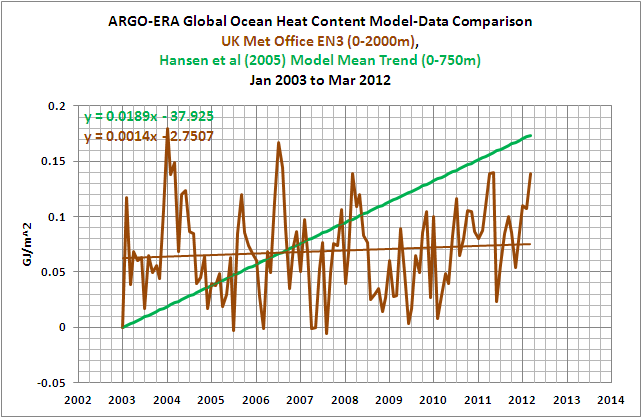

Figure 1
Can well-mixed human-created greenhouse gases pick and choose between the hemispheres, warming one but not the other? One might think that’s very unlikely.
Something else to consider: the Northern Hemisphere warming of ocean heat content for depths of 0-2000 meters occurs in only one ocean basin, and it’s not one of the big ones.
Right there is a premise falsifier. But I find this figure even more interesting:
There was a comparatively minor warming in the Northern Hemisphere at depths of 0-2000 meters from 2005 to 2012. But the upper 700 meters in the Northern Hemisphere cooled. The difference is provided to show the additional warming that occurred at depths of 700 to 2000 meters.

Figure 2
So the question here is simple. As Hannah Devlin writes in the Times:
The pause in global warming during the past decade is because more heat than expected is being absorbed by the deep oceans, according to scientists.
How does that heat get to the deep ocean hidey hole, down to 2000 meters, without first warming the upper 700 meters in transit? That’s some neat trick.
You can read more on how that deep ocean hidey hole doesn’t seem to hold up when the data is examined carefully here.
The claim has been made that its the sun doing it:
[Tisdale] SkepticalScience’s Rob Painting provides a reasonable explanation of the hypothetical cause of greenhouse gas-driven warming of the global oceans in the post Observed Warming in Ocean and Atmosphere is Incompatible with Natural Variation. Painting writes (my boldface):
Arguably the most significant climate-related impact of increased concentrations of greenhouse gases in the atmosphere, is that they trap more heat in the ocean. Over the last half-century around 93% of global warming has actually gone into heating the ocean. A little-known fact is that the oceans are almost exclusively heated by sunlight (shortwave radiation) entering the surface layers.
Back in 2009 it was claimed that solar radiation changes would do just that:

Well Duncan, we are still here, speaking clearly to the issue.
That article was a reaction to this Judith Lean Paper in GRL (bold mine):
=============================================================
How will Earth’s surface temperature change in future decades?
Judith L. Lean, David H. Rind Article first published online: 15 AUG 2009 DOI: 10.1029/2009GL038932
Reliable forecasts of climate change in the immediate future are difficult, especially on regional scales, where natural climate variations may amplify or mitigate anthropogenic warming in ways that numerical models capture poorly. By decomposing recent observed surface temperatures into components associated with ENSO, volcanic and solar activity, and anthropogenic influences, we anticipate global and regional changes in the next two decades. From 2009 to 2014, projected rises in anthropogenic influences and solar irradiance will increase global surface temperature 0.15 ± 0.03°C, at a rate 50% greater than predicted by IPCC. But as a result of declining solar activity in the subsequent five years, average temperature in 2019 is only 0.03 ± 0.01°C warmer than in 2014. This lack of overall warming is analogous to the period from 2002 to 2008 when decreasing solar irradiance also countered much of the anthropogenic warming. We further illustrate how a major volcanic eruption and a super ENSO would modify our global and regional temperature projections.
==================================================================
Since that obviously hasn’t happened, and “the pause” is an inconvenient truth, the cheerleaders are looking for alternate explanations. Voila! The deep ocean hidey hole.
The ocean provides the perfect cover for global warming because unlike the atmosphere, few people experience it directly. Few people go diving down to 2000 meters with thermometers and few people go swimming in the ocean with pH meters to check the claims of “ocean acidification”.
On the other hand, virtually the whole of humanity can and has experienced “the pause” in air temperatures.
When the deep ocean hidey hole doesn’t pan out in a few years, and that stored hidden warming doesn’t spring out of the deep ocean like a caged lion, where will they put the warming next? They are running out of places.
Sorry for the scream, but: again and again, WHAT IS THE MECHANISM? What told the heat to hide? In 50 words or less of plain English, please.
Picking fly sh*t out of the black pepper is always a productive enterprise, especially when it’s 2000 m under the ocean.
It’s hidden from view, but we will reveal it by shooting the pictures of boats at low tide.
Error Bars! Error Bars!
Ocean Heat Content should never be discussed without simultaneous conversion to changes in temperature: Worldwise it takes 273 ZettaJoules (ZJ) to raise the 0-2000m layer of ocean 0.1 deg C.
The most “alarming” figure, from the first chart, of 6.91E22 Joules/Decade for the Southern Hemisphere boils down to 69 ZJ/decade for maybe 1/2 of the world’s oceans. So, at worst case, we see 69/(273/2) or about 0.05 deg C / decade of warming of the ocean in the worst case.
Tele-connections.
Surely you remember them. Do I have to keep explaining this? The heat from here — tele-heats the stuff over there. Please see the relevant papers by Dr. M. Mann.
Sheesh — some people forget so easily.
Next problem please!
Just out of curiosity, why did this process (energy going into the deep ocean) not occur from 1970 to 1996? Does it just occur when the solar radiance decreases (rhetorical question.) I too, wondered to many AWG supporters how the deep ocean might warm, but the surface not. This is more pathological science from very poor scientists who have a poor grasp of basic thermodynamics.
In a few years the enthusiasts will have transformed into declaring success in CO2 emissions reduction resulting in the avoidance of the catastrophe they were always on top of with the best science had to offer.
With the ongoing advice and warning that their (our) work is far from done.
Much more monitoring, study, measuring, graphing and research is vital to stave off human ruination of the planet.
They will pile up a growing litany of human threats to mother earth and animal kind by mankind.
Wattupwiththat may have to augmented with ShutTheHellUp.com
.
Blaming the lost heat on the ocean seems like a loosing argument to me, not b/c it is necessarily wrong, but b/c it makes AGW no longer a threat. To see what I mean, here is a quick estimation of the time required to heat the oceans 2 C:
The ratio of the specific heat of water to air is approx=4/1.
The ratio of the mass of the oceans to the mass of the atmosphere is approx=1.5E21/5E18=300.
So, with 4 times the heat required to heat the same mass of water by 1 K as is needed for air, and 300 times as much mass of water in the oceans as air in the atmosphere. If the IPCC predicts that 100 yrs from now the air temp would have increased by 2 C, but all that heat goes into the ocean, it would take 4*300*100yrs=120,000 yrs to heat the ocean by 2 C!
That is a lot of time to look for a solution to such a minimal problem.
It would stand to reason that if the Earth was warming, the heat would be pretty much even distributed due to thermal diffusion. I find it laughable that the oceans have suddenly started absorbing the heat (or are preventing the release of the below 2000 meters heat that’s hiding beyond our sensors) without a subsequent rise in atmospheric and land temperatures.
It would seem the AGW proponents are suggesting that humanity is acting much like the Heat Miser. http://www.youtube.com/watch?v=hGRkNaMFp6w
Can I point out that it is not a pause until it starts again…
“When the deep ocean hidey hole doesn’t pan out in a few years, and that stored hidden warming doesn’t spring out of the deep ocean like a caged lion, where will they put the warming next? They are running out of places.”
The moon? Nasa have been there and found it on the dark side, that no one else can see.
About the only obvious mechanism for deep water to heat up is through vulcanism.
Everybody needs to get a paint stripping heat gun and try heating the surface of water. You will find that the heat is totally blocked. The water remains stone cold. That is the answer to this whole argument, surface tension blocks heat. Water accepts radiation but blocks heat. A warmer day does not mean a warmer ocean because of surface tension. Thats why there is a pause, the sun has reduced its activity and there is NO backup heat.
In short the “heat” in the ocean is not hiding it never went in in the first place. Somebody tell Trenberth. The irony of the situation is that if you are serious about heating water through the surface the only way to achieve is to float an object on the surface and apply the heat to the floating object. The floating kills the surface tension, creates an upside down pot and heat will flow. Why heat on a warm day does not pass from the atmosphere into the ocean by conduction, I don’t know but what I do know is that we don’t know enough about surface tension. And don’t get me started on the models.
So. Let me get this right.
Greenland and Antarctica are gaining ice mass. The Oceans aren’t warming. The planet hasn’t warmed in the last 20 years.
But sea level is rising?
http://www.climate4you.com/SeaTemperatures.htm#Global sea level
Must be that the data have been “adjusted, modified, tweaked, corrected, whatever, in order to create” a sea level rise (as Brother Bob puts it). Or maybe all the land is sinking.
C02 seems to be a sneaky devil. It causes upwelling of the water of the oceans, pushes down all the warm surface water up to a depth of 2000 metres, then sits back and laughs.
News just in!
Arctic methane ‘time bomb’ could have huge economic costs
‘Scientists say that the release of large amounts of methane from thawing permafrost in the Arctic could have huge economic impacts for the world.
The researchers estimate that the climate effects of the release of this gas could cost $60 trillion (£39 trillion), roughly the size of the global economy in 2012.
The impacts are most likely to be felt in developing countries they say.
The research has been published in the journal Nature.
“That’s an economic time bomb that at this stage has not been recognised on the world stage”
Prof Gaile Whiteman Erasmus University
Scientists have had concerns about the impact of rising temperatures on permafrost for many years. Large amounts of methane are concentrated in the frozen Arctic tundra but are also found as semi-solid gas hydrates under the sea.’
http://www.bbc.co.uk/news/science-environment-23432769
A better to place to hide the heat is in a lock box under the Antarctic ice shelf with even less data.
CIA wants to control the weather, climate change
No worries 😉
The energy necessary to heat all the water in the oceans by 1 deg C is about 5E24 J.
So, an increase of OHC by 1E22 is an increase in temperature of 0.002 deg C.
Maybe what Argo shows us is just digital noise in a constant average temperature.
Earl Wood says:
July 24, 2013 at 8:36 am
Blaming the lost heat on the ocean seems like a loosing argument to me, not b/c it is necessarily wrong, but b/c it makes AGW no longer a threat.
———————
I agree. But the warmies assure me I’m wrong! And that that heat will indeed come back to get me. It’ll shut down the ocean oscillations and it’ll screw up the food chain and it’ll drive faster sea level rise and it’ll reverse the gravitational pull of the earth and throw us all off into space. Well maybe not that last one so much yet, but I’m sure I’ll hear the argument one of these days…
Earl is so absolutely correct. If after a certain temperature the atmosphere doesn’t warm any more, but only ocean more than half a mile deep, then who cares? While we’re at it let’s warm the earth’s crust, but only a mile below the surface.
As for the mechanism, it is all those major hurricanes that have started up. They move the cold water from deep in the ocean up and move the warm water down. That’s it, all the extra major hurricanes we have been experiencing lately. Oh, wait…
I have looked at the NOAA data and see continued warming, just not as fast as a few years ago. Warming has not paused. All of you must be funded by a petrol industrial concern or need to be against something. We have had the hottest 10 years on record in the last 12 years and you claim that is not warming? Right now Paris is having 95 degree temperatures instead of their average 77 degrees. Arizona is making heat records in June and the northern hemisphere is warming earlier and longer every year. Looking at the data there are higher highs and higher lows. There are period where a couple years after a major peak the next few are not as high but the rise continues. I would not call you liars but I would say you see what you want to see and I can only assume your god fantasy or petrol chemical paychecks make you see what you see.
As I understand it, the deep oceans, with temperatures from 0 to 3C, make up the bulk of the ocean volume (approx 90%). This very cold water is derived form polar regions and sinks to the depth and basically stays there.
If the polar regions were supplying water at 3.01C instead of 3 (as an example) this would involve an enoumous heat content but be virtually unmeasurable.
Also, water does not expand significantly when warmed at these temps, so the impact of the extra heat would not show up in sea level rise.
Isn’t this a way they can explain the missing heat?
Since warmer fluids –air and water– rise rather than sink, any posited deep-ocean (“bathymetric”) warming would have to be due to some anomalous form of horizontally-layered currents. If so, this macro-effect should be easily discernible as so-called thermoclines akin to contour-lines on topographical maps.
To our knowledge no “climate science” (sic) researcher has yet investigated –nevermind reported– any such phenomenon, preferring to make blanket assertions of some physically impracticable, wholly unsupported “vertical circulation” mechanism at odds with thermodynamic principles.
There comes a point where AGW Catastrophists’ mutual-admiration “credentialism” strikes its factual iceberg in mid-stream. “Extreme weather,” Himalayan glaciers, ozone layers, Sahel desertification et al. have all failed utterly. What’s left– the Rajendra K. Pachauri Award for Soft-core Voudun? Pick your Myalist Okombo, dig deep to have the Zombie Science curse removed.
The missing heat is down the back of the sofa.