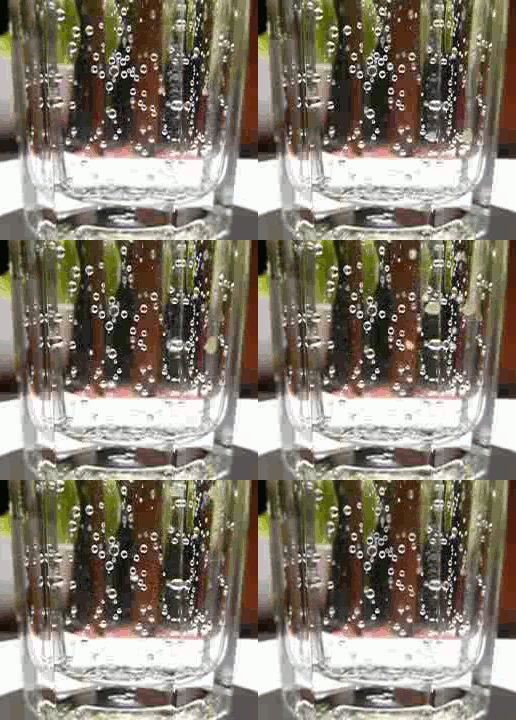
 From the Carnegie Institution , where soda pop science is like a carbonic acid trip, they say (thanks to modeling) we have to make big changes: “To save coral reefs, we need to transform our energy system…” while equating natural dissolution of CO2 into seawater with carbonation of soda pop, done under pressure and reduced temperature, making it supersaturated. The process is described as:
The amount of a gas like carbon dioxide that can be dissolved in water is described by Henry’s Law. Water is chilled, optimally to just above freezing, in order to permit the maximum amount of carbon dioxide to dissolve in it. Higher gas pressure and lower temperature cause more gas to dissolve in the liquid. When the temperature is raised or the pressure is reduced (as happens when a container of carbonated water is opened), carbon dioxide comes out of solution, in the form of bubbles.
While weak carbonic acid does get formed with CO2 dissolution in water [CO2 + H2O  H2CO3 ] the majority of the carbon dioxide is not converted into carbonic acid, remaining as CO2 molecules, which is why it outgasses so easily when a non-chemical catalyst is applied, like vibration. Carbonic acid does not make the soda pop “fizzy”; it is the fact that it is supersaturated, and stored in a way to seal pressure preventing gas escape and maintaining the supersaturation. It is pressure and temperature that drive the main outgassing process, as anyone who as left an open can of soda pop in their car during a hot summer can attest.
Major changes needed for coral reef survival
Washington, D.C.—To prevent coral reefs around the world from dying off, deep cuts in carbon dioxide emissions are required, says a new study from Carnegie’s Katharine Ricke and Ken Caldeira. They find that all existing coral reefs will be engulfed in inhospitable ocean chemistry conditions by the end of the century if civilization continues along its current emissions trajectory. Their work will be published July 3 by Environmental Research Letters.
Coral reefs are havens for marine biodiversity and underpin the economies of many coastal communities. But they are very sensitive to changes in ocean chemistry resulting from greenhouse gas emissions, as well as to coastal pollution, warming waters, overdevelopment, and overfishing.
Ricke and Caldeira, along with colleagues from Institut Pierre Simon Laplace and Stanford University, focused on the acidification of open ocean water surrounding coral reefs and how it affects a reef’s ability to survive.
Coral reefs use a mineral called aragonite to make their skeletons. It is a naturally occurring form of calcium carbonate, CaCO3. When carbon dioxide, CO2, from the atmosphere is absorbed by the ocean, it forms carbonic acid (the same thing that makes soda fizz), making the ocean more acidic and decreasing the ocean’s pH. This increase in acidity makes it more difficult for many marine organisms to grow their shells and skeletons, and threatens coral reefs the world over.
Using results from simulations conducted using an ensemble of sophisticated models, Ricke, Caldeira, and their co-authors calculated ocean chemical conditions that would occur under different future scenarios and determined whether these chemical conditions could sustain coral reef growth.
Ricke said: “Our results show that if we continue on our current emissions path, by the end of the century there will be no water left in the ocean with the chemical properties that have supported coral reef growth in the past. We can’t say with 100% certainty that all shallow-water coral reefs will die, but it is a pretty good bet.”
Deep cuts in emissions are necessary in order to save even a fraction of existing reefs, according to the team’s results. Chemical conditions that can support coral reef growth can be sustained only with very aggressive cuts in carbon dioxide emissions.
“To save coral reefs, we need to transform our energy system into one that does not use the atmosphere and oceans as waste dumps for carbon dioxide pollution. The decisions we make in the next years and decades are likely to determine whether or not coral reefs survive the rest of this century,” Caldeira said.
The World Climate Research Programme’s Coupled Model Intercomparison Project is provided support from the U.S. Department of Energy, which developed a software infrastructure in partnership with the Global Organization for Earth System Science Portals.
Discover more from Watts Up With That?
Subscribe to get the latest posts sent to your email.
Millions will believe them, that is the saddest part.
Maybe they should look at ‘soda pop’ in action:
http://climategrog.wordpress.com/?attachment_id=259
http://climategrog.wordpress.com/?attachment_id=233
how about they sample real water from around real reefs….
GIGO
Slippery phrase of the month award nominee!
“The computer results were predetermined.” “They set out to prove the hypothesis contrary to the scientific method.” “They did not entertain the null hypothesis.” “Despite this they convinced the world that CO2 is a serious problem.”
Word of the global warming scam is getting out.
[BTW — great gif of the bubbles in the glass!]
Hmmm… and what exactly is that CaCO3 made of? Isn’t CO2 playing major role in its formation, too…?
World’s deposits of marble and calcite are not source of sea organisms’ shells. They are deposits of these from times when there were way more CO2 in the atmosphere than today.
I thought Austrailian reefs had recovered from what was reckonned to be acid damage rather making a mockery of this idea.
Yes, how does photosynthesis take place underwater???
Today’s sesame street scientists. Because I am a puppet I can do anything you want me to.
I would like to post this, somewhat O/T but in the same theme. There has been major flooding in southern Alberta Canada now this cartoon popped up inferring so called “climate change” is to blame. Ignorance is amazing.
http://www.250news.com/blog/view/28767/1/man+survives+flood+clinging+to+%27climate+change+is+a+crock%27+sign?
“World’s deposits of marble and calcite are not source of sea organisms’ shells. They are deposits of these from times when there were way more CO2 in the atmosphere than today.”
Very good point , if you can justify that documented , it would be an effective counter argument.
Sounds like the warmists may be giving up on warming & once again are changing the focus, now to ocean acidification. They are bound & determined to get rid of fossil fuel use, one way or another,
In the equatorial south pacific. the surface water is already saturated with CO2, no amount that is added to the atmosphere is going into this area of the ocean. It is nearly always coming out of the ocean surface as the sea water is warmed as it goes from East to West. This area of the ocean is adding CO2 to the atmosphere at a rate that is an order of magnitude greater than all the global anthropogenic emissions. The cold polar waters are sucking it up at a slightly less rate resulting in a slow global accumulation. These rates are always changing, some on an annual time scale, others, in decades, or centurys. The rate of temperature change is the controlling factor at a specific area, not just equilibrium at some “global temperature”.
“Hmmm… and what exactly is that CaCO3 made of? Isn’t CO2 playing major role in its formation, too…?”
Yes. More CO2 means more biologically available CaCO3.
None of this sinks in with the voting public who go out in their millions and vote for energy Armageddon.
A Facebook friend (kind liberal leftie, into every Greenie cause) posted a photo last week of some US demo, with young people carrying placards reading “STOP Climate Change”. It seems the ‘scientists’ are on around the same intellectual level
While weak carbonic acid does get formed with CO2 dissolution in water [CO2 + H2O H2CO3 ] the majority of the carbon dioxide is not converted into carbonic acid, remaining as CO2 molecules, which is why it outgasses so easily when a non-chemical catalyst is applied, like vibration.
This is not completely true the overall dissolution process is as follows:
CO2 + H2O ⇋ H2CO3
H2CO3 ⇋ H+ + HCO3-
HCO3- ⇋ H+ + CO3–
Under present atmospheric and oceanic conditions the majority is in the form of bicarbonite ion (HCO3-).
http://upload.wikimedia.org/wikipedia/commons/9/93/Carbonate_system_of_seawater.svg
My radical leftist facebook friend has been on about ocean acidification for more than a year now. Setting aside the silly comment in the article, is there any hard science on acidification, one way or another?
doesn’t global warming prevent CO2 from entering the ocean? I thought that was basic science 101… you know warmer water = less CO2 holding.
Funny thing, coral evolved at a time when CO2 concentrations were 7 to 10 times higher than they are today.
Dissolution of CO2 in water is CO2 + H2O H2CO3
H2CO3 is carbonic acid which fairly rapidly dissociates into H3O+ and HCO2- (pKa1 ~3.6)
The reaction is driven to the right by “atmospheric pressure” and temperature. When you take the sody pop back to atmospheric, the formation of CO2 is rapid as seen by the bubbles.
So, he is sort of right about that and it is a “grade school” explanation. The chemistry of CO2 in water is a bit more complex, but it starts with the simple explanation offered.
Kasuha says:
June 28, 2013 at 11:34 am
Hmmm… and what exactly is that CaCO3 made of? Isn’t CO2 playing major role in its formation, too…?
World’s deposits of marble and calcite are not source of sea organisms’ shells. They are deposits of these from times when there were way more CO2 in the atmosphere than today.
In fact, the primary deposits of CaCO3 (comes as limestone, marble) are biological in origin. Old reefs and calcareous muck, The aragonite in coral and similar critters is in fact unstable at STP and gradually switches to calcite over long time spans once the material is no longer part of a living organism. Water saturated with CaCO3 precipitates calcite in cool conditions and aragonite in warmer conditions. Biological processes in coral and bivalves tend to force the production of aragonite rather than calcite regardless of the mineral’s preferred habit.
It appears that by and large, these modelers are not terribly concerned about biological reality. The very same facts that indicate that the planet would already be dead if the CAGW hypothesis made sense, also show that modern corals and shell fish are descended from populations that “survived” oceans that were exposed to several times the concentration of CO2 that we see at present. In fact many of these limestone and marble formations developed during eras of high atmospheric CO2.
The pH of carbonated water is 3-4, so adding CO2 (under pressure, etc) acidifies the water. The old story was that the EPA was going to define the hazardous characteristic of corrosive as liquids with pH of ~3.5 until someone pointed out that carbonated beverages would be classified as hazardous wastes. So, adding CO2 to sea water will decrease the pH. I believe we are seeing decreases from 8.3 to 8.2 (???). Since 8.2<8.3 the water is less basic by their lights it must be more acidic. A real piece of scary propaganda, lying definition.
In the Cretaceous Era, which ended 65 million years ago, the CO2 levels varied between 1,200 and 2,000ppm, or 3-5 times today’s levels. The chalk cliffs of SE England are part of a Cretaceous limestone bed, several thousand feet thick. The rest of the world is riddled with Cretaceous limestone reefs.
The geological record is the alarmists’ nemesis, as it regularly exposes their scare stories as BS.
Just dump massive amounts of CI into the ocean and raise the PH. Ya know, just like your pool !
In geological time carbon dioxide levels in the atmosphere have been very much higher than now. Indeed, the levels today are close to an all-time low.
I live within a 30 minute or so drive from Much Wenlock which is the home of the Much Wenlock Limestone Formation. At the time (the Silurian, c.425 Ma) the carbon dioxide level was in the thousands of ppm and corals thrived. Patch corals are abundant in the shallow water limestone, indeed, the extra pure calcium carbonate from coral reefs was mined and quarried to help iron production for the Industrial Revolution. The only time when corals did not exist were at the end of the Permian (c. 250 Ma) following the mass extinction of many forms of life. The Paleozoic corals died out and within a few tens of million years the modern, Scleractinia, corals evolved to fill the niche left behind.
Thus, through hundreds of millions of years corals have lived and thrived with atmospheric levels of carbon dioxide an order of magnitude higher (or more) than at present.
Part of the reason, no doubt is that adding carbon dioxide to sea water does not make it acidic. Seawater is alkaline and is an acid/alkali buffer. Thus, addition or removal of carbon dioxide has only a minor effect on pH.
Alan Bates
Retired industrial water chemist
Active student geologist