
Guest post by Alec Rawls
They say it all the time: even if there were some substantial mechanism of enhanced solar forcing it couldn’t be responsible for late 20th century warming because solar activity was roughly constant from 1950 to 2000. I have rounded up statements to this effect from eighteen top “consensus” climatologists, like Raimund Muscheler (2012):
Solar activity & cosmic rays were relatively constant (high solar activity, strong shielding and low cosmic rays) in the second part of the 20th century and, therefore, it is unlikely that solar activity (whatever process) was involved in causing the warming since 1970.
Is he assuming that the oceans equilibrate rapidly to any change in forcing so that continued high forcing is necessary just to maintain the new equilibrium, resulting in only a brief shot of warming? He doesn’t say. None of them say. They just make this highly counterintuitive claim that persistent forcing cannot cause continued warming, as if they actually believe that it is the change in the forcing rather than the level of the forcing that does the warming.
The tune changes however, as soon as the subject is forcing from greenhouse gases. A staple of the crusade against CO2 is the “commitment study,” where climatologists use their general circulation computer models (GCMs) to estimate the amount of future warming that would result if atmospheric CO2 were to stop increasing and just stay at current levels. That means no change in forcing going forward, just continued forcing at the present “high” level. The estimates of the continued warming this would cause over the 21st century are quite large, roughly equivalent to 20th century warming, or in the latest estimations, substantially higher.
AR4 estimated the “constant composition” commitment at 0.1°C/decade for the early 21st century, 0.6 °C for the whole century
From AR4 (§10.7.1, PP4):
The multi-model average warming for all radiative forcing agents held constant at year 2000 (reported earlier for several of the models by Meehl et al., 2005c), is about 0.6°C for the period 2090 to 2099 relative to the 1980 to 1999 reference period. This is roughly the magnitude of warming simulated in the 20th century. Applying the same uncertainty assessment as for the SRES scenarios in Fig. 10.29 (–40 to +60%), the likely uncertainty range is 0.3°C to 0.9°C. Hansen et al. (2005a) calculate the current energy imbalance of the Earth to be 0.85 W m–2, implying that the unrealised global warming is about 0.6°C without any further increase in radiative forcing. The committed warming trend values show a rate of warming averaged over the first two decades of the 21st century of about 0.1°C per decade, due mainly to the slow response of the oceans. About twice as much warming (0.2°C per decade) would be expected if emissions are within the range of the SRES scenarios.
Should Gerald Meehl’s estimate of 21st century commitment be reduced in compensation for the fact that he uses a 1980 – 1999 temperature average as a baseline? It seems that a decade’s worth of his 21st century warming estimate is actually taking place between 1990 (the center of his baseline period) and 2000. If so, the compensation would be at most about 0.1°C. That is the peak rate of warming the models produce for year-2000 Green House Gas levels. 1980-1999 GHG levels were lower, hence modeled warming would have been less than 0.1°C between the 1990 midpoint of the period and 2000 so less than 0.1°C of Meehl’s estimate of 21st century warming would actually be taking place during the 20th century.
But maybe no adjustment is needed. Meehl et al. certainly do not hesitate in presenting their figures as estimates of “further warming” vis a vis 2000. From the Meehl 2005 abstract:
Two global coupled climate models show that even if the concentrations of greenhouse gases in the atmosphere had been stabilized in the year 2000, we are already committed to further global warming of about another half degree and an additional 320% sea level rise caused by thermal expansion by the end of the 21st century. … At any given point in time, even if concentrations are stabilized, there is a commitment to future climate changes that will be greater than those we have already observed.
As for other commitment findings, Tom Wigley (2005) estimated that the “constant composition” warming commitment “could exceed 1°C,” and the graph at the top of the post is from Matthews and Weaver 2010, a pay-walled post-AR4 commitment study that was reviewed by Gavin Schmidt, who lists their commitment estimate from constant year-2000 GHG forcing as “an additional 0.3 to 0.8ºC warming over the 21st Century.”
AR5 commitment estimates are higher still, presumably because they project 2010 GHG levels. From the Second Order Draft (p. 12-60):
“Constant emission commitment” is the warming that would result from keeping anthropogenic emissions constant and is estimated for example at about 1–2.5°C by 2100 assuming constant (year 2010) emissions in the future, based on the MAGICC model calibrated to CMIP3 and C4MIP (Meinshausen et al., 2011a; Meinshausen et al., 2011b) (see FAQ 12.3).
At the low end, that is more warming than was seen during the 20th century, at the high end it is 3 to 4 times 20th century warming. Guess that nixes the idea of rapid ocean equilibration.
Talking out of both sides of their mouths
These commitment findings should be taken with a grain of salt. Would current levels of GHG forcing, which have coexisted with no statistically significant warming for 15 years now, really cause the present century to warm twice as fast as last? Such wild prognostications show how extravagantly the “consensus” scientists are willing to exaggerate in favor of their anti-CO2 narrative, but they can’t have it both ways. If they expect the persistence of a mildly elevated GHG forcing to cause many decades of substantial warming then it is pure dishonesty to turn around and declare that persistently elevated solar forcing, regardless of its level, could not cause more than a decade or two of warming.
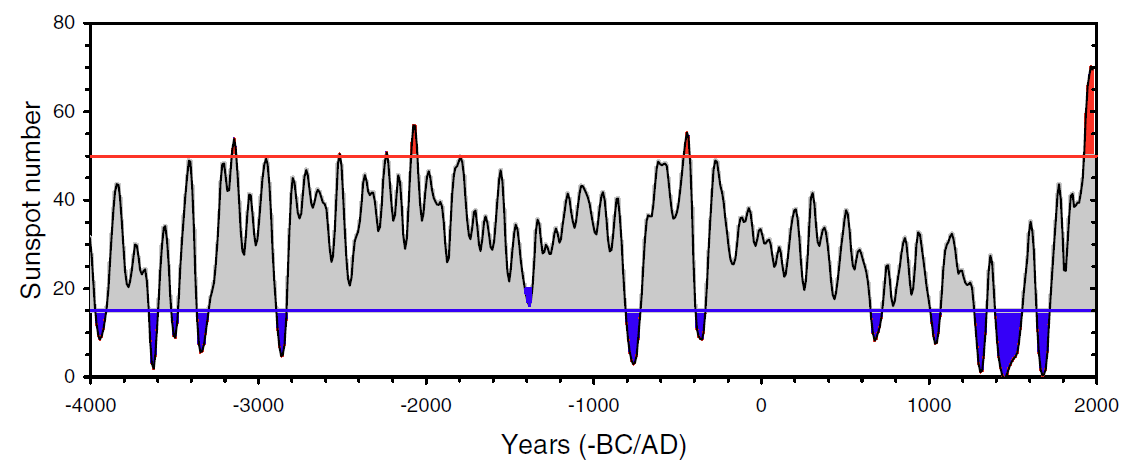
Some of these scientists have done very important work. Ilya Usoskin, for instance, has been a pioneer in developing cosmogenic nucleotide proxies for solar activity. That makes it unsettling to have to call him out, but HEY USOSKIN, it’s about time you renounced the BUT in Usoskin et al. 2005:
The long term trends in solar data and in northern hemisphere temperatures have a correlation coefficient of about 0.7 – .8 at a 94% – 98% confidence level.
BUT:
During these last 30 years the total solar irradiance, solar UV irradiance and cosmic ray flux has not shown any significant secular trend, so that at least this most warming episode must have another source.
Usoskin himself classifies 1920 to 2000 as a “grand maximum” of solar activity, thus his claim here is that even if a historically powerful driver of climate remains at a high level for an extended period of time it will still not cause continued warming. To cause continued warming it would have to keep going up (to higher than high levels).
Does he actually believe that, or did it just seem like a small price to pay to stay in the good graces of the funding institutions that Al Gore, Maurice Strong, James Hansen, Stephen Schneider et al. established in the 1990s? In fact it is a huge price to pay. It is a complete debasement of scientific principle, handing the anti-CO2 crusaders an utterly fraudulent grounds for dismissing the alternative solar-warming hypothesis, and pretty much all of the leading solar scientists have embraced the same trope.
Whether this is bias or cowardice it needs to stop, and for anyone who wants to be silenced no longer, the commitment studies offer an ironclad opportunity. After all, the GCM guys have their own field of expertise. If the computer modelers insist that a steady high level of forcing will cause at least several decades of substantial continued warming then who are the solar scientists to contradict them? All they have to do is stop making highly speculative claims about ocean equilibration that lie completely outside of their field and are unsupported by any reason or evidence.
Usoskin’s solar estimates are “grand maximum” even if post-1945 Waldmeier-era sunspot counts are reduced by 20% as Leif Svalgaard urges
Usoskin uses a “high activity threshold” of 50 so even if his sunspot counts (“75 ± 3 since 1950“) are reduced by 20% they are still at “grand maximum” levels from the 1940s to the 1990s by Usoskin’s criteria.
Hat tip to Lucia Liljegren
I asked Lucia if she knew of any GCM tests of the solar warming hypothesis. Had the “consensus” ever GCM-tested their oft-repeated claim that even if there were a substantial mechanism of enhanced solar forcing it could not have caused late 20th century warming?
Not that she knew of, but she suggested that the results of a persistent elevated level of solar forcing should be roughly the same as for a persistent elevated level of GHG forcing, as examined in the commitment studies. In both cases the amount of warming would be the same. Both would be calibrated to account for observed 20th century warming, so the resulting ocean equilibration process should be similar.
Thanks Lucia. The “consensus” has indeed already in-effect GCM-tested the alternate hypothesis, with just a slight change in time frame. Fifty years of high solar activity beginning in 1950 are analogous to fifty years of 2010-level CO2 forcing beginning in 2010, and the predicted warming from the CO2 commitment testing directly contradicts the stated rationale for dismissing a solar explanation for late 20th century warming.
Discover more from Watts Up With That?
Subscribe to get the latest posts sent to your email.
We are living inside the “experiment”, and can’t seem to measure the resultant changes.
What does that tell us ?
There is nothing more myopic than an adherent to the cause. Your logic unravels them. If the logic holds…..why is there an elephant in the room?
Thanks Alec. This is great stuff. I lapped it up with a spoon. And yet, how to get these guys to back away? MOst of them must realize they’re not being honest, but rationalization can be a powerful force. As is self interest. And yet, can’t they even begin to see that it ultimately is in their self-interest to start being honest? I keep waiting for a rush to the exits, but it never comes..
So, since the solar forcing change has been enough for 0.2 degrees this last century, we had 0.1 C in the first half of the century, and the other 0.1 C hit us after the sun stopped strengthening. Is that the bottom line?
Yes exactly.
I came across this numerous times, alarmist constantly claim that heat from c02 generates more heat, i.e. melting ice reduces albedo which increases temperature further, melting permafrost increases CH4 which increases temperature further etc, etc, But I have never once seen this argument applied to solar activity.
In other words, most consensus scientists agree that one “could argue” that natural processes produced the warming until about 1950, but after that you can no longer argue it, because solar activity didnt increase after about 1950. This is the very argument that led Sir David Attenborough to become convinced of strong AGW; temperatures should have gone down after the sun peaked in the mid 20th century, or thereabouts. (You can get a video of David Attenborough discussing this from the BBC, with the author of a famous paper showing modelled 20th century tempertures, also used by the IPCC, (I can’t remember the name of the paper, but it shows a decline in temperature using modelling from natural sources after about 1950, as compared to temperature trends using natural sources plus c02 after 1950).
Even with the IPCC’s claim that something like 10% (or less) of heating from ~1850 was caused by the sun, this means there would be some flow on effects, just as with c02. And the lags for c02 are LONG and leisurely, for the sun it’s nasty, brutish and short. Talk about selective lag bias!
Enoy reading your posts, but I think we will need some papers from consensus physicists in thermodynamics to ‘fess’ up and point out the gross errors and the selectivity, in some new papers in the spirit of honest science. Some of them out there are honest, after all.
Gosh, just take a bike. Start pedaling with a constant force of any amount and your bike will accelerate till an equilibrium point of air friction, tire and mechanical friction match the force. Until the new equilibrium point is reached the bike will get faster and faster.
These climate scientists need even a little multi-disciplinary common sense sometimes. (or get their brains out of their agendas)
Should not be needed to do a study or have an article – this seems as basic as parallel lines do not intersect. Sad indeed.
Have none of these guys ever boiled water on a stove? Or is that too simplistic?
Nice analysis. I was looking for an explanation of the chart.
Of course, for a skeptic to argue that solar forcing is “enhanced” but CO2 forcing is not might be a bit much. Maybe we should all split the difference and work on addressing global poverty.
I am wondering if you are saying that GHG forcings are cumulated but solar forcings / feedbacks are not?
Could you confirm:
1. Whether constant or variable annual solar forcing is taken into account by climate models?
2. Whichever approach is used, whether only annual solar forcing is taken into account or cumulative forcing? [I assume that the world ocean would be the sink for accumulating any gains or losses from variations in solar intensity.]
3. Alternatively. when estimating cumulative heat gains / losses by the world ocean oceanographers / climatologists take into account the cumulative effect of variable solar forcing?
[I am referring to those studies that use the average termperature variation in the word ocean to estimate climate sensitivity to forcing by GHG etc.]
As you are driving down the freeway, give the accelerator pedal a push and hold it there. You will notice that the vehicle picks up speed over time. It doesn’t suddenly, instantly jump from its former speed to the new speed. The oceans provide some thermal inertia for lack of a better term. As increased solar activity continues over several cycles, in this case almost 200 years since the end of the Dalton, we saw gradually increasing temperatures (with the exception of the late 60’s early 70’s which corresponded to a relatively weak cycle with weak solar wind). What is quoted above seems to be saying “since the temperatures didn’t just shoot up and stay there, since they rose gradually, the additional input from the sun could not have have been the cause so it must have been something that also changed gradually.
During the LIA we had several grand minima without much time from the end of one to the start of the next. Most of the post-LIA warming was accomplished by the 1930’s. The duration and magnitude of warming from 1910 to 1940 was very close to the duration and magnitude of warming from 1975 to 2005. The first episode of warming happened when CO2 emissions could not have possibly been the cause. We have an interesting problem where that initial warming is included when they want to count total 20th century warming but is conveniently excluded when talking about CO2 forcing because it would force them to have to find another cause of the early 20th century warming and that certainly can’t be due to CO2. By focusing any attention on that rise, people would begin to notice that the late 20th century rise was not significantly different. This is one reason I believe databases such as NCDC have been slowly adjusting pre-1940 temperatures downward and adjusting post-1940 temperatures upward. They are attempting to slowly erase that inconvenient fact in very tiny increments over the decades in the hope that they can do so slowly enough that nobody will notice. They have managed so far in 4 years to adjust about 0.1 degree of it away.
And there is yet another lesson in dishonestly that has happened lately and this might be bigger news where I live in my local media than it is in other places. Al Gore sold his Current TV to Al Jazeera. The dollars he took from them and put in his pocket were oil dollars. I listened today to a radio show where that was the topic of conversation. The San Francisco employees of Gore’s “Current TV” feel absolutely betrayed. To them, Gore has lost all credibility. Not only did he take oil dollars, but he also expedited the sale to get the favorable tax rates on the transaction by selling it at the very end of 2012 (announced that it had been sold on Jan 2, 2013). These people now believe that Gore has zero integrity and this calls into question everything he has said over the past couple of decades on the subject of climate change as he has basically betrayed the entire movement. They described it as feeling like Gore has “conned” them. He made millions of dollars on the whole climate change issue and then sold a business built on the reputation he gained in that space to what amounts to one of the largest oil companies in the world. The Qatar royal family have considerable influence and financial stakes in the company.
One of the great pontiffs of “climate change” is now thought by many of his most loyal followers to be nothing more than a con.
Frank White asks: “Whether constant or variable annual solar forcing is taken into account by climate models?”
The only solar forcing that the “consensus” GCMs take into account is Total Solar Irradiance (TSI), which varies only minutely over the solar cycle. There is at this point quite a pile of evidence that some mechanism of solar forcing beyond TSI must be at work, which is sometimes called “indirect solar forcing,” or “enhanced solar forcing,” or “solar amplification,” all just meaning “more than TSI alone.”
Frank also asks whether the models look at cumulative forcing. The GCMs, yes. They model heat storage so continued forcing at a given level will continue to cause warming, so long as the level of forcing is above what is needed to maintain the system at its current temperature (i.e. so long as the oceans have not yet equilibrated to the forcing). A big chunk of the warming response to a new level of forcing will occur quickly (less than ten years), but there will also be a medium term response.
This is what the commitment studies show. If the level of forcing is maintained at a new higher level then a slower warming will continue 50 and a 100 years, slowly tapering off over that time. But the “consensus” does not admit this in the case of CO2. They have never run GCM tests for enhanced solar forcing scenarios. (Obvious because they never cite any such tests when they declare that the 50 years of high post-1950 solar activity could not have caused post 1970 warming.)
So it is not the models that are the problem. The problem is that the models are not being applied to the alternate hypothesis.
Nice article thank you.
The jig from these science deniers is up… Let’s call the AGW crowd what they are – science deniers. Imagine if all the money wasted on costly green energy,and fake science was used for something humane like ending world hunger? What if it were used to fund building of nuclear and fracking and new ways to burn cleanly – instead of fighting progress. OK – I don’t think tax money should be used to pick winners… But by simply NOT taking tax money and applying to green, we’d have more incentive to progress. Where would we be now? How would all the cheap clean energy help the poor from the perspective of more jobs and more energy to amplify their productivity?
Imagine a world without political scientists…
A very inconvenient truth.
I think your article is very important, and hits the nail on the head on the very large and inconvenient error that I think forms the entire basis and argument for strong AGW from C02. Let me explain.
In the 1990s scientists were increasingly noticing that the earth had been warming since the 1970s (and longer than that as well) , but at the time there was no apparent natural reason for this to be occurring. When they looked at the sun, it wasn’t changing, so presumably, the only way to explain it was from human-derived greenhouse gas concentrations, which had been steadily increasing at much the same time. It was a very convenient explanation, as it opened up huge career options, as well as the backing of the entire green movement, that the whole world’s ways were was causing trouble to the climate, and entire research lifetimes could now be spent finding ways to alleviate the problem and change the world. You could get an entirely new career just studying the problem. It was also very politicially tempting to jump to the conclusion that is was all human c02, the entire green movement and most of the left would be behind you. Academic careers beckoned. You could save the world.
So many scientists decided that the only explanation for late 20th century warming was from greenhouse gases from human activities. They made up their mind, without properly considering alternatives, because it was just too politically tempting. The idea of multi-decadal heat lags from solar activity was not even known about, and too vague and unlikely to take seriously.
Trouble is, the scientists and agencies which were then formed to ‘look into’ the problem decided they already knew what they were talking about, and dug their heels in. The temperature was rising from c02 and other human activities, and that was that. Trouble is, if this was true, and this is what they genuinely expected, the temperature should have continued to rise after the 1990s. But it hasn’t. And now they have a problem, they can’t turn around and say they jumped to conclusions in the first place in the 1990s and go it wrong, because this would be a serious loss of face. All those media statements, papers, careers, warnings, all horribly and embarrasingly wrong. Too much is now invested, too many have been caught up with the moment, and it’s too late to backtrack and change your mind.
They should have never jumped to the very convenient academic conclusion that society had to be saved by academia. They should have said that they don’t know. They should not have jumped to hasty conclusions, and should had better examined other possibilities. They should not have dug their heels in and formed a house of cards ‘consensus’. They were irresponsible, and it’s going to come and back and haunt them.
When I first looked into the argument for AGW, within a few weeks I thought that multi-decadal heat lags from the high solar activity in the early 20th century could have caused late 20th century warming, couple with ocean changes and cycles, and I am an amateur. I looked into the consensus argument and their papers, and found that the consensus consistently ignored this possibility, only ever stating that late 20th century warming couldn’t be caused by the sun because solar activity had not increased during this time. It is a bad argument, because if that was true there would be no delay in the maximum summer temperatures weeks after the summer solstice, and even every single day after noon. Surely they had something else besides this, but actually they didn’t. All you had to do was to extend the idea of a heat lag out to longer times decadal time periods for solar activity, and late 20th century warming could be a possible explanation. You didnt need PHds and lifetime of research to understand it, but perhaps a lifetime of research had so cluttered one’s mind with false ideas and arguments that they no longer even thought of it. If I, as an amateur, could see things that people with PHds and years of experience couldn’t see, then what else were they missing?
It’s now very inconvenient for academics, to use Al Gore’s phrase, that the world has not been warming since the late 20th century. It undermines their entire argument. When they realise that the sun had a lot to do with late 20th century warming in the first place, when one realises that multi-decadal heat lag effects from solar activity could explain the warming of the late 20th century, the whole house of cards is going to gradually unravel. Late 20th century warming by c02 is the entire basis of their argument for catastrophic warming in the future and for strong AGW, that was what got them involved in the first place; if it was from the sun the entire basis of their argument and reason for their existance comes into serious question.
It’s not the first time ‘academia’ has been grossly irresponsible. The early 20th century saw social darwinism and eugenics, not to mention the re-ordering of society through ill conceived ‘communism’, which was in many places and times a widely respected and acceptable field of study. (Richard Piper, an expert of communism in the 20th century, blames communism’s development and success largely on irresponsible ‘radical intellectuals’. Sound familiar? It isn’t a left or right thing, its simply intellectuals of the right and the left being self serving and all high and mighty). But we can make such erroneous exaggerations and mistakes less likely to occur in the future, if we tighten up their own academic standards and accountablility, and let the self-correcting processes of science work themselves out in due course.
Why is June 21, the first day of summer, not the warmest day of the year in the Northern hemisphere? Solar energy is at maximum on that day. Why do temperatures keep increasing even though solar energy is falling after June 21? Surely this is impossible under the teachings of climate science. Rising temperature requires rising solar energy, otherwise CO2 must be the cause.
One of the great disasters of our time has been political correctness and the erosion of free speech, to the point where scientists fear to speak their minds. Instead they spout nonsense that any child of 5 could spot. At which point the children enter the school system to be “educated” and form the next generation of scientists.
The greatest evils of all time have been done in the name of doing good.
Like Midas all Gore touched turned gold,
Now the sun sets on his gleam.
====================
Another way in which the sun and CO2 are treated unequally is in the IPCC’s “positive feedbacks”. The IPCC is happy to accept a near trebling (from 1.2 to 3.2) of the CO2 effect using “positive feedbacks” for which there is no evidence, and, in the case of the cloud feedback, AFAIK there is not even a hypothesised mechanism (they don’t have a clue how it works they just parameterise it into the models). But, as Alec Rawls has pointed out, when it comes to the sun they look at direct TSI only.
Mario Lento;
Let’s call the AGW crowd what they are – science deniers.
>>>>>>>>>>>>>>>
’tis an ugly term, and no more applicable to them than to us. Further, like skeptics, one size does not fit all.
O/T –[snip . . indeed it is, but interesting and should be put up on Tips & Notes . .thanks. . mod]
The reason the True Believers persist with what I would call ignorance is quite simple the cost of being utterly wrong is not high enough and the cost of just be wrong is nil. The cost of this intellectual fraud is less then the cost of the real fraud of the financial markets. These people view themselves as powerful and the powerful have historically paid not real attention to shame. That goes way, way back so why do we expect it to change now.
Alec Rawls…
“The problem is that the models are not being applied to the alternate hypothesis.”
Do you mean ‘other’ hypotheses? The alternate hypothesis ( as apposed to null ) is exactly what is being tested with the GCM’s
About a decade ago now I coined two terms, the first being that we live in the “post-sentient age”.
The second was supposed to be a spoof, the “Theory of Inverse Reality”, in which you take any argument, construct its antithesis and shove-off.
Post-sentient essentially means unconscious. Unaware. Likely unable to follow Alec’s presentation or “Mike’s Nature Trick”.
Most adherents of AGW I speak with have no clue of when they live (possibly the end Holocene). Eyes tend to glaze over pretty quickly when you go through the “lite” version of the last several interglacials. It’s like, so what? It either actually does not matter to them if sea levels were somewhere between 6 and 42 meters higher than present at the end of the last one, or its just that the decision has already been made, for whatever reason, their data banks are full on what they needed to come to their commitment. The no longer aware, post-sentient, hominid.
Like watching a bullet come to rest in ballistic gel ask why they think it is a wise idea to take the pet climate security blanket out of the late Holocene atmosphere. I mean if it’s that good of a climate thermostat why take it out of the late Holocene atmosphere, with the sun gone all quiet on us, at a half-precessional old extreme interglacial?
Are we really smart enough to actually be thinking of eradicating CO2 to whatever concentration, irregardless of whether or not it is the heathen devil gas it is made out to be, with the sun gone all quiet on us, at a ~half-precession cycle old interglacial? We would cancel that vaunted next-glacial-onset insurance policy?
Making the call to strip CO2 from the late Holocene atmosphere might be the very definition of inverse reality. We might actually be so smart as to, at great cost, aid and abet the onset of the next glacial. Re-defining, in the inverse reality way, what it means to be “cool.”
Which might be a good thing.
As The Wise One (H.sapiens) we actually have been here before. We made it through the hotter last interglacial, the Eemian, or MIS-5e, and through two strong thermal pulses right at its very end. And a rag-tag bunch of us made it through the last ~90kyr glacial, finally establishing human civilizations during the Holocene. We lost the Neanderthals somewhere between MIS-7 and MIS-5.
Whatever hominid survives each eccentricity maxima gets thinned out by the post-MPT ice ages. Back in those days only the hardiest of us survived genetically to the present. Which occasions a thought or two as to how well post-sentient hominids are likely to “adjust” to the next natural climate climate tipping point (glacial onset), possibly of their own reality-inverted making.
Where will the next northern hemisphere glaciation grind to a halt? Kansas, again? That will definitely take the Alberta Tar Sands off the market.
What I think Alec has done quite nicely here is point up a not so fine point of current human nature. The ability to stare reality in the face AND keep on blinking and winking. So what if your hypothesis works against you? Are you actually expecting post-sentient’s to notice an inversted reality? Surely not in the post-sentient age of non reality TV!
If next glacial it is to be, with such reasoning capacity as post-sentient’s can muster, I hold great hope for our genus. Who knows what frontiers those that survive the next glacial, whenever it finally tips, and emerge in the next interglacial, assuming there is to be another one, might next interglacial Homos do?
I tend to think glacials have been very very good to us, but they pale in comparison to eccentricity minima http://www.manfredmudelsee.com/publ/pdf/Trends-rhythms-and-events-in-Plio-Pleistocene-African-climate.pdf
The question literally boils down to how well hominids that come to the exact opposite conclusion (inverse reality) will fare for maybe a couple dozen Dansgaard-Oeschger events, which, demonstrably warm things up 8C to 16C in just a few years to mere decades, eventually that warmth decaying back to the cold glacial world?
Take a moment to consider your answer. If you are really in it for the species, then our present climate simply must go on, regardless the cost. But what a crapshoot! Take the heathen devil gas out of the late Holocene atmosphere and you just might tip us into the glacial that inverse-thinking is unlikely to survive! A long time in which bad decisions don’t turn out all that well. Will such thinking survive to the next interglacial? Who amongst us would prefer that outcome?
Which leaves being in it for the genus. Inverse reality thinking just might get frozen-out, and we will find some of ourselves well-preserved in Alpine glaciers next interglacial, like we have late in this one. Assuming, of course, that there will be a next one…….
This leaves all manner of say geo-engineering options available to facilitate the onset of said next glacial. From a genetic perspective, given what is happening anthro-Wise these days, genus filtration (a glacial?) might not be such a bad thing.
Such is how the Theory of Inverse Reality works. Think of it as “let the Wookie win” genetic correctness. I mean this IS all about “our” future, right?
Guest post by Alec Rawls
They just make this highly counterintuitive claim that persistent forcing cannot cause continued warming, as if they actually believe that it is the change in the forcing rather than the level of the forcing that does the warming.
Here we go again: Image TSI was constant for a million years. Then changed suddenly by 1% ans stayed at that higher level for the next million years. You are claiming that during that second million years [and actually also during the first million years] that the temperature [warming] would continue to rise throughout all that time. If a million is too short, make it 100 million.
Thingadonta talks about how we can attribute late 20th century warming to “multi-decadal heat lags from the high solar activity in the early 20th century.”
I wouldn’t put it that way. It’s not a lagged response. It’s an ongoing slow warming from the persistence of the elevated solar forcing (or at least, that’s the hypothesis). There is a rapid temperature response to a step up in forcing, and if the step up in forcing persists, there will also be a medium term temperature response. These different time responses relate to how deep the warming penetrates into the oceans.
The surface layer warms up quickly (the best estimate seems to be less than ten years), which will in turn warm up the next ocean layer. If the elevated forcing persists the temperature differential between the upper layer and the next deeper layer will decrease, slowing the rate of heat loss from the upper layer, causing it to warm further, and this will continue for multi-decades and even multi-centuries.
This continued warming is not a lagged response to the step up in forcing. It is an ongoing response to the ongoing high level of forcing. It’s important to keep that straight, otherwise one can fall into the mistake all these “top scientists” are making, where they actually seem to think that temperature change is driven by the change in the forcing rather than the level of the forcing.
Usoskin’s solar estimates are “grand maximum” even if post-1945 Waldmeier-era sunspot counts are reduced by 20% as Leif Svalgaard urges…
You seem to be ignorant of the fact that there are two sunspot series in circulation. The Official [or International Sunspot Number – which has the Waldmeier problem] and the Group Sunspot Number suggested by Hoyt and Schatten. The Group Sunspot Number is too low by up to a factor of two going back to the 18th century. In that [artificial] light the Grand Maximum emerges.
Now, you could claim that the GSN must be the correct, or at least preferred, one to use since it provides a convenient explanation for recent warming. And, indeed, many people are making that claim, but that seems circular to me. Perhaps your bar for valid science is lower than mine. If so, fair enough, it takes all kinds of people….