Charles Rotter
A new paper published earlier this year in Communications Earth & Environment reports that the area of land in Asia’s major rice-producing nations exceeding rice’s long-term thermal limits will expand by ten to thirty times by the end of this century. The lead author is Nicolas Gauthier of the Florida Museum of Natural History. The funding came in part from the Zegar Family Foundation. The press coverage has been the kind of coverage one would expect.
Sample headlines: “Global warming is accelerating 5,000 times faster than rice can evolve” (Live Science). “After 9,000 years of cultivation, rice has reached its thermal limit” (Phys.org). The story is rice will fail, billions will suffer, and the climate is to blame.
The paper defines rice’s thermal limits as the 95% temperature range at locations where rice is currently grown, supplemented by 9000 years of archaeological occurrences. It then runs CMIP6 projections under three Shared Socioeconomic Pathway scenarios (SSP1-2.6, SSP3-7.0, SSP5-8.5), counts grid cells that exceed the thresholds, and reports the multiplier.
The headline range derives from spanning the three scenarios. Two of those three are now formally dead.
Two of the three scenarios just got retired
As WUWT readers will know from our extensive recent coverage, the ScenarioMIP team formally eliminated SSP5-8.5 and SSP3-7.0 from CMIP7 on April 7, 2026. The Van Vuuren et al. paper in Geoscientific Model Development is the document that did it. Pielke called this “the most significant development in climate science in decades.” The new CMIP7 HIGH scenario, on Pielke’s apples-to-apples FaIR comparison, produces about 0.9 °C less warming than SSP5-8.5 by 2081-2100, and roughly 1.4 °C less than IPCC AR6 reported.
The official justification reads:
On the high-end of the range, the CMIP6 high emission levels (quantified by SSP5-8.5) have become implausible, based on trends in the costs of renewables, the emergence of climate policy and recent emission trends.
Read it twice. The scenarios are not implausible because they always were. They are implausible because climate policy and renewable energy have made them so.
This is the gaslighting, and it is not subtle.
For fifteen years, anyone who pointed out that RCP 8.5 was built on impossible assumptions about coal expansion, population growth, and technological stagnation was branded a denier. The science was settled. The scenarios were peer-reviewed. The skeptics were wrong, possibly malicious, certainly not worth engaging. Now those scenarios have been retired by the institutions that built them, and the institutions are not apologizing. They are taking credit. The new story is that the scenarios used to be valid, and our heroic climate policies have made them implausible. Bask in the glow of the policy victory you funded.
The decade and a half of climate impact literature downstream of these scenarios is not being retracted. Pielke counts more than 2,600 studies in 2026 alone using the now-dead high-emission scenarios, and tens of thousands published in the preceding decade. The fearmongering headlines they produced are not being corrected. The trillions in policy investment justified by their projections are not being refunded. The institutional apparatus simply pivots, gives itself an award, and moves on.
The scenarios were implausibly high from the outset. Coal use has been roughly flat globally for a decade. Population projections have been revised downward across nearly every major forecast. Wind and solar combined remain under 10% of global primary energy. None of those values support a scenario built on a near-fivefold expansion of coal use through 2100. RCP 8.5 and SSP5-8.5 were always physically and demographically incoherent. The official 2026 explanation, which credits climate policy with making them implausible, is a rewriting of the record that requires the reader to forget what the underlying assumptions actually were.
That is the broader story. For the rice paper specifically, the operational fact is this: of the three scenarios the paper hinges on, two have just been killed. The headline ten-to-thirty range comes from spanning all three. The ten end is SSP1-2.6, still valid. The thirty end is SSP5-8.5, dead. The middle is SSP3-7.0, also dead. The press ran with the thirty.
The rest of the problems are routine
The methodology defines rice’s thermal limits as the 95% temperature range of places where rice is currently cultivated, then treats this as a biological constraint. It is not. It is a measurement of where rice has been grown, which is determined by rivers, paddy infrastructure, civilizational history, and ten thousand years of cultural practice. The archaeological supplement reports that no Holocene rice site experienced a mean annual temperature above 28.2 °C. This confirms that ancient civilizations did not establish themselves in the hottest deserts on earth.
The paper concedes in its own introduction that rice cultivation in China has shifted northward and intensified irrigation in hot zones, and that this has masked any potential adverse effects of rising temperatures.
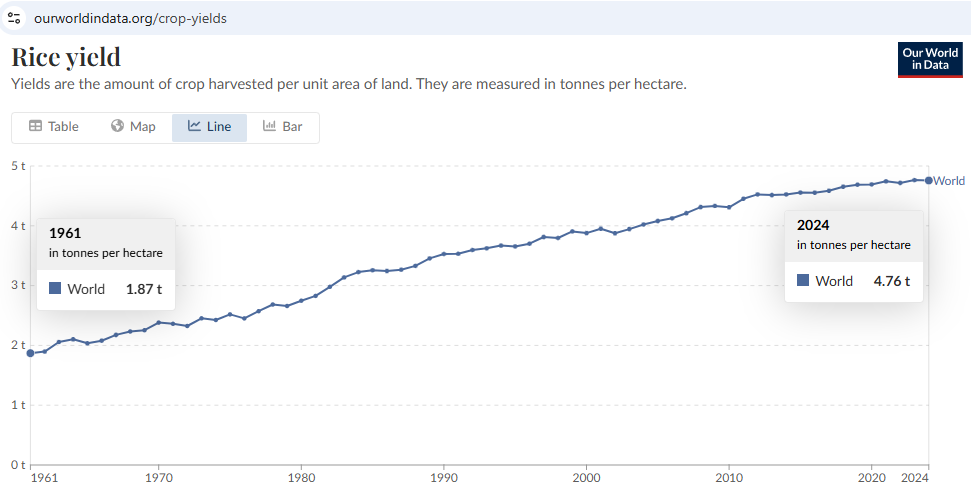
That is the system adapting. The projections credit no further adaptation. The paper also notes that the Green Revolution achieved rapid breeding advances within thirty years, then assumes the next thirty years of breeding, equipped with genomic tools the Green Revolution did not have, will produce less.
The 5,000-times-faster-than-rice-can-evolve number that drove the press headlines comes from a comparison of modern warming rates to wild grass niche evolution. The relevant rate for rice is human breeding, which moves several orders of magnitude faster than natural drift. And the lead author himself told Live Science that you could keep global rice production the same by moving cultivation around,
which is a different claim from the catastrophe framing of the press cycle.
What this looks like from the cheap seats
The rice paper was published three months before its principal scenarios were formally retired. The press cycle that ran with its catastrophic numbers has not been updated. The 2,600 impact studies still in the 2026 literature have not been corrected. The institutions that built the framework, defended it for fifteen years, declared it implausible last month, and are now taking credit for the implausibility are not apologizing.
Rice has fed civilizations through the Holocene Climatic Optimum, the mid-Holocene warm spike, the Medieval Warm Period, and the Little Ice Age. The paper’s own author concedes that aggregate production can be maintained. The paper’s own introduction acknowledges that adaptation is already masking the warming that has occurred. And the paper’s thirty-times figure rests on a scenario that no longer exists in the literature.
The press will not mention any of this. That is the press cycle doing its job, which is what the press cycle has always been for.