Essay by Eric Worrall
According to a recent study, climate models overestimate southern ocean surface heating, because they underestimate the impact of storms.
NEWS RELEASE 16-DEC-2025
Storms in the Southern Ocean mitigates global warming
Peer-Reviewed Publication
UNIVERSITY OF GOTHENBURGIntense storms that sweep over the Southern Ocean enable the ocean to absorb more heat from the atmosphere. New research from the University of Gothenburg shows that today’s climate models underestimate how storms mix the ocean and thereby give less reliable future projections of our climate.
The Southern Ocean is a vast expanse of ocean encircling the Antarctic continent, regulating Earth’s climate by moving heat, carbon, and nutrients out in the world’s oceans.
It provides a critical climate service by absorbing over 75 per cent of the excess heat generated by humans globally. The Southern Ocean’s capacity to reduce climate warming depends on how efficiently it can absorb heat from our atmosphere.
…
“Our research shows that summers with stronger storm activity generate lower surface temperatures across the Southern Ocean. Hence, a stormy ocean can absorb more heat from the atmosphere, then in calm weather,” says Marcel du Plessis, Researcher in oceanography at the University of Gothenburg and main author of the study.
How much heat the ocean absorbs from the atmosphere influences everything from how high temperatures will be on land, to the extent of sea ice and the severity of marine heatwaves.
…
Current climate models, which underpin the climate projections used to guide policy, tend to underestimate the strength of Southern Ocean storms and thereby simulate an overly warm ocean.
“That is why our findings are important, because a better representation of storm processes is essential for more accurate future climate projections,” says Marcel du Plessis.
…
It’s in the Antarctic summer that storms have their strongest impact on ocean heat uptake. In winter, completely different processes take place. This will be the next challenge for researchers to observe and understand.
Media Contact
Olof Lönnehed
University of Gothenburg
olof.lonnehed@science.gu.se
Office: +46 766-186970Expert Contact
Marcel du Plessis
Read more: https://www.eurekalert.org/news-releases/1109536
University of Gothenburg
marcel.du.plessis@gu.se
Cell: +46 72 900 8118
The abstract of the study;
Published: 03 December 2025
Southern Ocean summer warming is regulated by storm-driven mixing
- Marcel D. du Plessis,
- Sarah-Anne Nicholson,
- Isabelle Giddy,
- Pedro M. S. Monteiro,
- Channing J. Prend&
- Sebastiaan Swart
Nature Geoscience (2025)Cite this article
Abstract
The Southern Ocean absorbs most of the excess heat resulting from climate change. However, climate projections show a persistent warm summer bias in its sea surface temperatures, indicating a limited understanding of the air–sea heat exchange mechanisms governing this region. Here we examine the impact of storms on the interannual variability of Southern Ocean surface temperatures during summer using in situ observations from underwater and surface robotic vehicles, climate reanalyses and satellite data. We show that synoptic-scale storms regulate summer sea surface temperatures through alteration of the effective heat capacity of the mixed layer and the entrainment of colder water from below. Storms reduce the summer ocean heat gain by limiting solar radiation reaching the surface. This effect is partially offset by a reduction in heat loss due to turbulent air–sea exchange. We also find that interannual variations in sea surface temperature during summer in the Southern Ocean are driven by changes in storm-mean wind speeds, which are linked to the Southern Annular Mode. Our results demonstrate a causal link between storm forcing and sea surface temperature variability, which is critical for reducing warming biases in climate models and improving future climate projections.
Read more: https://www.nature.com/articles/s41561-025-01857-3
From the study;
…
During the third period (days 23 to 47), a series of intense storms deepened the mixed layer to about 100 m. This, along with a reduction of the mean net heat flux to 131 W m−2, decreased the SST warming rate to 0.025 °C d−1. The drop in heat flux was primarily due to the reduction in incoming top-of-atmosphere shortwave radiation (Fig. 2f). That said, with the positive net heat flux still large, the SST continued to increase until reaching the seasonal maximum (Tmax = 2.28 °C). After this, the SST remained comparatively stable at −0.002 °C d−1 as the net heat flux reduced to 88 W m−2, again due to a drop in incoming shortwave radiation (Fig. 2f). This slightly negative SST tendency—despite the positive heat flux—can be explained by a multi-day entrainment-driven cooling associated with deep turbulent mixing, starting on day 47 (Fig. 2e and Extended Data Fig. 3). Thus, in addition to regulating MLD and the mixed-layer’s heat capacity, intense storms can reduce SST through wind-driven entrainment of cooler subsurface water. This is seen during two other notable SST cooling events in response to mixing below the MLD, on days 5 and 24 (Fig. 2a,c). Cumulatively, all three entrainment events reduced the SST by about 1 °C over the summer (Fig. 2a), with the two strongest events cooling the SST by 0.4 °C each (days 24 to 27 and days 47 to 52). These large SST changes, caused by individual storms, highlight the rectified effect of storm-driven entrainment on the seasonal-scale warming during summer.
…
Read more: Same link as above
Interesting they forgot to mention the part about storms limiting solar radiation reaching the surface in the press release.
Another part they left out is how much this underestimated deep mixing is likely to retard global warming, thanks to the enormous thermal capacity of the oceans. Even if the model interpretation that most global warming is being absorbed by the ocean is correct, it would likely take thousands of years to nudge deep ocean temperature by a single degree. The ocean depths are just above freezing, 12,000 years of Holocene interglacial global warming has barely nudged the dial.
Given the uptick in storms when summer insolation heats the sea, storms which act to reduce sea surface temperature, it seems likely stronger than expected summer storms are yet another unaccounted for negative feedback which works against climate alarmist fantasies of runaway global warming.
Cows seek shade trees on hot summer afternoons – Study says
It COULD be that they’re anticipating a warmer planet. 🙂
Good grief, just give it up with the modelling.
Nothing wrong with modelling if they are attractive!
The ocean is not absorbing heat from the atmosphere nor any ‘excess’ heat from humans globally.
The atmosphere at 2 meters is on average 6°C colder than the global ocean, lagging by a month.
Absorbed solar radiation accumulates in the ocean, becoming global warming. The atmosphere is thus warmed by the stored sunshine that previously warmed the ocean.
But but but not uh, it does too.
And according to UAH data, most of that atmospheric warming comes in surges at strong El Nino events.
How much money did they get for “proving” what Willis E . ALREADY PROVED ?
Way more then Willis
More albedo & the Earth cools.
Less albedo & the Earth warms.
No albedo & the Earth becomes much like the Moon, barren & 400 K lit side, 100 K dark.
Remove the Earth’s atmosphere or even just the GHGs and the Earth becomes much like the Moon, no water vapor or clouds, no ice or snow, no oceans, no vegetation, no 30% albedo becoming a barren rock ball, hot^3 (400 K) on the lit side, cold^3 (100 K) on the dark. At Earth’s distance from the Sun space is hot (394 K) not cold (5 K).
That’s NOT what the RGHE theory says.
EVIDENCE:
RGHE theory says “288 K (15 C) w – 255 K (-18 C) w/o = a 33 C colder ice ball Earth.” 255 K assumes w/o case keeps 30% albedo, an assumption akin to criminal fraud. Nobody agrees 288 K is GMST plus it was 15 C in 1896. 288 K is a physical surface measurement. 255 K is a S-B equilibrium calculation at ToA. Apples and potatoes.
Nikolov “Airless Celestial Bodies”
Kramm “Moon as test bed for Earth”
UCLA Diviner lunar mission data
JWST solar shield (391.7 K)
Sky Lab golden awning
ISS HVAC design for lit side of 250 F. (ISS web site)
Astronaut backpack life support w/ AC and cool water tubing underwear. (Space Discovery Center)
I understand that graphic.
It is a flat earth model.
No measurement tolerances.
How does a cloud transfer W/m^2? If that parameter is applied to a column of air, as it should be, the earth is cooked.
As you point out, bad, bad model.
Its not really a model..
More like a totally unrealistic cartoon illustration.
Agreed. It is a sale pitch at best.
Everybody does the same bad model.
Nicholas, on your diagram you have made red circles and yellow boxes and seem to be generally confused about “back” radiation. Let me try to explain it.
Say your face is 32C and your bathroom mirror is 22 C.
Say emissivity =1 for simplicity.
And Watts/m^2= sigma T^4, the Stefan Boltzmann equation. Plus we’re actually ignoring the reflection of the mirror….ok then, it’s not a mirror, it’s just a patch of wall….
Face the mirror or patch of wall….
Your face radiates 490 W/m^2 toward the mirror, while the mirror radiates 418 W/m^2 back towards your face. The net 72 Watt/m^2 is what your metabolism must supply to your face to keep it at 32 C instead of you cooling down to room temperature.
Does that help your mental picture ?
Climate wise, the Earth’s surface is analogous to your face but emitting at 288 K, while the mirror sized patch of wall is the “sky” at an SB temp 278 K or about 5C (corresponding to 342 watts), which is a mosaic of outer space at -273 C, cloud bottoms of 0 C, cirrus clouds of -50 C, and mostly water vapor and CO2 below the clouds varying from 0 C to 15 C.
hope this clears up your mental impasse concerning “back” radiation and the SB equation compared to what you thought you knew about the 2nd Law of thermodynamics. “Back” radiation isn’t “heat” flowing the wrong way…it’s just “heat” that can’t flow from warm to cold by virtue of the cold body having some temperature warmer than absolute zero.
Unfortunately, what you say will likely have no impact on the ignorant and gullible who believe that adding CO2 to air makes thermometers hotter.
The possession of high intelligence or PhDs is no bar to absolute belief in pseudoscientific fairytales. That’s the nature of cultism – unwavering devotion to the words of the leaders.
For example, if we let the rays emitted by the body fall back on it, say by suitable reflection, the body, while again absorbing these rays, will necessarily be at the same time emitting new rays, and this is the compensation required by the second principle.
Generally we may say: Emission without simultaneous absorption is irreversible, while the opposite process, absorption without emission, is impossible in nature.
Max Planck. The Theory of Heat Radiation by Max Planck (English Edition) – Unraveling the Mysteries of Heat Radiation: Max Planck’s Groundbreaking Theory in English (p. 118). Prabhat Prakashan. Kindle Edition.
The compensation being discussed is that as the reflected rays are absorbed, they are also being emitted. Since the body can only radiate at its temperature, that means the cooling is slowed, not that it is reaching a higher temperature.
You bought it hook, line, and sinker.
Start with the ideal black body does not apply to gasses as there is no surface.
It is an interesting oversight that energy budget diagrams always show the “back” radiation so that it can make the “fore” radiation match the SB equation for a surface temp of 289 K….yet never show the integrated column kinetic energy, which is kilowatts in magnitude of convection and horizontal weather front air flow….but assumed to be NET zero…so, I s’pose no point in showing that it is huge compared to say 4 watts of CO2 forcing….just sayin’…
Trenberth’s “Heat Budget” you know, he updated that thing over ten years ago. The original found in the IPCC’s first 1990 assessment report shows that it balanced (energy in equaled energy out) so an update was in order. May have gone something like this. . . . . .
Once upon a time on a bright sunny morning a few years back, Dr. James Hansen was looking at Kevin Trenberth’s iconic “World Energy Budget”
when he choked on his morning coffee because he realized that the darn thing balanced. That’s right, energy in equaled energy out. You see, he’s been saying for some time now that heat energy is slowly building up in Earth’s climate system and that’s not going to happen if the energy budget is balanced.
So he did some fast calculations, snatched up his cell phone and punched in Trenberth’s number.
“Hi Kev, Hansen here, how’s it goin’ with you? Got a minute?”
“Sure Doc, what’s up?”
“Glad you asked. I’ve been looking at your energy budget and it balances, can you fix that?”
“What do you mean fix it, it’s supposed to balance?”
“Kev, listen carefully now, if it balances, heat will never build up in the system do you see where I’m going?”
“Uh I’m not sure, can you tell me a little more?”
“Come on Kev don’t you get it? I need heat to build up in the system. My papers say that heat is in the pipeline, there’s a slow feedback, there’s an imbalance between radiation in and radiation out. Your Energy Budget diagram says it balances. Do you understand now?”
“Gotcha Doc, I’ll get right on it” [starts to hang up the phone]
“WAIT! I need an imbalance of point nine Watts per square meter [0.9 Wm²] for everything to work out right.”
“Uh Doc, what if it doesn’t come out to that?”
“Jeez Kev! Just stick it in there. Run up some of the numbers for back-radiation so it looks like an update, glitz up the graphics a little and come up with some gobbledygook of why you re-did the chart you know how to do that sort of thing don’t you?”
“Sure do Doc, consider it done” [click]
And so:
Follow up to the above story:
If you run the numbers, 0.9 Wm² will warm the ocean 600 meters deep about 1/2°C in a little over 40 years. Truly amazing stuff. The noon-day sun puts out nearly 1370 wm² and these guys are claiming they’ve added up all the chaotic movements of heat over the entire planet and have determined an imbalance of 0.9 Wm². That’s an accuracy to five? four places. No plus or minus error bars or anything.
What it means is, all of the components
Reflected by clouds, Reflected by aerosols, Reflected by atmospheric gases, Reflected by surface, Absorbed by the surface, Absorbed by the atmosphere, Thermals, Evaporation, Transpiration, Latent heat, Emitted by clouds, Emitted by atmosphere, Atmospheric Window, AND Back radiation!
need to have an accuracy to those five? four places or better for the 0.9 Wm² to be true.
Perhaps Hansen didn’t ring up Trenberth and bully him into changing his chart but, Trenberth did change it to show an imbalance and I bet he did so because he realized that if it balanced like his 1997 version, heat wouldn’t build up.
And we all are supposed to sit still for this sort of thing.
Prof John Tyndall.
But it doesn’t. The laws of physics known even in Tyndall’s time suffice to explain why, but seem to be beyond the ken of “climate scientists.”
Sad but true.
It’s not what we know we don’t know.
The risk comes from what we do not know we don’t know.
Challenge the assumptions.
In other news….Trump Administration proposes to cut the NCAR in Boulder Colorado by over a billion dollars…….Hooray!
I’m not a meteorologist, but my understanding is that storms also transport heat from the ocean surface into the upper troposphere, which is one of the reasons that they leave cold water wakes behind them.
You can see the cold water wakes in maps of sea surface temperatures near hurricanes. Here are hurricanes Fabian and Isabel leaving cold water trails in their wakes in 2003:
https://svs.gsfc.nasa.gov/vis/a000000/a002800/a002897/a002897_320.webmhd.webm
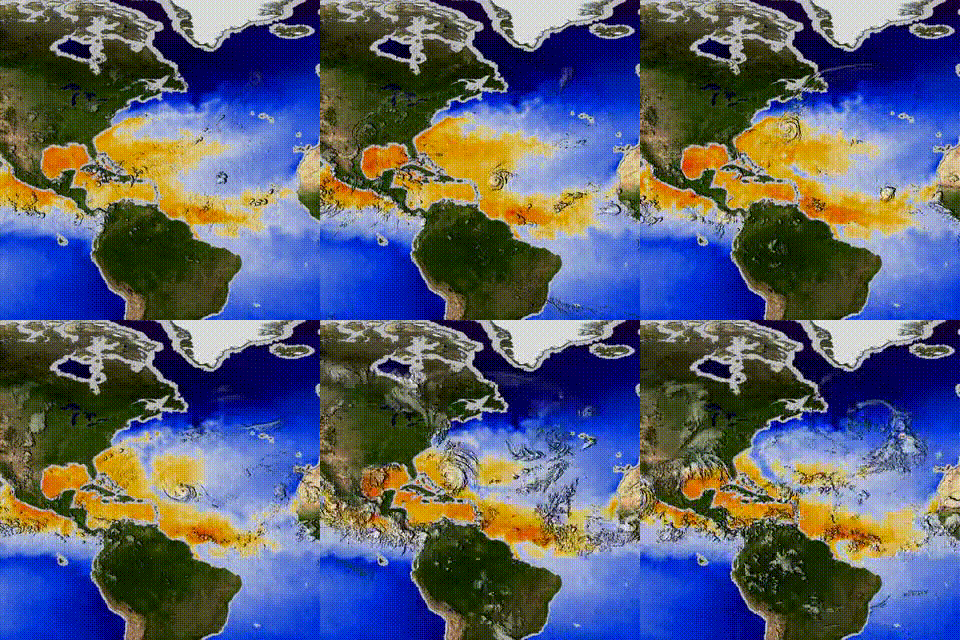
I think that the water temperature behind the hurricane is cooled in three ways: by mixing of the warmer surface water with the colder water beneath, by cold rainfall, and by updrafts carrying heat away from the surface, high into the troposphere. If I’ve got that wrong, somebody please educate me.
(Note: I converted NASA’s 3-second video to an animated .gif via the https://cloudconvert.com/webm-to-gif website.)
Everything above absolute zero emits IR. When matter emits IR, it cools unless that energy deficit is made good by an external energy source. The water obeys that natural law, so maybe you could start there, and then figure out why the water has lost more energy than has been replaced.
One step at a time. For example, why would colder denser water mix with warmer, less dense water floating on top? The warmer surface water is obviously radiating more IR than it receives, and cooling as a result. Why is this so? And so on. Feynman noted “Science is belief in the ignorance of experts”, so you might as well assume all “climate scientists” are ignorant, and go back to basics.
Feel free to solicit my opinion. It’s worthless, but might help you to discover the truth.
“…why would colder denser water mix with warmer, less dense water floating on top?”
It’s not just temperature. The surface layer is being cooled by evaporation, which raises the salinity, which helps the nightly overturning. (Stable “Warm” over “Cold” works in freshwater lakes, in warm weather.)
Cooled. Not as warm. Denser. Sinks, displacing less dense water, which replaces it at the surface, where it radiates heat to space.
So colder, denser water does not displace less dense, warmer water on the surface.
Surface water evaporating – produces higher salinity – along with cooling – denser – sinks. Just paraphrasing Willis E.
Cools. Loses energy. For continuous evaporation to occur resulting in cooling, certain conditions must be present. The net result is a loss of energy by radiation to outer space.
Your point about salinity is fair, but comes about as a result of evaporative
It’s a matter of observation that a very calm ocean surface can have surface skin temperatures in excess of 38 C. Plenty of sunlight, but where’s the “evaporative cooling”? I’ll leave it to one of the resident “experts” to explain. Willis Eschenbach, perhaps?
It doesn’t matter whether you agree or not, but after four and a half years of continuous sunlight, the Earth has cooled. Basic physics. Not even any need for Carl Sagan’s “faint young Sun” fantasy, which is apparently believed, if not explicitly stated, by many “climate scientists”, who are obviously ignorant and gullible.
I’ll leave it to one of the resident “experts” to explain. Willis Eschenbach, perhaps?
He already did, some years ago. Swimming after dark in tropical waters, and noting temperature differences as he went, colder water coming to the surface in a ‘patchy’ fashion. His usual question, “Why”. His answer, salinity difference.
No, that’s just the surface cooling at night by losing energy to outer space. I specifically mentioned the effect of the Sun. Not much Sun at night, although Willis might say “it doesn’t matter”.
“Salinity difference” does not cause temperature to change. That’s about as silly as thinking that adding CO2 to air makes thermometers hotter – like Willis does!
Salinity difference” does not cause temperature to change.
No, it causes ‘density’ to change, and the denser water sinks.
His answer, as usual, was nonsensical. “Salinity difference” is just Willis implying something, without being specific, trying to sound knowledgeable.
However, you now agree that denser water sinks. On the surface cold water is denser. It sinks. Not, as Willis implies “colder water coming to the surface in a ‘patchy’ fashion.”
No, colder water does not magically “come to the surface”, particularly if its salinity matches that of the surrounding water.
Appealing to the authority of the ignorant and gullible Willis Eschenbach just makes you look, well, even more ignorant and gullible than him.
Merry Christmas…..
And to you and yours!
Hurricanes rotate counter clockwise. Would not the swirling wind cool the the water behind the hurricane?
Well, considering that “swirling winds” aren’t emitting “cold rays”, it all depends. If the wind is 100% humidity, no. Your comment tells the questioner nothing useful. I presume you are talking about evaporation, which involves the surface losing more energy than it gains, and cooling as a result. The cooling effect of evaporation involves a few factors, and an objective consideration of the resultant result needs knowledge of the physical mechanism, and the circumstances.
So Dave has another factor to consider, which may do him no good at all. How to decide what factors are real? If all are, what contribution does each make?
Being a tentative scientist, Dave makes an observation, and asks “Why is that?”. I assume he wants more of an answer than ” . . . swirling winds cool the water . . . “. He may already be aware that “evaporation cools water”!
If he’s happy with your explanation, that’s fine.
You are on the right track, but you (and the authors of the study) are neglecting the most important factor leading to cooling of the oceans in the tropics: evapotranspiration. Evapotranspiration and the subsequent condensation of water vapor are the primary drivers of atmospheric meridional heat transfer away from tropical oceans, for the latent heat transferred from water to air by the phase change of water is exponentially greater than the heat passing directly from the water to the air.
When that latent heat is then transferred away from the ocean surface, either into the higher atmosphere by convection or away from the tropics by prevailing wind currents, these cooler locations induce condensation which releases the latent heat. There is a greater percentage of the heat transmitted to space in these locations.
The condensation leading to clouds directly over the ocean that decrease ocean heating is a twofer cooling benefit of evapotranspiration.
All of the heat from the Sun is radiated away to outer space. Plus about 44TW of internal heat.
You are correct, however exposing the lies and corruption of the Global Warming racketeers requires explaining why their models always overestimate the effect of rising CO2 on temperatures, and this requires understanding all of the other factors affecting climate (that they deny are significant). Their mistake is failing to account for clouds and storms and how they are likely far more important than CO2 in determining our climate.
Yes, all the heat is always dissipated eventually, but failure to understand where it is dissipated and why is the key to their failed models.
“According to a recent study, climate models overestimate southern ocean surface heating, because they underestimate the impact of storms.”
So, they underestimate some things and overestimate other things- but it’s “settled science”.
Well, in their estimate, the science is settled.
And they—the professional climate scientists employed by the US federal government—even have multiple, tens-of-$millions-cost-per-year supercomputers with associated climate models that say the “science is settled” with an uncertainty range of about ± 60%.
Maybe I missed something but didn’t we call this, in pre-model times, the negative feedback on clouds?
According to many articles on the “Thermostat Hypothesis” developed by Willis Eschenbach and appearing here on WUWT over many years as well as a nice, detailed summary of such available at https://www.oarval.org/thermostat.html describing how low altitude cloud development (particularly thunderstorm/CN clouds over oceans) regulates Earth’s temperature—as well as the “Iris Hypothesis” developed independently by Richard Lindzen describing the feedback effect of cirrus clouds (see https://en.wikipedia.org/wiki/Iris_hypothesis )—climate models overestimate southern ocean surface heating, because they underestimate the impact of
stormscloud developments even before they become full fledged storms.Complete nonsense, I’m afraid. Four and a half billion years of history shows the Earth has cooled, in spite of continuous sunlight, atmosphere, clouds, pixie dust, and the fervid dreams of those who believe that adding CO2 to air makes thermometers hotter.
Willis Eschenbach disregards the laws of physics and mathematics if they don’t fit his imaginary universe. For example, his “Steel greenhouse”. If you can’t see the obvious rejection of physical laws in that little fantasy, then you are as ignorant a gullible as Willis himself.
Feel free to take offense. I’m not responsible for your actions. Accept reality – adding CO2 to air does not make thermometers hotter, regardless of whether a “consensus” vigorously asserts it does.
I agree. CO2 does not affect thermometers, nor leave to planetary devastation.
I do not accept clouds as a thermostat. Wrong metaphor.
The earth energy systems are thermal (aka heat) engines. Clouds act in large part as the engine’s governor.
Well, then the automotive industry has it all wrong . . . they use thermostats to control water coolant loop temperature in the, ahem, Otto “heat cycle” utilized in internal combustion engines.
Oh, BTW, place a thermometer in the spray fan coming out of a CO2 fire extinguisher and read the resulting temperature change . . . I think that simple experiment will reveal that adding CO2 to air can indeed “affect thermometers”.
I agree. Maybe Sparta meant to say “make thermometers hotter”. You are correct – CO2 can make thermometers colder, if allowed to expand rapidly. Its presence in the atmosphere also reduces maximum surface temperatures.
Adding CO2 to air does not make thermometers hotter, and anybody who believes it does, is ignorant and gullible.
Rubbish paper. “Climate change” produces no heat, excess or otherwise. Dreams of dimwits who believe that adding CO2 to air makes thermometers hotter. The authors have “discovered” what any 6 year old knows – less sunlight means lower temperature. Clouds, roofs, parasols and Panama hats effect such lowering of temperature.
As Fourier pointed out, the Earth loses all heat it receives from the Sun to outer space – plus a little internal heat, currently about 44TW.
Hence the fact the Earth has cooled in spite of four and a half billion years of continuous sunlight.
“excess heat resulting from climate change.“
That part of the sentence is just sheer gibberish, anyway.
“Climate change” doesn’t result in extra “heat”…..
…. if anything, its the other way around.
The common usage is substituting climate for weather. Climate is the evil word.
I’m sure I don’t understand everything they are saying here but I fail to see why they couldn’t have said yes we have shown upturn cools the surface, winds cool things and clouds block the sun which keeps things from getting hotter. Where can I apply for a grant?
By the time they get the models right, after untold additional millions or billions squandered, they’ll arrive at the same conclusion anyone capable of logic and reason came to years ago.
There is nothing to worry about. And if “the climate” ever becomes something to worry about, it will be because it’s getting COLDER. NOT WARMER.
Here’s what Prof John Tyndall had to say about water in general more than a century ago –
“pours its heat into space” – whether it’s a gas, a liquid, or a solid. On the surface or somewhere above it.
So much for losing its heat by convection, conduction, or the magical properties of the mythical “greenhouse effect”. No, I’m not saying convection doesn’t exist – it merely moves a radiating fluid from place to place. Conduction is just a way of expressing radiation within a body.
The problem is radiation is used with EM energy and radiation is used with thermal energy.
Just like the word heat has common/social language context derived (fluid) definitions. Many, many definitions.
Agreed. EMR is light – all frequencies. All matter above absolute zero emits EMR. Matter interacts with EMR different ways, depending on the nature of the matter, and the frequency of the EMR.
I tend to describe EMR as photons, because an individual photon has a fixed quantity (out of an infinite number of possible quantities) of energy, proportional to its wavelength.
Infrared radiation is a vague term, referring to the infinite number of wavelengths (and hence energies) which are longer than visible red – which is vague anyway.
The ignorant and gullible bandy about such terms as “LWIR” and “SWIR”, unable or unwilling to specify a bandwidth, supposing that their audience is even dumber than they are.
And you would have to be pretty dumb to believe that adding CO2 to air makes thermometers hotter!
My takeaway : “climate scientists” hide their own ignorance about climate behind flawed models.
So, once we fix THIS error of the climate models, THEN they’ll be less wildly incorrect.