Essay by Eric Worrall
But at what cost?
Australia records biggest annual drop in emissions outside pandemic
By Mike Foley and Nick Toscano
November 26, 2025 — 10.00pmThe biggest annual drop in Australia’s greenhouse gas emissions outside the COVID-19 pandemic has been driven by record output from renewable energy that is squeezing more coal and gas out of the power grid.
…
Bowen said the biggest drivers of emission cuts came from growing supplies of renewables, coupled with limits on big polluting factories and mines under the government’s safeguard mechanism policy.
“We are on track to bring down energy bills and meet our climate targets if we stay the course and continue to lift our efforts,” Bowen said.
…
Read more: https://www.smh.com.au/politics/federal/australia-records-biggest-annual-drop-in-emissions-outside-pandemic-20251126-p5niok.html
The government might be boasting about coming electricity price cuts, but the chairman of the federal climate change authority is not so sure of when the promised price cuts will occur.
Climate Change Authority chair Matt Kean unable to say when power prices will stop rising in tense grilling
Climate Change Authority chair Matt Kean has been unable to provide a firm deadline on when power prices will stop rising for Australians after being grilled on energy costs.
Matt Hampson Digital Reporter
November 25, 2025 – 7:30PMClimate Change Authority chair Matt Kean has claimed power prices will stop rising when Labor’s renewable energy plan is rolled out, but could not say when that would be.
Power prices have continued to surge for Australians as the government pushes its agenda on renewables, which Prime Minister Anthony Albanese has claimed is the cheapest form of energy.
Meanwhile, a recent Australian Energy Council (AEC) report that surveyed energy CEOs under anonymity included one retailer saying they felt power prices would increase for at least the next 10 years “given the scale of capital being deployed in the industry”.
…
Read more: https://www.skynews.com.au/business/energy/climate-change-authority-chair-matt-kean-unable-to-say-when-power-prices-will-stop-rising-in-tense-grilling/news-story/6b6c17155f8667e63861ee49bdaedfdb
The sector which is bearing the brunt of these energy price games is Australian Manufacturing, or what is left of it;
Research Note: Hard times in Australian manufacturing
The last twelve months have been a very difficult time to be in Australian manufacturing. After two years of healthy growth following the pandemic, business conditions took a sudden turn for the worse. The industry entered recession around the middle of 2024, and contracted 2.6% over the last year. While weak economic conditions in Australia have proven difficult for most industries, manufacturing has declined faster and further than any of its peers.
…
Manufacturing falls into recession after a post-pandemic boom
Australian manufacturing has experienced very volatile conditions in the past five years. Like many industrial sectors, it was badly impacted by the public health restrictions of the COVID period. But following the pandemic, a strong rebound in Australia’s economy coupled with supply chain disruptions greatly increased the demand for manufactured goods. Manufacturing output surged by around 10% in 2022 to meet this demand, while employment expanded by 7% – its first proper workforce growth in over twenty years.
However, in 2024 conditions in manufacturing rapidly deteriorated. The sluggish Australian economy weighed heavily on local demand, while the restoration of global supply chains saw imports return and put downward pressure on prices. The industry fell into recession during the middle of 2024, and has contracted by 2.6% over the last year. Most branches of manufacturing have been affected, with only the food and beverage subindustry managing to eke out a weak 1.0% growth rate.
…
Industrial inflation – particularly gas prices – weigh heavily on balance sheets
One of the major pressures has been industrial inflation, with manufacturing experiencing some of the highest impacts of any industry in Australia.
In the five years since the pandemic, manufacturer input prices have risen by an astonishing 37.5%. This outpaced both the growth in Australian industrial prices (20.0%) and consumer prices (22.2%) across the same time.
…
These problems are particularly acute in the ‘heavy’ branches of manufacturing – particularly metals and petrochemicals – which rely on gas. These manufacturers consume around half of Australia’s domestic gas supply, and their need for heat and chemical feedstocks cannot be substituted for lower cost electricity supply. Surging energy costs must often be borne on the balance sheet, greatly reducing the profitability of energy-intensive branches of manufacturing.
Read more: https://www.australianindustrygroup.com.au/resourcecentre/research-economics/economics-intelligence/2025/hard-times-in-australian-manufacturing/
…
The manufacturing research document notes a buoyant gas export market is putting pressure on domestic supplies, but why aren’t domestic supplies responding to upward price pressure?
Part of the reason is political green extremism. For example, the State of Victoria, home substantial unconventional gas reserves, enshrined a ban on fracking in their State Constitution in 2021. NSW banned offshore oil and gas exploration in 2024. On the East Coast of Australia, which holds the bulk of Australia’s manufacturing sector, Queensland appears to be the only state which is offering any level of reassurance to manufacturers, though even Queensland regularly gets caught up in the energy price chaos of the green obsessed southern states.
ideologically driven closure of coal plants is also putting pressure on domestic gas supplies. Despite green outrage, gas is perceived as the least evil fossil fuel by politicians who know they get the blame if the power grid fails, gas is a “transition fuel”.
While it would be wrong to blame everything on Net Zero policies – the mining industry research note quoted above lists other significant issues such as skills shortages – it seems likely that the emissions cuts Australia’s Net Zero obsessed leaders are celebrating are largely being achieved by burning down what is left of Australia’s manufacturing industry.
Not that anyone in Australia notices, other than people directly affected by the manufacturing cutbacks. All this pain achieves exactly nothing. Whatever manufacturing capacity we lose is rapidly replaced by overseas factories powered in many cases by Aussie coal.
Six of one, half a dozen of the other. When will people realize that shutting down manufacturing and moving it to another country does nothing in the way of reducing CO2 output to our atmosphere? In some cases it increases CO2 output because now those goods not manufactured locally need to be transported in. It’s a fools game.
If you’re a green lunatic (including the Labor Party and many Libs too) your head would explode before you realize that.
“Climate Change Authority chair Matt Kean”
So HE’S the one who caused climate change! Get ‘im, boys!
How can it be that an ”authority” on any subject knows absolutely nothing about it?
When ideologues are running a country, reason, rationality & practicality don’t stand a chance of guiding the nation towards prosperity.
Because ideology and rationality cannot occupy the same mind space at the same time.
It is like reading histories of the 1930’s, and wondering “how could they be that daft”?
Hindsight is usually 20/20. Unless you fail to see.
“Whatever manufacturing capacity we lose is rapidly replaced by overseas factories powered in many cases by Aussie coal.”
Yes, but the logic is backward. Manufacturing has been shrinking for at least fifty years. There was no net zero when car manufacturing closed, or steel making shrivelled.
The reason is simple economics. Oz mines and exports huge amounts of iron, coal and other minerals. We are very good at it. And yes, China uses that and their huge work force to make manufactured goods. They are very good at that.
So how does Australia benefit? The only point of exporting is to get real goods in return. No use just getting paper credit. So we import manufactured goods. We have to. And local manufacture can’t compete.
Manufacturing as a percentage of GDP has shrunk for 50 years because other industries like mining have overtaken it but so-called climate policy has been slowly strangling it since 2007.
From your source
Steady shrinkage, no evidence of change due to climate policy.
That’s cute, reproducing a graph showing the share of GDP instead of the relevant graph at the link:
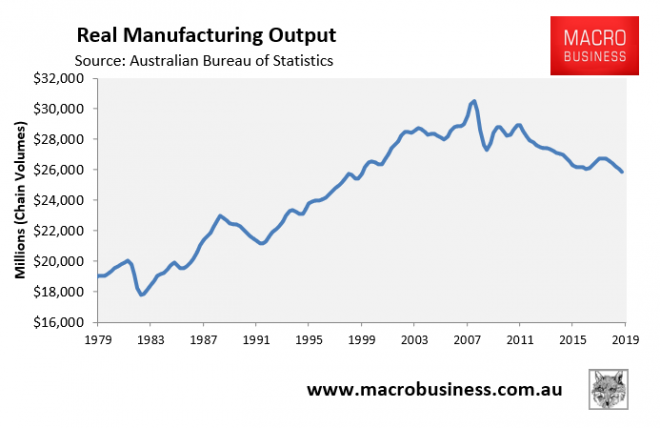
That graph mainly tells about inflation (plus population growth).
So, ever rising energy costs are not a severe problem for any nation?
You don’t have to just mine stuff Nick. The USA mines a lot of stuff and also value adds with manufacturing, a sector Trump is helping by lowering those input costs Aussie manufacturers cite as critical problems for their industry.
And the main reason places like China and India are competitive in manufacturing is they burn lots of coal to produce cheap energy. In many cases Aussie coal.
The US mines stuff, but not much for export. It is just part of what they need for their large local economy.
As to whether Trump is helping, we’ll see. No evidence so far.
The bigger reason they’re competitive is incredibly cheap labor. That’s the reason manufacturing started leaving western countries in the first place.
True, and we are now making the death of manufacturing complete with high power prices. It will lead to job losses, increasing poverty and ultimately a banana republic.
I understand both sides of the topic, but a key factor is minimum wage increases.
The USA pays, SWAG, $25 per hour versus Mexico, SWAG, $2.50 per hour versus China, SWAG, $0.25 per hour, industry relocates where labor is cheap.
Yes, Industry also relocates where energy is cheap.
It’s a done deal when both are in the same place.
But that cheap labor is even cheaper thanks to very cheap energy.
Union demands / ransom is what drove auto manufacturing away from Australia.
The last auto assembler to leave Oz was Toyota, when leftist Labor-appointed judge Mordy Bromberg ruled that Toyota could not directly discuss work conditions with its employees, but could only deal with unions.
Toyota just called – “enough”.
So, the workers (many of them) got greedy and the government got green. So, Australia seems like its doomed.
It’s not the workers who get greedy, Joseph, it’s the “power drunk” union thugs who think they run the country.
The Australian Labor Party was originally formed as and still is the official political arm of the union movement.
All politicians standing for election to parliament as Labor candidates must be union members and mostly tied to particular unions or factions.
And do exactly as they are instructed by their union masters.
So whenever Australia has a Labor government inflicted upon it (as is the case at present), the citizens there are ruled by a far left cabal whose priority is serving the interests of international socialism, and in some cases even outright communism.
Cheap energy helps make up for expensive labor. So the goal of any nation should be cheap energy so it’s labor force can earn a decent living.
As Eric says reducing emissions, if that’s your want, is easy if you simply destroy your industries along with the economy and living standards.
While emissions from electricity generation have dropped from 2009 at great cost the trend has levelled since 2023, the trend for emissions from all other sectors remaining more or less level (see down the page).
‘Decarbonizing’ the electricity sector is not going to get any easier, that’s for sure.
The most notable drop on the graph since 2009 has been from LULUFC an acronym that is nowhere explained but stands for ‘land use land use change and forestry’ a category that the renewables enthusiasts at the Australia Institute helpfully point out is a sham.
LULUFC fanatics would love to end all forestry- after all, they already own a nice wood home with nice wood furniture and paper products. At least this is the case here in New England.
Don’t kid yourself…the reduction of manufacturing output in most “developed” countries is due to the availability of low cost goods from elsewhere, mostly China. Almost zero to do with “net zero” ideology. And a lot to do with the development of relatively fast and low cost shipping methods, in combination with internet expediting that pressures suppliers to meet their promised quality and delivery.