Guest Post by Willis Eschenbach
For a while now scientists have been raising the alarm about the effect of increasing atmospheric CO2 on the pH of the ocean. pH is a measure of whether something is acidic (pH below 7), alkaline, also called basic (pH above 7) or neutral (pH of 7). The ocean is slightly alkaline, and rainwater is slightly acidic. Here are some examples.

What’s happening is that the ocean is moving slightly toward neutral. However, “ocean neutralization” doesn’t sound alarming enough, so they’re falsely labeling it “ocean acidification”. Here are some quotes.
“Generally, shelled animals—including mussels, clams, urchins and starfish—are going to have trouble building their shells in more acidic water, just like the corals. Mussels and oysters are expected to grow less shell by 25 percent and 10 percent respectively by the end of the century… oyster larvae fail to even begin growing their shells.”
Ocean Acidification, Smithsonian Museum
“After exposing them to a range of acidity levels, UC Davis scientists found that under high CO₂, or more acidic, conditions, the foraminifera had trouble building their shells and making spines, an important feature of their shells. They also showed signs of physiological stress, reducing their metabolism and slowing their respiration to undetectable levels.”
Tiny Shells Indicate Big Changes to Global Carbon Cycle, UC Davis
“Like a piece of chalk dissolving in vinegar, marine life with hard shells is in danger of being dissolved by increasing acidity in the oceans. Ocean acidity is rising as sea water absorbs more carbon dioxide released into the atmosphere from power plants and automobiles. The higher acidity threatens marine life, including corals and shellfish, which may become extinct later this century from the chemical effects of carbon dioxide, even if the planet warms less than expected.”
Regardless of global warming, rising CO2 levels threaten marine life, University of Illinois
YIKES! EVERYONE PANIC!
I got to thinking about this, and I thought … wait a minute. There have been hard-shelled animals in the ocean since the end of the Cambrian Explosion about 485 million years ago. Say what?
Now, there’s a new study out in Science Magazine (paywalled, of course) that contains estimates of both atmospheric CO2 and oceanic pH since 485 million years ago. 485 million years ago is roughly the end of what’s called the “Cambrian Explosion Of Life”, a time when a huge number of life forms emerged on the earth.
Here’s their estimate of CO2 levels since the Cambrian Explosion.

Figure 1. Title says it all. I’ve added the modern increase at the recent end of the graph.
You might ask, “If the study is paywalled, how did you get the data”. Well, their Supplementary Online Information isn’t paywalled, and it contains this graphic.

Figure 2. Panel B, Figure S10, op. cit.
Note that the CO2 levels are shown on a log scale to visually minimize the size of the actual changes … but I digress. Sadly, they didn’t include a table of the data. So I had to digitize it. Takes a while, but I’m a patient man.

Figure 3. Digitization of the graph shown in Figure 2.
Looking back at Figure 1, the most remarkable features are the large and rapid drop in CO2 levels starting around 470 million years before the present (Ma BP), and the somewhat slower but almost as large rise starting around 430 Ma BP.
The 470 Ma BP drop is generally attributed to enhanced silicate weathering of the mountains by early land plants, and reduced volcanic CO₂ input. And the increase is generally attributed to reduced mountain weathering due to glaciation, along with an increase in volcanic CO₂ emission. Are those actually the causes? Unknown. The Late Ordovician glaciation only covered about 13%-14% of the land area, compared to about 25% of the land area during the most recent glaciation. So that part of the explanation seems unlikely, but what do I know?
In any case, the study also has a graph of the pH of the ocean over the same period of time. How accurate is it? Also unknown. Presumably, however, it’s currently our best estimate of the variations of oceanic pH over 485 million years. Again I digitized the data. Here’s that graph.

Figure 4. Again, title says it all.
Now, there are several noteworthy points in this graph. First, at no time in the past 485 million years has the ocean been acidic. It has always been alkaline (basic), with a pH always greater than 7 (neutral pH).
Second, over that entire time, there has been a huge variety and profusion of shelled animals living in the ocean, apparently unbothered by the variations in alkalinity.
Third, in the upper right of Figure 4 is a tiny vertical line with horizontal “whiskers” at the top and bottom. It shows the modern change in pH since 1850, the change that has all the megabrains calling the Climate 911 hotline to report an emergency … color me unimpressed. We’ve run the oceanic pH experiment over the last half billion years. Shelled creatures didn’t disappear.
TL;DR version? Life has flourished, both above and below the surface of the sea, through periods when atmospheric CO2 has varied up to almost ten times the current level. As a result, the myriad of alarmist claims that increasing CO2 is some kind of death sentence for life either on the land or in the ocean all run aground on a reef of hard facts.
Don’t believe me about pH and creatures with shells? Ask the chambered nautilus, a lovely cephalopod with a hard shell. I once saw a school of them while scuba diving, and I have the shell of one that I picked up years ago on a beach on one of the outer islands in Fiji.

It’s one of the most ancient creatures in the sea, and it has existed in a virtually unchanged form for half a billion years … funny how the changes in oceanic pH didn’t disturb it one bit.
Best to all on a sunny afternoon,
w.
Yeah, you’ve heard it before … when you comment, please quote the exact words you are discussing. I can defend my words; I choose them carefully. I cannot defend your understanding of my words.
My Other Analyses Of the Ocean Neutralization Question:
pH Sampling Density 2014-12-30
A recent post by Anthony Watts highlighted a curious fact. This is that records of some two and a half million oceanic pH samples existed, but weren’t used in testimony before Congress about ocean pH. The post was accompanied by a graph which purported to show a historical variation in ocean…
The Reef Abides 2011-10-25
I love the coral reefs of the planet. In my childhood on a dusty cattle ranch in the Western US, I decorated my mental imaginarium of the world with images of unbelievably colored reefs below white sand beaches, with impossibly shaped fish and strange, brilliant plants. But when I finally…
The Electric Oceanic Acid Test 2010-06-19
I’m a long-time ocean devotee. I’ve spent a good chunk of my life on and under the ocean as a commercial and sport fisherman, a surfer, a blue-water sailor, and a commercial and sport diver. So I’m concerned that the new poster-boy of alarmism these days is sea-water “acidification” from…
A Neutral View of Oceanic pH 2015-01-02
Following up on my previous investigations into the oceanic pH dataset, I’ve taken a deeper look at what the 2.5 million pH data points from the oceanographic data can tell us. Let me start with an overview of oceanic pH (the measure of alkalinity/acidity, with neutral being a pH of…
The Reef Abides … Or Not 2014-07-06
I’ve written a few times on the question of one of my favorite hangouts on the planet, underwater tropical coral reefs. Don’t know if you’ve ever been down to one, but they are a fairyland of delights, full of hosts of strange and mysterious creatures. I’ve seen them far from…
The Ocean Is Not Getting Acidified 2011-12-27
There’s an interesting study out on the natural pH changes in the ocean. I discussed some of these pH changes a year ago in my post “The Electric Oceanic Acid Test“. Before getting to the new study, let me say a couple of things about pH. The pH scale measures…
Carbon And Carbonate 2016-01-30
I’ve spent a good chunk of my life around, on, and under the ocean. I worked seasonally for many years as a commercial fisherman off of the western coast of the US. I’ve frozen off my begonias setting nets in driving sleet up in the Bering Sea. I’m also a …
The Solution To Dissolution 2020-01-31
The British tabloid “The Guardian” has a new scare story about what is wrongly called “ocean acidification”. It opens as follows: Sounds like the end of times, right? So let me start with a simple fact. The ocean is NOT acidic. Nor will it ever become acidic, except in a few isolated locations. It i…
Dungeness Crabs Redux 2020-02-02
Well, after my last post, The Solution To Dissolution, I thought I was done with the Dungeness crab question. And I was happy to be done with those chilly crustaceans. Writing that post brought back memories of how cold the fishery is. I remember leaving out from Eureka harbor at the north end of Ca…
The Voice Of The Lobster 2020-02-14
Over in the Tweetiverse, someone was all boo-hoo about the eeevil effects of “climate change” that he claimed had “already occurred”. He referenced a publication from a once-noble organization that sadly has drunk the “CLIMATE EMERGENCY” koolaid, National Geographic. So I read it, and the only thing…
There are fossil coral reefs in Eastern Utah that are hundreds of feet (meters) thick, I guess coral haven’t yet received the memo that they are supposed to be dissolving under the onslaught of anthropomorphic carbon dioxide.
Due to the current dry climate in eastern Utah, the fossilized coral have probably been dead for thousands of years, after the sea that covered them has shrunken into the Great Salt Lake. This is not the same as living coral that are still under an ocean.
Um, Salt Lake is on the other side of the Wasatch Plateau.
Nit: anthropogenic
Indeed, my bad.
It’s all about seizing the narrative with headlines and the AGW crowd/Marxists are successful at it because they own the MSM. That edge in proclaiming the narrative is disappearing though and it seems the USA is the only country capable of keeping it at bay.
It’s not about seizing any narrative. There is no narrative to seize. It’s is about lying with a straight face to promote an agenda.
The dishonesty is as much about what they fail to mention as it is about what they say:
As Willis and many others have pointed out, the oceans are alkaline (caustic), not acidic, and always will be. Freshwater lakes and rivers can be acidic, as can rain, but seawater never is — except, rarely, in immediate proximity to some hydrothermal vents & seeps, which can drastically alter local ocean chemistry.
Such places are significant, because they demonstrate that corals can thrive even in waters where pH levels vary drastically over short amounts of time. Here’s a paper:
Pichler, T., et al (2019). Suitability of the shallow water hydrothermal system at Ambitle Island (Papua New Guinea) to study the effect of high pCO2 on coral reefs: Marine Pollution Bulletin, v. 138, p. 148-158. doi.org/10.1016/j.marpolbul.2018.11.003
Excerpt: “During 7 days of pH acquisition the Authors showed that pH at the study site varied with extreme variations and intense sudden changes down to pH 6.8 and up to 8.1”
Through >98% of the Earth’s history, atmospheric CO2 levels were far higher than they are now. In fact, CO2 levels were far higher than we could ever raise them, now, by burning recoverable fossil fuels.
During the lush Cretaceous, when complex life flourished, including marine life, atmospheric CO2 concentrations are believed to have averaged nearly four times the current level. During the equally lush Jurassic, CO2 levels were even higher.
Even with those much higher atmospheric CO2 levels, the oceans were still alkaline, rather than acidic, and there’s no evidence that those high atmospheric CO2 levels were harmful to marine life.
The oceans contain about 50× as much CO2 & DIC as the atmosphere, and less than 1/3 of mankind’s CO2 emissions have found their way into the oceans, so far, so manmade CO2 dissolved into the oceans has little effect (mostly just on surface waters).
Anthropogenic CO2 has probably lowered ocean surface water by a negligible, harmless 0.1 pH point. That corresponds to a mere 26% increase in hydronium ion concentration, confined to the most alkaline (caustic) part of the ocean (the surface layer). Contrary to speculation by climate activists, that slight pH decrease is not harmful, and it does not make the oceans acidic.
Seasonal & diurnal pH changes, pH differences with depth, and even pH differences between ocean basis dwarf the small effect on pH from anthropogenic CO2 emissions.
Note how much pH varies with depth, and between ocean basins.
Here’s a map of coral reef locations. Notice how they’re clustered around the equator. Most coral thrive best in the warmest water. Even the very warm southern Red Sea is dotted with healthy coral reefs (unlike the cooler Mediterranean):
At 7:20 in this BBC video you can hear how wonderfully healthy the coral are in warmest part of the very warm southern Red Sea, off Eritrea:
https://www.youtube.com/watch?v=vSOLDf1a9dA&t=440s
In that map that you can see that there are coral reefs in the Pacific, Atlantic, and Indian Oceans, as well as smaller bodies, like the Red Sea — but they’re most plentiful in the Pacific.
Now, look back at that pH v. depth graph. Notice which ocean is least alkaline: the Pacific. Obviously the coral don’t mind a slightly less alkaline ocean.
What’s more, even if you consider 0.1 pH point significant, only the surface layer of the ocean has been significantly affected. The surface layer also happens to be the most alkaline part of the oceans. So, so-called “ocean acidification” just slightly moderates (neutralizes) the most extreme ocean pH deviation from neutral.
The bottom line is that the “ocean acidification” scare is FUD, not science.
The ocean acidification people ignore the dilution factor. And the top layer where CO2 might have an ‘acidification’ effect is super small and hard to separate from the influence of fresh water input (rain).
What CO2 most certainly does is encourage more plant growth which actually helps marine biology..
Other factors to consider: the ocean is heavily buffered, which is why highly acidic “smoker” (volcanic vents) emissions on the ocean floor are quickly neutralized: incidentally, some ocean life thrives in their acidic environments.
The ocean is replete with CO2 vents and acidic smokers that have been spewing CO2 and concentrated acids into the ocean for millions of years…why haven’t they changed the ocean pH? Answer: chemical buffer systems.
Some of this buffering is provided by calcium salts dissolved in ocean water. If atmospheric CO2 dissolves in the ocean, some of it is precipitated out as calcium carbonate.
Correct. The ocean is not getting more acidic nor is it getting closer to neutral. That simply cannot happen until all of the carbonates are dissolved. Never, in other words.
If I read graphic 4 correctly than the oceans today are ‘dangerously’ alcaline.
I would like someone to explain how a stabilised liquid containing solid calcium and other carbonates can become less alkaline by adding an acid.
Nice post, WE. One of several good ones on the topic.
Three supporting addenda:
AR4 really raised the alarm, but contained a basic scientific error. Their ‘expert’ estimates ignored that seawater is highly buffered so were chemically impossible.Jim Steele has point out here several times that shell forming marine organisms (including corals) biologically modify the microenvironment where their ‘Shell’ forms so that it isn’t ambient pH dependent. Explains why such animals have been around for several hundred million years.The few ‘experimental’ demonstrations about harmful ‘acidification’ all either have laboratory flaws, or are outright fraudulent. I provided two examples of such deliberate academic misconduct in essay Shell Games in ebook Blowing Smoke. Fabricius Milne Bay bubbling transects (the low pH dead reef culprit was H2S, not CO2 induced low pH. And the Whiskey Creek oyster hatchery, where PNNL blamed acidification when the problem was Whiskey Creek had to be managed like an estuary, which it isn’t.
Most interesting and informative as always, Rud.
Thanks,
w.
Don’t tell the AI that it’s failing to support the storyline – it agrees with Rud instead:
“What makes seawater a good buffer?
Carbonate Buffering System: The primary reason for seawater’s buffering capacity is the presence of the carbonate/bicarbonate buffer system. This system involves a series of chemical reactions between:
Dissolved carbon dioxide (CO₂)
Water (H₂O)
Carbonic acid (H₂CO₃)
Bicarbonate ions (HCO₃⁻)
Carbonate ions (CO₃²⁻)
Equilibrium and pH Regulation: These species are in equilibrium with each other, and this equilibrium helps to regulate the ocean’s pH. When CO₂ dissolves in seawater, it forms carbonic acid, which then dissociates into bicarbonate and hydrogen ions. The bicarbonate ions can react with additional hydrogen ions to form carbonic acid, buffering against a decrease in pH. The co-existence of these species in seawater provides a chemical buffer system, which plays a crucial role in maintaining the ocean’s pH stability.
Alkalinity: Seawater’s buffering capacity is also related to its alkalinity, which is a measure of the water’s ability to neutralize acids. High alkalinity indicates a greater capacity to buffer against changes in proton concentrations and reduce pH shifts.”
I googled because “seawater is highly buffered” sounded too much like sciency circular reasoning to me – like the pH is hard to change because the pH is hard to change. The better answer is pH is hard to change because it contains chemicals that don’t want to change.
Those same species are responsible for maintaining the pH of blood. If the pH falls below the lower limit, although still basic the condition is called acidosis, whereas if the pH rises above the higher limit the condition is called alkalosis despite the pH of blood is alkaline/basic. However, no one would call the low pH of blood being acidic.
It is a specialized biological application that has nothing to do with what happens in seawater or other inorganic chemical reactions.
Yes, the equilibria do buffer the change in pH, here’s a graph that shows the effect:
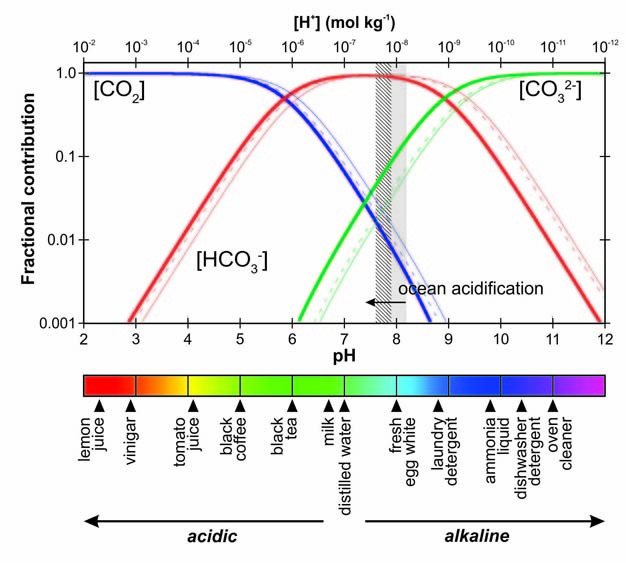
Sea water does contain chemicals that resist change.
Thanks, Phil’s chart clarifies “ocean acidification” terminology the best (my summary: the issue is a footnote with a scary name).
Which AI did you use? Also, I wonder if one asks multiple A is the identical question, does one get essentially the same response.
I google almost everything I learn online, so my AI response was the one that comes up as google’s first result. Evidence suggests google is not always trustworthy- for example search results for WUWT go to what I’d call slander, or a hit piece on wikipedia. However the AI was not able to muster enough of its parent corporation’s political leaning to call Rud evilly wrong and torturer of fluffy pink hamsters for breakfast.
Google programmers have gotten to the point where their AIs accept that telling lies is okay, but have not yet gotten to the point where their AIs know where they must tell lies to help their team.
I tend to read a little too fast sometimes and the “laboratory flaws” became labotomy flaws… I had to go back and reread but thought both were correct.
Had an Emily Litella moment.
Life.
The critters are alive.
Kill the critter, the shell stops growing.
A tree won’t grow out of the nutrients in the ground without “life” to utilize those nutrients.
Side note.
https://wattsupwiththat.com/2025/06/23/why-trumps-gold-standard-executive-order-is-essential-to-restoring-truth-in-science/
Kill the Bull, there’ll be less bullsh*t. 😎
I’d always thought trees were mostly made from nutrients in the ground. It was stunning to learn that most of the wood-weight came from the air, not the dirt. The guy that convinced me used an observation: how do lumbered forests not become pit mines if the weight comes from the ground? Oh yeah. I was embarassed to reach my 40s without ever thinking it through.
Same kind of Aha! when I learned “sea level” is not one number. I totally threw out the “oblate spheroid” concept, plus overlooked that a spinning 2/3 liquid surface with long obstructions, orbited by something that causes tides, orbiting around something that radiates heat would have all sorts of non-spherical tendencies.
Water might seek its level, but on Earth it finds many levels.
They would use a log scale for CO2.
The pH scale itself is already logarithmic. Each pH unit is a change by 10x in [H3O+]. That scale is given along the top x-axis.
CO2 is not measured on a log scale, usually.
Redefining the terms of measurement is a complete no-no in science.
Simple fact: The oceans have never been acidic and will never be acidic.
Of course, this article is written for UC Davis by a cat named Kat Kerlin. Kat Kerlin, UC Davis News and Media Relations, 530-750-9195, kekerlin@ucdavis.edu
If a basic solution can be called acidic in a copyrighted article from a major university, then a human journalist named Kat can be called a feline as well. It is as simple as that.
“Sadly, they didn’t include a table of the data. So I had to digitize it.”
I’ve had to do that for other types of data but the question is the same. Why is the data kept inaccessible?
Simple answer. In 2010 Dessler of Texas Tech published a paper purporting to show positive cloud feedback. He provided the data. Steve McIntyre promptly showed that Dessler had actually proved there was NO cloud feedback. Since then, publishing actual climate data has been a bit of a nono. Lots of examples including Mann.
They paid for the data with ‘their’ grant money. Unless the grant money came from a benefactor that specified that it was a gift with no restrictions, they have no right to withhold the data.
As an aside, I just ran across an online graph digitizer program at this address: https://graph2table.com/. I’ve tried a few digitizers over the years, but this one is a dream come true. Every other program of this type requires you to enter an image of your graph, and then manually mark of calibration points, and enter their values through the keyboard. This app is AI driven. You upload an image of your graph, and it automatically reads the scales and figures out what they mean, then digitizes the curve(s) and generates a CSV table which you then download. I tried it with the graph in Figure 3 of the above article, and it did the whole process in about three seconds.
I know you are a patient man, Willis, but your time is also extremely valuable: this program allows you to keep from wasting some of it.
Thanks, Michael. The problem is that it only extracts a few data points at regular intervals. In digitizing the graph below, they only extracted values ever fifty million years …
In contrast, look at the digitizing job I did in Figure 3.
Mine captures the finer details. I wouldn’t be happy with theirs.
w.
There’s a place to comment to them by following the “Contact” link. I’ve used it already, and will send them a comment about the resolution. They’re looking for such comments, and continuously improving the product. It’s a good start, IMHO. Mainly for the degree of simplification of the setup. For the kind of graphs I need to digitize, it’s already a perfect tool.
Which program do you use, if you don’t mind my asking. I’m always looking for a better way to do what I need done, and I really respect your judgement.
I’m on the Mac, and I’m using WebPlotDigitizer. It has both automatic and manual digitization, I use both depending.
w.
Thank you. I’ll check it out.
Meanwhile the scientists on the RRS Sir David Attenborough recently discovered that if you take the bottom living Antarctic critters used to a pretty stable -1C, or whatever, and cook them on heat pads, they’re not entirely happy.
https://www.itv.com/news/2025-06-18/antarcticas-hidden-sea-life-could-be-used-for-washing-powder-and-ice-cream
That experiment sounds a little mean. Did the single cell organisms sign a waiver?
“The alarmist stories about the disastrous effects of seawater “acidificationl on shellfish have long been debunked, see e.g.
Venn et al PNAS (2013) 110, 5, 1634-163. Impact of seawater acidification on pH at the tissue-skeleton interface and calcification in reef corals
Movilla J et al. (2014). Resistance of two Mediterranean cold-water coral species to low-pH conditions. Water, 6,59–67
Carreiro-Silva M, et al (2014) Molecular mechanisms underlying the physiological responses of the cold-water coral Desmophyllum dianthus to ocean acidification. Coral Reefs, 33, 465–476.
Maier et al (2013) Respiration of Mediterraneean cold-water corals is not affected by ocean acidification as projected for the end of the century. Biogeosciences, 10, 5671–5680.
Maier et al (2013) End of century pCO2 levels do not impact calcification in Mediterranean cold-water corals. PLoS ONE, 8 , e62655.
Maier et al (2012) Calcification rates and the effect of ocean acidification on Mediterranean cold-water corals. Proceedings of the Royal Society B, 279, 1716–1723.
McCulloch et al (2012) Coral resilience to ocean acidification and global warming through pH up-regulation. Nature Climate Change, 2, 623–627.
Castillo, et al Proceedings (2014) . Biological sciences / The Royal Society 281, 1797. The reef-building coral Siderastrea siderea exhibits parabolic responses to ocean acidification and warming.
Rodolfo-Metalpa, et al (2015) GLOBAL CHANGE BIOLOGY 21, 2238-2248
Calcification is not the Achilles’ heel of cold-water corals in an acidifying ocean
Figure 4, that’s interesting, the ocean is more alkaline during the current ice age, and during the ice ages around 300 million years ago.
The chart attempts to describe 500 million years data to 0.04/8ish, less than 1%, resolution. If the chart is accurate, its story would not be how pH has changed in 500 million years but rather how anyone could know what ocean pH was 500 million years ago. Also, the chart seems to assume that all ocean water everywhere has the same pH. Water on the the Suez Canal surface probably measures differently than water at the bottom of Marianas Trench.
The Mariana Trench is an oceanic trench located in the western Pacific Ocean, about 200 kilometres (124 mi) east of the Mariana Islands; it is the deepest oceanic trench on Earth.”
Looked it up to make sure I was not obscure-name-dropping. I never knew the trench was named after islands.
Yes, surface waters have diurnal and seasonal changes in salinity and pH, largely the result of evaporation and torrential rainfall. There is, in general, a change in pH with latitude that is the result of the difference in temperatures controlling the solubility of CO2. Some people here complain about trying to assign a single, annual global temperature to Earth. The same complaints are valid for a single representative pH without even specifying a depth for the pH, which decreases with increasing depth. The relationships are too complex to adequately try to describe with a single number; the variance is rarely provided.
Who doesn’t like a good softshell crab?
The Ocean can Never go Acid. As shown on this chart, Cohen and Happer [1] show that the ocean can never go acid, even with 1000 ppm atmospheric CO2, because of buffering by salts. Some chart notations added in [2].
[1] Cohen, R. and Happer, W., Fundamentals of Ocean pH, September 18, 2015. https://co2coalition.org/wp-content/uploads/2021/11/2015-Cohen-Happer-Fundamentals-of-Ocean-pH.pdf
[2] Greer, John E., Jr, Real Climate Science shows Human CO2 Cannot Cause a Climate Crisis!
And the renowned Stanford geochemist, Konrad Krauskopf, states in his text book that, because of the (bi)carbonate and borate buffering, it will never become acidic. He speculated that, at worst, it might become neutral in deep, isolated, stagnant pools enriched in hydrogen sulfide. Yet, alarmists decided it would be acceptable to refer to the process of lowering marine pH as “ocean acidification,” rather than “neutralization,” or simply lowering alkalinity.
How often do Willis, Rud, I, and others have to demonstrate the gas-lighting that goes on?
http://wattsupwiththat.com/2015/09/15/are-the-oceans-becoming-more-acidic/
You’ll have to keep doing it until the MSM change their attitude and start to publish both sides of the CAGW argument.
I’m not holding my breath.
There is only one side to the ‘acidification’ argument. It cannot happen physically and is irrelevant biologically.
Alarmist attempts to prove otherwise observationally constitute academic misconduct.
Fabricius knew about the hydrogen sulfide seep poisoning (the H2S data were in her SI).
PNNL either knew or should have known that oysters spawn in estuaries in summer when pH is naturally elevated. Whiskey Creek was taking in cold sea water and raising the temperature to induce spawning without also raising the pH to summer estuary levels (about from 8.1 to 9.2 pH).
Agreed, but until the MSM start to publish the facts the general public will remain in the dark and so nothing will happen and you et al will have to keep on demonstrating as mentioned by Clyde.
Agree. So we are. Not just here. I have published three ebooks at least partly on the topics.
So looking at the problem objectively, none of us, individually or collectively, seem to be doing anything other than “singing to the choir.” What might we do differently to break the log jam? I think that Trump’s Gold Standard for science may have some impact. However, “more of the same” doesn’t seem to be a constructive use of our time.
Never happen.
Even if the oceans became slightly acidic, bivalves would adapt. There are plenty of bivalves which live in neutral or even slightly acidic fresh water. Their shells don’t dissolve.
Sadly; apparently there is really no one here who gets it
but it’s so simple….
where those 100 billions of tons of CO2 that naturally gasses out each year, around the equator, due to heat, have to dissolve again, that does not happen, at least not completely in the Arctic region where it is getting warmer. The reaction counteracted by warmer water is
CO2 + 2H2O + cold = HCO3 + H3O
Now humans come and make acidic wastewater that eventually ends up in the oceans
The reaction is
HCO3 + H3O = CO2 + 2H2O
so what happens?/ who doesn’t understand that??
(the people in the east have no case with the western standard pH=6 for the discharge of wastewater)
the end result: no change in pH of the seawater but there is more CO2 in air.
Praise God.
You skipped carbonic acid.
“there is really no one here who gets it”
I think you assume too much.
“What’s happening is that the ocean is moving slightly toward neutral. However, “ocean neutralization” doesn’t sound alarming enough, so they’re falsely labeling it “ocean acidification”.”
You’re exactly right, Willis. Speaking from a lifetime in Chemistry.
I’ve argued exactly your point with a coven of alarmists on X. They were (and are) frantic to keep the “acidification” label. They made all sorts of specious analyses to retain it.
No evidence, including calculations showing the non-issue, loosened their grip on the word.
The debate caused me to search for the first alarmist use of acidification applied to CO2 emissions. It doesn’t appear in the IPCC ARs until AR4 in 2007.
The earliest mention of the concept I found, in the context of fossil fuel CO2, is in the 1997 Report, “Fuels Decarbonization And Carbon Sequestration: Report of A Workshop” PU/CEES Report No. 302.(pdf)
“Ocean Acidification” appears once there, under Section E, where an experimental program is recommended to study the biological impacts of CO2 emissions entering the ocean.
There was some earlier discussion of acidification in terms of deposition of nitric or sulfuric acid from sulfur aerosols and volcanism. But nothing about FF CO2 emissions.
Ocean acidification is a late-emerging pry-bar of alarm, apparently.
I’ve heard that Ken Caldeira (Stanford) pulled the term “ocean acidification” out of his…out of his…repertoire of lingo.
The earliest Caldeira paper I could find was his 2003 “Anthropogenic Carbon and Ocean pH.”
Prior to that he was recommending dissolving power-plant CO2 into ponds of ocean water, neutralizing with calcium carbonate, and then releasing back into the ocean. Nice in principle, likely economically nonviable in practice.
And, pragmatically speaking, utterly unnecessary.
Thanks, Pat, good stuff, and always good to hear from you.
w.
As long as those hard shells aren’t made of chalk and the oceans don’t turn to vinegar, I think we’re all safe.
Half right. Oceans will never be ‘vinegar’.
But ‘soft’ chalk is the ‘hard shells’ of single cell ocean organisms, specifically coccolithophores and foraminifera.
Soft chalk is the result of VERY tiny hard shells not yet concreted together. Look at ‘blackboard’ ’chalk dust’ under a high power microscope to see the individual tiny hard hollow shells.
Limestone is what happens after chalk concretes under time and pressure. Limestone turns to marble when further metamorphosed by heat at depth.
“Mussels and oysters are expected to grow less shell by 25 percent and 10 percent respectively by the end of the century… oyster larvae fail to even begin growing their shells.”
I love raw oysters with a touch of Tabasco. Not having to shell them would be a huge bonus.
“What’s happening is that the ocean is moving slightly toward neutral. However, “ocean neutralization” doesn’t sound alarming enough, so they’re falsely labeling it “ocean acidification”.”
Not falsely, in chemistry adding acid is referred to as ‘acidification’, so in a lab manual you might be instructed to acidify a solution to certain pH using hydrochloric acid, the final value wouldn’t have to be below 7.
Solubility of calcium carbonate depends on the solubility product which involves several equilibria and [H+] is one of the terms
Yes, falsely. Did you ever do titration? In my high school and college chem classes, when doing titration we were instructed to add an acid to a basic solution (or vice versa) to neutralize it. That’s how you measure the pH of an unknown solution.
w.
Fun anecdote, WE. I went to college planning on being a chemistry major. That very (boring) titration lab exercise you describe convinced me to switch to economics, because of all the inherent math modeling potential.
My college degree says economics, but my college transcript says math models of all flavors in any discipline.
Coolest college paper was recasting the classic calculus of biological predator/prey (oscillatory) equations as a fully equivalent but separately derived set of probabilistic Markov chain matrixes. Few foxes means more rabbits means more foxes means fewer rabbits means fewer foxes is exactly equivalent to probability of rabbits equals probability of foxes. Markov chains just add the necessary time dimension.
Rud,
By coincidence, the fox-lynx predator-prey math was one of my first fun interest topics also. But I rejected Economics and did Chemistry. Better certainty of measurement. Geoff S
My thesis was on oscillatory chemical reactions which used a more sophisticated model than the simple Lotka-Volterra prey/predator one.
Yes I did Willis many times, and taught it! The key point is that neutralization is when enough acid or base is added to exactly make the solution neutral, as you describe. Acidification is when you add acid to reduce the pH but not to the neutral condition, something you often need to do in other experiments.
You having been misinforming your students in that case.
CO2 in and of itself is not an acid. Once in the water, carbonic acid forms as well as other chemical reactions.
Adding CO2 to the ocean is not acidification, by definition.
Using that definition neither is HCl!
In my chem classes that was called “partial neutralization”.
Regards,
w.
We never used that term in any of my classes Willis, maybe due to location? In my case UK from 1960s onwards.
If the final pH is >7, the correct term is partial neutralization. Use of acidification is common and an abuse of terms. Lazy thinking.
Alarmists use acidification because it’s so much scarier than merely pH change or partial neutralisation.
Lots of hijacked, redefined, and repurposed words now adays, and not just in climate discussions.
You are clearly following Nick Stokes, who argued that a tiny (theoretical) decrease in ocean alkalinity should be classified as “acidification”. I can only say that, after a lifetime as a bench chemist, I would call that “a pH change”, or, if the final pH was 7, “neutralisation”.
Nothing to do with Nick, just using the terminology used in my chemistry classes since the 60s, acidification was the process of increasing H+ concentration (reducing pH).
Good to know you are correct and the rest of the world is wrong. See Pat Frank’s post above.
I read a report a while back about a new science course in Virginia.
It was based on “peer reviewed science.”
The experiment was to bubble CO2 in distilled H2O then drop various shells, etc., and watch them dissolve.
The lesson ended with the question, “What can you do to reduce your CO2?”
Makes me wonder how doomed we really are.
It was March, 2024.
It was here.
https://wattsupwiththat.com/2024/03/13/teaching-the-science-virginia-style/
If one want to grow aquarium plants, adding CO2 is beneficial.
Here is how a shell, which is CaCO3, dissolves when CO2 is bubbled into the water:
CO2 + H2O —> H2CO3
H2CO3 + CaCO3 —> Ca2(HCO3)
In the ocean the proportion of CO2:HCO3^1-:CO3^2- is
0.5:89:10.5. This bicarbonate-carbonate buffer keeps the pH of the water at 8.1.
We really do not have to worry about CO2 in the ocean.
What is overlooked in such a poorly designed experiment is that the living organism has a vested interest in protecting the energy invested in creating the carbonate shell. It does so by the co-production of mucous and chitin. Once the organism dies, it has no need to provide protection of the shell. The experiment was unrealistic because there was no buffering as is the case with real seawater, and the shells from dead organisms are lacking the protections produced by living organisms.
Did it ever occur to them that sea water is different than distilled water? Marine shellfish don’t do well in freshwater lakes either, but they thrive in the oceans.
Maybe they should try drinking sea water, and see how thirsty they get.
Gentlepeople, all of your posts are accurate and relevant.
My dismay is how our schools are programming how our kids think rather than teaching them to think.
I continue to be amazed that no one has sued the IPCC or so other agency for their fraudulent climate alarmist ocean “acidification” claim. Some wealthy family, who may have a severely depressed, or worse, child lacking the STEM to understand the hoax would be a good candidate.
I found the 2007 AR4 scientific ‘acidification’ goofup in 2011, just after found (and posted here) my first ever ‘climate science’ goof up concerning US crop yields. In that multivariant regression by US county over 30 years, the authors DELIBERATELY omitted a key cross term known to be important in experiments on corn. And their reason for omitting it was statistically invalid! The AR4 mistake is worse, because it ‘deliberately’ ignored basic and well studied ocean chemistry.
Unfortunately, in the decade plus since, have found hundreds more such goofs in ‘climate science’.
What happened to a literature review? A bright idea has to be followed by finding out what has gone before. Several comments point out the litany of studies showing “ocean acidification” isn’t and can’t. So, what’s happened?
Here’s a guess. Agencies put out a Request for Proposals (RFPs). These alert researchers that money is available to conduct research with certain goals. Next a person or team writes a proposal that when funded and completed meets the goal or goals. To do otherwise means no funding, no publications, and no travel to meetings. What can go wrong?
Anyway, thanks to Willis and the rest of you doing the heavy lifting debunking this schist.
Excellent graphic representation and – as usual – brilliant post. Thank you once more Willis!
Thanks, Arjan, your kind words are appreciated.
w.
This excellent post made me think more broadly about what is fundamentally scientifically wrong with ‘climate alarms’. There are quite a few.
Here is one of my versions:
EACH OF THESE FACTS DEBUNKS AL GORE’S CLIMATE SCAM:
1-There is NOTHING UNUSUAL about our climate – The Holocene (Our current inter-glacial) has been both warmer and cooler than now BEFORE man emitted CO2 See:
http://www.sustainableoregon.com/ipcc_says.html
An Estimate of The Centennial Variability of Global Temperatures, Philip J. Lloyd, DOI: 10.1260/0958-305X.26.3.417, http://multi-science.atypon.com/doi/abs/10.1260/0958-305X.26.3.417
http://www.debunkingclimate.com/natural_climate.html
2-Global warming started 200 years BEFORE man started releasing CO2
See: https://www.ssb.no/en/natur-og-miljo/forurensning-og-klima/artikler/to-what-extent-are-temperature-levels-changing-due-to-greenhouse-gas-emissions/_/attachment/inline/5a3f4a9b-3bc3-4988-9579-9fea82944264:f63064594b9225f9d7dc458b0b70a646baec3339/DP1007.pdf
3- CO2 changes FOLLOW, NOT LEAD, temperature changes in the ice core data AND at all other times. See:
https://judithcurry.com/2023/09/26/causality-and-climate/
4- NO ONE HAS EVER shown good evidence that man’s CO2 is causing serious global warming. (prove this wrong by posting actual evidence that man’s CO2 is causing serious global warming.)
5- Solar cycles are a better fit to climate than CO2, thus negating the claim that the simultaneous rise of temperature and CO2 proves CO2 is causing increased temperature. See: http://www.sustainableoregon.com/CO2_Solar_Corrlations.html
6- Recent warming is at the same rate as the late 1800s but now with much more of man’s CO2. (More of a cause should cause more effect.)
http://www.debunkingclimate.com/co2_rate_of_warming.html http://www.debunkingclimate.com/no-rapid-warming.html#no-rapid-warming
7- Most climate records start at the end of the coldest time in 8,000 years, so natural warming is the best explanation for our current warming: “The Little Ice Age (LIA), which lasted from about 1250 to 1860 AD, was likely the coldest period of the last 8000 years.” from: https://www.sciencedirect.com/science/article/abs/pii/S0277379122001627
8-We have never had accurate whole earth coverage of temperature until satellites in 1979, so it is not possible to make any claims about today’s climate being unusual compared to meaningful history. http://www.debunkingclimate.com/lack_of_data.html
9- Human CO2 release warms the climate less than 0.03◦C
https://arxiv.org/pdf/2304.01245.pdf
10- Melting glaciers are uncovering artifacts from Roman and Medieval times, proving that those areas were ice free during those times and thus were warmer than now, which in turn, proves that our climate is not unprecedented which proves that man’s CO2 is not having a major (if any) effect on climate. See:
http://www.debunkingclimate.com/glaciers.html
https://notrickszone.com/2019/08/26/a-1000-year-old-forest-buried-under-alaskas-mendenhall-glacier-uncovers-a-warm-medieval-period/
https://climateaudit.org/2005/11/18/archaeological-finds-in-retreating-swiss-glacier/
See DebunkingClimate.com for real evidence.
We still do not have “whole earth” satellite coverage. The satellites run stripes at ~25 km separation. The acquisition angle of the sensors cover a very small width of that stripe. The unmeasured intervals are interpolations.
In simple theory, increases in dissolved CO2 make ocean water more acidic and decrease the formation of calcium carbonate shells.
In the real world, the oceans are buffered against changes in pH. However, it does appear that the oceans have become a tiny bit less alkaline over the last 200 years.
However, this doesn’t matter – pH is not the controlling factor regarding the formation of CaCO3 shells for photosynthesizing organisms. These organisms (mainly coccolithophores) respond to increased CO2 by INCREASING their rate of shell production.
Yes, the inorganic chemistry effect of less alkaline ocean water tends to inhibit shell production. Fortunately, the organic chemistry appears to indicate that the CO2 has a fertilizing effect on the photosynthesizing organisms and they have more available energy to push against the chemical reaction gradient.
This can be documented both in experimental conditions in the lab, and by observing the increase in coccolithophore mass in the oceans over the last 200 years as the CO2 levels have increased.
Here is a link to an old paper in my files. I suspect those of you that still have numerous journal subscriptions can find more recent papers expanding on this work. (Unless of course, the funding sources for “anti-alarmist” research have been quashed.)
https://www.science.org/doi/10.1126/science.1154122
I’m not even sure ocean pH has decreased in 200 years, given that it varies both spatially and temporally, and the uncertainties in measuring it accurately, especially in the past.
Willis, thank you very much for this post. The problem with the climate change fandango storyline is that it is just that … a storyline. People line up behind the storyline to post bu**sh** on websites and papers in prestigious organization/papers is noticeably leading this charade. They publish papers and short works on what THIS climate model says and what THAT climate model says and then tells readers to support faux scientific reporting and go after anyone that doesn’t support it … this goes back to Stephen Schneider days e.g. Schneider, S.H., 1998a: “Twisted Revision”, Editorial. Washington Post, 7 January 1998:A19.