Russell Cook
Nice that someone big finally noticed the plagiarism problem going on. It just wasn’t an individual I was expecting.
I’ve only been trying to alert reporters and legal scholars to this problem for the last several years, including the Washington Free Beacon‘s Thomas Catenacci (and when he previously was reporting for Fox News and The Daily Caller). Catenacci did ultimately report about the basic problem on April 16, 2025 in his “Plagiarism Accusations Threaten To Upend Democrats’ Climate Lawsuit Against Oil Companies” article, but his news source was not me, it was no less than U.S. district court judge in Puerto Rico, Aida Delgado-Colon, who called out the David Efron PC law firm representing San Juan v Exxon for fundamentally violating ‘Rule 11(b), by submitting any filing in federal court, an attorney certifies the filing is truthful and presented in good faith.’ The article did not say how Judge Delgado-Colon found out that the Efron Law firm had copied pretty much its entire filing out of the Milberg Coleman Municipalities of Puerto Rico v Exxon filing. I myself could have told the judge that right after I finished writing my dissection of San Juan back on February 29, 2024.
Since the climate lawfare plagiarism problem is now being mentioned in a much more widespread way as the result of that story, this is a good time to review which filings in the climate lawfare pile contain essentially identical wording found in prior filings by law offices supposedly unrelated to the ones filing their own ‘unique’ lawsuit. Plus, one of myriad people I’ve alerted over the last few years using the same screencapture images below might see that Free Beacon plagiarism report and say, “wasn’t there a blogger who told me this already? Gelb–something?”
The problem here, as I’ve said many times now, is not simply that we have instances of law firms / Attorneys General law offices seemingly lazily ‘copying somebody else’s homework,’ we instead have a solidifying appearance of some kind of common template being distributed to these offices on what to write in their “ExxonKnew” lawsuits, possibly supplied by, shall we say, “the same advisors.” The elemental accusations in such a template — which I simplified into a single sentence and further explained numerous times here at GelbspanFiles regarding its individual elements, “Victory will be achieved when we pay Dr Wei-Hock Soon $1.2 million to reposition global warming as theory (not fact) via deceptive newspaper advertorials” — are all blatantly false. That’s where the Rule 11(b) problem is enough to kill every single one of these lawsuits, on whether any one of the plaintiffs’ attorneys / prosecuting AG offices undertook the most basic kind of due diligence to find out if the accusations – again, apparently in a template supplied to them – actually had any merit.
Let’s establish something first: by ‘instances of apparent plagiarism,’ what I mean is where a law firm / government law office certainly appears to have lifted major sections or accusations out of another law firm’s / government law office’s lawsuit filing that is either outright identical or only slightly altered from a few changes of specific words or adding/subtracting words where the paragraphs are still readily identifiable as coming from some other prior law firm’s / government law office’s filing. Such an effort always looks highly suspect, and not accidental. I’m not talking about a single law office – in this overall situation, the San Francisco law firm Sher Edling – filing multiple lawsuits in court where they reuse their own material from one place to the next. Is that kind of boilerplate copy filing effort still a Rule 11(b) violation when the firm can’t prove their particular accusations true if their reputation depended on it? I’ll leave that to judges and legal scholars to debate.
Sher Edling was the first to launch the current generation of “ExxonKnew” lawsuits in September 2017 (notwithstanding the ‘prior generation trio’ in 2004 / 2006 / 2008). In order of earliest filing appearance after 2017 are the lawsuits I’m aware of which have every appearance from reasonable analysis of ‘copying somebody else’s homework’:
1) Boulder County / San Miguel County v. Suncor (4/17/18) compared to California v BP (9/19/17) — Boulder‘s paragraph 398 and the first bit in 399, as I first described in my April 2018 dissection of it, mirrors what’s seen in CA v BP‘s paragraph 71. I’ve color-coded the blocks to show the similar wording. Is the similarity purely coincidental, or were the folks writing Boulder particularly artful in masking that? Same for these filings’ paragraphs 401 / 73. in their accusations against former Harvard-Smithsonian Center for Astrophysics scientist Dr Willie Soon.
2) “Washington, D.C.’s complaint [ 6/25/20 ] against ExxonMobil … included background paragraphs that were nearly verbatim copies of paragraphs in Minnesota’s [ 6/24/20 ] complaint” — that line comes from the above Free Beacon report, which cited a June 25, 2020 Energy in Depth piece by William Allison featuring side-by-side comparisons from each filing. The EiD comparisons aren’t especially remarkable beyond the identical wording, but what was remarkable was how the two filings with that degree of shared wording were filed by two supposedly separate Attorneys General offices only one day apart.
- I can’t say that I remember reading Allison’s 6/25/20 piece, so the plagiarism shown in it doesn’t stick out in my mind. My 6/26/20 dissection of MN v API is here, where at the very top I later added a late December 2020 note saying I’d switched the filing from “Independently-led” to “Sher Edling assistance.” My 6/30/20 dissection of D.C. v Exxon is here, where at the very top I later added a mid-October 2020 note saying I’d switched the filing from “Independently-led” to “Sher Edling assistance.” MN hurled the false accusations about both the “reposition global warming” memo set and the “victory will be achieved” memo set, but my dissection of D.C. told how it oddly chose to hurl only the less effective “victory will be achieved” memo set accusation. I re-checked – D.C. clearly did not lift their “victory” memo set out of MN . . . which makes what William Allison’s piece illustrates even more problematic. What explains the D.C. office not copying that accusation paragraph when it seemingly did so with the others? Meanwhile, regarding D.C., on July 1, 2020, I emailed another of EiD‘s (now former) reporters, Spencer Walrath, to point out that I’d just discovered what follows in the next plagiarism entry immediately below.
3) D.C. v Exxon (6/25/20) compared to Boulder County / San Miguel County v. Suncor (4/17/18) — D.C.‘s paragraph 68 is almost word-for-word identical to Boulder‘s paragraph 400. The identical words are red / orange-underlined in my comparison, and the blue underlines are for the slight variations. In Sept 2023, as explained here, I switched Boulder from my label of “Independently-led” to “Sher Edling assistance.” Interesting switch pattern there, yes? But that’s not the end of the problem with D.C. My March 31, 2025 blog post pointed out a significant apparent plagiarism example – D.C. compared to CA v BP (9/19/17).
4) City of Hoboken v Exxon (9/2/20) compared to the variety of Sher Edling boilerplate copy lawsuits — in my dissection of Hoboken, I suggested readers to compare it to, say, the most recently-filed Sher Edling lawsuit boilerplate copy at the time, with regard to its “reposition global warming” memos accusation. Hoboken compared to Honolulu v Sunoco (3/9/20).
5) Vermont v Exxon (9/14/21) compared to the variety of Sher Edling boilerplate copy lawsuits — in my dissection of this one, I pointed out how it shares especially similar traits with D.C. v Exxon: no footnotes at all, it relies solely on the “victory” memo set for evidence of industry-led disinfo campaigns, and – look more closely – its paragraph about ‘Defendants bankrolling skeptic scientists’ is really similar to D.C.‘s.
6) Municipalities of Puerto Rico v. Exxon (11/22/22) compared to the variety of Sher Edling boilerplate copy lawsuits. Compare Puerto Rico‘s ‘disinfo advertorials’ accusation to the month-earlier-filed Platkin v Exxon (10/18/22). Same for the “bankroll scientists” accusation, Puerto Rico‘s version compared to Charleston v Brabham Oil (9/9/20). Those examples, and more, as I showed in my Part 1 dissection.
7) County of Multnomah v. Exxon (6/22/23) compared to Puerto Rico v. Exxon (11/22/22) — My dissection of this one showed just how obvious the situation was. Somebody in the Puerto Rico law office misread the name “Bill Brier” as being “E Erie” in one of the old Greenpeace scan pages used as ‘evidence’ . . . Multnomah copied that mishap. When the handlers for the Puerto Rico filing repeated the ‘Exxon bribery’ accusation of Dr Willie Soon out of the Sher Edling filings, they strangely decided to ditch Sher Edling’s citation source and used a different archive link source. Multnomah dutifully copied that bizarre citation source choice.
8) State of California v. Exxon (9/15/23) compared to Platkin v Exxon (10/18/22) — in this filing, as I showed in my dissection of it, CA AG Rob Bonta’s office basically plagiarized its accusation against Dr Willie Soon out of the Sher Edling filings, but with a twist similar to the above Puerto Rico / Multnomah filings; Bonta’s office didn’t use Sher Edling’s citation source, a new source never seen before in these lawsuits was substituted.
9) Municipality of San Juan v. Exxon (12/13/23) compared to Puerto Rico v. Exxon (11/22/22) — The April 16, 2025 Washington Free Beacon article I linked to at the very top of this blog post covered the plagiarism of this filing very well, as did the same-day “Federal Judge Accuses San Juan’s Climate Lawsuit of ‘Astonishing Plagiarism’.” And to repeat what I said at the top, I could have told the Puerto Rico judge about this in February 2024.
10) Chicago v. BP (2/20/2024) compared to California v. Exxon (9/15/23) — Let’s be clear right here, this one is the 19th boilerplate copy lawsuit Sher Edling has filed (my dissections of them are collected in this tag category), and they have all the right in the world to copy their own material from one court location to the next. But as I showed in my dissection of Chicago, what then explains their copy ’n paste of the same new citation source that CA AG Rob Bonta substituted in his copy of Sher Edling’s accusation against Dr Willie Soon?
11) Bucks County v. BP (3/25/2024) compared to Chicago v. BP (2/20/2024) — My dissection of that one showed that while the Chicago filing gave the Chicago-based law firm DiCello Levitt LLP top billing for that filing, Chicago nevertheless had all the hallmarks of being yet another pure Sher Edling boilerplate copy lawsuit. However, Bucks County appeared to be nothing more than – similar to the San Juan / Puerto Rico news situation – a plagiarized copy of Chicago. DiCello Levitt is the handler of Bucks County . . . with zero mention of Sher Edling input anywhere.
12) Maine v. BP (11/26/2024) compared to CA v BP (9/19/17) — the first ‘California,’ not the later one by CA AG Bonta against Exxon. Again, with this Maine filing being the latest in Sher Edling’s lineage, they can copy their own material all they want. But the question I emphasized in my dissection of Maine, was: what then explains their copy ’n paste of their egregiously false accusation against the late Dr S Fred Singer out of CA v BP?
This cannot be pure coincidence. The hapless law firm that’s caught the ire of district court judge Aida Delgado-Colon just happened to be the easiest of all the loose threads in the climate lawfare effort to pull on since it was so obvious. I’ve suggested to the reporters at the Washington Free Beacon and others to make full use of any available plagiarism detection/illustrating software available to compare all of the 2017-to-present “ExxonKnew” lawsuits to each other and to any other kind of online content. It is plausible that someone behind the scenes in this whole mess was clumsy enough to share the possible central template – if there is one – that’s used to assemble these lawsuits.
Besides the legal issue of plagiarism, this whole idea is scientifically absurd!
I few days ago I wrote that
S. Rahmstorf had an article on realclimate how his Atlantic ocean current slowing is not present in the newer models, which can serve as an example how these findings change with model improvements.
It is quite telling that his statement “Thus I consider CMIP6 models as less suited to test how well the ‘cold blob’ works as AMOC indicator than the CMIP5 models”
still stands in their flagship webpage uncorrected:
https://www.realclimate.org/index.php/archives/2025/01/the-amoc-is-slowing-its-stable-its-slowing-no-yes/
and it is important to realize what the difference between the two model generations is.
CMIP5 is older and thus has lower resolution and they improved the cloud microphysics for the CMIP6s.
He literally propagates to make the models worse and incorrect to show features he wants!
The problem is we now know that they were just artefacts and running CMIP5 models with nowadays knowledge MUST include a detailed uncertainty analysis proving that these or other features are not just model artefacts. I wrote this comment to a post about F. Otto´s work, she has a similar problem as her older attribution work also needs to be scrutinized to reflect our current better understanding of problems of global climate models.
We know without any doubt that these roughly 5 year old models were significantly lacking!
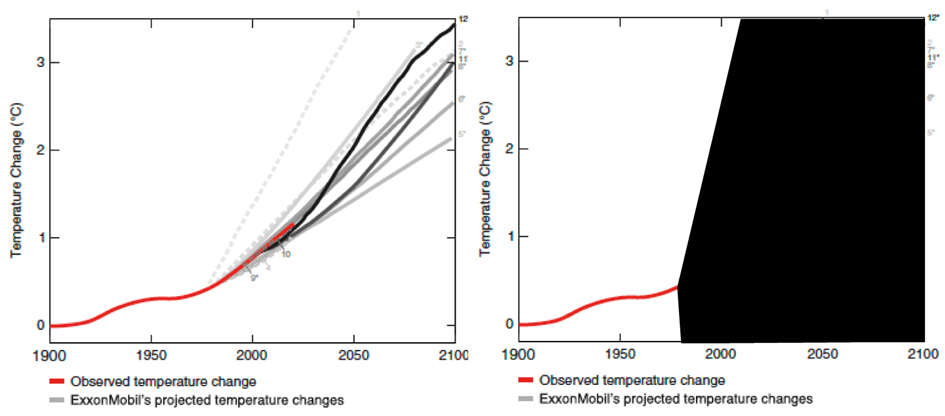
Pat Frank had a post (and a peer reviewed publication http://dx.doi.org/10.13140/RG.2.2.11035.64808/1 ) here on WUWT about two years ago pointing out what happens to the model uncertainty if you cast all known problems back for a few decades:
 ?ssl=1
https://wattsupwiththat.com/2023/05/17/what-i-learned-about-what-exxon-knew/
The scientist might have formulated a hypothesis, but knowing in a n on-religious way looks very different that what they could work with back then!
«ExxonKnew» stage magick trick is a refinement of Pentagon Papers trick. The payload is demand that authority of a given gang of “experts” must be accepted blindly. Whether they spout nonsense (which they did in both cases) or not.
Many arguments against the “ExxonKnew” lawsuits.
http://www.masterresource.org/exxon-mobil/more-exxonknew-correction-lyons/
“… review which filings in the climate lawfare pile contain essentially identical wording found in prior filings by law offices supposedly unrelated to the ones filing their own ‘unique’ lawsuit.”
It’s a sign of the times. Many have seen clips on TV of programs and political ads in which key words and phrases are repeated apparently under instructions from an unseen king of spin.
If these people started thinking for themselves, no narrative would survive long. They absolutely must follow a script.
They follow the money. As much as the can get their grubby little hands on.
Indebted once again to WUWT and Charles Rotter here for getting my list out to a wider reading audience, where somebody out there might have influence to get this whole climate lawfare madness deeply investigated to see exactly who’s running it. My educated guess is that it is the small little clique of enviros I’ve detailed at much depth at my GelbspanFiles blog, but I’m limited in my own reach to get to the bottom of it. I did leave a message a few days back with the judicial assistant for the judge I mention at the top of this guest post, on how the apparent plagiarism extends beyond just the San Juan v Exxon case. And I did my best earlier today to alert the Commerce Committee that Senator Ted Cruz heads (which was investigating the main San Francisco law firm pushing these lawsuits), along with Senator Ron Johnson’s Permanent Subcommittee on Investigations. The question really may be whether somebody is committing a Federal crime of some sort coordinating climate lawfare lawsuits filed in bad faith.
“The question really may be whether somebody is committing a Federal crime of some sort coordinating climate lawfare lawsuits filed in bad faith.”
I think that is the question. It sounds like a Racketeering Conspiracy to me. Who is paying for all this?
Naomi Oreskes repeats false accusations in her Friend of the Court briefs – plural – on behalf of the plaintiffs suing Big Oil, and she’s on retainer with the main firm filing the bulk of these lawsuits, but I have not yet found found out who’s paying her to do this. Certainly she does not do this for free. Meanwhile, regarding the small little clique of enviros I spoke of in my prior comment, one of them includes this guy, who’s swimming in a minimum of $25 million after leaving Greenpeace to run his mystery LLC company. The irony there is how a particular 2015 FOIA-released email out of the New York state Attorney General’s office shows that both he and his former Greenpeace subordinate are at the heart of the false accusation against Willie Soon. They were part of setup to talk then-NY AG Eric Schneiderman into launching an “ExxonKnew”-style lawsuit.
BTW, my “Summary for Policymakers” bit in the title here is a swipe at the IPCC. That mob intended their simplistic SPMs to be read by politicians who’d never question anything in them but instead use them to fund/implement drastic CAGW mitigation efforts. Politicians who are critical thinkers are welcome to look into my SPMs to see where the second part of the “settled science / don’t listen to industry-paid skeptics” talking point implodes.
Yes. Exxon knew they were providing us with a highly beneficial product, improving the quality of life for everyone. Shame on them.
Great article and a very important analysis.
For context about who “knew” what when, concerning any expectation of harmful impact from emissions of CO2, I wrote about what #NASA_Knew in January 2009. The “dog not barking” was NASA’s omission of any mention of crisis or danger. They explicitly described the atmosphere and ocean circulations as dynamic heat engine responses to absorbed energy. This implies a highly self-regulating climate system in which energy is not, in fact, “trapped” down here as sensible heat gain from the minor radiative influence of incremental CO2 and other IR-active substances like CH4 and N2O – certainly not to any harmful extent.
More here.
https://wattsupwiththat.com/2022/05/16/wuwt-contest-runner-up-professional-nasa-knew-better-nasa_knew/
So, these folks are not only crooked but also lazy.
This doesn’t surprise me at all as Democrats are well known for all reading from the same playbook. There are so many examples of democrats criticizing the current administration all using identical wording. So why shouldn’t lawyers do exactly the same thing. Saves a lot of time when you know already that your lawsuit is just a harassment tactic and will ultimately be dismissed.
A few years back, I read the Exxon report being used as evidence that “Exxon knew.”
First thing I saw was yellow highlighting of specific sentences and paragraphs that “proved” the claim.
I ignored the yellow and read the whole report, which was embedded with skepticism and caveats or gross uncertainty.
What the study did was, assuming the models used are correct (they were not Exxon models) and assuming projections of oil consumption are correct and assuming oil usage results in assumed levels of CO2, the analysis calculated the temperature rise.
The report included many statements of uncertainty and a disclaimer that the calculations were not projecting robust results and advised management that there were numerous factors not considered.
This is one of the pieces of evidence still in use.
It was also countered by other such research reports that refuted the conclusions.
So, Exxon looked at it and came away with no conclusions. Hence “Exxon knew.”
First of all, why «plagiarism problem»? It’s a very formal framework, not a market of competing Tolkien rip-offs.
Second of all, why is it necessarily «copied […] out of the […] filing»?
They both may be copying from «the possible central template», filling in the blanks, indeed. I mean, it is fairly obvious that the claim to fame of such cases is establishing a precedent. And when the interests predictably affected by a given precedent are larger than the plaintiff and the defendant put together by several orders of magnitude, why should we assume nothing is going on but some opportunistic local initiative?
The last paragraph is quite sensible! But it also shows how pointless most of the article (beyond plain facts) before it was.
WUWT allows dissenting comments questioning its content, other sites do not (ask me how I know). Your points seem to be indicators that you literally do not understand what the concept of plagiarism involves, and what the nature of of the ‘evidence’ is in these lawsuits. I’ll explain: No matter what the topic is, when a group of people want you to gather, analyze and present material on their behalf to address a particular problem, the expectation is that you will offer this material on good faith (in court cases, under Rule 11 in the U.S. Federal Rules of Civil Procedure). Meaning it is your own work. If it is someone else’s work, the group of people would rightfully expect them to do this work, or that you would minimally credit them with the work in full disclosure. Here in these lawsuits, the simplest set of words (italicized as follows) would eliminate all perceptions of plagiarism — “Plaintiffs concur with the 2017 court case filed in San Francisco – as originally implied operatives of Greenpeace / Ozone Action for a decade+ and further reinforced by specific documents provided to the San Francisco law firm by a former Greenpeace operative – that the fossil fuel declared “Victory will be achieved when we pay Dr Wei-Hock Soon $1.2 million to reposition global warming as theory (not fact) via deceptive newspaper advertorials.”
Now, here’s what you don’t seem to understand about the ‘evidence’: It’s worthless. The two memo sets were never implemented anywhere, Dr Soon was not paid by Exxon in any amount to write or present false climate assessments, and two the long-publicized ‘newspaper advertorials’ seen in these lawsuits were never published anywhere, while the third has its ad text cropped out because the actual published text contains no disinformation. The plaintiffs’ attorneys present this evidence in bad faith because they either did no due diligence to find out if it actually had any merit, or else they know it is worthless but hope the defendants’ attorneys never find out about that.
Point being, every one of these lawsuits run the risk of being dismissed because of Rule 11(b), because of the plagiarism faults and because they do not present a prima facie case that any industry disinformation campaign employing ‘shill’ skeptic scientists ever occurred.