Essay by Eric Worrall
My question – if warmer temperatures cause more rats, why aren’t the tropics permanently overrun with vermin?
Rats worldwide are enjoying the perks of climate change
A new study has linked increasing temperatures to growing rat populations.
By Dr. Christopher Wachuku
February 1, 2025, 7:23 AMClimate change is contributing to a global rise in urban rat infestations, according to a new Science Advances study.
As temperatures increase, rats are better able to thrive — even in inclement weather that would typically deter the population’s growth, the article explained.
…
“So we imagine it probably increases their survival over the winter. And we’re pretty sure that that increased food intake also will lead to more reproductive bouts for these rats, which can accelerate population growth,” Jonathan Richmond, the study’s lead author and professor of biology at University of Richmond, told ABC news.
…In Washington, D.C., for example, the rat population is growing 1.5 times faster than it is in New York City, because the more northerly city has taken notable steps to keep rodents in check. In New Orleans and Tokyo – two cities with robust rodent response teams and good citizen reporting systems – the rat populations appear to be shrinking.
Richardson said that cities experiencing declines might be outliers, rather than part of a broader trend, though he did note that in Tokyo, residents seem willing to post rat sightings on social media in a “name and shame” approach to getting businesses to clean up their act.
Read more: https://abcnews.go.com/Health/rats-worldwide-enjoying-perks-climate-change/story?id=118284253
…
The abstract of the study;
Increasing rat numbers in cities are linked to climate warming, urbanization, and human population
JONATHAN L. RICHARDSON, ELIZABETH P. MCCOY, NICHOLAS PARLAVECCHIO, RYAN SZYKOWNY, ELI BEECH-BROWN, JAN A. BUIJS, JACQUELINE BUCKLEY, ROBERT M. CORRIGAN, FEDERICO COSTA, RAY DELANEY, RACHEL DENNY, LEAH HELMS, WADE LEE , MAUREEN H. MURRAY, CLAUDIA RIEGEL, FABIO N. SOUZA, JOHN ULRICH, ADENA WHY, AND YASUSHI KIYOKAWA
Urban rats are commensal pests that thrive in cities by exploiting the resources accompanying large human populations. Identifying long-term trends in rat numbers and how they are shaped by environmental changes is critical for understanding their ecology, and projecting future vulnerabilities and mitigation needs. Here, we use public complaint and inspection data from 16 cities around the world to estimate trends in rat populations. Eleven of 16 cities (69%) had significant increasing trends in rat numbers, including Washington D.C., New York, and Amsterdam. Just three cities experienced declines. Cities experiencing greater temperature increases over time saw larger increases in rats. Cities with more dense human populations and more urbanization also saw larger increases in rats. Warming temperatures and more people living in cities may be expanding the seasonal activity periods and food availability for urban rats. Cities will have to integrate the biological impacts of these variables into future management strategies.
Read more: https://www.science.org/doi/10.1126/sciadv.ads6782
Reading the study, the only subtropical location studied, New Orleans, is an exception to the rule that warmer temperatures have caused a rise in rat numbers. The study doesn’t attempt to explain why New Orleans is flowing counter to the claimed trend, other than mentioning New Orleans’ proactive rat control measures, and stating “… Insights from nontemperate cities nearer to the equator will be important to fully understand the latitudinal climate links to rat population dynamics. …”
If the study authors had bothered to include a few more warm climate cities, they might have discovered how with minimal effort rat populations can easily be managed.
In my subtropical home town, rats are taken seriously, but they are not a significant nuisance, except on rare occasions when a wet year in the desert followed by a drought drives a temporary surge in numbers.
So why isn’t my subtropical home town full of rats?
Probably for the same reason as New Orleans. The same conditions which provide better survival conditions for rats also provide better survival conditions for creatures which hunt rats.
Trash in my hometown is stored in sturdy plastic bins. Lots of householders in my area own dogs and cats, the sky is full of crows and eagles, and at night normally timid snakes and large lizards gorge themselves on anything small and unwary enough to venture within striking distance.
An even more interesting example of rat control is practiced in the Turkish city of Istanbul.
Residents of Istanbul practice an ancient rat management tradition, they encourage feral cats. The cats don’t live in homes, they live outside, they take care of their own living arrangements, though locals provide boxes and other spaces which cats can use as dens. Locals leave food for cats, and even sometimes take them to the vet, but they aren’t pets. Cats live alongside humans, but are not part of the family.
The cats are feral, they can’t be domesticated. They accept friendly contact from humans, but only on their own terms. My friends in Istanbul once tried to domesticate one of the friendlier cats, but it didn’t want to stay. The cat wasn’t happy until they let it return to the streets.
It took me a while to figure out a possible explanation. Centuries ago, Istanbul, or Constantinople as it was once known, was hit harder than most Eurasian cities by the Plague. Istanbul suffered repeated devastations, a repeating cycle of pain which started many centuries before the Plague reached Western Europe.
Although airborne transmission is possible, the Plague is mostly transmitted by contact with rat fleas. Cats are susceptible to the Plague, and can transmit the illness to humans, so close contact with cats was dangerous. But you need cats to control rats. Not only do cats hunt rats, the very presence of a cat can deter rats from settling in the area.
So out of this period of horror and death, the survivors of Istanbul’s repeated devastations developed a tradition of keeping cats close, but not too close – a tradition which has survived into modern times.
The west also has a tradition which involves cats, but sadly our ancestors may have been a little slower on the uptake than the hard pressed residents of plague stricken Istanbul / Constantinople. “Witches” who spread plague in Western tradition were frequently associated with cats. It is easy to imagine that elderly cat lady who stayed healthy while fit young people were dropping in the streets, to the ignorant such unnatural good health could obviously only be explained by magic. And of course, if one of the old lady’s cats got sick, that just proved the old witch was using her devil familiar cats to spread disease.
Cats eventually became widely accepted in Western households, which may have contributed to the eventual decline in US, British and West European plague outbreaks.
Note there is significant historical disagreement about the evolution of attitudes towards cats, in both the West and the East, and the evidence in some cases is sparse, so it is possible my analysis about the history of cats is completely wrong. For example, there is a persistent rumour that Pope Gregory IX ordered the death of cats in medieval Western Europe in the 13th century, but there appears to be no solid historical evidence he ever did such a thing, which leads to the intriguing possibility that medieval people killed cats because they falsely believed that Pope Gregory had instructed that cats were the agents of the devil. Or perhaps stories of medieval killing of cats for religious reasons are themselves revisionist falsehoods.
As the great Terry Pratchett once said, In the bathtub of history the truth is harder to hold than the soap and much more difficult to find. That applies with a vengeance to figuring out how our ancestors treated cats, and the relationship between possible cat purges and plague outbreaks.
One thing we know for sure, places where cats are common don’t have a rat problem. If you don’t want to be overrun by rats and rat borne diseases, forget about trying to control the weather, the right solution is to provide space in your community for animals which hunt rats. Allow cats to do some rat control, either by owning a cat, or by embracing the Istanbul solution – treating feral cats as welcome co-habitants of our urban spaces.
If climate change is causing droughts and lower food yields, how can it feed more rats?
This is the problem with “experts”, they can’t see outside of their very narrow specialisations.
I read someplace that Rats were susceptible to temperature extremes. That a rat’s preferred temperature range is usually somewhere between 64°F to 79°F (18°C to 26°C). They are most comfortable within that range and can experience stress or health issues if temperatures fall significantly below or rise significantly above it.
European rat descendants in Australia have no problem with much harsher conditions, for the last 2 months in my hometown the minimum temperature has been over 22C most days, with maximum around 30c, yet we would still be overrun if it wasn’t for our cat and the local rat hunting wildlife.
They also successfully outcompeted native Aussie marsupial rodents.
Rats are adaptable and breed fast, I suspect if temperatures rose they would adapt.
I would imagine that like many creatures, rats can genetically acclimatize to a gradual shifting of their climate Especially since their generational cycle is 5-12 weeks after birth. You can have 5 – 10 generations in a year or 500 – 1000 in a century. Certainly allows for adaptation to increasing temperatures of +1-1.5°C
Global map of rat populations
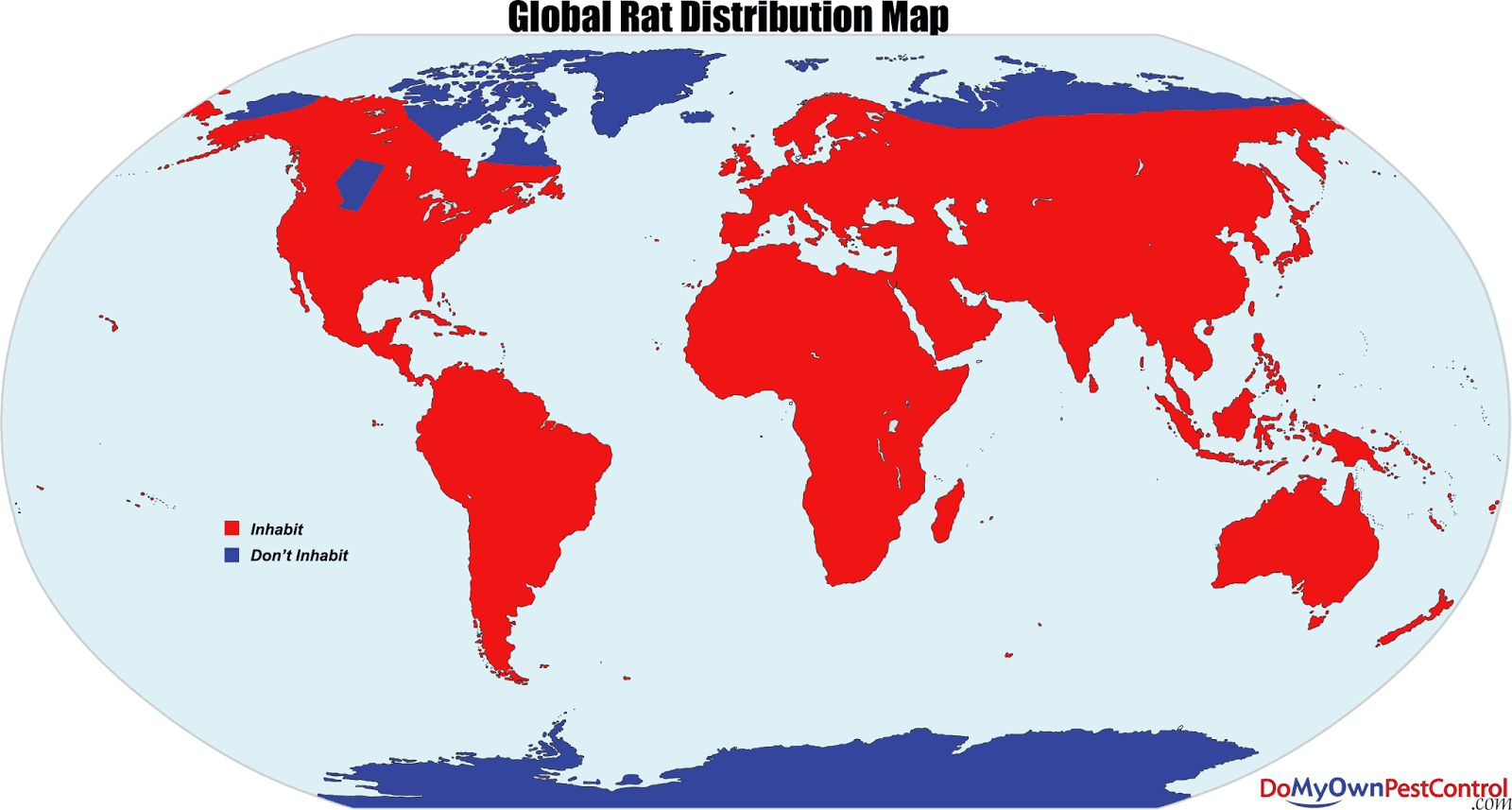
What is it with Alberta?
Probably different burrocrats counting them differently.
The government does take credit although some say it’s the climate.
https://lethbridgeherald.com/hot-summer-guide/2024/09/10/rats-or-maybe-not/
Everyone knows that all the Albertan rats prefer to live in Ottowa or Toranto, where there are seats of government and big Universities.
It couldn’t be the sampling method.
In the UK all the rats are part of the government.
Norwegian rat is a species from – er Norway. Except that is probably apoxcryphalThe brown rat (Rattus norvegicus), also known as the common rat, street rat, sewer rat, wharf rat, Hanover rat, Norway rat and Norwegian rat, is a widespread species of common rat…
…It exists on every continent except Antarctica. It doesn’t like the cold.
But it is very doubtful that it cant stand some cold. We all like “…a temperature range somewhere between 64°F to 79°F (18°C to 26°C).”
But we don’t die if we don’t get it.
That’s a wee bit chilly 🙁
If authorities get people and businesses to clean up their schist, rats will have to find other things to eat. That will create serious rat-people encounters. Where is the Pied Piper of Hamelin when he is needed? However, because many cities don’t pay properly for needed services, the piper has ways of making the defaulter pay. Beware.
Avoiding human / rat encounters is probably why Istanbul started encouraging feral cats.
Fun story. My Wisconsin dairy farm has both a field mouse and a rat problem. The former is solved by our coyotes, the latter by our many feral barn cats. And peanut butter baited strategically placed mouse traps solve the winter field mouse problem in the old farmhouse, as I am allergic to cat dander.
Don’t import Cane Toads to eat them
A little too cold for cane toads in Wisconsin winters. We will get along with coyotes and grey wolves.
or myxomatosis
The rats in these incidences may be disguised as human beings ….
During medieval times, weren’t infestations of rats common in cities and towns? Wasn’t The Black Death caused mainly by the fleas these animals carried? Coincidentally, much of that period occurred during the Little Ice Age when global temperatures were lower than today’s. So how did these rodents manage to flourish then, or didn’t the colder climate affect them and maybe the general lower hygiene and sanitation levels among humans was the real culprit. So here we just have another variation of climate alarmism so beloved by by those that know they’re fighting a losing battle in trying to convince the public that every variation of Nature is caused by human activity.
Actually no. The Black Death coincided with the end of the Mediaeval warm period…and although the plague did continue with sporadic outbreaks up to the start of the Little Ice age I can’t say that that had much to do with the climate.
Rats live where there is food. My garden used to have them when the ex dumped compost of food scraps out. I don’t do that anymore and the rats are conspicuous by their absence, as are the hedgehogs – badgers have moved in and they eat them.
A lot of that going round…
What a load of utter crap.
There is only one thing that enables rat plagues. Grain from agriculture. Nothing to do with the climate.
Fun story. Our beloved dog (now one year deceased from a very agressive cancer) was a Cairn Terrier. Originally bred in Scotland to attack rodent vermin in their Cairns—Scottish grainery stone piles. And she could go thru cold, wind, rain, snow, sleet, to do that. We had to special groom her to survive Florida summers, where her walk attack target was only little lizards.
The Bubonic Plague was in the LIA.
No. The Bubonic (Black) plague peaked in the 1300’s during the MWP. Nothing directly to do with MWP, everything to do with enabled expanded trade routes during which. Furs, rats, fleas, plague. It is thought rats on ships were the origin.
What peaked in the LIA was syphilis, relatively newly imported from Americas, and cholera from growing population density in European cities without properly drained sanitation.
Wouldn’t weather that is good for rats, also be good for cats?
Having lots of rats to eat is good for cats. Cat’s are adaptable, anywhere from Egypt to the Arctic is fine by them.
Perhaps we will soon have a war between the ‘cats keep rat populations down’ and the ‘cats kill millions of songbirds every year’ sides.
It’s an urban myth about cats eating songbirds. Maybe some. We had more than fifty effen starlings around for some years. A hawk turned up and the starlings disappeared together with the songbirds.
proper use of pellet air guns, and even BB guns, can be quite hard on rats.
Used to have fun plinking rats in my grandpa’s house, but that’s more a sport than a serious rodent control strategy.
At the dump for my former Canada summer fishing ‘cottage’ we got quite proficient with both high power .177 pellet guns and 0.22 rifles—both scoped.
I wish that I still had my Sheridan .177 pump pellet gun; that or the Diana break-barrel pellet rifle that I used to use for shooting the fluffy-tailed rats (California ground squirrels) that colonized an adjacent vacant lot of my parents property. Even when I was shooting enough for a turkey vulture to do fly-bys several times a day, they still stripped EVERY apple, pear, peach, and apricot from the trees; and the tomatoes had to be protected with chicken wire and PVC pipe cage! I would have preferred a scoped Ruger 1022, but Commifornia Marxists frown on firearms in the hands of anyone but the government!
Forget my farm rodent stories. This lonely new widower went and just sacrificed an hour looking at the underlying ‘rat’ paper. Bottom line, pathetic. Several indicia.
I am sorry for your loss.
Thank you for this comment, saved me some effort. My first thought was to look up the paper to understand how their claims are justified. I wish there was a way to hold all the authors and reviewers accountable for the weak methodology and conclusions.
The obvious explanation for why the DC rat population is growing 1.5 times faster than in NYC is the affinity and professional courtesy the DC pols and burrocrats feel towards them! Over the last four years I imagine they were employing the anti-Istanbul strategy; provide food and shelter for the feral rats to protect them from cats; much like they do in Commifornia as companions for the homeless!
We don’t get many rats up here in the high desert Southwest (too many lions, and coyotes, and bears, oh, my!) but we do get lots of mice trying to move indoors, especially in winter! A few months after I first escaped up here, I mentioned to my landlord that I had used up all my .22 ammo shooting at mice in the house, but not to worry, I still had plenty of .45ACP and 30-30! He promptly gave me two kittens, and I’ve only had to go through the heartache of replacement once since!
Fighting rats by investing in renewable energy might have something to do with the failure of rat control.
That begs the question of who the real rats are, the rodents or those investing in the supposed “renewable” energy! My energy is renewable, but it is a lot lower, and it requires a LOT more coffee than it used to!
You remind me of an old joke: why don’t sharks eat lawyers? Professional courtesy.
Wait! That was a joke!?
“As temperatures increase,
ratsall living things, particularly Humans, are better able to thrive — even in inclement weather that would typically deter the population’s growth,”It is not warmer temperatures it is simply food availability. Not only that but they stick to a food supply route if they can. But they will abandon a route altogether if (for example) you remove food sources for two weeks or so. Useful if you have a rat eating from a bird feeder for example.
Correct! And those conditions also support rat competitors. Rabbits introduced into Australia not only had fewer predators (until feral cats were ubiquitous), but out-competed the local grazers for a marginal food source.
This didn’t happen the same way on (e.g.) Easter Island, where there were plentiful rat food sources, but no predators and no competition.
Peanut’s (and Fred’s) revenge!
Had to laugh the other day. While watching a TV reporter doing his piece to camera, on a seafront somewhere, during last weekend’s storm in Scotland, I noticed, completely unbeknown to him as he struggled to stay on his feet, a large rat casually stroll past in the background. I wished I’d been recording it!
ClimateProp 101
(or Donald Trump, Liberals, Brexit, the UK Labour government or, as a last resort…
Both Rattus Rattus (the black rat that carries bubonic plague) and Rattus Norvegicus (the brown rat that doesn’t carry plague, but carries other nasty stuff) are anthropochorous animals, meaning inadvertently domesticated. Anthropochorous critters live in the wild, but they are more numerous around human habitations because they have adapted to surviving on human leavings, human habitations, or both.
A few other anthropochorous creatures are cockroaches, crows, raccoons, and barn swallows. Some provide benefits to their human hosts, some pose hazards, and some are neutral.
Black and brown rats are both rated as serious pests, but paradoxically, the brown rat took over from the black rat with the rise in global commerce during the Renaissance and the Age of Discovery. Brown rats are a little bigger, more aggressive, and better swimmers than black rats, so they had an easier time boarding and stowing away on ships, and hiding in cargoes.
The rise of the brown rat was a major factor in the decline of bubonic plague. They carry typhus, which is almost as bad. Either way, rat infestations are no picnic — except for the rats.
Rodents can be a serious problem out in the country where I live. Packrats
will chew through wiring on a vehicle kept outside. Victor snap traps
with a few mods placed underneath vehicles stored outdoors and also on the air
cleaners. I use wood boxes with a small opening on one end to eliminate unintended
catches of birds. Chipmunks are also a problem around the homestead and traps
work well. I prefer a 5gal bucket with 6″ of water and sunflower seeds floating on the water.
I put a 1×3 board with peanutbutter smears and sunflower seeds. We haven’t used cats
for many years but have had owls around the place at night. Beaver and rockchucks
and ground squirrels also require managing. Then our fiber/prescribed grazing flocks attract coyotes and other predators that I’ve a lifetime of managing… I learned about rats on my
grandfathers dairy farm In WI at a very young age. It was his 15K laying hens feed that
brought in the rats, but that’s another story
Rats are very interesting creatures. They live in social groups. They can survive in burrows in prairie winters. Their group mating rituals are amazing. Being reflex ovulators, the females need sexual stimulation with intervals that are inconsistent with the copulation intervals males need to ejaculate. Read all about it.
Group mating among Norway rats II. The social dynamics of copulation: Competition, cooperation, and mate choice
https://www.sciencedirect.com/science/article/abs/pii/S0003347282800523
Nonsensical. Rats are a problem of lack of proper sanitation and lack of organized systematic rodent control measures. Garbage on the streets and in open dumpsters provide an endless supply of food, while run-down buildings and junked-up alleys provide warm, dry living quarters.
Increasing temperatures, if they actually are increasing in the cities studied, are not critical or even important to rat populations, which are not living in the ambient environment, but in building basements, sewers, underground utility tunnels — all of which are have their own environmental temperatures quite different from the ambient 2 meter average air temperature.
The study has measured an unrelated association.
Increased urbanization leads to increased urban heat island effect. It also leads to conditions better for the rats.
Everyone, not just the rats, could be enjoying the ‘perks’ of Climate Change, if they could just stop worrying about non-existent threats.
linked to climate warming, urbanization, and human population
.. so what is the split ?